Original Research Article
Assessment of knowledge and skill of sahiyya (ASHA) and anganwadi
worker on appropriate usage of mother and child protection card in
Ranchi, Jharkhand: a cross sectional study
Mithilesh Kumar, Swati Shikha*, Vivek Kashyap
INTRODUCTION
Mother and child protection card as one major initiative for accelerating reduction in maternal, neonatal and infant mortality and child under nutrition has been the adoption of WHO Child Growth Standards, with effect from 15 August 2008 in both ICDS and NRHM, through a joint circular dated 6 August 2008, issued by both the Secretaries of Women and Child Development and Health and Family Welfare, Government of India. This initiative has been enriched and complemented by
another decision of both the ministries by introducing a common Mother and Child Protection Card for both ICDS and NRHM, to strengthen the continuum of care for pregnant mothers and children under-three years of age, incorporating the new WHO Child Growth Standards. The MCP card is a maternal and child care entitlement card, a counseling and family empowerment tool which would ensure tracking of mother child cohort for health purposes. It is meant to promote key family care behaviors, highlights danger signs and links families to the referral system. The MCP card would enable
ABSTRACT
Background: Mother and child protection card (MCP card) is a common card to maintain the record of health care delivery including antenatal care, post-natal care and care of the child that can be used by both the health personnel and the beneficiaries. This study was done among Sahiyyas and AWWs to assess their awareness about MCP card, to find out their training status, to assess their knowledge and skill in recording information in MCP card and assess their role perception of MCP card.
Methods: A multi-stage stratified random sampling method was adopted to select Sahiyyas and AWW’s for interview between November 2017 – April 2018 (6 months). 17 Sahiyya and 19 AWWs were interviewed using a pre tested schedule. Templates were generated in MS Excel sheet and data analysis was done using SPSS software (version 20).
Results: All the Anganwadi workers who were included in this study were aware about the MCP card whereas 15 out of 17 sahiyyas had awareness about the existence of MCP card. Training in order to orient the AWW and Sahiyya about using MCP card was very low, only 6 out of 19 (31.6%) of AWW had received training and 8 out of 17 (47.1%) Sahiyya’s were trained. We found that majority of the workers and Sahiyya had knowlwdge about most of the sections and had used it to record information in MCP card.
Conclusions: Sahiyya’s and AWWs were aware about existence of MCP card, and most of them use it, despite very low training status.
Keywords: Knowledge, Skill, Sahiya, AWW, MCP card
Department ofPSM, Rajendra Institute of Medical Sciences, Ranchi, Jharkhand, India
Received: 21 September 2018
Revised: 09 November 2018
Accepted: 13 November 2018
*Correspondence:
Dr. Swati Shikha,
E-mail: [email protected]
Copyright: © the author(s), publisher and licensee Medip Academy. This is an open-access article distributed under the terms of the Creative Commons Attribution Non-Commercial License, which permits unrestricted non-commercial use, distribution, and reproduction in any medium, provided the original work is properly cited.
gender disaggregated tracking, to ensure optimal care of the girl child.1
It endorses an integrated, holistic approach to ensure proper child care leading to survival, growth, development and protection of the young child through child centered, family focused and community based intervention.2
The concept for development of such a card was to have a home based record that can be used by both the community health worker and the mothers and will contribute to active development of both the individuals and families.3 Being an entitlement card it would ensure greater inclusion of unreached groups to demand and universalize access to key MCH services.3
With the increase in the outreach of ICDS, as well as, NRHM under which there are monthly fixed Village Health and Nutrition Days and Village Health and Sanitation Committees, the common Mother and Child Protection Card would enable the large network of ASHAs, AWWs and ANMs to converge their efforts and utilize the critical contact opportunities more effectively.4 So far, none of the studies are done in the state like Jharkhand to evaluate the knowledge and skill of ASHA and AWW, where around 41000 ASHA’s are functioning.
With the above in view, this study was conducted among Sahiyyas and AWWs to assess their awareness about MCP card, to find out their training status, to assess their knowledge and skill in recording information in MCP card and assess their role perception of MCP card.
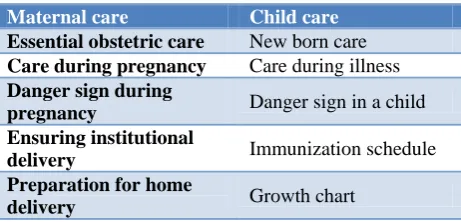
Table 1: Different sections of MCP Card studied.3
Maternal care Child care
Essential obstetric care New born care
Care during pregnancy Care during illness
Danger sign during
pregnancy Danger sign in a child Ensuring institutional
delivery Immunization schedule
Preparation for home
delivery Growth chart
METHODS
A community based cross sectional study was conducted in Ranchi district of Jharkhand between November 2017 to April 2018 to assess the knowledge and skill of Sahiyya and AWW on usage of MCP card. By multi stage stratified random sampling method, two Blocks (Namkum and Kanke) out of 18 blocks in Ranchi district were selected randomly and five villages from each of selected blocks, (total 10 villages) were randomly selected. In each village two Sahiyyas and two AWWs were interviewed using a pre tested schedule. The tool used for data collection contained information about Awareness of MCP card, role perception with regard to MCP card, training status, knowledge and skill in recording information.
Exclusion criteria
Sahiyyas whose house was found locked in 2 consecutive data collection days and AWWs who were unavailable at their respective AWCs were excluded. Also, Sahiyyas or AWWs who did not give consent for the study were excluded. A total of 17 Sahiyyas and 19 AWWs were interviewed. Templates were generated on MS Excel sheet and analysis of data was done using SPSS software version 20. The study was approved by the ethics committee of the institution.
RESULTS
Information about the awareness and training status of ICDS functionaries i.e. AWW and Health functionarie i.e. Sahiyya are shown in Table 2. All the AWW were aware and also had used the MCP card to record information, whereas, not all, but 15 out of 17 (88.2%) of Sahiyya were aware and 12 out of 17 (70.59%) had used it. Majority of the Sahiyyas who were trained, were trained in PHC, whereas, among AWW’s who were trained, 50% of them received training as job training and rest 50% in PHC.
Table 3 shows the knowledge and skills that these workers possess in recording information in MCP card. We found that in all the parameters on knowledge and skill, AWWs had better skill and knowledge as compared to Sahiyyas.
Table 2: Awareness and training status about MCP card among Sahiyya and AWW.
Variables Sahiyya (n=17) AWW (n=19)
Frequency Percentage (%) Frequency Percentage (%)
Awareness Yes 15 88.2 19 100
No 02 11.8 00 0
Usage Yes 12 70.59 19 100
No 05 29.41 00 0
Training Status Yes 08 47.1 06 31.6
No 09 52.9 13 68.4
Place of Training
Job training 01 5.9 03 15.8
PHC/Sectoral 07 41.2 03 15.8
Figure 1 (A and B): Duration of training of AWW and Sahiyya.
Table 3: Knowledge and skill in recording information in MCP card.
Variable:
Knowledge about
Sahiyya (n=17) AWW (n=19)
Frequency Percentage (%) Frequency Percentage (%)
General information in MCP card
Delivery
Date and time 15 88.2 19 100
Place 12 70.59 19 100
Type 12 70.59 14 73.7
Term/preterm 09 52.94 13 68.4
Complications 06 35.29 06 31.6
Baby
Gender 15 88.2 19 100
Weight 15 88.2 19 100
Cry 02 11.76 03 15.8
Initiation of BF 00 0 09 47.4
Danger signs in pregnancy
Yes 14 82.4 17 89.5
No 03 17.6 02 10.5
Danger signs in newborn Yes 13 76.5 19 100
No 04 23.5 00 0
Growth Monitoring Steps Yes 00 0 17 89.5
No 17 100 02 10.5
Table 4: Role perception about MCP card.
Variables Sahiyya (n=17) AWW (n=19)
Frequency Percentage (%) Frequency Percentage (%)
Maternal and child monitoring 15 88.2 19 100
Coordination among health and ICDS
functionaries 15 88.2 10 52.63
Recording vital events 02 11.76 10 52.63
Mobilization of community 06 35.29 17 89.47
Reminder for delivery of services 13 76.47 14 73.68
Better understanding among mothers about
child care 09 52.9 18 94.74
Table 4 shows the role of MCP card in maternal and child monitoring was the most important as perceived by both AWW and Sahiyya. Its role as a reminder for delivery of services was also perceived by majority of AWW and
Sahiyya. Role of MCP card in mobilization of community to avail health services, was perceived by 17 out of 19 (89.47%) of AWWs.
5.30%
15.80%
10.50%
68.4%
AWW
1 day 5 Days Others No training
5.90%
23.50%
17.60%
52.9%
Sahiyya
3 DAYS 5 DAYS OTHERS NO TRAINING
DISCUSSION
The present study was a community based cross sectional study conducted among Sahiyyas and AWWs to assess their awareness about MCP card, to find out their training status, to assess their knowledge and skill in recording information in MCP card and assess their role perception of MCP card.
Sahiyya (ASHA) was created in each village within the identified states to act as a bridge between the rural people and health facilities. The task expected of ASHA requires that she works in close coordination with ANM and AWW for effective delivery of services.
MCP cards are very useful tool for maintenance of records for health service and can be used by both the health care provider and the beneficiaries. In the present study, it was found that all the AWWs were aware about MCP card but not all Sahiyyas were aware. In the report on ASHA by National Institute of Public Cooperation and Child Development, New Delhi, all the AWW and Sahiyya were aware about MCP card which is in line with the findings of our study.2 The AWW and sahiyya are aware because they have been trained and have been using it as a part of their responsibilities and duties. Since sahiyyas are the first person in the village who are contacted after a women becomes pregnant and also the person whose responsibility ends 42 days after delivery, so, she should be aware about sections of MCP card which covers this duration.
We have found that the training status was poor both among Sahiyyas and AWWs whereas in a study conducted by Thakur et al in Mandi, Himachal Pradesh, to assess the knowledge and practices of Anganwadi workers (AWWs), they found that all the AWWs were trained before joining, the reason for deficiency of training as found in our study could be due to lack of interest by AWWs and sahiyyas or may be due to excessive burden of their own household work.5
In the present study we found that 89.5% of AWWs had knowledge about steps of growth monitoring while in a study conducted by Thakur et al in Mandi, Himachal Pradesh, to assess the knowledge and practices of Anganwadi workers (AWWs) only 56.67% of AWWs had satisfactory knowledge regarding growth monitoring of child which is lesser than that found by our study.5 We have found that none of the Sahiyyas had knowledge about the steps of growth monitoring by using growth charts in MCP card which is similar to the findings of Karir et al in a study done to assess the practices by Sahiyya in relation to child health. This could be due to the fact that growth monitoring is not a part of responsibilities of Sahiyya (ASHA). In the field set up, growth monitoring is done by AWW.6
In our study we have found that about 82.4% of Sahiyya had knowledge about danger signs of pregnancy which is similar to the findings of a descriptive cross-sectional study conducted in North-East district of Delhi among 55 ASHA workers by Kohli et al.7 The reason behind this finding is that it is the sole responsibility of ASHA to get the pregnant women registered and to follow her up and also accompany her to health care facility. So, if she is not aware about the danger signs or complications of pregnancy, she would not be able to deliver her duties. The proportion of ASHAs having knowledge about symptoms of complications in pregnancy ranged from 74.5% for symptom visual disturbances to 85.5% for symptom no movement of fetus.
CONCLUSION
Although Sahiyyas and AWWs were aware about MCP card and have been using it, but in an unskilled manner because most of them lack the training. So, training should be organised at regular intervals as reorientation training/refresher training besides the initial induction training, so as to fill up the gaps in their knowledge and skill as found in this study.
ACKNOWLEDGEMENTS
We are grateful to all the respondents who participated in the study for giving their valuable time and information and helping us in carrying out this study. We would also like to thank the MSW of Department of Community Medicine, RIMS, Ranchi for helping in locating the AWCs and residence of the study participants.
Funding: No funding sources Conflict of interest: None declared
Ethical approval: The study was approved by the Institutional Ethics Committee
REFERENCES
1. Paul D, Srivastav S.K, Dr. Bhatiya N: Evaluation of Functioning of Accredited Social Health Activists (ASHAs) in ICDS Related Activities, A Report, NIPCCD.
2. Evaluation of Usage of Mother and Child Protection Card by ICDS and Health Functionaries, Report of Pre-Test Study; MCPC. National Institute of Public Cooperation and Child Development, New Delhi; 2005.
3. Bag S, Datta M. Evaluation of mother and child protection card entries in a rural area of West Bengal. Int J Community Med Public Health. 2017;4:2604-7.
5. Thakur K, Chauhan HS, Gupta NL, Thakur P, Malla D. A Study to Assess the Knowledge & Practices of Anganwadi Workers & Availability of Infrastructure in ICDS Program, at District Mandi of Himachal Pradesh. Int Multidiscipl Res J. 2015;2(1):1-6.
6. Karir S, Kumar M, Sunderam S, Kiran A, Kashyap V. Assessment of Sahiyya (Accredited Social Health Activist) in Relation to Child Health in Ranchi, Jharkhand. Int J Med Sci Public Health. 2018;7(9):703-8.
7. Kohli C, Kishore J, Sharma S. Knowledge and practice of Accredited Social Health Activists for maternal healthcare delivery in Delhi. J family med prim care. 2015;4(3):359–63.