Original Research Article
A community based cross sectional study on morbidities and social
problems among geriatric population
Sangeetha Jairaj
1, Ramesh Palabindela
2*, Sridhar D.
3INTRODUCTION
In India, in the last one and half decades longevity of the people has increased due to decline in mortality rate,
better medical and health care facilities and
improvements in overall quality of life of people.1 Due to the increase in longevity of the people, geriatric population is on the rise. Presently India has the second largest geriatric population in the globe.2 In 2001, geriatric population was 77 million in India and it is estimated that in India total number of elderly will rise to 150 million by 2025 and by the year 2050 the number would rise to about 324 million.3,4 This changing scenario
has given rise to three major needs: social, health & financial security to elderly.
India has thus acquired the label of an “Ageing Nation”.4 Along with this; life expectancy has steadily gone up from 32 years at the time of independence to over 63 years in 2001. The geriatric population is regarded as precious asset for any country. With rich experience and wisdom, they contribute their might for sustenance and progress of the nation.5
But due to advents of urbanization, industrialization, education & exposure to western life styles the social
ABSTRACT
Background: In India, in the last one and half decades longevity of the people has increased due to decline in mortality rate, better medical and health care facilities and improvements in overall quality of life of people. Presently India has the second largest geriatric population in the globe. In 2001, geriatric population was 77 million in India and it is estimated that in India total number of elderly will rise to 150 million by 2025 and by the year 2050 the number would rise to about 324 million.4
Methods: A community based cross sectional study was conducted in an urban slum located in Secunderabad. Almost 225 subjects more than 60 years were included in study after giving oral consent. People with severe morbidity and unable to give consent were excluded from study.
Results: Majority (70%) of the resident experienced verbal abuse followed by physical abuse (13%) at least one time. About 11% felt they were being neglected by their family members. Daughter-in-law was the major person involved in the elder abuse accounting for 45.9%, followed by son 24.3%. Abuse from relatives accounted for 21.6%. Spouse and daughter were involved in elder abuse in about 5.4% and 2.7% cases respectively.
Conclusions: As recently said by Financial Minister in Parliament of India, old age population growing drastically in India, especially in south India. Increasing geriatric population leading to increase in need of health care and psychological assistance.
Keywords: Geriatric health, Status, Social health morbidity
Department of Community Medicine, 1Government Medical College, Nalgonda, 2Shadan Institute of Medical
Sciences, 3ESIC Medical College, Hyderabad, India
Received: 07 July 2019
Revised: 17 July 2019
Accepted: 18 July 2019
*Correspondence:
Dr. Ramesh Palabindela,
E-mail: [email protected]
Copyright: © the author(s), publisher and licensee Medip Academy. This is an open-access article distributed under the terms of the Creative Commons Attribution Non-Commercial License, which permits unrestricted non-commercial use, distribution, and reproduction in any medium, provided the original work is properly cited.
values towards elderly are changing leading to a rapid breakdown from joint family support system to nuclear family system which further leads to problems like economic insecurity, loneliness, lack of emotional support, lack of protection for their lives and property and dependency.6
Objectives:
To observe morbidity pattern among geriatric
population.
To describe social problems among study
population.
METHODS
A community based cross sectional study was conducted in an urban slum located in Secunderabad. Almost 225 subjects more than 60 years were included in study after giving oral consent. Pre-designed and pre-tested questionnaire was administered in randomly selected subjects. Study was conducted from November 2017 to December 2017 for 2 months. Questions were explained in local language and filled. People with severe morbidity and unable to give consent were excluded from study. Data was entered in Microsoft excel and analyzed by using Epi Info7. Categorical variables were summarized with n (%), while quantitative variables were summarized by mean±S.D. Difference in the two groups were tested for Statistical Significance using parametric tests such as t-test categorical variables tested by chi square test.
P-value less than 0.05 considered to
be statistically significant.
RESULTS
The mean age of the study population was 70.05 years with SD of 7.93 years. The age groups were categorized as young old (60-69 years), old (70-79 years) and oldest old (80 years and above). Majority were young old accounting for 48%, followed by 34% were old and 18% were in the age group of 80 years and above. Females were 65% and males were 35%.
Majority (61%) were widowed/widower, 3% living separate from spouse because of familial reasons. Female widowers were 73%. Almost all (96%) residents were belonging to Hindu religion. Majority (46%) were illiterates and 29% stopped the schooling once they reached primary schooling. About 5% of the elderly had done their graduation. Among illiterates females formed the major group with 81% and among graduates males formed the major group with 80%.
Majority (45%) were not engaged in any work. 22% were housewives, followed by semi-skilled workers (13%). Professional and business people accounted for 8% and 10% respectively. Only 2% of the residents were skilled workers.
In our study for majority of the residents (43%), social security in the form of old age pension/ widow pension was the current source of income, for 21% of the elderly money was given by family members and 6% were dependent on property and only 2% were gainfully employed to meet their expenses.
Majority (70%) of the resident experienced verbal abuse followed by physical abuse (13%) at least one time. About 11% felt they were being neglected by their family members.
Daughter-in-law was the major person involved in the elder abuse accounting for 45.9%, followed by son 24.3%. Abuse from relatives accounted for 21.6%. Spouse and daughter were involved in elder abuse in about 5.4% and 2.7% cases respectively. (Some social problems described in Table 1).
Table 1:Some social problems (multiple answers).
Social problem Percentage
(%)
Feeling loneliness 78
Inability to manage daily activities independently 64 Frustration about health issues 85
Feeling boredom 92
Financial issues 99
Unable to coping up with aging 59
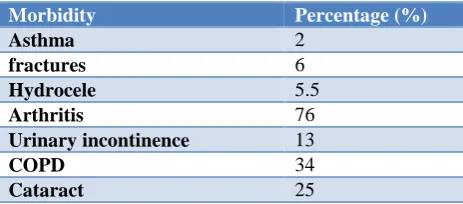
In our study, with respect to previously diagnosed chronic morbidities, 10.5% had diabetes mellitus, 36.2% had hypertension and 12.4% had osteoarthritis. Other
chronic morbidities found were asthma,
neuro-fibromatosis, hydrocele, kyphosis, fracture femur, back pain and COPD (Table 2).
Table 2: Morbidities found in geriatric population.
Morbidity Percentage (%)
Asthma 2
fractures 6
Hydrocele 5.5
Arthritis 76
Urinary incontinence 13
COPD 34
Cataract 25
in 20% of the residents. Mobility was affected in 39% of the residents.
DISCUSSION
Majority in our study belong to young old group i.e 60-69 years. This finding were similar with Ramadurg et al, Ray et al similar mean age group were found in Shashikanth et al.7-9 These studies were also conducted in urban localities where similar kind of population distribution present. Similar pattern saw in 2011 census also.
The mean age of male and female respondents were 75.3 (±8.6) and 76.8 (±7.7) respectively.12 Similar results were found in a study by Mundada et al.10 Similar results were found in a study by Bhatia et al which also showed female predominance.11 We can see similar trends in NFHS 4 and 2011 Census. Because of high life expectancy among females showed this kind of results.
Most of study population in our study were widowed. It is similar with the study done by Singh et al reports that 64.3% of elderly women were widows and most of them were dependent.12 Contradict to that, elderly were found living with their spouse and other members found in study of Srivastava et al.13
A study from New Delhi, conducted by All India Institute of Medical Sciences, New Delhi found Hindus (73%) as the predominant group, followed by Christians (21%) and Sikh (6%).14 In a study conducted by Rani et al, in Chennai showed that around 71% belonged to Hindu religion 28% were Christians and Muslims 1%. Our study area predominately have Hindus so results came accordingly.15
Our study showed that almost half of our respondents were illiterate and around 29% had education up to the primary level. Padda et al reported 38.6% illiteracy at Amritsar, while it was 78% in a study conducted in Tamil Nadu by Elango and Singh et al reported 80.2%.12,16,17 A similar study of Kishore and Garg found 59% of males and 9.9% of females had a primary and secondary education.18
In our study, approximately 13% were still working as unskilled workers against those who were at home (45%). Similar results were seen in a study by Elango, while Singh et al in his study, reported that 55.8% were occupied in productive work, 28% in agriculture, 15.1% in labor, and 44.2% were dependent on others.12,17 Another study done Bhat et alin Ahmedabad suggested that 52.3% elderly were not indulged in any occupation and 39% were working but in sedentary way.19
A need assessment study from Bhopal showed that remittances from children are the major source of income for the elderly (57%). Pension as their source of income was told by 29% of the residents and 30% had house rent
as a source of income.20 A project report prepared by Das et al, from Gujarat revealed that only about (43%) of the elderly have an independent source of income either in the form of pension or savings interest which means that more than half of them are without any financial security who have their financial assistance from relatives (27%) and assistance from children (17%).1
In a study done by Rufus et al, of Tirunelveli district, Tamil Nadu revealed they faced mixed abuse (47%) followed by emotional abuse 16.3%, financial abuse (14.3%), neglect (8.3%) and sexual abuse (2.3%).21 A study conducted by Sebastian et al carried out in the community setting in Kerala reported nearly half (49%) experienced some form of abuse or neglect from their family, among them most common forms stated by the residents were verbal abuse (39%) and neglect (39%) followed by physical abuse (13%) and financial abuse (10%).22
A study conducted by Singh et al, in an urban slum of Delhi reported the prevalence of diabetes in elderly persons to be 18.8%.23 A study conducted by Sharifi et al, in Iran reported, overall prevalence of diabetes mellitus was 18.5%.24
A study done by hypertension study group in Bangladesh and India reported that the overall prevalence of hypertension among elderly was 65%.25 A study from Kalavathy et al, done in Kerala found the overall prevalence of hypertension to be 51.8%.26 A study from Sharifi F et al in Iran reported, the overall prevalence of hypertension was 61%.24 In a study conducted by Katta et al, from rural Tamil Nadu found that under nutrition was about 34.6% and obesity was found in about 17.4% of the study subjects.27 A study done by Swami et al in Chandigarh found 14.36% elderly to be under nourished and obesity was found in 7.54% of the elderly. Overweight was found in 33.15% of the elderly.28
A study conducted by a team from All India Institute of Medical Sciences (AIIMS) in the OAHs of New Delhi reported 38% prevalence of anaemia based on clinical diagnosis.14
The findings of our study are comparable to a study done by Vedantam et al in rural south India, in which the MNA scale classified 14% as malnourished and 49% at risk of malnourishment.29
Our study findings are similar to a study from Jain RK et al, done in the urban slums of Mumbai which found the prevalence of depression to be around 45.9%.30 In a study from Sandhya et al in a rural community of South Kerala, the prevalence of depression among people of 60 years and above was found to be 25.4%.31
age homes of Southern India, visual impairment was found in about 28% of the residents and hearing deficit was found in about 42% of the residents.33 A study conducted by Dey et al among older Indians reported that hearing deficit was noted in about 31.6% of the elderly.34
CONCLUSION
As recently said by Financial Minister in Parliament of India, old age population growing drastically in India, especially in south India. Increasing geriatric population leading to increase in need of health care and psychological assistance. Social assistance schemes are helping to certain levels but to address social problems and psychological problems schemes supposed to enhance to such level to cover all aspects of geriatric health.
Funding: No funding sources Conflict of interest: None declared
Ethical approval: The study was approved by the Institutional Ethics Committee
REFERENCES
1. Das NP, Shah U. A Study of old age homes in the care of the elderly in Gujarat. Baroda: population research centre, MS university of Baroda; 2004.
2. Kujur D, Ekka RP. Socio-economic status of elderly
people in India. Int Referred Res J. 2010;2(15):3.
3. Dawale AK, Mudey A, Lanjewar A, Wagh VV.
Study of morbidity pattern in inmates of old age homes in urban area of central India. J Indian Acad Geriatr. 2010;6(1):23-7.
4. Ingle GK, Nath A. Geriatric health in India:
Concerns and Solutions. Indian J Community Med. 2008;33(4):214-8.
5. Chandwani HR, Jivarajani PJ, Jivarajani HP. Health
and social problems of geriatric population in an urban setting of Gujarat, India. Internet J Health. 2009;9(2):1-2.
6. Pandey, Manoj K. On ageing, health and poverty in
rural India. Munich Personal RePEc Arch. 2009: 15932.
7. Ramadurg UY, Lankeshwar S. A study of
socio-demographic profile of geriatric population in rural field practice area of Adichunchanagiri Institute of Medical Sciences. Med Innovat. 2012;1(1):23.
8. Ray KP, Chattopadhyay A. A study on morbidity
pattern and care seeking behavior of elderly in a rural area of West Bengal, India. Int J Basic Appl Med Sci. 2012;2(3):221-7.
9. Kant S, Mishra P, Goswami A. Morbidity among
elderly persons residing in a resettlement colony of Delhi. Ind J Prev Soc Med. 2004;35(1):2.
10. Mundada V, Jadhav V, Gaikwad AV. Study of
addiction problems and morbidity among geriatric population in rural area of Aurangabad district. J Mid Life Health. 2013;4(3):172-5.
11. Bhatia SPS, Swami HM, Thakur JS, Bhatia V. A
study of health problem and loneliness among elderly in Chandigarh. IJCM. 2007;32(4):255-8. 12. Singh C, Mathur JS, Mishra VN, Singh JV, Singh
RB, Garg BS. Social problems of aged in a rural population. Indian J Community Med. 1994;19:23-5.
13. Srivastava HC, Mishra NR. Living arrangement & morbidity pattern among elderly in rural India. Institute for Population Science, Mumbai; 2005: 1. 14. All India Institute of Medical Sciences. Evaluation
of health status and health needs of old age home residents and establishment of minimum standards of health services in long stay institutions in India, 2006-07. New Delhi, All India Institute of Medical Sciences; 2007: 46-57.
15. Rani AM, Palani G, Sathiyasekaran BWC. Social
problems of elders in old age homes in Chennai. J Indian Acad Geriatr. 2012;8(3):101.
16. Padda AS, Mohan V, Singh J, Deepti SS, Singh G,
Dhillon HS. Health Profile of aged persons in urban and rural field practice areas of Medical College Amritsar. Indian J Community Med. 1998;23:72-6. 17. Elango S. A study of health and health related social
problems in the Geriatric population in a rural area
of Tamil Nadu. Indian J Public Health.
1998;42(1):7-8.
18. Kishore S, Garg BS. Socio-medical problems of
aged population in a rural area of Wardha District. IJPH. 1997;41(2):43-8.
19. Bhatt R, Gadhvi MS, Sonaliya KN, Solanki A,
Nayak H. An epidemiological study of the morbidity pattern among the elderly population in Ahmedabad, Gujarat. National J Community Med. 2011;2(2):233-6.
20. Report for Helpage India. Needs assessment study
among elderly of Bhopal Available at:
http://www.Helpageindia
programme.org/other/Publications/Study%20among
%20Elderly%20_Bhopal.pdf. Accessed on 18
January 2019.
21. Rufus D, Shekar B. A study on victims of elder abuse: a case study of residents of old age homes in Tirunelveli District. Helpage India-Res Develop J. 2011;17(3):29-39.
22. Sebastian D, Sekhar TV. Extent and Nature of Elder
Abuse in Indian Families: A Study in Kerala. Helpage India-Res Develop J. 2011;17(3):20-8.
23. Singh AK , Mani K, Krishnan A, Agarwal P, Gupta
SK. Prevalence, Awareness, Treatment and control of diabetes among elderly persons in an urban slum
of Delhi. Indian J Community Med.
2012;37(4):236-9.
24. Sharifi F, Mirarefin M, Fakhrzadeh H, Saadat S, Ghaderpanahi M, Badamchizade Z. Prevalence of Hypertension and Diabetes in Elderly: elderly Kahrizak study. Iranian J Diabetes Lipid Disorders. 2010;9:1-7.
25. Hypertension Study Group. Prevalence, awareness,
elderly in Bangladesh and India: a multicentre
study. Bull World Health Organization.
2001;79(6):490-500.
26. Kalavathy MC, Thankappan KR, Sarma S, Vasan
RS. Prevalence, awareness, treatment and control of hypertension in an elderly community-based sample in Kerala, India. Natl Med J India. 2000;13(1):9-15.
27. Katta A, Krishnan GS, Kumar GP, Amalraj CV, Jha
RK, Munuswamy S. Morbidity pattern and nutritional status of elderly population in rural Tamil Nadu. J Indian Acad Geriatr. 2011;7(4):159-62.
28. Swami HM, Bhatia V, Gupta AK, Bhatia SPS. An
epidemiological study of obesity among elderly in
Chandigarh. Indian J Community Med.
2005;30(1):11-3.
29. Vedantam A, Subramanian V, Rao NV, John KR.
Malnutrition in free-living elderly in rural south India: prevalence and risk factors. Cambridge J Public Health Nutr. 2010;13(9):1328-32.
30. Jain RK, Aras RY. Depression in geriatric
population in urban slums of Mumbai. Ind J Public Health. 2007;51(2):112-3.
31. Sandya GI. Geriatric depression & related factors- A cross sectional study from a rural community in South Kerala. J Indian Acad Geriatr. 2010;6(2):61-3.
32. Sharma S, Thakur M, Kaur S. Health problems and
treatment seeking behaviour among elderly. Helpage India-Res Develop J. 2012;18(2):21-7. 33. Majra JP, Gur A. Medico social profile of the
inmates of the old age homes in southern India. Middle East J Age Aging. 2010;7(3):2.
34. Dey AB, Soneja S, Nagarkar KM, Jhingan HP.
Evaluation of the health and functional status of older Indians as a prelude to the development of a
health programme. Natl Med J India.
2001;14(3):135-8.
Cite this article as: Jairaj S, Palabindela R, Sridhar
D.A community based cross sectional study on