services in the North West
Brettle, AJ, Maden, M and Payne, C
Title
Evaluating the impact of clinical librarian services in the North West
Authors
Brettle, AJ, Maden, M and Payne, C
Type
Monograph
URL
This version is available at: http://usir.salford.ac.uk/39033/
Published Date
2015
USIR is a digital collection of the research output of the University of Salford. Where copyright
permits, full text material held in the repository is made freely available online and can be read,
downloaded and copied for noncommercial private study or research purposes. Please check the
manuscript for any further copyright restrictions.
For more information, including our policy and submission procedure, please
Evaluating the impact of Clinical Librarian Services: a
North West Study
Alison Brettle and members of the North West Clinical
Librarians Group
Michelle Maden-Jenkins
Clare Payne
Helen Medley
Tracey Pratchett
Michael Reid
Gary Sutton
Debra Thornton
Rosalind McNally
Pippa Orr
Morag Platt
Denise Thomas
Anne Webb
Riz Zafar
Research Team
Dr Alison Brettle – Senior Lecturer, School of Nursing, Midwifery and Social Work,
University of Salford
Michelle Maden-Jenkins - Clinical Information Specialist, Aintree University Hospitals
NHS Trust
Clare Payne – Clinical Librarian, Mersey Care NHS Trust
Clinical Librarians responsible for data collection
Rosalind McNally – Manchester Mental Health and Social Care Trust
Helen Medley – Liverpool PCT
Pippa Orr – North Cumbria University Hospitals NHS Foundation Trust
Morag Platt – NHS Cumbria
Tracey Pratchett – University Hospitals of Morcambe Bay Foundation Trust
Michael Reid – Blackpool Teaching Hospitals NHS Foundation Trust
Gary Sutton Warrington and Halton Hospitals NHS Foundation Trust
Denise Thomas – St Helens and Knowsley Health Informatics
Debra Thornton – Blackpool Teaching Hospitals NHS Foundation Trust
Anne Webb – Christie Hospital NHS Foundation Trust
Riz Zafar - Christie Hospital NHS Foundation Trust
Clinical Librarian responsible for report proof reading
Contents
EXECUTIVE SUMMARY ... 6
BACKGROUND ... 6
OBJECTIVES ... 6
METHODS ... 6
RESULTS ... 6
CONCLUSIONS ... 8
CHAPTER ONE: INTRODUCTION, BACKGROUND AND AIMS ... 9
INTRODUCTION ... 9
BACKGROUND ... 9
CLINICAL LIBRARIAN SERVICES IN THE NORTH WEST ... 9
EVIDENCE ON CLINICAL LIBRARIAN SERVICES PRIOR TO 2005 ... 9
SYSTEMATIC REVIEW ON EVALUATION OF CLINICAL LIBRARIAN SERVICES (BRETTLE ET AL, ... 10
2011) ... 10
AIM ... 11
OBJECTIVES ... 11
CHAPTER TWO: METHODS ... 11
PROJECT MANAGEMENT AND ORGANISATION ... 11
DATA COLLECTION ... 12
Sample ... 12
Questionnaire development ... 12
Questionnaire distribution ... 14
Semi-‐structured interviews ... 14
DATA ANALYSIS ... 15
WAYS OF WORKING AND RESEARCH CAPACITY BUILDING ... 15
ETHICS ... 15
CHAPTER THREE: RESULTS ... 17
PARTICIPANTS ... 17
QUESTIONNAIRE SURVEY ... 17
SERVICES PROVIDED BY CLINICAL LIBRARIANS ... 18
QUALITY OF SERVICE PROVIDED ... 19
IMPACT OF CLINICAL LIBRARIAN SERVICES ... 19
Impact of Clinical Librarians on decision making and evidence based practice ... 20
Contribution to patient centred care and healthcare outcomes ... 21
Quality of care ... 22
Contribution to service development ... 24
Impact of clinical librarians on continuing professional development ... 25
Impact of clinical librarians on efficiency, finance and risk management ... 26
QUANTITATIVE ANALYSIS ... 28
Differences between Professional Groups ... 28
Impact by professional group % response ... 30
INTERVIEWS ... 34
BUILDING RESEARCH CAPACITY ... 46
Questionnaire development and distribution ... 46
Interviews ... 46
Qualitative data analysis ... 46
Academic writing and presentations ... 46
Summary ... 46
CHAPTER FOUR: DISCUSSION ... 47
Direct impact (current impact) or potential impact in future ... 49
Limitations of the approach ... 50
Capturing impact of the wider role played by CLs ... 51
CHAPTER FIVE: CONCLUSIONS AND RECOMMENDATIONS ... 53
RECOMMENDATIONS ... 53
Practice and policy ... 53
Research ... 54
REFERENCES ... 55
APPENDIX 1:PARTICIPATING LIBRARIANS AND THEIR CONTRIBUTIONS TO THE PROJECT AND RESEARCH CAPACITY BUILDING ... 59
APPENDIX 2:QUESTIONNAIRE ... 61
APPENDIX 3:EMAIL TO RESPONDENTS ... 66
APPENDIX FOUR:INTERVIEW SCHEDULE ... 67
APPENDIX 5:INVITATION TO PARTICIPATE - INTERVIEWS ... 72
APPENDIX 6:INFORMATION SHEET AND CONSENT - INTERVIEWS ... 73
APPENDIX 7:CRITICAL INCIDENT – TOPICS ... 76
APPENDIX 8: INTERVIEW CASE REPORTS ... 79
List of Tables
Table 1: Difference in purpose for professional group requests
Table 2: Impact by professional group
Table 3: Differences between clinicians and non clinicians
Table 4: Summary of interviews
Table 5: Greatest direct impacts made by clinical librarians
List of Figures
Figure 1: Clinical Librarian Services
Figure 2: Policy documents and core themes identified from content analysis
Figure 3: Developing the questions from themes
Figure 4: Outcomes identified from the policy documents
Figure 5: Breakdown of responses per participating Trust
Figure 6: Breakdown of responses by professional group
Figure 7: Breakdown of services provided
Figure 8: Impact of clinical librarians on decision making and evidence based
practice
Figure 9: Impact of clinical librarians on patient centred care and healthcare
outcomes
Figure 10: Impact of clinical librarians on quality of care
Figure 11: Impact of clinical librarians on service development
Figure 12: Impact of clinical librarians on education
Figure 13: Impact of clinical librarians on finance, efficiency and risk management
Glossary
CL/CLs
Clinical Librarian(s)
CIT
Critical Incident Technique
CPD
Continuing Professional Development
LoS
Length of Stay
MAP
Making Alignment a Priority
LIHNN
Library and Information Health Network Northwest
QoL
Quality of Life
QIPP
Quality, Innovation, Productivity and Prevention
Executive Summary
Background
Clinical librarians “provide quality assured information to health professionals at the point of need to
support clinical decision making”, (Hill, 2008) and in the UK tend to follow an outreach model which
delivers services such as literature searching and training across hospital Trusts (Brettle et al 2011). A
number of systematic reviews have examined the effectiveness of clinical librarians (Weightman,
Urquhart, Spink, & Thomas 2008; Winning & Beverley 2003) but have found them lacking. A review
conducted by a group of librarians within the North West; examined methods of evaluating clinical
librarian services as well as providing an update of the literature on effectiveness (Brettle et al 2011).
This report describes a follow up study to the North West systematic review which seeks to put its
recommendations into practice and aims to:
• Undertake a rigorous mixed methods evaluation study on the impact of Clinical Librarian services in the
North West health region.
Objectives
• To use a framework that ensures consistent and robust data is collected across all NHS Trusts,
providing an increased body of evidence.
• To test the use of the MAP (Making Alignment a Priority) Toolkit in ensuring that evaluations meet
organisational objectives.
• To build research capacity amongst a group of clinical librarians
Methods
This evaluation study was based on best available evidence on how to conduct evaluations in this field (Brettle et al 2011). The services provided by Clinical librarians (CLs) are considered a complex intervention made up of a number of elements and wide ranging potential outcomes which are affected by other factors within the
organisation. An experimental design to ascertain their effectiveness and impact is inappropriate and would be compromised by a wide range of confounding variables. This study is therefore based on the premise that CLs contribute to a range of outcomes and organisational objectives. A critical incident technique (CIT) was therefore used to understand and collect data on these contributions and their impact using a mixed methods approach.
A regionwide survey linked to organisational outcomes was used to collect data on all uses of the CL service over a 6 month period. This was followed by structured interviews with service users from the subsequent 6 month period to triangulate, illustrate, and illuminate the questionnaire findings.
Built into the design of the study was a capacity building element to improve research and evaluation skills in a group of clinical librarians. The research was undertaken with the librarians who participated in a number of ways e.g. questionnaire design, conducting interviews, analysing data, presenting results, receiving training and using standardised tools as appropriate throughout.
Results
340 critical incidents were collected which demonstrated that CLs contribute to a wide range of outcomes. The outcomes were separated into 6 categories which reflected NHS priorities and objectives: Decision making and evidence based practice; Patient centred care and health outcomes; Quality of care; Service development; Continuing professional development (CPD); Efficiency, financial or risk management. Within each of these categories, data on more specific outcomes were collected.
T
he 10 most reported impacts and the number of times they were reported are listed in the chart below.In line with the services traditionally provided by NHS library services the majority of these fall within the Continuing Professional Development and the Decision Making and Evidence Based Practice categories of outcomes. However, it is of significant note that based on responses to the question “Did the service provided contribute to…”:
• 1/3 incidents demonstrated that CLs contribute directly to patient outcomes such as diagnosis and
choice of intervention or test.
• 1/4 incidents demonstrated that CLs contribute directly to improvements in quality of life, increased
patient involvement in decision making and improved access to patient information.
• 1/4 incidents demonstrated that CLs contribute to cost savings and risk management and more
specifically 20% in avoiding tests, referrals and readmissions and 14% in reducing length of stay (LoS).
The questionnaires also provided evidence on what outcomes the CLs “may contribute to in the future”. The responses to these were even higher, with the interviews suggesting that the reason for this is that much of the information provided will contribute to outcomes over the long term, e.g. guideline development.
The interviews illustrated the complexity of the incidents and the wide range of outcomes to which the CLs contribute from one incident. In addition, the interviews illuminated how these contributions are made.
The questionnaire proved to be a useful tool for collecting outcome data, but feedback from participants and data from the interviews demonstrated that some refinements need to be made.
Top Ten Incidents
243
193
170 162
155 154
134 133 127
The study was successful in further developing the research skills of the clinical librarians involved in the project.
Conclusions
Clinical librarians contribute to a wide range of outcomes including those which affect direct patient care and save money within NHS organisations.
The multi-method approach was successful in aligning CL contributions to organisational outcomes and providing more detail about the CL contribution than previous studies.
Recommendations for a revised questionnaire and a common data set are made. Future evaluations are urged to use this approach and collect data on the same outcomes which will further add to the evidence base about the effectiveness and impact of clinical librarians.
Chapter One: Introduction, Background and Aims
Introduction
Clinical librarians “provide quality assured information to health professionals at the point of need to
support clinical decision making” (Hill 2008) and in the UK tend to follow an outreach model which
delivers services such as literature searching and training across hospital Trusts (Brettle et al 2011). A
number of systematic reviews have been conducted which examine the effectiveness of clinical
librarians (Weightman, Urquhart, Spink, & Thomas 2008; Winning & Beverley 2003) and a review
conducted by a group of librarians within the North West; examined methods of evaluating clinical
librarian services as well as providing an update of the literature on effectiveness (Brettle et al 2011).
This report describes a follow up study to the systematic review conducted by Brettle et al (2011). In
particular, it seeks to put the recommendations regarding evaluation studies into practice and continues
to build the research skills of a group of clinical librarians working in the North West.
Background
Clinical Librarian Services in the North West
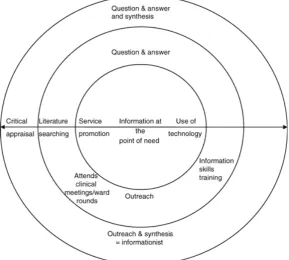
There are approximately 20 clinical librarian services within the North West (although this has fluctuated over the last few years) due to service reorganisations. A community of practice exists, the North West Clinical Librarians Group, under the wider umbrella of Library and Information Health Network North West (LIHNN). Any clinical librarian working within the region can join the group which meets quarterly to share ideas and practice; establish common standards and a co-ordinated approach; provide training relevant to the role; and maintain useful resources (http://www.lihnn.nhs.uk/index.php/lihnnhome/lihnn-groups/clinical-librarians). Previous work identified that clinical librarians in the NW operate different models across the region according to the needs and resources of each NHS Trust. They include a static question and answer service; outreach where librarians support a range of initiatives including journal clubs and outreach plus critical appraisal and synthesis (Brettle et al 2011). In common, all the NW CL services provide literature searches although the level of critical appraisal and synthesis of the evidence varies across services as shown in Figure 1 (taken from Brettle et al 2011).
Evidence on Clinical Librarian Services prior to 2005
There are a large number of papers published on clinical librarian services as well as many evaluations. The systematic review which underpins this study (Brettle et al 2011) reviewed the evidence and highlighted 3 systematic reviews which summarised the evidence to 2005 (Winning and Beverley 2003; Wagner and Byrd 2004; Weightman and Williamson 2005) as well as an earlier review of the literature (Cimpl 1985). In summary, these reviews found that CL services were well used and liked by clinicians, but could find little evidence of effectiveness or impact; due mainly to the poor quality of reporting and design of the studies available.
Figure 1: Clinical Librarian Services
Systematic Review on Evaluation of Clinical Librarian Services (Brettle et al,
2011)
Within the UK there was considerable development in CL services post 2005, thus in 2011 it was determined that there was a need to undertake a further review of CL services (Brettle et al 2011). This was undertaken as a group venture and a means of building research and critical appraisal capacity within the NW CL group as well as providing a foundation for this evaluation study. In summary, the review located both published studies and evaluations published within the grey literature and included 18 studies which had been undertaken since 2005. The systematic review found:
• Limited evidence of CLs Impact.
• CLs are effective in saving health professionals time.
• CLs have a positive effect on clinical decision making by contributing to better informed decisions. • Impact on patient care for diagnosis and the choice of drug or therapy.
However, Brettle et al (2011) also echoed previous reviews in highlighting the poor quality in both the design and reporting of impact studies, especially the inadequate information provided on sample size, data collection instruments, and failure to address sources of bias. Although there was some improvement in the more recent studies it was still evident that more work in the reporting of data collection and analysis was required and the following recommendations were made for conducting future impact studies.
Methods chosen must be robust, adequately conducted, limit bias and reported explicitly. In particular, it was suggested that use was made of previous evaluations and recommendations so that the data collected across studies was more standardised and comparable. This would make it possible to build an evidence base for CL studies. The Toolkit developed by Weightman et al. (2008) provided an ideal starting point to do this;
demonstrating direct impact on patient care is extremely difficult to prove. Studies should therefore determine if CLs make a contribution to patient care rather than a direct impact. The Critical Incident Technique was highlighted as a useful means of demonstrating evidence of specific instances of impact.
that may occur in the future. Now more than ever, library services need to be explicit about the contribution they make towards achieving the organisational objectives of their Trust.
Work in the North West in this field, has included development of an Alignment Toolkit (Pratchett 2010) which enables health libraries to link their work to organisational objectives. Brettle et al (2011) suggested that further research should investigate whether it was possible to use Alignment Toolkits to demonstrate organisational impact of CL services
.
Finally Brettle et al (2011) was unique in that it aimed from the outset to develop research and systematic review capacity in a group of librarians and methods for doing this were explicitly built into the methodology of the project. Any further project should seek to build on this base and further develop the research skills of those involved in the original systematic review and begin to develop research skills in a wider group of clinical librarians. This project therefore seeks to build on the previous systematic review in the North West and implement the recommendations in practice. It therefore establishes the following aims and objectives.
Aim
To undertake a multi-method evaluation study on the impact of Clinical Librarian (CL) services in the North West health region.
Objectives
l To use a framework that ensures consistent and robust data is collected across all Trusts, providing an increased body of evidence.
l To test the use of the MAP (Making Alignment a Priority) Toolkit in ensuring that evaluations measure contribution to organisational objectives.
l
To build research capacity amongst a group of clinical librarians.
Chapter Two: Methods
Project Management and Organisation
The project was managed and co-ordinated by a researcher (Alison Brettle) from the School of Nursing, Midwifery, Social Work and Social Sciences at the University of Salford. Clinical/Outreach Librarians working within the North West region were invited to participate in the project at the levels outlined below.
• Level 1 participation – send out questionnaire to service users and ensure research governance
processes have been followed within their particular Trust.
• Level 2 participation - 1 + conduct semi structured interviews of selected service users in a
neighbouring Trust
• Level 3 participation – 1&2 + help to conduct a thematic analysis of the interview results.
and a wiki which was used to store and manage data throughout the project. Two Clinical Librarians also became more deeply involved in the questionnaire design and dissemination of the results. Appendix 1 provides details of the librarians involved and their participation.
Data Collection
Data was collected by means of a questionnaire (see Appendix 2) and semi structured interviews (see Appendix 4). This approach was based on the recommendations of Brettle et al (2011) and the guidance provided in the impact Toolkit (Urquhart 2008).
Sample
Each participating librarian recorded details of those using the CL service. Questionnaires were sent to every service user over a 6 month period, approximately 6 weeks following the initial request for information. Questionnaire distribution occurred between January and October 2011, witheach service distributing for a 6 month period, within this time frame. The decision to send questionnaires to all service users in this time frame was made following analysis of the number of requests to the CL services over the previous six month period. It was anticipated that this would provide an approximate sample of 1000 responses, providing that the same volume of requests were received. This was considered to be feasible within the time frame of the project and would also enable a significantly larger study to be conducted than previously in the UK.
Questionnaire development
An initial questionnaire, based on the Critical Incident Technique, was developed in Survey Monkey Online Software by the project manager using recommendations from Brettle et al (2011) and the Impact Toolkit (Urquhart 2008). Following discussions at a meeting of all the CLs involved, the questionnaire was revised and then further refined by a core team (the project manager and two additional CLs from the wider team) to ensure the orgnaisational impacts identified in the Alignment Toolkit (Pratchett 2010) were included.
Figure 2: Policy documents and core themes identified from content analysis
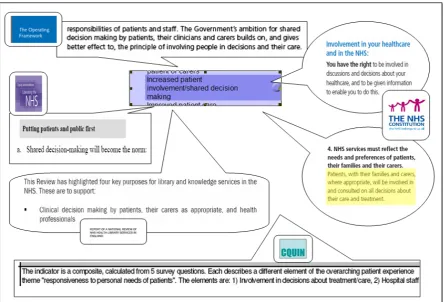
Figure 3: Developing the questions from themes
The refined version was piloted by each partcipating CL with up to 5 of their recent users (32 responses), and following this feedback minor changes were made to produce the final version (Appendix 2).
• Decision Making and Evidence Based Practice • Patient centred care
• Quality of care and Improving healthcare outcomes • Service development
• Efficiency, Financial or Risk Management
• Accountability and transparency
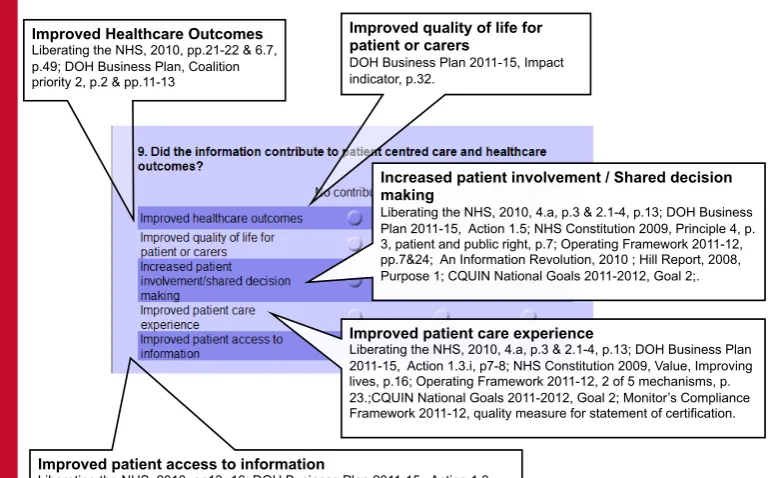
Improved Healthcare Outcomes Liberating the NHS, 2010, pp.21-22 & 6.7, p.49; DOH Business Plan, Coalition priority 2, p.2 & pp.11-13
Improved quality of life for patient or carers
DOH Business Plan 2011-15, Impact indicator, p.32.
Increased patient involvement / Shared decision making
Liberating the NHS, 2010, 4.a, p.3 & 2.1-4, p.13; DOH Business Plan 2011-15, Action 1.5; NHS Constitution 2009, Principle 4, p. 3, patient and public right, p.7; Operating Framework 2011-12, pp.7&24; An Information Revolution, 2010 ; Hill Report, 2008, Purpose 1; CQUIN National Goals 2011-2012, Goal 2;.
Improved patient care experience
Liberating the NHS, 2010, 4.a, p.3 & 2.1-4, p.13; DOH Business Plan 2011-15, Action 1.3.i, p7-8; NHS Constitution 2009, Value, Improving lives, p.16; Operating Framework 2011-12, 2 of 5 mechanisms, p. 23.;CQUIN National Goals 2011-2012, Goal 2; Monitor’s Compliance Framework 2011-12, quality measure for statement of certification.
Improved patient access to information
[image:14.595.74.459.405.644.2]Figure 4: Outcomes identified from the policy documents
Questionnaire distribution
A standard email with a link to the questionnaire (Appendix 3) was distributed by each CL involved in the project, to each service user over a 6 month time period. Responses were collated in SurveyMonkey and accessible only by the project manager and the member of staff analysing the data (not those responsible for providing the service). Reminder emails were sent out approximately 3 weeks following the initial email.
Semi-structured interviews
Semi-structured interviews were conducted by 6 CLs. These originated from a variety of Trusts, providing good coverage both of Trust type (primary, acute, mental health) and geographic distribution across the region. The Trusts who participated included Aintree University Hospitals NHS Trust, Blackpool Teaching Hospitals NHS Foundation Trust, Mersey Care NHS Trust, Liverpool PCT, University Hospitals of Morcambe Bay NHS Trust and Warrington and Halton Hospitals NHS Foundation Trust.
Interviews were conducted according to a standardised schedule (see Appendix 4). A buddy system was implemented where 3 pairs of CLs interviewed staff from a neighbouring Trust on a reciprocal basis. This approach was adopted to reduce bias by ensuring that CLs do not interview their own service users. It had the further advantage of research capacity and confidence building as buddies were able to practise their interview techniques on each other prior to conducting the interviews.
were sought to participate in the interview sample. Potential interviewees were sent an email from the clinical librarian in their own Trust (see Appendix 5), those who responded positively were contacted by the “buddy” CL to arrange a convenient meeting and go through information and consent issues. Interviews wereconducted either face to face or via telephone. All were recorded and transcribed by an independent transcriber.
Guidelines in this area suggest that 20 interviews is an appropriate number for this type of study (Urquhart et al 2008).
Data analysis
Data from the questionaire was initially exported from SurveyMonkey into Excel, which was used to perform descriptive statistics. These are reported as absolute and percentages (to two decimal places) for each
outcome. Subsequently the raw data was exported into SPSS for the calculation of inferential statistics. The Chi-squared test was used to determine whether there was any statistically significant differences in responses between the professional groups and between clinical/non-clinical groups.
Data from the interviews was transcribed by an independent transcriber and verified by the librarian who had conducted the interview. Due to the structured nature of the interviews and the complexity and richness of the data obtained; it was not possible to conduct a meaningful thematic analysis. Instead a template was developed by members of the interview analysis team; which summarised the outcomes described in each interview alongside quotes which explained and illuminated the data for each outcome. Each interview is therefore presented as a case in its own right in Appendix 8.
The data gained from the qualitative aspect of the study is used to expand on and clarify issues raised from the quantitative data and is presented in both the results and discussion chapters.
Ways of working and research capacity building
There is a lack of research skills and confidence amongst the CL community to conduct service evaluations themselves. Furthermore, there has been flaws in previous research in this area where small scale evaluations have been conducted using a non standard approach, so that results cannot be compared across studies (or sites). This project has therefore been designed to include the CLs throughout the research process, at a level at which they are comfortable. Furthermore, support was built into the project design to help them carry out the agreed tasks at the same time as developing practical research skills. This included training at various points, buddying of experienced and less experienced members and providing standardised tools for them to use. Communication throughout the project was via a wiki (an approach used successfully in a wide range of NW librarian projects) and a series of face to face meetings. Face to face meetings took place at the outset of the project to set parameters, in questionnaire development and piloting, at the outset of interviews and to train staff in interview procedures for interview analysis training. Regular updates regarding the project were sent via email as well as posted on the wiki. Questionnaire results per Trust were posted on the wiki. All documentation regarding the project was also stored on the wiki. When dissemination opportunities (eg conference
presentations) arose, details and ideas were circulated via email for comments and volunteers to present. These were taken up by various team members according to their interests. A list of contributions is presented in Appendix 1 to illustrate the capacity building and individual contribution to the research process.
Ethics
CLs used a standard template to record details of service users during the study period (Appendix 7). Each CL maintained their records which were kept securely. An email sent to service users provided information about the study and a link to the online questionnaire. Informed consent was presumed if a service user accessed the link and returned the questionnaire. For those taking part in interviews informed consent was sought as
described above before the interview took place.
Responses to the questionnaires were anonymous. Interview participants were given a unique code and the list kept separate from the interview transcripts. Quotes used in the production of this report have been
Chapter Three: Results
Participants
A total of 10 CLs took part in the study, representing 16 Trusts across the North West Region.
Questionnaire Survey
Over a 6 month period, 779 questionnaires were sent out to all users who received a service from the
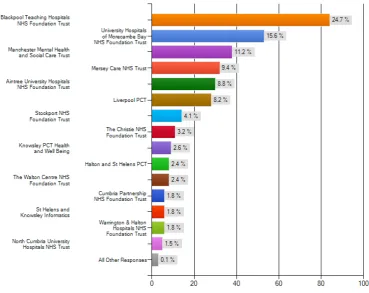
[image:18.595.96.466.395.688.2]participating clinical librarians. As the questionnaire was based on a critical incident technique, those who used the service more than once during this time would receive multiple requests to complete a questionnaire, with each request comprising a separate incident. A total of 360 respondents began the survey but only 340 answered the demographic questions and 329 completed each question on the survey. A response rate of 43.6% (based on demographic response) and 42.2% useable responses. Responses were received from participating Trusts as indicated in Figure 5. Over 50% of responses were received from acute or mental health Trusts. The volume of questionnaires sent out by each participating Trust ranged from 7-209, indicating a large variation in the number of “incidents” reported by each Trust. This is understandable as there is a large variation in clinical librarian roles, size of Trusts and number of hours worked by each CL in that role. Furthermore, some CLs provide services for more than one Trust. Response rates for individual Trusts ranged from 20.6%-62.5%. In line with the protocol established at the beginning of the project to show a regionwide picture of the impact of the service and in an attempt to conduct a large study; all of the responses will be presented as a whole rather than per Trust. Each individual librarian has been provided with data for their own Trusts separately and for their own purposes. There has been no attempt to compare and contrast the work of different librarians as part of the study.
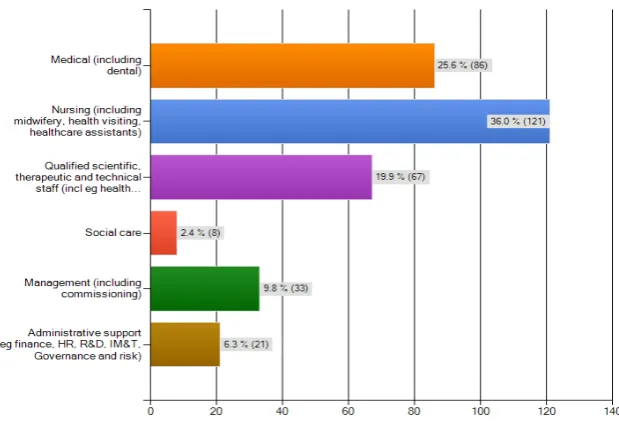
Breakdown by profession
[image:19.595.101.411.156.369.2]Responses were received from a variety of professional groups, indicating that CLs provide services to a wide range of staff. Nursing, medical and allied health professionals were the largest groupings. However, managers and other administrative support comprised a significant minority of respondents, suggesting that CL services are not limited to direct patient care but support a much wider information agenda.
Figure 6: Breakdown of responses by professional group
Services provided by Clinical Librarians
Figure 7: Breakdown of services provided
Some of the clinical librarians are involved in other services, such as journal clubs. In these cases the role is much more than the provision of a literature search. One interview participant described how the Clinical Librarian is involved.
“Her role in that team was to do literature searches around the questions devised and circulate the evidence, say 4 or 5 articles to the team to agree on the 2 articles for discussion which were then disseminated to the rest of the potential attendees. We recognized early on from the evidence around journal clubs that some discplines had a lot more experience in critiquing the literature. For the nurses it wasn’t part of their professional pre-reg training. We recognized a disparity in the ability to critique the literature so the CL taught some critical appraisal training in the first few weeks. Really useful”. (Nurse, Comm 4)
“We asked CL to do a comprehensive literature search for a piece of work we’re doing. We’re doing a project with other EU members at the moment, this country and 4 other countries. We asked her to do a literature search on employment and MH professionals’ involvement in learning products for people with MH difficulties, that type of thing. [“Was this one of the projects CL was involved with”] Yes, and what we also wanted was to look at not only in the UK but also other countries as well in relation to what they are doing around their models as well”. (Manager, Comm 6)
Respondents were asked to give details regarding the “critical incident” to which the remainder of the questionnaire is referring. A full list of incidents is provided in Appendix 7. Themes which recur, but are non specific include: training, information for direct patient care, training to support further study, searches and training to support academic writing, guideline development or quality assurance.
Quality of service provided
Respondents were asked whether the service provided met their needs; 341 replied and the vast majority of these were highly satisfied 78.6% (n=268) believed that the information provided wholly met their needs and 21.1% (n=72) stated that the information partly met their needs. Only 1 case believed that the service provided did not meet their needs at all.
When asked to rate the information provided for relevancy to the original request, 343 responded. On a scale of 1 (low) to 5 (highly relevant), the majority (94.7%, n=325) rated the information as 4 or above indicating that the information provided was relevant to the original request. Similarly the majority of respondents 318 out of 343 believed that the service rated highly on saving time (92.7%). Only 2 respondents believed that using the service had not saved them time.
Impact of Clinical Librarian Services
Impact of Clinical Librarians on decision making and evidence based practice
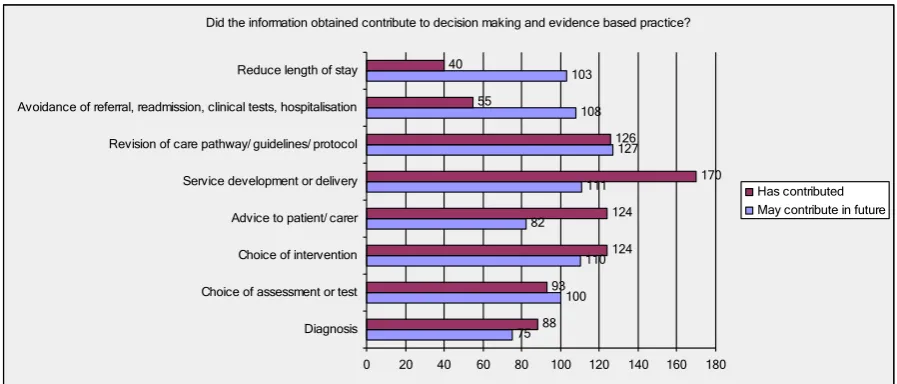
A total of 333 respondents answered this question, providing evidence of the contribution of the CL in this area. The largest impact is on service development or delivery, with over 50% respondents suggesting that the information provided had made a difference to this area. Almost all the interviews highlight current impacts in areas of decision making and evidence based practice. Although the numbers are relatively small, clear evidence is provided where clinical librarians are contributing to reduced costs by impacting on LoS (40
incidents, 12%) and avoidance of referral, tests or readmission (55 incidents, 16%). This contribution to reduced costs is further illuminated in the interviews with staff at Acute Trusts (Acute 3, 4, 10, 12, 13, 15).
The surveys showed 88 incidents (26%) of CL contributions to diagnosis, in the interviews one physiotherapist explained how this contribution was made.
“Has contributed…Within the literature she sent me, there were some very good articles with ‘objective testing’. So if you get a patient in who’s got a certain set of symptoms, it tells you exactly what test to do and will differentiate between, like, muscle pull or whether it’s [encapsulating?] stability which is saying ‘yes, they’ve probably got a posterior laxity’ which can lead to dislocations, so it was specific testing information, so it was ideal”. (Physio, Acute 13)
Evidence is also provided of the impact of CLs on choosing tests, interventions and in providing advice to patients or carers.
“cos part of documentation is the assessment of a patient so it contributes to that. And the way we assess them and look at then writing it, you know, writing it down or documenting it in some format, so yeah, it does contribute to that”. (Nurse, Acute 18)
[image:21.595.73.522.500.692.2]Although the surveys were distributed 6 weeks following the original request, it is possible that there has not been time for the information provided to have an impact. Over one third of respondents suggested that the information provided may contribute to future savings, for example by avoiding readmission or tests or reducing length of stay.
Figure 8: Impact of clinical librarians on decision making and evidence based
practice
Did the information obtained contribute to decision making and evidence based practice?
75 100 110 82 111 127 108 103 88 93 124 124 170 126 55 40
0 20 40 60 80 100 120 140 160 180 Diagnosis
Choice of assessment or test Choice of intervention Advice to patient/ carer Service development or delivery Revision of care pathway/ guidelines/ protocol Avoidance of referral, readmission, clinical tests, hospitalisation Reduce length of stay
There were 126 (37%) incidents where CLs contributed immediately to the revision of guidelines and protocols, but most of the impacts from this will be seen in the future.
“I mean, it’s out for review at the moment.” So it has contributed to the revision of it although it’s not actually… It’s not been published yet”. (Nurse, Acute 14)
Contribution to patient centred care and healthcare outcomes
A total of 328 respondents answered this question and provided evidence of a wide range of contributions. The largest responses were suggesting that rather than have an immediate impact in this area; clinical librarians may contribute to this in the future. Nevertheless, over a quarter of respondents reported immediate contributions to outcomes for improved quality of life (QoL), increased patient involvement in decision making and improved patient access to information. Furthermore, over 50% respondents noted that the clinical librarian service may contribute to improved quality of life in the future (164 incidents, 48%) and improved health care outcomes (163 incidents, 48%).
The highest contribution to an immediate outcome was 109 incidents (32%) for an improved patient care experience. This was further illuminated by the responses to the interviews which also illustrate some of the complexity involved in collecting data about the impact of CL services. For example, one respondent noted that there was an impact on the patient care experience, but this was not a positive one, “I warn them that it’s going to sting there.”….. and this then impacted on patient involvement in decision making “Yeah, because I have to warn them about it and they decide if they want the spray or not”. (Nurse, Acute10)
In some cases, due to the nature of the service provided or perhaps the type of Trust where the service was conducted, the wording of the questions needed to be somewhat interpreted, but nevertheless an impact could be seen for that particular outcome, for example an outcome relating to diagnosis
“I think it contributed in terms of diagnosing what the state of play or the baseline was in each of the countries involved in the project”. (Manager, Comm 6)
Did the information contribute to patient centred care and healthcare outcomes?
163 164 123
146 113
105 86
88 109 83
0 50 100 150 200
Improved healthcare outcomes Improved quality of
life for patient or carers Increased patient involvement/ shared
decision making Improved patient
care experience Improved patient
access to information
Figure 9: Impact of clinical librarians on patient centred care and healthcare
outcomes
One CL was involved in a project group regarding nursing supplies, although some of the impacts were difficult to measure due to the nature of the group and its role, clear contributions could be seen. One example was given on how the information provided via a literature search as part of the project contributed to shared decision making.
“Again, have contributed. Simply because we’ve, via the group, it’s meant that we can make, kind of standardised decisions etcetera. So, given the power of that group to actually make decisions on behalf of everyone else within the Trust”. (Nurse, Acute 12)
Quality of care
A total of 324 respondents answered the question regarding quality of care and indicated that this was another area where clinical librarians provide direct and high level impact. Figure 10 shows that the largest area of impact is in the contribution to ensure that interventions are based on best practice or current evidence (155 incidents, 46%). Other areas where clinical librarians make an impact are in implementing guidelines (134 critical incidents, 39%) and improving quality of care (133 critical incidents, 39%).
These three outcomes are summed up in case study Acute 16 which following a request for a literature search on falls assessment in children was identified as having an impact on quality standards and ensuring that interventions are based on current evidence.
“Yes. Basically because they say that bedrails shouldn’t be used on children under the age of 12, it’s made us think about the practice that we actually do, so by looking at how or looking at articles and information around that area, it means that we then are, erm, thinking about what we do and improving it so, and meeting quality standards really”. (Nurse, Acute 16)
Involvement in project teams, such as a nursing supplies group which is responsible for conducting a range of small projects provided an example of how the information provided can impact on guidelines.
“Yeah I think this definitely has contributed because we’ve now got standardised products which we actually use within the hospital and because we’re multisite, it’s quite difficult to get to that stage. But via the group, it’s meant we can set guidelines and also more people about using best practice etcetera”. (Nurse, Acute 12)
A nurse who ran a journal club along with a clinical librarian suggested that the CL intervention impacts on the patient experience in the following way.
“I think the above fits into that as well. For example, less use of seclusion. Being able to spot when someone is feeling unsafe and counseled rather than waiting until it becomes such that they respond in an aggressive manner and averting that. I think that the patient experience is being improved by all of this, by improving the knowledge of the staff working closely with them, that’s what’s come from the JC, rather than improved skills there is something of a change in attitude but I think the most measurable thing is improved knowledge”. (Nurse, Comm 4)
Future contribution to quality of care
“ I think there are, there are implications for the way our staff move between patients in ITU, that will reduce the risk of infection and that will then subsequently improve quality of care because the risk of infection will be reduced and patient transmission will be reduced, so there is still some work that we’ll be doing in ITU”. (Acute 17)
“We expect that the…allow us to hit the quality standards for the [emergency?] departments, 95% of patients seen within 4 hours, and it would do that by implementing the best practice. So the information we’ve already got has been constructed into an action plan and of course the trick then is to put that in place and how we’re going to monitor audit. So that’s how it will work for that part”. (Manager, Acute 10)
Future contribution to health care outcomes
“It will contribute in the future ‘cos at the moment our document…we’re still working on the documentation, so you know…it’s contributed a little bit, because we’ve developed a new booklet for documentation, but the main focus of that will be in the future when we start using it and getting it out there on the shop floor”. (Nurse Acute 18)
“It’s helped us to keep on top of best practice. We’ve got a much more critical eye on best practice and what is best practice and how does it compare with the practice we deliver. We’re much more up-to-date with current research and literature and actually what we now need to do is evidence better the outcomes of the JC. We’re getting there. We’re starting to have the impact that was the initial aim but we’re just 16mths old with this and so it’s taking it’s time as with everything in the NHS”. (Nurse, Comm 4)
Future contribution to innovative practice
“I think the JC itself and the input of the library services in establishing the JC is innovative practice initially and then I’d have to say that innovation is pending I think, for example, the patient safety toolkit that is innovative and awaiting approval. Section 17 of the template for discretionary decision-making on the part of nursing staff –the template for them to do that is awaiting governance. There are a couple of innovative things but we’re still waiting”. (Nurse, Comm 4)
Figure 10: Impact of clinical librarians on quality of care
Contribution to service development
A total of 325 participants responded to this question and given the nature of service development; it was found that the highest responses indicated most impact could be determined as contributing in the future to ensuring that service development is underpinned by the evidence base (139, 41% critical incidents) or the inequalities are addressed (123, 36% critical incidents). However, evidence of more immediate impact was also reported for service development (127, 37% critical incidents) and working with other health and social care providers (99, 29% critical incidents), providing integrated care and addressing inequalities or an unmet need in care. Contributions to immediate service developments were also reported in the interviews across the acute and community sectors (Acute 5, 7, 17, 18 Comm 2, 4, 5, 6).
Figure 11: Impact of clinical librarians on service development
Did the information contribute to quality of care?
115 135 135 121 141 159 119 133 134 155 88 88
0 50 100 150 200
Meet quality standards Improved quality of care Implement clinical guidelines/ best practice Interventions based on best practice or
current evidence
Evaluation or audit Innovative practice
Has contributed May contribute in future
Did the information contribute to service development?
123 139 112 119 68 127 99 85
0 20 40 60 80 100 120 140 160
Address inequalities in access to care or unmet
need in service Service development/ delivery underpinned by evidence
base Working with other health
and social care providers Integrated care
[image:25.595.74.520.517.728.2]One physiotherapist suggested that because the information had already contributed to the diagnosis, it also contributed to service delivery based on evidence.
“ … because I think the testing is more specific. They’re notoriously difficult things to diagnose, so yeah I think, you know, as Clinicians, we’re being more effective in our diagnosis, and if you think the
diagnosis is right, then the treatment is better”. (Physio, Acute 13)
Impact of clinical librarians on continuing professional development
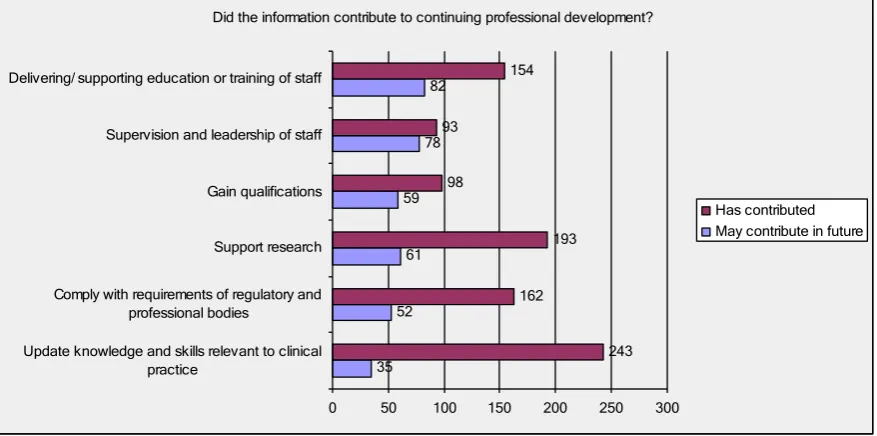
This section of questions was completed by 325 respondents and was an area which demonstrated where clinical librarians have one of the highest impacts. Almost 3/4 respondents reported that CLs have a direct contribution to ensuring their skills and knowledge are updated (243, 71% critical incidents and across all interviews).
A journal club had a number of impacts in this area
“Definitely we have a lot more staff able to do basic, some can do advanced literature searches but certainly basic literature searches based on keywords, if that’s all they can do then that’s an
improvement. A lot more staff reading at least 2 articles a month, where perhaps they never read any. Reading habits are improved. They’re attitude towards the evidence base has improved. They become much more curious about what’s out there, what might be out there. They’re a lot more critical about their own practice. I kept a register of attendance for journal club, I’ve not got the figures to hand but attendance would count towards their prep hours. Personally I got a publication out of it. I suppose also the presentation at the forthcoming conferences. With the service users and learning how to literature search, obviously they are not professionals but it certainly developed them. There is certainly a lot more creative thought and practice on the wards as well”. (Nurse, Comm 4)
Figure 12: Impact of clinical librarians on CPD
One interviewee noted that the information had contributed to many of the outcomes in this area.
“Has contributed – definitely”. …“I mean it was specifically about a CPD in-service training. It was, the whole purpose of the event was a) for me to learn some more and b) provide the in-service training and it’s helped our whole department. You know, it’s helped heaps so those questions are very very relevant”. (Physio, Acute 13)
Impact of clinical librarians on efficiency, finance and risk management
This area of potential impact is one which is not traditionally associated with a library contribution, but nevertheless is seen by some as potentially key to survival given the current fiscal climate. Although visible impacts in this area are notably lower than in the others, there is nevertheless clear evidence of impact to be seen.
For example
“Yeah, going back to what I mentioned about…the information gave us very specific information with regard to what would work for what patient. So rather than us see a patient trying to get an outcome from physiotherapy, now we know which ones are likely to succeed and which ones aren’t. We can refer to the right person straight away, thereby not wasting appointments really”. (Physio, Acute 13)
A total of 315 respondents answered questions in this area. A quarter reported direct impact in improving patient and staff safety (85, 25% critical incidents) as well as in risk management (79, 23% critical incidents, Acute 3, 7, 9, 10, 16, 17, 18, Comm 4).
“Yeah. Yes, I would say so because if a child gets their head trapped in a bedrail, then that’s going to have a huge impact on the financial situation of the Trust through litigation”. (Nurse, Acute 16)
“Yeah, well it’s actually for the future because a lot of this is still in the planning stages what we’re going to do. So yeah, we’re talking a lot of – we’re doing the talk at the moment, but it’s actually putting the actions into place that are important”. (Nurse, Acute 18)
Did the information contribute to continuing professional development?
35 52
61 59
78 82
243 162
193 98
93
154
0 50 100 150 200 250 300
Update knowledge and skills relevant to clinical practice
Comply with requirements of regulatory and professional bodies
Support research Gain qualifications Supervision and leadership of staff Delivering/ supporting education or training of staff
There are also small (but important, because of the associated income generation or saving money) examples of direct impacts on business development and commissioning or decommissioning of services (29 (8.5%) critical incidents each). Equally encouraging is the number of potential impacts which have been identified for future contributions such as supporting Quality, Innovation, Productivity and Prevention (QIPP) and legal issues.
Figure 13: Impact of clinical librarians on finance, efficiency and risk
management
There were 71 (21%) examples in the questionnaire results where CLs had directly contributed to the
demonstration of value for money (VfM) or a cost effective service. One illustration from the interviews was in relation to the involvement in a nursing supplies group.
“Yeah, it definitely has contributed ‘cause that’s one of the things that I monitor against the nursing supplies group and many of the things we discuss clinically whether it’s acceptable, and then obviously the cost implications of making that change etcetera”. (Nurse, Acute 12)
In some cases, for example, where a CL has been involved in providing monthly horizon scanning bulletins, the direct contribution to QIPP could already be seen, the respondent gave an example of the production of a bulletin on length of stay.
“Has supported, has contributed. What we hope to do is by reducing length of stay and giving the patient a better experience than what’s clinically appropriate, that might lead to a reduction in the bed base which in turn will lead to savings. So it’s directly helping with the…hitting the Trust’s targets for the QIPP in cost improvement programmes through a fairly lengthy convoluted route where actually the aim is to lower it”. (Manager, Acute 11)
Other areas where complex contributions may be made in the future and may not be traditionally associated with clinical librarians are in legal and ethical issues (43, 13% direct contributions and 103, 30% potential
contributions).
“Certainly legal, wrt Section 17 leave in the Mental Health Act. Legalities of smoking on NHS premises has also been explored. Wrt ethical considerations I would pin that on patient safety and the ethics around that. You would not expect to be a patient in a hospital and feel unsafe. The ethics around patients feeling unsafe in a hospital, whether that is more of a moral or ethical issue I think maybe both.
Did the information contribute to efficiency, financial or risk management?
92 118 116 100 85 94 123 92 102 38 54 71 79 29 29 85 46 43
0 20 40 60 80 100 120 140
Support Trust financial strategies (eg CIP - Cost Improvement Programme) Support QIPP Plans (Quality, Innovation, Productivity and Prevention) Demonstrate providing value for money/ cost effective service Risk managment Business development (eg income generation, tenders) Commissioning/ decommissioning of services Improve patient/ staff safety Improve accountability/ transparency of services Legal/ ethical issues
Also the ethical issues around the discretionary powers that nurses have in granting prescribed leave. What we’ve managed to find is that a lot of the time, leave was withheld by nurses with I’m sure, the best of intention, but it was withheld, illegally and definitely unethically. However, we are constantly aware of that now and constantly monitoring that much better through audit. So we’re striving to eradicate those cultures”. (Nurse, Comm 4)
Quantitative Analysis
Differences between Professional Groups
Chi-square test was used to determine whether there were any significant findings amongst the professional groups surveyed. Missing data (i.e. unanswered questions) were omitted from the analysis.
Outcome Chi-square df p-value
Diagnosis 15.907 14 0.319
Choice of Assessment 14.427 14 0.418
Choice of Intervention 29.247 14 0.010
Patient Advice 28.094 14 0.014
Service Development 15.251 14 0.361
Guideline Revision 20.746 14 0.108
Avoidance of Readmission 20.441 14 0.117
LoS 20.989 14 0.102
Health Outcome 25.231 14 0.032
QoL 18.224 14 0.197
Patient Involvement 26.010 14 0.026
Patient Experience 30.553 14 0.006
Patient Access to Information 25.163 14 0.033
Quality Standards 25.262 14 0.032
Quality of Care 21.311 14 0.094
Implement Guidelines 14.608 14 0.405
Interventions Based on Best Practice 16.387 14 0.290
Evaluation/Audit 15.463 14 0.347
Address Inequalities 26.810 14 0.020
Service Development Underpinned by Best Evidence 25.949 14 0.026
Work with others 29.651 14 0.009
Integrated Care 22.091 14 0.077
Knowledge and Skills 74.918 14 0.000
Regulatory Bodies 31.841 14 0.004
Research 15.757 14 0.328
Qualifications 17.014 14 0.255
Supervision 26.905 14 0.020
Education 37.438 14 0.001
Financial Strategies 23.475 14 0.053
QIPP 16.004 14 0.313
VfM 21.097 14 0.099
Risk Management 27.337 14 0.017
Business Development 20.605 14 0.112
Commissioning 21.522 14 0.089
Patient Safety 24.736 14 0.037
Accountability 16.713 14 0.272
[image:30.595.65.532.67.529.2]Legal/Ethical 26.599 14 0.022
Table 1: Difference in purpose for professional group requests
Statistically significant differences (p<0.05) in responses (shown in yellow in Table 2) between the professional groups surveyed were seen in the following areas (top profession demonstrating greater impact) : Choice of intervention (Nurses), Patient Advice (Social), Health Outcome (Nurses), Patient Involvement (Social), Patient Experience (Nurses), Patient Access to Information (Nurses), Address Inequalities (Medics), Service
Development Underpinned by Best Evidence (Social), Working with Others (Social), Regulatory Bodies (AHP), Supervision (Nurses), Risk Management (Managers), Patient Safety (Nurses) and Legal/Ethical (Nurses).
Impact by professional group % response
% has impact (% may impact)
Outcome Medic Nurse AHP Social Manager
s
Admin
p-value
Diagnosis 32.1(32.1) 39.6(24) 24.1(25.9) 14.3(14.3) 30.4(21.7) 23.1(15.4) 0.319
Choice of Assessment
32(36) 38.9(34.7) 33.3(35.1) 14.3(14.3) 20.8(45.8) 15.4(30.8) 0.418
Choice of Intervention
41.8(40.5) 47.6(32.4) 42.9(44.6) 42.9(-) 20.8(41.7) 14.2(35.7) 0.010
Patient Advice 42.1(34.2) 51.2(27.8) 50.9(23.6) 66.7(16.7) 20.8(25) 7.1(35.7) 0.014
Service Development
45.5(37.7) 55.9(38.7) 54.2(32.2) 85.7(14.3) 64.5(29) 42.9(35.7) 0.361
Guideline Revision 40.5(40.5) 47.3(43.6) 31.6(42.1) 57.1(42.9) 42.9(32.1) 28.6(35.7) 0.108
Avoidance of Readmission
26.3(36.8) 22.7(45.4) 9.6(28.8) 16.7(16.7) 16.7(41.7) 7.7(30.8) 0.117
LOS 19.2(32.9) 18.9(45.3) 5.8(32.7) -(16.7) 8(48) 15.4(23.1) 0.102
Health Outcome 31.7(51.2) 42.1(47.7) 32.8(62.1) 37.5(50) 16(64) 14.3(50) 0.032
QOL 28.2(50) 33(49.1) 26.8(66.1) 15.4(62.5) 15.4(65.4) 13.3(53.3) 0.197
Patient Involvement
30.3(34.2) 36.8(44.3) 27.8(44.4) 42.9(57.1) 12(48) 13.3(46.7) 0.026
Patient Experience 32.9(40.8) 43.1(44) 39.7(51.7) 28.6(57.1) 23.3(66.7) 7.1(50) 0.006
Patient Access to Information
30.3(28.9) 36.9(40.8) 22.2(40.7) 16.7(66.7) 14.8(48.1) -(46.7) 0.033
Quality Standards 36.8(39.5) 51.5(38.8) 28.3(45.3) 42.9(28.6) 44.4(37) 23.1(23.1) 0.032
Quality of Care 42.1(44.7) 50.5(43.1) 47.2(43.4) 62.5(25) 33.3(55.6) 21.4(57.1) 0.094
Implement Guidelines
43.6(42.3) 50.5(43) 36.4(50.9) 28.6(71.4) 44.4(40.7) 30.8(38.5) 0.405
Interventions Based on Best Practice
50.6(38) 54.7(39.6) 47.4(40.4) 42.9(57.1) 50(35.7) 35.7(42.9) 0.290
Evaluation/Audit 31.2(44.2) 31.4(52) 21.4(53.6) 57.1(28.6) 29.6(44.4) 30.8(23.1) 0.347
Innovative Practice 27(50) 35.6(51.5) 25.9(61.1) 33.3(66.7) 31(58.6) 21.4(57.1) 0.639
Inequalities
Service Development Underpinned by Best Evidence
33(38) 40.5(50.5) 42.4(49.2) 57.1(28.6) 48.4(35.5) 38.5(38.5) 0.026
Work with others 28.6(31.2) 44.1(39.2) 31.1(36.4) 42.9(28.6) 22.6(58.1) 21.4(42.9) 0.009
Integrated Care 28.2(32.1) 38.4(41.4) 25.9(44.5) 42.9(28.6) 26.9(46.2) 7.1(57.1) 0.077
Knowledge and Skills
81.7(11) 82.4(9.3) 92.1(6.3) 57.1(28.6) 38.5(26.9) 33.3(-) 0.000
Regulatory Bodies 55.3(10.5) 58.3(21.4) 71.9(14) 33.3(33.3) 36(24) 8.3(25) 0.004
Research 59.5(19) 68.6(20) 67.8(15.3) 62.5(37.5) 46.4(32.1) 46.2(15.4) 0.328
Qualifications 28.4(23) 43.4(20.8) 35.1(17.5) 16.7(16.7) 16.7(16.7) 16.7(16.7) 0.255
Supervision 28.9(25) 43.1(29.4) 29.6(18.5) 42.9(42.9) 11.1(37) 16.7(16.7) 0.020
Education 60(16) 58.1(33.3) 51.8(30.4) 50(50) 23.1(30.8) 46.2(15.4) 0.001
Financial Strategies
13.2(34.2) 11.5(36.5) 1.9(28.8) 16.7(33.3) 37.5(20.8) 25(25) 0.053
QIPP 14.5(34.2) 17.6(47.1) 15.1(43.4) 16.7(33.3) 38.5(38.5) 23.1(30.8) 0.313
VFM 23.4(29.9) 25(44.2) 12.3(45.6) 28.6(28.6) 46.4(32.1) 23.1(30.8) 0.099
Risk Management 24.7(28.6) 35.9(39.8) 11.1(33.3) -(33.3) 38.5(26.9) 23.1(38.5) 0.017
Business Development
13.2(21.1) 12.2(32.7) 5.7(26.4) -(50) 16.7(50) -(50) 0.112
Commissioning 13.5(29.7) 10(33) 3.8(26.9) 14.3(42.9) 23.1(50) -(50) 0.089
Patient Safety 25.3(45.6) 50.6(44.7) 18.5(38.9) 14.3(28.6) 28.6(35.7) 25(25) 0.037
Accountability 13.3(25.3) 22.4(39.8) 7.5(32.1) 28.6(28.6) 12(32) 16.7(33.3) 0.272
[image:32.595.69.555.70.608.2]Legal/Ethical 14.7(30.7) 24.5(41.8) 8(30) -(83.3) 8.3(41.7) -(33.3) 0.022
Differences between Clinical versus Non-Clinical Professionals
Chi-square test was used to determine whether there were any significant findings amongst the professional groups surveyed. Missing data (i.e. unanswered questions) were omitted from the analysis.
Outcome Chi-square df p-value
Diagnosis 2.570 2 0.277
Choice of Assessment 2.224 2 0.329
Choice of Intervention 9.556 2 0.008
Patient Advice 19.029 2 0.000
Service Development 0.286 2 0.867
Guideline Revision 4.047 2 0.132
Avoidance of Readmission 1.197 2 0.550
LOS 1.307 2 0.520
Health Outcome 7.560 2 0.023
QOL 2.890 2 0.236
Patient Involvement 11.606 2 0.003
Patient Experience 7.837 2 0.020
Patient Access to Information 7.665 2 0.022
Quality Standards 2.929 2 0.231
Quality of Care 7.342 2 0.025
Implement Guidelines 2.090 2 0.352
Interventions Based on Best Practice 1.608 2 0.448
Evaluation/Audit 3.309 2 0.191
Innovative Practice 0.776 2 0.678
Address Inequalities 1.380 2 0.502
Service Development Underpinned by Best Evidence 1.037 2 0.596
Work with others 4.567 2 0.102
Integrated Care 6.220 2 0.045
Knowledge and Skills 46.176 2 0.000
Research 4.974 2 0.083
Qualifications 7.530 2 0.023
Supervision 9.515 2 0.009
Education 20.456 2 0.000
Financial Strategies 12.947 2 0.002
QIPP 6.696 2 0.035
VFM 3.800 2 0.150
Risk Management 0.700 2 0.705
Business Development 3.974 2 0.137
Commissioning 3.997 2 0.136
Patient Safety 3.384 2 0.184
Accountability 0.120 2 0.942
[image:34.595.66.532.71.387.2]Legal/Ethical 2.458 2 0.293
Table 3: Differences between clinicians and non clinicians
Statistically significant differences (p<0.05) in responses between the professional groups surveyed were seen in the following areas (top profession demonstrating greater impact): Choice of intervention (clinical), Health Outcome (clinical), Patient Involvement (clinical), Patient Experience (clinical), Patient Access to Information (clinical), Quality of Care (clinical), Integrated Care (clinical), Regulatory Bodies clinical), Qualifications (clinical), Financial Strategies (non-clinical) and QIPP (non-clinical).
Highly statistically significant differences (p<0.001) between professional groups were seen in Patient Advice (clinical), Knowledge and Skills (clinical) and Education (clinical).