Original Research Article
Effect of saphenous vein space packing in conventional
varicose vein surgery
Thrishuli P. B.
1, Shashank K. J.
2*, Divakar S. R.
1, Akshata Kamath
1INTRODUCTION
Treatment of varicose veins constitutes a major part of the workload of a surgeon. Although there are various treatment methods, surgery remains the standard therapy for symptomatic varicose veins. Management of varicose vein disease has changed drastically over the past decades. Since its introduction, surgery has gone through several stages of evolution until the method of ligation
with stripping eventually became and remained the standard for a long time.
Unavoidable intraoperative bleeding with immediate postoperative haematoma formation (subclinical and clinical) associated with this procedure may lead to significant pain and discomfort in the recovery period and cosmetically unacceptable subcutaneous bruising, taking many weeks to disappear.1
ABSTRACT
Background: Varicose veins are common. The prevalence has been variously reported from as little as 2% to over 20% in population studies. Management of varicose vein disease has changed drastically over the past decades. Since its introduction, surgery has gone through several stages of evolution until the method of ligation with stripping eventually became and remained the standard for a long time. The objective was to study the effect on Saphenous vein space packing in conventional varicose vein surgery on intra-operative bleeding and post-operative patient recovery.
Methods: A prospective comparative study was conducted in JSS Hospital, Mysuru from August 2016 to October 2018. A total of 60 patients were selected for the purpose of the study based on the inclusion and exclusion criteria. The patient was passed on post operative day 2, 4, 7 and 30. The study population was divided into 2 groups, Group 1: 30 patients undergoing varicose vein surgery with packing and Group 2: 30 patients undergoing traditional varicose vein surgery without packing.
Results: On pre-operative evaluation of GSV diameter, the mean diameter was found to be 8.20±2.3 mm in the conventional group and 7.30±1.82 mm in vein packing technique. The pain was found to be more in conventional group than Saphenous vein packing technique and score was found to statistically significant between the two groups on day 2 and 4.
Conclusions: Saphenous vein space packing is an easy, economical and effective way of reducing post-operative pain in conventional varicose vein surgery.
Keywords: Varicose veins, Stripping, Pain, Packing, Saphenous vein
1
Department of General Surgery, JSS Medical College, Mysore, Karnataka, India
2
Department of Community Medicine, Chamarajanagara Institute of Medical Sciences, Chamarajanagara, Karnataka, India
Received: 14 May 2019
Revised: 16 June 2019
Accepted: 18 June 2019
*Correspondence:
Dr. Shashank K. J.,
E-mail: [email protected]
Copyright: © the author(s), publisher and licensee Medip Academy. This is an open-access article distributed under the terms of the Creative Commons Attribution Non-Commercial License, which permits unrestricted non-commercial use, distribution, and reproduction in any medium, provided the original work is properly cited.
Haemorrhage may be made worse by perioperative venous distension (associated with most types of surgery), which on intravenous infusion may distend veins by up to 57%, contributing more to increased haemorrhage.
If blood is left in place in the stripping tunnel, a firm palpable cord, sometimes called pseudothrombophlebitis results. This will eventually reabsorb but contributes to the significant early discomfort traditionally associated with vein-stripping procedures.2
Postoperative bleeding leads to limb discomfort. Most of the bleeding after surgery has been shown to occur within the first few minutes after stripping of varicose veins.
Crepe bandage is usually used in the immediate post-operative period, applied while patient is still on the table but the duration of effective compression is short due to slipping.1
Hence there is a need to incorporate adjunctive methods to reduce the intra-operative bleeding (first few minutes post-stripping).
Objective
The objective of our study was to assess the effect of great saphenous vein space packing in conventional varicose vein surgery on intra-operative bleed and post-operative patient recovery.
METHODS
A prospective comparative study was conducted in JSS Hospital, Mysuru from August 2016 to October 2018. A total of 60 patients were selected for the purpose of the study based on the inclusion and exclusion criteria. The patients were passed on post-operative day 2, 4. 7 and 30.
The study population was divided into 2 groups, Group 1: 30 patients undergoing varicose vein surgery with packing and Group 2: 30 patients undergoing traditional varicose vein surgery without packing.
Inclusion criteria
Patients admitted in general surgery ward (both male and female) in JSS hospital diagnosed with primary varicose veins between August 2016 to October 2018 undergoing TRENDELENBERG procedure with great saphenous vein stripping and perforator ligation and Patients who were between the ages 18-60 years.
Exclusion criteria
Patients who are hypersensitive to the test dose of lignocaine with adrenaline.
Coagulation disorders
Patients with secondary varicose veins
Patients with known cardiac disorder
Collection of data
Pre-operatively
Measure the diameter of great saphenous vein at Sapheno femoral junction (venous doppler) and truncal diameter.
Intraoperatively
Duration of procedure in minutes
Duration of pack placement in minutes Post-operatively
On day 2:
Assess pain with VAS (visual analog scale)
Surface scan to check for hematoma/ collection
Monitor vitals
Check for ecchymosis, bruising, edema
Willingness to ambulate On day 4, 1 week and one month:
Assess pain with VAS scale
Check for ecchymosis, bruising, edema
Willingness to return to daily activities
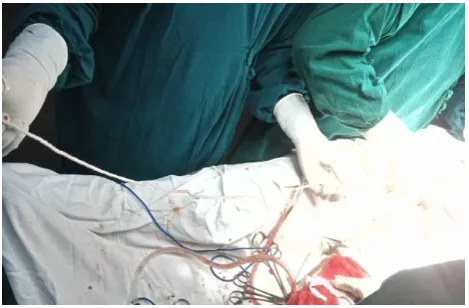
In this study we tie a length of roller gauze soaked in lidocaine with epinephrine to the end of the stripper. This provides direct compression, absorption of blood in the tunnel, and application of epinephrine to the avulsed tributary sites.
Figure 1: Placing of the pack in saphenous space post stripping.
(measured by VAS) and need for analgesia, occurrence of swelling, pseudothrombophlebitis, ecchymosis and surgical site infections on post op days 2, 4, 1 week and one month.
Data was entered into Microsoft excel data sheet and was analyzed using SPSS 22 version software. Categorical data was represented in the form of Frequencies and proportions. Chi-square test and non parameric test (Man whittney U test) was used as test of significance for qualitative data. Continuous data was represented as mean and standard deviation and p value was calculate using independent t test or Z test.
Graphical representation of data
MS Excel and MS word was used to obtain various types of graphs such as bar diagram, pie diagram.
P value (probability that the result is true) of <0.05 was considered as statistically significant after assuming all the rules of statistical tests.
Statistical software
MS Excel, SPSS version 21 (IBM SPSS Statistics, Somers NY, USA) was used to analyze data.
RESULTS
A total of sixty patients with primary varicose veins who were treated in JSS Hospital Mysuru, during 2016 to 2018 were included in the study.
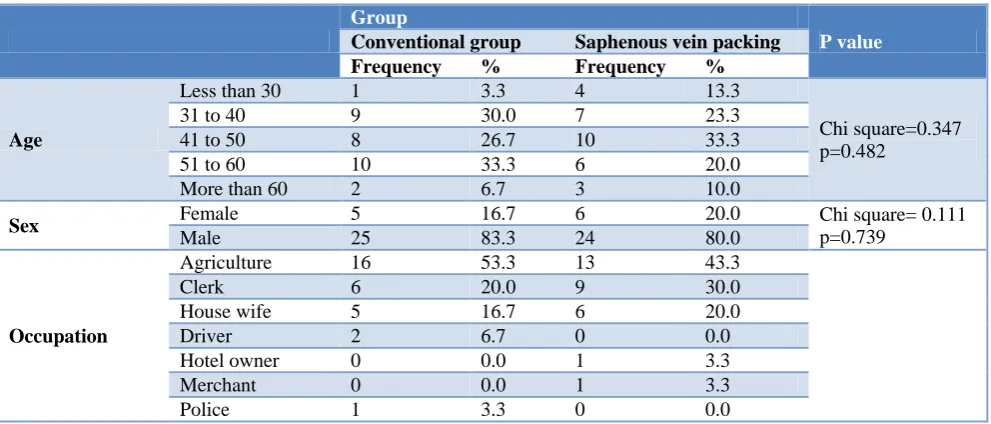
In our study the majority of the study subjects were between the ages of 30 to 60 years. 18 (30%) of the study subjects were 41 to 50 years, 16 (26.6%) of the study subjects were in the 31 to 40 and 51 to 60 years in each group. The age was also found to be statistically not significant between the two groups.
In our study majority of the subjects affected from varicose veins was male (81.6%) and female (18.4%). The gender was found to be statistically not significant between the two.
Table 1: Comparison of social profile of the study subjects.
Group
P value Conventional group Saphenous vein packing
Frequency % Frequency %
Age
Less than 30 1 3.3 4 13.3
Chi square=0.347 p=0.482
31 to 40 9 30.0 7 23.3
41 to 50 8 26.7 10 33.3
51 to 60 10 33.3 6 20.0
More than 60 2 6.7 3 10.0
Sex Female 5 16.7 6 20.0 Chi square= 0.111
p=0.739
Male 25 83.3 24 80.0
Occupation
Agriculture 16 53.3 13 43.3
Clerk 6 20.0 9 30.0
House wife 5 16.7 6 20.0
Driver 2 6.7 0 0.0
Hotel owner 0 0.0 1 3.3
Merchant 0 0.0 1 3.3
Police 1 3.3 0 0.0
Table 2: Etiological comparison of varicose veins signs and symptoms in both the groups.
Group
Total (%) Conventional group Saphenous vein packing
Count Column (%) Count Column (%)
C
No visible veins 0 0.0 0 0.0 0 (0)
Telangiectasia or reticular veins 0 0.0 0 0.0 0 (0)
Varicose veins 10 33.3 5 16.7 15 (25)
Edema 3 10.0 8 26.7 11 (18.3)
Pigmentation, Eczema
Lipodermatosclerosis 13 43.3 12 40.0 25 (41.6)
Skin changes with healed ulcer 4 13.3 5 16.7 9 (15)
E Primary 30 100.0 30 100.0 60 (100)
A Superficial and Perforator 30 100.0 30 100.0 60 (100)
Table 3: Comparison of surgery findings of varicose vein between the groups.
Group
P value Conventional group Saphenous vein packing
Mean Standard deviation Mean Standard deviation
GSV diameter 8.20 2.30 7.30 1.82 0.20
Duration of surgery in hrs. 2.23 0.50 2.30 0.47 0.597
Mean hospital stay in days. 7.27 2.82 7.77 4.14 0.587
Mean post op hospital stay 4.57 1.47 4.83 2.19 0.584
Table 4: Comparison of post-surgery complication between the groups.
Group
P value Conventional Group Saphenous Vein Packing
Count Column (%) Count Column (%)
Wound infection Present 4 13.3 3 10.0 X
2
= 0.162, p=0.688
Absent 26 86.7 27 90.0
Bleeding Present 16 53.3 10 33.3 X
2
= 2.443 p=0.118
Absent 14 46.7 20 66.7
Wound dehiscence Present 0 0 0 0
Pseudo
thrombophlebitis
Present 8 26.7 3 10.0 X 2 = 2.78,
p=0.09
Absent 22 73.3 27 90.0
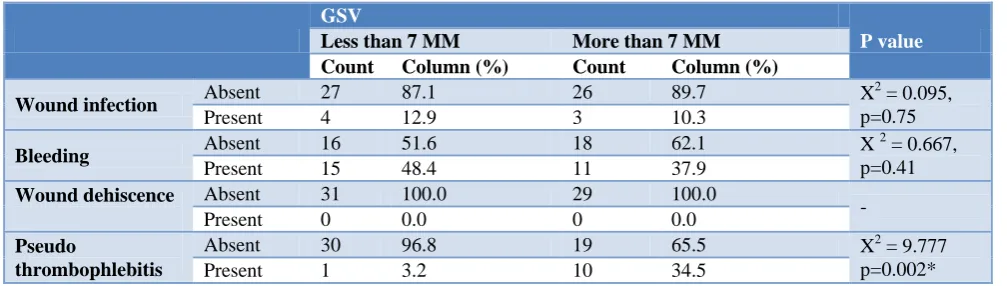
Table 5: Comparison of great saphenous vein diameter and complications.
GSV
P value Less than 7 MM More than 7 MM
Count Column (%) Count Column (%)
Wound infection Absent 27 87.1 26 89.7 X
2
= 0.095, p=0.75
Present 4 12.9 3 10.3
Bleeding Absent 16 51.6 18 62.1 X
2
= 0.667, p=0.41
Present 15 48.4 11 37.9
Wound dehiscence Absent 31 100.0 29 100.0
-
Present 0 0.0 0 0.0
Pseudo
thrombophlebitis
Absent 30 96.8 19 65.5 X2 = 9.777
p=0.002*
Present 1 3.2 10 34.5
Occupation is an important factor in the etiology of varicose veins especially those that involve prolonged standing. Out of the 60 subjects that were studied, 29 (48.3%) were involved in agricultural jobs, 15 (25%) were office clerks and 11 (18.3%) were housewives.
Other individuals who were affected were drivers (3.3%) hotel owners, merchants and police.
In our study the side of limb affected was almost equal with 31 (51.6%) on left side and 29 (48.4%) on right side. The side of limb affected was also found to be statistically significant.
The classification of varicose veins was done based on CEAP. Varicose Veins was seen in 15 (25%) of the total study subjects. 11 (18.3%) of the subjects had edema and 25 (41.6%) of the subjects had pigmentation, eczema
lipodermatosclerosis. Only 9 (15%) of the subjects has skin changes with healed ulcer.
All the cases the cause of varicose veins was found to be primary cause and had both superficial and deep perforators valves responsible for this condition.
The mean great saphenous vein diameter in the conventional group was 8.20±2.3 mm and 7.30±1.82 mm in vein packing technique. The p value was found to be statistically not significant between the two groups.
The mean duration of surgery in conventional group was 2.23±0.5 hours and in vein packing technique it was 2.30±0.47. The p value was found to be statistically not significant between the two groups.
the association was found to be statistically not significant.
The mean post op hospital stay was 4.57 days in conventional methods and 4.83 days in vein packing methods and it was also found to be not significant statistically.
The complications seen post-surgery was compared between both the groups. Wound infection was seen in only 4 (13.3%) in conventional group and 3 (10%) cases in vein packing technique. The wound infection was found to statistically not significant between the groups.
Bleeding was seen more in the conventional method (53.3%) of varicose vein surgery than vein packing technique (33.3%) but the association was found to statistically not significant.
Wound dehiscence was found to be nil in both groups. Pseudo thrombophlebitis was also seen more in the conventional method (26.7%) than vein packing technique (10%) and the association was found to be statistically not significant.
The great saphenous vein diameter was found to Statistically Significant associated with only complication of Pseudo thrombophlebitis post-surgery and not significantly associated with other complications of wound infection, bleeding and wound dehiscence.
The pain was assed using VAS scale on post-operative day 2, day 4, day 7 and day 30 post-operative day. The pain was found to be more in conventional group than saphenous vein packing technique.
Table 6: Pain VAS scoring on day 2, 4, 7 and 30 in both the groups.
Group
P value* Conventional group Saphenous vein packing
Mean Standard deviation Median Mean Standard deviation Median
Pain At D 2 7 1 7 6 1 6 0.0001
Pain At D 4 6 1 6 4 1 4 0.0001
Pain At D 7 2 1 2 2 1 2 0.224
Pain At D 30 1 1 1 0 1 0 0.256
*Mann-Whitney U test.
Table 7: Mean packing time in saphenous vein packing group.
Mean Standard deviation
Packing time in saphenous vein packing group 6 1
Figure 2: Preoperative picture of study subjects with varicose veins.
Figure 3: 2 week post operative picture of study subjects who underwent saphenous vein packing
The mean score of pain in conventional method on day 2 was 7 and 6 in vein packing technique and the association was found to be statistically significant. On day 4 also mean pain score was 6 in conventional method and 4 in vein packing technique.
The pain score was found to statistically significant between the two groups on day 2 and 4 and non-significant on day 7 and day 30.
The mean packing time in the saphenous vein packing group was 6 min with 1 min standard deviation. In our study an significant association could not be made between the packing time (in minutes) and the post-operative complications.
DISCUSSION
In our study a total number of 60 patients with primary varicose veins were admitted, investigated, operated and followed up. The results were analyzed and compared with other similar studies. The analysis is as;
In the study done by Malhotra et al comprising 677 patients from both North and South India had an age range of 18-65 years.3 In the Wright et al in their study of 1338 patients in England had an age range of 20-75 years, which was similar to our study findings.4
The male to female ratio was found to be 5:1 in the conventional group and 4:1 in the saphenous space packing group. Widmer in Switzerland recorded a ratio of 1:1.5 Callam et aln England and Leipnitz et al recorded a ratio of 1:2.6,7
The mean duration of surgery in conventional group was 2.23±0.5 hours and in vein packing technique it was 2.30±0.47. In our study which is similar to the study done by Potula who showed an average operating time of 52 mins.8
In our study the side of limb affected was almost equal with 31 (51.6%) on left side and 29 (48.4%) on right side in comparison to a study performed by Dur, Mackaay et al where the Right limb was involved in 48.55% and left limb in 51.45% of the subjects under study.9
The most common presenting symptoms were dilated veins seen in about 90% of the subjects which was comparable to a study findings of Campbell et al.Pain as a symptom was seen in only 23% of the subjects in our study as compared 23% in the study performed by W. B Campbell et al. The most common complications seen among the study subjects was prominent veins 54 (90%) followed by pigmentation 30 (50%). Edema was seen in 16 (26.7%), ulcerations in 9 (15%) and pain in 14 (23.3%).10
The mean great saphenous vein diameter in the Conventional group was 8.20±2.3 mm and 7.30±1.82 mm
in saphenous vein space packing technique. When we aimed to extract an association between the GSV diameter and clinical presentation, we observed that patients having a GSV diameter of more than 7 mm had greater severity of symptomatology. This was compared to the study by Hamel-Desnos et al which showed a clear association between clinical class and GSV diameter (the higher the clinical class, the larger the diameter; p<0.0001), between venous symptoms and diameter (the larger the diameter, the higher the intensity of symptoms, p<0.0001 for overall discomfort) and between proximal extent of reflux and diameter (the more proximal the extent of reflux, the larger the diameter, p<0.0001).11
Pigmentation, eczema and lipodermatosclerosis was seen in 45. 3% of subjects having GSV diameter measuring greater than 7mm as compared to 31.2% in patients with diameter less than 7 mm. Venous ulcers were seen in 15.9% of the subjects with GSV more than 6 mm and those with GSV of less than 6 mm had ulcers in 12.5% of the cases studied. When we studied the association of GSV diameter and post-operative complications it was observed that the great saphenous vein diameter was found to statistically significant associated with only complication of pseudo thrombophlebitis post-surgery and not significantly associated with other complications of wound infection, bleeding and wound dehiscence. The complication seen in our study was also seen in other studies.8,9,11
The post-operative complications were studied between the conventional group and the saphenous vein space packing group and it was noted that wound Infection was seen in only 4 (13.3%) in conventional group and 3 (10%) cases in saphenous vein space packing technique. Bleeding was seen more in the conventional method (53.3%) of varicose vein surgery than saphenous vein space packing technique (33.3%). Wound dehiscence was found to be nil in both groups. Pseudothrombophlebitis was also seen more in the conventional method (26.7%) than saphenous vein space packing technique (10%). In the study findings of our study were found to be similar to the findings of by Figueiredo et al and Potula et al.8,12
CONCLUSION
It was observed that patients with GSV diameter of 7 mm had greater severity of symptomatology. When we studied the association of GSV diameter and post-operative complications it was observed that the great saphenous vein diameter was found to statistically significant associated with only complication of pseudothrombophlebitis post-surgery. The pain score was found to statistically significant between the two groups on day 2 and 4.
Recommendations
Saphenous vein space packing is an easy, economical and effective way of reducing post-operative pain in conventional varicose vein surgery. Though clinically
there was lesser incidence of post-operative
complications such as bleeding and pseudothrom-bophlebitis, high volume studies are required to extract significant association.
Funding: No funding sources Conflict of interest: None declared
Ethical approval: The study was approved by the Institutional Ethics Committee
REFERENCES
1. Travers JP, Rhodes JE. Post-operative limb compression in reduction of haemorrage after varicose vein surgery. Ann Royal Coll Surg Eng. 1993;75:119-22.
2. Iafrati MD, O’Donnell TF. Varicose veins: surgical treatment. In: Sidawy AN, Perler BA, eds. Rutherford's Vascular Surgery and Endovascular Therapy. 9th ed. Philadelphia, PA: Elsevier; 2019: 154.
3. Malhotra SL. An Epidemiological Study of
Varicose Veins in Indian Railroad Workers from the South and North of India, with Special Reference to the Causation and Prevention of Varicose Veins. Int J Epidemiol. 1972;1:177-83.
4. Wright. The prevalence of venous disease in a west London population. In: Davy A, stemmer R, Eds. Phlebology 89. Paris: libbey Eurotext. 1989: 176-178.
5. Widmer LK. Peripheral venous disorders prevalence and socio-medical importance. Bern: Hans Huber. 1978:1-90.
6. Callam, M. J. Epidemiology of varicose veins. Br J Surg. 1994;81;167–73.
7. Leipnitz G, Kiesewetter P, Waldhausen P, Jung F, Witt R, Wenzel E. Prevalence of venous disease in the population: first results from a prospective study carried out in greater Aachen. Phlebology. 1989;89:169-71.
8. Potula VS. Varicose vein surgery stripping method compared to radio frequency ablation. Int Surg J. 2018;21;5(5):1807-11.
9. Dur AH, Mackaay AJ, Raurweda JA. Duplex
assessment of clinically diagnosed venous
insufficiency. Br J Surg. 1992;79:155-61.
10. Campbell WB. Venous ulceration. J Dermatol Surg Onco. 2003;19:764.
11. Hamel-Desnos CM, De Maeseneer M, Josnin M, Gillet JL, Allaert FA, Lausecker M, et al. Great Saphenous Vein Diameters in Phlebological Practice in France: A Report of the DIAGRAVES Study by the French Society of Phlebology. Eur J Vascular Endovascular Surg. 2018;10:19.
12. Figueiredo M, Araújo S, Barros Jr N, Miranda Jr F. Results of surgical treatment compared with ultrasound-guided foam sclerotherapy in patients with varicose veins: a prospective randomised study. Eur J Vascular Endovascular Surg. 2009;38(6):758-63.