Original Research Article
Knowledge, attitude and practices regarding work related hazards
among salt workers in Marakkanam, Tamil Nadu
Johnson Cherian
1*, Zile Singh
2, Joy Bazroy
2, Anil J. Purty
2, Murugan Natesan
2INTRODUCTION
After the home environment, the working people spend most of their time engaged in their occupations. Each occupation has its own specific as well as non-specific risk exposures, making workers to experience varied morbid conditions and worse fatal conditions too. The World Health Organization (WHO) estimates that each year, occupational exposure to risk factors contributed to 1.2 Million deaths and 73 million DALYs globally accounting for 2.1 percent of all deaths and 2.7 percent of global burden of disease.1
Common salt has an essential part in everyone's daily health requirement. However it causes uncommonly harsh travails for those who manufacture it. The salt pan workers suffer enormously from the saline environment in which they live and work. They are one of the most marginalized and vulnerable sections of the society.
The salt workers work under a pitiless scorching sun doing the toughest of manual jobs without having appropriate safety, health training, basic amenities like drinking water, shelter and education. Our assessment of the morbidity pattern among this targeted salt workers in Marakkanam showed that they suffered from morbidities
ABSTRACT
Background: The salt pan workers are exposed to severe health hazards like extreme heat, intense manual labour, direct contact with salt, sunlight glare from salt crystals. This paper describes their knowledge, attitude and practices (KAP) regarding their work related hazards as well as availability and use of personal protective equipments (PPEs). Methods: A community based cross sectional study was conducted in 4 randomly selected villages among the 10 salt worker villages in Marakkanam, Tamil Nadu. A house to house survey of the selected villages enrolled 331 salt workers. The data was collected using a pre designed and pre tested questionnaire.
Results: Majority of salt worker (78.5%) reported of being aware of one or more hazards like physical stress (70.7%), direct sunlight (38.7%) and glare from salt crystals (16%) in salt work that resulted in musculoskeletal problems, ophthalmic problems, headache and giddiness. 87% of the salt workers were aware of one or the other personal protective equipments. However, only less than 10% were using the conventional PPEs. The reasons for not using PPE were mainly inconvenience in using and PPE not provided by the employer.
Conclusions: Most of the study population is aware of the hazards as well as one or the other methods of protective equipment but actual use of PPE is very low because of non-availability and perception of inconvenience in using them. There is a large gap between awareness and practice regarding PPE usage among these salt workers.
Keywords: Occupational hazard, KAP, Salt workers, Personal protective equipments
1Department of Community Medicine, Indira Gandhi Medical College and Research Institute, Pondicherry, India 2Department of Community Medicine, Pondicherry Institute of Medical Sciences, Pondicherry, India
Received: 24 September 2019 Revised: 03 October 2019 Accepted: 15 October 2019
*Correspondence: Dr. Johnson Cherian,
E-mail: [email protected]
Copyright: © the author(s), publisher and licensee Medip Academy. This is an open-access article distributed under the terms of the Creative Commons Attribution Non-Commercial License, which permits unrestricted non-commercial use, distribution, and reproduction in any medium, provided the original work is properly cited.
like musculoskeletal, ocular problems, headache and giddiness, respiratory and gastrointestinal problems.2 The observed morbidities also included clinical pallor (44%), ocular morbidities (42%), caries teeth (41%), hypertension (23%), underweight (19%), goiter (19%), obesity (14%) and dermal conditions (9%).2
Assessment of knowledge, attitude and practices among salt workers is of much importance considering that they are exposed to severe health hazards like extreme heat, intense manual labor, and direct contact with salt, glare from reflection of sunlight from the salt crystals. It is also evident from the review of literature that there are very few studies on salt workers.3-6 This paper is on knowledge, attitude and practices regarding their work related hazards as well as the availability and use of Personal protective equipments.
METHODS
This study was conducted in Marakkanam, one of the 22 community development blocks in Villupuram district of Tamil Nadu located coastally around 130 kilometres south of Chennai. The major occupations in Marakkanam were agriculture, fishing and salt production. The salt pans spread over 2000 acres, is located in the northern most coastal part of the block, where the backwaters from the Bay of Bengal enter the land. Around 2000 salt workers were settled in 10 villages located closely around these salt pans. These salt worker villages were homogenous in nature. Of these 10 villages, four were randomly selected for a community based cross sectional study from April 2010 to March 2011. The study included individuals employed in salt work for at least 2 years. A house to house survey of the selected villages was done in the evening hours when the workers were available after the day’s work. The survey in these 4 villages enlisted 389 eligible salt workers, who were employed in salt work for two years or more. Of these 389 salt workers, 331 workers who were available at the time of survey were included in this study. The salt workers were explained regarding purpose of the study. The consenting workers were included in the study. Confidentiality of all participants was maintained. Support of the village leaders, representatives was sought prior to the start of the survey in each of these villages. The data on the knowledge, attitude and practices towards occupational hazards and usage of personal protective equipments at work was collected using a pre designed and pre tested questionnaire. The data was compiled, analyzed and tabulated using SPSS Version 11.5.
The salt production in Marakkanam is by the traditional method of evaporation of brine (water with high concentration of salt) filled in the salt pans. The procedure is labour intensive with no modern equipments being used. At the start of the season, the salt workers are engaged in preparation of the salt pans. This includes cleaning the silt and vegetations accumulated in the salt pans as a result of the previous rains, stamping the floor
of the salt pan after sprinkling it with river sand to make it hard and smooth. The land is divided into squares of salt pans measuring 20-25 feet on its sides and is levelled with a slight slope towards one direction for the water to drain into successive pans. Once the salt pans are ready, the sea water or underground water with high concentration of sodium chloride (sub soil brine) or a mixture of both is pumped into it. The brine is collected into the first pan and kept for evaporation for three days. This concentrated brine is then let out into the second and subsequently into the third and fourth pans in the field. In the last pan where its concentration is high, sodium chloride separates into crystals. The crystals which separate lie on the earth and are collected by wooden shovels with long handles. This process is called ‘scrapping of salt’. The salt thus formed is heaped in the corners of each pan. It is then carried overhead in baskets and stored in a central place or platform till they become dry. Later, the workers fill the salts in gunny bags, weigh them and load them into trucks for transport.
RESULTS
Of the 331 salt workers enrolled in the study, 191 (57.7%) were females, nearly 50% were aged between 40 to 59 years with a mean age of 41.9±10.8 years. Majority (92%) were Hindus, rest Christians. Only 7% of them had been educated with high school and higher secondary education. Most (79.7%) of them belonged to Middle and Lower middle socio-economic strata as per B G Prasad scale for socioeconomic status (Table 1).
Among the 331 salt workers, 71 (21.5%) reported of being not aware of any hazard in salt work. Physical stress (70.7%), direct sunlight (38.7%) and glare from salt crystals (16%) were the major occupational hazards as reported by them. Majority (75.5%) of the salt workers considered musculoskeletal problems as morbidity related to salt work, followed by ocular morbidities (55.9%), giddiness and headache (18.4%) (Table 2).
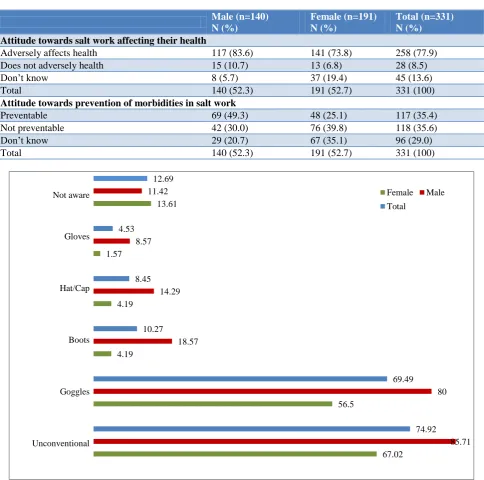
Among 331 salt workers, 42 (12.6%) were not aware of any personal protective measure (PPE) used in salt pans. Majority (74.9%) of the salt workers were aware of unconventional PPE (turban on head) used in salt work, followed by goggles (69.4%). The awareness on boots, hat and gloves were very low (10% and below). In all of these PPEs, females workers were less aware than the male salt workers (Figure 1).
Of the total 289 salt workers who were aware of PPEs, only 67 (23.2%) were willing to use them. 115 (39.8%) salt workers perceived some or the other benefit in using PPEs at work. 227 (78.6%) salt workers perceived difficulty in using PPEs at work. Males when compared to the female workers, were more willing to use PPE (31.5% versus 17%), they perceived more benefit in using in PPE (53.2% versus 29.7%) (Table 4).
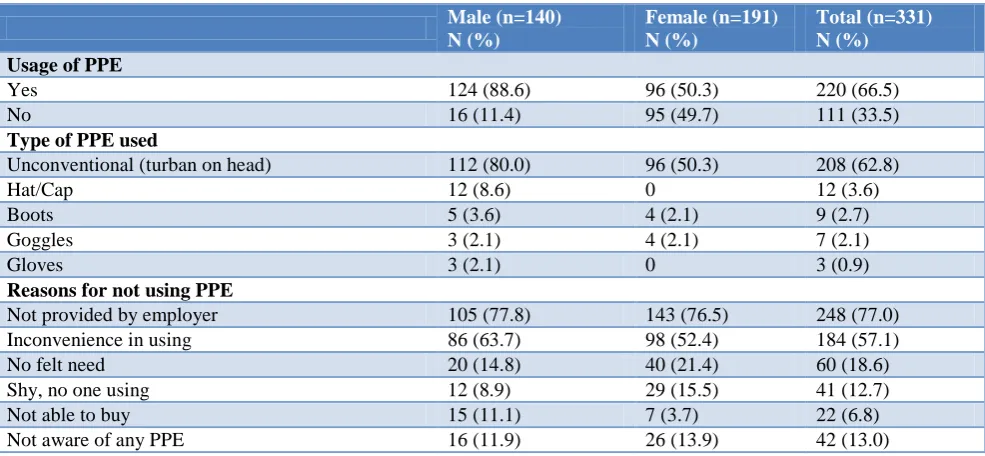
Out of 331 salt workers, 220 (66.5%) were using one or more protective measure at work which include mainly the unconventional methods (62.8%). The conventional PPEs including hat, boots and goggles were used by very few numbers of salt workers (less than 10%). Of the 322 salt workers not using conventional PPE, maximum (77%) gave reasons that PPE was not provided to them by their employers, followed by inconvenience in using (57.1%). Sixty (18.6%) salt workers did not feel the need for using PPE (Table 5).
Table 1: Socio-demographic characteristics of the surveyed salt worker (n=331).
Socio-demographic characteristics Frequency Percentage (%)
Gender Male 140 42.3
Female 191 57.7
Age (years)
20-39 144 43.5
40-59 164 49.5
≥60 23 7.0
Religion Hindu 305 92.1
Christian 26 7.9
Educational Status
Illiterate 161 48.6
Less than high school 147 44.4 High school and higher secondary 23 7.0
SES
I (Upper) 11 3.3
II (Upper middle) 24 7.3
III (Middle) 120 36.2
IV (Lower middle) 144 43.5
V (Lower) 32 9.7
Table 2: Awareness among respondents towards occupational hazards and morbidity due to salt work (multiple response).
Frequency Percentage (%)
Awareness of occupational hazards
Physical stress 234 70.7
Direct sunlight 128 38.7
Glare from salt crystals 53 16.0
Contact with salt and brine 10 3.0
Injury from salt crystals 3 0.9
Injury from spade 2 0.6
Not aware 71 21.5
Awareness of occupational morbidity
Musculoskeletal 250 75.5
Ocular morbidities 185 55.9
Giddiness and Headache 61 18.4
Chest pain 31 9.4
Gastro-intestinal 30 9.1
Dermal 23 7.0
Breathlessness 19 5.7
Hypertension 10 3.0
Injury 7 2.1
Table 3: Attitude towards effect of salt work on health and its prevention.
Male (n=140) N (%)
Female (n=191) N (%)
Total (n=331) N (%) Attitude towards salt work affecting their health
Adversely affects health 117 (83.6) 141 (73.8) 258 (77.9) Does not adversely health 15 (10.7) 13 (6.8) 28 (8.5)
Don’t know 8 (5.7) 37 (19.4) 45 (13.6)
Total 140 (52.3) 191 (52.7) 331 (100)
Attitude towards prevention of morbidities in salt work
Preventable 69 (49.3) 48 (25.1) 117 (35.4)
Not preventable 42 (30.0) 76 (39.8) 118 (35.6)
Don’t know 29 (20.7) 67 (35.1) 96 (29.0)
Total 140 (52.3) 191 (52.7) 331 (100)
Figure 1: Awareness of personal protective equipment among salt workers.
Table 4: Attitude among salt workers towards use of conventional PPEs.
Male (n=124) N (%)
Female (n=165) N (%)
Total (n=289) N (%) Willing to use PPE at work
Willing 39 (31.5) 28 (17.0) 67 (23.2)
Not willing 85 (68.6) 137 (83.0) 222 (76.8)
Any perceived benefits of using PPE at work
Yes 66 (53.2) 49 (29.7) 115 (39.8)
No 58 (46.8) 116 (70.3) 174 (60.2)
Any perceived difficulty in using PPE at work
Yes 93 (75.0) 134 (81.2) 227 (78.6)
No 31 (25.0) 31 (18.8) 62 (21.5)
67.02
85.71 74.92
56.5
80 69.49 4.19
18.57 10.27
4.19
14.29 8.45 1.57
8.57 4.53
13.61 11.42
12.69
Female Male Total
Not aware
Gloves
Hat/Cap
Boots
Goggles
Table 5: Usage of PPE among salt workers
Male (n=140) N (%)
Female (n=191) N (%)
Total (n=331) N (%) Usage of PPE
Yes 124 (88.6) 96 (50.3) 220 (66.5)
No 16 (11.4) 95 (49.7) 111 (33.5)
Type of PPE used
Unconventional (turban on head) 112 (80.0) 96 (50.3) 208 (62.8)
Hat/Cap 12 (8.6) 0 12 (3.6)
Boots 5 (3.6) 4 (2.1) 9 (2.7)
Goggles 3 (2.1) 4 (2.1) 7 (2.1)
Gloves 3 (2.1) 0 3 (0.9)
Reasons for not using PPE
Not provided by employer 105 (77.8) 143 (76.5) 248 (77.0) Inconvenience in using 86 (63.7) 98 (52.4) 184 (57.1)
No felt need 20 (14.8) 40 (21.4) 60 (18.6)
Shy, no one using 12 (8.9) 29 (15.5) 41 (12.7)
Not able to buy 15 (11.1) 7 (3.7) 22 (6.8)
Not aware of any PPE 16 (11.9) 26 (13.9) 42 (13.0)
DISCUSSION
The objective of occupational health and safety is to assure as far as possible that every working man and woman in the nation has a safe and healthy working environment so as to preserve human resources. Though this objective has been achieved to a great extent in the developed countries, developing countries still have far to go in satisfying this requirement. One of the main reasons for this is lack of awareness among workers with reference to health and safety measures.7
It is also well known that labour from low socio-economic families have to do unskilled jobs and jobs that no one else takes up because of the associated hazards related to poor environmental conditions, and therefore are exposed to more illness.8Salt work is no exception to this, as a lot of occupational hazards exist and the morbidity is also high in Marakkanam as reported by us previously.2 Only few studies have been conducted to assess the health status and KAP among salt workers.2-6
In a study involving 205 salt workers in Rajasthan, it was found that the brine (concentrated salt water) workers had a fair knowledge of occupational health problems (98.7%) and protective measures (100%) as compared to non-brine workers for whom these figures were 89% and 85.8% respectively.4 In our study, both brine and non-brine workers were taken together as all of them were involved in both brine and non-brine work of salt production. We found that the salt workers in Marakkanam were aware of the hazards at salt work like Physical stress (70.7%), direct sunlight (38.7%) and glare from salt crystals (16%). This was lesser than the Rajasthan study probably because the sample in that study was from voluntary health camps and probably included the more health aware or actually health affected
workers. A study in similar coastal areas of southern Tamil Nadu involving 598 salt workers also documented hazards similar to our study like physical stress, glare from sunlight reflected by salt crystals.5 Despite this, the salt workers still pursued to be in this occupation ignoring the hazards involved because getting work and a livelihood is more important for the workers in the unorganised sector.9
We found that the musculoskeletal problems (75.5%) followed by ophthalmic (55.9%), giddiness and headache (18.4%) were major health problems perceived. The other studies from Tamil Nadudocumented the ophthalmic and dermatological problems as major morbidities.5,6 In Rajasthan, the most common problems reported were ulcerated feet (71.8%), calloused palms (66.7%) and irritation to the eyes (61.5%).4
CONCLUSION
The extreme weather and hard labour conditions in the salt pans cause lot of morbidities among the salt workers. These morbidities are aggravated if the salt workers do not protect themselves with personal protective measures. Though most of the study population is aware of one or the other methods of protective equipment against adverse effects of working in salt pans, the actual use of PPE is very low because of non-availability and inconvenience in using them. There is a large gap between awareness and practice regarding PPE usage among these salt workers
Recommendations
Intensive IEC campaigns are needed to educate the salt workers about the adverse effects from adverse environmental conditions. Provision of adequate and safe protective equipment and devices by the employers should be ensured along with training of salt workers in adopting and proper use of personal protective equipment such as hats/caps, eye goggles, light and loose clothing, gloves and gum boots.
ACKNOWLEDGEMENTS
We would like to thank and acknowledge the support of Mr. John Sabestian of Micronutrient Initiative, the local village heads and the participants. Due acknowledgement to the field staff at Chunampet Rural Health Training centre of the Pondicherry Institute of Medical Sciences for all the support and logistics for the study.
Funding: No funding sources Conflict of interest: None declared
Ethical approval: The study was approved by the Institutional Ethics Committee
REFERENCES
1. World Health Organization. Global Health Risks: Mortality and burden of disease attributable to
selected major risks. Available at: https://www.who. int/healthinfo/global_burden_disease/GlobalHealthR isks_report_full.pdf. Accessed on 20th September 2019.
2. Cherian J, Singh Z, Bazroy J, Purty A, Natesan M, Chavada V. Study of Morbidity Pattern Among Salt Workers in Marakkanam, Tamil Nadu, India. J Clin Diag Res. 2015;9(4):LC01-03.
3. Sachdeva R, Mathur ML, Haldiya KR, Saiyed HN. Work-related health problems in salt workers of Rajasthan, India. IJOEM. 2006;10:62-4.
4. Haldiya KR, Sachdeva R, Mathur ML, Saiyed HN. Knowledge, attitude and
5. practices related to occupational health problems among salt workers working in
6. dessert of rajasthan, India. J Occup Health. 2005;47:85-8.
7. Durairaj D, Murugan S. A study on health hazards of salt workers in Tamil Nadu coastal areas. Int J Pharm Sci Rev Res. 2016;40(2):137-41.
8. Vasudevan J, Vaithiyalingam S, Anandan V, Mishra AK, Purty AJ. Common morbidities and felt needs of salt pan workers in a coastal area of Tamil Nadu, India. Int J Res Med Sci. 2019;7:805-9.
9. Parimalam P, Kamalamma N, Ganguli AK. Knowledge, attitude and practices
10. related to occupational health problems among garment workers in Tamil Nadu,
11. India. J Occup Health. 2007;49:528-34.
12. Mandal AK. Stratergies and policies deteriorate occupational health situation in India: A review based on social determinants framework. IJOEM. 2009;(13):113-20.
13. Jaiswal A, Patro BK, Pandav CS. Occupational health and safety: Role of academic institutions. IJOEM. 2006;10(3):97-101.
Cite this article as: Cherian J, Singh Z, BazroyJ, Purty AJ, Natesan M. Knowledge, attitude and practices regarding work related hazards among salt workers in Marakkanam, Tamil Nadu. Int J