Journal of Engineering Sciences, Volume 6, Issue 1 (2019), pp. F 19–F 24 F 19 JOURNAL OF ENGINEERING SCIENCES
ЖУРНАЛ ІНЖЕНЕРНИХ НАУК
ЖУРНАЛ ИНЖЕНЕРНЫХ НАУК
Web site: http://jes.sumdu.edu.ua
DOI: 10.21272/jes.2019.6(1).f4 Volume 6, Issue 1 (2019)
UDC 66.06
Hydrodynamics of a Liquid Film Downflow on a Flat Surface
in Evaporation Conditions into a Flow of Neutral Gas
Lukashov V. K.*, Kostiuchenko Y. V., Timofeev S. V.
Shostka Institute of Sumy State University, 1 Haharina St., 41100 Shostka, Ukraine
Article info:
Paper received:
The final version of the paper received: Paper accepted online:
November 22, 2018 February 25, 2019 March 1, 2019
*
Corresponding Author’s Address:
[email protected]
Abstract. The work is devoted to the study of the gravitational motion of a liquid film under evaporation condi-tions into a flow of neutral gas as applied to film machines with a plane-parallel nozzle. The aim of the work is to de-velop a mathematical model of such a process and establish its laws. The model is based on the physical concepts of a liquid film flowing down a flat surface heated from outside under the assumption that the film flows in isothermal conditions under steady-state laminar mode without wave formation and in the absence of friction between the gas and the film. The mathematical description of the film flow down process in these conditions includes the equation of motion and the continuity equation for the liquid film, which are supplemented by the equations of mass transfer, the material balance of the gas phase in the evaporated liquid, the relative content of the vaporized substance in the gas phase and the equation expressing the Dalton’s law. As a result of solving this system of equations, dependencies are obtained that make it possible, at known values of the mass transfer coefficient in the gas phase, to carry out calcula-tions and simulate the hydrodynamics of the liquid film flow under condicalcula-tions of evaporation into a flow of neutral gas. For the water-to-air system, regularities were established in which the film thickness and speed of movement along the surface height were varied for different types of film interaction with the air flow: forward flow, backflow, and cross-flow, as well as with different hydrodynamic and temperature conditions of its flow down under cross in-teractions conditions of the flows. It has been shown that in all cases a decrease in the thickness and speed of move-ment of the film is observed, with the largest decrease occurring during cross-interaction, which is associated with an intense removal of the resulting vapor from the film surface. The developed mathematical model can be used to eval-uate the operating modes of film machines with a plane-parallel nozzle.
Keywords: film machine, plane-parallel nozzle, cross-interaction, film thickness, mass transfer coefficient, evapora-tion rate.
1
Introduction
Film machines, whose operation is based on the gravi-tational flow of a liquid, are widely used for heat and mass transfer processes in the “liquid – gas (vapor)” sys-tem. Many of these processes are accompanied by evapo-ration of the liquid. Introducing a neutral (inert) gas flow with respect to the liquid into the machineand evaporat-ing the liquid into it allows the temperature of such pro-cesses to be reduced. This also makes promising the use of film machine with a neutral gas flow for example for the concentration of aqueous solutions of non-volatile liquids (sulfuric acid, glycerin, etc.). Special interest in this case are film apparatuses with flat-sheet nozzles, which allow you to organize cross-phase movement, which makes it possible to increase the driving force of the process at high density irrigation nozzles. However,
the theory of such a process has not been developed suf-ficiently, which makes it difficult to carry out engineering calculations of these apparatuses. The aim of this work is to develop a mathematical model and establish on its basis the laws of the liquid film flow down over a flat surface in the conditions of evaporation into a flow of neutral gas.
2
Literature Review
F 20 CHEMICAL ENGINEERING: Processes in Machines and Devices hydraulic resistance, small residence time of liquid in the
machine, which is important for thermolabile materials. Depending on the design of the machine, a film may form on the surface of different geometries, for example, a number of papers deal with the liquid film flowing down along the inner surface of vertical pipes, the outer surface of horizontal pipes or on surfaces of other geome-try (half cylinder, cone, plate) [2–4]. Promising from the point of view of the organization of heat and mass trans-fer processes is the liquid film flow down on a flat sur-face [5, 6]. Such a fluid flow is described by equations of motion and continuity which have the following forms:
(1)
, 0
z u y
u (2)
where ρl− the density of the liquid, kg/m3; μl− the d
y-namic viscosity of the liquid, H∙s/m2
; u −component of the liquid rate in the direction of the film flowing, m/s; g – gravitational acceleration, m/s2, y − transverse coor-dinate, z − longitudinal coordinate in the direction of the film flow down.
Liquid evaporation from a film to a neutral gas has features that must be taken into account when developing film machines. The introduction of a neutral gas into the liquid-vapor system leads to the fact that during evapora-tion, conditions close to the action of vacuum are achieved and accordingly allows the process to be carried out at a lower temperature [7]. The effectiveness of such machines increases with evaporation into a neutral gas flow, which also serves as the carrier of the resulting vapor [8, 9]. At the same time, along with the gas flow rate, the nature of the interaction of the gas flow with the flowing down liquid film also influences the liquid evap-oration from the film. It can be forward flow, backflow or cross-flow. This can be quite easily organized using a plane-parallel nozzle [10].
However these questions were not sufficiently devel-oped and therefore the following tasks were set to achieve the objectives of this work:
– developing a mathematical model and, on its basis, an algorithm for calculating hydrodynamics of the liquid film flow down on a flat surface under the evaporation conditions into a neutral gas flow;
– using the developed model to establish the effect of the interaction nature of the neutral gas flow with a liq-uid film, as well as regime parameters on the change in the thickness and movement rate of the film.
3
Research Methodology
3.1
The mathematical description of the
process
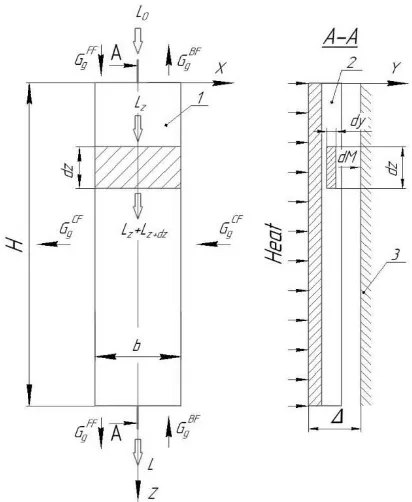
A mathematical model of the liquid film downflow under the conditions of evaporation into a flow of neutral gas was developed on the basis of the scheme presented in Figure 1.
Figure 1 − Calculation scheme for the liquid film flow down:
1 − surface; 2 − film; 3 − bounding wall
According to this scheme the film of liquid 1 moves under the action of gravity along a vertical surface 2, uniformly heated from the outside. With this heating, the heat from the surface is transferred to the liquid, as a result of which the liquid evaporates into the space bounded by the wall 3. A flow of neutral gas enters this space, which traps liquid vapor and carries it outside the surface. Suggesting that the liquid film flow occurs under isothermal conditions, we assume that the temperature of the liquid is constant and equal in the entire volume of the film. Considering the movement of the film at a sufficient distance from the upper edge of the surface, we take it steady and occurring in a laminar mode without wave formation. In this case, the friction between the gas and the liquid, as well as the change in pressure along the height of the surface, is neglected.
Under these conditions, the change in the film thick-ness of the liquid δ and the speed of the film u along the Z axis (surface height) were determined, while the values along the X axis (surface width) were assumed to be un-changed.
The equation of motion of the liquid film (1) can be obtained by considering the selected element in it with the volume bdydz (section A–A in Figure 1). Expressing the frictional forces arising from the movement of liquid on the front and rear faces of an element, through shear stresses, and also using the basic principle of dynamics, the continuity equation in evaporation conditions will differ from equation (2).
Journal of Engineering Sciences, Volume 6, Issue 1 (2019), pp. F 19–F 24 F 21 where u is the velocity of the film (average
liquidvelocity in the cross section of the film), m/s; δ −
film thickness, m. We believe that changes in the mass flow of a liquid occur due to its evaporation through the surface bdz of the front face of the element. At the same time, the evaporation through the surfaces of its left and right faces is neglected. Then the mass flow of liquid turning into vapor is equal to
(3) This flow can be expressed as
(4) where w is the evaporation rate (specific vapor flow), kg/(m2·s).
Substituting the dependence (4) into (3) and express-ing the mass flows through their components, we obtain the continuity equation in the following form
(5) Equations (1) and (5) are complemented by the follow-ing dependencies:
1) the mass transfer equation from the film surface: (6) where M − the mass of the resulting steam, kg; β − mass transfer coefficient to the gas phase, kg/(m2·s·Pa); Psv − the saturated vapor pressure of the evaporated li q-uid, Pa; Pv − partial vapor pressure in the gas phase, Pa; F – evaporation surface, m2; τ − time, s;
2) material balance equation for gas phase of evapo-rated liquid:
(7) where Gg is the neutral gas flow (indices in Figure 1: FF − forward flow; BF − backflow; CF – cross flow), kg/s; dg, dg0− the current and initial relative contents of the moisture content of the evaporated substance in a neutral gas, kg/kg;
3) the equation of the relative content of the evapo-rated substance in the gas phase, which is written on the basis of the Clapeyron equations of state for vapor and neutral gas:
(8) where mv, mg are the molar masses of evaporated sub-stance and neutral gas, kg/kmol; Pg− the partial pressure of a neutral gas in the gas phase, Pa;
4) an equation expressing Dalton’s law:
(9) The presented system of equations (1), (5)–(9) de-scribes the hydrodynamics of the flow down of a liquid film over a flat surface under the conditions of evapora-tion of a liquid into a neutral gas flow.
3.2
Equations solution and calculation
algorithm
To solve the equations of motion we use the following approach. If it is assumed that the evaporation of a liquid from the free surface of the film does not affect the distri-bution profile of the local liquid velocity along the Y axis (in cross sections of the film), then under boundary con-ditions y = 0, u = 0 and y = δ, ∂u/∂y = 0 (there is no fric-tion force on the free surface of the film) it can be used the classical solution of the equation of motion:
Accordingly by averaging the velocity of the liquid over its volume passing per unit time through the cross section of the film we obtain the dependence for deter-mining the velocity of the film
(10) The quantity u in equation (5) is a linear (referred to the wetted surface width) watering volume, m2/s.
Turn-ing to the linear waterTurn-ing mass Г = ρl(u), we integrate equation (5) in the range from z = 0 to the current z and
from Г = Г0to the current value of Г. As a result, consid-ering the dependence (10), we have
,3
3 0
2 wz
g
l
l
(11)
where Г0 = L0/b is the initial linear watering mass, kg/(m∙s); L0 is the initial mass flow of the liquid, kg/s.
Expressing the evaporation rate as
from equation (6) we have
(12) From equations (8) and (9) we get
(13) Equating the left sides of equations (6) and (7), after the appropriate transformations with regard to depend-ence (13), we obtain the quadratic equation
F 22 CHEMICAL ENGINEERING: Processes in Machines and Devices 1) forward flow:
2) backflow:
3) cross-flow:
The positive real root of equation (14) is the value of the relative content of the vaporized substance in the gas phase (moisture content for water).
Obtained as a result of solving the system of equations of the above mathematical description of dependencies (10)–(14) allow for known values of the mass transfer coefficient β to carry out calculations and modeling of hydrodynamics of a liquid film flowing down a flat sur-face under conditions of evaporation into a neutral gas flow. The initial data for the calculation are the following values: v − velocity of neutral gas, m/s; L0− the initial mass flow of the liquid , kg/s; b − surface width, m; H − surface height, m; ∆− the distance from the surface to the bounding wall, m; tl − liquid temperature, − the initial temperature of the neutral gas, °C; ta− the ambient temperature, °C; φa − the relative content of the evapo-rated substance in the environment, %; B − atmospheric pressure, Pa.
The calculation is carried out in accordance with the following algorithm.
1) take the temperature of the gas phase is equal to
2) using reference data, the tg value is used to deter-mine the kinematic viscosity of the neutral gas vg and the vapor diffusion coefficient to-neutral gas necessary to calculate the mass transfer coefficient β, and also Pvs. By value tl we determine the values ρl and μl, by value tl we determine the values ρl and μl, by value of ta is deter-mined by the value of the partial vapor pressure in the environment Pa. Next, using the known formulas, we calculate the values of the content of the evaporated sub-stance in the environment da and the specific volume of the environment containing this substance γa;
3) calculating the volume flow rate of neutral gas for forward flow and backflow:
for the cross-flow
and its mass flow
4) setting the values of the longitudinal coordinate from z = 0 to z = H, for each value we calculate:
– the relative content of the vaporized substance in the gas phase dg according to equation (14), having previous-ly determined the coefficient p and the free term q for a specific type of the phases interaction;
– partial vapor pressure of this substance in the gas phase Pv according to equation (13);
– evaporation rate w according to equation (12);
– film thickness δ according to equation (11);
– film speed u according to equation (10).
According to the results of the calculation, we estab-lish the change in the thickness and speed of movement of the film along the height of the surface.
4
Results
The study of the regularities of the liquid film flow down on a flat surface under the conditions of evapora-tion into a flow of neutral gas was carried out using the calculation algorithm described above. In this case, water was taken as a liquid, and air was taken as a neutral gas. The necessary data for calculating the mass transfer
coef-ficient β was determined by the well-known empirical formula of Gilliland and Sherwood [11]. The results were presented in the form of dependences of the change in film thickness and speed on the surface height with dif-ferent types of film interaction with air flow: forward flow, backflow and cross flow, as well as various hydro-dynamic and temperature regimes of its flowing down under cross-interaction conditions.
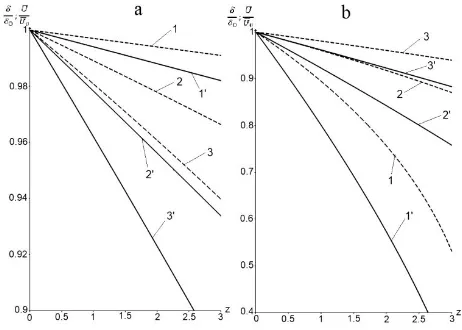
The analysis of these dependences shows that the film thickness and the rate of its flow down in all cases de-crease along the surface height as a result of the water evaporation. From a comparison of these dependences with a different character of film interaction with the air flow (Figure 2), it follows that the decrease in film thick-ness and speed during cross-interaction is comparable with the backflow and even slightly exceeds it.
Such a feature of cross-flow interaction is associated with the rapid removal of vapor from the film surface, which reduces its partial pressure in the air flow through-out the film’s movement path and, accordingly, increases the driving force of the evaporation process.
in-Journal of Engineering Sciences, Volume 6, Issue 1 (2019), pp. F 19–F 24 F 23 tense decrease in the film thickness and speed with
in-creasing air rate, which is associated with an increase in the mass transfer coefficient and, accordingly, evapora-tion rate. With an increase in the mass flow of water en-tering the film, a decrease in the thickness and speed of movement of the film, on the contrary, is less intense.
The study of the effect of temperature regimes on the regularities of the film flow down was carried out in the absence of water boiling in the film (tl < 100 °C).
Figure 2 − Effect of the nature of the interaction of the water
film with the air flow on thickness changes (dotted lines) and the speed of movement (solid lines) of the film (tl = 80 C;
tl0 = 20 °C; v = 10 m/s; L0 = 0.005 kg/s): 1, 1/– forward
flow; 2, 2/– backflow; 3, 3/− cross-flow
Figure 3 − Influence of hydrodynamic regimes of the flow
down process of a water film on the change in its thickness (dotted lines) and speed of movement (solid lines) during cross
flow interaction: a − flow rates (tl = 80 °C; L0 = 0.005 kg/s;
tg0 = 20 °C): 1, 1 /−
v = 1.0 m/s; 2, 2/− v = 5.0 m/s; 3, 3/− v = 10 m/s; b − the initial mass flow of water (tl = 80 °C; v = 10.0 m/s; tl0 = 20 °C): 1, 1
/−
L0 = 0.001 kg/s;
2, 2/− L0 = 0.0025 kg/s; 3, 3/− L0 = 0.005 kg/s
Calculations show that in this case, an increase in both the water temperature in the film and the temperature of air supplied to the evaporation surface leads to a more intensive decrease in the thickness and movement speed of the film (Figure 4).
It was established that with significant initial air tem-peratures (tg0 > 100 °C) complete water evaporation can be achieved (Figure 4 b). This is due to the increase in the saturated vapor pressure and accordingly the evaporation rate in accordance with equation (11).
Figure 4 - Influence of temperature regimes of the flow down process of a water film on the change of its thickness (dotted lines) and movement speed (solid lines) during cross flow interaction: a − liquid temperature (v = 10 m/s; L0 = 0.005 kg/s;
tg0 = 20 °C): 1, 1/− tl = 20 °C; 2, 2/− tl = 50 °C;
3, 3/− tl = 80 °C; b − gas temperature (tl = 80 °C; v = 10 m/s;
L0 = 0.005 kg/s): 1, 1/–tg = 20 °C; 2, 2/–tg = 50 °C; 3, 3/–tg = 100 °C; 4, 4
/–
tg = 150 °C
5
Conclusions
On the basis of the developed mathematical model, hydrodynamic regularities of a liquid film flowing down along a flat surface are established considering evapora-tion into a neutral gas flow. These regularities include the influence of the nature of the neutral gas flows interaction with a liquid film, as well as regime parameters on the change in film thickness and speed. It is shown that the film thickness and motion speed of the film decreases most intensively with cross-flow interaction. The intensi-ty of the decrease in the thickness and speed of move-ment of the film along the surface height increases with an increase in the velocity of the neutral gas, and with an increase in the flow velocity of the liquid decreases. With a significant temperature of neutral gas (tg0 > 100 °C) at a certain height of the surface, complete evaporation of the liquid is achieved.
F 24 CHEMICAL ENGINEERING: Processes in Machines and Devices
References
1. Olevsky, V. M., Ruchinsky, V. R., et al. (1988). Film heat and mass exchange equipment. Moscow, Chemistry [in Russian]. 2. Fujita, I., & Hihara, E. (2005). Heat and mass transfer coefficients of falling-film absorption process. International Journal of
Heat and Mass Transfer, Vol. 48(3), pp. 2779–2786, doi: 10.1016/j.ijheatmasstransfer.2004.11.028.
3. Narvaez-Romo, B., & Simoes-Moreira, J. R. (2017). Falling liquid film evaporation in subcooled and saturated water over hori-zontal heated tubes. Heat Transfer Engineering, Vol. 38(3), pp. 361–376, doi: 10.1080/01457632.2016.1189275.
4. Danilov, Yu. V., & Gavrilichenko, I. G. (2013). Evaporation during the gravitational motion of the film of a solution. Bulletin of NTU “KhPI”, No. 55(1028), pp. 148–153 [in Russian].
5. Kuznetsov, V. V., Vitovskiy, O. V., & Krasovsky, V. A. (2007). Experimental study of flow regimes during the evaporation of a liquid on a vertical heating surface. Thermal Physics of High Temperatures, Vol. 45(1), pp. 77–84 [in Russian].
6. El Haj Assad, M., & Lampinen, M. J. (2002). Mathematical modeling of falling liquid film evaporation process. International Journal of Refrigeration, Vol. 7, pp. 985–991, doi: 10.1016/S0140-7007(01)00064-0.
7. Serafimov, L. A., & Frolkova, A. V. (2008). Observance of the first law of Konovalov in the process of rectification with inert gas. Review of MITHT, Vol. 3(2), pp. 45–52 [in Russian].
8. Tsay, Y. L., & Lin, T. F. (1995). Evaporation of a heated falling liquid film into a laminar gas stream. Experimental Thermal and Fluid Science, Vol. 11(1), pp. 61–71, doi: 10.1016/0894-1777(94)00112-L.
9. Mohamed, A. B., Orfi, J., Debissi, C., & Ben Nasrallah, S. (2005). The evaporation of a liquid film into a humid air stream un-der mixed convection condition along a vertical channel and the inversion temperature. International Journal of Heat and Tech-nology, Vol. 23(2), pp. 101–108.
10. Gorodilov, A.A. (2016). Intensification of the process of heat and mass transfer in contact apparatus with a regular nozzle. Ph.D. Thesis, MSTU MAMI [in Russian].
11. Ramm, V. M. (1966). Gas absorption. Moscow, Chemistry [in Russian].
Гідродинаміка стікання плівки рідини по плоскій поверхні
в умовах
випаровування
у
потік нейтрального газу
Лукашов В.К., Костюченко Є.В., Тимофіїв С.В.
Шосткінський інститут Сумського державного університету, вул. Гагаріна, 1, 41100, м.Шостка, Україна
Анотація.Робота присвячена дослідженню гравітаційного руху плівки рідини в умовах випаровування у
потік нейтрального газу для застосування у плівкових апаратах із плоскопаралельною насадкою. Метою роботи є розробка математичної моделі такого процесу і встановлення його закономірностей. За основу
моделі обрано фізичні закономірності стікання плівки рідини уздовж нагрітої ззовні плоскої поверхні за припущень, що стікання плівки відбувається в ізотермічних умовах при сталому ламінарному режимі без хвилеутворення та завідсутності тертя між газом і плівкою. Математичнамодель процесу стікання плівки в цих умовах містить рівняння руху і нерозривності плівки рідини, доповнені рівняннями масовіддачі, матеріального балансу газової фази за випаровуваноюрідиною, відносного вмісту випаровуваної речовини у газовій фазітарівняннямзаконуДальтона. Урезультаті розв’язання системи рівнянь отримано залежності, що дозволяють (за відомих значень коефіцієнта масовіддачі у газову фазу) здійснювати розрахунки і
моделювати гідродинаміку стікання плівки рідини за умов випаровування у потік нейтрального газу. Для системи «вода–повітря» були встановлені закономірності зміни товщини і швидкості руху плівки по висоті поверхні за різного характеру взаємодії плівки з потоком повітря (прямоточного, протитечійного і
перехресного), а також за різних гідродинамічних і температурних режимівїї стікання в умовах перехресної взаємодії потоків. Показано, що для всіх випадків спостерігається зменшення товщини ташвидкості руху плівки, причомунайбільше зменшення відбувається при перехресній взаємодії, що пов’язано з інтенсивним відводом утворюваної пари від поверхні плівки. Розроблена математична модель може бути використання для оцінюваннярежимів роботи плівкових апаратів із плоскопаралельною насадкою.
Ключові слова: плівковий апарат, плоскопаралельна насадка, перехресна взаємодія, товщина плівки,