Original Research Article
Assessment of unmet need for family planning and its determinants
in a rural block of Haryana
Srishti Singh
1*, Meenakshi Kalhan
1, J. S. Malik
1, Anuj Jangra
1,
Nitika Sharma
1, Srijan Singh
2INTRODUCTION
Every day about 830 women die from preventable causes related to pregnancy and childbirth. 99% of these maternal deaths occur in developing countries.1 Pregnancies that occur too early, too late or too frequently can lead to illness during pregnancy and complications at the time of birth. When these pregnancies result in births, they contribute to higher fertility rates and population growth.2
Unmet need for family planning is a valuable concept that is widely used for advocacy, development of family planning policies, implementation and monitoring of
family planning programmes worldwide. Women with unmet need are those who are fecund and sexually active but are not using any method of contraception, and report not wanting any more children or wanting to delay the next child.3 Once derived, the figure of unmet need for family planning can be broken down into unmet need for spacing (women who want a child after two or more years) andunmet need for limiting (women who want no more children).
It has been estimated that there are 225 million women in the world who want to use safe and effective family planning methods but are unable to do so because they lack access to information, services, or the support of
ABSTRACT
Background: Unmet need represents the gap between women’s reproductive intentions and their contraceptive behavior. Meeting the unmet need for family planning would help to reduce the mortality and morbidity from unwanted pregnancies. Objectives of the study were to assess the unmet need for family planning and its determinants among married rural women.
Methods: The present study was community based cross-sectional study conducted in rural area of Haryana from September 2015 to August 2016 among 500 currently married women (18-49 years).
Results: The unmet need for family planning was 19.2% (4.8% spacing and 14.4% limiting). Education, occupation and desirable number of children were significantly associated with unmet need for family planning. The commonest reason for not using contraception among those with unmet need was fear of side-effects (37.5%) followed by in-laws disapproval (21.9%) and others.
Conclusions: The unmet need for family planning was high. Women’s education and empowerment by protecting their health, wellbeing and rights, including their reproductive rights would prove to be beneficial.
Keywords: Unmet need, Contraceptives, Family planning, Education
1
Department ofCommunity Medicine, Pt. B. D. Sharma PGIMS, Rohtak, Haryana, India
2
Department of Pediatrics, Maulana Azad Medical College, New Delhi, India
Received: 22 February 2018
Accepted: 21 March 2018
*Correspondence:
Dr. Srishti Singh,
E-mail: [email protected]
Copyright: © the author(s), publisher and licensee Medip Academy. This is an open-access article distributed under the terms of the Creative Commons Attribution Non-Commercial License, which permits unrestricted non-commercial use, distribution, and reproduction in any medium, provided the original work is properly cited.
their partners or communities. Most of these women with an unmet need for contraceptives live in 69 of the poorest countries on earth.4
Unmet need has received an unprecedented level of scrutiny since it is included in Millennium Development Goals as target 5.6 i.e. Achieve, by 2015, universal access to reproductive health.5 Recently the Sustainable Development Goals have also focused on reproductive health issues and gender equity in its target 3.7 and 5.6.6
In 2015, 57% of married or in-union women of reproductive age used a modern method of family planning while the unmet need was reported as 12%.5 According to NFHS-3, the unmet need for family planning for India was 12.8% including 6.2% for spacing and 6.6% for limiting.7 NFHS-4 Haryana reported it as 9.3% (3.8% for spacing and 5.5% for limiting).8
Unmet need represents the gap between women’s reproductive intentions and their contraceptive behavior. Increasing access to family planning is a cost-effective intervention that would reduce maternal and newborn health related costs by US$11.3 billion annually apart from averting 19 million unsafe abortions and 29% maternal deaths.9,10 With these issues in background, this study was planned with the aim to assess the unmet need for family planning and its determinants among women in rural areas.
METHODS
Study design
Community based cross-sectional study.
Study area
Rural area of block Lakhan Majra of district Rohtak (Haryana).
Study subjects
Currently married women in the reproductive age group (18-49 years), residing in the study area for more than one year and consenting to participate in the study. All
those women who were affected with any
critical/terminal illness or other co-morbid conditions were excluded.
Study period
One year (September 2015 to August 2016).
Sample size
Assuming the prevalence of unmet need for family planning as 28.8% (as per DLHS-4 Rohtak) and allowable error of 15% at level of significance of 95%,
and using the formula N=4pq/E2, the calculated sample size (N) was 440 but for the purpose of the study, a sample size of 500 eligible subjects was taken.11
Sampling technique
Out of the 20 subcentres under a CHC, 10 subcentres were randomly selected. The sample size of 500 subjects was equally divided and thus, 50 study subjects were selected from each subcentre by systematic random sampling.
Study tool
Pre-designed, pretested and semi-structured interview schedule. Data analysis was done using MS Excel 2007 and SPSSv20.0. Appropriate statistical tests were applied.
RESULTS
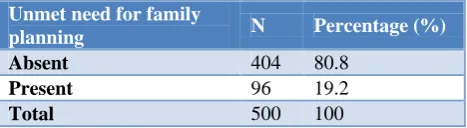
Table 1: Distribution of study participants according to unmet need for family planning.
Unmet need for family
planning N Percentage (%)
Absent 404 80.8
Present 96 19.2
Total 500 100
Table 1 shows that 96 participants (19.2%) had unmet need for family planning out of which 24 participants had unmet need for spacing (4.8%) while 72 participants had unmet need for limiting (14.4%).
Table 2: Reasons for unmet need for family planning (n=96).
Reasons for unmet need
for family planning N Percentage (%)
Husband’s disapproval 8 8.3
Lack of knowledge 12 12.5
Fear of side-effects 36 37.5
Inconvenient to use 19 19.8
In-laws disapproval 21 21.9
Total 96 100
Among the participants with unmet need for family planning, the commonest reason for not using contraception was fear of side-effects (37.5%) followed by in-laws disapproval (21.9%) and other reasons (Table 2).
Unmet need for family planning was highest among 35-44 years (20.7%), illiterates (29.1%), labourers (50%)
and lowest among those who desire to have two children (16%) (Table 3).
Table 3: Distribution of unmet need for family planning according to various determinants.
Variables Unmet need for family
planning absent
Unmet need for family planning present
Age group (years)
18-24 109 (81.3) 25 (18.7) χ2
- 2.745, df-3, p=0.433
25-34 201 (79.8) 51 (20.2)
35-44 69 (79.3) 18 (20.7)
45-49 25 (92.6) 2 (7.4)
Educational status
Illiterate 73 (70.9) 30 (29.1)
χ2
- 13.442, df-4, p=0.009
Primary 79 (81.4) 18 (18.6)
Middle 72 (76.6) 22 (23.4)
High school 141 (87) 21 (13)
Graduate and above 39 (88.6) 5 (11.4)
Occupation
Housewife 369 (81.6) 83 (18.4) χ2
- 21.331, df-2, p<0.01
Labourer 13 (50) 13 (50)
Service 22 (100) 0 (0)
Desirable number of children
1 17 (63) 10 (37) χ2
- 10.205, df-2, p=0.006
2 295 (84) 56 (16)
3 or more 92 (75.4) 30 (24.6)
(Figures in parentheses represent percentage)
Table 4: Independent association of various variables with unmet need for family planning.
Variables cOR (95% C.I.) aOR (95% C.I.) P value
Education
Illiterate Reference 0.638
Primary 0.554 (0.285-1.078) 0.711 (0.342-1.478) 0.360
Middle 0.744 (0.392-1.409) 0.940 (0.459-1.923) 0.865
High school 0.362 (0.194-0.677) 0.596 (0.287-1.238) 0.165
Graduate and above 0.312 (0.112-0.868) 0.774 (0.243-2.463) 0.665
Occupation
Housewife Reference 0.001
Labourer 4.446 (1.988-9.942) 2.817 (1.133-7.007) 0.026
Service 0.008 (0.005-0.011) 0.004 (0.003-0.007) 0.998
Socio-economic status (according to Udai Pareek’s socio-economic scale)
Upper Reference 0.716
Upper Middle 0.003 (0.002-0.006) 0.005 (0.001-0.008) 1.000
Lower middle 0.319 (0.128-0.797) 0.764 (0.264-2.216) 0.621
Upper lower 0.274 (0.131-0.571) 0.636 (0.271-1.495) 0.300
Lower 0.382 (0.198-0.733) 0.664 (0.318-1.385) 0.275
Number of daughters
0 Reference 0.013
1-2 1.940 (1.102-3.413) 2.330 (1.245-4.362) 0.008
3 or more 3.575 (1.624-7.869) 3.373 (1.320-8.623) 0.011
Knowledge regarding contraception
Absent Reference
Present 0.200 (0.107-0.374) 0.233 (0.113-0.479) 0.000
Concordance between husband and wife regarding number of children
No Reference
Yes 0.281 (0.143-0.549) 0.260 (0.123-0.551) 0.000
On applying binary logistic regression, it was found that the odds of having unmet need for family planning in the
engaged in service had lower odds of unmet need for family planning.
It was reported that as the number of daughters increased, the odds of having unmet need for family planning increased. Women who knew about contraception had lower odds of having unmet need for family planning (aOR=0.233: C.I.-0.113-0.479) in comparison to those who did not know about contraception. Among the couples with concordance regarding number of children, there were lesser chances of unmet need for family planning (aOR=0.260: C.I.-0.123-0.551) in comparison to discordant couples. Thus, it can be concluded that knowledge regarding contraception and concordance between husband and wife regarding number of children had a protective effect on unmet need for family planning (Table 4).
DISCUSSION
Our study reported that the total unmet need for family planning was 19.2% comprising of 4.8% and 14.4% as unmet need for spacing and limiting respectively. The MDG Report 2015 and NFHS-3 India reported it to be around 12% approximately.5,7 Our study reported a higher level of unmet need for family planning in comparison to worldwide and Indian data possibly because of regional differences and a smaller sample size. Our study reported a higher level of unmet need for family planning in comparison to NFHS-4 Haryana but lower as regards to DLHS-4 Rohtak which may be because of the fact that our study was restricted to rural population in a single block of Haryana.8,11 Rasheed et al from Uttar Pradesh, Chaudhary et al from Rajasthan and Rajkumari et al from Manipur reported the unmet need for family planning as 25.9%, 31.15% and 23.9% respectively.12-14 Mathews et al from Kerala reported a lower (8%) unmet need for family planning in comparison to our study.15 It could be so because women in the southern states literate and enjoy more reproductive rights.
Our study reported that unmet need for family planning was highest in 35-44 years age group (20.7%). Rasheed et al concluded that women below 35 years of age had higher unmet need for family planning in comparison to those above 35 years (p value <0.001).12
In our study it was observed that as the educational status improved, the unmet need for family planning decreased (p= 0.009). Relwani et al reported that that those who were educated below senior secondary level had 27% unmet need for family planning while those educated above senior secondary had 11% (p value <0.001) which is similar to our study findings.16 Vohra et al from Rajasthan reported that unmet need for family planning was comparatively lower in better educated study subjects as compared to those less educated.17 It may be concluded that women education and empowerment by protecting their health, wellbeing and rights, including
their reproductive rights would greatly reduce the burden of unmet need for family planning.
Our study reported that the unmet need for family planning was highest among labourers (50%) followed by housewives (18.4%) (p<0.01). Pal et al found that unmet need for family planning was 66.3% among non-working/housewives and 51.9% among working subjects (p = 0.046).18 Kumar et al found that the odds of having unmet need for family planning in working subjects was lower (aOR:0.990 C.I. 7.17-0.27) as compared to the non-working subjects.19 It was also found in our study that the unmet need for family planning was highest among lower SES (38%) possibly because of inadequate access to the contraceptive methods. Vohra et al had also made similar observations.17
It was reported that the unmet need for family planning was lowest among those who desire to have two children (16%) in comparison to those who desire a larger family size. Kumar et al reported that working women desired to have lesser children in comparison to those non-working (p<0.05).20 Thus a favourable attitude towards desirable family size (i.e. ≤2) shows the inclination towards the adoption of family planning methods. Our study reported that unmet need for family planning was high among those who had more daughters (p=0.004). This may be because of a strong preference for sons in Northern India. It has been seen that those women who had already borne their desired number of sons would like to restrict childbearing and adopt use of contraceptive methods while those with daughters only might not have achieved their desired family composition thus, not so receptive to the use of family planning measures.
Shrivastava et al found that the odds of having unmet need for family planning was around six times (aOR=6.22 C.I.-3.456-11.17) among those whose husbands had a discouraging behavior towards contraceptive methods as compared to those who encouraged.21 Our study had also reported similar findings.
Our study found that the commonest reason for non-usage of contraceptive methods was fear of side-effects (37.5%) followed by in-laws disapproval (21.9%). Patel et al in their study found that lack of knowledge (55%) and ignorance (25%) as the common reasons.22 Wasnik et al had also reported similar findings.23
CONCLUSION
aware about family planning methods which requires commitment on the part of different sectors like health, education and mass media. Encouraging spousal communication and male participation in family planning is important in bridging the gap between met and unmet need.
Funding: No funding sources Conflict of interest: None declared
Ethical approval: The study was approved by the Institutional Ethics Committee
REFERENCES
1. World Health Organization. Maternal Mortality. WHO Factsheet N0348. Geneva: World Health Organization; 2015 Nov. [Internet]. Available at: http://www.who.int/mediacentre/factsheets/fs348/e. Accessed 10 January 2018.
2. United Nations Population Fund, World Health Organization. National level monitoring of the Achievement of universal access to reproductive health. Geneva, Switzerland: World Health Organization; 2008. [Internet] Available at: https://www.who.int>publication>monitoring. Accessed 10 January 2018.
3. World Health Organization. Sexual and
Reproductive Health. Unmet need for family planning. Geneva: World Health Organization;
2013. [Internet] Available at:
http://www.who.int/reproductive
health/topics/family_planning/unmet_need_fp/en. Accessed 10 January 2018.
4. World Health Organization. Family Planning. WHO
Factsheets N0351. Geneva: World Health
Organization; 2015 May. [Internet] Available at: http://www.who.int/mediacentre/factsheets/fs351/e. Accessed 10 January 2018.
5. United Nations. The Millennium Development Goals Report 2015. New York: United Nations;
2015. [Internet] Available at:
https://www.un.org>MDG2015rev (July1).
Accessed 10 January 2018.
6. United Nations. Transforming our world: The 2030 agenda for sustainable development. New York: United Nations; 2015 [Internet] Available at: https://sustainabledevelopment.un.org?post2015/tra nsformingourworld. Accessed 10 January 2018. 7. International Institute for Population Science (IIPS)
and Macro International. National Family Health Survey (NFHS-3), 2005-2006, India: Key Findings.
IIPS, Mumbai. [Internet] Available at:
https://dhsprogram.com>FRIND3-Vol2. Accessed 10 January 2018.
8. International Institute for Population Science (IIPS) and Macro International. National Family Health Survey (NFHS-4), 2015-16, India, Haryana: Key Findings. IIPS, Mumbai. [Internet] Available at: https://www.rchiips.org>pdf>NFHS4>HR_Factshee t. Accessed 10 January 2018.
9. World Health Organization. Family Planning. WHO
Factsheets N0351. Geneva: World Health
Organization; 2015 May. [Internet] Available at: http://www.who.int/mediacentre/factsheets/fs351/en . Accessed 10 January 2018.
10. Prata N, Sreenivas A, Vahidnia F, Potts M. Saving maternal lives in resource-poor settings: Facing reality. Health Policy (Amsterdam, Netherlands). 2009;89(2):131-48.
11. International Institute for Population Science (IIPS) and Macro International. District Level Household and Facility Survey 4: Fact Sheet, Rohtak. IIPS, Mumbai. 2012-13 [Internet] Available at: https://nrhm-mis.nic.in>Haryana>Rohtak. Accessed 10 January 2018.
12. Rasheed N, Khan Z, Khalique N, Siddiqui AR, Hakim S. Unmet need of contraception among married women of reproductive age group in Uttar Pradesh, India. Int J Med Health Sci. 2016;5(1):14-9.
13. Choudhary K, Shekhawat K, Kumawat R. Unmet need for family planning methods in a rural settings:A cross sectional study. IJSAR. 2015;2(3):41-5.
14. Rajkumari B, Nula P, Longjam U. Contraceptive uptake and its determinants and unmet need for contraception amongst women in an urban Muslim community: A cross-sectional study. J Med Soc. 2013;27:181-6.
15. Mathew AA, Saju CR, Catherin N. Family planning practices among married women of reproductive age group in a rural area in Thrissur district, Kerala, India. Int J Curr Res Aca Rev. 2015;3(11):36-41. 16. Relwani NR, Saoji AV, Kulkarni M, Kasturwar N,
Zade R, Wadke R. Revealing unmet need for contraception among married women in an urban slum of Nagpur. Int J Med Sci Public Health. 2015;4(8):1136-40.
17. Vohra R, Vohra A, Sharma S, Rathore MS, Sharma BN, Sharma MP. Determinants of the unmet need for family planning among women of Jaipur, Rajasthan. Int J Adv Med Res. 2014;1:20-5.
18. Pal A, Mohan U, Idris MZ, Masood J. Factors affecting unmet need for family planning in married women of reproductive age group in urban slums of
Lucknow. Indian J Community Health.
2014;26(1):44-9.
19. Kumar A, Singh A. Trends and determinants of unmet need for family planning in Bihar (India):Studies from NFHS. Scientific Res Advances Appl Soc. 2013;2(2):157-63.
20. Kumar D, Goel N, Kalik M, Mittal P, Srivastava P. Working status of women and fertility pattern in an urban community. Internet J Health. 2007;8(1). 21. Srivastava DK, Gautam P, Gautam R, Gour N,
22. Patel SV, Patel DN, Pandit NB, Patel MV. A cross sectional study of contraceptive uses and unmet need for family planning among rural population of Vadodara. IJBAR. 2015;6(11):765-7.
23. Wasnik VR, Jawarkar AK, Dhumale DM. Study of family planning practices with special reference to unmet need among married women in rural area of Amravati district of Maharashtra. Indian J Community Health. 2013;25(4):348-53.