FINGERPRINT RECOGNITION SYSTEM USING
MINUTIAE DECTECTION WITH THEIR
ORIENTATION
Vinay Rishiwal
1, Akriti Gupta
2, Rakhi Saxena
3, Rajani
4 1,2,3,4Department of Computer Science, MJP Rohilkhand University, (India)
ABSTRACT
Fingerprint Recognition System, that match a query print against a large database of prints, rely on the pattern of ridges in the query image to narrow their search in the database (fingerprint indexing), and on the minutiae points to determine an exact match (fingerprint matching). Various researches have been done in this field based on minutiae detection. Some researches have been done using the parameter Orientation. But least work has been done by combining these two features viz. minutiae and orientation. Fingerprint Recognition System presented in this paper is based on Minutiae Detection along with a parameter “Orientation” (FPRO). Thus the
performance of the system increases with the use of this added parameter. The performance has been measured on the basis of False Acceptance Ratio (FAR).
Keywords (11Bold Italic): About Five Key Words In Alphabetical Order, Separated By Comma (10,
Times New Roman Italic)
I. INTRODUCTION
Humans have used body characteristics like face, voice, finger prints, Iris, etc. to acknowledge one another.
Automatic recognition of those characteristics referred to as a biometrics; currently days it's become a full of life
analysis space in pattern recognition. Over a decade's fingerprint is one amongst the oldest style of identification
due to their individuality, consistency, the intrinsic ease in acquisition, distinctiveness, persistence and high
matching accuracy rate. Finger ridge patterns don't amendment throughout the lifetime of a personal. This
property makes fingerprint a wonderful biometric symbol and can also be used as rhetorical proof. It has
received a lot and a lot of attention throughout the last amount because of the necessity for society. Among the
biometric options, the fingerprint is taken into account as one of the sensible ones. Fingerprint recognition needs
a lowest effort from the user and provides comparatively sensible performance. Fingerprint recognition refers to
the machine-controlled technique of collaborative a match between two human fingerprints. Fingerprints square
measure one amongst several kinds of bioscience accustomed establishes people and verifies their identity.
Basically Skin of human fingertips consists of ridges and valleys and that they compounding along type the
distinctive patterns. A fingerprint is that the composition of the many ridges and furrows. Fingerprints largely
aren't distinguished by their ridges and furrows however square measure distinguished by point that square
bifurcation. Termination is additionally referred to as ending and bifurcation is additionally referred to as
branch.
II. RELATED WORK
A lot of work has been already done in this fingerprint recognition. Minutiae detection algorithm [1] proposed
Fingerprint Recognition by extracting ridge bifurcations and ridge endings and subsequently saving them in the
databases. The final ridge structure will be used to generate fingerprint feature vector or minutiae map, which
will characterize the fingerprint.
Ratha et al. [2] proposed a unimodal distortion tolerant Fingerprint Authentication technique based on
representation of graphs. A weighted graph of minutiae was constructed by employing Fingerprint minutiae
features for both reference and query fingerprint. The algorithm proposed by author delivered excellent results
tested on a large private database with the use of optical biometric sensor.
S. Mil'shtein et al. [3] proposed a fingerprint recognition algorithm for partial and full fingerprints. In this study,
they propose two new algorithms. The first algorithm, called the Spaced Frequency Transformation Algorithm
(SFTA), is based on taking the Fast Fourier Transform of the images. The second algorithm, called the Line
Scan Algorithm (LSA), was developed to compare partial fingerprints and reduce the time taken to compare full
fingerprints. A combination of SFTA and LSA provides a very efficient recognition technique. The most notable
advantages of these algorithms are the high accuracy in the case of partial fingerprints.
Prabhakar and Jain [4] showed, in the context of a fingerprint verification system, that combining multiple
matchers, multiple enrolment templates, and multiple fingers of a user can significantly improve the accuracy of
a fingerprint verification system. They also argue that selecting matchers based on some “goodness” statistic
may be necessary to avoid performance degradation when combining multiple biometric modalities. There is a
large amount of literature available on the various combination strategies for fusing multiple biometric
modalities using the matching scores.
Qijun Zhao et al. [5] have given a pore model for fingerprint pore extraction. Sweat pores have been employed
for automated fingerprint identification, in which the pores are extracted by skeletonization method which is
expensive as far as computations are considered. This paper shows that it is not always the case that real pores
are isotropic. An adaptive and robust anisotropic pore model is proposed whose parameters are adjusted as per
fingerprint ridge direction and period. Experiments are performed on a high resolution (1200dpi) fingerprint
dataset. Results of the paper shows that the proposed model and method can locate pores more accurately and
robustly.
Moheb R. et al. [6] proposed an approach to image extraction and accurate skin detection from web pages. This
paper proposes a system to extract images from web pages and then detect the skin colour regions of these
images. The performance evaluation of the efficiency of the proposed system in extracting images before and
after loading the web page from local host or any server in terms of the number of extracted images is presented.
Finally, the results of comparing the two skin detection techniques in terms of the number of pixels detected are
presented.
Manvjeet Kaur et al. [7] proposed a fingerprint verification system using minutiae extraction technique. This
work has combined many methods to build a minutia extractor and a minutia matcher. Also some novel changes
marking with special considering the triple branch counting, minutia unification by decomposing a branch into
three terminations, and matching in the unified x-y coordinate system after a two-step transformation are used in
the work.
Hoi Le et al. [8] proposed online fingerprint identification with a fast and distortion tolerant hashing method.
Biometrics such as fingerprint, face, eye retina, and voice offer a more reliable means for authentication.
However, due to large biometric database and complicated biometric measures, it is difficult to design both an
accurate and fast biometric recognition. Particularly, fast fingerprint indexing is one of the most challenging
problems faced in fingerprint authentication system. This proposed work manages and handle the above issues
in a well defined manner.
Anil Jain et al. [9] proposed a Pores and Ridges: Fingerprint Matching Using Level 3 (pores and ridge shapes)
features. Experimental results on a median-sized database show that Level 3 features carry significant
discriminatory information. EER values are reduced (relatively ∼20%) when Level 3 features are employed in
combination with Level 1 and 2 features.
Mayank Vatsa et al. [10] proposed a combining pores and ridges with minutiae for improved fingerprint
verification. They presented a fast fingerprint verification algorithm using level-2 minutiae and level-3 pore and
ridge features. The proposed algorithm uses a two-stage process to register fingerprint images. Experimental
results and statistical evaluation show that the feature super vector yields discriminatory information and higher
accuracy compared to exist ing recognition and fusion algorithms.
Ruud M. Bolle et al. [11] proposed the evaluation techniques for biometrics-based authentication systems
(FRR). Biometrics-based authentication is becoming popular because of increasing ease-of-use and reliability.
Performance evaluation of such systems is an important issue. Authors have proposed some measures to
characterize the data set so that the performance of a given system on different data sets can be compared. This
paper also compares the parametric and nonparametric (bootstrap) methods for measuring confidence intervals.
They give special attention to false reject rate estimates.
Coetzee and Botha [12] proposed a binarization technique based on the use of edges extracted using
Marr-Hilderith operator. The resulting edge image is used in conjunction with the original gray scale image to obtain
the binarized image.
Ballan et al. [13] printed a quick machine controlled feature-based technique for classifying fingerprints. The
technique extracts the singular points i.e. deltas and cores within the fingerprints supported the directional
histograms. It finds the directional pictures by checking the orientations of individual pixels, computes
directional histograms exploitation overlapping blocks within the directional image, and classifies the
fingerprint into the Wirbel categories whorl and twin loop or the Lasso categories (arch, tented arch, right loop,
or left loop). The complexness of the technique is that the order of the quantity of pixels within the fingerprint
image. However, it takes abundant time for classification.
Wei Cui et al. [14] proposed the research of edge detection algorithm for fingerprint images. This paper
introduces some edge detection operators and compares their characteristics and performances. At last the
experiment show that each algorithm has its advantages and disadvantages, and the suitable algorithm should be
selected according the characteristic of the images detected, so that it can perform perfectly.
Shunshan li et al. [15] proposed the Image Enhancement Method for Fingerprint Recognition System. In this
connect the ridge breaks, ensures the maximal gray values located at the ridge centre and has the ability to
compensate for the nonlinear deformations. it includes ridge orientation estimation, a Gabor filter processing
and a refined Gabor filter processing. A refined Gabor filter is applied in fingerprint image processing, then a
good quality fingerprint image is achieved, and the performance of Fingerprint Recognition System has been
improved.
Deepak Kumar Karna et al. [16] proposed normalized cross-correlation based fingerprint matching. Use of
correlation-based methods is increasing day-by-day in the field of biometrics as it provides better results. In this
paper, they propose normalized cross-correlation technique for fingerprint matching to minimize error rate as
well as reduce the computational effort than the minutiae matching method. The EER (Equal Error Rate)
obtained from result till now with minutiae matching method is 3%, while that obtained for the method
proposed in this paper is approx 2% for all types of fingerprints in combined form.
Asker M. Bazen et al. [17] proposed a correlation-based fingerprint verification system. Unlike the traditional
minutiae-based systems, this system directly uses the richer gray-scale information of the fingerprints.
Experiments have shown that the performance of this system at the moment is comparable to the performance of
many other fingerprint verification systems.
David G. Lowe [18] proposed an approach to distinctive image features from scale-invariant key points. This
paper presents a method for extracting distinctive invariant features from images that can be used to perform
reliable matching between different views of an object or scene. This paper also describes an approach to using
these features for object recognition. The recognition proceeds by matching individual features to a database of
features from known objects using a fast nearest-neighbour algorithm, followed by a Hough transformation to
identify clusters belonging to a single object, and finally performing verification through least-squares solution
for consistent pores parameters. This approach to recognition can robustly identify objects among clutter and
occlusion while achieving near real-time performance.
Umut Uludaga et al. [19] proposed a Biometric template selection and update: a case study in fingerprints. In
this paper authors have proposed two methods DEND and MDIST to perform automatic template selection
where the goal is to select prototype fingerprint templates for a finger from a given set of fingerprint
impressions. The Proposed methods have also been utilized to perform automatic template update.
Experimental results underscore the importance of these techniques.
Wang Yuan et al. [20] proposed a real time fingerprint recognition system based on novel fingerprint matching
strategy. In this paper they present a real time fingerprint recognition system based on a novel fingerprint
minutiae matching algorithm. The system is developed to be applicable to today's embedded systems for
fingerprint authentication, in which small area sensors are employed. Experiment on FVC database show that
the proposed system has a better performance than compared. For the image enhancement and matching
techniques they use high efficiency, it can also give a real time identification result with high reliability.
The work done in the area of fingerprint recognition either consider minutiae detection or orientation
independently. No work has been done using both parameters together. This paper presents a fingerprint
recognition system using minutiae detection using orientation (FPRO) which combines the two parameters in
III. FINGERPRINT RECOGNITION SYSTEM USING MINUTIAE DETECTION WITH
THEIR ORIENTATION
The uniqueness of a fingerprint is determined by the topographic relief of its ridge structure and the presence of
certain ridge anomalies termed as minutiae points. Typically, the global configuration defined by the ridge
structure is used to determine the class of the fingerprint, while the distribution of minutiae points is used to
match and establish the similarity between two fingerprints. Minutiae, in fingerprinting terms, are the points of
interest in a fingerprint, such as bifurcations (a ridge splitting into two) and ridge endings etc. As shown in Fig.
1.
We propose a simple and effective approach for fingerprint recognition with minutiae extraction based on the
frequency and orientation of the local ridges and thereby extracting correct minutiae as shown in Fig. 2. Various
steps which are used in FPRO are given and discussed below.
ALGORITHM: FPRO
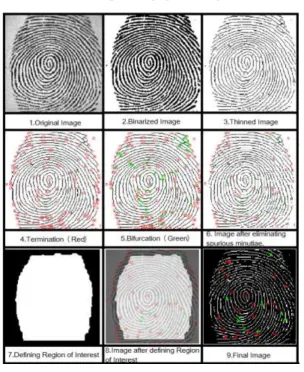
Step 1: Load the original image[Table 1.1].
Step 2: Binarization of original image: A threshold value is set and the pixel having value greater than the
threshold is set to 1 and the ones lower than the threshold is et to 0[Table 1.2].
Step 3: Thinning of binarized image: Ridge thining is done on the binarized image to eliminate the redundant
pixels of ridges till the ridges are just one pixel wide.This is done by using the following Matlab’s Thinning
function[Table 1.3].
bwmorph(binary image,'thin','inf');
Step 4: Extracting Minutiae points from processed image: We filter the thinned ridged map using nlfilter to
compute the number of minutiae i.e. endings and bifurcations on the thinned image.
After completion of fingerprint ridge thinning, minutiae marking is done by using 3 x3 pixel window as follows.
In case of minutia marking the concept of Crossing Number (CN) is mainly used.
Termination
In 3 x 3 windows if the central pixel is 1 and has only 1 one-value neighbour, then the central pixel is a
ridge ending or termination. i.e Cn(p)=1 for a pixel “p” [Table 1.4].
Bifurcation
In 3 x 3 windows if the central pixel is 1 and has exactly 3 one-value neighbours, then the central pixel is a
ridge branch or bifurcation. i.e Cn(p)=3 for a pixel “p” [Table 1.5].
We have a lot of spurious minutae and we are going to process them. Let D be some threshold value and we find
the distance using Matlab function DEuclid( ) [Table 1.6].
Process 1: if the distance between a termination and a bifurcation is smaller than D, we remove this minutiae.
DEuclid(Centroid of Bifurcation,Centroid of Termination)
Process 2: if the distance between two bifurcations is smaller than D, we remove this minutiae.
DEuclid(Centroid of Bifurcation)
Process 3: if the distance between two terminations is smaller than D, we remove this minutiae.
DEuclid(Centroid of Termination)
Step 5: ROI: The unnecessary outline of the thinned image is discarded by finding the Region of Interest by
two Morphological methods those are CLOSING and OPENING. By using the OPENING operation we can
enhance images and remove the peaks caused by background noise and we use CLOSING operation to shrink
the images and to eliminate the small cavities [Table 1.7].
Step 6: Determining Orientation of minutiae: We have orientation of each minutiae [Table 1.8].
We know one type of minutia can be change to other type easily, coming in contact with the different types of
data acquisition conditions. So we have to save them in some form of representation that is both for termination
and bifurcation. So each minutia is completely characterized by the following parameters at last:
1) x-coordinate
2) y-coordinate
3) Orientation
4) Associated ridge
Actually a bifurcation can be broken down to three terminations each having their own x-y coordinates,
orientation and an associated ridge.
The orientation for each termination (tx, ty) is estimated by using the following method
.
a) First of all we have to track a ridge segment, whose starting point must be the termination and length is D.
b) Then sum up all the x-coordinates of points present in that particular ridge segment.
c) After that to get sx we have to divide the above summation with D and sequentially we get sy using the
same technique.
3.1 Matching Algorithm
The algorithm is used to match the X and Y co-ordinates of both the Termination points as well as the
bifurcations. We also match their orientations to ensure a perfect match if found. On discovery of a proper
match, the match count is raised by one at the end of the matching. The match score is calculated as the total
number of matches divided by the total number of samples matched as given :
Match Score =
After calculating the match score its percentage is calculated and further it is compared with a pre-specified
threshold value which is taken as 60 because it depicts a high probability that the user is genuine.
IV. PERFORMANCE PARAMETERS
1. False rejection rate (FRR): The rate at which the system falsely rejects a registered user compared to the
total number of trials.
2. False acceptance rate (FAR): The rate at which the system falsely accepts a nonregistered (or another
registered) user as a registered one compared to the total number of trials. The FAR is in this report used in
the identification version, as a contrast to verification procedures, where it measures if a user is accepted
under a false claimed identity.
3. Equal error rate (EER): The common value of the FAR and FRR when the FAR equals the FRR. This is
the value where both the FAR and FRR are kept as low as possible at the same time (see Fig. 3). A low
This paper presents that the value of FAR and EER decreases with the added orientation parameter in the
fingerprint recognition system.
V. FIGURES AND TABLES
Fig.1 Types of Ridges Fig.2 Measuring Ridges angles
Fig. 3.Relationship between FAR,FRR & EER
VI. CONCLUSION
This paper presents the Fingerprint matching algorithm using Minutiae detection along with their Orientation. It
helps in enhancing the accuracy of the algorithm. This paper presents matching of fingerprint on the basis of
frequency and orientation for which we binarize, eliminate the redundant pixels, and then subsequently find out
the Region of Interest. Finally, we analyze the extracted minutiae points on the basis of orientation.
REFERENCES
This heading is not assigned a number. A reference list MUST be included using the following information as a
guide. Only cited text references are included. Each reference is referred to in the text by a number enclosed in a
square bracket (i.e., [3]). References must be numbered and ordered according to where they are first mentioned
in the paper, NOT alphabetically.
Examples follow
Journal Papers
[1] M Ozaki, Y. Adachi, Y. Iwahori, and N. Ishii, Application of fuzzy theory to writer recognition of Chinese
characters, International Journal of Modelling and Simulation, 18(2), 1998, 112-116. Note that the journal
title, in italics
Books: [2] R.E. Moore, Interval analysis (Englewood Cliffs, NJ: Prentice-Hall, 1966). Note that the title of the
book is in lower case letters and italicized. There is no comma following the title. Place of publication and
publisher are given.
Theses: [3] D.S. Chan, Theory and implementation of multidimensional discrete systems for signal processing,
doctoral diss., Massachusetts Institute of Technology, Cambridge, MA, 1978. Note that thesis title is set in
italics and the university that granted the degree is listed along with location information
Proceedings Papers:
[4] W.J. Book, Modeling design and control of flexible manipulator arms: A tutorial review, Proc. 29th IEEE