www.nat-hazards-earth-syst-sci.net/15/1757/2015/ doi:10.5194/nhess-15-1757-2015
© Author(s) 2015. CC Attribution 3.0 License.
Statistical detection and modeling of the over-dispersion
of winter storm occurrence
M. Raschke
Independent researcher, Stolze-Schrey-Str. 1, Wiesbaden, Germany
Correspondence to: M. Raschke ([email protected])
Received: 1 February 2015 – Published in Nat. Hazards Earth Syst. Sci. Discuss.: 3 March 2015 Revised: 28 July 2015 – Accepted: 29 July 2015 – Published: 11 August 2015
Abstract. In this communication, I improve the detection and modeling of the over-dispersion of winter storm occur-rence. For this purpose, the generalized Poisson distribution and the Bayesian information criterion are introduced; the latter is used for statistical model selection. Moreover, I re-place the frequently used dispersion statistics by an over-dispersion parameter which does not depend on the consid-ered return period of storm events. These models and meth-ods are applied in order to properly detect the over-dispersion in winter storm data for Germany, carrying out a joint esti-mation of the distribution models for different samples.
1 Introduction
A possible over-dispersion of the occurrence of European winter storms is the topic of previous studies (e.g., Mailier et al., 2006; Pinto et al., 2013; Karremann et al., 2014). Over-dispersion means that the variance (a spreading parameter) of the number of events per storm season is larger than the corresponding expectation. This is frequently called cluster-ing. However it is difficult to detect statistical significance of over-dispersion of historic winter storms due to the small sample sizes and the relatively small over-dispersion (cf. Vi-tolo et al., 2009).
Here I present a combination of statistical models and methods that improve the modeling of the over-dispersion of European winter storms and the detection of its statistical significance. The generalized Poisson distribution (GPD) is introduced in the following section. It is more universal than the negative binomial distribution (NBD) which is already applied to storms (e.g., Karremann et al., 2014). In Sect. 3, I introduce an over-dispersion parameter which remains the
same for each return period, in contrast to frequently used dispersion statistics (e.g., Karremann et al., 2014). The cor-responding thinning process is also explained. In Sect. 4, I introduce the statistical model selection by an information criterion. Finally, I use this criterion when I apply the GPD to the data set of German winter storms analyzed in Karre-mann et al. (2014). Therein the over-dispersion in the data of historic storms is well detected by an over-dispersion pa-rameter, estimated for a large sample of storms from climate model simulations.
2 The generalized Poisson distribution (GPD)
The occurrence of European winter storms on a timescale can be modeled by an inhomogeneous Poisson process (Mailier et al., 2006). In consequence, the number of storms per sea-son, with a magnitude equal to or larger than a defined level, can be modeled by a distribution that is a mixture of Pois-son distributions (PDs). The NBD is such a mixture and is already applied to storm occurrence (e.g., Sakamoto, 1973; Karremann et al. 2014). The PD is a limit case of the NBD and includes neither over- nor under-dispersion. In contrast to the limitations of the NBD to the case of over-dispersion (cf. Johnson et al., 2005, Eq. 5.5), the GPD can consider over-dispersion or under-over-dispersion and includes the PD as a spe-cial case. The GPD is more universal and it also is a mixture of PD in case of over-dispersion (Joe and Zhu, 2005). Hence I use the GPD. The GPD has been developed by Consul and Jain (1973) and is formulated for the discrete random vari-ableX ≥0 for count data with
P (x)=λ(λ+xθ )
x−1 x! e
It describes the probability ofX=xand uses the parameters λ >0 andθ. The expectationE(X) and varianceV (X)can replace the parametersλandθhaving
θ=1− s
E(X)
V (X) (2)
and
λ= s
E(X)3
V (X). (3)
A certain inhomogeneous Poisson process of event occur-rence in time does not necessarily need to result exactly in a NBD or a GPD for the count data of events per storm sea-son. But I assume that the GPD is at least an appropriate approximation. The similarity of the NBD and the GPD for the case of over-dispersion supports this assumption; each approximates the other. This is later validated for and by the analyzed storm data.
The parameters of the GPD can be estimated by the well-known maximum likelihood (ML) method. Therein the pa-rameter vector θ, with the maximum of the logarithmized likelihood function
log(L(θ))=
nx
X
x
log(P (x;θ)) (4)
represents the point estimation. nx is the observed number
of seasons withX=x. The ML method is recommended for the NBD (Johnson et al., 2005) and the GPD (Consul and Shoukri, 1984). Therein, the estimated expectationE(X)ˆ is equal to the sample mean. The moment method is also an es-tablished estimation method for discrete distributions in con-trast to the least square method (cf. Johnson et al., 2005).
3 What does over-dispersion mean?
Mailier et al. (2006), Vitolo et al. (2009) and Karremann et al. (2014) define the over-dispersion in the random distribu-tion of the number of storms as serial clustering, and quantify it by the dispersion statistics
φ=V (X)/E(X)−1. (5)
However, the terms cluster and clustering have different meanings. A cluster in an auto-correlated time series consists of a number of observations that represent a partial series of exceedances of a given threshold (Coles, 2001, Fig. 5.4), e.g., of the time series of river discharge. An earthquake cluster is a group of earthquake events that include a main event with a large magnitude and a series of secondary events (after- and/or foreshocks; e.g., Ogata, 2001). There is a rela-tion in time and space between these events. If a clustering of
storm magnitudes existed, similar to the clustering of earth-quakes, the number of smaller storms with low return peri-ods (RPs) should be higher for years with an event with a high RP. Nevertheless, this cannot be stated for the data ana-lyzed by Karremann et al. (2014). This fact is associated with the physical processes leading to the occurrence of cyclone clusters (Pinto et al., 2014).
Here, X is the number of storms, in a season, whose storm magnitudes have RPs equal to or larger than a con-sidered return period (CRP). If over-dispersion in the count variableXwere generated only by an inhomogeneous Pois-son process at the timescale, then each storm event would be independent of the others. In this case, the increase of the CRP from CRPold to CRPnew includes a random thin-ning of the sampling ofX. Therein, the survival probabil-ityPsurvival=CRPold/CRPnew with CRPold>CRPnew is the probability of a storm event of the sample with CRPoldto be also member of the sample with a higher CRPnew. The RP of the magnitude of a storm, which is also a random variable, determines if this storm stays in the sample with CRPnew or not. In other words, the counted storm events are thinned out by the increasing of the CRP. A possible over-dispersion withV (X) > E(X)is determined independent of the CRP by (cf. Mack, 2002)
V (X)=E(X)+βE(X)2, (6)
where the over-dispersion parameterβ≥0 (β=0 means no over- or under-dispersion). This is a result of well-known re-lations between random variables (cf. Ross, 2007). I present a derivation of Eq. (6) in the Supplement. The relation be-tween the expectation of the storm number and the CRP is obviously E(X)=1/CRP. The important advantage of the over-dispersion parameterβ is that it has one fixed value for all CRP, in contrast to the over-dispersion statisticsφwhich depends on the CRP (cf. Karremann et al., 2014; they use the term return level). An example of the corresponding relations is shown in Fig. 1. The over-dispersion statisticsφdecreases with the increasing of CRP=1/E(X)for the fixedβ. This behavior explains very well, as by Karremann et al. (2014; Table 3), the estimations for large storm samples from cli-mate model simulations. It seems to be likely that the over-dispersion of storms is caused by inhomogeneous occurrence intensity of events in time.
4 Statistical significance and model selection
clas-Figure 1. Relation between variance and expectation accord-ing to Eq. (6) with dispersion parameter β=0.307 and corre-sponding behavior of dispersion statisticsφ according to Eq. (5) (CRP=1/E(X)).
sicalt test (Fahrmeir et al., 2013). The functionality of such model selection can also be validated by Monte Carlo simula-tions (Raschke and Thürmer, 2010). Here, I apply for model selection the well-known Bayesian information criterion of Schwarz (1978):
BIC= −2L(θ)+mlog(n). (7)
In Eq. (7)mstands for the number of estimated parameters and has to be taken into account while applying a criterion for model selection to avoid an over-fit. This sounds simple and reasonable, but it is not fulfilled in every model (cf. Raschke, 2014). The sample size is againnin Eq. (7), and log(L(θ ))is the logarithmized likelihood function (cf. Eq. 4). A smaller BIC indicates the better model, the smallest the best. A larger difference between the criteria of alternative models indi-cates a better differentiation. BIC is very popular in statistics (Lindsey, 1996; Upton and Cook, 2006; Ismail and Jemain, 2007; Claeskens and Hjort, 2008), based on the Kullback– Leibler distance and also related to the likelihood ratio test. In contrast to the latter, the BIC also considers the case of equal number of parameter, and many alternative models can be easily compared. If the BIC selects the models (or the most models) with over-dispersion instead of a model (or the most models) without, then the statistical significance of the over-dispersion is proved.
I do not apply any goodness-of-fit test here because there is no special goodness-of-fit test for the NBD or GPD (cf. Stephend, 1986), and moreover the χ2 test does not work well for small sample size (see, e.g., Raschke, 2009). The goodness of fit was also not discussed by Karremann et al. (2014).
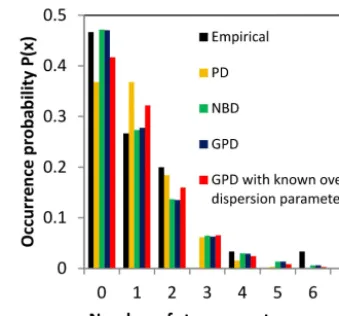
Figure 2. Estimated distributions for the DWD sample with CRP=1.
5 Over-dispersion of winter storms in Germany
Karremann et al. (2014) have published samples of num-bers X of winter storms per season. They have counted storms with a RP of their storm magnitude which fulfill the condition RP≥CRP. Therein the cases are presented where CRP=1, 2 and 5 year. The data are listed in the Supple-ment and include a sample of historic storms from a period of 30 years (n=30), with magnitudes calculated based on wind station data (DWD) and on data from reanalyzed his-toric storms (NCEP, ERAI), as well as a very large sam-ple (n=4092) obtained from a climate model simulation (GCMcorr). I do not consider the other samples presented by Karremann et al. (2014). The storm magnitudes (return level with return periods in Coles, 2001) are measured by Karre-mann et al. (2014) by using two indexes which consider the wind speed of different sites (stations or grid points) in Ger-many and beyond. Details and issues such as the quantifica-tion of storm magnitudes are not topics of this work and do not affect the introduced models and methods.
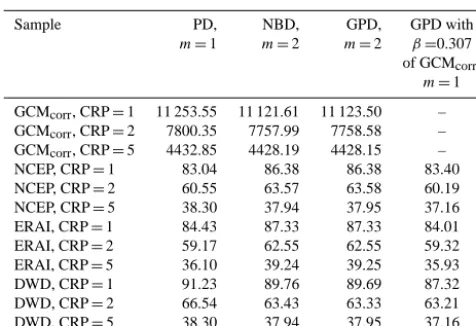
In a first analysis I have estimated for all samples the pa-rameters for distributions PD, NBD and the GPD. The re-sults are listed in Table 1. In every ML estimation applies
ˆ
E(X)=1/CRP, as described in the previous sections. The estimated distributions for DWD data with CRP=1 year are shown in Fig. 2. It is clear that the NBD and the GPD are very similar. Additionally, the BIC for the NBD and GPD are al-most equal for all samples (Table 1). NBD and GPD approx-imate each other as assumed in Sect. 2. However, the BIC detect the PD as the best model for 56 % of the samples of historic storms. The over-dispersion is detected only in 44 % of the historic storms. But over-dispersion is detected clearly for all GCMcorrsamples from climate model simulations.
ap-Table 1. BIC for some samples of winter storm in Germany accord-ing to Karremann et al. (2014) (n=4092 for GCMcorr, otherwise n=30).
Sample PD, NBD, GPD, GPD with
m=1 m=2 m=2 β=0.307 of GCMcorr,
m=1 GCMcorr, CRP=1 11 253.55 11 121.61 11 123.50 – GCMcorr, CRP=2 7800.35 7757.99 7758.58 – GCMcorr, CRP=5 4432.85 4428.19 4428.15 – NCEP, CRP=1 83.04 86.38 86.38 83.40 NCEP, CRP=2 60.55 63.57 63.58 60.19 NCEP, CRP=5 38.30 37.94 37.95 37.16 ERAI, CRP=1 84.43 87.33 87.33 84.01 ERAI, CRP=2 59.17 62.55 62.55 59.32 ERAI, CRP=5 36.10 39.24 39.25 35.93 DWD, CRP=1 91.23 89.76 89.69 87.32 DWD, CRP=2 66.54 63.43 63.33 63.21 DWD, CRP=5 38.30 37.94 37.95 37.16
ply this parameter value to estimate the GPD for the his-toric storm samples. Therein GPD is now parametrized by the expectation and the over-dispersion parameter. The lat-ter is now known and only the expectation is estimated. Both determine the varianceV (X)according to Eq. (6). This esti-mation procedure is possible because the over-dispersion pa-rameter does not depend on the CRP. The GCMcorrsample is relatively large (n=409230) and independent of the sam-ples of historic storms. Furthermore, all samsam-ples are from the same random variableX– the number of winter storms per season in Germany for the current climate. Using this special procedure with one known parameter, over-dispersion in the data of historic winter storms in Germany can be properly de-tected (Table 1, last column). The BIC selects the GPD with known over-dispersionβ=0.307 in 78 % of the samples of historic storms. Thus the over-dispersion is largely proved for historic storms.
6 Summary
In this communication, I have improved the detection and modeling of the over-dispersion of winter storm occurrence. For this purpose, the GPD, information criterion for the model selection and an over-dispersion parameter have been introduced. The GPD has the advantage of being more uni-versal than the NBD previously used. The application of the information criterion BIC indirectly ensures statistical signif-icance. In addition, the over-dispersion parameterβ is more universal than the dispersion statistics φ because the over-dispersion parameter is the same for every CRP. All this el-ements are used in the analysis of the winter storm data for Germany by Karremann et al. (2014). The statistical over-dispersion in historical storm time series for recent decades could be largely proven by a combination of these elements. In this way, the basic conclusions by Karremann et al. (2014)
– i.e., that there is over-dispersion in winter storms in Ger-many – have been confirmed at a higher level of statistical analysis.
The Supplement related to this article is available online at doi:10.5194/nhess-15-1757-2015-supplement.
Acknowledgements. I gratefully acknowledge Joaquim G. Pinto
and Matthias Klawa for the fruitful discussions about clustering of storms.
Edited by: B. Merz
Reviewed by: J. G. Pinto and F. Serinaldi
References
Claeskens, G. and Hjort, N. L.: Model selection and model averag-ing, in: Cambridge Series in Statistical and Probabilistic Mathe-matics, Cambridge University Press, Cambridge, 2008. Coles, S.: An introduction to statistical modeling of extreme values,
Springer, London, 2001.
Consul, P. C. and Jain, G. C.: A generalization of the Poisson distri-bution, Technometrics, 15, 791–799, 1973.
Consul, P. C. and Shoukri, M. M.: Maximum likelihood estimation for the generalized Poisson distribution, Commun. Stat. Theory Meth., 10, 977–991, 1984.
Fahrmeir, L., Kneib, T., Lang, S., and Marx, B.: Regression – mod-els, methods and applications, Springer, Heidelberg, Germany, 2013.
Ismail, N. and Jemain, A. A.: Handling Overdispersion with Nega-tive Binomial and Generalized Poisson Regression Model, Casu-alty Actuarial Society Forum, Arlington, VA, 103–158, 2007. Joe, H. and Zhu, R.: Generalized Poisson distribution: the property
of mixture of Poisson and comparison with negative binomial distribution, Biometrical J., 47, 219–229, 2005.
Johnson, N. L., Kemp, A. W., and Kotz, S.: Univariate discrete dis-tributions, in: Wiley Series in Probability and Statistics, 3rd Edn., Wiley, New York, USA, 208–247, 2005.
Karremann, M. K., Pinto, J. G., von Bomhard, P. J., and Klawa, M.: On the clustering of winter storm loss events over Germany, Nat. Hazards Earth Syst. Sci., 14, 2041–2052, doi:10.5194/nhess-14-2041-2014, 2014.
Lindsey, J. K.: Parametric statistical inference, in: Oxford Science Publications, Oxford University Press, Oxford, UK, 1996. Mack, T.: Schadenversicherungsmathematik (Non-life insurance
mathematics), 2nd Edn., Deutsche Gesellschaft für Ver-sicherungsmathematik, Karlsruhe, Germany, 332–334, 2002. Mailier, P. J., Stephenson, D. B., Ferro, C. A. T., and Hodges, K. I.:
Serial Clustering of extratropical cyclones, Mon. Weather Rev., 134, 2224–2240, 2006.
Pinto, J. G., Bellenbaum, N., Karremann, M. K., and Della-Marta, P. M.: Serial clustering of extratropical cyclones over the North Atlantic and Europe under recent and future climate conditions, J. Geophys. Res.-Atmos., 118, 12476–12485, 2013.
Pinto, J. G., Gómara, I., Masato, G., Dacre, H. F., Woollings, T., and Caballero, R.: Large-scale dynamics Associated with clustering of extra-tropical cyclones affecting Western Europe, J. Geophys. Res.-Atmos., 119, 13704–13719, 2014.
Raschke, M.: The Biased Transformation and Its Application in Goodness-of-Fit Tests for the Beta and Gamma Distribution, Commun. Stat. Simul. Comput., 38, 1870–1890, 2009.
Raschke, M.: Insufficient statistical model development of ground motion relations for regions with low seismicity, Bull. Seismol. Soc. Am., 104, 1002–1005, 2014.
Raschke, M. and Thürmer, K.: Diskussion der Modellselektion und weiterer Defizite in der Hochwasserstatistik, Wasser Abfall, 06/2010, 47–51, 2010.
Ross, S. M.: Introduction to probability models, 9th Edn., Elsevier, Amsterdam, the Netherlands, 2007.
Sakamoto, C. M.: Application of the Poisson and Negative Bino-mial Models to Thunderstorm and Hail Days, Mon. Weather Rev., 101, 350–355, 1973.
Schwarz, G.: Estimating the Dimension of a Model, Ann. Stat., 6, 461–464, 1978.
Stephens, M. A.: Tests based on EDF statistics, in: Goodness-of-Fit Techniques, Statistics: Textbooks and Monographs, Vol. 68, edited by: D’Augustino, R. B. and Stephens, M. A., Mar-cel Dekker, New York, 97–194, 1986.
Upton, G. and Cook, I.: A dictionary of statistics, 2nd Edn., Oxford University Press, Oxford, UK, 2006.