IOT System Model,Challenges and Threats
Bhawna Ahlawat, Anil Sangwan, Vikas SindhuAbstract: IOT (Internet of things) have emerged incredibly since its beginning and today one can easily make use of extensive applications that have entered into real world may it be smart monitoring systems, smart buildings, smart wearable accessories to smart healthcare services, smart grids etc. It connects people sitting at home or working at office to any application or service that is to be done through internet. Yet there is much vulnerability related to issues of security and privacy and this adds to challenges of IOT that need to overcome to make it further promising technology. So this paper discusses about the architecture or model if IOT as well as challenges seen by researchers like data mining challenge, privacy challenge. Also various security attacks present at various levels have been overviewed. Furthermore, comparative analysis of various security models has been discussed along with the technique used. Security issues at the application layer has been presented constituting sniffing attack, access control attack etc.
Keywords: IOT, Model of IOT, Security attacks, DOS attack, challenges.
—————————— ——————————
1.
INTRODUCTION
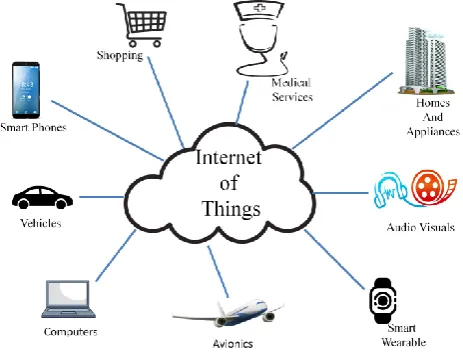
Today IOT [1][2][3][4] has been a hot topic in area of wireless communication since its deployment. The omnipresent linkage and wide intellect of IOTs along with use of wireless sensor technology have become a main point in remote controlling and management [5] and this has been much more with rapid increase in population as a result of which the count of devices connection with internet have developed rapidly making an era of IOTs. The term was initially coined by the researchers of industry and then it became more like of a public thing and that made it accepted widely. In other words one might say that IOT [6][7] constitutes the capability of intellectual devices that are competent to sense, gather plus analyse the info that surrounds us and then ultimately send it over the internet or some local network and thus response as per information received. Fundamentally IOT is combination of hardware devices that gets connected to each other in order to transfer information [8]. IOT has become a versatile area from practical topics to societal and social issues like security, privacy [9]. Nevertheless IOT has enabled communication over a wider area by making use of various protocols, many domains and a number of applications [10]. Also automation has led to introduction of some very amazing and trendy concepts of things like smart cities [11] and smart grid that might be understood by the interconnectivity provided by IOT [12]. As may be understood in Figure 1 a simple configuration of the things connected to form internet of things in work. IOT may be identified by three prototypes: Internet, oriented sensors and knowledge [13]. According to [14] [15] 5g technology soon will be seen enlarging IOT beyond the concept of present technologies. Internet of Things consists of three main constituents namely: things or objects, comm. Network that binds them, computer system using data streaming from to and from objects [16].The rest of the paper is organised as Sec II discusses interrelated work, Sec III deals with model of IOT and threats present, Sec IV and V discusses security issues at application layer and applications respectively, Sec VI discusses challenges in evolution of IOT, Sec VII have results and discussions and Sec VIII conclude with conclusion.
2.
R
ELATED WORK
In [17] [18]authors have done survey and concerns on the present status of IOT security. Moreover security issues at each level among the three layer architecture discussed is presented. To name them few are integrity, authenticity, confidentiality. In order to make IOT more secure, some concepts of identity management, architecture standards, awareness of security has been addressed in detail. In [19]various security attacks in IOT have addressed along with brief summary of its architecture. Then a comparison has been made by table. Some of these attacks may be escaped by taking few security precautions while others need efficient solution in order to tackle them. In [20] authors have studied simulation based traffic of sensors and have analysed inter packet arrival pattern as number of sender changes also simulation results are prepared using Cooja simulator and that too follows with Pareto distribution. He gave a “80-20” rule according to which for any number of events roughly 80% of the effects come from 20% of causes that is the server must have ability to control 80% of peak load or senders. In [21]authors have evaluated performance of video streaming over COAP by wireless networks. Many experiments have been done by tuning various congestion control parameters as per conditions of network. Default COAP parameters lead to
bad quality video. Value of RTO has been changed by researchers from high to low in order to get less segment download time and hence to get desired results. In [22] [23] authors have given a brief overview of IOT and its applications in day to day life that has advanced because of advancement in technologies as RFID, NFC(Near ______________________________
• First author name: Bhawna Ahlawat, Deptt. Of ECE, UIET
MDU Rohtak, India. Email:
• Second author name: Dr. Anil Sangwan, Deptt. Of ECE,
UIET MDU Rohtak, India. Email:
Field Comm.), M2M(Machine to machine comm.). Also they have discussed some challenges and applications and protocols like idea of smart home, smart grid, smart water management system concerning IOTs. Several issues are compared with the help of some papers. In [24] authors provided the readers with various threats while deploying IOT. Threat models along with issues of security based on information, access level and functional one say authorization, availability. Then attacks relying on the characteristic of device, adversary location, and host based protocols attacks are discussed in detail. In [25]authors reviewed model of smart campus using IOR and its implementation in universities. IOT flipped classroom approach is studied in detail and comparisons have been drawn with that of traditional approach where most of students are in favour of new approach. Concept of IOT smart orangery has been put to solve problem of less oxygen in rooms of universities and at last but not the least they are looking forward to put IOT heaters to save energy sources. In [26] authors have made a low cost crowd management system using IOT enabled [27] seats that acts smartly by detecting and displaying its occupancy status and that too on real time. The project has been simulated on netsim [28]simulator and after getting promising results a hardware prototype had been built for the same.
3.
M
ODEL OF IOT AND THREATS
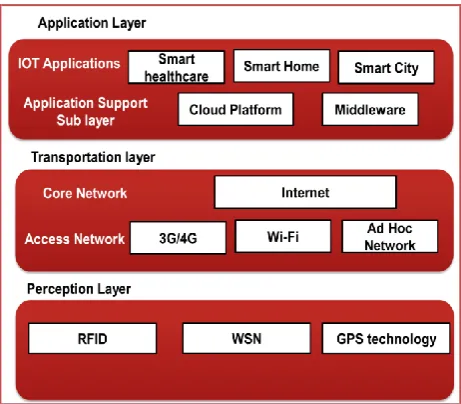
The basic architecture [29] [30] of IOT may be wholly considered and given by three key layers that are: Perception, Transportation and Application layer [31] [32] [33]. Every layer of this system model shown in fig 2 has its specific technology that might bring some threats [34] [35] to security of that layer. So here’s a brief description of each of them as follows:
3.1 Perception Layer
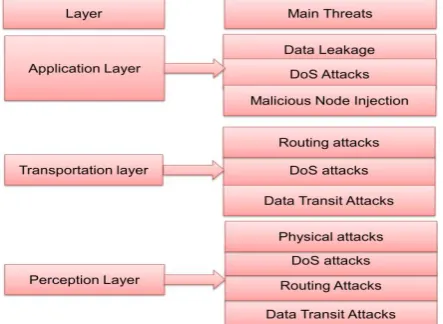
This foremost layer is associated with various IOT sensors that supports gathering of data and then processes it on different technologies like RFID, GPS, and WSN. Further it also comprises actuators to do distinct measurements that might include temperature, humidity or acceleration etc. and purpose to find out location may be carried out by this. Since we know the way structure organized is different and node resources are also restricted so major threats of security approaching this one are as described:
a. Physical Attack: Here attention is given to
hardware constituents of IOT network. The attacker must be actually closer or within the IOT network to make it work.
b. DOS (Denial Of Service) Attacks: In this the
aggressor utilize the processing capability of nodes, thus makes them out of reach.
c. Routing Attack: While gathering data and directing
it many intermediate nasty nodes may change the routing paths that were correct.
3.2 Transportation Layer
This layer precisely gives the pervasive environment reach for the perception layer. The objective here particular is to communicate assembled data that has been acquired by perception level to any explicit data organizing arrangement across present communication systems handed down by both Access systems like
3G/LTE or Main Set-ups i.e. internet. Predominantly main attacks at this layer are:
a. Routing Attacks: means here the intruder exploits the right routing path and hence passes data onto wrong path in the network.
b. Data Transit Attack: here different attack happens on the data confidentiality and integrity while data transiting in entrance or fundamental networks. c. DOS Attacks: The IOT networks being complex
and heterogeneous, the transportation layer is exposed to get an attack.
Fig 2 IOT system model showing different layers
3.3 Application Layer
This third one makes the amenities available plead for via the clients. For example the customers are asking assessment of temperature, pressure, air humidity or some other factor then application layer has capability to provide with such information. The significance of this layer can be understood by the fact that it has potential to give high end services to encounter the demands of customer. A lot of unique environments of IOT may be created just like smart city, smart orangery, and smart factory with this level. The major security warnings here are:
a. Leakage of Data: The striker may comfortably take
out the data like user id password etc. by familiar vulnerability of the application or service.
b. Malicious Code Injection: The intruder might
upload infected nodes by well familiar vulnerabilities taking it out to fetcher software injection.
4.
A
PPLICATIONS
4.1 Smart city:
comes with threat of privacy at stake of citizens of city as their data is being monitored for the same purpose.
4.2 Smart water supply:
This is a good idea to see how water may be saved by monitoring supply of water whether it is for commercial purpose or residential one. Loss of water might be easily detected by wireless sensors systems. Tokyo in an article had premeditated that they are saving $169 million each year by perceiving water leakage problems. So a kind of setup is installed that could tell pipe flowing measure data regularly. Along with this also send automatic alerts if water use is beyond what was estimated. That would allow smart city to know place where pipes is leaking plus repairing them accurately to avoid water loss.
5.
S
ECURITY DISPUTES IN APPLICATION
LAYER: [36] [37]
So the application layer has to personally meet with the services provided to end users. This layer consists of the applications in IOT[38] [39] as smart grids, smart meters, smart cities, automation of room or factories or any building or it may be your smart home [40]. Therefore security threats and issues at this particular layer are different from those in above layers. Sometimes a sub layer is also included in between the network as well as application layer specifically known as application support layer or middleware [41] layer. This layer holds up different business applications and thus lends a hand in intelligence allocation of resources as well in computation. Major security issue faced by this layer are as below:
5.1 Data theft:
Applications of IOT has to face with much analytical and personal data of users. Also the problem here is that much data handling is required on data that is in motion and that means there is large data activity and static data is something that is easy to tackle with problem of attacks and security. That’s why the consumer present always remains ardent to have their data or info archived on these applications so to avoid this kind of attack. Data ciphered, data isolated, network and user verification, are few procedures to tackle this attack.
5.2 Service Interruption Attack:
This attack frequently also known as illegal interrupt attack or Dos attacks in present fiction. One can see different instances to see this kind of attack in IOT uses. Such things deny the authorized users for utilizing the service of IOT solicitations by insincerely creating system engaged in order to response.
5.3Sniffing attacks:
Here the intruders might make use of sniffer solicitations to observe the system traffic in particular IOT applications. The attacker might bring together sniffer programs onto network in order to take network data. Their foremost purpose is to snip passwords, files, email texts etc. Much of existing protocols are liable to to sniffing. This might help intruder to get over confidential and private data of end user if proper security protocols and prevention measures has taken out to avoid it.
5.4 Access control attacks:
This type of attack happens because there is a procedure called access control mechanism is followed that gives permission only to valid and genuine users or processes to have the account or information. So this make an important security issue when talking about application layer since at any time access is co-operated, then the whole applications become out of control and is susceptible to attacks.
Fig 3 Various attacks at different layers
5.5 Reprogram attacks:
The attackers may wish to reprogram the IOT things distantly when the programming mechanism is neglected. Here, attacker once have reach to source code of original programmer then it may try to modify it, in such a case the application perhaps went in infinite loophole. So it has to be protected in one or another way in order to escape this type of attack otherwise it might also lead to hijacking.
5.6 Malicious code injection attack:
So this one is another aspect of attack in which the attacker seeks to have coolest and straightforward method that can be used to smash the network. Due to improper check codes the network might be susceptible to nasty scripts and wrong directions so this became the leading entrance point that any invader would select. Mostly invaders practise XSS (Crossed site script) to put some mischievous scripts onto then reliable website. And in any case if this attack goes successfully then it could effect in take-over the IOT account of user and thus paralyzing the whole IOT network.
6.
C
HALLENGES IN EVOLUTION OF IOT
On the basis of observation of practices of IOT, this portion examines the multiple challenges [42] [43] [44] [45] in evolvement of IOT by research scholars. The IOT introduces many challenges in approving it implementation as with any other novel renovation. So here we are going to present four major of them namely data management, privacy, security and chaos.
6.1 Data management challenge:
their network. Therefore in this way they would be capable to organise information needed for tasks or help on basis of wants and value. Hence centres of information would be much expanded to surpass processing optimally.
6.2 Privacy challenge:
IOT services make available enormous amount of information about the whereabouts of user of IOT and its action- each of them can light up remarkable privacy worries. This is necessary to look after the confidentiality of user data and material as this is going to increase the quality and therefore led to decrease in cost of service supplier. The IOT will enhance the worth of lives of users if this challenge is overcome. Yet IOT still keep up momentum with applications like smart grid and smart home systems and many smart devices like this but acceptance and undertaking of IOT would rely on the safekeeping of end user privacy.
6.3 Security Challenge:
As multiple devices are being introduced in IOT networks so the risk of threat to security increases manifold. IOT yet ameliorates the throughput of company and make lives of people good, but there is always huge probability for attackers and hackers to get hold on the network information. Because of Table 1 Analysis of various Security models proposed by various authors along with technique used
unavailability of data encryption, not so secure web interface and lacking authorization the IOT remain susceptible to be in danger. Thus absence of reliability and isolation generate unwillingness in adopting IOT and its applications by the persons. So these have to be set on by skilled developers to assimilate solutions in
security in services and products and hereby inspiring people to make use of inbuilt security attributes.
6.4 Chaos Challenge:
The development of IOT technology is going in a faster way than classic consumer product revolution cycle. That means these are facing competing standards, less security, isolation problems, multiplex communication and increasing number of poor testing devices are making lives of user in great mess. When environment around us is not connected then minor fallacy or flaw do not cut back the network nevertheless in hyperlinked area the mistake in any part of network may lead to chaos everywhere in the system. Due to Traffic presented by acceleratory devices the available bandwidth is going to saturate that would ultimately lead to extensive difficulties in area related to performance of system. So in order to avoid all these problems the enterprises must take every possible step in order to provide seamless communication, privacy and enhance security.
7.
R
ESULTS AND DISCUSSION
The architecture of IOT has been seen over here that was a 3 layered architecture of application, network and perception layer. After then various security issues and challenges of IOT has been discussed. Various solutions have also been provided by researchers like block chain solution but more security and privacy can be obtained
by new protocols and algorithms. Comparative Analysis of various Security models proposed by various authors along with technique used is shown in Table 1.
8.
C
ONCLUSION
During past decades IOT has shown a rapid development that a technology can have. Much of the things and services have been available due to its wide S. No. Author Name Proposed
Approach
Year Techniques Used Problems Advantages
1. Roman Schlegal et. al [46]
Threat Modelling Approach
2015 Structured System threat modelling and
mitigation study
Identifying threats area in industry automation system
Allows agreement between too specific and
general tools making unstructured data utilizable for automated
processing.
2. Hajoon ko et. al [47]
IOT Service Dependency Tree (SDT)
approach
2016 Tree based Validation Virtualization Security Effectively appropriate in real scenarios, lower overhead
3. Jesus Pacheco et. al [48]
IOT security model for smart
homes and buildings
2016 ABA-IDS (Anomaly Behaviour Analysis- Intrusion Detection
Analysis)
Inability to detect attack attacks, Low
detection rate
Notice identified and unidentified attacks for IOT end nodes, low false
alarms, Great detection rate
4. Preetha Thulasiraman
et. al [49]
Light weight trust based security architecture
2019 Modified RPL routing algorithm
Unsafe data transfer, high control overhead,
low packet delivery rate
Shielding against Denial of Service (DoS) attack, lower control overhead, high detection rate, low
false alarms
5. Shailendra Rathore et. al[50]
Decentralized Security architecture
2019 Software Defined Networking coupled
with block chain technology
Storage constraints, high latency, issue of
monitoring
Provides with continuous monitoring, cheap computation, low latency,
implementation. The way it is evolving has led to applications like smart water management supply, room automation, smart grids, concept of smart orangery and likewise there are many more. This paper discussed with some of the technical challenges faced by users during its realization into real world. Also security threats at various layers have been presented in brief and security issues at application layer have been presented. A comparative analysis of proposed methodology and technique used for various security models has been done along with advantages. In future it is worth watching that how these security attacks can be minimised in order to enhance its adaption among users by using various techniques and algorithms.
R
EFERENCES
[1] Kiel, D. A. N. I. E. L., C. H. R. I. S. T. I. A. N. Arnold, M. A. T. T. H. I. A. S. Collisi, and K. I. Voigt. "The impact of the industrial internet of things on established business models." In Proceedings of the 25th international association for management of technology (IAMOT) conference, pp. 673-695. 2016.
[2] Braun, Peter, Alfredo Cuzzocrea, Carson K. Leung, Adam GM Pazdor, Syed K. Tanbeer, and Giorgio Mario Grasso. "An innovative framework for supporting frequent pattern mining problems in IoT environments." In International Conference on Computational Science and Its Applications, pp. 642-657. Springer, Cham, 2018.
[3] Hwang, DongYeop, JungYong Choi, and Ki-Hyung Kim. "Dynamic Access Control Scheme for IoT Devices using Blockchain." In 2018 International Conference on Information and Communication Technology Convergence (ICTC), pp. 713-715. IEEE, 2018.
[4] Li, He, Kaoru Ota, and Mianxiong Dong. "Learning IoT in edge: Deep learning for the Internet of Things with edge computing." IEEE Network 32, no. 1 (2018): 96-101. [5] Ghayvat, Hemant, Subhas Mukhopadhyay, Xiang Gui, and
Nagender Suryadevara. "WSN-and IOT-based smart homes and
their extension to smart buildings." Sensors 15, no. 5 (2015): 10350-10379.
[6] de Souza, Cesar A., Juliana N. Correa, Moacir M. Oliveira, Annabeth Aagaard, and Mirko Presser. "IoT Driven Business Model Innovation and Sustainability: a literature review and a case Study in Brazil." In 2019 Global IoT Summit (GIoTS), pp. 1-6. IEEE, 2019.
[7] Sanchez, Luis, Luis Muñoz, Jose Antonio Galache, Pablo Sotres, Juan R. Santana, Veronica Gutierrez, Rajiv Ramdhany et al. "SmartSantander: IoT experimentation over a smart city testbed." Computer Networks 61 (2014): 217-238.
[8] Punia, Divya, and Rajender Kumar. "Effect of Mobility in IoT Environment." In 2018 2nd International Conference on Trends in Electronics and Informatics (ICOEI), pp. 1534-1537. IEEE, 2018.
[9] Gluhak, Alexander, Srdjan Krco, Michele Nati, Dennis Pfisterer, Nathalie Mitton, and Tahiry Razafindralambo. "A survey on facilities for experimental internet of things research." (2011).
[10] Lee, In, and Kyoochun Lee. "The Internet of Things (IoT):
Applications, investments, and challenges for
enterprises." Business Horizons 58, no. 4 (2015): 431-440. [11] Eckhoff, David, and Isabel Wagner. "Privacy in the smart
city—Applications, technologies, challenges, and
solutions." IEEE Communications Surveys & Tutorials 20, no. 1 (2017): 489-516.
[12] Deogirikar, Jyoti, and Amarsinh Vidhate. "Security attacks in IoT: A survey." In 2017 International Conference on I-SMAC (IoT in Social, Mobile, Analytics and Cloud)(I-SMAC), pp. 32-37. IEEE, 2017.
[13] Zhamanov, Azamat, Zhulduz Sakhiyeva, Rassim Suliyev, and Zhazira Kaldykulova. "IoT smart campus review and implementation of IoT applications into education process of university." In 2017 13th International Conference on
Electronics, Computer and Computation (ICECCO), pp. 1-4. IEEE, 2017.
[14] Li, Shancang, Li Da Xu, and Shanshan Zhao. "5G Internet of Things: A survey." Journal of Industrial Information Integration 10 (2018): 1-9.
[15] Goudos, Sotirios K., Panagiotis I. Dallas, Stella Chatziefthymiou, and Sofoklis Kyriazakos. "A survey of IoT key enabling and future technologies: 5G, mobile IoT, sematic web and applications." Wireless Personal Communications 97, no. 2 (2017): 1645-1675.
[16] Stergiou, Christos, Kostas E. Psannis, Byung-Gyu Kim, and Brij Gupta. "Secure integration of IoT and cloud computing." Future Generation Computer Systems 78 (2018): 964-975.
[17] Mahmoud, Rwan, Tasneem Yousuf, Fadi Aloul, and Imran Zualkernan. "Internet of things (IoT) security: Current status, challenges and prospective measures." In 2015 10th International Conference for Internet Technology and Secured Transactions (ICITST), pp. 336-341. IEEE, 2015. [18] Di Martino, B., M. Rak, M. Ficco, A. Esposito, S. A. Maisto,
and S. Nacchia. "Internet of things reference architectures, security and interoperability: A survey." Internet of Things 1 (2018): 99-112.
[19] Deogirikar, Jyoti, and Amarsinh Vidhate. "Security attacks in IoT: A survey." In 2017 International Conference on I-SMAC (IoT in Social, Mobile, Analytics and Cloud)(I-SMAC), pp. 32-37. IEEE, 2017.
[20] Shyam, S. M., and Golla Vara Prasad. "Modeling of Sensor Packet Arrival in Simulation Environment." In 2018 Second International Conference on Inventive Communication and Computational Technologies (ICICCT), pp. 37-40. IEEE, 2018.
[21] Rahman, Waqas Ur, Young-Seok Choi, and Kwangsue Chung. "Performance Evaluation of Video Streaming Application Over CoAP in IoT." IEEE Access 7 (2019): 39852-39861.
[22] Shah, Sajjad Hussain, and Ilyas Yaqoob. "A survey: Internet of Things (IOT) technologies, applications and challenges." In 2016 IEEE Smart Energy Grid Engineering (SEGE), pp. 381-385. IEEE, 2016.
[23] Farhan, Laith, Sinan T. Shukur, Ali E. Alissa, Mohmad Alrweg, Umar Raza, and Rupak Kharel. "A survey on the challenges and opportunities of the Internet of Things (IoT)." In 2017 Eleventh International Conference on Sensing Technology (ICST), pp. 1-5. IEEE, 2017.
[24] Hossain, Md Mahmud, Maziar Fotouhi, and Ragib Hasan. "Towards an analysis of security issues, challenges, and open problems in the internet of things." In 2015 IEEE World Congress on Services, pp. 21-28. IEEE, 2015.
[25] Zhamanov, Azamat, Zhulduz Sakhiyeva, Rassim Suliyev, and Zhazira Kaldykulova. "IoT smart campus review and implementation of IoT applications into education process of university." In 2017 13th International Conference on Electronics, Computer and Computation (ICECCO), pp. 1-4. IEEE, 2017.
[26] Vidyasagaran, Sachin, S. Renuga Devi, Aditya Varma, A. Rajesh, and Hari Charan. "A low cost IoT based crowd management system for public transport." In 2017 International Conference on Inventive Computing and Informatics (ICICI), pp. 222-225. IEEE, 2017.
[27] Amin, Ruhul, Neeraj Kumar, G. P. Biswas, Rahat Iqbal, and Victor Chang. "A light weight authentication protocol for
IoT-enabled devices in distributed Cloud Computing
environment." Future Generation Computer Systems 78 (2018): 1005-1019.
[28] Nayak, Padmalaya, and Pallavishree Sinha. "Analysis of random way point and random walk mobility model for reactive routing protocols for MANET using NetSim simulator." In 2015 3rd International Conference on Artificial Intelligence, Modelling and Simulation (AIMS), pp. 427-432. IEEE, 2015.
[29] Khan, Minhaj Ahmad, and Khaled Salah. "IoT security: Review, blockchain solutions, and open challenges." Future Generation Computer Systems 82 (2018): 395-411.
[30] Hassija, Vikas, Vinay Chamola, Vikas Saxena, Divyansh Jain, Pranav Goyal, and Biplab Sikdar. "A survey on IoT security: application areas, security threats, and solution architectures." IEEE Access 7 (2019): 82721-82743. [31] Mahmoud, Rwan, Tasneem Yousuf, Fadi Aloul, and Imran
challenges and prospective measures." In 2015 10th International Conference for Internet Technology and Secured Transactions (ICITST), pp. 336-341. IEEE, 2015. [32] Frustaci, Mario, Pasquale Pace, Gianluca Aloi, and
Giancarlo Fortino. "Evaluating critical security issues of the IoT world: Present and future challenges." IEEE Internet of Things Journal 5, no. 4 (2017): 2483-2495.
[33] Frustaci, Mario, Pasquale Pace, and Gianluca Aloi. "Securing the IoT world: issues and perspectives." In 2017 IEEE Conference on Standards for Communications and Networking (CSCN), pp. 246-251. IEEE, 2017.
[34] Meneghello, Francesca, Matteo Calore, Daniel Zucchetto, Michele Polese, and Andrea Zanella. "IoT: Internet of Threats? A Survey of Practical Security Vulnerabilities in Real IoT Devices." IEEE Internet of Things Journal 6, no. 5 (2019): 8182-8201.
[35] Butt, Shariq Aziz, Jorge Luis Diaz-Martinez, Tauseef Jamal, Arshad Ali, Emiro De-La-Hoz-Franco, and Muhammad Shoaib. "IoT Smart Health Security Threats." In 2019 19th International Conference on Computational Science and Its Applications (ICCSA), pp. 26-31. IEEE, 2019.
[36] Hassija, Vikas, Vinay Chamola, Vikas Saxena, Divyansh Jain, Pranav Goyal, and Biplab Sikdar. "A survey on IoT security: application areas, security threats, and solution architectures." IEEE Access 7 (2019): 82721-82743. [37] Qian, Yongfeng, Yingying Jiang, Jing Chen, Yu Zhang,
Jeungeun Song, Ming Zhou, and Matevž Pustišek. "Towards decentralized IoT security enhancement: A blockchain approach." Computers & Electrical Engineering 72 (2018): 266-273.
[38] Kathjoo, Mujtaba Yousuf, Farooq A. Khanday, and M. Tariq Banday. "A Comparative Study of WSN and IoT." In 2018 Second International Conference on Advances in Electronics, Computers and Communications (ICAECC), pp. 1-5. IEEE, 2018.
[39] Deore, Rakesh K., Vijay R. Sonawane, and Pooja H. Satpute. "Internet of Thing Based Home Appliances Control." In 2015 International Conference on Computational Intelligence and Communication Networks (CICN), pp. 898-902. IEEE, 2015.
[40] Perera, Charith, Arkady Zaslavsky, Peter Christen, and Dimitrios Georgakopoulos. "Sensing as a service model for smart cities supported by internet of things." Transactions on emerging telecommunications technologies 25, no. 1 (2014): 81-93.
[41] Rodríguez-Molina, Jesús, José-Fernán Martínez, Pedro Castillejo, and Lourdes López. "Combining wireless sensor networks and semantic middleware for an internet of
things-based sportsman/woman monitoring
application." Sensors 13, no. 2 (2013): 1787-1835.
[42] Nicolalde, Fabián Constante, Fernando Silva, Boris Herrera, and António Pereira. "Big Data Analytics in IOT: Challenges, Open Research Issues and Tools." In World Conference on Information Systems and Technologies, pp. 775-788. Springer, Cham, 2018.
[43] Afzal, Bilal, Muhammad Umair, Ghalib Asadullah Shah, and Ejaz Ahmed. "Enabling IoT platforms for social IoT
applications: vision, feature mapping, and
challenges." Future Generation Computer Systems 92 (2019): 718-731.
[44] Guarda, Teresa, Marcelo Leon, Maria Fernanda Augusto, Lídice Haz, Mariuxi De la Cruz, Walter Orozco, and Jorge Alvarez. "Internet of Things challenges." In 2017 12th Iberian Conference on Information Systems and Technologies (CISTI), pp. 1-4. IEEE, 2017.
[45] Eckhoff, David, and Isabel Wagner. "Privacy in the smart
city—Applications, technologies, challenges, and
solutions." IEEE Communications Surveys & Tutorials 20, no. 1 (2017): 489-516.
[46] Schlegel, Roman, Sebastian Obermeier, and Johannes Schneider. "Structured system threat modeling and mitigation analysis for industrial automation systems." In 2015 IEEE 13th International Conference on Industrial Informatics (INDIN), pp. 197-203. IEEE, 2015.
[47] Ko, Hajoon, Jiong Jin, and Sye Loong Keoh. "Secure service virtualization in IoT by dynamic service dependency verification." IEEE Internet of Things Journal 3, no. 6 (2016): 1006-1014.
[48] Pacheco, Jesus, and Salim Hariri. "IoT security framework for smart cyber infrastructures." In 2016 IEEE 1st
International Workshops on Foundations and Applications of Self* Systems (FAS* W), pp. 242-247. IEEE, 2016.
[49] Thulasiraman, Preetha, and Yizhong Wang. "A Lightweight Trust-Based Security Architecture for RPL in Mobile IoT Networks." In 2019 16th IEEE Annual Consumer Communications & Networking Conference (CCNC), pp. 1-6. IEEE, 2019.