Single Chip 2.4GHz Transceiver
Product Specification v1.0
Key Features
• Worldwide 2.4GHz ISM band operation • 250kbps, 1Mbps and 2Mbps on air data
rates
• Ultra low power operation
• 11.3mA TX at 0dBm output power • 13.5mA RX at 2Mbps air data rate • 900nA in power down
• 26µA in standby-I • On chip voltage regulator • 1.9 to 3.6V supply range • Enhanced ShockBurst™ • Automatic packet handling • Auto packet transaction handling • 6 data pipe MultiCeiver™
• Drop-in compatibility with nRF24L01 • On-air compatible in 250kbps and 1Mbps
with nRF2401A, nRF2402, nRF24E1 and nRF24E2
• Low cost BOM
Applications
• Wireless PC Peripherals • Mouse, keyboards and remotes • 3-in-1 desktop bundles
• Advanced Media center remote controls • VoIP headsets
• Game controllers
• Sports watches and sensors
• RF remote controls for consumer electronics • Home and commercial automation
• Ultra low power sensor networks • Active RFID
• Asset tracking systems • Toys
Liability disclaimer
Nordic Semiconductor ASA reserves the right to make changes without further notice to the product to improve reliability, function or design. Nordic Semiconductor ASA does not assume any liability arising out of the application or use of any product or circuits described herein.
All application information is advisory and does not form part of the specification.
Limiting values
Stress above one or more of the limiting values may cause permanent damage to the device. These are stress ratings only and operation of the device at these or at any other conditions above those given in the specifications are not implied. Exposure to limiting values for extended periods may affect device reliability.
Life support applications
These products are not designed for use in life support appliances, devices, or systems where malfunction of these products can reasonably be expected to result in personal injury. Nordic Semiconductor ASA cus-tomers using or selling these products for use in such applications do so at their own risk and agree to fully indemnify Nordic Semiconductor ASA for any damages resulting from such improper use or sale.
Contact details
Visit www.nordicsemi.no for Nordic Semiconductor sales offices and distributors worldwide Main office:
Otto Nielsens vei 12
7004 Trondheim
Phone: +47 72 89 89 00
Fax: +47 72 89 89 89
www.nordicsemi.no
Data sheet status
Objective product specification This product specification contains target specifications for product development.
Preliminary product specification This product specification contains preliminary data; supplementary data may be published from Nordic Semiconductor ASA later.
Product specification This product specification contains final product specifications. Nordic Semiconductor ASA reserves the right to make changes at any time without notice in order to improve design and supply the best possible product.
Writing Conventions
This product specification follows a set of typographic rules that makes the document consistent and easy to read. The following writing conventions are used:
• Commands, bit state conditions, and register names are written in Courier.
• Pin names and pin signal conditions are written in Courier bold. • Cross references are underlined and highlighted in blue.
Revision History
Attention!
Date Version Description
September 2008 1.0
Observe precaution for handling Electrostatic Sensitive Device. HBM (Human Body Model) > 1Kv MM (Machine Model) > 200V
Contents
1
Introduction ... 7
1.1
Features ... 8
1.2
Block diagram ... 9
2
Pin Information... 10
2.1
Pin assignment... 10
2.2
Pin functions... 11
3
Absolute maximum ratings ... 12
4
Operating conditions ... 13
5
Electrical specifications ... 14
5.1
Power consumption... 14
5.2
General RF conditions ... 15
5.3
Transmitter operation ... 15
5.4
Receiver operation ... 16
5.5
Crystal specifications ... 19
5.6
DC characteristics ... 20
5.7
Power on reset ... 20
6
Radio Control ... 21
6.1
Operational Modes... 21
6.1.1
State diagram ... 21
6.1.2
Power Down Mode ... 22
6.1.3
Standby Modes... 22
6.1.4
RX mode... 23
6.1.5
TX mode ... 23
6.1.6
Operational modes configuration... 24
6.1.7
Timing Information... 24
6.2
Air data rate... 25
6.3
RF channel frequency ... 25
6.4
Received Power Detector measurements... 25
6.5
PA control... 26
6.6
RX/TX control... 26
7
Enhanced ShockBurst™ ... 27
7.1
Features ... 27
7.2
Enhanced ShockBurst™ overview... 27
7.3
Enhanced Shockburst™ packet format... 28
7.3.1
Preamble ... 28
7.3.2
Address ... 28
7.3.3
Packet control field ... 28
7.3.4
Payload... 29
7.3.5
CRC (Cyclic Redundancy Check) ... 30
7.3.6
Automatic packet assembly... 31
7.3.7
Automatic packet disassembly ... 32
7.4
Automatic packet transaction handling ... 33
7.5
Enhanced ShockBurst flowcharts ... 35
7.5.1
PTX operation... 35
7.5.2
PRX operation ... 37
7.6
MultiCeiver™... 39
7.7
Enhanced ShockBurst™ timing ... 42
7.8
Enhanced ShockBurst™ transaction diagram ... 45
7.8.1
Single transaction with ACK packet and interrupts... 45
7.8.2
Single transaction with a lost packet ... 46
7.8.3
Single transaction with a lost ACK packet ... 46
7.8.4
Single transaction with ACK payload packet ... 47
7.8.5
Single transaction with ACK payload packet and lost packet... 47
7.8.6
Two transactions with ACK payload packet and the first
ACK packet lost ... 48
7.8.7
Two transactions where max retransmissions is reached ... 48
7.9
Compatibility with ShockBurst™ ... 49
7.9.1
ShockBurst™ packet format... 49
8
Data and Control Interface ... 50
8.1
Features ... 50
8.2
Functional description ... 50
8.3
SPI operation ... 50
8.3.1
SPI commands ... 50
8.3.2
SPI timing ... 52
8.4
Data FIFO ... 55
8.5
Interrupt... 56
9
Register Map... 57
9.1
Register map table ... 57
10
Peripheral RF Information ... 64
10.1
Antenna output... 64
10.2
Crystal oscillator... 64
10.3
nRF24L01+ crystal sharing with an MCU... 64
10.3.1
Crystal parameters ... 64
10.3.2
Input crystal amplitude and current consumption ... 64
10.4
PCB layout and decoupling guidelines... 65
11
Application example ... 66
11.1
PCB layout examples... 67
Enhanced ShockBurst™ receive payload... 76
Appendix B - Configuration for compatibility with nRF24XX... 77
Appendix C - Constant carrier wave output for testing... 78
1 Introduction
The nRF24L01+ is a single chip 2.4GHz transceiver with an embedded baseband protocol engine
(Enhanced ShockBurst™), suitable for ultra low power wireless applications. The nRF24L01+ is designed for operation in the world wide ISM frequency band at 2.400 - 2.4835GHz.
To design a radio system with the nRF24L01+, you simply need an MCU (microcontroller) and a few exter-nal passive components.
You can operate and configure the nRF24L01+ through a Serial Peripheral Interface (SPI). The register map, which is accessible through the SPI, contains all configuration registers in the nRF24L01+ and is accessible in all operation modes of the chip.
The embedded baseband protocol engine (Enhanced ShockBurst™) is based on packet communication and supports various modes from manual operation to advanced autonomous protocol operation. Internal FIFOs ensure a smooth data flow between the radio front end and the system’s MCU. Enhanced Shock-Burst™ reduces system cost by handling all the high speed link layer operations.
The radio front end uses GFSK modulation. It has user configurable parameters like frequency channel, output power and air data rate. nRF24L01+ supports an air data rate of 250 kbps, 1 Mbps and 2Mbps. The high air data rate combined with two power saving modes make the nRF24L01+ very suitable for ultra low power designs.
nRF24L01+ is drop-in compatible with nRF24L01 and on-air compatible with nRF2401A, nRF2402, nRF24E1 and nRF24E2. Intermodulation and wideband blocking values in nRF24L01+ are much
improved in comparison to the nRF24L01 and the addition of internal filtering to nRF24L01+ has improved the margins for meeting RF regulatory standards.
Internal voltage regulators ensure a high Power Supply Rejection Ratio (PSRR) and a wide power supply range.
1.1 Features
Features of the nRF24L01+ include: • Radio
X Worldwide 2.4GHz ISM band operation X 126 RF channels
X Common RX and TX interface X GFSK modulation
X 250kbps, 1 and 2Mbps air data rate
X 1MHz non-overlapping channel spacing at 1Mbps X 2MHz non-overlapping channel spacing at 2Mbps
• Transmitter
X Programmable output power: 0, -6, -12 or -18dBm X 11.3mA at 0dBm output power
• Receiver
X Fast AGC for improved dynamic range X Integrated channel filters
X 13.5mA at 2Mbps
X -82dBm sensitivity at 2Mbps X -85dBm sensitivity at 1Mbps X -94dBm sensitivity at 250kbps
• RF Synthesizer
X Fully integrated synthesizer
X No external loop filer, VCO varactor diode or resonator X Accepts low cost ±60ppm 16MHz crystal
• Enhanced ShockBurst™
X 1 to 32 bytes dynamic payload length X Automatic packet handling
X Auto packet transaction handling
X 6 data pipe MultiCeiver™ for 1:6 star networks
• Power Management
X Integrated voltage regulator X 1.9 to 3.6V supply range
X Idle modes with fast start-up times for advanced power management X 26µA Standby-I mode, 900nA power down mode
X Max 1.5ms start-up from power down mode X Max 130us start-up from standby-I mode
• Host Interface
X 4-pin hardware SPI X Max 10Mbps
X 3 separate 32 bytes TX and RX FIFOs X 5V tolerant inputs
1.2 Block diagram
Figure 1. nRF24L01+ block diagram
RF Receiver XC1 XC2 ANT1 ANT2 Enhanced ShockBurst Baseband Engine TX FIFOs RX FIFOs Radio Control GFSK Modulator SPI PA LNA TX Filter RX Filter
RF Synthesiser Power Management
RF Transmitter Baseband CSN SCK MISO MOSI IRQ CE VS S VDD DVDD VDD_ PA GFSK Demodulator Reg is ter map IR E F
2 Pin Information
2.1 Pin assignment
Figure 2. nRF24L01+ pin assignment (top view) for the QFN20 4x4 package
CE CSN SCK MOSI MISO VDD VSS ANT2 ANT1 VDD_PA IR Q VD D VS S XC 2 XC 1 VSS DVD D VDD VSS IRE F 1 2 3 4 5 15 14 13 12 11 6 7 8 9 10 16 17 18 19 20
nRF24L01+
QFN20 4X42.2 Pin functions
Table 1. nRF24L01+ pin function
Pin Name Pin function Description
1 CE Digital Input Chip Enable Activates RX or TX mode
2 CSN Digital Input SPI Chip Select
3 SCK Digital Input SPI Clock
4 MOSI Digital Input SPI Slave Data Input
5 MISO Digital Output SPI Slave Data Output, with tri-state option 6 IRQ Digital Output Maskable interrupt pin. Active low
7 VDD Power Power Supply (+1.9V - +3.6V DC)
8 VSS Power Ground (0V)
9 XC2 Analog Output Crystal Pin 2
10 XC1 Analog Input Crystal Pin 1
11 VDD_PA Power Output Power Supply Output (+1.8V) for the internal nRF24L01+ Power Amplifier. Must be connected to ANT1 and ANT2 as shown in Figure 32.
12 ANT1 RF Antenna interface 1
13 ANT2 RF Antenna interface 2
14 VSS Power Ground (0V)
15 VDD Power Power Supply (+1.9V - +3.6V DC)
16 IREF Analog Input Reference current. Connect a 22kΩ resistor to ground. See Figure 32.
17 VSS Power Ground (0V)
18 VDD Power Power Supply (+1.9V - +3.6V DC)
19 DVDD Power Output Internal digital supply output for de-coupling pur-poses. See Figure 32.
3 Absolute maximum ratings
Note: Exceeding one or more of the limiting values may cause permanent damage to nRF24L01+.
Table 2. Absolute maximum ratings
Operating conditions Minimum Maximum Units Supply voltages VDD -0.3 3.6 V VSS 0 V Input voltage VI -0.3 5.25 V Output voltage VO VSS to VDD VSS to VDD
Total Power Dissipation
PD (TA=85°C) 60 mW
Temperatures
Operating Temperature -40 +85 °C
4 Operating conditions
Table 3. Operating conditions
Symbol Parameter (condition) Notes Min. Typ. Max. Units
VDD Supply voltage 1.9 3.0 3.6 V
VDD Supply voltage if input signals >3.6V 2.7 3.0 3.3 V
5 Electrical specifications
Conditions: VDD = +3V, VSS = 0V, TA = - 40ºC to + 85ºC
5.1 Power consumption
Table 4. Power consumption
Symbol Parameter (condition) Notes Min. Typ. Max. Units Idle modes
IVDD_PD Supply current in power down 900 nA
IVDD_ST1 Supply current in standby-I mode a
a. This current is for a 12pF crystal. Current when using external clock is dependent on signal swing.
26 µA
IVDD_ST2 Supply current in standby-II mode 320 µA
IVDD_SU Average current during 1.5ms crystal oscillator startup
400 µA
Transmit
IVDD_TX0 Supply current @ 0dBm output power b
b. Antenna load impedance = 15Ω+j88Ω..
11.3 mA
IVDD_TX6 Supply current @ -6dBm output power
b 9.0 mA
IVDD_TX12 Supply current @ -12dBm output power
b 7.5 mA
IVDD_TX18 Supply current @ -18dBm output power
b 7.0 mA
IVDD_AVG Average Supply current @ -6dBm out-put power, ShockBurst™
c
c. Antenna load impedance = 15Ω+j88Ω. Average data rate 10kbps and max. payload length packets.
0.12 mA
IVDD_TXS Average current during TX settling d
d. Average current consumption during TX startup (130µs) and when changing mode from RX to TX (130µs). 8.0 mA Receive IVDD_2M Supply current 2Mbps 13.5 mA IVDD_1M Supply current 1Mbps 13.1 mA IVDD_250 Supply current 250kbps 12.6 mA
IVDD_RXS Average current during RX settling e
e. Average current consumption during RX startup (130µs) and when changing mode from TX to RX (130µs).
5.2 General RF conditions
Table 5. General RF conditions
5.3 Transmitter operation
Symbol Parameter (condition) Notes Min. Typ. Max. Units
fOP Operating frequency a
a. Regulatory standards determine the band range you can use.
2400 2525 MHz
PLLres PLL Programming resolution 1 MHz
fXTAL Crystal frequency 16 MHz
Δf250 Frequency deviation @ 250kbps ±160 kHz
Δf1M Frequency deviation @ 1Mbps ±160 kHz
Δf2M Frequency deviation @ 2Mbps ±320 kHz
RGFSK Air Data rate b
b. Data rate in each burst on-air
250 2000 kbps
FCHANNEL 1M Non-overlapping channel spacing @ 250kbps/ 1Mbps
c
c. The minimum channel spacing is 1MHz
1 MHz
FCHANNEL 2M Non-overlapping channel spacing @ 2Mbps c 2 MHz
Symbol Parameter (condition) Notes Min. Typ. Max. Units
PRF Maximum Output Power a 0 +4 dBm
PRFC RF Power Control Range 16 18 20 dB
PRFCR RF Power Accuracy ±4 dB
PBW2 20dB Bandwidth for Modulated Carrier (2Mbps) 1800 2000 kHz PBW1 20dB Bandwidth for Modulated Carrier (1Mbps) 900 1000 kHz PBW250 20dB Bandwidth for Modulated Carrier (250kbps) 700 800 kHz
PRF1.2 1st Adjacent Channel Transmit Power 2MHz (2Mbps)
-20 dBc
PRF2.2 2nd Adjacent Channel Transmit Power 4MHz (2Mbps)
-50 dBc
PRF1.1 1st Adjacent Channel Transmit Power 1MHz (1Mbps)
-20 dBc
PRF2.1 2nd Adjacent Channel Transmit Power 2MHz (1Mbps)
-45 dBc
5.4 Receiver operation
Table 7. RX Sensitivity
Table 8. RX selectivity according to ETSI EN 300 440-1 V1.3.1 (2001-09) page 27
Datarate Symbol Parameter (condition) Notes Min. Typ. Max. Units
RXmax Maximum received signal at <0.1% BER 0 dBm
2Mbps RXSENS Sensitivity (0.1%BER) @2Mbps -82 dBm
1Mbps RXSENS Sensitivity (0.1%BER) @1Mbps -85 dBm
250kbps RXSENS Sensitivity (0.1%BER) @250kbps -94 dBm
Datarate Symbol Parameter (condition) Notes Min. Typ. Max. Units
2Mbps C/ICO C/I Co-channel 7 dBc
C/I1ST 1st ACS (Adjacent Channel Selectivity) C/I 2MHz 3 dBc
C/I2ND 2nd ACS C/I 4MHz -17 dBc
C/I3RD 3rd ACS C/I 6MHz -21 dBc
C/INth Nth ACS C/I, fi > 12MHz -40 dBc
C/INth Nth ACS C/I, f
i > 36MHz a
a. Narrow Band (In Band) Blocking measurements:
0 to ±40MHz; 1MHz step size
For Interferer frequency offsets n*2*fxtal, blocking performance is degraded by approximately 5dB com-pared to adjacent figures.
-48 dBc
1Mbps C/ICO C/I Co-channel 9 dBc
C/I1ST 1st ACS C/I 1MHz 8 dBc
C/I2ND 2nd ACS C/I 2MHz -20 dBc
C/I3RD 3rd ACS C/I 3MHz -30 dBc
C/INth Nth ACS C/I, fi > 6MHz -40 dBc
C/INth Nth ACS C/I, fi > 25MHz a -47 dBc
250kbps C/ICO C/I Co-channel 12 dBc
C/I1ST 1st ACS C/I 1MHz -12 dBc
C/I2ND 2nd ACS C/I 2MHz -33 dBc
C/I3RD 3rd ACS C/I 3MHz -38 dBc
C/INth Nth ACS C/I, f
i > 6MHz -50 dBc
Table 9. RX selectivity with nRF24L01+ equal modulation on interfering signal. Measured using Pin = -67dBm for wanted signal.
Datarate Symbol Parameter (condition) Notes Min. Typ. Max. Units
2Mbps C/ICO C/I Co-channel (Modulated carrier) 11 dBc
C/I1ST 1st ACS C/I 2MHz 4 dBc
C/I2ND 2nd ACS C/I 4MHz -18 dBc
C/I3RD 3rd ACS C/I 6MHz -24 dBc
C/INth Nth ACS C/I, f
i > 12MHz -40 dBc
C/INth Nth ACS C/I, fi > 36MHz a -48 dBc
1Mbps C/ICO C/I Co-channel 12 dBc
C/I1ST 1st ACS C/I 1MHz 8 dBc
C/I2ND 2nd ACS C/I 2MHz -21 dBc
C/I3RD 3rd ACS C/I 3MHz -30 dBc
C/INth Nth ACS C/I, f
i > 6MHz -40 dBc
C/INth Nth ACS C/I, f
i > 25MHz a -50 dBc
250kbps C/ICO C/I Co-channel 7 dBc
C/I1ST 1st ACS C/I 1MHz -12 dBc
C/I2ND 2nd ACS C/I 2MHz -34 dBc
C/I3RD 3rd ACS C/I 3MHz -39 dBc
C/INth Nth ACS C/I, fi >6MHz -50 dBc
C/INth Nth ACS C/I, f
i >25MHz a -60 dBc
a. Narrow Band (In Band) Blocking measurements:
0 to ±40MHz; 1MHz step size
Wide Band Blocking measurements: 30MHz to 2000MHz; 10MHz step size 2000MHz to 2399MHz; 3MHz step size 2484MHz to 3000MHz; 3MHz step size 3GHz to 12.75GHz; 25MHz step size
Wanted signal for wideband blocking measurements: -67dBm in 1Mbps and 2Mbps mode
-77dBm in 250kbps mode
For Interferer frequency offsets n*2*fxtal, blocking performance are degraded by approximately 5dB compared to adjacent figures.
If the wanted signal is 3dB or more above the sensitivity level then, the carrier/interferer ratio is indepen-dent of the wanted signal level for a given frequency offset.
Note: Wanted signal level at Pin = -64 dBm. Two interferers with equal input power are used. The interferer closest in frequency is unmodulated, the other interferer is modulated equal with the wanted signal. The input power of interferers where the sensitivity equals BER = 0.1% is pre-sented.
Table 10. RX intermodulation test performed according to Bluetooth Specification version 2.0
Datarate Symbol Parameter (condition) Notes Min. Typ. Max. Units 2Mbps P_IM(6 Input power of IM interferers at 6 and 12MHz offset
from wanted signal
-42 dBm
P_IM(8) Input power of IM interferers at 8 and 16MHz offset from wanted signal
-38 dBm
P_IM(10) Input power of IM interferers at 10 and 20MHz offset from wanted signal
-37 dBm
1Mbps P_IM(3) Input power of IM interferers at 3 and 6MHz offset from wanted signal
-36 dBm
P_IM(4) Input power of IM interferers at 4 and 8MHz offset from wanted signal
-36 dBm
P_IM(5) Input power of IM interferers at 5 and 10MHz offset from wanted signal
-36 dBm
250kbps P_IM(3) Input power of IM interferers at 3 and 6MHz offset from wanted signal
-36 dBm
P_IM(4) Input power of IM interferers at 4 and 8MHz offset from wanted signal
-36 dBm
P_IM(5) Input power of IM interferers at 5 and 10MHz offset from wanted signal
5.5 Crystal specifications
Table 11. Crystal specifications
The crystal oscillator startup time is proportional to the crystal equivalent inductance. The trend in crystal design is to reduce the physical outline. An effect of a small outline is an increase in equivalent serial inductance Ls, which gives a longer startup time. The maximum crystal oscillator startup time, Tpd2stby = 1.5 ms, is set using a crystal with equivalent serial inductance of maximum 30mH.
An application specific worst case startup time can be calculated as : Tpd2stby= Ls/30mH *1.5ms if Ls exceeds 30mH.
Note: In some crystal datasheets Ls is called L1 or Lm and Cs is called C1 or Cm.
Figure 3. Equivalent crystal components
Symbol Parameter (condition) Notes Min. Typ. Max. Units
Fxo Crystal Frequency 16 MHz
ΔF Tolerance ab
a. Frequency accuracy including; tolerance at 25ºC, temperature drift, aging and crystal loading.
b. Frequency regulations in certain regions set tighter requirements for frequency tolerance (For example, Japan and South Korea specify max. +/- 50ppm).
±60 ppm
C0 Equivalent parallel capacitance 1.5 7.0 pF
Ls Equivalent serial inductance c
c. Startup time from power down to standby mode is dependant on the Ls parameter. See Table 16. on
page 24 for details.
30 mH
CL Load capacitance 8 12 16 pF
ESR Equivalent Series Resistance 100 Ω
Co
Cs
Ls
5.6 DC characteristics
Table 12. Digital input pin
Table 13. Digital output pin
5.7 Power on reset
Table 14.Power on reset
Symbol Parameter (condition) Notes Min. Typ. Max. Units
VIH HIGH level input voltage 0.7VDD 5.25a
a. If the input signal >3.6V, the VDD of the nRF24L01+ must be between 2.7V and 3.3V (3.0V±10%)
V
VIL LOW level input voltage VSS 0.3VDD V
Symbol Parameter (condition) Notes Min. Typ. Max. Units VOH HIGH level output voltage (IOH=-0.25mA) VDD -0.3 VDD V
VOL LOW level output voltage (IOL=0.25mA) 0.3 V
Symbol Parameter (condition) Notes Min. Typ. Max. Units
TPUP Power ramp up time a
a. From 0V to 1.9V.
100 ms
TPOR Power on reset b
b. Measured from when the VDD reaches 1.9V to when the reset finishes.
6 Radio Control
This chapter describes the nRF24L01+ radio transceiver’s operating modes and the parameters used to control the radio.
The nRF24L01+ has a built-in state machine that controls the transitions between the chip’s operating modes. The state machine takes input from user defined register values and internal signals.
6.1 Operational Modes
You can configure the nRF24L01+ in power down, standby, RX or TX mode. This section describes these modes in detail.
6.1.1 State diagram
The state diagram in Figure 4. shows the operating modes and how they function. There are three types of distinct states highlighted in the state diagram:
• Recommended operating mode: is a recommended state used during normal operation. • Possible operating mode: is a possible operating state, but is not used during normal operation. • Transition state: is a time limited state used during start up of the oscillator and settling of the PLL. When the VDD reaches 1.9V or higher nRF24L01+ enters the Power on reset state where it remains in reset until entering the Power Down mode.
.
Figure 4. Radio control state diagram
6.1.2 Power Down Mode
In power down mode nRF24L01+ is disabled using minimal current consumption. All register values avail-able are maintained and the SPI is kept active, enabling change of configuration and the uploading/down-loading of data registers. For start up times see Table 16. on page 24. Power down mode is entered by setting the PWR_UP bit in the CONFIG register low.
6.1.3 Standby Modes
6.1.3.1 Standby-I mode
By setting the PWR_UP bit in the CONFIG register to 1, the device enters standby-I mode. Standby-I mode is
used to minimize average current consumption while maintaining short start up times. In this mode only part of the crystal oscillator is active. Change to active modes only happens if CE is set high and when CE is set low, the nRF24L01 returns to standby-I mode from both the TX and RX modes.
VDD >= 1.9V Undefined Power on reset 100ms Power Down Standby-I RX Mode TX Mode Standby-II RX Settling 130 µs Crystal oscillator start up Tpd2stby PWR_UP = 1 PWR_UP = 0 TX Settling 130 µs TX FIFO not empty PRIM_RX = 0 CE = 1 for more than 10µs PRIM_RX = 1
CE = 1
CE = 0
TX FIFO empty CE = 1 TX FIFO not empty CE = 1 PRIM_RX = 0 TX FIFO empty CE = 1 PWR_UP = 0 PWR_UP = 0 PWR_UP=0 CE = 0 PWR_UP=0 PWR_UP=0
TX finished with one packet CE = 0
CE = 1 TX FIFO not empty Possible operating mode
Recommended path between operating modes Possible path between operating modes Recommended operating mode
Transition state
CE = 1 Pin signal condition PWR_DN = 1 Bit state condition
Undefined
TX FIFO empty System information Undefined
6.1.3.2 Standby-II mode
In standby-II mode extra clock buffers are active and more current is used compared to standby-I mode. nRF24L01+ enters standby-II mode if CE is held high on a PTX device with an empty TX FIFO. If a new packet is uploaded to the TX FIFO, the PLL immediately starts and the packet is transmitted after the nor-mal PLL settling delay (130µs).
Register values are maintained and the SPI can be activated during both standby modes. For start up times see Table 16. on page 24.
6.1.4 RX mode
The RX mode is an active mode where the nRF24L01+ radio is used as a receiver. To enter this mode, the nRF24L01+ must have the PWR_UP bit, PRIM_RX bit and the CE pin set high.
In RX mode the receiver demodulates the signals from the RF channel, constantly presenting the demodu-lated data to the baseband protocol engine. The baseband protocol engine constantly searches for a valid packet. If a valid packet is found (by a matching address and a valid CRC) the payload of the packet is pre-sented in a vacant slot in the RX FIFOs. If the RX FIFOs are full, the received packet is discarded.
The nRF24L01+ remains in RX mode until the MCU configures it to standby-I mode or power down mode. However, if the automatic protocol features (Enhanced ShockBurst™) in the baseband protocol engine are enabled, the nRF24L01+ can enter other modes in order to execute the protocol.
In RX mode a Received Power Detector (RPD) signal is available. The RPD is a signal that is set high when a RF signal higher than -64 dBm is detected inside the receiving frequency channel. The internal
RPD signal is filtered before presented to the RPD register. The RF signal must be present for at least 40µs
before the RPD is set high. How to use the RPD is described in Section 6.4 on page 25.
6.1.5 TX mode
The TX mode is an active mode for transmitting packets. To enter this mode, the nRF24L01+ must have the PWR_UP bit set high, PRIM_RX bit set low, a payload in the TX FIFO and a high pulse on the CE for
more than 10µs.
The nRF24L01+ stays in TX mode until it finishes transmitting a packet. If CE = 0, nRF24L01+ returns to standby-I mode. If CE = 1, the status of the TX FIFO determines the next action. If the TX FIFO is not empty the nRF24L01+ remains in TX mode and transmits the next packet. If the TX FIFO is empty the nRF24L01+ goes into standby-II mode. The nRF24L01+ transmitter PLL operates in open loop when in TX mode. It is important never to keep the nRF24L01+ in TX mode for more than 4ms at a time. If the Enhanced ShockBurst™ features are enabled, nRF24L01+ is never in TX mode longer than 4ms.
6.1.6 Operational modes configuration
The following table (Table 15.) describes how to configure the operational modes.
Table 15. nRF24L01+ main modes
6.1.7 Timing Information
The timing information in this section relates to the transitions between modes and the timing for the CE pin. The transition from TX mode to RX mode or vice versa is the same as the transition from the standby modes to TX mode or RX mode (max. 130µs), as described in Table 16.
Table 16. Operational timing of nRF24L01+
For nRF24L01+ to go from power down mode to TX or RX mode it must first pass through stand-by mode. There must be a delay of Tpd2stby (see Table 16.) after the nRF24L01+ leaves power down mode before the CE is set high.
Note: If VDD is turned off the register value is lost and you must configure nRF24L01+ before enter-ing the TX or RX modes.
Mode registerPWR_UP PRIM_RXregister CE input pin FIFO state
RX mode 1 1 1
-TX mode 1 0 1 Data in TX FIFOs. Will empty all
levels in TX FIFOsa.
a. If CE is held high all TX FIFOs are emptied and all necessary ACK and possible retransmits are
car-ried out. The transmission continues as long as the TX FIFO is refilled. If the TX FIFO is empty when
the CE is still high, nRF24L01+ enters standby-II mode. In this mode the transmission of a packet is
started as soon as the CSN is set high after an upload (UL) of a packet to TX FIFO.
TX mode 1 0 Minimum 10µs
high pulse
Data in TX FIFOs.Will empty one level in TX FIFOsb.
b. This operating mode pulses the CE high for at least 10µs. This allows one packet to be transmitted.
This is the normal operating mode. After the packet is transmitted, the nRF24L01+ enters standby-I mode.
Standby-II 1 0 1 TX FIFO empty.
Standby-I 1 - 0 No ongoing packet transmission.
Power Down 0 - -
-Name nRF24L01+ Notes Max. Min. Comments
Tpd2stby Power Down Î Standby mode
150µs With external clock a
a. See Table 11. on page 19 for crystal specifications.
1.5ms External crystal, Ls < 30mH 3ms External crystal, Ls = 60mH 4.5ms External crystal, Ls = 90mH Tstby2a Standby modes Î TX/RX mode 130µs
Thce Minimum CE high 10µs
Tpece2csn Delay from CE positive edge to CSN low
6.2 Air data rate
The air data rate is the modulated signaling rate the nRF24L01+ uses when transmitting and receiving data. It can be 250kbps, 1Mbps or 2Mbps. Using lower air data rate gives better receiver sensitivity than higher air data rate. But, high air data rate gives lower average current consumption and reduced probabil-ity of on-air collisions.
The air data rate is set by the RF_DR bit in the RF_SETUP register. A transmitter and a receiver must be
programmed with the same air data rate to communicate with each other.
nRF24L01+ is fully compatible with nRF24L01. For compatibility with nRF2401A, nRF2402, nRF24E1, and nRF24E2 the air data rate must be set to 250kbps or 1Mbps.
6.3 RF channel frequency
The RF channel frequency determines the center of the channel used by the nRF24L01+. The channel occupies a bandwidth of less than 1MHz at 250kbps and 1Mbps and a bandwidth of less than 2MHz at 2Mbps. nRF24L01+ can operate on frequencies from 2.400GHz to 2.525GHz. The programming resolu-tion of the RF channel frequency setting is 1MHz.
At 2Mbps the channel occupies a bandwidth wider than the resolution of the RF channel frequency setting. To ensure non-overlapping channels in 2Mbps mode, the channel spacing must be 2MHz or more. At 1Mbps and 250kbps the channel bandwidth is the same or lower than the resolution of the RF frequency. The RF channel frequency is set by the RF_CH register according to the following formula:
F0= 2400 + RF_CH [MHz]
You must program a transmitter and a receiver with the same RF channel frequency to communicate with each other.
6.4 Received Power Detector measurements
Received Power Detector (RPD), located in register 09, bit 0, triggers at received power levels above -64 dBm that are present in the RF channel you receive on. If the received power is less than -64 dBm, RDP = 0.
The RPD can be read out at any time while nRF24L01+ is in receive mode. This offers a snapshot of the current received power level in the channel. The RPD status is latched when a valid packet is received which then indicates signal strength from your own transmitter. If no packets are received the RPD is
6.5 PA control
The PA (Power Amplifier) control is used to set the output power from the nRF24L01+ power amplifier. In TX mode PA control has four programmable steps, see Table 17.
The PA control is set by the RF_PWR bits in the RF_SETUP register.
Conditions: VDD = 3.0V, VSS = 0V, TA = 27ºC, Load impedance = 15Ω+j88Ω.
Table 17. RF output power setting for the nRF24L01+
6.6 RX/TX control
The RX/TX control is set by PRIM_RX bit in the CONFIG register and sets the nRF24L01+ in transmit/
receive mode. SPI RF-SETUP (RF_PWR) RF output power DC current consumption 11 0dBm 11.3mA 10 -6dBm 9.0mA 01 -12dBm 7.5mA 00 -18dBm 7.0mA
7 Enhanced ShockBurst™
Enhanced ShockBurst™ is a packet based data link layer that features automatic packet assembly and timing, automatic acknowledgement and retransmissions of packets. Enhanced ShockBurst™ enables the implementation of ultra low power and high performance communication with low cost host microcon-trollers. The Enhanced ShockBurst™ features enable significant improvements of power efficiency for bi-directional and uni-bi-directional systems, without adding complexity on the host controller side.
7.1 Features
The main features of Enhanced ShockBurst™ are: • 1 to 32 bytes dynamic payload length • Automatic packet handling
• Automatic packet transaction handling
X Auto Acknowledgement with payload X Auto retransmit
• 6 data pipe MultiCeiver™ for 1:6 star networks
7.2 Enhanced ShockBurst™ overview
Enhanced ShockBurst™ uses ShockBurst™ for automatic packet handling and timing. During transmit, ShockBurst™ assembles the packet and clocks the bits in the data packet for transmission. During receive, ShockBurst™ constantly searches for a valid address in the demodulated signal. When Shock-Burst™ finds a valid address, it processes the rest of the packet and validates it by CRC. If the packet is valid the payload is moved into a vacant slot in the RX FIFOs. All high speed bit handling and timing is con-trolled by ShockBurst™.
Enhanced ShockBurst™ features automatic packet transaction handling for the easy implementation of a reliable bi-directional data link. An Enhanced ShockBurst™ packet transaction is a packet exchange between two transceivers, with one transceiver acting as the Primary Receiver (PRX) and the other trans-ceiver acting as the Primary Transmitter (PTX). An Enhanced ShockBurst™ packet transaction is always initiated by a packet transmission from the PTX, the transaction is complete when the PTX has received an acknowledgment packet (ACK packet) from the PRX. The PRX can attach user data to the ACK packet enabling a bi-directional data link.
The automatic packet transaction handling works as follows:
1. You begin the transaction by transmitting a data packet from the PTX to the PRX. Enhanced ShockBurst™ automatically sets the PTX in receive mode to wait for the ACK packet.
7.3 Enhanced Shockburst
™
packet format
The format of the Enhanced ShockBurst™ packet is described in this section. The Enhanced Shock-Burst™ packet contains a preamble, address, packet control, payload and CRC field. Figure 5. shows the packet format with MSB to the left.
Figure 5. An Enhanced ShockBurst™ packet with payload (0-32 bytes)
7.3.1 Preamble
The preamble is a bit sequence used tosynchronize the receivers demodulator to the incoming bit stream. The preamble is one byte long and is either 01010101 or 10101010. If the first bit in the address is 1 the preamble is automatically set to 10101010 and if the first bit is 0 the preamble is automatically set to 01010101. This is done to ensure there are enough transitions in the preamble to stabilize the receiver.
7.3.2 Address
This is the address for the receiver. An address ensures that the packet is detected and received by the correct receiver, preventing accidental cross talk between multiple nRF24L01+ systems. You can configure the address field width in the AW register to be 3, 4 or 5 bytes, see Table 28. on page 63.
Note: Addresses where the level shifts only one time (that is, 000FFFFFFF) can often be detected in noise and can give a false detection, which may give a raised Packet Error Rate. Addresses as a continuation of the preamble (hi-low toggling) also raises the Packet Error Rate.
7.3.3 Packet control field
Figure 6. shows the format of the 9 bit packet control field, MSB to the left.
Figure 6. Packet control field
The packet control field contains a 6 bit payload length field, a 2 bit PID (Packet Identity) field and a 1 bit
NO_ACK flag.
P re a m b le 1 b y te A d d re s s 3 -5 b y te P a c k e t C o n tro l F ie ld 9 b it P a y lo a d 0 - 3 2 b y te C R C 1 -2 b y te
NO_ACK 1bit PID 2bit
7.3.3.1 Payload length
This 6 bit field specifies the length of the payload in bytes. The length of the payload can be from 0 to 32 bytes.
Coding: 000000 = 0 byte (only used in empty ACK packets.) 100000 = 32 byte, 100001 = Don’t care. This field is only used if the Dynamic Payload Length function is enabled.
7.3.3.2 PID (Packet identification)
The 2 bit PID field is used to detect if the received packet is new or retransmitted. PID prevents the PRX device from presenting the same payload more than once to the receiving host MCU. The PID field is incremented at the TX side for each new packet received through the SPI. The PID and CRC fields (see
section 7.3.5 on page 30) are used by the PRX device to determine if a packet is retransmitted or new.
When several data packets are lost on the link, the PID fields may become equal to the last received PID. If a packet has the same PID as the previous packet, nRF24L01+ compares the CRC sums from both packets. If the CRC sums are also equal, the last received packet is considered a copy of the previously received packet and discarded.
7.3.3.3 No Acknowledgment flag (
NO_ACK)
The Selective Auto Acknowledgement feature controls the NO_ACK flag.
This flag is only used when the auto acknowledgement feature is used. Setting the flag high tells the receiver that the packet is not to be auto acknowledged.
On the PTX you can set the NO_ACK flag bit in the Packet Control Field with this command: W_TX_PAYLOAD_NOACK
However, the function must first be enabled in the FEATURE register by setting the EN_DYN_ACK bit.
When you use this option the PTX goes directly to standby-I mode after transmitting the packet. The PRX does not transmit an ACK packet when it receives the packet.
7.3.4 Payload
The payload is the user defined content of the packet. It can be 0 to 32 bytes wide and is transmitted on-air when it is uploaded to nRF24L01+.
With the DPL feature the nRF24L01+ can decode the payload length of the received packet automatically instead of using the RX_PW_Px registers. The MCU can read the length of the received payload by using
the R_RX_PL_WID command.
Note: Always check if the packet width reported is 32 bytes or shorter when using the
R_RX_PL_WID command. If its width is longer than 32 bytes then the packet contains errors
and must be discarded. Discard the packet by using the Flush_RX command.
In order to enable DPL the EN_DPL bit in the FEATURE register must be enabled. In RX mode the DYNPD
register must be set. A PTX that transmits to a PRX with DPL enabled must have the DPL_P0 bit in DYNPD
set.
7.3.5 CRC (Cyclic Redundancy Check)
The CRC is the mandatory error detection mechanism in the packet. It is either 1 or 2 bytes and is calcu-lated over the address, Packet Control Field and Payload.
The polynomial for 1 byte CRC is X8 + X2 + X + 1. Initial value 0xFF. The polynomial for 2 byte CRC is X16+ X12 + X5 + 1. Initial value 0xFFFF.
The number of bytes in the CRC is set by the CRCO bit in the CONFIG register. No packet is accepted by
7.3.6 Automatic packet assembly
The automatic packet assembly assembles the preamble, address, packet control field, payload and CRC to make a complete packet before it is transmitted.
Start:
Collect Address from TX_ADDR register
TX_ADDR MSB =1
Add preamble 0x55 Add preamble 0xAA
EN_DPL=1
PID[7:3]= #bytes in TX_FIFO
SPI TX command: W_TX_PAYLOAD
PID[0]=0 PID[0]=1 PID[2:1]++
Collect Payload from TX_FIFO EN_CRC = 1 CRCO = 1 New data in TX_FIFO REUSE_TX_PL active
7.3.7 Automatic packet disassembly
After the packet is validated, Enhanced ShockBurst™ disassembles the packet and loads the payload into the RX FIFO, and asserts the RX_DR IRQ.
Figure 8. Automatic packet disassembly
Start
Received window = RX_ADDR_Px Read Address width
from SETUP_AW Monitor SETUP_AW wide
window of received bit stream
PID = 1 byte from received bit stream
EN_DPL=1
PID[2:1] Changed from last
packet
STOP Payload = PID[7:3] bytes from received bit stream
Payload = RX_PW_Px bytes from received bit
stream
CRCO = 1
RX_CRC = 2 Byte CRC calculated from received Address, PID and Payload TX_CRC = 2 Bytes from
received bit stream
TX_CRC = 1 Byte from received bit stream
RX_CRC = 1 Byte CRC calculated from received Address, PID and Payload
TX_CRC = RX_CRC
CRC Changed from last
packet
7.4 Automatic packet transaction handling
Enhanced ShockBurst™ has two functions for automatic packet transaction handling; auto acknowledge-ment and auto re-transmit.
7.4.1 Auto acknowledgement
Auto acknowledgment is a function that automatically transmits an ACK packet to the PTX after it has received and validated a packet. The auto acknowledgement function reduces the load of the system MCU and can remove the need for dedicated SPI hardware. This also reduces cost and average current con-sumption. The Auto Acknowledgement feature is enabled by setting the EN_AA register.
Note: If the received packet has the NO_ACK flag set, auto acknowledgement is not executed.
An ACK packet can contain an optional payload from PRX to PTX. In order to use this feature, the Dynamic Payload Length (DPL) feature must be enabled. The MCU on the PRX side has to upload the payload by clocking it into the TX FIFO by using the W_ACK_PAYLOAD command. The payload is pending
in the TX FIFO (PRX) until a new packet is received from the PTX. nRF24L01+ can have three ACK packet payloads pending in the TX FIFO (PRX) at the same time.
Figure 9. TX FIFO (PRX) with pending payloads
Figure 9. shows how the TX FIFO (PRX) is operated when handling pending ACK packet payloads. From
the MCU the payload is clocked in with the W_ACK_PAYLOAD command. The address decoder and buffer
controller ensure that the payload is stored in a vacant slot in the TX FIFO (PRX). When a packet is received, the address decoder and buffer controller are notified with the PTX address. This ensures that the right payload is presented to the ACK generator.
If the TX FIFO (PRX) contains more than one payload to a PTX, payloads are handled using the first in – first out principle. The TX FIFO (PRX) is blocked if all pending payloads are addressed to a PTX where the link is lost. In this case, the MCU can flush the TX FIFO (PRX) by using the command.
TX FIFO
Payload 1 Payload 2 Payload 3
Address decoder and buffer controller
SPI Module ACK generator RX Pipe address TX Pipe address From MCU
• Auto Retransmit Delay (ARD) has elapsed.
• No address match within 250µs (or 500µs in 250kbps mode). • After received packet (CRC correct or not).
nRF24L01+ asserts the TX_DS IRQ when the ACK packet is received.
nRF24L01+ enters standby-I mode if there is no more untransmitted data in the TX FIFO and the CE pin is low. If the ACK packet is not received, nRF24L01+ goes back to TX mode after a delay defined by ARD and retransmits the data. This continues until acknowledgment is received, or the maximum number of retransmits is reached.
Two packet loss counters are incremented each time a packet is lost, ARC_CNT and PLOS_CNT in the
OBSERVE_TX register. The ARC_CNT counts the number of retransmissions for the current transaction.
You reset ARC_CNT by initiating a new transaction. The PLOS_CNT counts the total number of retrans-missions since the last channel change. You reset PLOS_CNT by writing to the RF_CH register. It is
possi-ble to use the information in the OBSERVE_TX register to make an overall assessment of the channel
quality.
The ARD defines the time from the end of a transmitted packet to when a retransmit starts on the PTX. ARD is set in SETUP_RETR register in steps of 250µs. A retransmit is made if no ACK packet is received by
the PTX.
There is a restriction on the length of ARD when using ACK packets with payload. The ARD time must never be shorter than the sum of the startup time and the time on-air for the ACK packet:
• For 2Mbps data rate and 5 byte address; 15 byte is maximum ACK packet payload length for ARD=250µs (reset value).
• For 1Mbps data rate and 5 byte address; 5 byte is maximum ACK packet payload length for ARD=250µs (reset value).
ARD=500µs is long enough for any ACK payload length in 1 or 2Mbps mode. • For 250kbps data rate and 5byte address the following values apply:
Table 18. Maximum ACK payload length for different retransmit delays at 250kbps
As an alternative to Auto Retransmit it is possible to manually set the nRF24L01+ to retransmit a packet a number of times. This is done by the REUSE_TX_PL command. The MCU must initiate each transmission
of the packet with a pulse on the CE pin when this command is used.
ARD ACK packet size (in bytes)
1500µs All ACK payload sizes
1250µs < 24
1000µs < 16
750µs < 8
7.5 Enhanced ShockBurst flowcharts
This section contains flowcharts outlining PTX and PRX operation in Enhanced ShockBurst™.
7.5.1 PTX operation
The flowchart in Figure 10. outlines how a nRF24L01+ configured as a PTX behaves after entering standby-I mode. Start Primary TX Standby-I mode Standby-II mode CE=1 Packet in TX FIFO? Transmit Packet Is Auto Re-Transmit enabled? RX mode and packet disassembly Yes Yes Yes No Packet in TX FIFO? No Is an ACK received? Timeout? Has ARD Yes Standby-II mode TX Settling and packet assembly Packet in TX FIFO? Yes Is CE=1? No Is CE=1? No Yes No Yes No RX Settling
Set MAX_RT IRQ
No
No
Yes
Has the ACK payload? Set TX_DS IRQ Yes No No_ACK? No Yes No Yes ShockBurst operation
Activate PTX mode by setting the CE pin high. If there is a packet present in the TX FIFO the nRF24L01+ enters TX mode and transmits the packet. If Auto Retransmit is enabled, the state machine checks if the
NO_ACK flag is set. If it is not set, the nRF24L01+ enters RX mode to receive an ACK packet. If the
received ACK packet is empty, only the TX_DS IRQ is asserted. If the ACK packet contains a payload,
both TX_DS IRQ and RX_DR IRQ are asserted simultaneously before nRF24L01+ returns to standby-I
mode.
If the ACK packet is not received before timeout occurs, the nRF24L01+ returns to standby-II mode. It stays in standby-II mode until the ARD has elapsed. If the number of retransmits has not reached the ARC, the nRF24L01+ enters TX mode and transmits the last packet once more.
While executing the Auto Retransmit feature, the number of retransmits can reach the maximum number defined in ARC. If this happens, the nRF24L01+ asserts the MAX_RT IRQ and returns to standby-I mode.
7.5.2 PRX operation
The flowchart in Figure 11. outlines how a nRF24L01+ configured as a PRX behaves after entering standby-I mode. Start Primary RX Standby-I mode Is CE=1? Is Auto Acknowledgement enabled? RX mode Yes No No_ACK set in received packet? Is the received packet a new packet?
Was there payload attached with the last
ACK? RX Settling Pending payload in TX FIFO? Put payload in RX FIFO and set RX_DR IRQ Packet received? Yes No No Yes Is CE=1? No Yes Put payload in RX FIFO and set RX_DR IRQ Discard packet No Yes Yes No Set TX_DS IRQ Yes No Yes No ShockBurst operation RX FIFO Full? No Yes
RX FIFO and the RX_DR IRQ is asserted. If the last received packet from the transmitter is acknowledged
with an ACK packet with payload, the TX_DS IRQ indicates that the PTX received the ACK packet with
payload. If the No_ACK flag is not set in the received packet, the PRX enters TX mode. If there is a pending
payload in the TX FIFO it is attached to the ACK packet. After the ACK packet is transmitted, the nRF24L01+ returns to RX mode.
A copy of a previously received packet might be received if the ACK packet is lost. In this case, the PRX discards the received packet and transmits an ACK packet before it returns to RX mode.
7.6 MultiCeiver
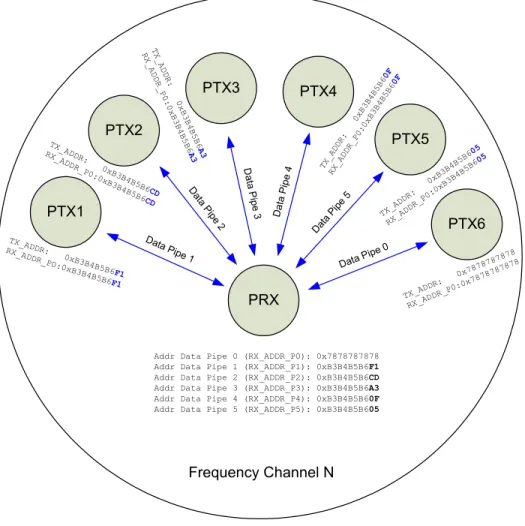
™MultiCeiver™ is a feature used in RX mode that contains a set of six parallel data pipes with unique add-resses. A data pipe is a logical channel in the physical RF channel. Each data pipe has its own physical address (data pipe address) decoding in the nRF24L01+.
Figure 12. PRX using MultiCeiver™
nRF24L01+ configured as PRX (primary receiver) can receive data addressed to six different data pipes in one frequency channel as shown in Figure 12. Each data pipe has its own unique address and can be con-figured for individual behavior.
Up to six nRF24L01+s configured as PTX can communicate with one nRF24L01+ configured as a PRX. All data pipe addresses are searched for simultaneously. Only one data pipe can receive a packet at a time. All data pipes can perform Enhanced ShockBurst™ functionality.
The following settings are common to all data pipes:
• CRC enabled/disabled (CRC always enabled when Enhanced ShockBurst™ is enabled)
PRX PTX1 PTX2 PTX3 PTX4 PTX5 PTX6 Data Pipe 1 D ata P ipe 2 D ata P ip e 3 Dat a P ipe 4 Data Pip e 5 Data Pi pe 0 Frequency Channel N
Each pipe can have up to a 5 byte configurable address. Data pipe 0 has a unique 5 byte address. Data pipes 1-5 share the four most significant address bytes. The LSByte must be unique for all six pipes.
Fig-ure 13. is an example of how data pipes 0-5 are addressed.
Figure 13. Addressing data pipes 0-5
0xC2 0xC2 0xC2 0xC2
0xC2 0xC2 0xC2 0xC2
0xC2 0xC2 0xC2 0xC2
0xC2 0xC2 0xC2 0xC2
Byte 4 Byte 3 Byte 2 Byte 1 Byte 0
0xC2 0xC2 0xC2 0xC2 0xC2
0xC3 0xC4 0xC5 0xC6 Data pipe 1 (RX_ADDR_P1)
Data pipe 2 (RX_ADDR_P2) Data pipe 3 (RX_ADDR_P3) Data pipe 4 (RX_ADDR_P4) Data pipe 5 (RX_ADDR_P5)
0xE7 0xD3 0xF0 0x35 0x77
The PRX, using MultiCeiver™ and Enhanced ShockBurst™, receives packets from more than one PTX. To ensure that the ACK packet from the PRX is transmitted to the correct PTX, the PRX takes the data pipe address where it received the packet and uses it as the TX address when transmitting the ACK packet.
Figure 14. is an example of an address configuration for the PRX and PTX. On the PRX the RX_ADDR_Pn,
defined as the pipe address, must be unique. On the PTX the TX_ADDR must be the same as the RX_ADDR_P0 and as the pipe address for the designated pipe.
Figure 14. Example of data pipe addressing in MultiCeiver™
PRX PTX1 PTX2 PTX3 PTX4 PTX5 PTX6 Data P ipe 1 D ata P ipe 2 D ata P ip e 3 Data Pip e 4 Data Pip e 5 Data Pi pe 0 Frequency Channel N TX_A DDR: 0 xB3B 4B5B 605 RX_A DDR_ P0:0 xB3B 4B5B 605 TX_A DDR: 0 xB3B 4B5B 60F RX_A DDR_ P0:0 xB3B 4B5B 60F TX _A DD R: 0 xB 3B 4B 5B6 A3 RX _A DD R_ P0 :0 xB 3B 4B 5B6 A3 TX_A DDR: 0 xB3B 4B5B6CD RX_A DDR_P0:0 xB3B4B5B 6CD TX_ADDR: 0 xB3B4B5B6 F1 RX_ADDR_P0:0 xB3B4B5B6 F1 TX_ADD R: 0 x78787 87878 RX_ADD R_P0:0 x78787 87878
Addr Data Pipe 0 (RX_ADDR_P0): 0x7878787878 Addr Data Pipe 1 (RX_ADDR_P1): 0xB3B4B5B6F1 Addr Data Pipe 2 (RX_ADDR_P2): 0xB3B4B5B6CD Addr Data Pipe 3 (RX_ADDR_P3): 0xB3B4B5B6A3 Addr Data Pipe 4 (RX_ADDR_P4): 0xB3B4B5B60F Addr Data Pipe 5 (RX_ADDR_P5): 0xB3B4B5B605
7.7 Enhanced ShockBurst
™timing
This section describes the timing sequence of Enhanced ShockBurst™ and how all modes are initiated and operated. The Enhanced ShockBurst™ timing is controlled through the Data and Control interface. The nRF24L01+ can be set to static modes or autonomous modes where the internal state machine con-trols the events. Each autonomous mode/sequence ends with an interrupt at the IRQ pin. All the interrupts are indicated as IRQ events in the timing diagrams.
Figure 15. Transmitting one packet with NO_ACK on
The following equations calculate various timing measurements:
Table 19. Timing equations
Symbol Description Equation
TOA Time on-air
TACK Time on-air Ack
TUL Time Upload
TESB Time Enhanced Shock-Burst™ cycle
TESB = TUL + 2 . Tstby2a + TOA + TACK + TIRQ 1 IRQ if No Ack is on.
TIRQ = 8.2µs @ 1Mbps, TIRQ = 6.0µs @ 2Mbps, Tstdby2a = 130us
Standby-I PLL Lock TX PTX IRQ PTX MODE UL PTX CE PTX SPI TOA Tstdby2a TUL IRQ: TX DS1 Standby-I TIRQ >10us [ ] [ ] [ ] [ ] [ ]
[ ]
bits rate data air bit bytes or bytes N bytes or byte byte bit rate data air length packetTOA preamble address payload CRC packetcontrolfield
9 2 1 5 4 , 3 1 8 ⎟+ ⎠ ⎞ ⎜ ⎝ ⎛ + + + ⋅ ⎥⎦ ⎤ ⎢⎣ ⎡ = = [ ] [ ] [ ] [ ] [ ]
[ ]
bits rate data air bit bytes or bytes N bytes or byte byte bit rate data air length packetTACK preamble address payload CRC packetcontrolfield
9 2 1 5 4 , 3 1 8 ⎟+ ⎠ ⎞ ⎜ ⎝ ⎛ + + + ⋅ ⎥⎦ ⎤ ⎢⎣ ⎡ = =
[
]
[ ]
bits rate data SPI bytes N byte bit rate data SPI length payload T payload UL ⋅ ⎥⎦ ⎤ ⎢⎣ ⎡ = = 8Figure 16. Timing of Enhanced ShockBurst™ for one packet upload (2Mbps)
In Figure 16. the transmission and acknowledgement of a packet is shown. The PRX device activates RX
mode (CE=1), and the PTX device is activated in TX mode (CE=1 for minimum 10µs). After 130µs the transmission starts and finishes after the elapse of TOA.
When the transmission ends the PTX device automatically switches to RX mode to wait for the ACK packet from the PRX device. When the PRX device receives the packet it sets the interrupt for the host MCU and switches to TX mode to send an ACK.After the PTX device receives the ACK packet it sets the interrupt to the MCU and clears the packet from the TX FIFO.
Standby 1 PLL Lock TX Standby 1
PTX IRQ PTX MODE UL PTX CE PTX SPI TOA 130us TUL PLL Lock TX RX
PLL Lock PLL Lock PLL Lock
PRX MODE PRX IRQ PRX CE RX PRX SPI TESB Cycle RX IRQ: TX DS TIRQ Standby 1 >10us
130us 130us TACK 130us
IRQ:RX DR/DL
In Figure 17. the PTX timing of a packet transmission is shown when the first ACK packet is lost. To see the complete transmission when the ACK packet fails see Figure 20. on page 46.
Figure 17. Timing of Enhanced ShockBurst™ when the first ACK packet is lost (2Mbps)
Standby I PLL Lock TX TX PTX IRQ PTX MODE UL PTX CE PTX SPI TOA 130us TUL PLL Lock >10us ARD Standby II RX
130us 250us max
PLL Lock 130us
7.8 Enhanced ShockBurst
™transaction diagram
This section describes several scenarios for the Enhanced ShockBurst™ automatic transaction handling. The call outs in this section’s figures indicate the IRQs and other events. For MCU activity the event may be placed at a different timeframe.
Note: The figures in this section indicate the earliest possible download (DL) of the packet to the MCU and the latest possible upload (UL) of payload to the transmitter.
7.8.1 Single transaction with ACK packet and interrupts
In Figure 18. the basic auto acknowledgement is shown. After the packet is transmitted by the PTX and
received by the PRX the ACK packet is transmitted from the PRX to the PTX. The RX_DR IRQ is asserted
after the packet is received by the PRX, whereas the TX_DS IRQ is asserted when the packet is
acknowl-edged and the ACK packet is received by the PTX.
Figure 18. TX/RX cycles with ACK and the according interrupts
1 Radio Turn Around Delay
TX:PID=1 RX PTX PRX RX ACK:PID=1 UL MCU PTX 130us1 IRQ DL MCU PRX Packet received IRQ: RX DR (PID=1) Ack received IRQ:TX DS (PID=1)
7.8.2 Single transaction with a lost packet
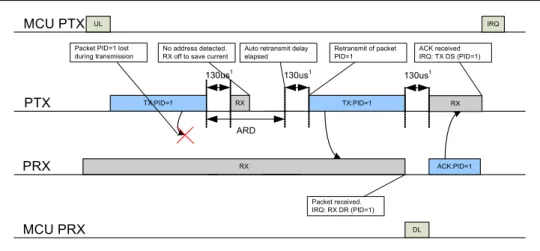
Figure 19. is a scenario where a retransmission is needed due to loss of the first packet transmit. After the
packet is transmitted, the PTX enters RX mode to receive the ACK packet. After the first transmission, the PTX waits a specified time for the ACK packet, if it is not in the specific time slot the PTX retransmits the packet as shown in Figure 19.
Figure 19. TX/RX cycles with ACK and the according interrupts when the first packet transmit fails
When an address is detected the PTX stays in RX mode until the packet is received. When the retransmit-ted packet is received by the PRX (see Figure 19.), the RX_DR IRQ is asserted and an ACK is transmitted
back to the PTX. When the ACK is received by the PTX, the TX_DS IRQ is asserted.
7.8.3 Single transaction with a lost ACK packet
Figure 20. is a scenario where a retransmission is needed after a loss of the ACK packet. The
correspond-ing interrupts are also indicated.
Figure 20. TX/RX cycles with ACK and the according interrupts when the ACK packet fails
TX:PID=1 RX PTX PRX RX ACK:PID=1 DL MCU PRX UL MCU PTX 130us1 TX:PID=1 RX IRQ ARD
Auto retransmit delay elapsed No address detected. RX off to save current
Retransmit of packet PID=1 Packet PID=1 lost
during transmission Packet received. IRQ: RX DR (PID=1) ACK received IRQ: TX DS (PID=1) 130us1 130us1
1 Radio Turn Around Delay
TX:PID=1 RX PTX PRX RX ACK:PID=1 DL MCU PRX UL MCU PTX 130us1 TX:PID=1 RX IRQ ARD
Auto retransmit delay elapsed No address detected. RX off to save current
Retransmit of packet PID=1
ACK PID=1 lost during transmission Packet received. IRQ: RX DR (PID=1) ACK received IRQ: TX DS (PID=1) ACK:PID=1 RX Packet detected as copy of previous, discarded 130us1 130us1
7.8.4 Single transaction with ACK payload packet
Figure 21. is a scenario of the basic auto acknowledgement with payload. After the packet is transmitted by
the PTX and received by the PRX the ACK packet with payload is transmitted from the PRX to the PTX. The RX_DR IRQ is asserted after the packet is received by the PRX, whereas on the PTX side the TX_DS
IRQ is asserted when the ACK packet is received by the PTX. On the PRX side, the TX_DS IRQ for the
ACK packet payload is asserted after a new packet from PTX is received. The position of the IRQ in Figure 21. shows where the MCU can respond to the interrupt.
Figure 21. TX/RX cycles with ACK Payload and the according interrupts
7.8.5 Single transaction with ACK payload packet and lost packet
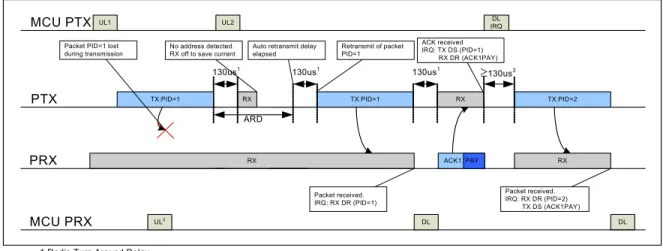
Figure 22. is a scenario where the first packet is lost and a retransmission is needed before the RX_DR IRQ
on the PRX side is asserted. For the PTX both the TX_DS and RX_DR IRQ are asserted after the ACK
packet is received. After the second packet (PID=2) is received on the PRX side both the RX_DR (PID=2)
and TX_DS (ACK packet payload) IRQ are asserted.
1 Radio Turn Around Delay 2 Uploading Payload for Ack Packet 3 Delay defined by MCU on PTX side, ≥ 130us
TX:PID=1 RX PTX PRX RX MCU PRX UL1 MCU PTX TX:PID=2 DL IRQ ACK received IRQ: TX DS (PID=1) RX DR (ACK1PAY) Transmit of packet PID=2 Packet received. IRQ: RX DR (PID=1) RX Packet received. IRQ: RX DR (PID=2) TX DS (ACK1PAY) DL IRQDL UL2 UL2 130us1 ≥130us3 ACK1 PAY TX:PID=1 RX PTX UL1 MCU PTX 130us1 TX:PID=1 RX No address detected. RX off to save current
Retransmit of packet PID=1 ACK received IRQ: TX DS (PID=1) RX DR (ACK1PAY) TX:PID=2 Auto retransmit delay
elapsed
130us1 130us1
Packet PID=1 lost during transmission
UL2 IRQDL
7.8.6 Two transactions with ACK payload packet and the first ACK packet lost
Figure 23. TX/RX cycles with ACK Payload and the according interrupts when the ACK packet fails
In Figure 23. the ACK packet is lost and a retransmission is needed before the TX_DS IRQ is asserted, but
the RX_DR IRQ is asserted immediately. The retransmission of the packet (PID=1) results in a discarded
packet. For the PTX both the TX_DS and RX_DR IRQ are asserted after the second transmission of ACK,
which is received. After the second packet (PID=2) is received on the PRX both the RX_DR (PID=2) and TX_DS (ACK1PAY) IRQ is asserted. The callouts explains the different events and interrupts.
7.8.7 Two transactions where max retransmissions is reached
Figure 24. TX/RX cycles with ACK Payload and the according interrupts when the transmission fails. ARC is set to 2.
MAX_RT IRQ is asserted if the auto retransmit counter (ARC_CNT) exceeds the programmed maximum limit
(ARC). In Figure 24. the packet transmission ends with a MAX_RT IRQ. The payload in TX FIFO is NOT
removed and the MCU decides the next step in the protocol. A toggle of the CE starts a new transmitting sequence of the same packet. The payload can be removed from the TX FIFO using the FLUSH_TX
com-mand. TX:PID=1 RX PTX PRX RX MCU PRX UL1 MCU PTX 130us1 TX:PID=1 RX ARD No address detected.
RX off to save current Retransmit of packet PID=1
ACK PID=1 lost during transmission Packet received. IRQ: RX DR (PID=1) ACK received IRQ: TX DS (PID=1) RX DR (ACK1PAY) RX ACK1 PAY TX:PID=2 RX UL2 ACK1 PAY Packet received. IRQ: RX DR (PID=2) TX DS (ACK1PAY) Auto retransmit delay
elapsed 130us1 130us1 DL UL12 DL IRQ DL IRQ UL22 RX ACK received IRQ: TX DS (PID=2) RX DR (ACK2PAY) ACK2 PAY 130us1 TX:PID=3 RX Packet received. IRQ: RX DR (PID=3) TX DS (ACK2PAY) UL3 ≥130us3 ≥130us3 Packet detected as copy of previous, discarded
1 Radio Turn Around Delay 2 Uploading Payload for Ack Packet 3 Delay defined by MCU on PTX side, ≥ 130us
TX:PID=1 RX PTX PRX RX MCU PRX UL MCU PTX 130us1 ARD No address detected. RX off to save current
Retransmit of packet PID=1
ACK PID=1 lost during transmission Packet received.
IRQ: RX DR (PID=1)
RX ACK1 PAY
Auto retransmit delay elapsed 130us1 130us1 DL UL2 IRQ ≥130us3 RX No address detected. RX off to save current
TX:PID=1 TX:PID=1 RX
130us1
ARD
ACK PID=1 lost during transmission ACK1 PAY
No address detected. RX off to save current. IRQ:MAX_RT reached
130us1
RX
ACK PID=1 lost during transmission
Packet detected as copy of previous, discarded
1 Radio Turn Around Delay 2 Uploading Paylod for Ack Packet 3 Delay defined by MCU on PTX side, ≥ 130us
7.9 Compatibility with ShockBurst™
You must disable Enhanced ShockBurst™ for backward compatibility with the nRF2401A, nRF2402, nRF24E1 and nRF24E2. Set the register EN_AA = 0x00 and ARC = 0 to disable Enhanced ShockBurst™.
In addition, the nRF24L01+ air data rate must be set to 1Mbps or 250kbps.
7.9.1 ShockBurst™ packet format
Figure 25. shows the packet format with MSB to the left.
Figure 25. A ShockBurst™ packet compatible with nRF2401/nRF2402/nRF24E1/nRF24E2 devices.
The ShockBurst™ packet format has a preamble, address, payload and CRC field that are the same as the Enhanced ShockBurst™ packet format described in section 7.3 on page 28.
The differences between the ShockBurst™ packet and the Enhanced ShockBurst™ packet are: • The 9 bit Packet Control Field is not present in the ShockBurst™ packet format.
• The CRC is optional in the ShockBurst™ packet format and is controlled by the EN_CRC bit in the CONFIG register.
8 Data and Control Interface
The data and control interface gives you access to all the features in the nRF24L01+. The data and control interface consists of the following six 5Volt tolerant digital signals:
• IRQ (this signal is active low and controlled by three maskable interrupt sources) • CE (this signal is active high and used to activate the chip in RX or TX mode) • CSN (SPI signal)
• SCK (SPI signal) • MOSI (SPI signal) • MISO (SPI signal)
Using 1 byte SPI commands, you can activate the nRF24L01+ data FIFOs or the register map during all modes of operation.
8.1 Features
• Special SPI commands for quick access to the most frequently used features • 0-10Mbps 4-wire SPI
• 8 bit command set
• Easily configurable register map
• Full three level FIFO for both TX and RX direction
8.2 Functional description
The SPI is a standard SPI with a maximum data rate of 10Mbps.
8.3 SPI operation
This section describes the SPI commands and timing.
8.3.1 SPI commands
The SPI commands are shown in Table 20. Every new command must be started by a high to low transi-tion on CSN.
The STATUS register is serially shifted out on the MISO pin simultaneously to the SPI command word shift-ing to the MOSI pin.
The serial shifting SPI commands is in the following format: <Command word: MSBit to LSBit (one byte)>
<Data bytes: LSByte to MSByte, MSBit in each byte first>
Command name word (binary)Command # Data bytes Operation
R_REGISTER 000A AAAA 1 to 5
LSByte first
Read command and status registers. AAAAA = 5 bit Register Map Address
W_REGISTER 001A AAAA 1 to 5
LSByte first
Write command and status registers. AAAAA = 5 bit Register Map Address
Executable in power down or standby modes only.
R_RX_PAYLOAD 0110 0001 1 to 32
LSByte first
Read RX-payload: 1 – 32 bytes. A read operation always starts at byte 0. Payload is deleted from FIFO after it is read. Used in RX mode.
W_TX_PAYLOAD 1010 0000 1 to 32
LSByte first
Write TX-payload: 1 – 32 bytes. A write operation