CHANGES IN THE SPERMATOGENESIS AND cAMP- RESPONSIVE ELEMENT MODULATOR (CREM) GENE EXPRESSION IN RAT TREATED WITH SALVIA
HYPOLEUCA
Estakhr Jasem, Javdan Nasim
Science and Research Branch, Islamic Azad University, Fars, Iran.
Corresponding Address: Jasem Estakhr, [email protected]. Tel: +989179283966
Summary
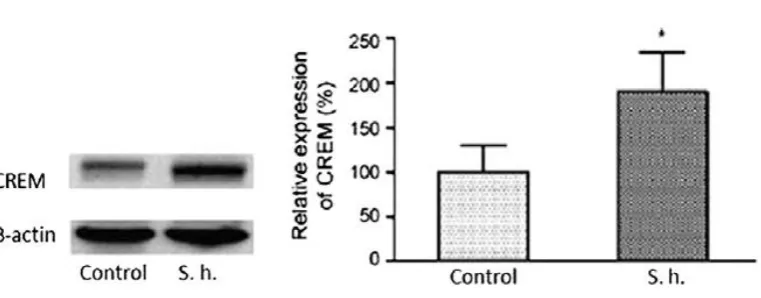
Salvia species which are medicinal herbs have been used to improve male reproductive functions in traditional medicine. They also, have been used to treat several diseases. In this present study, effects of Salvia hypoleuca on male rat reproductive function were investigated by sperm analysis and assessment of CREM expression at mRNA and protein levels. Two hundred and fifty mg/kg/day of S. hypoleuca as treatment was given to 10-week old male wistar rats for 56 consecutive days. Sperm analysis, RT-PCR and western blot were carried out to investigate rat reproductive function. Results indicated significant increase in the weights of testis, epididymal sperm counts, and sperm motility compared to control group. RT-PCR and western blot showed an increase in the expression of both CREM mRNA and protein levels.
KEYWORDS: Spermatogenesis; CREM expression; Saliva hypoleuca.
Corresponding author details:Jasem Estakhr, Email: [email protected]; Tel: +98917 9283966
Introduction
The plants of the genus Salvia, which consist about 900 species (8) are generally known for their multiple pharmacological effects such as analgesic and anti-inflammatory (9), antioxidant (10), hepatoprotective (11), hypoglycemic activities (12), and antiischemia (13,14). The results of recent studies have shown that some species of Salvia impress fertility in rat. The data obtained from previous studies clearly demonstrated that Salvia hematodes enhances the orientation of males towards the female by increased anogenital behavior and enhance licking and grooming of the genitals (15). This plant also increases the ejaculation latency. Salvia fruticosa produces adverse effects on the fertility of male and female rats (16). In this study, we examined the effect of Salvia hypoleuca on male reproductive function in rats, using sperm analysis. We also investigated the effect of S. hypoleuca on spermatogenesis by assessingCREMexpression at themRNAand protein levels.
Materials and methods
Plant material
S. hypoleuca was collected from Guilan province (Iran), and authenticated at Medicinal Plants & Drugs Research Institute, Shahid-Beheshti University, Tehran, Iran. Its leaves and fruits were dried, under shade and powdered. The extract was prepared by maceration method (80% ethanol in 300 g/l for 48 h), and was filtered with a filter paper. Ethanol was removed by a rotary evaporator. The extract was dissolved in normal saline and administrated orally into rats.
Animals and treatment
Male wistar rats purchased from Razi Institute, (Karaj, Iran) and were divided randomly into two groups consisting eight rats per group: control (rats treated with normal saline) and experimental (rats treated with 250 mg/kg/body weight S. hypoleuca). Experimental group administered S. hypoleuca extract (250 mg/kg/day) for 56 days.
Tissue preparation
At end of treatment rats were anesthetized by pentobarbital sodium. The testis was removed, cleared and weighed. Weights were expressed in term of 100 mg of body weight. The epididymis was removed and used for sperm analysis.
Sperm analysis
Epididymis was exposed by scrotal incision and sperms were expressed out by cutting distal end of the caudal epididymidal tubule. Sperms with epididymal fluid were diluted with physiological saline and sperm motility and morphology were studied. Spermatozoa were counted according to Zaneveld and Polakoski (17). Sperm suspension was placed on both sides of Neubauer’s hemocytometer and allowed to settle in a humid chamber for 1 h. The number of sperms in the appropriate squares of the hemocytometer was counted under the microscope of 100 magnification.
RNA isolation and RT-PCR
Total RNA isolation from rat testis
The aqueous phase was transferred to fresh tubes and isopropanol was added. The supernatants were incubated for 10 min at room temperature and centrifuged (12,000 rpm, 15 min, 4 _C); the RNA pellets were washed with 70% ethanol, air dried, and resuspended in diethylprocarbonation-treated water (DEPC-H2O). Total RNA samples were analyzed using gel electrophoresis. The final amount of RNA was estimated by determining the optical density at 260 nm.
cDNA synthesis and PCR-amplification
First strand cDNA synthesis with total RNA was performed using reverse transcriptase. Subsequently, PCR-amplification was performed by the method described Saiki et al. (18) the sequence of CREM primers were 50-GATTGAAGAAGAAAAATCAGA- 30 (forward primers, exon B) and 50-TTGACATATTCTTTCTTCTT- 30 (reverse primer, exon H), while for rat b-actin, AGGCATCCTGACCCTGAAGAT-30 and 50-TCTTCATGAGGTAGTCTGT-CAG-30 were used. The PCR products were separated on 1.5% agarose gels, visualized under UV light, and analyzed using NTSYS software.
Western blot
Proteins from homogenized testis were separated using a nuclear extract kit. The samples for protein extraction were half of the same testis used for RNA extraction. The protein extracts were separated in 10% tris-glycine gels by sodium dodecyl sulfate– polyacrylamide gel electrophoresis and transferred to nitrocellulose membranes electrophoretically. X-12 CREM-1 was used as the primary antibody against CREM-t, and conjugated goat anti-rabbit IgG was used as the secondary antibody. The antigens were detected using seePico CBB stain kit.
Statistical analysis
Data were expressed as mean± standard deviation. Student’s t-test was used to compare means. A level of p< 0.05 was considered as statistically significant.
Results
Table 1: Body, testicular weight, and sperm parameters of control and experimental groups.
Figure 1: RT-PCR analysis of CREM gene expression in testis from Salvia hypoleuca-treated rats. The left panel shows the expression of CREM and b-actin mRNA. The right panel, CREM mRNA levels are expressed as a ratio of those of the control group. Each column represents the mean ± S.D. *Shows that the mean differs significantly between the control and the Salvia hypoleuca-treated group (p<0.05).
Discussion
Results of our study indicated that S. hypoleuca affected sperm parameters and spermatogenesis in rat. In the present study treatment of rats with the extract of S. hypoleuca caused a significant increase in sperm count and motility, and decrease in sperm abnormalities compared with control group and increased testis weight of rats. CREM gene expression and protein level in rat testis treated with S. hypoleuca were higher compared with the control group. CREM is essential for spermatogenesis, and males lacking functional CREM gene are sterile due to their round spermatid maturation arrest (4,5,19). The CREM gene encodes the transcription activator CREM, which is highly expressed in male germ cells (20) and regulates the expression of many important post-meiotic genes (21). In addition, infertile men have substantial reduction or complete lack of both CREM protein and CREM mRNA. In present study, S. hypoleuca caused little change in body weight and no animal died during the study; no animal exhibited noticeable adverse effect from the administration of the extract. Results showed S. hypoleuca may increase male fertility by elevating sperm quality due to CREM expression at mRNA and protein levels.
Acknowledgements
We are thankful to staff of Medicinal Plants and Drugs Institute, Shahid-Beheshti University for providing necessary facilities for this study.
References
(1) Iammarrone E, Balet R, Lower AM, Gillott C, Grudzinskas JG. Male infertility. Best Pract Res Clin Obstet Gynaecol 2003;17:211–29.
(2) Hassun Filho PA, Cedenho AP, Lima SB, Ortiz V, Srougi M. Single nucleotide polymorphisms of the heat shock protein 90 gene in varicocele associated infertility. Int Braz J Urol 2005;31:236–42.
(3) Zhao GQ, Garbers DL. Male germ cell specification and differentiation. Dev Cell 2002;2:537–74.
(4) Blendy JA, Kaestner KH, Weinbaure GF, Nieschlag E, Schuetz G. Severe impairment of spermatogenesis in mice lacking the CREM gene. Nature 1996; 380:162 5.
(5) Nantel F, Monaco L, Foulkes NS, Masuilier D, Lemeur M, Henriksen K, et al. Spermiogenesis deficiency and germ cell apoptosis in CREM-mutant mice. Naturen 1996;380:159–62.
(6) Zargari A. Medical plants, Tehran: Tehran University; 2003, p. 3595–6.
(7) Rustayan A, Masoudi S, Monfared A, Komilizadeh H. Volstile constituents of three Salvia species grown wild in Iran. Flavor Fragrance J 1999;14:267–78.
(10) Cuppett SL, Hall CA. Antioxidant activity of the Labiatae. Adv Food Nutr Res 1998;42:245–71.
(11) Wasser S, Ho JM, Ang HK, Tan CE. Salvia miltiorrhiza reduce experimentally-induced hepatic fibrosis in rats. J Hepatol 1998;29:760–71.
(12) Jimenez J, Risco S, Ruiz T, Zarzuelo A. Hypoglycemic activity of Salvia lavandulifolia. Planta Med 1996;4:260–2.
(13) Akbar S, Tariq M, Nisa M. A study on CNS depressant activity of Salvia haematodes wall. Int J Crude Drug Res 1984;22:41–4.
(14) Yu WG. Effect of acetylsalvianolic acid A on Platelet function. Yao Xao Xue 1994;29:412–6.
(15) Islam MW, Tariq M, Ageel AM, Al-said MS, Al-yahya AM. Effect of Salvia haematodes on sexual behavior of male rats. J Ethnopharmacol 1991;33:67–72.
(16) Elbetieha A, Al-hamood MH, Alkofahi A, Bataineh H. Reproductive Toxicity potentials of Salvia fruticosa (Labiatae) in rats. J Ethnopharmacol 1998;61:67–74.
(17) Zaneveld LJD, Polakoski KL. Collection and physical examination of the ejaculation. In: Hafez ESE, editor. Techniques of human Andrology; 1977. p. 147–56. (18) Saiki RK, Bugawan TL, Horn GT, Mullis KB, Erlich HA. Analysis of enzymatically amplified beta-globin and HLA-DQ alpha DNA with allele-specific oligonucleotide probes. Nature 1986;324:163–6.
(19) Steger K, Klonisch T, Govenis K, Behr R, Schaller V, Drabent B, et al. Round spermatids show normal testis-specific H1t but reduced cAMP-responsive element modulator and transition protein 1 expression in men with round spermatid maturation arrest. J Androl 1999;20:747–54.
(20) Foulkes NS, Mellstrom B, Benusiglio E, Sassone-Corsi P. Developmental switch of CREM function during spermatogenesis: from antagonist to activator. Nature 1992;355:80–4.