IJEDR1703150
International Journal of Engineering Development and Research (
www.ijedr.org
)
1064
Effect of cetane improver on the performance and
emission characteristics of biodiesel fueled DI diesel
engine with exhaust gas recirculation technique
1
Anaveerappa,
2Dr.M.C.Navindgi
1P.G. Student Thermal Power Engineering1Department Of Mechanical Engineering PDA College of Engineering, Kalaburgi, Karnataka. India, 2Professor Department of Mechanical Engineering PDA College of Engineering, Kalaburgi, Karnataka. India ________________________________________________________________________________________________________ Abstract— Cetane improver in biodiesel-blend with exhaust gas recirculation technique (EGR) reveals the marginal reduction in NOx emission compared with base line diesel fuel without EGR. Addition of cetane improver, 2-ethyl hexyl
nitrate (2EHN) reduces the ignition delay, which in turn minimizes the combustion temperatures. Exhaust gas recirculation (EGR) also reduces the maximum temperature in engine cylinder. The present work signifies the addition of 2% by volume cetane improver in Pongamia biodiesel blends with EGR technique towards NOx reduction. The experiment and investigations were conducted on Single-cylinder, four stroke, naturally aspirated, water cooled, DI diesel engine at constant, speed 1500 rpm and injection pressure 180 bar. The results revealed in improved brake thermal efficiency with increase in EGR percentage and little variation in brake specific fuel consumption. Combustion finished earlier with advanced, ignition and peak pressure by few degrees of crank angle. Marginal NOx reduction found up to 31%, with reduced CO, HC and little
variation in smoke emission for B20I with 15% EGR when compared with diesel fuel emissions.
keywords — Cetane improver, biodiesel-blend, exhaust gas recirculation (EGR), 2-ethyl hexyl nitrate (2EHN), and injection pressure.
________________________________________________________________________________________________________
I. INTRODUCTION
The transportation fuels have become increasingly important to the world economy due to its employment to energize the transportation industry. Increase in fuels demand, due to the increase in world population. Projected the need of 113 million barrels of hydrocarbon fuel (conventional petroleum based fuel) per day in 2030, the transportation sector accounts up to 74 percent [17]. In addition emission of harmful pollutants like NOx (nitrogen oxides) and particulate matter from conventional petroleum based engines is a concerned issue. Moreover, the production of carbon dioxide gas from these engines, which is marked as a global warming gas, is not readily acceptable keeping in mind the environmental constraints.[2] Faster depletion and increased emission of fossil fuels are the motivating factors for the development of alternative energy sources. Biodiesel is gaining momentum as an alternative to petroleum diesel, since the properties of the biodiesel are close to that of diesel. Biodiesel entails some advantages over diesel as the former has in built oxygen, which helps in reducing the emissions like CO, HC and Particulates. However, higher viscosity of biodiesel affects some processes such as atomization, vaporization and fuel air mixing. Furthermore, increased NOx on the other hand is another disadvantage associated with bio- diesel usage.[1] Among the available biodiesels Pongamia biodiesel is used for the experimentation, as it is easily produced from the Pongamia seeds by transesterification process and are readily made available. The use of biodiesel necessitates the NOx reduction techniques like exhaust gas recirculation, which is recirculation of a part of the exhaust gas into the intake which helps in reducing the NOx. Oxygen content in biodiesel is the primary source for NOx to increase, as nitrogen has a tendency to react with oxygen at higher temperatures in the combustion chamber and increases NOx[18]. Additives such as oxygenates, bio additives and cetane number improvers have been used, former additives are used to improve the fuel qualities such as viscosity, heating value etc, the later cetane number improvers are used to increase the cetane number of the fuel. cetane number is an inverse function of a fuel's ignition delay, and the time period between the start of injection and the first identifiable pressure increase during combustion of the fuel. In a particular diesel engine, higher cetane fuels will have shorter ignition delay periods[2].
In the Present work, the biodiesel prepared from transesterification process by extracting the crude Pongamia oil from the Pongamia seed (locally called Honge seed). Different diesel-biodiesel blends such as B10I, B20I and B30I (B30 indicates 30% biodiesel and I indicates ignition or cetane improver) with 2% by volume additive cetane improver, 2-Ethyl Hexyl Nitrate (2EHN) having chemical formula: C8H17NO3, were prepared by flash mixing. The said blends used as fuel in single cylinder, four stroke, DI diesel engine with different EGR percentage. The combined effect of cetane improver and EGR technique were investigated on the performance, emission and combustion characteristics of DI diesel engine.
II. EXPERIMENTAL SET-UP AND PROCEDURE
IJEDR1703150
International Journal of Engineering Development and Research (
www.ijedr.org
)
1065
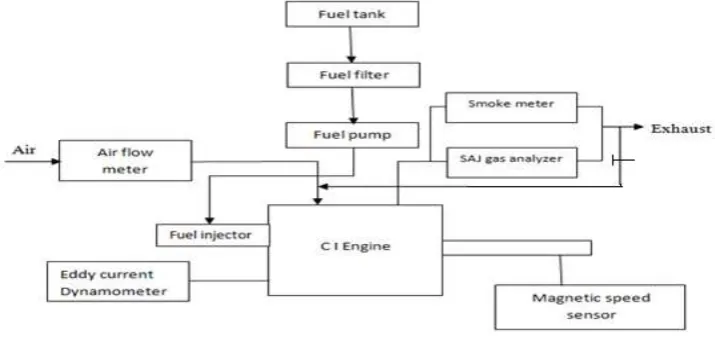
consists of a control valve and a manometer. This engine has used for investigation of performance, combustion and emission characteristics of biodiesel and diesel blends.The engine is operated at a constant speed of 1500 rpm. The first stage experiment has performed with pure diesel at different loads from idle load to full load with EGR percentage such as 0%, 5%, 10% and 15% at constant speed. The engine loads are controlled by eddy current dynamometer. The exhaust gases are tapped from the exhaust pipe and connected to the inlet air flow passage. The percentage of EGR is varied with the help of an EGR control valve which is fixed in the intake passage pipe control. The second stage of the experiment has conducted using various blends of diesel-biodiesel with cetane improver 2EHN 2% by volume (designated as B10I, B20I and B30I).
Figure 1.Schematic diagram of diesel engine for experiment set up. Table 1 Specification of test diesel engine.
Manufacturer Kirloskar oil engines Ltd, India Working cycle four stroke
Model TV-SR, naturally aspirated Injection pressure 200bar/23 deg before TDC
Engine Single cylinder, DI Type of sensor Piezo electric
Bore/stroke 87.5mm/110mm Response time 4 micro seconds
C.R. 17.5:1 Crank angle sensor 1-degree crank angle
Speed 1500r/min, constant Resolution of 1 deg 360 deg with a resolution of
1deg Rated power 5.2kw
III. RESULTS AND DISCUSSIONS.
Performance characteristics.
Increase in BTE can be found with increase in load. BTE of pure Pongamia biodiesel, and all other blends B10I, B20I, B30I is below that of diesel fuel. Maximum brake thermal efficiency found at 75% full load. From the fig. 2 it is evident that B20I blend has the highest brake thermal efficiency compared with other blends. The close value to diesel fuel is because of improved combustion characteristics such as reduced ignition delay, by the addition of 2EHN and it is just 3-4% lower than that of diesel fuel. The maximum thermal efficiency obtained for diesel, biodiesel, B10I, B20I and B30I blends are, 28.36%, 25.12%, 26.17%, 27.02% and 26.32 respectively. Figure 3 shows the effect of EGR on the optimum blend B20I. The BTE is increasing with increase in EGR percentage due to re-combustion of unburned hydrocarbons and increase in initial ignition temperature. The combined effect of 2EHN and EGR brought the BTE very close to diesel fuel i.e. 28.21% where as diesel has 28.36%. The diesel-biodiesel blend B20I with 15% EGR is considered as best for performance.
IJEDR1703150
International Journal of Engineering Development and Research (
www.ijedr.org
)
1066
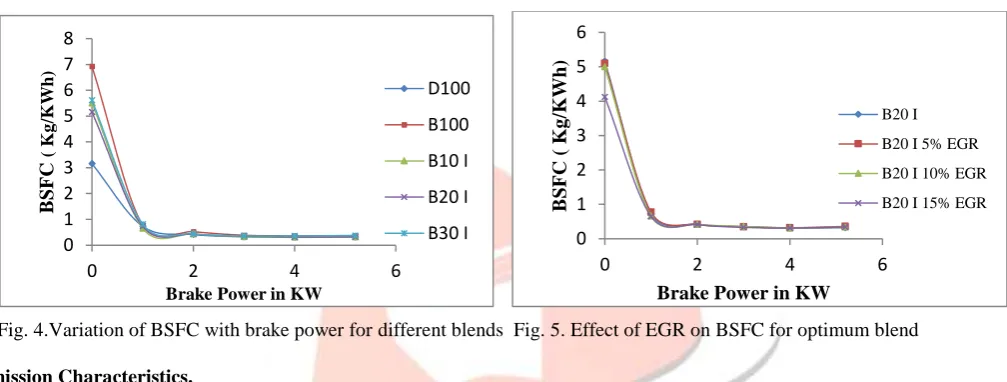
amount of fuel supply from governor. B20I blend with 15 percentage EGR found decreased BSFC, 0.31 at full load and it is best suitable for alternate to the diesel.Fig.2.Variation of BTE with brake power for different blends. Fig. 3. Effect of EGR on BTE for optimum blend
Fig. 4.Variation of BSFC with brake power for different blends Fig. 5. Effect of EGR on BSFC for optimum blend Emission Characteristics.
Figure 6 shows the variation of nitrogen with brake power for different blends. NOx emission is one of the important factor in diesel engine. It has more impact on environment and health, due to this reason NOx reduction necessitates. NOx emission in biodiesel is much higher, due to oxygen content in biodiesel, which is the primary source for increase in NOx and has a tendency to react with oxygen at higher temperatures in the combustion chamber and increases NOx. On addition of Cetane improver, 2EHN reduced the ignition delay, which in turn reduced the combustion temperatures thereby reduced the NOx emissions of all other blends. Fig 6 shows the reduction in the NOx emission as the reduction in Pongamia biodiesel percentage reduces. B20I blend emission is little higher then B10I as the tradeoff between performance, percentage of biodiesel and emission, B20I blend is selected as optimum. Fig. 7 shows that EGR and 2EHN have a combined effect on reducing NOx emissions significantly. At 15% EGR, biodiesel blend B20 with 2EHN demonstrates greater reduction in NOx against diesel without EGR which is 31% less. The reason for the greater reduction in NOx with combined EGR and 2EHN is the reduction of combustion temperature as a result of the addition of exhaust gases to the intake air which increases the amount of combustion accompanying gases mainly CO2 which reduces the combustion temperature. Still higher EGR rates could reduce NOx emissions by a large amount, which, however, is accompanied by a reduction in BTE and an increase in CO, HC and smoke emissions.
Smoke is the visible product of diesel engine emission. The comparison of smoke opacity of B10I, B20I, B30I, B100 with petroleum diesel with respect to brake power is shown in fig. 8 It is observed that as compared with diesel the smoke opacity of biodiesel and its blends with cetane improver are higher at part load and as the load increases the smoke opacity is effectively reduced up to 35-40%. The formation of local rich mixtures in the combustion chamber due to high viscosity of biodiesel results in poor atomization at part load operations. At higher loads the smoke formation is diminished may be because of oxygenated nature of biodiesel that leads to complete combustion.
Fig.9 shows the comparison of smoke emission between diesel and optimum blend, B20I with 15% EGR. Smoke emission significantly increased as 16.06 1/m where as diesel has 2.93 1/m.
Combustion characteristics.
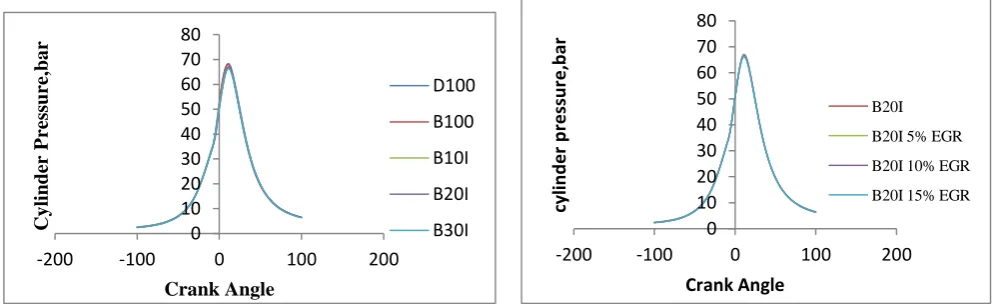
The variation in cylinder pressure with crank angle for D100, B100 B10I, B20I and B30I is shown in fig.10 It can be observed that cylinder pressure of biodiesel blends with diesel follows similar trend as that of conventional fuel under various operating conditions. Fig. 10 shows the maximum cylinder pressure for various biodiesel blends at different loads. It also revealed that, as load increases, maximum pressure increases for all tested fuels.
0 5 10 15 20 25 30
0 2 4 6
B
T
E
(
%)
Brake Power in KW
D100
B100
B10 I
B20 I
B30 I
0 5 10 15 20 25 30
0 2 4 6
B
T
E
(
(
%)
Brake Power in KW
B20 I
B20 I 5% EGR
B20 I 10% EGR B20 I 15% EGR
0 1 2 3 4 5 6 7 8
0 2 4 6
B
SFC
(
K
g
/K
W
h
)
Brake Power in KW
D100
B100
B10 I
B20 I
B30 I 0
1 2 3 4 5 6
0 2 4 6
B
SFC
(
K
g
/K
Wh)
Brake Power in KW
B20 I
B20 I 5% EGR
B20 I 10% EGR
IJEDR1703150
International Journal of Engineering Development and Research (
www.ijedr.org
)
1067
Fig.6 Variation of NOx emission with brake power for different blends Fig .7 Effect of EGR percentage on NOx emission
Fig. 8 Variation of smoke emission with BP for different blends. Fig. 9 Effect of EGR percentage on smoke emission
Maximum peak pressure fond identical for B100, B10I and B30I but, the peak pressure of B20I is slightly higher 2-3% then the rest of the blends. Fig. 11 shows the effect of EGR on optimum blend at 0, 5, 10 and 15 % EGR. It is observed that maximum cylinder pressure decreases slightly with increase in EGR. It is also seen from these graphs that the injection of biodiesel blends is advanced by a few degrees of crank angle, and consequently peak pressure is pre-poned by 2 - 3° crank angle and the combustion is finished earlier than that of diesel. Maximum cylinder pressure Pmax is 68.35 bar has been recorded for diesel while Pmax of 66.07 bar has been recorded for optimum blend B20I with 15% EGR.
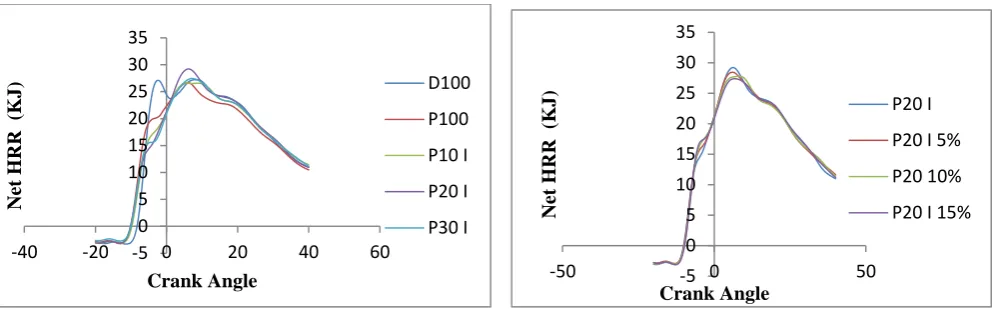
Figure 12 shows the variation of net heat release rate with crank angle for diesel and biodiesel blends. The first peak HRR is low as compared with diesel for all blends. It may be because of early fuel injection and early start of combustion. Second and highest Peak of HRR of B20I is higher than diesel, due to 2EHN the complete combustion and increased velocity of combustion. The maximum HRR for diesel is 27.22 J/0C where as 26.68, 26.61, 29.22 and 27.46 J/0C for B100, B10I, B20I and B20I respectively. Fig. 13 shows the variation of net heat release rate with crank angle for optimum blend B20I with 0, 5, 10 and 15 % EGR percentage. Higher EGR percentage decreased the peak HRR of all the fuels including diesel. The highest peak HRR for B20I at 0, 5, 10 and 15% EGR are 29.22, 28.45, 27.63 and 27.42 J/0C respectively, where as diesel has 27.05 J/0C. Compared with diesel, the crank angle of maximum heat release rate of biodiesel blends are preponed by few degrees, due to ignition delay is reduced by cetane improver to the biodiesel blends, which is an indication of better ignition quality of the blends.
Fig. 10 Variation of engine cylinder peak pressure with Fig. 11 Effect of EGR percentage on cylinder pressure Crank angle for different blends
0 200 400 600 800 1000
0 2 4 6
NO x em is sio n (P P M )
Brake Power in KW
D100 B100 B10 I B20 I B30 I 0 100 200 300 400 500 600 700
0 2 4 6
NO x em is sio n (P P M )
Brake Power in KW
B20 I
B20 I 5% EGR B20 I 10% EGR B20 I 15% EGR -1 0 1 2 3 4 5
0 2 4 6
Sm o k e K ( 1 /m )
Brake Power in KW
D100 B100 B10 I B20 I B30 I -5 0 5 10 15 20
0 2 4 6
Sm o k e K ( 1 /m )
Brake Power in KW
B20 I
B20 I 5% EGR B20 I 10% EGR B20 I 15% EGR 0 10 20 30 40 50 60 70 80
-200 -100 0 100 200
Cy lin der P re ss ure, ba r Crank Angle D100 B100 B10I B20I B30I 0 10 20 30 40 50 60 70 80
-200 -100 0 100 200
cy lin d e r p re ssur e ,b ar Crank Angle B20I
B20I 5% EGR
B20I 10% EGR
IJEDR1703150
International Journal of Engineering Development and Research (
www.ijedr.org
)
1068
Fig. 12 Variation of net HRR with crank angle for Fig.13 Effect of EGR percentage on net HRR. different blends
IV. CONCLUSION
The conclusions confirmed from the experimental investigation on diesel engine fueled with Pongamia biodiesel blends with the combined use of cetane improver, 2EHN and the EGR are summarized as follows:
1) The Pongamia biodiesel satisfies the important properties like density, viscosity. Flash point, fire point and calorific value as per ASTM standards. This can be used in diesel engine without any engine modification. And performance emission and combustion results are comparable with petroleum based fuel.
2) The increase in load increases the BTE for all blends including diesel fuel. The B20I biodiesel blend with addition of 2% 2EHN approaches just 3-4% below the diesel value. On introducing EGR, BTE increase with EGR rate, up to certain limit. The BTE value of B20I with 15% EGR observed 0.5% less compared to diesel.
3) BSFC at idle run with biodiesel fuel is higher and decreases as the percentage of biodiesel is decreased in blends. At higher loads it is almost same as diesel fuel.
4) Significant reduction in NOx emission up to 30-35 % as compared with diesel fuel, B20I with 15% EGR emits 31% less NOx. Further increase in EGR rate may further reduce in NOx emission, but it influences negative effects on performance and other emissions.
5) The emission of CO and HC for Pongamia biodiesel blends with cetane improver are less as compared with diesel. And increases with the increase in EGR rate. It has observed that, B20I with 15% EGR emits CO 10% and HC 11% less, compared with diesel. Whereas smoke emission is little much higher side.
6) The combustion of Pongamia biodiesel blends with 2% 2EHN, reduces the ignition delay, and advances the ignition by 2-3 degrees of crank angle. Peak pressure and net heat release rate also advanced by 2-3 degrees of crank angle.
Thus, Results indicate that the combined effect of cetane improver, 2EHN and EGR technique can be used effectively for reducing NOx emission. Hence the most disadvantageous factor in using biodiesel can be avoided. The blend B20I with 15% EGR can be used in DI diesel engine in place of diesel as an alternate fuel.
REFERANCES
[1] K. Venkateswarlu1, B. S. R. Murthy ,V. V. Subbarao: An experimental investigation to study the effect of fuel additives and exhaust gas recirculation on combustion and emissions of diesel–biodiesel blends, The Brazilian Society of Mechanical Sciences and Engineering 2016, vol.38:735–744 DOI 10.1007/s40430-015-0376-7
[2] Wu Yu, Gen Chen, Zuohua Huang: Influence of cetane number improver on performance and emissions of a common-rail diesel engine fueled with biodiesel-methanol blend, Front. Energy 2011, 5(4): 412–418 DOI 10.1007/s11708-011-0163-9. [3] Pani Sharanappa, Mallinath. C. Navindagi, A study of fuel properties of ternary blend diesel- Mahuva methyl ester-Ethanol,
International Journal of Mechanical And Production Engineering, ISSN: 2320-2092, Special Issue, Sep.-2016
[4] Pani Sharanappa, Mallinath. C. Navindagi, Effect of Exhaust Gas Recirculation on Performance and Emission of Direct Ignition Diesel Engine Fuelled with Diesel-Biodiesel-Ethanol Blend, International Journal on Emerging Technologies (Special Issue on ICRIET-2016) 7(2): 148-153(2016)
[5] D.H. Qia∗, C.F. Lee b,c, P.P. Wanga and S.T. Wua, Effect of ethanol on the performance, emission and combustion characteristics of a compression ignition engine fuelled with vegetable oil–diesel blend, International Journal of Ambient Energy, 2016 Vol. 37, No. 3, 284–293, http://dx.doi.org/10.1080/01430750.2014.962087,
[6] Best Practices Manual from a Secor Groep of CEFIC DecSmber 2005, Fuel Additive Packages containing 2-Ethylhexyl nitrate (2EHN).
[7] K.Nantha Gopal, R Thundil Karupparaj, Effect of Pongamia biodiesel on emission and combustion characteristics of DI compression ignition engine, Ain Shams Engineering Journal (2015) 6, 297–305.
[8] J. Hemanandh, K.V. Narayanan, Emission and performance analyses of hydro-treated refined sunflower oil as alternate fuel, Alexandria Engineering Journel 2015.
[9] Mohd Hafizil Mat Yasina, Rizalman Mamata*, Ahmad Fitri Yusopa, Perowansa Parukaa, Talal Yusafband Gholamhassan Najafic, Effects of Exhaust Gas Recirculation (EGR) on a Diesel Engine fuelled with Palm-Biodiesel, The 7th International Conference on Applied Energy – ICAE2015”
-5 0 5 10 15 20 25 30 35
-40 -20 0 20 40 60
Net
H
RR
(
K
J
)
Crank Angle
D100
P100
P10 I
P20 I
P30 I
-5 0 5 10 15 20 25 30 35
-50 0 50
Net
H
RR
(
K
J
)
Crank Angle
P20 I
P20 I 5%
P20 10%
IJEDR1703150
International Journal of Engineering Development and Research (
www.ijedr.org
)
1069
[10]S. Senthilkumar, G Shivakumar, Sidharth Manoharan, Investigation of Palm methyl ester biodiesel with additives onperformance and emission characteristics of diesel engine under 8 mode testing cycle, Alexandria Engineering Journel 2015.
[11]A.Rama Krishna , B.Prabakaran, Performance and emission characteristics of cottonseed oil Methyl ester in a diesel engine, Arja , 4(3): March, 2015, ISSN: 2277-9655 Scientific Journal Impact Factor: 3.449 (ISRA), Impact Factor: 2.114. [12]N.Vadivela, P.Somasundaramb, M.Krishnamoorthia, Performance and emission characteristics of a ci engine fueled with
diesel –biodiesel (mahua/mustard) blend with diethyl ether additive, Journal of Chemical and Pharmaceutical Sciences(2015), ISSN: 0974-2115.
[13]Xiaoyan Shi, Xiaobing Pang, Yujing Mu, Hong He , Shijin Shuai, Jianxin Wang, Hu Chen, Rulong Li.(2005), Emission reduction potential of using ethanol–biodiesel–diesel fuel blend on a heavy-duty diesel engine, Atmospheric environment vol.40 (2016) 2567-2574.
[14]Vijayaraj, K. and A.P. Sathiyagnanam, Experimental investigation of methyl ester of cotton seed oil blend with diesel on ci engine, American Journal of Applied Sciences vol. 11 (10): 1819-1829, 2014.
[15]Xiaohu Fan1, Xi Wang, Engine Performance Test of Cottonseed Oil Biodiesel, The Open Fuels & Energy Science Journal, 2008,vol. 1, 40-45
[16] Leon G. Schumacher, Fueling diesel engines with Blends of methyl ester Soybean oil and diesel fuel.
[17] Santoshkumar KH, Dr.Omprakash. D. Hebbal, Performance emission and combustion characteristics of C.I engine using blends of methanol and Pongamia biodiesel, project report submitted to PDA college of engineering in 2015.