Munich Personal RePEc Archive
A perspective on the recent
developments in international financial
reporting
Dima (Cristea), Stefana Maria and David, Delia and
Păiuşan, Luminiţa
4 November 2010
Online at
https://mpra.ub.uni-muenchen.de/27306/
A PERSPECTIVE ON THE RECENT DEVELOPMENTS IN
INTERNATIONAL FINANCIAL REPORTING
Ştefana DIMA (CRISTEA), PhD Lecturer,
Email address: [email protected]
DELIA DAVID, PhD Lecturer, Email address: [email protected]
LUMINIŢA PĂIUŞAN, Lecturer, PhD Student,
Email address: [email protected]
Vasile Goldiş Western University of Arad Faculty of Economic Sciences Address: 15, Mihai Eminescu St., Arad, Romania Tel: +40 257 213066
Abstract
The objective of the present paper is to provide a synopsis of the recent international financial reporting developments as well as to identify some of the related worldwide implications. The unprecedented joint activity of the International Accounting Standards Board (IASB) and US Financial Accounting Standards Board (FASB) has caused, in the last decade, a series of debates on whether or not International Financial Reporting Standards (IFRSs) represent what is best of the international accounting practices. The adoption of these IFRSs by more than one hundred jurisdictions around the world is probably one of the most important recent changes in financial information environment. In this context it is imperative to examine the position of the United States of America and European Union in relation to the endorsement of these standards, in order to differentiate the institutional decisions able to influence greatly the adoption process. Moreover, this paper explores several aspects connected to the changes in IASB’s conceptual framework and in the main accounting standards. From the proposed analysis, it emerges the image of IASB’s standards complex nature and the role played by these recent developments in reshaping the future of accounting.
1. INTRODUCTION
Due to the growing interdependence of economies around the world, the global economic and financial crisis had influenced greatly the general public’s perception on financial reporting issues. The role that accounting plays in the contemporary society has been largely debated over the last two years as a wide range of key organizations such as UNCTAD, G-8 Finance Ministers, G-20 Summit, the European Council of Ministers and the United States Congress paid more attention to the need for a sound accounting language able to ensure financial and economic stability.
Recently, at the Pittsburgh Summit, the G-20 leaders urged the international accounting bodies to speed up their convergence efforts in order to achieve a single set of high quality global accounting standards by June 2011. In addition, in its declaration of April, 2nd, 2009, the G-20 agreed that the standard setters should consider the following aspects:
(a) Reduce the complexity of accounting standards for financial instruments;
(b) Strengthen accounting recognition of loan-loss provisions by incorporating a broader range of credit information;
(c) Improve accounting standards for provisioning, off-balance sheet exposures and valuation uncertainty; (d) Achieve clarity and consistency in the application of valuation standards, internationally, working with
supervisors;
(e) Make significant progress towards a single set of high quality global accounting standards;
(f) Within the framework of the independent accounting standard-setting process, improve the involvement of stakeholders, including prudential regulators and emerging markets, through the IASB’s constitutional review.
regulators to improve standards on valuation and provisioning in order to achieve the desired set of high quality global accounting standards.
However, beyond the difficult task to rise up to these expectations, the increasing complexity of IFRSs as well as its growing volume has put many developing and in transition countries in a constant struggle to keep up with the frequent changes in these standards. For this reason and not only, at the June 2009 United Nations Conference on the World Financial and Economic Crisis and its Impact on Development, many representatives “stressed the importance of strengthening the international financial system to overcome severe impacts of the current crisis and to help prevent the occurrence of similar crises in the future”1. In this regard, the representatives identified some major challenges related to IFRSs implementation (a – d) and financial reporting in a distressed economic situation (e – i), such as:
(a) the complexity of accounting standards;
(b) the need for additional guidance on their practical implementation (as valuation of financial instruments);
(c) the suitability of international accounting standards for SMEs;
(d) a number of other important technical matters (e.g. fair value measurement). (e) measurement in illiquid markets (particularly of financial instruments); (f) the pro-cyclicality of IFRSs;
(g) provisioning aspects;
(h) risk management and related disclosures and audit considerations;
(i) financial reporting’s objective to provide early warning signals to avert major financial disasters.
As a response to the crisis, IASB and FASB have established in 2009 a Financial Crisis Advisory Group (FCAG) which comprises around 20 senior leaders experienced in international financial markets’ related aspects. The role of FCAG is to advise the two Boards in regard to the implications that the financial crisis alongside the possible changes in the global regulatory environment might have on standard-setting. The latest report of the FCAG articulates four main principles and contains a series of recommendations to improve the functioning and effectiveness of global standard-setting. The main areas addressed by the report are: effective financial reporting; limitations of financial reporting; convergence of accounting standards; standard setter independence and accountability.
Hence, due to the evolution of the financial and economic crisis, we can state that the convergence process between the two boards, IASB and FASB, had to speed up. In this context, the qualitative research represented by the present paper will examine the status of the convergence process as well as its main outcomes, including the responses to the expectations of the above mentioned organizations and the standpoints of the United States of America and European Union in relation to the endorsement of these standards.
2. RECENT DEVELOPMENTS IN THEIASB -FASB CONVERGENCE PROCESS
2.1. The status of the convergence process
At the moment, more than 120 jurisdictions from around the world permit or require IFRSs for domestic listed companies2. In this context, the implementation of IFRSs worldwide depends greatly on the status of the convergence process and on the standpoints of the US Securities and Exchange Commission (SEC) and of the European Union; since these are the “trend setters” for companies planning to get listed on the most developed financial markets in the world.
Thus, it worth mentioning that through the Norwalk Agreement in October 2002, FASB and IASB committed for the first time to eliminate the differences in the accounting treatments stipulated by IAS/IFRS and US GAAP. In addition, the two Boards decided to co-ordinate their future activities in order to ensure that, once achieved, compatibility is maintained. Moreover, in February 2006 (and updated in 2008), the Boards released a new Memorandum of Understanding (MOU) identifying short-term and long-term convergence projects and setting the steps and milestones towards achieving convergence. Recently, as reaction to the pressure exercised by international groups and organizations, IASB and FASB reaffirmed
1
United Nations (2009). Conference on the World Financial and Economic Crisis and Its Impact on Development. A/Conf.214/3.New York. 24–25 June.
2
their commitment to convergence by issuing a statement outlining steps for completing the major joint projects by 2011.
To this decision contributed in certain extend the standpoint of US SEC in regard to IASB-FASB convergence process, since right at the beginning of the economic and financial crisis, the SEC’s decision to drop the reconciliation requirements for foreign registrants that adopt IFRSs came as a surprise. Till November 2007, the foreign companies had two choices: either to prepare US GAAP based financial statements or to fill a reconciliation form of net income and net assets to US GAAP (Form 20-F). Thus, this was the case for more than 1.100 non-US companies of the approximately 15,000 companies registered with SEC. The cost of such reconciliation for European companies was between 1 and 10 million euros annually depending on their size and field of activity (McCreevy, 2005).
However, due to the progress of the convergence process, SEC dropped these requirements and allowed the use of IFRSs as issued by the IASB; by this, meaning the full set of standards including the carve-out made by the European Union and the continuous amendments to IFRSs.
Moreover, in August 2007, SEC launched a public debate on whether or not to allow US domestic issuers to prepare IFRS financial statements for the purpose of complying with the rules and regulations of the SEC. To show its clear intentions, in November 2008, SEC published for a proposed “IFRS roadmap”, which outlines the milestones that, if achieved, may lead to mandatory transition to IFRS starting December 2014; certain entities are allowed to adopt IFRS in advance. In addition, in February 2010, the SEC published a Statement in Support of Convergence and Global Accounting Standards aiming at facilitating the development and execution of a “Work Plan” that will enable SEC to reach a decision regarding the use of IFRSs by US issuers by 2015 /2016.
On the other hand, endorsement of IFRSs for use in the European Union is a long and complex process involving a series of EU institutions. According to the EU Accounting Regulation, IFRSs must be individually endorsed for use in Europe. The steps of the endorsement process are3:
(a) EU translates the IFRSs into all European languages;
(b) European Financial Reporting Advisory Group (EFRAG) gives its views to the European Commission (EC);
(c) Standards Advice Review Group (SARG) gives its views to the EC on EFRAG’s recommendations; (d) EC’s Accounting Regulatory Committee (ARC) makes an endorsement recommendation;
(e) EC submits the endorsement proposal to the European Parliament’s Regulatory Procedure with Scrutiny Committee and to the 27-member Council of the EU. Both must approve endorsement or the proposal is sent back to the EC for further consideration.
So far, the European Commission voted:
♦ to endorse all IFRSs except the revisions to IFRS 1 and IAS 24;
♦ to endorse all Interpretations except IFRIC 19 and the amendments to IFRIC 14; ♦ the latest standard’s endorsement (IFRS 9) has been postponed.
In regard to the last statement, after assessing the costs and benefits that this standard’s implementation might have4, EFRAG stated that endorsement would lead to reliable and comparable information. However, both EFRAG and ARC postponed the decision on IFRS 9 implementation arguing that "more time should be taken to consider the output from the IASB project to improve accounting for financial instruments"5. IASB attempted to reply to the European Commission expressed concerns, such as that the standard would have resulted in expanded application of fair value accounting, in particular when it is not the most decision useful measurement basis. The EU has linked this issue to the G20’s and ECOFIN Council’s objective to ensure that accounting standards do not undermine financial stability while improving decision making process. Thus, the issuance of IFRS 9 caused a dispute that tested the boundaries of current EC and IASB relationship. An exchange of official letters was carried out and this situation has begun to have a negative on European investors’ perception of recent changes in the field of financial instruments. Even some Member States started to show some discomfort with IFRS 9 based on country particularities. In order to calm things down, the European Commissioner McCreevy stated on 19.11.2009 that "The European
3
Regulation (EC) No. 1606/2002 of the European Parliament and of the Council of 19 July 2002, Official Journal L 243, 11 September 2002; 2006/505/EC Commission Decision of 14 July 2006 setting up a Standards Advice Review Group to advise the Commission on the objectivity and neutrality of the European Financial Reporting Advisory Group's (EFRAG’s) opinions 4
Available on-line at http://www.iasplus.com/efrag/0911draftendorsementadviceifrs9.doc accessed on December 13, 2009 5
Commission remains fully committed to IFRS as the single set of globally accepted accounting standards"6. The Commission will continue to assess all the aspects of the new standards, remaining for the next college of Commissioners to take a final decision in regard to this.
2.2. Major IASB -FASB convergence projects
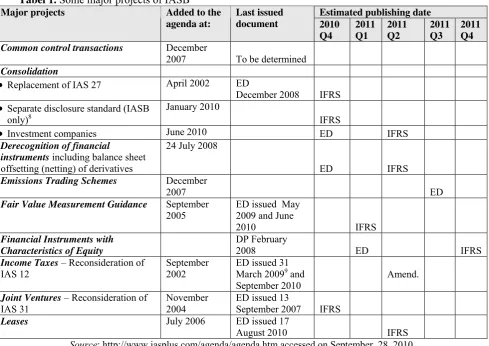
[image:5.595.56.546.266.612.2]In the last years, it became increasingly difficult even for experienced professionals to stay up-to-date with the developments in the IFRSs. As previously stated the expectations of Financial Stability Forum, G 20 leaders and other global organizations dominated the IASB’s working agenda. In response to the global financial crisis, IASB has launched a number of projects (such as fair value measurement and financial instruments). Moreover, IASB: had amended requirements on the reclassification of some financial assets from fair value categories to amortized cost categories; issued additional technical guidance on the determination of fair values of financial assets in illiquid / inactive markets; IASC Foundation made amendments to its governance structures as part of its 2008-2010 Constitution Review and included a regular formal consultation with constituents on the IASB’s priorities and Agenda since this year.
Tabel 1. Some major projects of IASB7
Estimated publishing date
Major projects Added to the
agenda at:
Last issued
document 2010
Q4 2011 Q1 2011 Q2 2011 Q3 2011 Q4
Common control transactions December
2007 To be determined
Consolidation
• Replacement of IAS 27 April 2002 ED
December 2008 IFRS • Separate disclosure standard (IASB
only)8
January 2010
IFRS
• Investment companies June 2010 ED IFRS
Derecognition of financial
instruments including balance sheet offsetting (netting) of derivatives
24 July 2008
ED IFRS
Emissions Trading Schemes December
2007 ED
Fair Value Measurement Guidance September 2005
ED issued May 2009 and June
2010 IFRS
Financial Instruments with Characteristics of Equity
DP February
2008 ED IFRS
Income Taxes – Reconsideration of IAS 12
September 2002
ED issued 31 March 20099 and September 2010
Amend.
Joint Ventures – Reconsideration of IAS 31
November 2004
ED issued 13
September 2007 IFRS
Leases July 2006 ED issued 17
August 2010 IFRS
Source: http://www.iasplus.com/agenda/agenda.htm accessed on September, 28, 2010
Apart from the projects expected to be completed in the near future and revealed by Table 1, there are several other projects on IASB’s Agenda (revenue recognition, financial statements presentation, installments on impairment, hedge accounting and so on). We shall address in more detail two of the major ones:
A) Financial Instruments: Presentation, classification, recognition, measurement and disclosures;
B) IASB’s conceptual framework: The objective of financial reporting & Qualitative characteristics of useful financial information.
6
Available on-line at http://www.iasplus.com/europe/0911responsefrommccreevy.pdf accessed on December 15, 2009 7
ED – exposure draft; DP – discussion paper.
8
for a reporting entity's involvement with other entities that are not in the scope of IAS 39/IFRS 9 (including subsidiaries, associates and joint arrangements and unconsolidated SPEs/structured entities)
9
A) Financial Instruments: Presentation, classification, recognition, measurement and disclosures
At present, the set of IASs/IFRSs issued by IASB includes four standards in the area of financial instruments as follows:
■ IAS 32 Financial Instruments: Presentation;
■ IAS 39 Financial Instruments: Recognition and Measurement;
■ IFRS 7 Financial Instruments: Disclosures;
■ IFRS 9 Financial Instruments: Classification and Measurement.
In April 2009, IASB had decided to undertake a three-stage modification of IAS 39:
a)
Classification and Measurement of Financial Instruments: this first stage has closed on financial assets with the consultative due process of September 2009 and was followed on November, 12 by the issuance of IFRS 9, which will replace IAS 39 from 2013, with early adoption permitted starting in 2009. In respect to financial liabilities, an exposure draft is expected in the second quarter of 2010 (final IFRS expected in the second half of 2010);b)
Impairment and Provisioning: the IASB issued an exposure draft on impairment in October 2009 (Final IFRS expected on the fourth quarter of 2010);c)
Hedge Accounting: IASB is expected to issue an exposure draft in the second quarter of 2010 (final IFRS expected in the fourth quarter of 2010 or the first quarter of 2011).The general idea was that stakeholders, including investors, consider indispensable the revision of IAS 39 (Papa, 2010). On 7 October 2010, IASB issued amendments to IFRS 7 as part of its comprehensive review of off balance sheet activities; these amendments will allow users of financial statements to improve their understanding of transfer transactions of financial assets (for example, securitizations), including understanding the possible effects of any risks that may remain with the entity that transferred the assets; also, these will broadly align the relevant disclosure requirements of IFRSs and US GAAP.
B) IASB’s conceptual framework: The objective of financial reporting & Qualitative characteristics of useful financial information
The purpose of this joint IASB and FASB project was to “create a sound foundation for future accounting standards that are principles-based, internally consistent and internationally converged”10. The intention was to have a framework dealing with a broad range of accounting issues and based on the current IASB and FASB frameworks. The IASB has revised portions of its framework; while the FASB has issued ‘Concepts Statement 8’ to replace ‘Concepts Statements 1 and 2’. The initial plan was to complete the entire project by 2010, however taking into account the busy working schedule of both boards and the numerous comments received for each phase, the deadline postponed several times. The entire project started in 2005 and it has eight phases: Phase A: Objective and qualitative characteristics; Phase B: Elements and recognition; Phase C: Measurement; Phase D: Reporting entity; Phase E: Presentation and disclosure; Phase F: Purpose and status of framework; Phase G: Applicability to not-for-profit entities; Phase H: Other issues.
Out of the eight phases, we shall address the first phase consisting so far in the two chapters published this year: Chapter 1 The objective of financial reporting, respectively Chapter 3 Qualitative characteristics of useful financial information. These chapters will replace the respective paragraphs of the 1989 Conceptual Framework’s version. This first stage represents a significant change from the previous framework as shown by the essential aspects shortly reviewed here:
The main categories of financial information users are believed to be the investors and the creditors, by considering that the interests and information needs of these categories are identical and cover the interests of all the other categories. We agree with EFRAG (2008: 7), considering that the informational needs of the users are not homogenous and a hierarchy of these is required;
In regard to the qualitative characteristics of financial information, the concept of reliability is replaced with faithful representation. This modification seems more a change of substance, one which takes place
10
in the American Conceptual Framework as well. In Chapter 3, there remain only two main qualitative characteristics relevance and faithfulrepresentation (IASB, 2010: QC5);
Materiality is no longer a constraint (IASB, 2008: QC27), but an entity-specific aspect of relevance based on the nature or magnitude, or both, of the items to which the information relates in the context of an individual entity’s financial report (IASB, 2010: QC11);
Comparability, verifiability, timeliness and understandability are qualitative characteristics that enhance the usefulness of information that is relevant and faithfully represented (IASB, 2010: QC19). In the 1989 version, comparability and understandability were seen as main qualitative characteristics, timeliness was one of the requirements for the financial information to be relevant and credible, while verifiability was not explicitly referred to as a credibility aspect;
In both Framework versions, cost is a pervasive constraint on useful financial reporting. Since reporting financial information imposes costs, and it is important that those costs are justified by the benefits of reporting (IASB, 2010: QC35);
The substance over form principle and the prudence concept are omitted. The first one - seen by IASB as included into the other characteristics – is in fact of enormously importance for the ensuring the accounting improvement in all jurisdictions. The second principle - considered obsolete by the IASB’s proposal– would continue to be useful especially in countries not accustomed to IFRS and which rely on professional judgment.
CONCLUSIONS
The present paper provides a synopsis of the recent international financial reporting developments in the context of the current financial and economic crisis. We notice that the convergence process between the two boards, IASB and FASB, had to speed up due to external pressure represented by the expectations of certain international organizations and institutions, including US SEC, European Union, G-20 leaders, UNCTAD and so on.
Thus, IASB and FASB had to deal with several joint projects in the same time, in order to address these expectations. As reducing the complexity of accounting standards for financial instruments was one of the core issues in the recent debates involving global financial reporting, we discussed shortly the IASB’s project on the matter. Also, many of the reflections in the previous paragraphs concentrate on the improvement of the accounting Conceptual Framework as doctrinal basis for the present and future projects of IASB and as a support and guidance for the further application around the world. The choice of this project among all the important projects that IASB and FASB have on their active agenda is motivated by the great importance this phase and its subsequent developments would have on the entire set of IFRS and consequently on the international business environment.
Therefore, from the proposed analysis, emerges the image of IASB’s standards complex nature and the great role played by these recent developments in reshaping the future of accounting.
REFERENCES
EFRAG (2008), “EFRAG’s Comment Letter on the Exposure Draft of An Improved Conceptual Framework for Financial Reporting: Chapter 1 and 2”, available at http://www.efrag.org/ files/EFRAG%20public%20letters/ Conceptual%20Framework/Phase%20A/EFRAGs%20comment%20letter%20on%20Framework%20DP%20on%20C hapters%201%20and%202.pdf accessed on January, 20, 2009
IASB (2008), “Exposure Draft Conceptual Framework for Financial Reporting: The Objective of Financial Reporting and Qualitative Characteristics and Constraints of Decision-Useful Financial Reporting Information”
IASB (2010), “Conceptual Framework for Financial Reporting 2010”, available at http://www.ifrs.org/NR/rdonlyres/ 0BD5A2FE-1659-44D1-9074-FE07E4459E6D/0/CFFeedbackStatement.pdf accessed on September, 28, 2010 G20 Working Group 1 (2009), Enhancing Sound Regulation and Strengthening Transparency. Final Report, available at
http://www.g20.org/Documents/g20_wg2_010409.pdf accessed on October, 20, 2010
Papa, V. (2010) “IFRS 9 - A Perspective on Financial Instrument Accounting” available on-line at http://www.webcpa.com/news/IFRS-9-Perspective-Financial-Instrument-Accou nting-53015-1.html accessed on February, 27, 2010
McCreevy, C., (2005), EC Strategy on Financial Reporting: progress on convergence and consistency, Brussels, December, 1, 2005, discourse at the European Federation of Accountants' (FEE) Seminar on International Financial Reporting Standards (IFRS)