1
Molecules and the Eigenstate Thermalization Hypothesis
David M. Leitner Department of Chemistry
University of Nevada, Reno, NV 89557, USA Email: [email protected]
Abstract
We review a theory that predicts the onset of thermalization in a quantum mechanical coupled non-linear oscillator system, which models the vibrational degrees of freedom of a molecule. A system of N non-linear oscillators perturbed by cubic anharmonic interactions exhibits a many-body localization (MBL) transition in the vibrational state space (VSS) of the molecule. This transition can occur at rather high energy in a sizable molecule because the density of states coupled by cubic anharmonic terms scales as ~ N3, in marked contrast to the total density of states, which scales as exp(aN), where a is a constant. The emergence of a MBL transition in the VSS is seen by analysis of a random matrix ensemble that captures the locality of coupling in the VSS, referred to as local random matrix theory (LRMT). Upon introducing higher order anharmonicity, the location of the MBL transition of even a sizable molecule, such as an organic molecule with tens of atoms, still lies at an energy that may exceed the energy to surmount a barrier to reaction, such as a barrier to conformational change. Illustrative calculations are provided, and some recent work on the influence of thermalization on thermal conduction in molecular junctions is also discussed.
1. Introduction
The Eigenstate Thermalization Hypothesis (ETH) provides justification for replacing time averages with ensemble averages of closed quantum mechanical systems [1-4]. For chemists the ETH offers at least partial rationale for the application of microcanonical transition state theory (TST) to predict the rate of, say, the conformational change of a molecule. However, concerns about whether molecules thermalize under their own dynamics have long been raised [5-9]. In the following, we think of a molecule as a quantum mechanical system of coupled nonlinear oscillators. The system of uncoupled oscillators is integrable and does not obey the ETH. If, upon perturbation, the ETH is valid for the coupled oscillator system, i.e., molecule, the time-average for a molecule exploring the vibrational state space (VSS, sketched in Fig. 1) can be replaced by an ensemble average. The molecule, prepared out of equilibrium, relaxes to equilibrium and stays there, with few significant deviations, as time progresses. However, the ETH is often not satisfied for molecules [9]. The vibrational eigenstates of even a large molecule are often localized in the VSS, an example of many-body localization (MBL) [10]. In this article, we review criteria for MBL in the VSS of a large molecule, and discuss implications for the validity of the ETH for molecules, its application in reaction rate theory and thermal transport through molecules.
oscillators. We excite the molecule to a state out of equilibrium, illustrated by one of the lattice points in Fig. 1. Since the states are coupled by anharmonic interactions, the system is no longer integrable and may thermalize. However, coupling in the VSS is local. If we, e.g., consider for now only cubic anharmonic interactions, sites that lie at most a distance 3 positions away from the state in which the molecule was prepared are directly coupled. Even if the total density of states of the molecule is quite large, relatively few states are coupled by the cubic anharmonic interactions. More specifically, though the total density of states increases as exp(aN), where N is the number of oscillators and a is a constant, the local density of states coupled by the cubic anharmonic interactions increases only as N3. The magnitude of the coupling needed for the ETH to be valid is therefore much larger than if all zero-order states of the VSS were coupled. We cannot, of course, simply truncate the interactions to third-order in the anharmonicity, since higher-order terms, while relatively small, are numerous and become more important in establishing quantum ergodicity as N increases. Nevertheless, the locality of coupling remains important.
occupies such a state is the microcanonical TST reaction rate. The formalism for this calculation, named for four of its developers and called RRKM theory (Rice-Ramsperger-Kassel-Marcus theory) [22-24], continues to enjoy wide use [25]. We shall point out below one of a number of important cases where the theory fails to predict the reaction rate to illustrate how the breakdown of the ETH and the emergence of MBL in molecules manifest themselves in chemistry.
2. Criteria for quantum ergodicity in molecules
The coupled nonlinear oscillator Hamiltonian is H = H0 + V,
H0 = ea( ˆ n a) a=1
N
å
(1a)V= 1
3! fabg ba
++b a
(
)
a,b,g
å
bb++b b(
)
bg++b g(
)
, (1b)where the sum in Eq. (1b) excludes . The zero-order Hamiltonian H0 consists of
a sum over the energies of the N nonlinear oscillators, where each oscillator has frequency , and nonlinearity , and the number operator is defined by n ˆ a = ba+ba. The potential in Eq. (1) includes cubic anharmonic coupling. We will modify the Hamiltonian to address anharmonicity of higher order later.
We take the set of zero order energies, {ea}, and the cubic anharmonic coefficients, fabg, to be random variables with suitable distributions. For example, the distribution of zero-order energies will be determined in part by the distribution of normal mode frequencies of the molecule. Eq. (1) represents the perturbation of the integrable system, H0, and we seek criteria for which the perturbation leads to an ergodic system,
LRMT has the form of a tight-binding picture in the VSS with random site energies. Each site in the VSS is an eigenstate j of the uncoupled Hamiltonian, H0. If
there are na(j) quanta in oscillator in state j , then this zero-order state is given by
for the N oscillator system. In this basis, given the locality of the coupling between the zero-order states, the coupled many-oscillator Hamiltonian is equivalent to a tight-binding Hamiltonian,
H = ej
j
å
j j + Vj,k j k j,k(k¹j)å
, (2)where the sums run over all sites in the VSS. The problem of quantum energy flow and ergodicity in the VSS of a molecule thereby resembles the problem of single-particle quantum transport on a many-dimensional disordered lattice. Theoretical approaches to address the condensed phase problem can be brought to bear on describing vibrational energy flow in molecules. Exploiting this connection, Logan and Wolynes identified criteria for localization in the VSS that occurs at a critical value of the product of the vibrational coupling and local density of states [7]. This is an example of many-body localization (MBL), which has been the focus of much attention in recent years [10, 31, 35-39].
The eigenstates El of H are expressed in terms of j as
El = cjl
j
å
j . (3)microcanonical average depends on the coefficients,
{ }
cjl . When an eigenstate of H is localized to state j the molecule will not relax to a Bose-Einstein distribution. More generally, consider an observable, O. Individual El O Eˆ l will not generally resemble the microcanonical average at energies close to the total energy of the molecule when an eigenstate of H is localized to state j . When the ETH is valid, El O Eˆ l exhibits fluctuations that are exponentially small in N, so that any El O Eˆ l lies very close to the microcanonical average [1-4]. We expect the ETH to be valid if El is extended andoverlaps many zero-order states, where cjl 2 is of the order of the inverse of the number of states on the energy shell, which grows exponentially with N. This is the result one obtains when the distribution of the eigenvectors of H are those of random matrix ensembles such as the Gaussian Orthogonal Ensemble (GOE), which have been suggested to model spectral statistics of quantum systems for which the corresponding classical system exhibits chaos [40]. We seek to learn under what conditions we can make this association for molecules.
The local density of states,
r
3(E), coupled to a zero-order state of the VSS via third-order anharmonic interactions scales with the number of oscillators, N, as N3. LetV3 be the average magnitude of an off-diagonal matrix element that couples two states
via third-order anharmonic interactions. Detailed analysis reveals that the eigenstates of H are localized when [7],
T(E)º2p
3
(
V3 r3)
2Indeed, one finds that the probability distribution of cjl 2corresponds to the Porter-Thomas distribution when T > 1 [27], the result for the GOE. More specifically, we obtain for the probability distribution foryº cjl2, where the transition criterion has been satisfied [27],
Py(y)=
(
2py y)
-1/2exp(
-py/ (2 y ))
. (5)The Porter-Thomas distribution is predicted to describe the distribution of cjl 2for extended eigenstates of a many-body system when T > 1 as well as the eigenstates of a low-dimensional system at energies where the corresponding classical Hamiltonian exhibits chaotic dynamics [40, 41]. We thus expect that when T > 1 the ETH should hold for molecules.
In general we need to consider higher-order anharmonic coupling. We thus generalize the Hamiltonian to include anharmonic coupling of arbitrary order. We express a coupled nonlinear oscillator Hamiltonian, H = H0 + V, as [9, 26]
H0 = ea( ˆ n a) a=1
N
å
(6a)V=
m
å
Fm(a
Õ
ba+)ma+(ba) ma
, (6b)
where m={m1±,m2±...}. As expressed by Eq. (6b), V includes anharmonicity of all orders. For example, cubic anharmonicity includes terms where ma±
a
å
is at most 3. For higherorder anharmonicity, we assume [9, 26] Fm= F3
s
p-3
which has been validated numerically for molecules [42]. As in a random matrix theory, the set of zero order energies, {ea}, and coefficients, {Fm}, are treated as random variables with suitable average and variance for each m.
To lowest order in the perturbation expansion [9], in which only direct resonant coupling is taken into account, one finds the criterion for localization [9, 26],
T(E)º2p
3 Q
å
=3á|VQ|ñrQ é ë ê ê ù û ú ú 2<1, (8)
where Q represents an order in the anharmonic coupling. (Corrections due to higher-order terms in the perturbation expansion have been addressed and T(E) retains a form like Eq. (8) [9, 26, 43]) In the limit where N/ is of order 1 or less, terms beyond Q = 3 make little contribute to T and a potential truncated at cubic anharmonic interactions is sufficient. However, when N is very large, higher order terms need to be taken into account. More specifically, let M be the average occupation number of each oscillator and
w
rms the root-mean-square oscillator frequency; one finds that a good approximation to Tis [26]
T(E)=2p 3
˜ f 2s6F2
(k), (9a)
k=2NM1/ 2
s , (9b)
˜
f
= F3(
pw
rms)
-1. (9c)
F(k)=
( )
2p -1/2 Q-1 keQ æ è ç ö ø ÷
Q=3
å
Qæ
è
çç öø÷÷. (9b)
≈ – 1, if this is greater than 3, and is otherwise the cubic anharmonic term [26]. Since often ≈ 10 [42], the model given by Eq. (1), where the anharmonicity is truncated at third order, provides a reasonable predictor for the localization transition for many molecules, but for molecules with ~ 10 or more atoms we need to consider higher order anharmonic terms to locate the localization transition.
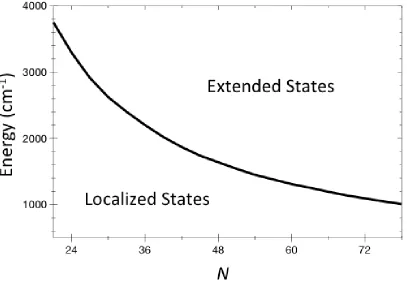
We can plot the separation of localized from extended states in terms of parameters that represent vibrational properties of the molecule, and its energy. We do this in Fig. 2, where we plot values of energy where T = 1 using Eq. (9) at different N from 21 to 78. We have used as representative values F3 = 6.4 cm-1,
w
rms= 1127 cm-1, and = 10. (1 cm-1 corresponds to about 1.5 K.) Some of these values have been obtained for the molecule stilbene, which is discussed in the next section, but they are anyway reasonable and representative of a sizable organic molecule. Importantly, the energy for which localized states are found can be higher than barriers to chemical reactions, even for large molecules. Reactions such as the change of structure of a molecule often occur over energy barriers on the order of 1000 cm-1.3. Quantum ergodicity and the kinetics of conformational change
reasonable amount of time). If A and B are stable structures, the transition from one structure to another is a rare event that involves passage through a transition state, A*.
The reaction rate may be conveniently calculated using equilibrium statistical mechanics to determine the probability, P*, that a molecule in structure A is in a transition state, A*. The reaction rate is then calculated as the product of P* and the rate to pass from the transition state to structure B, which we will call A. The reaction rate, k(E), at
energy E is thus A P*. In practice, P* is very small and A may be on the order of ps-1 or
faster. There are well-developed methods for carrying out such calculations, notably RRKM theory, mentioned in Sec. 1, which have been applied to the calculation of rates of unimolecular reactions, those in which a molecule, after collision or photoexcitation, forms a new chemical species. We do not review RRKM theory here; the calculation is straightforward and has been applied for many years [44]. We refer to the RRKM theory microcanonical unimolecular reaction rate as kRRKM(E).
In microcanonical transition state theory there is an implicit assumption about
relaxation times, which can be seen as follows: Consider the kinetic model A«
kIVR
k'IVR
A*®
nA
B.
Here kIVR is the rate constant for what is often referred to as intramolecular vibrational redistribution (IVR), specifically for population transfer from a state of the transition region to a state outside the transition region. k'IVR is the rate constant for population transfer from a state outside the transition region to a state in the transition region. Detailed balance gives k'IVR=kIVRP*(E), where P*(E) is the probability that the reactant is in a transition state at energy, E. As already noted, the RRKM theory rate constant is
k(E)= kIVR(E)
kIVR(E)+nA(E)
kRRKM(E) (10)
This correction to kRRKM includes the relaxation time, 1/kIVR, to equilibrate
following depletion of a transition state due to reaction in the time 1/A. Therefore, for the
formalism of RRKM theory to provide an accurate estimate to the rate of conformational change both the ETH must be satisfied and the relaxation rate must be faster than the vibrational time for passing from a transition state to product. If the energy barrier to a reaction such as a conformational change, or isomerization, lies below the energy at which the ETH is valid then RRKM theory clearly breaks down, and alternatives that address dynamics at these energies are required [45]. Even if the ETH is valid for that molecule at energies above the reaction barrier, the rate of reaction is often lower than predicted by RRKM theory due to the correction introduced in Eq. (10). In that case transition rates, kIVR, in the VSS need to be calculated separately to calculate the rate of reaction.
defined energy. If isomerization occurs more rapidly than fluorescence the rate can be detected.
Isomerization of trans stilbene is only observed at energies corresponding to about 1200 cm-1 or more vibrational energy in the excited electronic state [47]. Therefore 1200 cm-1 was assumed to be close to the barrier to reaction [48]. However, as seen in Fig. 3, the RRKM theory rate calculated with that barrier was nevertheless found to be an order of magnitude greater than the rates that were measured [13] for the isomerization of trans stilbene in molecular beams. After ab initio electronic structure calculations set the reaction barrier at about 800 cm-1, it was recognized that the reason reaction was not observed at energies between about 800 and 1200 cm-1 is that the molecule is prepared experimentally in states that do not have access to transitions states, from where it can react, at least before it fluoresces back to the ground electronic state. Using LRMT, the quantum ergodicity threshold for stilbene was found to correspond to about 1200 cm-1 [15, 16]. Therefore, above 1200 cm-1 the molecule has access to transition states regardless of the state in which it is prepared.
4. Thermalization and thermal transport in molecules
Recently there has been much interest in the role of thermalization in thermal conduction through molecular junctions [50-72]. The study of thermal conduction through molecules from of order 10 to 1000 atoms [14, 73-84] has been motivated by the more general desire to control thermal transport at the nanoscale towards the design of nanoscale devices [85, 86], small composite materials in which interfaces often mediate heat flow. Work on this problem has been driven by potential applications that include avoiding high concentrations of heat in small devices [85, 86], thermoelectric applications [87], the possibility of thermal rectification at the nanoscale [57, 88-93], and the contribution of thermal gradients to electron transfer [58, 65, 66].
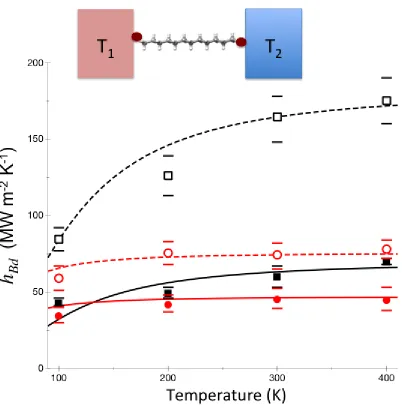
On molecular scales of ~ 1 nm, the energy diffusion picture and Fourier’s heat law break down, as revealed by numerous experimental measurements probing vibrational energy and thermal transport in molecules, which indicate absence of thermalization and often ballistic heat transport [50, 51, 56, 94-96]. Of course, a molecule at a junction, such as the alkane chain illustrated in Fig. 4, is not isolated. Still, we may ask if the molecule where isolated whether it would thermalize under its own dynamics, or if, for energies corresponding to thermal energies in experiments, thermalization does not occur? If a molecule exhibits MBL when isolated, it thermalizes only very slowly when its end-groups are in contact with its environment, and thus does not thermalize on a time that is relevant to thermal transport in a junction on the nm length scale [64]. We illustrate this here for alkane chains.
individual molecules occurs in parallel [97]. Bonding between molecule and substrate has been found to control thermal transport at the interface [50, 59], but in studies that have controlled for bonding while varying the length of the molecule [97] conductance does not appear to change in many cases, for example for alkane chain monolayers, indicating that thermal transport through the molecule occurs essentially ballistically. In the absence of thermalization a quantum mechanical approach based on the Landauer method, which neglects effects of inelastic scattering and thermalization [51, 98, 99], may be appropriate for modeling thermal conduction. The Landauer formalism, introduced to quantify electrical conductance in mesoscopic systems [100, 101], can be applied to thermal transport through molecules between two leads at different temperature. We find that this approach yields results for the thermal conductance through alkane chains and fluorinated alkane chains bridging gold and sapphire that are in good agreement with experiment [56], as shown in Fig. 4.
1.6 nm in length, to 10 units, about 4 nm in length. Differences in predictions where thermalization does and does not occur are striking. For these systems, separate calculations indicate that thermalization is expected to be quite rapid, and we expect thermal conductance to rise more rapidly with temperature than the Landauer model predicts. Which of these trends actually occurs can be settled by the kind of experiments [56] that were carried out on alkane and perfluoroalkane chains, which produced the results plotted in Fig. 4.
For sufficiently slow thermalization, a calculation that neglects thermalization altogether can predict thermal conduction in a molecular junction quite well. In this respect, the question of whether or not the ETH is valid for the molecule that forms the junction is not that important. Nevertheless, quantum mechanical effects that give rise to localization in the VSS of isolated molecules can substantially reduce the rate of thermalization when the molecules form a junction. For example, an isolated alkane chain with 15 carbon atoms and energy corresponding to about 200 K is predicted to exhibit localization in the VSS. Even accounting for coupling to the leads, the rate of thermalization, below 0.1 ps, is much too slow to influence thermal conduction through the ≈ 2.5 nm junction [64]. Longer alkanes thermalize in ~ 1 ps, fast enough that thermalization in the junction may contribute to thermal conduction.
5. Conclusions
space (VSS) of the molecule. This transition can occur at rather high energy in a sizable molecule. If the Hamiltonian includes only cubic anharmonic interactions, the density of states coupled by cubic anharmonic terms scales as ~ N3, in marked contrast to the total density of states, which scales as exp(aN), where a is a constant. The locality of coupling is due to the selection rules that arise from the anharmonic interactions, which is incorporated in a random matrix ensemble, as has been done for other selection rules in random matrix models [41, 102-104]. The emergence of a MBL transition in the VSS (Fock space) of this system is obtained by analysis of a random matrix ensemble that captures the locality of coupling in the VSS, and we refer to this approach as local random matrix theory (LRMT). LRMT has been generalized to include anharmonicity of order greater than 3 and applied to locate the MBL transition for many molecules [9]. We have provided an illustrative calculation here that reveals that for the ETH to be valid, even a sizable molecule, with tens of atoms, may require energy that exceeds the energy to surmount a barrier to reaction.
research topic [105-125]. We have also reviewed here some recent work examining the role of thermalization in thermal conduction in molecular junctions.
Computational studies of coupled many-oscillator systems [126], reviewed elsewhere [9, 127], support the picture presented here, and we expect future computational work will further probe the localization transition in the VSS of molecules and the validity of the ETH. We also anticipate that the MBL transition in molecules will be further tested by experimental and computational studies of the vibrational states of cold molecules and their chemistry in cold environments [128-148].
Acknowledgements
Figures
Figure 3. Comparison of the RRKM theory (dotted curves), one using an energy barrier to reaction of about 800 cm-1, as obtained by ab initio electronic structure calculations,[15] and the other a 1200 cm-1 reaction barrier, as was assumed for some RRKM theory calculations,[48] and corrections to the RRKM theory estimate to the rate using LRMT to establish where the quantum ergodicity threshold lies, as well as calculations of the relaxation rate (solid line) rates for transcis isomerization of trans-stilbene, shown at the top. Experimental results from Ref. [13] are plotted as solid circles. LRMT rates are plotted for several barrier heights consistent with ab initio electronic structure calculations – 750 cm-1
Figure 5. Thermal boundary conductance between Au and sapphire (black), and the thermal boundary conductance with a layer of PEG4 (violet), PEG6 (blue), PEG8 (green),
PEG10 (red) between Au and sapphire, where calculations were carried out using both the
References
[1] J.M. Deutsch, Quantum statistical mechanics in a closed system, Phys. Rev. A 43 (1991) 2046 - 2049.
[2] M. Srednicki, Chaos and quantum thermalization, Phys. Rev. E 50 (1994) 888 - 901. [3] M. Rigol, V. Dunjko, M. Olshanii, Thermalization and its mechanism for generic isolated quantum systems, Nature 452 (2008) 854 - 858.
[4] L. D'Alessio, Y. Kafri, A. Polkovnikov, M. Rigol, From Quantum Chaos and
Eigenstate Thermalization to Statistical Mechanics and Thermodynamics, Adv. Phys. 65 (2016) 239 - 362.
[5] O.K. Rice, Einige Bemerkungen über Energieaustausch innerhalb Molekülen und zwischen Molekülen bei Zusammenstoss, Z. Phys. Chem. B 7 (1930) 226 - 233.
[6] M.V. Kuzmin, V.S. Letokhov, A.A. Stuchebrukhov, Threshold energy dependence of the intramolecular vibrational relaxation rate for an isolated polyatomic molecule, Sov. Phys. JETP 63 (1986) 254 - 271.
[7] D.E. Logan, P.G. Wolynes, Quantum localization and energy flow in many-dimensional Fermi resonant systems, J. Chem. Phys. 93 (1990) 4994-5012.
[8] T. Uzer, Theories of intramolecular vibrational energy transfer, Phys. Rep. 199 (1991) 73-146.
[9] D.M. Leitner, Quantum ergodicity and energy flow in molecules, Adv. Phys. 64 (2015) 445 - 517.
[10] R. Nandkishore, D.A. Huse, Many-body localization and thermalization in quantum statistical mechanics, Annu. Rev. Cond. Mat. Phys. 6 (2015) 15 - 38.
[11] D.M. Campbell, M. Mackowiak, J. Jonas, Cyclohexane revisited: high pressure nuclear magnetic resonance rotating frame relaxation study of the dynamical solvent effects on the conformational isomerization of cyclohexane, J. Chem. Phys. 96 (1992) 2717 - 2723.
[12] D.L. Hasha, T. Eguchi, J. Jonas, Dynamical effects on conformational isomerization of cyclohexane, J. Chem. Phys. 75 (1981) 1571 - 1572.
[13] P.M. Felker, A.H. Zewail, Rates of photoisomerization of trans-stilbene in isolated and solvated molecules-experiments on the deuterium-isotope effect and RRKM behavior, J. Phys. Chem. 89 (1985) 5402-5411
[15] D.M. Leitner, B. Levine, J. Quenneville, T.J. Martinez, P.G. Wolynes, Quantum energy flow and trans stilbene photoisomerization: an example of a non-RRKM reaction, J. Phys. Chem. 107 (2003) 10706-10716.
[16] D.M. Leitner, P.G. Wolynes, Quantum energy flow during molecular isomerization, Chem. Phys. Lett. 280 (1997) 411-418.
[17] S. Nordholm, Photoisomerization of stilbene - a theoretical study of deuteration shifts and limited internal vibrational redistribution, Chem. Phys. 137 (1989) 109-120.
[18] D.M. Leitner, M. Gruebele, A quantum model of restricted vibrational energy flow on the way to the transition state in unimolecular reactions, Mol. Phys. 106 (2008) 433 - 442.
[19] D.M. Leitner, Influence of quantum energy flow and localization on molecular isomerization in gas and condensed phases, Int. J. Quantum Chem. 75 (1999) 523-531. [20] D.A. McWhorter, E. Hudspeth, B.H. Pate, The rotational spectra of single molecular eigenstates of 2-fluoroethanol: Measurement of the conformational isomerization rate at 2980 cm-1, J. Chem. Phys. 110 (1999) 2000-2009.
[21] M.W. Balk, G.R. Fleming, Unimolecular reactions in isolated and collisional systems - is the transition-state rate an upper limit for the isomerization of stilbene, J. Phys. Chem. 90 (1986) 3975-3983
[22] R.A. Marcus, Unimolecular dissociations and free radical recombination reactions, J. Chem. Phys. 20 (1952) 359-364.
[23] P.J. Robinson, K.A. Holbrook, Unimolecular reactions, Wiley Intersci., New York, 1972.
[24] W. Forst, Theory of Unimolecular Reactions, Academic Press, New York, 1973. [25] W. Forst, Unimolecular Reactions: A Concise Introduction, Cambridge University Press, Cambridge, 2003.
[26] D.M. Leitner, P.G. Wolynes, Vibrational relaxation and energy localization in polyatomics: Effects of high-order resonances on flow rates and the quantum ergodicity transition, J. Chem. Phys. 105 (1996) 11226-11236.
[27] D.M. Leitner, P.G. Wolynes, Statistical properties of localized vibrational eigenstates, Chem. Phys. Lett. 258 (1996) 18-24.
[28] D.M. Leitner, P.G. Wolynes, Many-dimensional quantum energy flow at low energy, Phys. Rev. Lett. 76 (1996) 216-219.
[29] D.M. Leitner, P.G. Wolynes, Predictions of local random matrix theory for
[30] D.M. Leitner, P.G. Wolynes, Vibrational mixing and energy flow in polyatomics: Quantitative prediction using local random matrix theory, J. Phys. Chem. A 101 (1997) 541-548.
[31] B.L. Altshuler, Y. Gefen, A. Kamenev, L.S. Levitov, Quasiparticle lifetime in a finite system: A nonperturbative approach, Phys. Rev. Lett. 78 (1997) 2803-3806.
[32] M. Feingold, D.M. Leitner, O. Piro, Semiclassical structure of Hamiltonians, Phys. Rev. A 39 (1989) 6507 - 6514.
[33] M. Wilkinson, M. Feingold, D.M. Leitner, Localization and spectral statistics in a banded random matrix ensemble, J. Phys. A: Mathematical and General 24 (1991) 175 - 181.
[34] M. Feingold, D.M. Leitner, M. Wilkinson, Spectral statistics in semiclassical random matrix ensembles, Phys. Rev. Lett. 66 (1991) 986 - 989.
[35] A. Burin, Localization and chaos in a quantum spin glass model in random longitudinal fields: Mapping to the localization problem in a Bethe lattice with a correlated disorder, Ann. der Physik 529 (2017) 1600292.
[36] A.L. Burin, Many-body localization in a strongly disordered system with long-range interactions: Finite-size scaling, Phys. Rev. B 91 (2015) 094202.
[37] D.M. Basko, I.L. Aleiner, B.L. Altshuler, Possible experimental manifestations of the many-body localization, Phys. Rev. Lett. 76 (2007) 052203.
[38] Y.B. Lev, D.R. Reichman, Dynamics of many-body localization, Phys. Rev. B 89 (2014) 220201(R).
[39] C. Khripkov, A. Vardi, D. Cohen, Semiclassical theory of strong localization for quantum thermalization, Phys. Rev. E 97 (2018) 022127.
[40] M.-J. Giannoni, A. Voros, J. Zinn-Justin, Chaos and Quantum Physics, North-Holland1991.
[41] C.E. Porter, Statistical Theories of Spectra: Fluctuations, Academic Press, New York, 1965.
[42] R. Bigwood, M. Gruebele, D.M. Leitner, P.G. Wolynes, The vibrational energy flow transition in organic molecules: Theory meets experiment, Proc. Natl. Acad. Sci. USA 95 (1998) 5960-5964.
[43] D.M. Leitner, Dynamical tunneling from the edge of vibrational state space of large molecules, in: S. Keshavamurthy, P. Schlagheck (Eds.), Dynamical Tunneling: Theory and Experiment, CRC Press, Boca Raton, 2011, pp. 211 - 224.
[45] D.M. Leitner, P.G. Wolynes, Quantum theory of enhanced unimolecular reaction rates below the ergodicity threshold, Chemical Physics 329 (2006) 163-167.
[46] D.H. Waldeck, Photoisomerization dynamics of stilbenes, Chem. Rev. 91 (1991) 415 - 436.
[47] J.A. Syage, W.R. Lambert, P.M. Felker, A.H. Zewail, R.M. Hochstrasser, Picosecond excitation and trans-cis isomerization of stilbene in a supersonic jet - dynamics and
spectra, Chem. Phys. Lett. 88 (1982) 266-270.
[48] L.R. Khundkar, R.A. Marcus, A.H. Zewail, Unimolecular reactions at low energies and RRKM behavior: isomerization and dissociation, J. Phys. Chem. 87 (1983) 2473 - 2476.
[49] R.E. Weston, J.R. Barker, On modeling the pressure-dependent photoisomerization of trans-stilbene by including slow intramolecular vibrational energy redistribution, J. Phys. Chem. A 110 (2006) 7888 - 7897.
[50] M.D. Losego, M.E. Grady, N.R. Sottow, D.G. Cahill, P.V. Braun, Effects of chemical bonding on heat transport across interfaces, Nat. Mat. 11 (2012) 502 - 506.
[51] S. Majumdar, J.A. Sierra-Suarez, S.N. Schiffres, W.-L. Ong, C.F. Higgs, A.J.H. McGaughey, J.A. Malen, Vibrational Mismatch of Metal Leads Controls Thermal
Conductance of Self-Assembled Monolayer Junctions, Nano. Lett. 15 (2015) 2985 - 2991. [52] M. Galperin, A. Nitzan, M.A. Ratner, Heat conduction in molecular transport
junctions, Phys. Rev. B 75 (2007) 155312.
[53] W. Lee, K. Kim, W. Jeong, L.A. Zotti, F. Pauly, J.C. Cuevas, P. Reddy, Heat dissipation in atomic-scale junctions, Nature 498 (2013) 209 - 213.
[54] D. Segal, A. Nitzan, P. Hänggi, Thermal conductance through molecular wires, J. Chem. Phys. 119 (2003) 6840-6855.
[55] D. Segal, B.K. Agarwalla, Vibrational heat transport in molecular junctions, Ann. Rev. Phys. Chem. 67 (2016) 185 - 209.
[56] J.T. Gaskins, A. Bulusu, A.J. Giordano, J.C. Duda, S. Graham, P.E. Hopkins,
Thermal Conductance across Phosphonic Acid Molecules and Interfaces: Ballistic versus Diffusive Vibrational Transport in Molecular Monolayers, J. Phys. Chem. C 119 (2015) 20931 - 20939.
[57] D.M. Leitner, Thermal boundary conductance and rectification in molecules, J. Phys. Chem. B 117 (2013) 12820 - 12828.
[58] G.T. Craven, A. Nitzan, Electron transfer across a thermal gradient, Proc. Natl. Acad. Sci. (USA) 113 (2016) 9421 - 9429.
enhancement at inorganic heterointerfaces using nanomolecular monolayers, Nat. Mater. 12 (2012) 118 - 122.
[60] L. Cui, R. Miao, C. Jiang, E. Meyhofer, P. Reddy, Perspective: Thermal and thermoelectric transport in molecular junctions, J. Chem. Phys. 146 (2017) 092201. [61] H.D. Pandey, D.M. Leitner, Small Saccharides as a Blanket Around Proteins: A Computational Study, J. Phys. Chem. B 122 (2018) 7277 - 7285.
[62] H.D. Pandey, D.M. Leitner, Influence of thermalization on thermal conduction through molecular junctions: Computational study of PEG oligomers, J. Chem. Phys. 147 (2017) 084701.
[63] H.D. Pandey, D.M. Leitner, Vibrational energy transport in molecules and the statistical properties of vibrational modes, Chem. Phys. 482 (2017) 81 - 85.
[64] H.D. Pandey, D.M. Leitner, Thermalization and thermal transport in molecules, J. Phys. Chem. Lett. 7 (2016) 5062 - 5067.
[65] G.T. Craven, A. Nitzan, Electron transfer at thermally heterogeneous molecule-metal interfaces, J. Chem. Phys. 146 (2017) 092305.
[66] R. Chen, G.T. Craven, A. Nitzan, Electron-transfer-induced and phononic heat transport in molecular environments, J. Chem. Phys. 147 (2017) 124101.
[67] D. He, J. Thingna, J. Cao, Interfacial thermal transport with strong system-bath coupling: A phonon delocalization effect, Phys. Rev. B 97 (2018) 195437.
[68] J. Liu, C.-Y. Hsieh, C. Wu, J. Cao, Frequency-dependent current noise in quantum heat transfer with full counting statistics, J. Chem. Phys. 148 (2018) 234104.
[69] D.M. Leitner, Energy Relaxation and Thermal Transport in Molecules, in: W. Andreoni, S. Yip (Eds.), Handbook of Materials Modeling, Springer, Cham, 2018. [70] A. Buldum, D.M. Leitner, S. Ciraci, Thermal conduction through a molecule, Europhys. Lett. 47 (1999) 208 - 212.
[71] Z. Zhang, J. Wang, Vibrational and coherence dynamics of molecules, Phys. Chem. Chem. Phys. 17 (2015) 23754-23760.
[72] Z. Zhang, J. Wang, Landscape, kinetics, paths and statistics of curl flux, coherence, entanglement and energy transfer in non-equilibrium quantum systems, New J. Phys. 17 (2015) 043053.
[73] X. Yu, D.M. Leitner, Heat flow in proteins: Computation of thermal transport coefficients, J. Chem. Phys. 122 (2005) 054902.
[75] D.M. Leitner, Energy flow in proteins, Ann. Rev. Phys. Chem. 59 (2008) 233 - 259. [76] Z. Wang, J.A. Carter, A. Lagutchev, Y.K. Koh, N.-H. Seong, D.G. Cahill, D.D. Dlott, Ultrafast flash thermal conductance of molecular chains, Science 317 (2007) 787 - 790. [77] D.M. Leitner, Vibrational energy transfer in helices, Phys. Rev. Lett. 87 (2001) 188102.
[78] D.M. Leitner, Vibrational energy transfer and heat conduction in a one-dimensional glass, Phys. Rev. B 64 (2001) 094201
[79] D.M. Leitner, J.E. Straub, Proteins: Energy, Heat and Signal Flow CRC Press, Taylor & Francis Group, Boca Raton, FL, 2009.
[80] D.M. Leitner, T. Yamato, Mapping energy transport networks in proteins, in: A.L. Parrill, K.B. Lipkowitz (Eds.), Rev. Comp. Chem., John Wiley & Sons, Inc.2018, pp. 63 - 114.
[81] V. Botan, E.H.G. Backus, R. Pfister, A. Moretto, M. Crisma, C. Toniolo, P.H. Nguyen, G. Stock, P. Hamm, Energy transport in peptide helices, Proc. Natl. Acad. Sci. (USA) 104 (2007) 12749 - 12754.
[82] X. Wu, V. Varshney, J. Lee, Y. Pang, A.K. Roy, T. Luo, How to characterize thermal transport capability of 2D materials fairly? – Sheet thermal conductance and the choice of thickness, Chem. Phys. Lett. 669 (2017) 233 - 237.
[83] T. Luo, G. Chen, Nanoscale heat transfer - from computation to experiment, Phys. Chem. Chem. Phys. 15 (2013) 3389 - 3412.
[84] K.M. Stocker, S.M. Neidhart, J.D. Gezelter, Interfacial thermal conductance of thiolate-protected gold nanospheres, J. Appl. Phys. 119 (2016) 025106.
[85] D.G. Cahill, W.K. Ford, K.E. Goodson, G.D. Mahan, A. Majumdar, H.J. Maris, R. Merlin, S.R. Phillpot, Nanoscale thermal transport, J. Appl. Phys. 93 (2003) 793 - 818. [86] D.G. Cahill, P.V. Braun, G. Chen, D.R. Clarke, S. Fan, K.E. Goodson, P. Keblinski, W.P. King, G.D. Mahan, A. Majumdar, H.J. Maris, S.R. Phillpot, E. Pop, L. Shi,
Nanoscale thermal transport. II. 2003–2012, Appl. Phys. Rev. 1 (2014) 011305.
[87] X.-H. Cao, W.-X. Zhou, C.-Y. Chen, L.-M. Tang, M. Long, K.-Q.Chen, Excellent thermoelectric properties induced by different contact geometries in phenalenyl-based single-molecule devices, Sci. Rep. 7 (2017) 10842.
[88] T. Zhang, T. Luo, Giant Thermal Rectification from Polyethylene Nanofiber Thermal Diodes, Small 11 (2015) 4657–4665.
[90] D.M. Leitner, H.D. Pandey, Quantum bottlenecks and unidirectional energy flow in molecules, Ann. der Phys. 527 (2015) 601 - 609.
[91] D.M. Leitner, H.D. Pandey, Asymmetric energy flow in liquid alkylbenzenes: A computational study, J. Chem. Phys. 143 (2015) 144301.
[92] B.C. Pein, Y. Sun, D.D. Dlott, Unidirectional Vibrational Energy Flow in Nitrobenzene, J. Phys. Chem. A 117 (2013) 6066 - 6072.
[93] B.C. Pein, Y. Sun, D.D. Dlott, Controlling Vibrational Energy Flow in Liquid Alkylbenzenes, j. Phys. Chem. B 117 (2013) 10898 - 10904.
[94] N.I. Rubtsova, L.N. Qasim, A.A. Kurnosov, A.L. Burin, I.V. Rubtsov, Ballistic Energy Transport in Oligomers, Accounts of Chem. Res. 48 (2015) 2547 - 2555.
[95] Z. Lin, I.V. Rubtsov, Constant-speed vibrational signaling along polyethyleneglycol chain up to 60 Å distance, Proc. Natl. Acad. Sci. (USA) 109 (2012) 1413-1418.
[96] N.I. Rubtsova, I.V. Rubtsov, Vibrational energy transport in molecules studied by relaxation-assisted two-dimensional infrared spectroscopy, Ann. Rev. Phys. Chem. 66 (2015) 717 - 738.
[97] T. Meier, F. Menges, P. Nirmalraj, H. Hölscher, H. Riel, B. Gotsmann, Length-Dependent Thermal Transport along Molecular Chains, Phys. Rev. Lett. 113 (2014) 060801.
[98] P.E. Hopkins, Thermal Transport across Solid Interfaces with Nanoscale
Imperfections: Effects of Roughness, Disorder, Dislocations and Bonding on Thermal Boundary Conductance (Review Article), ISRN Mechanical Engineering 2013 (2013) art. no. 682586.
[99] Q. Li, I. Duchemin, S. Xiong, G.C. Solomon, D. Donadio, Mechanical Tuning of Thermal Transport in a Molecular Junction, J. Phys. Chem. C 119 (2015) 24636 - 24642. [100] S. Datta, Electronic Transport in Mesoscopic Systems, Cambridge University Press, Cambridge, 1995.
[101] Q. Li, M. Strange, I. Duchemin, D. Donadio, G.C. Solomon, A Strategy to Suppress Phonon Transport in Molecular Junctions Using π-Stacked Systems, J. Phys. Chem. C 121 (2017) 7175 - 7182.
[102] O. Bohigas, S. Tomsovic, D. Ullmo, Manifestations of Classical Phase Space Structures in Quantum Mechanics, Phys. Rep. 223 (1993) 43 - 133.
[103] D.M. Leitner, Real-symmetric random matrix ensembles of Hamiltonians with partial symmetry-breaking, Phys. Rev. E 48 (1993) 2536 - 2546.
[105] D.M. Leitner, P.G. Wolynes, Semiclassical quantization of the stochastic pump model of Arnold diffusion, Phys. Rev. Lett. 79 (1997) 55 - 58.
[106] F.A.L. Mauguiere, P. Collins, G.S. Ezra, S.C. Farantos, S. Wiggins, Multiple Transition States and Roaming in Ion-Molecule Reactions: a Phase Space Perspective, Chem. Phys. Lett. 592 (2014) 282 - 287.
[107] F. Revuelta, T. Bartsch, R.M. Benito, F. Borondo, Communication: Transition state theory for dissipative systems without a dividing surface, J. Chem. Phys. 136 (2012). [108] P. Collins, Z.C. Kramer, B.K. Carpenter, G.S. Ezra, S. Wiggins, Nonstatistical dynamics on the caldera, J. Chem. Phys. 141 (2014) 034111.
[109] C.-B. Li, A. Shoujiguchi, M. Toda, T. Komatsuzaki, Definability of No-Return Transition States in the High-Energy Regime
above the Reaction Threshold, Phys. Rev. Lett. 97 (2006) 028302.
[110] S. Kawaiand, T. Komatsuzaki, Quantum reaction boundary to mediate reactions in laser fields, J. Chem. Phys. 134 (2011) 024317.
[111] T. Uzer, C. Jaffe, J. Palacián, P. Yanguas, S. Wiggins, The geometry of reaction dynamics, Nonlinearity 15 (2002) 957 - 992.
[112] H. Teramoto, M. Toda, T. Komatsuzaki, Breakdown mechanisms of normally hyperbolic invariant manifolds in terms of unstable periodic orbits and
homoclinic/heteroclinic orbits in Hamiltonian systems, Nonlinearity 28 (2015) 2677 - 2698.
[113] P.K. Yadava, S. Keshavamurthy, Breaking a bond: when is it statistical?, Faraday Disc. 177 (2015) 21 - 32.
[114] T. Komatsuzaki, R.S. Berry, D.M. Leitner, Advancing Theory for Kinetics and Dynamics of Complex, Many-Dimensional Systems: Clusters and Proteins, Wiley, Hoboken, 2011.
[115] S. Keshavamurthy, Eigenstates of thiophosgene near the dissociation threshold: Deviations from ergodicity, J. Phys. Chem. A 117 (2013) 8729 - 8736.
[116] P. Manikandan, S. Keshavamurthy, Dynamical traps lead to the slowing down of intramolecular vibrational energy flow, Proc. Natl. Acad. Sci. (USA) 111 (2014) 14354 - 14359.
[117] D.M. Leitner, Y. Matsunaga, C.-B. Li, T. Komatsuzaki, A. Shojiguchi, M. Toda, Non-Brownian Phase Space Dynamics of Molecules, the Nature of Their Vibrational States, and Non-RRKM Kinetics, Adv. Chem. Phys. 145 (2011) 83 - 122.
[119] D.M. Leitner, Quantum localization and protein-assisted vibrational energy flow in cofactors, New J. Phys. 12 (2010) 085004.
[120] J.K. Agbo, D.M. Leitner, D.A. Evans, D.J. Wales, Influence of vibrational energy flow on isomerization of flexible molecules: Incorporating non-RRKM kinetics in the simulation of dipeptide isomerization, J. Chem. Phys. 123 (2005) 124304.
[121] J.K. Agbo, D.M. Leitner, E.M. Myshakin, K.D. Jordan, Quantum energy flow and the kinetics of water shuttling between hydrogen bonding sites on trans-formanilide (TFA), J. Chem. Phys. 127 (2007) art. 064315, pp. 064311 – 064310
[122] S. Patra, S. Keshavamurthy, Classical-quantum correspondence in a model for conformational dynamics: Connecting phase space reactive islands with rare events sampling, Chem. Phys. Lett. 634 (2015) 1 - 10.
[123] S. Patra, S. Keshavamurthy, Detecting reactive islands using Lagrangian descriptors and the relevance to transition path sampling, Phys. Chem. Chem. Phys. 20 (2018) 4970 - 4981.
[124] D.M. Leitner, Mode damping rates in a protein chromophore, Chem. Phys. Lett. 530 (2012) 102 - 106.
[125] J.B. Perez, J.C. Arce, Quantum dynamics of the intramolecular vibrational energy redistribution in OCS: From localization to quasi-thermalization, J. Chem. Phys. 148 (2018) 214302.
[126] S.A. Schofield, R.E. Wyatt, P.G. Wolynes, Computational study of
many-dimensional quantum energy flow: From action diffusion to localization, Phys. Rev. Lett. 74 (1995) 3720-3723.
[127] S.A. Schofield, P.G. Wolynes, Picturing quantized intramolecular vibrational energy flow: Action diffusion, localization, and scaling, in: R.E. Wyatt, J.Z.H. Zhang (Eds.), Dynamics of Molecules and Chemical Reactions, Marcel Dekker, New York, 1996. [128] R.V. Krems, Ultracold controlled chemistry, Physics 3 (2010) 10.
[129] N. Tariq, N.A. Taisan, V. Singh, J.D. Weinstein, Spectroscopic Detection of the LiHe Molecule, Phys. Rev. Lett. 110 (2013) 153201.
[130] M. Lemeshko, R.V. Krems, J.M. Doyle, S. Kais, Manipulation of molecules with electromagnetic fields, Mol. Phys. 111 (2013) 1648 - 1682.
[131] D. Patterson, E. Tsikata, J.M. Doyle, Cooling and collisions of large gas phase molecules, Phys. Chem. Chem. Phys. 12 (2010) 9736–9741.
[132] D. Patterson, J.M. Doyle, Cooling molecules in a cell for FTMW spectroscopy, Mol. Phys. 110 (2012) 1757-1766.
[134] A. Frisch, M. Mark, K. Aikawa, F. Ferlaino, J.L. Bohn, C. Makrides, A. Petrov, S. Kotochigova, Quantum chaos in ultracold collisions of gas phase erbium atoms, Nature 507 (2014) 475–479
[135] J. Cui, Z. Li, R.V. Krems, Collision lifetimes of polyatomic molecules at low
temperatures: benzene - benzene vs benzene - rare gas atom collisions, J. Chem. Phys. 141 (2014) 164315.
[136] Z. Li, R.V. Krems, E.J. Heller, Collision dynamics of polyatomic molecules containing carbon rings at low temperatures, J. Chem. Phys. 141 (2014) 104317. [137] B. Yang, P. Zhang, X. Wang, P.C. Stancil, J.M. Bowman, N. Balakrishnan, R.C. Forrey, Quantum dynamics of CO-H2 in full dimensionality, Nat. Comm. 6 (2015) 6629. [138] B.K. Kendrick, J. Hazra, N. Balakrishnan, The Geometric Phase Controls Ultracold Chemistry, Nat. Comm. 6 (2015) 7918.
[139] B.K. Stuhl, M.T. Hummon, J. Ye, Cold State-Selected Molecular Collisions and Reactions, Ann. Rev. Phys. Chem. 65 (2014) 501 - 518.
[140] G. Quéméner, P.S. Julienne, Ultracold Molecules under Control!, Chem. Rev. 112 (2012) 4949 - 5011.
[141] J. Wang, J.N. Byrd, I. Simbotin, R. Côté, Tuning ultracold chemical reactions via Rydberg-dressed interactions, Phys. Rev. Lett. 113 (2014) 025302.
[142] R. Côté, Ultracold Molecules: Their Formation and Application to Quantum Computing, Adv. Chem. Phys. 154 (2014) 403 - 448.
[143] N. Quiros, N. Tariq, T.V. Tscherbul, J.D. Weinstein, Cold Anisotropically Interacting van der Waals Molecule: TiHe, Phys. Rev. Lett. 118 (2017) 213401.
[144] D. Vieira, R.V. Krems, T.V. Tscherbul, Molecular collisions and reactive scattering in external fields: Are field-induced couplings important at short range?, J. Chem. Phys. 146 (2017) 024102.
[145] S. Eibenberger, J. Doyle, D. Patterson, Enantiomer-Specific State Transfer of Chiral Molecules, Phys. Rev. Lett. 118 (2017) 123002.
[146] D. Shyshlov, E. Berrios, M. Gruebele, D. Babikov, On readout of vibrational qubits using quantum beats, J. Chem. Phys. 141 (2014) 224306.
[147] L.S. Cederbaum, Efficient non-resonant intermolecular vibrational energy transfer, Mol. Phys. DOI: 10.1080/00268976.2018.1473654 (2018).
![Figure 3. Comparison of the RRKM theory (dotted curves), one using an energy barrier to reaction of about 800 cm-1, as obtained by ab initio electronic structure calculations,[15] and the other a 1200 cm-1 reaction barrier, as was assumed for some RRKM th](https://thumb-us.123doks.com/thumbv2/123dok_us/1000864.1599897/21.612.114.512.105.531/comparison-reaction-obtained-electronic-structure-calculations-reaction-assumed.webp)