Article
Applying Lean Tools and Principles to Improve
Sustainability of Waste Management: A Case Study
Nguyen Dat Minh 1*, Nguyen Danh Nguyen 2 and Phan Kien Cuong 31Faculty of Industrial and Energy Management, Electric Power University, Hanoi, Vietnam; Email: [email protected]
2 School of Economics and Management, Hanoi University of Science and Technology, Hanoi, Vietnam;
Email: [email protected]
3 Toyota Motor Vietnam, Vinh Phuc, Vietnam;
Email: [email protected]
* Correspondence: [email protected] Tel: +84-97236-0032 Received: ; Accepted: ; Published:
Abstract: Lean is one of the systematic approach to achieve higher value for organizations through eliminate non-value-added activities. It is an integrated set of tools, techniques, and principles designed to optimize cost, quality and delivery while improving safety. In Vietnam, industry waste management and treatment has become serious issue. The aim of this research is to present the effective of Lean application for industrial wastes collecting and delivery improvement. Through a case study, this paper showed the way of Lean tools and principles applied for wastes management and treatment such as Value Stream Mapping, Pull system, Visual Control, and Andon.... to get benefit on both economic and environment. In addition, the results introduced a good experience for Vietnamese enterprises in cost saving and sustainable development in waste management.
Keywords: Lean, JIT, Pull System, Waste Management, Sustainable improvement, Waste flow Mapping.
1. Introduction
1.1.Background
Today, the efficiency of the production system is less of resources including material, manpower, machine, energy and lower generation of waste and emissions to air and water [1]. The waste generation and waste water are very common to any industry [2]. To meet the challenges of improvement and environmental management, various sustainable management norms, visions, directions and business models such as natural capitalism, ecological step have been introduced by various authors [1]. In this context, where customers have become more demanding and more versatile, Lean has been widely adopted [3]. Today Lean is the paradigm in industrial management in the automotive industry. It focuses on elimination of work losses, particularly any human activity that absorbs resources but creates no value [1]. The strength of Lean is reduce manufacturing cost through elimination all types of waste and guide a company to become a world-class organization [4]. The ultimate goal of Lean is the reduction of wastes, inventory, time to market and manufacturing space by using its tools and principles [5-7]. Waste generation is the closest area to the Lean concept, focused on the reduction of any type of redundancy [2] and to minimize the environmental impact from production [1, 8]. Early studies investigated the hypothesis that Lean reduces the marginal cost of environmental management and, consequently results in enhanced environmental performance [9-11]. The overall aim of Lean and green approaches is to include environmental principles in the
LM principles and then derive appropriate tools for the challenges [1]. Therefore, an integrating Lean approaches and environment can improve the environment performance and it often lowers the marginal cost of pollution reduction thus enhancing competitiveness [2]. And more recently, the convergence between the two concepts has been again underlined: Lean orientation may also help firms to adopt environmental management practices which aim at reducing waste and pollutant ejection [12].
The effective and environmentally aware companies have opportunities to improve waste management, because waste management often involves several members and staffs from various organizations, therefore making it difficult to manage [1, 13]. This paper focuses on the waste management improvement from perspective of Lean and operations management. A several of Lean tools for combined operations and environmental improvement and realization of waste management was conducted by case-based study. This paper focuses on an analysis of the industrial waste management routing improvement from workplace to handling stations to separation center, and to vendors or final treatment. Finally, the objective of this paper is to enhance the knowledge of how Lean principles and environmental management can be integrated, focusing on the waste management handling.
1.2.Industrial waste
Waste is defined as an unusable or unwanted substance or material [14] including solid and fluid waste [1]. The components that constitute the solid waste are metals, paper, textile, leather, food waste, rubber, plastic and glass… [14]. Industrial waste can be classified into two major categories include hazardous waste and non-hazardous waste [15] as below:
- Hazardous waste refers to solid, liquid or gaseous wastes, that are harmful, such as highly flammable, corrosive, highly reactive or toxic substances, which also include treated hazardous waste [15].
- Non-hazardous waste refers to wastes generated in manufacturing or production that are not harmful to humans, property or the environment.
Waste generator refers to a factory that generates or possesses industrial waste listed in the waste [15]. Factories are divided into two categories: (1) Large industrial waste generators generate more than 1,000 kilograms of industrial waste per month. (2) Medium industrial waste generators generate more than 100 kilograms but less than 1,000 kilograms of industrial waste per month [15].
1.3.Waste handling systems
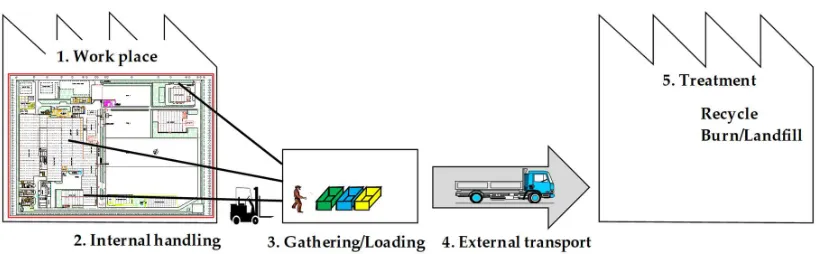
Today, most manufacturing factories are in need of detailed analysis of their waste management system at all stages of production, and studied waste streams to identified opportunities for recovery and resource saving [16]. Thus, the main objective of waste management in factories was to find a method of organizing a waste management system for a particular company, and of gaining an overview of the whole system. Common stages of the process were included workplace waste, waste collection, internal handling (separation, container loading), transport, and final treatment [1, 16].
Figure 1. Overall waste management main processes [1, 16]
1.4.Lean tools and principles used to waste management
The term “Lean” is a concept used in production system for eliminating waste and non-value-added (NVA) operations by using a series of activities or solutions [3]. Lean was first introduced by Womack and Jones in 1990 in their book “The Machine That Changed the World”, which describes the Toyota production system (TPS) [20, 21]. Lean focuses on elimination of waste within the firm’s production system through continuous improvement and process changes for reducing NVA activities or elimination of wastes [20]. Womack and Jones (2003) describes Lean as: “The most powerful tool available for creating value while eliminating waste in any organization” [6]. The fundamental principles of Lean are visualization and “go and see” or “Genchi-Genbutsu” [7]. These fundamentals have been leading lights in the development of LM tools and techniques to achieve the target of improvement. There are many Lean techniques can also specifically address environmental concerns [22]. Some tools and principles of Lean such as Pull system, Andon, Value Stream Mapping, and Kanban can be applied for environment management which efficient material flows, shorten lead-time, and minimal waste of time (Muda) [23, 24].
- Value Stream Mapping (VSM) is a tool used to showing the mapping for material flow in the factory floor [8] and find operational inefficiencies in a process [23]. Later, in the latest publications, the VSM extends to link factories, across the production chain. A VSM can be drawn for the entire supply chain, a process or a single subprocess. The VSM can also be used in a non-detailed way to analyze processes and subprocesses to visualize improvement potentials [1]. The conventional VSM can be further extended through environmental [1, 22]. In environmental, VSM can be used to map material use in different processes such as energy consumption, waste and excess material. From these activities, time and information in the process including lead-time and inventory are diagnosed and mapped. Materials being processed in manufacturing constitute a large part of final product expenditures, and a VSM analysis aims at both economic and environmental improvements. Utilizing VSM proved to be an effective way for management to functionally address problems of production materials [1, 8, 22]. VSM analysis for waste management considers how waste handling is performed, for instance loading and sorting [1].
- The terms “pull” or “pull system” are often used interchangeably with flow. It should be understood that, like flow, pull is a concept, and the two are linked, but not the same. Flow defines that state of material as it moves from process to process. Pull dictates when material is moved and who (the customer) determines that it is to be moved [25]. Pull system enables the production based on customer demand; the downstream process/customer takes the product/service they need and 'pulls' it from the producer [26]. A “pull system” is an aggregation of several elements that support the process of pulling. The successful Pull system depends on flowing product, pacing the processes to takt time, and signaling replenishment via a Kanban signal and leveling of product mix and quantity over time [26]. The Kanban signal is one of the tools used as part of a Pull system. The Kanban is simply Work place
waste
Waste collection
Internal
handling Transport
the communication method and could be a card, an empty space, a cart, or any other signaling method for the customer to say, “I am ready for more” [6]. Kanban system provide mixed model production along with optimal inventory level which results in less lead time in delivery and effective utilization of resources [26]. Womack and Jones (2003) indicated that it is possible to design a system that will be effective in any situation [6]. Therefore, in environment field, pull system can be used for design a signal for waste collection, delivery and connection between shop-floor, waste separation center, and final treatment vendors.
- Visual control via Andon system: Visual control (VC) is any communication device used in the work environment that tells us at a glance how work should be done and whether it is deviating from the standard [7]. VC limit and guide human response in terms of height, size, quantity, volume, weight, width, length and breadth [27]. They answer the information need for the basic where, how many, who, when and what questions by integrating the message into the physical environment at the point-of-use and leaving not many options for people [28]. VC are mostly seen in production and logistics, maintenance, quality and safety management efforts [29]. Bordering, outlining, marking, color-coding are some of the cognitive design methods adopted for visual controls [28]. Andon is a term for a visual control system using an electric light board or screen monitor to visual information and/or progressive of operations [7, 30]. The idea of Andon is that worker can pull the so-called Andon cord, triggering the light and/or music as a call for help decision making [30]. In waste management, Andon can help visualize and control the progress of waste handling such as collection, storage, truck loading, and delivery.
2. Materials and method
In this research, an integrated Waste Flow Mapping (WFM) by using VSM method was used in a case study. The case study examined the waste flows, labor costs, handling efficiency and transport efficiency in the waste management system at production and non-production sites. The method was designed to enable efficient routing and optimize costs with limited resources by LM tools and principles applied. Two of the authors participated, serving as leader and main member of a “Eco Center” project in case company.
2.1.Case study
The research was based on studies from the case of Toyota Motor Vietnam (TMV), a leading manufacturer of automotive industry and Lean application in Vietnam. The multi-site waste mapping project focused on waste management and procurement of waste management services are conducted.
The approach of this research requires knowledge of waste management and treatment standards of Vietnam. The specific characteristics of the shop site level analysis included overall analysis of the waste volumes and the costs for waste handling from the shop site to vendors. Performance measurements were included to compare the results with best practices of the internal waste handling and ownership of operations, together with the potential to improve sorting and minimize costs of manpower and transportation. The analysis also resulted in recommendations for the continuous improvement and development of waste management services in manufacturing enterprises in Vietnam.
2.1.1. Company production and wastes situation
including: Stamping – Welding – Painting – Assembly – Inspection. TMV is producing and assembly three sedan models are Camry, Corolla Altis, and Vios and one model of Multi-Purpose Vehicle (MPV) is Innova. Total employees in TMV in 2018 are nearly 1,800 members with 1,300 operators and delivery members. TMV is holding the leading position in the Vietnamese automobile market with the capacity of more than 50,000 units per year in 2017 with two working shifts a day. Average Takt time up to April, 2018 for sedan line is 6.7 minutes and MPV line is 16 minutes. In 2018, TMV has 25 local suppliers and 10 foreign suppliers from Japan, Thailand, Indonesia, Malaysia, Taiwan... with more than 300 components and parts (TMV documents)
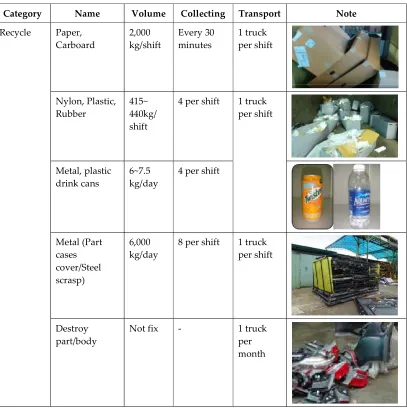
TMV is a large industrial waste generator in Vietnam. Totally, TMV generate more than 5 tons of waste in a production day. The case study resulted in a vast amount of detailed data and photos on the waste management in TMV and the waste supply chain. Table. 1 shows the overall picture of the amount of waste in the TMV’s production, non-production and logistic shops by weight.
Table 1. Waste categories and volumes in TMV
Category Name Volume Collecting Transport Note
Recycle Paper,
Carboard 2,000 kg/shift Every 30 minutes 1 truck per shift
Nylon, Plastic,
Rubber 415~ 440kg/ shift
4 per shift 1 truck per shift
Metal, plastic
drink cans 6~7.5 kg/day 4 per shift
Metal (Part cases cover/Steel scrasp)
6,000
kg/day 8 per shift 1 truck per shift
Destroy part/body
Not fix - 1 truck
Burned Organic waste
from canteen 85 kg/shift 2 per shift 1 truck per shift
Glover, rag 15~18
kg/shift 4 per shift
Complex
waste 120~160 kg/shift 4 per shift
Hazardous Oiled glover,
rag 12.5~18 kg/shift 4 per shift
Sealer/ Primer/ PVC/ Sticky tape
1.5~2.5
kg/shift 2 per shift 1 truck per 2 weeks
Air
filter/Absorbab le substances
5~6
kg/shift 2 per shift
Sanding paper/ Grindstone/ Grinding disk
4~6.5
kg/shift 2 per shift
Battery/Electro nic devices waste/Printer cartrigde
Not fix -
Clinic waste <1.5
kg/day 1 per day
Empty metal drum/ container
14 pcs/shift
2 per shift 1 truck per weeks
Empty plastic
container 57~62 pcs/shift 2 per shift
Engine waste oil/lubrication oil
~120 liter/ week
1 per week 1 per month (combine d)
Paint
sludge/Photph ate sludge
~120
kg/week 1 per week 1 truck per week
Wastewater
sludge 5,500 kg/week 1 per day
2.2.Data collection
The data collection was performed on both quantitative and qualitative data to visualize the waste handling management. Quantitative data was collected by orserved system’s performance, charateristics and behavior of waste collection and handling. Qualitative datas were collected on the method’s functionality, charateristics and usability.
For the collecting the qualitative data, the production and waste management activities in the cases were analysed as systems with inputs, proccesses, and outputs [1]. Taking a system view of waste management, involving collection, transportation and storage operations, is an effective way to gain efficiency and effectiveness [31]. The information on the total number of volumes, weights and types of waste at each site along with the procurement effort for equipment and services was collected and used as input for operational development regarding the waste management. The analysis on each manufacturing site also considered the interactions between system elements such as equipment, management, contractor companies, humans, environmental emissions and wastes, operation/ process efficiency and the economic/social impacts [1].
2.3.Current map of waste generation points
The waste management process was studied with a value stream mapping approach in a non-detailed way. The waste management system was divided into subprocesses in the value stream approach include work place waste operation, internal handling, waste gathering, external transport and final treatment. This paper focuses on of waste generations points, amount of each, and how waste to be separated and transported to buyers and treatment. The waste management main processes are shown in Figure 2.
Data were collected on each process regarding resources, inventories, handling and movements. Process (1) at the internal collection point was mapped using layouts visualize (see Fig. 3), including data on the number and type of pallets, bins, fractions, time for collecting and delivery (Table 1) and consider inefficiencies in the main operation due to waste handling. In process (2), the handling of waste sources from operations to the external waste-handling contractor was mapped by data on handling time, and manpower for handling. In process (3), the layouts of “waste center” for separation, sorting and storage were mapped to show NVA activities. In process (4) was mapped by the type and cost of external transportation off-site for each material segment. Process (5) at the disposal/final treatment operations was analyzed by type of disposal or recycling code, and location. However, the full life cycle assessment data on the final treatment were not available. The data of information management were collected by observes, interviews and data records, and the improvement process was documented by interviews and process efficiency data.
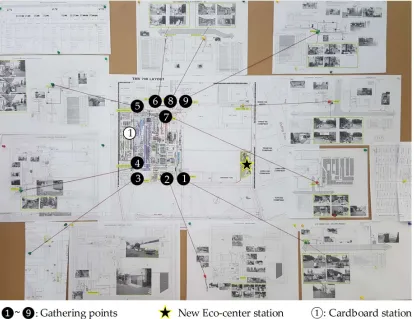
Figure 2 show the main points of waste generation from production and non-production in TMV plant. There are total 28 main routes for waste delivery from shop site to separation center before truck loading and transport to treatment destinations. In addition, to collect and delivery more than 35 types of waste include hazardous and non-hazardous waste are generated from shop floors (Table 1), TMV need 40 operators for waste handling from sources to waste center for separate and loading.
Figure 2. Current map of waste generation points in TMV
When trying to make the overall operation as Lean as possible, the focus is on minimizing the use and handling of NVA (Called MUDA in Toyota). In practical improvement work, the MUDA are addressed simultaneously. First, the overall of waste routing is analyzed to show the MUDA of transportation, motion, and over processing. Then, indicate the Kaizen point (chance to improvement) for each of operation. All of these activities are conducted based on “Genchi-Genbutsu” principle (Genchi-Genbutsu mean go to shop site and see what happening). One example is that if only one large bin is used for all types of waste, the efficiency measure for bins is good but the costs of final treatment and sorting, as well as internal transportation (There are 108 waste points with 108 waste bins in TMV assembly shop), will give a non-optimal result. Therefore, in this study, the improvement approach is conducted through several step include: Waste generation mapping and photograph fractions, map of internal logistic of waste, Map of collecting points, Collect and analyze data on out-site transportation and treatment. In order to improve work place environment and expand production plant, TMV president required a new waste center called “Eco center” in a new place as far as possible from production. Therefore, project team proposed a new place for Eco-center and setup a new full process from shop site to Eco Eco-center to vendors. Next section will present Lean applying for waste operation improvement for three stages in waste flow, include internal waste flow improvement, waste center operation improvement, and truck calling system improvement for new Eco center.
Carboard Metal Nylon, Plastic Waste Hazardous Other
3. Improvement method employed using Lean tools and techniques
3.1.Flow mapping of waste handling
Figure 3 show the overall picture of waste flow mapping for waste collecting and delivery design. In order to minimize cost of collecting, moving and sorting, the project team proposed nine stations to gather all the waste. Project team also divided waste into four main routes with different transport methods include: (1) Mixed, (2) Cardboard, (3) Metal, (4) Water-sludge
The mixed waste routes delivery both hazardous and non-hazardous waste but they are separated by different color of bags or bins. Every 60 minutes, delivery member come and collect bags/bins and move to Eco center from point No.1 to point No.9 as shown in Fig.3. The driver will utilize an electric car with connected bins to collect or replace bins and come to Eco center before put them to its locations. The schedule for mixed waste collecting is planned based on pull principle from the sources. Table 2 show delivery schedule in one shift of production at TMV. In addition, sub-routes for all of waste from shop-floor and office to station are also calculated to minimize moving and costs (Fig.3)
Figure 3. Waste flow visualization and mapping proposal
Cardboard are continuously delivered from Shop-site to Eco center by Electric cars. In the first round, driver pull empty cases from Eco center come to cardboard station (Point ① in Fig.3) and
Metal from press and weld shop and water-sludge waste are moved to Eco center by forklift directly with returned pallets and cases. The operation procedure of these delivery is same principle with cardboard and mixed waste (Come with empty them replace to full one and move to Eco center).
Table 2. Scheduling for mixed waste delivery in one production shift
(Source: TMV’s Eco-center project document)
After applied waste flow mapping and combination waste routing, TMV’s project team saved 9 operators in total manpower for waste handling operation (save 23% manpower) and reduce 12 routes from 28 routes to 16 routes (Fig.4). In addition, all of wastes from TMV are separated and full managed between hazardous and non-hazardous waste by scheduling system visualized in control board located in each waste station.
Figure 4. Some indicators of improvement result
Time 7:00 8:00 9:00 10:00 11:00 12:00 13:00 14:00 15:00 16:00 17:00
Ele-car No.1
Ele-Car No.2
Shop VLD, GPS, Canteen - clinic
Assy - Bumper
- W.P.LW Assy - Bumper Assy - Bumper Assy - Bumper Training - VLD, Export,
Depot Assy - Bumper
Assy - Bumper
- W.P.LW Assy - Bumper Assy - Bumper
Training - Canteen - VLD,
Export, GPS, clinic
Weight 80Kg 97 Kg 48 kg 45 kg 45 kg 37 Kg 45 Kg 80 Kg 45 Kg 45 Kg 82 Kg Food waste: 45
kg
Nylon: 35 Kg Nylon: 35 Kg Nylon: 35 Kg Nylon: 35 Kg Nylon: 10 Kg Nylon: 35 Kg Nylon: 35 Kg Nylon: 35 Kg Nylon: 35 Kg Nylon: 5 Kg Nylon: 8 Kg Waste: 15 kg Waste: 10 Kg Waste: 10 Kg Waste: 10 Kg Paper: 5 Kg Waste: 10 Kg Waste:15 Kg Waste: 10 Kg Waste: 10 Kg Carton: 10 Kg Carton: 10 Kg Carton: 10 Kg Paper: 5 Kg Paper: 5 Kg Waste: 10 Kg Waste: 10 Kg
Waste: 10 Kg Food waste: 45
Kg Paint bottle: 3
Kg Oiled glover/rag: 25 Oiled glover/rag: 3 Oiled glover/rag: - Oiled glover/rag: - KgPaint bottle: 2 Oiled glover/rag: - Oiled glover/rag: 15 Oiled glover/rag Oiled glover/rag Paint bottle: 3 Kg Clinic: 0.5 Kg Hard package
(paint, glue…)
Hard package :- Hard package :
-Hard package :
-Clinic: - Hard package: -Hard package (paint, glue…)
Hard package Hard package Clinic: 0.5 Kg Cartridge: - Filter: 5 Kg Cartridge: - Filter: 3 Kg Cartridge: - Electronic: - Abrasive
material: 5 Kg Electronic; - Abrasive material: 5 Kg Electronic: - Oiled
glover/rag: 2 Weld rod, rag: 10 Kg Oiled glover/rag: - Weld rod, rag: 5 Kg Oiled glover/rag: 3 Kg Lamp: - Sealer 2 Kg Lamp: - Sealer: 2 Kg Lamp: -
Non hazardous Hazardous 40 31 0 5 10 15 20 25 30 35 40 45 Before After
Manpower Reduction
3.2.Pull principle applying to Truck calling system
In order to design Lean operation for waste management and Just in Time (JIT) treatment, an information sharing system between production line with Eco center and between Eco center with buyers, vendors need to be setup. The first principle of JIT is setup pull information system from the sources. All of waste generation must be mapped and visualized (as shown in section 3.1) before make schedule to collecting and delivery to Eco center.
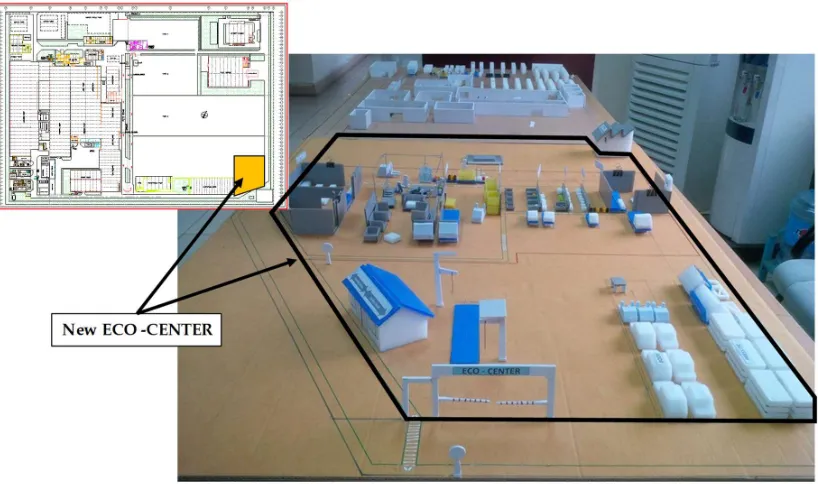
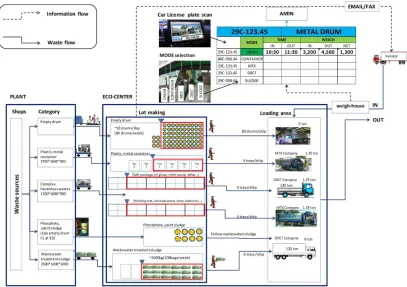
Figure 5 show new location for Eco center location and its simulate of sorting and storage. The model of Eco center is made in the rate of 1/500 and all of activities for input (contain waste from shop site), main operations (contain waste sorting, pre-treatment, storage, worker operation), and output (contain truck calling, waste loading, goods controlling, and weighting) are visualized on Andon board. The operation of Andon board for truck calling and controlling is shown in figure 6.
Figure 5. Eco-center design and simulation model
Based on the truck capacity for waste loading and transportation by weight and dimension and distance between TMV and vendor, the system will count quantity of waste storage to identity time to call vendors come to load the waste automatically and transport. For example, the full capacity of a 1.5 tons truck for mixed waste is 18 standard bags of waste. Count system will count the coming bag one by one through light sensors, and confirmation button. Andon will send a signal to vendor to come and load when enough 18 bags are counted from storage and show on Andon board. The operation system for all of wastes are similarly. The pull principle is follow seven steps as below: (1) Waste come and separate at Eco center (2) Quantity count (3) Sync to Andon board (4)
Call truck (5) Load the waste (6) Transport (7) Treatment (See calling points in block “Lot making” show in figure 6).
production-day because quantity of waste generation for one day is little. Vendor often load these wastes every one or two weeks.
When driver come TMV gate, he must drive the truck to weighing station to weights in empty status. At station, truck license plate will be scanned and driver select one of the modes of loading. For example, when truck come to load cardboard, driver must select cardboard mode by pull the rope named CARDBOARD. Then, a light and/or sound will be turned and the barrier is also opened to truck come. After finished loading, the full-truck will drive back to weighing station to weights again. The weight of bulks is calculated by minus between before and after waste loaded. All of these activities are controlled and visualized, and confirmation by Administration department to calculate cost or income from each ship. Steps of pull principle for calling system is follow main seven steps, include: (1) Full lot of waste (2) Call vendor by E-Kanban/Email (3) Truck come (4) Scan license plate and weights and select mode of loading (4) Waste loading (6) Weights again and confirmation (7) Transport (see Andon visualize in figure 6). This improvement of calling process has achieved JIT with pull system, and the problem related to waiting, over-stock, and less than truck load was eliminated.
Figure 6. Truck calling system using Andon (Example for hazardous waste)
4. Discussion and conclusion
To analyze the criteria and requirements of current methods, an effort was made to cover as many strategic and operational factors as possible from reverse internal and external logistics systems [32]. Sustainable operation, including cleaner production, eco-efficiency, material flow cost accounting and environmental management accounting were taken into consideration to cover different aspects from enterprises. The tools and principles included address the analysis of materials, movements, related costs, information, reports and methods, which are also in line with the chosen system approach for this study [1, 33]. The Lean principles approach appears to be useful for implementation at the enterprise in waste management and eco-efficiency.
The majority of manufacturing enterprises in Vietnam are not familiar with Lean principles and have studying to created their production systems based on the Lean and the elimination of Muda. However, Lean approach often focuses on improve production activities rather than efficiency and sustainable development. Therefore, waste management are often neglected. When an enterprise applied Lean on waste management has previously proven fruitful in healthcare and construction [1]. Minimizing NVA activities is fundamental of Lean, and waste management activities by focusing on flow mapping and visualization are not only improves collaboration and shares information but also covers scattered waste management responsibilities in the waste handling process for stockholder.
Implementing Lean tools and principles as a framework for analyzing the waste management process, revealing NVA, and identifying sustainable improvement chances, and environment saving. Categorizing different waste fractions into segments and analyzing segments individually are necessary steps to identify best practices for the different segments. Applying Lean approach to a multiple-site case study highlighted the importance of visualization, mapping, and Genchi-Genbutsu in any production or non-production activities. This is a good reference for Vietnamese enterprises in production control and waste management in general. This more in-depth work would enable Vietnamese enterprises also to precise the impact of a waste improvement plan onto the different facets of company performance: economic, environmental and social. Finally, this approach for waste management could be expanded to other sectors, such as environment treatment companies.
Acknowledgements
The authors sincerely thank the Editor-in-Chief Dr. Graziano Abrate and the reviewers for the kind support in the development and completion of this issue. We are also special thanks to Mr. Tadashi Yoshida – Production and Logistic Director, and Mr. Huynh Anh Tuan – Deputy General Manager from Toyota Motor Vietnam for all of their comments and suggestions.
Author contributions
Nguyen Dat Minh mostly contributed at literature study, data collection, data analysis, design improvement methods, and writes the paper. Nguyen Danh Nguyen supported data analysis, and propose improvement methods, and give suggestions. Phan Kien Cuong supported for data collection and propose improvement methods.
Conflicts of interest
The authors declares no conflicts of interest.
References
2. Fercoq, A.; Lamouri, S.; Carbone, V.; Lelièvre, A.; Lemieux, A.A. Combining lean and green in manufacturing: a model of waste management.IFAC Proceedings Volumes. 2013, 46, 117-122. 3. Manzouri, M.; Ab-Rahman, M.N.; Zain, C.R.; Jamsari, E.A. Increasing production and
eliminating waste through lean tools and techniques for halal food companies.Sustainability. 2014, 6, 9179-9204.
4. Papadopoulou, T.; Özbayrak, M. Leanness: experiences from the journey to date. Journal of Manufacturing Technology Management. 2005, 16, 784-807.
5. Ohno, T. Toyota production system: beyond large-scale production. CRC Press, 1988. 6. Womack, J.; Jones, D. Lean Thinking. Free Press, 2003.
7. Liker, J.K. The Toyota Way: 14 Management Principles from the World's Greatest Manufacturer. McGraw-Hill, 2004.
8. Torres Jr, A.S.; Gati, A.T. Environmental value stream mapping (EVSM) as sustainability management tool. in Management of Engineering & Technology, 2009. PICMET 2009. Portland International Conference on. 2009. IEEE.
9. King, A.A.; Lenox, M.J. Lean and green? An empirical examination of the relationship between lean production and environmental performance.Production and operations management. 2001, 10, 244-256.
10. Herrmann, C.; Thiede, S.; Stehr, J.; Bergmann, L. An environmental perspective on Lean Production, in Manufacturing Systems and Technologies for the New Frontier. Springer, 2008.
11. Florida, R. Lean and green: the move to environmentally conscious manufacturing. California management review. 1996, 39, 80-105.
12. Yang, M.G.M.; Hong, P.; Modi, S.B. Impact of lean manufacturing and environmental management on business performance: An empirical study of manufacturing firms.International Journal of Production Economics. 2011, 129, 251-261.
13. Halme, M.; Anttonen, M.; Kuisma, M.; Kontoniemi, N.; Heino, E. Business models for material efficiency services: Conceptualization and application.Ecological Economics. 2007, 63, 126-137. 14. Golomeova, S.; Srebrenkoska, V.; Krsteva, S.; Spasova, S. Solid waste treatment technologies.
Machines, Technologies, Materials. 2013, 9, 59-61.
15. Plubcharoensuk, P.; Nakayama, H.; Shimaoka, T. Material Flow Analysis for Industrial Waste Management in Thailand. Memoirs of the Faculty of Engineering, Kyushu University. 2008, 68, 107-127.
16. Hogland, W.; Stenis, J. Assessment and system analysis of industrial waste management. Waste Management. 2000, 20, 537-543.
17. Wang, F.; Roddick, F. SWIM- interactive software for continuous improvement of solid waste management.J Resour Manage Technol. 1994, 22, 63-72.
18. Barlishen, K.; Baetz, B. Development of a decision support system for municipal solid waste management systems planning.Waste Management & Research. 1996, 14, 71-86.
19. Roberge, H.; Baetz, B.W. Optimization modelling for industrial waste reduction planning. Waste Management. 1994, 14, 35-48.
20. Womack, J.P.; Jones, d.t.; Roos, D. Machine that changed the world. Simon and Schuster, 1990. 21. Alaskari, O.; Ahmad, M.M.; Dhafr, N., Pinedo-Cuenca, R. Critical successful factors (CSFs) for
successful implementation of lean tools and ERP systems.Proceedings of the World Congress on Engineering. 2012.
23. Rother, M.;Shook, J. Learning to see: value stream mapping to add value and eliminate muda. Lean Enterprise Institute, 2003.
24. Mike, R. Toyota Kata Managing People for Improvment, Adaptiveness and Supeior Resolts. McGraw-Hill, USA, 2010.
25. Liker, J. The Toyota way fieldbook. Esensi, 2006.
26. Sundar, R.; Balaji, A.; Kumar, R.S. A review on lean manufacturing implementation techniques. Procedia Engineering. 2014, 97, 875-1885.
27. Galsworth, G.D. Visual systems: harnessing the power of the visual workplace. American Management Association, 1997.
28. Tezel, A.; Aziz, Z. Visual controls at the workface of road construction and maintenance: Preliminary report. 2015.
29. Suzaki, K. New shop floor management: empowering people for continuous improvement. Simon and Schuster, 1993.
30. Ismail, S.Z. Design and Development of Andon System for Machining Machine at FKP Lab. UMP, 2013. 31. Seadon, J.K. Sustainable waste management systems.Journal of Cleaner Production. 2010, 18,
1639-1651.
![Figure 1. Overall waste management main processes [1, 16]](https://thumb-us.123doks.com/thumbv2/123dok_us/995593.1599276/3.612.98.515.68.177/figure-overall-waste-management-main-processes.webp)