Upgrade Decision Support Model (UDSM) for Enterprise
Systems: Drivers and Processes
Gerald George Feldman
PhD
Upgrade Decision Support Model (UDSM) for Enterprise
Systems: Drivers and Processes
Gerald George Feldman
Faculty of Computing, Engineering and the Built
Environment (CEBE)
A thesis submitted to the school of Engineering Design and
Manufacturing Systems in partial fulfilment for the degree of
Doctor of Philosophy
Thanks be to God, for the strength and willpower.
I
ABSTRACT
Enterprise Systems (ES) have matured over the years, offering continuous improvement to
the underlying technology and functionality, hence, it is reasonable to anticipate that
organisations would upgrade their systems to realise the benefits of these improvements.
However, the range of benefits and risks involved within upgrade projects, motivates only
few organisations to upgrade; indicating that upgrade decision-making is not trivial, and
requires a comprehensive consideration of the impacts, efforts, and benefits. To date,
research on ES upgrade recommends practical guidance for managing and supporting
upgrade projects, with few studies focusing on upgrade decision-making, yet the upgrade
decision process remains one of the areas in post-implementation that is least explored.
This research investigates the interrelated aspects of ES upgrade phenomena to explore the
drivers and decision processes. A qualitative survey design was adopted to explore ES
upgrade decision-making process and through web-based questionnaires and
semi-structured interviews, qualitative data from 41 respondents representing 23 organisations
was collected, coded, and analysed. Drawing from the
Technology-Organisation-Environment (T-O-E) framework and process view of decision-making to theorise the
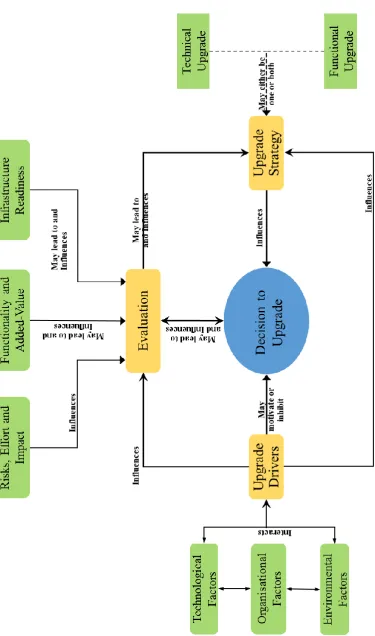
findings, this research proposes an Upgrade Decision Support Model (UDSM) to represent
ES upgrade decision-making process. The model comprises of two phases namely
exploration and evaluation. The evaluation phase consists of two processes, which are
objective assessment and strategy selection. In addition, objective assessment includes three
sub-processes these are technical analysis, functional gap-fit analysis, and impact
II
The study findings indicate that the decision to upgrade is an outcome of understanding the
upgrade need, possible impacts, and benefits. Thus, asserting the importance of assessing
the level of change, effort required and modifications to be reapplied prior to the upgrade
decision. Additionally, the findings advocate that there is a relationship between upgrade
drivers and the selection of an upgrade strategy, which guides the processes undertaken
during the making. This research contributes key insights on ES upgrade
decision-making offering a thorough understanding of the drivers and processes. In addition, it
presents decision makers with a methodical strategy for approaching upgrade decisions;
hence, enables the identification of possible challenges and measures to overcome these
III
ACKNOWLEDGEMENTS
First, and foremost my sincere thanks go to my director of studies Prof Hanifa Shah, your
intellectual guidance allowed me to grow in confidence as a person and as a researcher. To
my supervisory team (Prof Hanifa Shah, Prof Craig Chapman, and Mr Ardavan Amini), I
am indebted for your wisdom, insights and confidence in my ability; working with such a
prolific team, is something I will treasure for the rest of my career.
This doctorate journey would have not been possible if it were not for Mr Ardavan Amini,
providing me with the opportunity to undertake this research; my deepest appreciation goes
to him.
This thesis would not be possible without the contribution from all the respondents who
accepted to participate in this research. I am grateful to them for sharing their experience,
knowledge, and views, which cover the majority of the work, presented in this thesis. I am
also grateful to SAP and Oracle user groups for accepting to publish my research
participation request in their monthly newsletters.
Particular thanks go to Dr. Pathmeswaran Raju, Professor Mark Reed, and Dr. Andrew
Thomas, for their valuable recommendations, which significantly informed my research. I
also thank the research community at the faculty of Computing, Engineering, and the Built
Environment (CEBE), for providing me with numerous opportunities to share and expose
my research within Birmingham City University and the research community at large.
Very special thanks to Mani, Shiva, and Venkatesh for their friendship, encouragement,
tolerance, and support throughout this journey. To my colleagues and friends at the
IV
TABLE OF CONTENTS
LIST OF FIGURES ... VII
LIST OF TABLES ... VIII
ABBREVIATIONS ... IX
CHAPTER 1 INTRODUCTION ... 1
1.1 Background ... 1
1.1.1 Problem Statement ... 4
1.1.2 Research Questions ... 7
1.1.3 Research Aims and Objectives ... 8
1.1.4 Research Scope ... 9
1.2 Thesis Structure ... 10
CHAPTER 2 ENTERPRISE SYSTEMS BACKGROUND ... 13
2.1 Enterprise Systems Adoption ... 13
2.2 ES Life Cycle ... 14
2.2.1 Implementation Phase ... 16
2.2.2 Post-Implementation Phase ... 19
2.3 Chapter Summary ... 24
CHAPTER 3 ENTERPRISE SYSTEMS UPGRADE ... 25
3.1 Upgrade Overview ... 25
3.1.1 ES Upgrades as an Assimilation Process ... 27
3.1.2 The Need to Upgrade ... 30
3.1.2.1 Environmental Factors ... 34
3.1.2.2 Organisational Factors ... 35
3.1.2.3 Technological Factors... 36
3.1.3 Upgrade Decision Models ... 38
3.2 Organisational Decision-Making ... 42
3.2.1 Descriptive Decision-Making Models ... 43
3.3 Synthesising Upgrade Decision-Making ... 47
3.4 Chapter Summary ... 50
CHAPTER 4 RESEARCH METHODOLOGY ... 51
V
4.2 Qualitative Approach ... 53
4.3 Research Design ... 55
4.3.1 Qualitative Survey Strategy ... 57
4.3.1.1 Accounting for Rigor in the Design ... 58
4.3.2 Data Collection Techniques... 60
4.3.2.1 Wed-Based Questionnaire ... 60
4.3.2.2 Semi-Structured Interviews ... 63
4.3.3 Participant Selection ... 64
4.3.3.1 Web-Based Questionnaire Participants ... 65
4.3.3.2 Semi-Structured Interview Participants ... 67
4.4 Qualitative Data Analysis ... 67
4.4.1 Preparing the Data ... 69
4.4.2 Systematic Coding ... 69
4.4.3 Drawing Conclusions ... 70
4.5 UDSM Evaluation ... 71
4.6 Chapter Summary ... 72
CHAPTER 5 RESPONDENTS’ PERSPECTIVE ON ES UPGRADE ... 73
5.1 Respondent Demographics ... 73
5.2 Reflection on the Data Collection Techniques ... 76
5.3 ES Upgrades ... 78
5.3.1 Upgrade Philosophy ... 79
5.3.1.1 Phased Approach ... 80
5.3.1.2 Big-Bang Approach ... 80
5.3.2 Upgrade Strategies ... 81
5.3.2.1 Technical Upgrade ... 82
5.3.2.2 Functional Upgrade ... 83
5.4 Upgrade Stages ... 84
5.4.1 Scoping ... 84
5.4.2 Planning ... 86
5.4.3 Design ... 88
5.4.4 Realisation ... 90
5.4.5 Go Live and Support ... 91
5.5 Chapter Summary ... 92
VI
6.1 Towards the Upgrade Model ... 93
6.2 Enterprise Systems UDSM ... 95
6.2.1 Exploration ... 97
6.2.1.1 Environmental Context ... 100
6.2.1.2 Organisational Context ... 103
6.2.1.3 Technological Context ... 107
6.2.2 Evaluation Phase ... 109
6.2.2.1 Objective Assessment ... 110
6.2.2.2 Strategy Selection ... 116
6.2.3 Upgrade Decision ... 118
6.2.4 The Model Pathways ... 121
6.2.4.1 Technical Pathway ... 121
6.2.4.2 Functional Pathway ... 122
6.2.4.3 Objective Pathway ... 123
6.3 UDSM Evaluation with Respondents ... 125
6.4 Elucidation of the Research Findings ... 127
6.5 Chapter Summary ... 130
CHAPTER 7 SUMMARY AND CONCLUSION ... 131
7.1 Summary of the Thesis ... 131
7.2 Positioning UDSM among ES Upgrade Literature ... 133
7.2.1 Upgrade Decision-Making ... 134
7.2.2 Upgrade Drivers and Strategy Selection ... 135
7.3 Research Contributions ... 136
7.3.1 Contributions to Body of Knowledge ... 136
7.3.2 Implications for Practice ... 137
7.4 Limitations ... 139
7.5 Future Research Directions ... 141
7.6 Conclusion ... 142
REFERENCES 144 WEB-BASED QUESTIONNAIRE ... 161
EVALUATION QUESTIONNAIRE ... 169
VII
LIST OF FIGURES
Figure 1-1: Research stages alongside the thesis outline ... 10
Figure 2-1: Maintenance classification (adapted from Nah et al., 2001) ... 21
Figure 3-1: T-O-E view of ES upgrade ... 29
Figure 3-2: Eight step project model (adapted from Farbey et al., 1993) ... 31
Figure 3-3: Representation of previous upgrade decision models ... 40
Figure 3-4: Decision-making process model (adapted from Simon, 1977) ... 44
Figure 3-5: The conceptual ES upgrade decision support model ... 48
Figure 4-1: Research design ... 56
Figure 4-2: Strategies to improve findings’ confidence ... 59
Figure 4-3: Inductive content analysis stages ... 68
Figure 5-1: Respondents’ distribution between the two data collection techniques ... 74
Figure 5-2: Refined conceptual ES upgrade decision-making model ... 77
Figure 5-3: Main constructs from the web-based questionnaire ... 78
Figure 6-1: Upgrade stages ... 94
Figure 6-2: The proposed upgrade decision support model (UDSM) ... 96
Figure 6-3: ES upgrade motivation based on T-O-E framework ... 99
Figure 6-4: Relationship between impact, resources, and project scope ... 114
Figure 6-5: Relationship between upgrade drivers and scope ... 117
Figure 6-6: Upgrade scope super imposition ... 119
Figure 6-7: Influences on upgrade strategy selection ... 120
Figure 6-8: Technical pathway ... 122
Figure 6-9: Functional pathway ... 123
Figure 6-10: Objective pathway ... 124
VIII
LIST OF TABLES
Table 2-1: ES life cycle models in ascending order of the year published (adapted from
Shaul & Tauber, 2013) ... 15
Table 2-2: Research trends in post-implementation phase ... 23
Table 3-1: Factors influencing upgrade decisions ... 33
Table 4-1: Questionnaire themes ... 61
Table 4-2: Semi-structured interview protocol ... 64
Table 5-1: Summary of responses ... 74
Table 5-2: Respondents’ experience... 75
Table 5-3: Respondents’ roles ... 75
Table 5-4: Interview respondents’ role ... 76
Table 6-1: Summary of upgrade drivers ... 100
IX
ABBREVIATIONS
CRM - Customer Relationship Management
DOI - Diffusion of Innovation
ERP - Enterprise Resource Planning
ES - Enterprise Systems
IP - Internet Protocol
IT - Information Technology
IS - Information Systems
MRP - Material Requirement Planning
MRPII - Manufacturing Resources Planning
PID - Project Initiation Document
RQ - Research Question
RPD - Recognition Primed Decision
SCM - Supply Chain Management
TAM - Technology Acceptance Model
T-O-E - Technology-Organisation-Environment
UDSM - Upgrade Decision Support Model
1
CHAPTER 1
INTRODUCTION
This chapter explains the importance of conducting this research, to support the growing
interest in Enterprise Systems (ES) research, especially in the post-implementation phase.
The chapter starts by presenting an overview of ES as the research domain and is followed
by discussing the challenges that led to the research questions, which this research intends
to address. Next, it summarises the thesis structure outlining the significance of each chapter
in accomplishing the aims and objectives of this research.
1.1
Background
The shift in operating conditions and ever-changing business environments has led many
organisations to adopt enterprise systems (ES) as a mechanism to gain competitive
advantage and improve performance. There are many instances in literature where Enterprise
Resource Planning (ERP) systems and ES have been interchangeably used for example
(Beheshti & Beheshti, 2010), implying that ERP systems and ES are indistinguishable.
Though, Davenport (1998; 2000) suggests that ES and ERP are different, as ES constitutes
a variety of comprehensive systems in combination with other technologies to support
supply chain optimisation, sales force automation, and customer service. While, Ward et al. (2005) describe an ES as a comprehensive, configurable, and integrated suite of systems and
information resources, which support organisational-wide operational and management
processes. on the other hand ERP systems are classified as a dedicated system that enables
business processes integration on a specific technological platform to address organisation
2
2006; Dittrich et al., 2009; Elragal & Haddara, 2012). As such, Sheldon suggests that ERP is the “spinal cord and information flow that link top-management thinking and planning
with marketing, sales, capacity, planning, procurement and customer services” (Sheldon,
2005, p.3). Hence, ERP systems are complex systems, offering a range of capabilities that
simplify cross-functional integration of data and processes.
However, ES incorporates ERP and other systems such as Customer Relationship
Management (CRM), Supply Chain Management (SCM) and so forth, providing a complete
overhaul of the transactions processing systems landscape (Markus & Tanis, 2000; Shang &
Seddon, 2002). Furthermore, Xu (2011) posits that ES encompasses capabilities to integrate
and extend business processes within and outside of the organisation. Thus, ES is referred
to as a holistic system that incorporates numerous systems; presenting a range of capabilities
to support organisation-wide end-to-end processes, which enable integration, collaboration,
interaction, and the processing needs of the entire organisation.
The adoption of ES has facilitated streamlining of business processes and improving
productivity; however, there are many reports of failed implementation projects that resulted
from the fact that organisations’ did not achieve the perceived benefits. According to Willis
& Willis-Brown (2002) this could be related to the way organisations recognise the actual
project completion, such that organisations that only consider system ‘go-live’ as the final
stage fail to acquire the full potential of these systems. Thus, it can be explained that in order
to realise the benefits of ES, it is important to understand the different phases and stages
within the system lifespan (explained in section 2.2). According Willis & Willis-Brown
(2002) there are two distinct phases namely, implementation and post-implementation. The
implementation phase concentrates on planning and system selection with the purpose of
ensuring the system deployment occurs without complications. The post-implementation
3
operation, along with functionality enhancements (Hecht et al., 2011). Thus, upgrading is considered as one of the main activities in post-implementation, which ensures continuous
improvements and effective management of the system.
Upgrading ensures the system is stable, operates efficiently, and can be expanded according
to the organisation needs (Nah et al., 2001; Motiwalla & Thompson, 2009; Ng & Gable, 2009; Hecht et al., 2011). Therefore, upgrading can be defined as a process that intends to expand the existing system core capabilities by improving functionalities and taking
advantage of new technology features offered in a new version (Vaucouleur, 2009). While
Ng (2011) defines upgrading as replacing the existing version entirely or partly with a newer
version from the same vendor or different vendor. The common attribute between these two
definitions is upgrade results in functionality and features improvement when compared to
the current installed version. However, it also signifies two upgrade dimensions: same
system version upgrade and system-to-system upgrade. Same system
version-to-version upgrade implies the current installed version-to-version is replaced with a newer version-to-version of the
same system from the same vendor. While system-to-system upgrade means that the
currently installed version is traded with another system altogether possibly from a different
vendor, this could be because the new version of existing installed system does not support
the organisation’s requirements.
Therefore, in the context of this research, ES upgrade implies an improvement to the existing
system version, through implementing a newer version from the same vendor offering
additional features, functionalities, and enhanced technology capabilities. In addition,
upgrade requires an extensive understanding and knowledge of the underlying system and
business processes, as changes applied in one business module may affect other modules of
the associated system (Rothenberger & Srite, 2009). Thus, according to Beatty & Williams
4
technical aspects of the system, along with database and systems administrators’ to offer the
diversified expertise needed to support upgrade projects. In addition, the team should include
top management and user representatives in order to attain better support for the upgrade
from management and end-users.
1.1.1
Problem Statement
By upgrading ES, organisations intend to gain improved performance and minimise
maintenance costs, as well as re-examine and automate business processes (Beatty &
Williams, 2006; Khoo & Robey, 2007; Olson & Zhao, 2007; Dempsey et al., 2013). Additionally, Berinato (2005) suggests that organisations upgrade to take advantage of
features introduced by continual improvements to the systems, such as service oriented
architecture capabilities. Yet, the survey results from Hamerman et al. (2011) study reveal that more than 50% of the survey participants are still utilising systems, which are at least
two versions behind the current release. These results indicate that not all organisations
upgrade their systems when a new version is available, as organisations prefer to maintain
control of their systems irrespective of the version release cycle. Moreover, Dempsey et al. (2013) mention high costs along with compatibility, reliability, and stability of the new
version, as some of the reasons for not upgrading. According to Swanton (2004) upgrade
costs are almost “50% of the original software licensing fee and 20% of the original
implementation cost per user - £5.2m for a 5,000-user system”. Likewise, Otieno (2010)
suggests that upgrading ranges between 20% and 30 and Ng et al. (2003a) estimate it ranges between 25-33% of the initial implementation cost. Hence, over the years upgrade costs
remain consistently high, thus it can have a significant influence on ES upgrade projects,
5
Apart from costs, Khoo & Robey (2007) suggest that the impact of the new version on the
existing version plays a critical role in upgrade projects. The impact can be due to either
compatibility of the new version with the existing version or reliability and stability of the
new version. One of the possible causes of compatibility issues is extensive modification
applied to the existing system. Modification and customisation have been used
interchangeably (see Light, 2001; Ng & Gable, 2009; Vaucouleur, 2009); however Brehm
et al. (2001) argues that customisation is a mechanism for enabling or disabling already existing features and differs from modification. Thus, modifications refer to the alterations
of the underlying code structure to include features and functionalities to fulfil the
organisation requirements that are not included in the system. These changes are not always
supported in the new version; hence, there is a high possibility to introduce consistency
issues. According to Beatty & Williams (2006) these issues, normally would consume the
majority of the upgrade time, specifically for testing all the imposed changes. Such
suggestions propose that ES upgrade should not be taken lightly, as it involves huge financial
commitment and effort to accomplish, to an extent Beatty & Williams (2006) advised
upgrades be treated as new implementation projects.
Nevertheless, hesitation to upgrade to the new version implies organisations utilise outdated
systems and risk losing continued technical support or obtaining support at a very steep price.
Additionally there is a possibility of encountering bottlenecks in systems performance and
functionality (Ng, 2001; Vaucouleur, 2009). Thus, it is possible for organisations to gain
benefits from upgrading, yet the initial investment and risks associated with the process
makes the decision not trivial, then again not upgrading can result in increased operational
overheads, suggesting that upgrade decision-making is complex. In addition, the upgrade
6
(Claybaugh, 2010). As a result, the decision to upgrade should be undertaken for the right
reasons based on establishing a strong case, which should clearly make business sense.
Recent studies have addressed ES upgrades, proposing practical guidance for managing
upgrade projects; such as best practise and lessons learned (Beatty & Williams, 2006;
Zarotsky et al., 2006; Wenrich & Ahmad, 2009), success factors (Whang et al., 2003; Nah & Delgado, 2006; Olson & Zhao, 2007; Shi & Zhao, 2009; Leyh & Muschick, 2013;
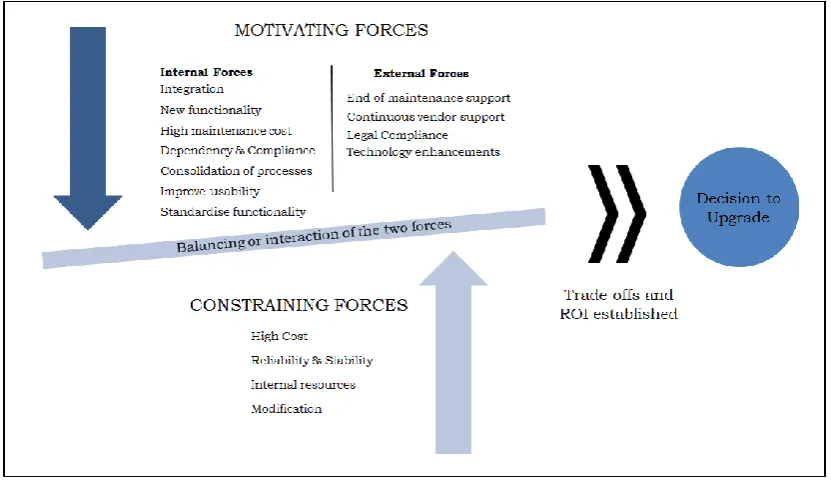
Scheckenbach et al., 2014) and business process changes alignment (Cao et al., 2013; Paradonsaree et al., 2014). In addition, there are several studies (Khoo, 2006; Claybaugh, 2010; Otieno, 2010; Ng, 2011; Dempsey et al., 2013), which explored these factors at length and proposed that the decision to upgrade is an output from the interaction of motivating
and constraining forces. In addition, Khoo (2006), Otieno (2010), and Ng (2011) propose
upgrade decision models, which conceptualise the upgrade decision-making process
(explained in detail in section 3.1.3). Although these studies offered valuable insights into
upgrade decision-making, Ng (2011) mentions that little is known about upgrade decisions;
according to Dempsey et al. (2013) this could be associated with the fact that literature on ES systems upgrade is not mature. This supports the suggestions by Khoo (2006) and Otieno
(2010) that exploring how organisations reach the decision to upgrade especially through
adopting a process view of decision-making could enhance our understanding of ES upgrade
decision-making. This implies that upgrade decision-making involves several processes,
which evaluate the net benefits of adopting the new version and assessing how the changes
affect the existing version (Goldstein, 2006; Ng & Gable, 2009). While Riis & Schubert
(2012) propose transition processes, which illustrates the decision processes, however their
research focused on vendors and resellers. Hence, considering processes involved in the
decision-making from an organisation’s view could provide insightful details on strategies
7
seeks to investigate the inter-related aspects of ES upgrade, with the focus on the decision
processes adopted by organisations during upgrade decision-making.
1.1.2
Research Questions
Upgrade is a continuous process recurring at least once every three years (Olson & Zhao,
2007), or depending on the vendors version release cycle. However, only a few organisations
opt to upgrade their systems, despite the continuous improvement in the underlying
technology and enhanced features and functionalities. Many organisations delay upgrading
until the stability and reliability of the new version is established (Vaidyanathan & Sabbaghi,
2007; Urem et al., 2011). This implies upgrading needs extensive planning and serious consideration of the impact and estimation of the required efforts (Dor et al., 2008; Ng & Gable, 2009). According to Beatty & Williams (2006) it is important to assess the
infrastructure and have mechanisms that ensure the systems will perform smoothly after the
upgrade in order to take full advantage of the upgrade. Therefore, more effort is required to
analyse how organisations reach the decision to upgrade and understand the significance for
undertaking upgrades.
In addition, it is reasoned that organisations upgrade in order to gain improved performance
and minimise maintenance costs, along with re-examining and automating business
processes or keep within the vendors’ release cycles. Due to these several reasons,
organisations undertake different upgrade strategies, as Dempsey et al. (2013) suggest that an organisation can either undertake a technical or functional upgrade or a combination of
both. Technical upgrade entails moving the existing system to the latest technology platform
version and focuses purely on technology aspects of the system. Whereas, functional
upgrade mainly focuses on functionality extension and optimising business processes based
8
consolidation of different systems, to provide better agility and flexibility to support systems
integration and implementation of new business processes or automating existing manual
processes. Several authors (Kremers & van Dissel, 2000; Khoo, 2006; Vaidyanathan &
Sabbaghi, 2007; Claybaugh, 2010; Otieno, 2010; Ng, 2011; Dempsey et al., 2013) explored and identified numerous factors influencing upgrade decision, yet only a few studies make
reference of the upgrade strategies (Khoo, 2006; Zhao, 2007; Otieno, 2010). Additionally,
most of the studies fall short in explaining how these factors influence the selection of an
upgrade strategy and there is no evidence highlighting a direct association between the
options and the drivers influencing the upgrade decision. Chapter 3 highlights further the
issues that warrant consideration and provide extensive reasoning for exploring ES upgrade
decision-making.
Thus, this research investigates the interconnected processes of ES upgrade decision-making
to understand how the different processes facilitate the organisation to reach the decision to
upgrade; and explore any association between the upgrade drivers and the upgrade strategy
selection. This led to the formation of the two research questions, which aims to contribute
towards the growing body of ES upgrade research.
RQ1: How do organisations reach the decision to upgrade their systems?
RQ2: What upgrade drivers’ influence organisations to select a specific upgrade strategy?
1.1.3
Research Aims and Objectives
Against the backdrop of these two research questions, the aims of this research are:
9
(2) To propose an ES upgrade decision support model, which offers systematic
processes that assist ES decision makers to reduce the risks and complexity of
upgrade decisions.
In order to achieve these aims, the following objectives are proposed for this research:
(i) Undertake an extensive literature review to identify existing and relevant ES
upgrade models, along with theories to contextualise the decision processes and
aspects related to ES upgrade.
(ii) To identify the decision processes and sub-processes undertaken during ES
upgrade decision-making and establish key drivers influencing upgrade decisions
by conducting a qualitative survey, which probes the respondents involved in
recent ES upgrades.
(iii) Formulate an upgrade decision support model (conceptually) based on the
analysed data from (ii) and using theories from (i).
(iv) Evaluate the proposed upgrade decision support model with respondents and draw
conclusions on its usefulness and workability to support ES upgrade
decision-making.
1.1.4
Research Scope
This thesis focuses on how organisations reach the decision to upgrade their ES, specifically
concentrating on decision processes and the drivers that influence the decision to upgrade.
However, instead of exploring all upgrade dimensions, it is limited to same system
version-to-version upgrade (defined in section 1.1). It explores the decision-making processes that
organisations undertake when upgrading the different systems encompassed within an ES
landscape from an organisation perspective. This is achieved by probing different
10
have been involved in at least one upgrade projects. As the aim was to explore the
decision-making processes during ES upgrade, it was important to gather information, views and
experience from the respondents, who were recently or currently involved in upgrade
decision-making process. Thus, the research defined the upgrade period between previous 6
months to next 24 months.
1.2
Thesis Structure
Figure 1-1 highlights the chapters discussed in this thesis; and categorises them into the
following research stages: research problem identification, literature review, research
methodology, presentation of the findings, upgrade decision support model formulation,
evaluation of the model, and finally conclusion.
Research Problem
Literature Review
Findings
Model Formulation
Evaluation
Chapter 1 Introduction
Conclusion Research Methodology
Chapter 2 Enterprise Systems Background
Chapter 3 Enterprise Systems upgrade
Chapter 4 Research Methodology
Chapter 5 Experts’ perspective on ES upgrade
Chapter 6 ES upgrade decision support model
Chapter 7 Conclusion
Research Questions Research Philosophy Interpretative qualitative survey Process view decision-making Existing ES upgrade decision-making models Problem Reformulation Research Design Induced model Decision-Making theories Feedback Results Research Contributions Results
11
The first chapter focuses on identification of the research problem, and highlights the need
for undertaking this research. Next, it introduces the research questions and their relevance
to the research domain. Based on the research questions, two aims and four objectives were
formulated in order to address the research questions effectively. The review of relevant
literature is addressed in the second and third chapters. Whereby, chapter two presents a
brief background of the research domain as whole and explores previous studies within this
domain. Next, it establishes the focal point of this research by highlighting areas within the
domain that were not extensively addressed in existing studies.
The third chapter offers a review of relevant ES upgrade literature and expands on the need
to address the different research questions. As a result, it draws from ES upgrade literature
to offer justification for conducting this research. In addition, chapter three draws from
Tornatzky & Fleischer (1990) Technology-Organisation-Environment (T-O-E) framework
and organisational decision-making theories specifically process view of decision-making
as lenses for analysis. Based on the concepts identified from the literature and the theoretical
lenses a conceptual research model is developed. This research model incorporates the
logical outline of the decision-making process, which maps out the landscape of the literature
in relation to upgrade decision-making. The model is used to guide the data collection and
structure the analysis in order to draw out the theoretical constructs and providing a
perspective to the findings.
The fourth chapter discusses the research methodology and philosophy. It also presents an
extensive discussion on the reasons for designing this research as a qualitative survey study
and outlines the data collection and analysis techniques utilised in this research. The findings
of the research are presented in chapter five as subjective interpretation of the respondents’
12
which includes subject-expert comments and explanation of meaning in order to draw
references about the ES upgrade decision-making processes and drivers.
The upgrade decision support model details and evaluation are conveyed in chapter six. In
addition, chapter six outlines the different phases and processes undertaken during the
upgrade decision-making and highlights the different categories of the drivers that influence
the decision to upgrade. Next, it positions the model contributions and uniqueness by
evaluating it to existing literature, in order to identify any similarities or difference.
Additionally, it presents the views of the respondents who evaluated the model to justify its
usefulness and workability. Chapter seven provides a summary of the key discussion points
of this thesis, including the contribution from both research and industry perspective. In
addition, it highlights the limitation as well as outlines future work that can be undertaken
13
CHAPTER 2
ENTERPRISE SYSTEMS BACKGROUND
This chapter provides a short background of Enterprise Systems, highlighting the reasons
for adopting such systems, and the associated challenges encountered during the
implementation phase. Next, it explores the ES life cycle, to explain the different stages
involved and how these stages differ from standard system life cycle stages. The last section
focuses on post-implementation phase, highlighting the importance of this phase and
outlines the current research trends, which builds the groundwork for undertaking this
research.
2.1
Enterprise Systems Adoption
The perceived benefits of ES may differ from one organisation to another, however the
promise of potential operational cost reduction, improved performance, increased
competitiveness, efficient business processes, and real-time decision-making capabilities are
cited as some of the key reasons for adopting ES (Esteves & Pastor, 1999; Nah et al., 2001; Dittrich et al., 2009). In addition, it was anticipated that the adoption of ES would provide reliable and timely access to information, and improve business efficiency (Davenport et al., 2004; Grabski et al., 2011); as ES eases integration of different processes, people, and technology to help streamline operations. Despite these advantages, predominant adopters
of ES are large organisations (Teltumbde, 2000; Liang & Xue, 2004; Sharma, 2009). This
inclination can be associated with huge initial investments and relatively longer
implementation time, which in many cases can cause negative outcomes in ES projects, such
as project failure (Davenport, 1998; Scott & Vessey, 2002). Such outcomes arise due to
14
research suggests that ES adoption is a complex phenomenon due to its intangible nature,
which progresses over time, thus, the success of these systems is bound within the system
life cycle (Stefanou, 2002). In addition Willis & Willis-Brown (2002) postulates that the full
potential of ES would only be attained after implementation. This justifies the need to
explore and understand ES not only from the adoption and implementation perspective, but
also through the entire system lifespan.
2.2
ES Life Cycle
ES literature, specifically ERP studies have loosely defined system lifespan, which
encompass several stages associated with configuring, implementing, and managing ES.
According to Chang (2004) this involves several revisions of the initial implementation and
goes beyond use and maintenance of these systems. Additionally, Shaul & Tauber (2013)
suggest that there is a noteworthy difference from traditional IS life cycles, which only
comprises of the following stages: development, implementation, and maintenance. This
argument is supported by most of the authors of ES life cycle models, who claim that it is
difficult to represent ES lifespan using only the three traditional stages, as these generic
stages do not fully represent the complexity of adopting ES. Accordingly, they proposed life
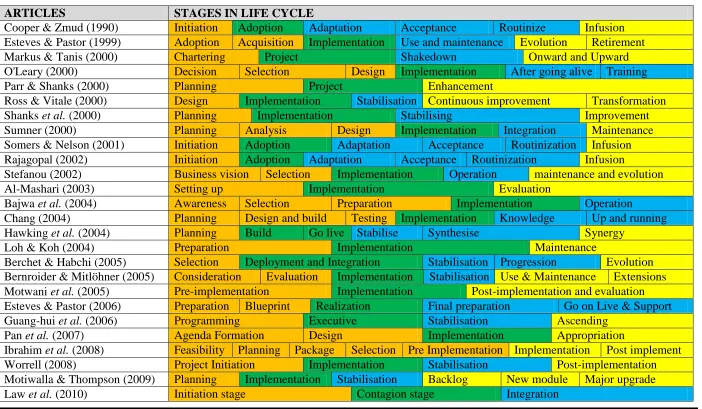
cycle models with varying number of stages (3 to 7) as shown in Table 2-1. Based on Worrell
(2008) life cycle definition, these different life cycle stages can be explained as four main
stages namely project initiation, implementation, stabilisation, and post-implementation.
The project initiation stage focuses on defining the business case and features selection, and
15
Table 2-1: ES life cycle models in ascending order of the year published (adapted from Shaul & Tauber, 2013)
ARTICLES STAGES IN LIFE CYCLE
Cooper & Zmud (1990) Initiation Adoption Adaptation Acceptance Routinize Infusion Esteves & Pastor (1999) Adoption Acquisition Implementation Use and maintenance Evolution Retirement Markus & Tanis (2000) Chartering Project Shakedown Onward and Upward O'Leary (2000) Decision Selection Design Implementation After going alive Training Parr & Shanks (2000) Planning Project Enhancement
Ross & Vitale (2000) Design Implementation Stabilisation Continuous improvement Transformation Shanks et al. (2000) Planning Implementation Stabilising Improvement Sumner (2000) Planning Analysis Design Implementation Integration Maintenance Somers & Nelson (2001) Initiation Adoption Adaptation Acceptance Routinization Infusion Rajagopal (2002) Initiation Adoption Adaptation Acceptance Routinization Infusion
Stefanou (2002) Business vision Selection Implementation Operation maintenance and evolution Al-Mashari (2003) Setting up Implementation Evaluation
Bajwa et al. (2004) Awareness Selection Preparation Implementation Operation
Chang (2004) Planning Design and build Testing Implementation Knowledge Up and running Hawking et al. (2004) Planning Build Go live Stabilise Synthesise Synergy
Loh & Koh (2004) Preparation Implementation Maintenance
Berchet & Habchi (2005) Selection Deployment and Integration Stabilisation Progression Evolution Bernroider & Mitlöhner (2005) Consideration Evaluation Implementation Stabilisation Use & Maintenance Extensions Motwani et al. (2005) Pre-implementation Implementation Post-implementation and evaluation Esteves & Pastor (2006) Preparation Blueprint Realization Final preparation Go on Live & Support Guang-hui et al. (2006) Programming Executive Stabilisation Ascending
Pan et al. (2007) Agenda Formation Design Implementation Appropriation
Ibrahim et al. (2008) Feasibility Planning Package Selection Pre Implementation Implementation Post implement Worrell (2008) Project Initiation Implementation Stabilisation Post-implementation Motiwalla & Thompson (2009) Planning Implementation Stabilisation Backlog New module Major upgrade Law et al. (2010) Initiation stage Contagion stage Integration
16
The stabilisation stage is concerned with eliminating `bugs' and ensuring normal operations,
performance tuning, and training activities. Whereas the post-implementation stage ensures
continuous improvement to the system and focuses on activities that ensure system extension
(Worrell, 2008). These stages can be grouped into either implementation phase or
post-implementation phase, which the next section explains, in order to outline the foundation of
this research.
2.2.1
Implementation Phase
Organisations have invested heavily on ES implementation, for example Salmeron & López
(2010) suggest that billions have been spent on ERP implementation. The main objective of
implementing these systems was to address the maintenance issues of legacy systems, reduce
development risk, provide timely access to information and improve business efficiency
(Davenport et al., 2004; Grabski et al., 2011). These efforts resulted in a situation whereby organisations achieved better consistency and capability to automate business processes and
improved competitive edge. Parr & Shanks suggest that ES specially ERP systems are
becoming the “de facto industry standard for replacement of legacy systems” (Parr &
Shanks, 2000, p.1). This can be associated with the generic business process offered in these
systems and integration of different processes, which significantly reduces redundancies,
making ES implementation more appealing when compared to developing systems in-house
(Chang & Gable, 2001; Beheshti, 2006). In addition, Davenport et al. (2004) and Olson (2004) advocate improved business operations and standardised processes, as advantages for
adopting ES. These result in reduction of complex interfaces and redundant processes, thus,
allowing streamlining of processes, decrease in product development cycles, and enhance
external collaboration. Likewise, it provides a platform for information integration across
17
decisions. The report from Panorama Consulting Solutions (2013) outlines several other
advantages, such as:
Reduction in maintenance efforts specially where legacy systems are concerned
Increased collaboration and interaction
Enterprise-wide information availability
Improved productivity
However, each implementation project is unique because of the different organisational
characteristics and implementation strategy. As a result, there are a number of instances,
where organisations have failed to realise these benefits and end-up running into costly
implementation, increased maintenance, and operational challenges (Davenport, 1998;
Chang, 2004). According to Al-Mashari & Al-Mudimigh (2003) ES implementation results
in significant changes to the organisation, which have to be planned carefully in order to
fully gain the benefits presented by these systems. The planning includes selecting the right
methodology and strategy that involves considering what changes are required and how to
implement these changes, along with considering resources required for implementing the
project. The terms implementation methodologies and strategies have been used
interchangeably, yet some researchers (for example Holland & Light, 1999; Parr & Shanks,
2000) consider strategies as the approach and mechanism taken during system ‘go-live’ or
deployment. As such, methodology implies the complete set of processes undertaken in an
orderly manner to accomplish the adoption, planning, and deployment of the system.
Most vendors offer suggestions for implementation by providing their own methodology,
however amongst the decisions organisations have to make are on implementation
methodology and strategy. Therefore, one of the elements of planning would include
18
& Light, 1999). The big-bang approach goal is to replace all legacy systems features by
implementing the whole system and all its functionality at once. Although the big-bang
approach proposes a number of benefits, it is a resource intensive approach and requires
longer duration, thus increasing the risk of failure (O'Leary, 2000). A phased approach
sometimes referred to as a modular approach, involves implementing changes gradually
starting with the basic necessary functionality, which co-exists with other legacy systems.
Parr & Shanks (2000) caution that the difference between these approaches is too granular
to offer any formal distinction. As a result, they propose an alternative classification that
comprises of three approaches that is ‘comprehensive’, ‘middle-road’, and ‘vanilla’. A
comprehensive approach involves implementing the physical aspects and functionality of
the systems, across all the sites at once. Thus, it involves significant efforts for business
process re-engineering, as this approach would not utilise the standard processes offered in
systems. To an extent, this approach would either adopt implementing the functionality in a
modular approach or opt for a big-bang approach. Middle-road is between comprehensive
and vanilla approaches and involves some level of business process re-engineering, however
this approach follows a modular implementation strategy. A ‘vanilla’ implementation
approach implies the systems are deployed with standard functionality based on the generic
processes, as this approach allows organisations to utilise the process model offered by the
vendors. These generic processes are touted as best operating practices, however these are
merely the vendors’ vision of how organisations should operate (Davenport, 1998). In
addition, a complete ‘vanilla’ approach is not often practical (Light, 2005a); as there is a
need to create a fit between the processes and system (Light, 2005b; Rothenberger & Srite,
2009). As Otieno (2010) suggests there will always be a gap between the functionality and
organisation requirements, despite the extensive industry processes made available in these
19
Creating this fit involves altering systems’ processes to align with the organisation’s
business processes, a phenomenon referred to as modification. This involves introducing
changes to the underlying system core infrastructure, in order to add functionality that can
support the organisation existing business processes (Rothenberger & Srite, 2009). These
changes propagate throughout the system life cycle, which results in increased maintenance
efforts and complexity during upgrade. As vendors do not support extensive modifications,
hence it increases maintenance costs and requires significant effort for maintaining these
modifications (Brehm et al., 2001; Vaucouleur, 2009). Despite implementation being an important milestone, ES projects are never complete at the implementation phase, since the
deployment of these systems involves interaction of organisational, technological, and
environmental aspects. Hence, organisations’ need to give due consideration to the stages
after implementation, commonly referred to as post-implementation phase that begins after
the systems ‘go-live’.
2.2.2
Post-Implementation Phase
On completion of ES implementation, the focus turns into efficient utilisation, stabilisation,
and expansion of the implemented system, as the actual ES value becomes visible and
realised during this period referred to as post-implementation phase. This is critical, because
it ensures the system is stable and aligned to the organisation’s processes, as well as catering
for changes and new user requirements. Therefore, highlighting the importance of planning
for continuous improvements and refinement of the system landscape (Willis &
Willis-Brown, 2002). As a result, several stages have been proposed as part of the
post-implementation phase to support organisations to manage their systems effectively and
efficiently, in order to take advantage of the benefits offered by these systems. For example,
post-20
implementation; while Motiwalla & Thompson (2009) ES life cycle definition offers four
stages that is stabilisation, backlog, new module and major upgrade stages. The backlog
stage deals with modification development, evaluating new requirements and processes to
support business needs. The new module stage extends the implemented system with
additional capabilities to support existing processes and improvement of performance, the
major upgrade stage focuses on extending and expanding the existing systems depending on
business needs and keeping pace with the vendor’s version release cycle.
The fundamental distinction in these two life cycle models is the later model provides a
clearer explanation of what activities (routine maintenance, supporting users, enhancements,
and upgrade) are included in the post-implementation phase. Hence, suggesting there are
two core activities maintenance and major upgrade that have to be considered during the
post-implementation phase. In contrast, Nah et al. (2001) and Ng et al. (2002) suggest that post-implementation phase encompasses only maintenance as the main activity, which is
divided into several sub activities such as bug fixing, user training, performance tuning,
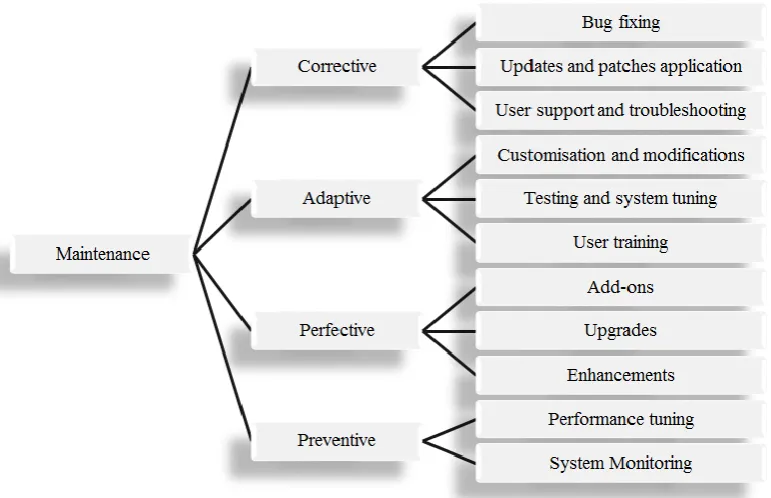
stabilisation, enhancement, and upgrades. In addition, Nah et al. (2001) categorises maintenance activities as corrective, adaptive, perfective and preventive (Figure 2-1);
whereby each category addresses a different perspective of maintenance but collectively
ensures the existing system operates efficiently and is sufficiently supported, as well as
21
Figure 2-1: Maintenance classification (adapted from Nah et al., 2001)
This categorisation posits that upgrade is part of maintenance activities, Hecht et al. (2011) support this argument and explain that different capabilities are required to support upgrade
during maintenance. However, Botta-Genoulaz et al. (2005) postulate that maintenance and upgrade are separate stages, an argument supported by Motiwalla & Thompson (2009)
explanation of the life cycle stages. Thus, this research considers maintenance and upgrade
to be separate processes. Since upgrade focuses on improvement and extension of the
existing system, and requires an in-depth planning, impact analysis and reapplication of
modification, which demand greater resources (financial and human) and strategies to
support the upgrade (Ng & Gable, 2009; Hecht et al., 2011; Paradonsaree et al., 2014). On the other hand, maintenance begins once the systems ‘go-live’ and focuses on user support,
improvements, and operations stabilisation.
ES maintenance and upgrade differs from traditional maintenance and upgrade activities
especially when considering systems developed in-house in twofold; firstly, ES are standard
integrated systems, having greater level of complexity due to the amount of modifications
22
(2001) posits that upgrading to a new version reduces the enhancements and modification
introduced to the systems. Thus, it requires more time and effort to maintain modifications,
to avoid disruptions and demands great depth of systems’ functional and technical
knowledge to support smooth operation of the system. As a result, it involves different
stakeholders, such as vendors, consultants, functional, business, and technical personnel.
Secondly, ES maintenance and upgrade are mostly controlled by the vendors through
frequently offering patches and new version (Nah et al., 2001). Thus, ES maintenance and upgrade is a balance between different internal and external attributes which influence the
process (Ng et al., 2003a). Due to the need for balancing these different attributes, Wenrich & Ahmad (2009) propose the use of best practice and standards to support upgrade projects;
however, they claim that this remains an uncharted domain. Although Botta-Genoulaz et al. (2005) suggest there is a growing interest in maintenance activities, reviews by Esteves &
Bohorquez (2007) and Moon (2007) assert that there is inadequate representation of the
post-implementation phase. Likewise, Schlichter & Kraemmergaard (2010) suggest that out of a
pool of 1,196 journal publications analysed only 17 per cent represented
post-implementation optimisation. Though the main focus of these reviews was on ERP systems;
the findings highlight a significant uncharted research domain, which Grabski et al. (2011) concurs and postulate that there is need for more studies to concentrate on the
post-implementation phase. In addition, Paradonsaree et al. (2014) and Scheckenbach et al. (2014) states that research on upgrades specifically on ERP systems is scarce, this argument
supports Grabski et al. (2011) suggestions that further research is needed to explore post-implementation phase, such as ES upgrade challenges, decision-making, exploring the role
of business process change, and measuring performance.
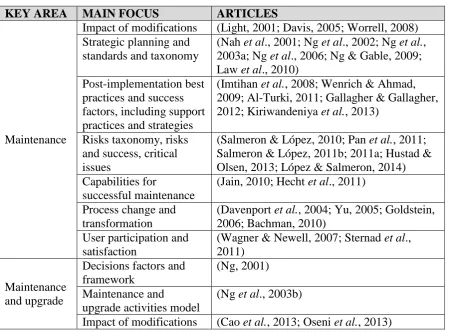
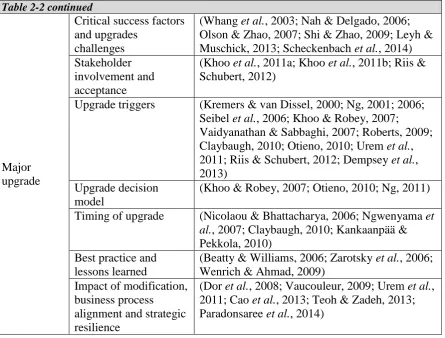
A synthesis of the selected literature on post-implementation phase (Table 2-2) indicates that
23
maintenance standards and taxonomy, understanding the impact of modifications, best
practice, and critical success factors. This includes support practices, exploring risks, and
critical issues associated with operations and optimisation of the systems. However, there
has been limited representation of upgrade; one possible explanation could be that upgrade
is regarded as part of the maintenance activity as explained above. Thus, there is a necessity
for further research to investigate and explore ES post-implementation activities such as
upgrade process in order to support decisions and manage challenges (Esteves & Bohorquez,
2007; Olson & Zhao, 2007; Grabski et al., 2011). This research intends to contribute towards ES post-implementation literature, by exploring ES upgrade decision-making (detailed
explanation in chapter 3).
Table 2-2: Research trends in post-implementation phase
KEY AREA MAIN FOCUS ARTICLES
Maintenance
Impact of modifications (Light, 2001; Davis, 2005; Worrell, 2008) Strategic planning and
standards and taxonomy
(Nah et al., 2001; Ng et al., 2002; Ng et al., 2003a; Ng et al., 2006; Ng & Gable, 2009; Law et al., 2010)
Post-implementation best practices and success factors, including support practices and strategies
(Imtihan et al., 2008; Wenrich & Ahmad, 2009; Al-Turki, 2011; Gallagher & Gallagher, 2012; Kiriwandeniya et al., 2013)
Risks taxonomy, risks and success, critical issues
(Salmeron & López, 2010; Pan et al., 2011; Salmeron & López, 2011b; 2011a; Hustad & Olsen, 2013; López & Salmeron, 2014) Capabilities for
successful maintenance
(Jain, 2010; Hecht et al., 2011) Process change and
transformation
(Davenport et al., 2004; Yu, 2005; Goldstein, 2006; Bachman, 2010)
User participation and satisfaction
(Wagner & Newell, 2007; Sternad et al., 2011)
Maintenance and upgrade
Decisions factors and framework
(Ng, 2001)
Maintenance and
upgrade activities model
(Ng et al., 2003b)
24
Table 2-2 continued
Major upgrade
Critical success factors and upgrades
challenges
(Whang et al., 2003; Nah & Delgado, 2006; Olson & Zhao, 2007; Shi & Zhao, 2009; Leyh & Muschick, 2013; Scheckenbach et al., 2014) Stakeholder
involvement and acceptance
(Khoo et al., 2011a; Khoo et al., 2011b; Riis & Schubert, 2012)
Upgrade triggers (Kremers & van Dissel, 2000; Ng, 2001; 2006; Seibel et al., 2006; Khoo & Robey, 2007; Vaidyanathan & Sabbaghi, 2007; Roberts, 2009; Claybaugh, 2010; Otieno, 2010; Urem et al., 2011; Riis & Schubert, 2012; Dempsey et al., 2013)
Upgrade decision model
(Khoo & Robey, 2007; Otieno, 2010; Ng, 2011)
Timing of upgrade (Nicolaou & Bhattacharya, 2006; Ngwenyama et al., 2007; Claybaugh, 2010; Kankaanpää & Pekkola, 2010)
Best practice and lessons learned
(Beatty & Williams, 2006; Zarotsky et al., 2006; Wenrich & Ahmad, 2009)
Impact of modification, business process
alignment and strategic resilience
(Dor et al., 2008; Vaucouleur, 2009; Urem et al., 2011; Cao et al., 2013; Teoh & Zadeh, 2013; Paradonsaree et al., 2014)
2.3
Chapter Summary
This chapter provided an overview of ES, expanding on the two different phases of the
system lifespan, namely implementation and post-implementation. The focus of the chapter
has been on these two phases, in order to provide a foundation for understanding the ES
domain and illustrate its dynamic nature. In addition, it highlighted important aspects of the
post-implementation phase, which aided in identifying areas that need further exploration in
order to contribute towards ES post-implementation phase. The next chapter expands on the
recent ES upgrade research, in order to demonstrate the importance of addressing the
25
CHAPTER 3
ENTERPRISE SYSTEMS UPGRADE
Upgrades are considered an essential component of the ES post-implementation phase, since
it is during this phase the benefits of ES are realised as explained in chapter 2. This chapter
begins by providing an overview of ES upgrade and offers an explanation on the different
upgrade philosophies. Next, it positions ES upgrade as an assimilation process and explores
research trends, to identify and classify the drivers’ that influence the organisation to
upgrade. Next, it draws from ES upgrade decision-making literature to provide a detailed
landscape and justify the importance for conducting this research. Lastly, it argues for the
need to use decision-making theories and proposes a process view of decision-making as a
lens for analysing the upgrade decision processes.
3.1
Upgrade Overview
Prior to exploring upgrade literature, it is important to recap on this study scope. As proposed
in section 1.1, upgrade implies implementing a newer version to replace the existing version
by extending its capabilities through enabling other processes and features, which were not
included in the original implementation. Acknowledging that upgrade could involve
replacing the existing ES with a different system from either the same vendor or different
vendor altogether. However, in context of this research, upgrade is limited to implementing
a newer version of the same system from the same vendor, which offers new functionality
to address organisations expansion and improvement needs.
Upgrade is an important aspect in the systems lifespan, as it enables organisations to take
26
addition, Nicolaou & Bhattacharya (2006) point out that upgrade considerably influences
the organisation’s performance and competiveness. However, there is a significant
difference between the initial implementation and upgrade, as the initial implementation will
only happen once, upgrades are recurring throughout the system’s lifespan (Zhao, 2007).
Secondly, the efforts are significantly different, as an upgrade involves extending existing
systems, which have been operational for some time. Despite these differences, Beatty &
Williams (2006) advise to treat upgrades as new implementation projects; since, in addition
to justifying the business needs, ES upgrade is a complex phenomenon, which requires to be
undertaken at an appropriate time that guarantees minimal disruption to the system. Thus,
implying the same level of preparation and planning as in the initial implementation is
required when upgrading, otherwise there is high risk of not achieving the desired outcome.
The upgrade timing plays a critical role, as there are numerous internal and external factors
(for example business needs, vendor support) that affect the upgrade timing (Claybaugh,
2010). On that basis, there is a necessity for organisations to adopt efficient strategies to
effectively plan and manage upgrade projects.
Although major ES vendors offer strategies, methodologies and best practices to manage
and support upgrades, the focus of these strategies and methodologies are vendor specific.
Hence, not supporting all the organisation needs, as most organisations would have multiple
systems from various vendors. This necessitates organisations to employ their own informal
strategies and methodologies, along with relying on informal philosophies when
contemplating upgrading their ES to the latest version. According to Seibel et al. (2006) most of these strategies are undocumented but regarded as common philosophy among
management circles, these include either:
27
Adopt every alternate version between the releases, implying the organisation skips
one version between the new versions, or
Only upgrade when there is a need, such as influences from internal and external
factors.
Ng (2006) explains that there is a tendency for upgrading whenever there is a new version
in order to avoid losing support or paying a high premium for support. Generally, this results
in changes only to the technical aspects of the system, without affecting any functionality or
business processes. Normally when organisations consider upgrading in order to support
business requirements, it is referred to as persuasive upgrade. Many organisations follow
persuasive upgrade philosophy, because of the different internal and external drivers, which
motivates undertaking upgrades (Khoo & Robey, 2007; Otieno, 2010; Dempsey et al., 2013). Depending on the philosophy followed and the motivation, the upgrade can be regarded to
as either a technical or a functional upgrade. Therefore, it is important to understand what
drives organisations to upgrade their systems and how these will affect the strategy adopted.
3.1.1
ES Upgrades as an Assimilation Process
Drawing from Information Systems (IS) innovation taxonomy by Swanson (1994), which
suggests that an assimilation process results from three scenarios. These are, firstly to
enhance efficiency of the IS tasks, secondly to improve administrative functions and lastly
to enrich the features embedded in the core systems. In comparison to ES upgrades, Khoo &
Robey (2007) propose that upgrade introduces changes to the existing business processes
and implementation of new functionalities. In addition, upgrading expands core system
capabilities by taking advantage of new technology features (Vaucouleur, 2009). Lastly
upgrading ensures that the system is stable and operates efficiently, and can be expanded
28
Hecht et al., 2011). As such, upgrading results in productivity and performance improvement, minimisation of maintenance efforts, and competitiveness, hence, it can be
argued that ES upgrades can be considered as an assimilation process. Similarly, Claybaugh
(2010) positions ES upgrade as an technological assimilation, in order to study the upgrade
of ERP systems. Claybaugh (2010) argues that considering upgrade as assimilation of
technology allows comprehending the factors affecting the decisions as organisations’ are at
different stages of the assimilation processes.
The body of literature on adoption of ES encompasses several theories such as technology
acceptance model (TAM) (Davis, 1989); Unified Theory of Acceptance and Use of
Technology (UTAUT) (Venkatesh et al., 2003); Diffusion of Innovation (DOI) (Rogers, 2003); and T-O-E framework (Tornatzky & Fleischer, 1990). However, both TAM and
UTAUT are concerned with the usefulness and ease of use of an adopted technology. Thus,
these theories are more suitable when assessing the usefulness of technology adoption, and
not during the assimilation process. On the other hand, T-O-E framework and DOI are
appropriate theories for studying the decisions during the assimilation process. T-O-E
framework suggests that the assimilation decision is influenced by external and internal
factors, including the characteristics of the technology. As a result, these drivers are
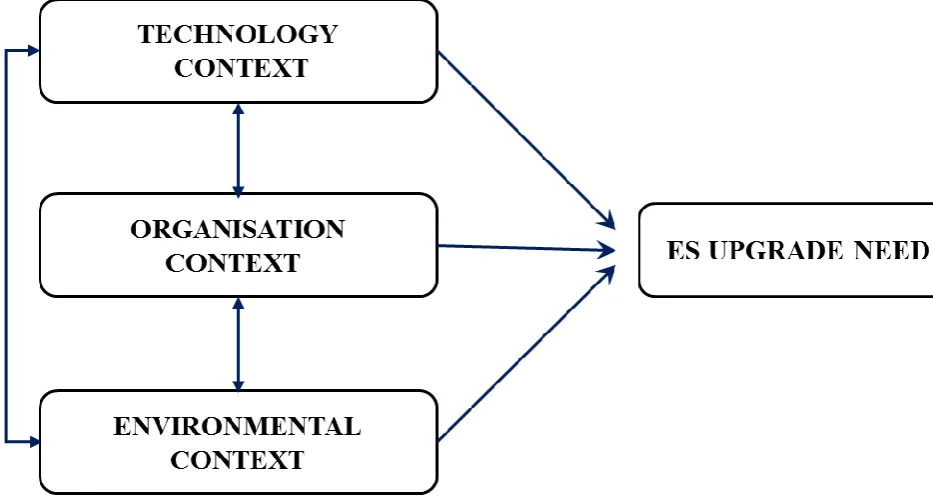
classified in three contexts: technology, organisational and environmental. Technology
context represents existing new technologies relevant to the organisation. Organisational
context describes the internal measures such as scope, size, managerial structure, and
availability of resources. Environmental context refers to the field in which the organisation
operates, this includes elements such as government legislation and vendors’ support
(Tornatzky & Fleischer, 1990). However, Rogers (2003) DOI theory, posits technological
characteristics, organisation’s internal characteristics and external characteristics as drivers
29
environmental context, the internal organisation characteristics, which include leader
characteristics, are identical to the organisational context, and technological characteristics
resemble the technology context. Thus, according to Zhu et al. (2006) and Wang et al. (2010) the T-O-E framework demonstrates similar characteristics with those of DOI theory. The
literature demonstrates that T-O-E framework has an established theoretical base and
consistent empirical support for studying ES upgrades specifically on assimilation and
adoption of an innovation (Oliveira & Martins, 2011). For example, there is an extensive use
of T-O-E framework in the literature, with various studies focusing on ES adoption (for
example Raymond & Uwizeyemungu, 2007; Chong & Ooi, 2008; Pan & Jang, 2008;
Claybaugh, 2010; Hongjun & Xu, 2010; Shahawai & Idrus, 2010; Safavi et al., 2014). Against this backdrop, this research adopts T-O-E framework (Figure 3-1), as an
investigative lens for analysing and studying the drivers that influence ES upgrade decisions.
30
3.1.2
The Need to Upgrade
There are several reasons that influence organisations to upgrade their systems; this section
outlines the different studies that have focused on exploring these various drivers. As one of
the early contributors to ES upgrade, Kremers & van Dissel (2000) examine upgrade issues
from both vendor and customer perspectives and propose four categorises for each group.
Their findings demonstrate that upgrading also benefits vendors, such as ensuring customer
lock-in, solidifying the customer base, and allowing vendors to support only fewer versions.
Several other studies have expanded and provided different explanations from the
organisations perspective these studies are explained below.
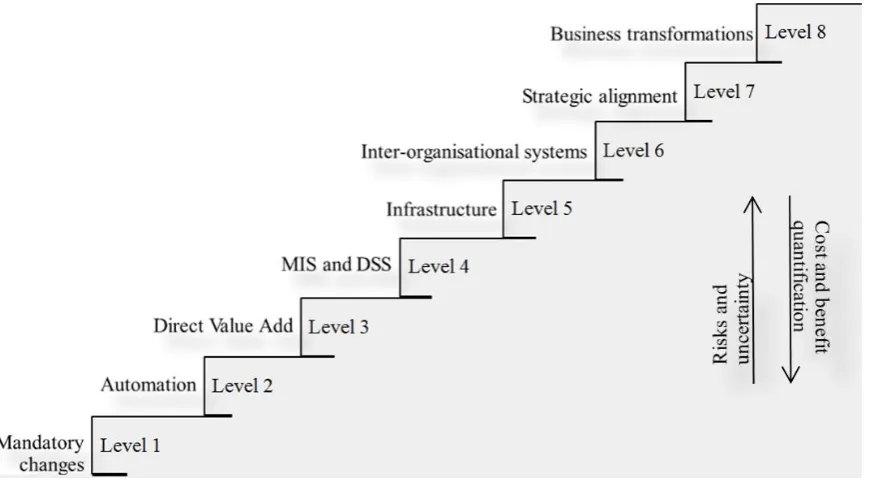
Farbey et al. (1993) propose an eight-step model that effectively communicate the changes applied during projects to the different stakeholders involved. This model can be interpreted
in a number of ways, and one of the many interpretations explains the need for upgrading.
The upgrade interpretation explains how the different attributes, benefits, risks, and
uncertainty associated with the changes, can influence upgrade decisions. Most of the steps
outlined in the model (Figure 3-2) proposed by Farbey et al. (1993), have a direct or an indirect association to ES upgrade; however mandatory changes, automation, and ‘direct
value add’ exhibit a close affiliation to the issue of why organisations upgrade.
Mandatory changes are considered unavoidable and performed to fulfil certain
external requirements, which can result in undesirable effects when not implemented.
For example, the withdrawal of vendor support would imply increase in maintenance
costs; thus, it is easier to quantify benefits and costs.
Automation refers to the need of adjusting business process using some of