The Effect of Performance Context and Skill Level on the Frequency of Flow Experiences
Abstract
The main purpose of this study was to examine interaction effects between skill level and performance contexts on the experience of flow in adolescent tennis players. The study employed a factorial design to examine differences in flow frequency between competition and training settings and the independent groups factor of ranking-list and club players. Junior tennis players (55 males, 29 females) completed the Dispositional Flow Scale-2 in training and competition settings. A repeated-measure ANCOVA, with years of tennis experience and training hours per week as covariates, showed a significant main effect for skill level, F(1, 82) = 6.67, p < .05, np² = .08, a significant main effect for performance contexts, F(1, 82) = 7.69, p < .01, np² = .09, and a significant disordinal interaction, F(1, 82) = 9.93, p < .01, np² = .11. Lower skilled athletes experienced flow with similar frequency across performance contexts, whereas advanced players experienced flow more often during training than competition. Qualitative results showed that club players’ involvement in both performance contexts was mainly based on intrinsic reasons, whereas ranking-list players reported intrinsic reasons for training, but a high number of extrinsic reasons for competition. Future studies should take propositions of the flow model into account in order to advance theoretical developments on interaction effects and shed more light into the complex processes underlying flow in sport.
Key Words: optimal experience, performance context, tennis. Running head: Interaction effect on flow in tennis
1
2
3
4
5
6
7
8
9
10
11
12
13
14
15
16
17
18
19
20
21
22
23
The Effect of Performance Context and Skill Level on the Frequency of Flow Experiences
Subjective experiences are an integral part of sport and physical activities. Optimal experiences can arise from enjoyment and a successful performance (Jackson &
Csikszentmihalyi, 1999). Csikszentmihalyi (1975, 1988a) defined this optimal state as flow. Flow in physical activities and sport is reflected by an enjoyable immersion in the task at hand that is often associated with feelings of intrinsic motivation and a heightened sense of self (Csikszentmihalyi, 1975, 1988b). Individuals who repeatedly get into flow may
experience a general increase in well-being, as well as an enhancement in effort and
perseverance (Csikszentmihalyi, 1988b). Positive experiences during physical activities and sport are particularly important during adolescence as it provides young people with the impetus for ongoing participation, skill development, and personal growth (Csikszentmihalyi & Larson, 1984; Massimini & Carli, 1988). The purpose of this study was to examine
interaction effects between performance contexts and skill level on the experience of flow in adolescent tennis players.
Csikszentmihalyi (1975) proposed that flow can emerge from virtually any activity that is structured and provides individuals with action opportunities. One main precondition to get into flow is the perception that personal skills match situational challenges
(Csikszentmihalyi, 1975; Jackson, 1995). Nine dimensions have been proposed to reflect flow experiences in sport, including challenge-skills balance, action-awareness merging, clear goals, unambiguous feedback, concentration on the task at hand, sense of control, loss of self-consciousness, time transformation, and autotelic experience (Jackson, 1995; Jackson & Eklund, 2002; Kawabata & Mallett, 2011).
In sport, the two core settings for performance are training and competition. As organised structures, training provides athletes with practise opportunities to develop their
25
26
27
28
29
30
31
32
33
34
35
36
37
38
39
40
41
42
43
44
45
46
47
48
technical, physical, and mental skills (Jackson & Csikszentmihalyi, 1999), whereas in competition these skills are put to the test against other athletes (Pol & Kavussanu, 2011). Direct competitions, in which two teams (e.g., football or basketball) or two athletes (e.g., tennis or squash) go head-to-head, are interactive and largely externally paced, meaning that performance outcomes depend to a high degree on the opponent. Csikszentmihalyi (1975) advocated that rewards from direct competition are mainly derived from measuring oneself against others, evaluating personal performance against the opponents’ performance, whereas rewards in training can be derived from measuring oneself against own ideals. The training context is guided and initiated by coaches, allowing athletes to make their performance more rewarding (Cervelló, Santos-Rosa, García Calvo, Jiménez, & Iglesias, 2007; Kimiecik & Stein, 1992). Based on theoretical considerations, it appears that athletes could gain rewards and positive experiences more frequently in training, than in competition contexts.
Kimiecik and Stein (1992) introduced a sport-specific interaction framework,
consisting of person and situation factors that influence flow. To date the flow framework has not received much attention, and flow studies using a factorial design have been rare (e.g., Russell, 2001). Kimiecik and Stein (1992) argued that sport type and environmental factors, such as commitment, meaningful challenge, clarity, perceived choice, and focus on the task at hand can influence the experience of flow in competition. Russell (2001) investigated
interaction effects between gender and sport type (team versus individual sports) on flow state in college athletes. The results of the two-way MANOVA showed no significant main or interaction effects. The findings could have been influenced by the small sample size (N = 42) and methodological issues. The selection of sport types may not have been sufficiently distinct, that is sports with similar performance characteristics (e.g., self-paced and
externally-paced sports) in both categories may override a potential effect on flow. Few studies have examined the effect of skill differences on athletes’ experiences.
50
51
52
53
54
55
56
57
58
59
60
61
62
63
64
65
66
67
68
69
70
71
72
73
Casper and Andrew (2008) assessed whether collegiate and recreational tennis players differ in their perceptions of sport commitment and enjoyment. The authors found an inverse relationship between commitment and enjoyment, indicating that with the improvement of sport-specific skills college athletes were more committed than recreational players, but, interestingly, they enjoyed the game less than players competing at lower skill levels.
The purpose of this study was threefold. The first purpose was to examine skill level effects (tennis club players vs. ranking-list players) on flow. To experience flow in sport, Jackson and Csikszentmihalyi (1999) asserted that situational challenges need to match skills on a physical, mental, technical, and tactical level. In tennis, advanced athletes should be better equipped than beginners or intermediates to find action opportunities that match their individual skills (Casper & Andrew, 2008). Hence, it is hypothesised that advanced players would perceive flow more often than players with inferior skills. The second purpose of this study was to assess the effect of performance contexts (training vs. competition) on flow. The conditions of the performance contexts appear to be diverse (Pol & Kavussanu, 2011), and the structures of the training and competition settings can affect flow in different ways (Csikszentmihalyi, 1975). Numerous environmental challenges have been found to disrupt and prevent flow in competition (Jackson, 1995; Russell, 2001; Young, 2000), therefore, it is hypothesised that flow occurs more frequently in training than in competition contexts. The third purpose of this study was to investigate the interaction effect between skill level and performance context on dispositional flow. Given the lack of research on flow using factorial designs, it is difficult to make predictions on potential interaction effects with great
confidence. Based on theoretical assertions advocating that in a competition context athletes’ measure themselves against others, whereas training is characterised by measuring
performance against their own ideal (Csikszentmihalyi, 1975), it is hypothesised that athletes of different skill levels will perceive flow differently in competition but not in training
75
76
77
78
79
80
81
82
83
84
85
86
87
88
89
90
91
92
93
94
95
96
97
98
contexts. More specifically, flow frequency in training should be similar for athletes’ of different skill levels, as coaches’ generally try to structure training tasks that facilitate
learning and performance based on the individual challenge-skill level (Cervelló et al., 2007; Kimiecik & Stein, 1992). Testing one’s skills in competition, it would appear that more advanced athletes with a greater repertoire of technical, physical, and mental skills are better equipped to meet situational challenges. In a competition context, advanced athletes would experience flow more frequently than athletes of a lower skill level. Therefore, an ordinal interaction between performance context and skill level is hypothesised.
Methods
Participants
We recruited a total of 84 junior tennis players (55 males, 65.5%; 29 females, 34.5%), between 11 and 18 years (M = 14.45; SD = 1.53). One sub-sample included 40 advanced players (24 males, 16 females), who competed frequently and were listed in the Australian Junior Rankings. The ranking-list position ranged between number 17 and number 1647 (Median = 238). The other sub-sample consisted of 44 club players (31 males, 13 females), who played tennis for recreational purposes and were not listed in the Australian Junior Rankings. The majority of club player (n = 24) joined 1 to 5 tournaments per year, whereas all ranking-list players, except for one, reported to competed between 6 and 25 tournaments per annum. Overall, the participants had been involved in tennis for an average of 6.77 years (SD = 2.14) and in competitions for 4.61 years (SD = 1.71). The average time for on-court training was 9.64 hours per week (SD = 5.18). The questionnaire return rate was 85.71%.
Measures
Dispositional Flow Scale-2 (DFS-2; Jackson & Eklund, 2002). The DFS-2 assesses the frequency of flow in sport. The questionnaire consists of 36 items representing nine subscales, each comprising four items with a 5-point Likert scale anchored by 1 (never) and 5
100
101
102
103
104
105
106
107
108
109
110
111
112
113
114
115
116
117
118
119
120
121
122
123
(always). Item examples of the nine subscales are reflected in “My abilities match the high challenge of the situation” (challenge-skills balance), “Things seem to happen automatically” (action-awareness merging), “I know clearly what I wanted to do” (clear goals), “I am aware of how well I am performing” (unambiguous feedback), “My attention is focused entirely on what I am doing” (concentration on the task at hand), “I have a sense of control over what I am doing” (sense of control), “I am not concerned with how others may be evaluating me” (loss of self-consciousness), “It feels like time goes by quickly” (time transformation), and “I really enjoy the experience” (autotelic experience). The subscales showed acceptable
reliability values, ranging between .81 and .90 (Jackson & Eklund, 2002). The DFS-2 has been frequently used in previous studies (e.g., Hodge, Lonsdale, & Jackson, 2009; Jackson & Eklund, 2002; Jackson, Martin, & Eklund, 2008).
Open-ended questions. In addition to the completion of the DFS-2, participants answered two questions with regards to their involvement in tennis. In conjunction with the assessment of flow frequency in competition, participants were asked “What is your main reason to compete in tennis in general?”. When reflecting on flow experiences in training, participants were asked “What is your main reason to train in tennis in general?”.
Procedures and Data Collection
Following approval from an Australian University’s Ethics Committee, we contacted tennis tournament directors to gain permission to approach tennis players. Information statements and consent forms were handed out to players and parents or legal guardians before the onset of the competition. Players who wanted to join the study as volunteers and who had received consent from their parent or guardian returned the signed consent form to the researcher. Firstly, one of the researchers explained to the participants what the
questionnaire was about and how to complete it. Secondly, the researcher asked the participants to read the introductory section, before filling out the questionnaire. Written
125
126
127
128
129
130
131
132
133
134
135
136
137
138
139
140
141
142
143
144
145
146
147
148
instructions were provided in the introductory section on top of the questionnaire. The researcher emphasized that all responses should be based on experiences in competition matches. Finally, the researcher encouraged participants to ask questions both immediately after hearing and reading instructions, and at any time during the data collection. All participants filled out the DFS-2 at the tournament venue within one hour before their competition matches. The researcher met with the participants a second time at their training venue. Participants completed the DFS-2 before the onset of the training session answering all items with regards to their flow experiences in training. Following completion of the DFS-2 in both contexts, the researcher thanked the players at the end of the data collection for volunteering in and contributing to this study.
Design and Statistical Analyses
The study employed a factorial design to examine differences in performance contexts and skill-level on the frequency of flow experiences. The first purpose of the study was to test the main effect of the independent group variable of skill level on dispositional flow. We initially employed independent t-tests to examine differences between club and ranking-list players based on demographic information. The demographic variables that revealed significant differences were entered in the following analyses as covariates.
The second purpose the study was to examine the main effect of performance contexts on flow. We examined differences between training and competition through open-ended questions to assess whether athletes’ involvement in tennis training and competition was based on similar reasons. Specifically, we assigned qualitative responses on athletes’ tennis involvement into intrinsic (e.g., ‘for fun’, ‘I enjoy playing tennis’, ‘love this game’) and extrinsic (e.g., ‘my friends play’, ‘I want to win’, ‘I want to become a professional’) categories. Intrinsic and extrinsic categories were based on criteria proposed by Ryan & Deci’s (2000) self-determination theory. Several studies have applied self-determination
150
151
152
153
154
155
156
157
158
159
160
161
162
163
164
165
166
167
168
169
170
171
172
173
theory in the context of flow (Kowal & Fortier, 1999; Kowal & Fortier, 2000). For instance, we categorised all responses associated with enjoyment and inherent satisfaction (e.g., fun) as intrinsic, and responses that reflect ego-involvement and extrinsic rewards (e.g., winning) as extrinsic. In addition, we assessed the relationship of flow dimensions between training and competition contexts for each sub-sample, employing Pearson’s product-moment correlation coefficients. The third purpose of the study was to investigate the interaction effect of skill levels and performance contexts on flow. We used two-way repeated measures ANCOVAs to analyse main and interaction effects on dispositional flow. To adjust for multiple
comparisons a corrected Bonferoni cut-off was used to test the hypotheses on a more stringent significance level.
Results
Internal Consistency
Internal consistency for the flow dimensions in the training and competition context ranged between .69 and .92 (Table 1). The only subscales that remained under .70 were found in the advanced group, including action-awareness merging (training) and sense of control (competition). These two dimensions have been retained for further analyses as both subscales were marginally below the .70 value (Nunnally & Bernstein, 1994), although the results of these two subscales will be viewed with caution. Internal consistency for the overall scales were acceptable for the club sample, training DFS-2 = .86, competition DFS-2 = .85, and the ranking-list sample, training DFS-2 = .86, competition DFS-2 = .89.
Reasons for Training and Competition Involvement
The majority of participants reported that their involvement in tennis is based on intrinsic reasons. A total of 31 (77.5%) ranking-list players and a total of 40 (90.9%) club players reported to play tennis because it is fun and enjoyable. For the competition context, ranking-list players provided a number of reasons why they compete in tennis tournaments.
175
176
177
178
179
180
181
182
183
184
185
186
187
188
189
190
191
192
193
194
195
196
197
198
Only 50.0% of players named intrinsic reasons, whereas the other half favoured extrinsic rewards, such as ‘I want to win’, ‘I want to become a professional player’, or ‘I want to become the No. 1’. In comparison, a relatively high number of club players (n = 36; 81.18%) reported intrinsic motives as main reasons for their involvement in tennis competitions.
Table 1
Means, Standard Deviations, and Cronbach’s Alpha for DFS-2 Measures
Club Players Ranking-List Players
DFS-2 Training CompetitionDFS-2 DFS-2 Training DFS-2 Competition
M SD α M SD α M SD α M SD α
CSB 3.70 0.51 .70 3.70 0.51 .75 4.05 0.44 .75 3.87 0.55 .71 AA
M 3.40 0.86 .88 3.32 0.76 .86 3.72 0.48 .69 3.50 0.53 .73 CG 3.94 0.61 .74 4.01 0.65 .75 4.28 0.69 .88 4.12 0.79 .90 UF 4.00 0.76 .86 4.00 0.68 .82 4.28 0.63 .86 4.18 0.69 .82 CTH 3.55 0.8
1 .84 3.35 0.7
6 .85
3.8 7
0.6
5 .83 3.65 0.69 .83 SC 3.85 0.55 .70 3.76 0.50 .71 3.76 0.58 .70 3.68 0.57 .69 LSC 3.14 1.00 .85 3.35 0.99 .84 3.60 0.84 .83 3.48 0.90 .85 TT 3.13 1.03 .86 2.77 1.02 .91 3.18 1.15 .92 3.18 0.99 .88 AE 3.90 0.68 .81 4.01 0.85 .89 4.29 0.60 .81 4.35 0.49 .72 Note. CSB = challenge-skills balance; AAM = action-awareness merging; CG = clear goals; UF = unambiguous feedback; CTH = concentration on the task at hand; SC = sense of control; LSC = loss of self-consciousness; TT = time transformation; AE = autotelic experience.
200
201
202
203
204
205
206
207
208
209
210
Demographic Variables
Between the groups of ranking-list and club players there were no significant differences in age (Mdiff = .19 years) and competition experience (Mdiff = .11 years). Significant differences were found for general tennis experiences (Mdiff = 1.09 years) and training hours per week (Mdiff = 6.62 hours), indicating that rankings-list players were more experienced, t(1, 82) = 2.39, p < .05, effect size d = .52, and spent more time training, t(1, 82) = 7.61, p < .001, effect size d = 1.64, than club players. Following, the two-way repeated measures ANCOVA was conducted with years of tennis experience and training hours per week as covariates.
Flow Correlations across Training and Competition
Table 2 showed the results of the correlation analyses for the two skill-level groups. The relationship for each flow dimension was assessed across performance contexts. All
correlations for club level and ranking list players were significant on a .01 level. For the sub-sample of club players, there was an overlap between training and competition flow
accounting for 25% to 52% of the variance. The strongest overlap for this sub-sample was found for action-awareness merging (52%), unambiguous feedback (50%), and time
transformation (50%). The smallest overlap was found for concentration on the task (27%), loss of self-consciousness (26%), and clear goals (25%). The correlation results for the ranking-list players revealed similar findings. The shared variance between training and competition flow ranged from 21% (challenge-skills balance) to 62% (time transformation). In the more advanced sample, the amount of variance was considerably higher for some flow dimensions, including concentration on the task at hand (50%), loss of self-consciousness (52%), and clear goals (46%). The smallest overlap between training and competition variables was found for unambiguous feedback (27%) and challenge-skills balance (21%).
212
213
214
215
216
217
218
219
220
221
222
223
224
225
226
227
228
229
230
231
232
233
234
235
Table 2
Pearson’s Product-Moment Correlation Coefficients for Dispositional Flow in Training and Competition for Club and Ranking-List Players
Club Players Ranking-ListPlayers
Challenge-Skills Balance .56 .46
Action-Awareness Merging .72 .61
Clear Goals .50 .68
Unambiguous Feedback .71 .52
Concentration on the Task at Hand .52 .70
Sense of Control .56 .68
Loss of Self-Concsiousness .51 .72
Time Transformation .71 .79
Autotelic Experience .66 .65
Note. All values were significant at p < .01 level.
Main Effects of Skill Level on Flow
The independent groups factor of ranking-list and club players also showed a significant difference in dispositional flow, F(1, 82) = 6.67, p < .05, np² = .08. Additional analysis on a subscale level using a corrected Bonferoni cut-off of p < .006 for multiple comparisons showed no significant main effects. The results of partial eta squared, np², did indicate
differences for some flow dimensions. Based on Cohen’s (1988) guidelines, researchers have interpreted values of .01, .06, and .14 for small, medium, and large effects (Aron, Aron, & Coups, 2008; Coolican, 2009). The results showed small to medium effects for challenge-skills balance (np² = .04) sense of control (np² = .06), and autotelic experience (np² = .04). Interestingly, the pairwise comparisons showed a mean difference (.32), indicating that club players scored significantly higher on sense of control than ranking-list players, whereas
237
238
239
240
241
242
243
244
245
246
247
248
249
250
251
ranking-list players scored higher than club players on challenge-skills balance and autotelic experience.
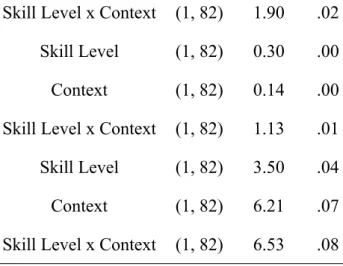
Table 3
Main and Interaction Effects between Skill Levels and Contexts on Flow Dimensions
Dimension Factor df F np²
Challenge-Skills Balance Skill Level (1, 82) 3.24 .04
Context (1, 82) 2.14 .03
Skill Level x Context (1, 82) 11.47* .13
Action-Awareness Merging Skill Level (1, 82) 0.09 .00
Context (1, 82) 9.09* .10
Skill Level x Context (1, 82) 6.64 .08
Clear Goals Skill Level (1, 82) 0.27 .00
Context (1, 82) 3.50 .04
Skill Level x Context (1, 82) 9.19* .10
Unambiguous Feedback Skill Level (1, 82) 0.29 .00
Context (1, 82) 1.18 .01
Skill Level x Context (1, 82) 3.05 .04 Concentration on the Task at Hand Skill Level (1, 82) 0.59 .01
Context (1, 82) 3.48 .04
Skill Level x Context (1, 82) 0.63 .01
Sense of Control Skill Level (1, 82) 5.24 .06
Context (1, 82) 0.07 .00
Skill Level x Context (1, 82) 0.00 .00 Loss of Self-Consciousness Skill Level (1, 82) 0.10 .00
Context (1, 82) 0.01 .00
253
254
255
256
Skill Level x Context (1, 82) 1.90 .02
Time Transformation Skill Level (1, 82) 0.30 .00
Context (1, 82) 0.14 .00
Skill Level x Context (1, 82) 1.13 .01
Autotelic Experience Skill Level (1, 82) 3.50 .04
Context (1, 82) 6.21 .07
Skill Level x Context (1, 82) 6.53 .08 Note. Significance level *p < .006.
Main Effects for Context on Flow
The results showed a significant main effect for performance context on flow, F(1, 82) = 7.69, p < .01, with an effect size of np² = .09. Using an adjusted Bonferoni cut-off on a subscale level (p < .006), a significant main effect showed that participants experienced action-awareness merging more frequently in training than in competition, p = .003; np² = .10. Furthermore, partial eta squared values indicated small to medium effects for challenge-skills balance (np² = .03), clear goals (np² = .04), and concentration on the task (np² = .04), and a medium effect for autotelic experience (np² = .07). Ranking-list players scored higher on these dimensions than club players.
Interaction Effect between Skill Level and Context on Flow
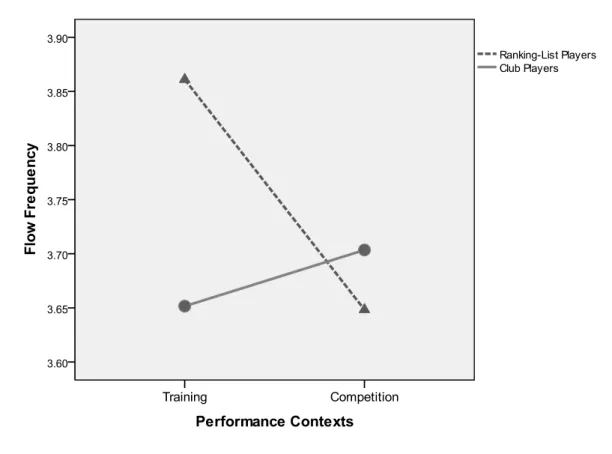
Figure 1 showed a significant disordinal interaction effect between performance contexts and groups, F(1, 82) = 9.93, p < .01, np² = .11. The results showed that ranking-list players scored higher on flow in training, but club players experienced flow more frequently in competition. Significant interactions on a .006 level emerged for two flow dimensions, namely challenge-skills balance (p = .001; np² = .13) and clear goals (p = .003; np² = .10). Medium to large effects were found for action-awareness merging (np² = .08) and autotelic experience (np² = .08), and small to medium effects for unambiguous feedback (np² = .04).
258
259
260
261
262
263
264
265
266
267
268
269
270
271
272
273
274
275
Figure 1. Main and interaction effects between groups and performance contexts on flow frequency.
Discussion
This study examined differences in the frequency of flow across performance contexts between ranking-list and club players. The first purpose of this study was to test differences in flow frequency across skill levels. The hypothesis that advanced players would perceive flow more frequently than club players was partly confirmed. There was a significant main effect for skill level, indicating that ranking-list players scored significantly higher on flow than club players, although there was no evidence for a significant effect on a subscale level, but effect sizes indicated substantial differences for challenge-skills balance, sense of control, and autotelic experience. In order to reach an advanced skill level, athletes need to invest time and effort, and competition play becomes a mean to advance in the rankings. Thereby,
277
278
279
280
281
282
283
284
285
286
287
288
289
290
the game becomes more serious, competition rather than skill mastery a main focus, and athletes may be more easily frustrated if performance does not match expectations (Casper & Andrew, 2008). The similarity in flow frequency across performance contexts for club players could be a reflection of their lower investment in the sport. The results indicated that club players’ involvement in tennis and competition is mainly based on intrinsic reasons, such as fun and enjoyment. Competition and training might be viewed as opportunities for skill development and mastery, whereas ranking-list players put more emphasis on winning in order to advance in the rankings. The results showed that 77.5% of ranking-list players reported intrinsic reasons for the involvement in tennis, but half of the sub-sample named extrinsic reasons for their involvement in tennis competitions. It is possible that differences in sport involvement and commitment had a debilitating effect on the flow experiences of ranking-list players in competition, whereas no such effect was detected for lower skilled players.
The second purpose of the study was to examine differences in dispositional flow across performance contexts. The hypothesis that flow occurs more frequently in training than in competition has been supported, indicating that athletes’ scored substantially higher on flow in training. The results confirmed a previous finding by Young (2000) that for advanced tennis players the training environment appears to be more conducive to
experiencing flow. Training situations allow coaches to regulate drills so that players can use and develop their skills optimally. Similarly, Kimiecik and Stein (1992) concluded that coaches can structure the training environment in a way to facilitate flow. This was partly reflected by small to medium effect sizes on a subscale level, indicating that athletes’ experienced action-awareness merging, challenge-skills balance, clear goals, concentration on the task, and autotelic experience more frequently in training than in competition. Furthermore, the regression results underpinned that flow dimensions in training are not a
292
293
294
295
296
297
298
299
300
301
302
303
304
305
306
307
308
309
310
311
312
313
314
315
strong predictor of flow in competition, leaving large amounts of variance unexplained. Apparently, training situations provide more control over individual performances and allow players, independent of their skill level, to evaluate their performance against their own ideal (Csikszentmihalyi, 1975). In direct competitions, athletes involuntarily need do evaluate and compare the performance outcomes (e.g., a lost baseline rally) in order to improve their performance. Hence, competition experiences are much closer tight to performance, which, at least for ranking-list players, can have debilitating effects on flow. Training and competition contexts reflect different performance conditions that can affect athletes’ experiences of flow.
The third purpose of the study was to examine the interaction effect of skill level and performance context on flow. The hypothesis of an ordinal interaction was not confirmed, but a significant disordinal interaction effect was evident, indicating that flow experiences were relatively stable for club players across training and competition, whereas ranking-list players showed a high flow frequency in training, but fewer flow experiences in competition.
Additional analyses on a subscale level revealed significant disordinal interaction effects for challenge-skills balance and clear goals. The findings indicated a reversal effect, as the performance context had a moderating effect, triggering a change in experience for the higher, but not for the low-skilled group. According to reversal theory, Apter (2007) advocated that athletes vary in how they view performance contexts. In a telic state (e.g., a competition match) athletes adopt a serious, goal-directed view, whereas in a paratelic state (e.g., a training session) a non-directional view may be dominant, providing the opportunity to enjoy and ‘get lost’ in the moment. As advocated in Kimiecik and Stein’s (1992) flow model, aspects such as competition importance and commitment might be crucial variables of athletes’ sport involvement that might help expain individual differences in the experience of flow. For instance, facing a fellow player of a similar skill level in a training match could indeed facilitate the experiences of flow as learning or training aspects could outweigh
317
318
319
320
321
322
323
324
325
326
327
328
329
330
331
332
333
334
335
336
337
338
339
340
potential competing goals, such as winning. These findings bear similarities with the Casper and Andrew (2008) study indicating that more advanced tennis players were more committed but appeared to perceive less enjoyment from the game than recreational players. Club players in this study reported that their engagement in tennis, based on years of experience and training hours per week, were considerably lower than for the higher-skill group. These players may approach the performance situation in training and competition in a similar way, so that no reversal took place. This may partly explain the disordinal effect between skill level and activity setting on flow frequency.
One of the main limitations of this study was the use of a retrospective design, which does not allow for making conclusions on causal, one-directional, or reciprocal relationships between flow experiences in training and competition contexts. Future studies need to examine potential effects between optimal training and competition experiences, which would be of great relevance for coaches and practitioners. Another important aspect that may have an impact on the results was response bias. The effect of performance outcome (e.g., winning or losing) on self-report assessments, such as flow, can be compromised by methods of retrospective introspection (Brewer, Van Raalte, Linder, & Van Raalte, 1991). In order to minimise response bias athletes have been approached before the onset of competition or training to complete the questionnaires. Finally, the external validity of the findings is limited to adolescent tennis players. Previous studies recruited diverse samples with athletes from various sports (e.g., Jackson, 1995; Russell, 2001) that allowed for more generalised conclusions, whereas the results of this study provided some specific indications for the current sample.
Practical implications can be derived from the main finding of this study that showed a significant disordinal interaction between skill level and context on flow. As flow in club players was similar across performance context, for coaches and practitioners it is important
342
343
344
345
346
347
348
349
350
351
352
353
354
355
356
357
358
359
360
361
362
363
364
365
to realise that competition can have a potentially debilitating effect on the flow experience of advanced players. Flow dimensions that are critical for junior tennis players are challenge-skills balance and clear goals. Particularly for advanced athletes, it is crucial to find a balance between situational challenges and personal skills in competition. As suggested by Jackson and Csikszentmihalyi (1999), a match of challenges and skills can occur on a technical, physical, or mental level. In order to more frequently experience flow, advanced competitive athletes need to find which of their personal skills, including use of groundstrokes, tactical or mental game plans, allow them to ‘get into’ the match and give them the edge over their opponents. The development of pre-performance routines, focusing on challenge-skills balance and clear goals, would help advanced junior athletes to achieve a state of optimal mental preparation and readiness for the competition to attain flow (Jackson, 1995; Russell, 2001; Young, 2000).
Future studies should be guided by Kimiecik and Stein’s (1992) flow model on interaction effects on flow in sport. Although researchers have rarely used the flow model as underlying framework for their studies, the proposition of interaction effects between
personal and situational factors on the experience of flow appears to be paramount and should be used as a theoretical basis for further research. For instance, factorial study designs could be used to examine athletes’ commitment and involvement in training and competition, in order to shed more light into the complex processes underlying flow in sport. Theoretical advancements could be made by evaluating constituents of the flow model (Kimiecik & Stein, 1992) and the sport commitment model (Scanlan, Carpenter, Schmidt, Simons, & Keeler, 1993) that would allow conclusions as to how positive experience and commitment affect participation and effort expenditure on different performance levels. The results of this study also provide direction for applied research. Future studies should examine the influence of the coach-athlete relationship on flow experiences in training and competition. This could
367
368
369
370
371
372
373
374
375
376
377
378
379
380
381
382
383
384
385
386
387
388
389
390
lead to interventions that aim to enhance flow and competition performance in advanced athletes and to an increase flow in beginner and intermediate athletes in order to facilitate continued participation in sport.
Acknowledgements
We would like to thank Tennis Australia and Tennis Coaches Australia-Victoria for their support in conducting the study. The study was conducted with no internal or external financial support.
References
Apter, M.J. (2007). Reversal Theory: The Dynamics of Motivation, Emotion and Personality (2nd ed.). Oxford: Oneworld Publications.
Aron , A, Aron, E.N., & Coups, E.J. (2008). Statistics for psychology (5th ed.). Upper Saddle River, NJ: Pearson.
Brewer, B. W., Van Raalte, J. L., Linder, D. E., & Van Raalte, N. S. (1991). Peak
performance and the perils of retrospective introspection. Journal of Sport & Exercise Psychology, 8, 227–238.
Casper, J.M., & Andrew, D.P.S. (2008). Sport commitment differences among tennis players on the basis of participation outlet and skill level. Journal of Sport Behavior, 31, 201-219.
Cervelló, E., Santos-Rosa, F., García Calvo, T., Jiménez, R., & Iglesias, D. (2007). Young tennis players’ competitive task involvement and performance: The role of goal orientations, contextual motivational climate, and coach-initiated motivational climate. Journal of Applied Sport Psychology, 19, 304–321.
Cohen, J. (1988). Statistical power analysis for the behavioral sciences (2nd ed.). New York:
392
393
394
395
396
397
398
399
400
401
402
403
404
405
406
407
408
409
410
411
412
413
414
415
Academic Press.
Coolican, H. (2009). Research methods and statistics in psychology (5th ed.). Hodder Education: London.
Csikszentmihalyi, M. (1975). Beyond boredom and anxiety. San Francisco, CA: Jossey-Bass Publishers.
Csikszentmihalyi, M. (1988a). Introduction. In M. Csikszentmihalyi & I. S. Csikszentmihalyi (Eds.), Optimal experience: Psychological studies of flow in consciousness (pp. 3– 14). New York, NY: Cambridge University Press.
Csikszentmihalyi, M. (1988b). The flow experience and its significance for human psychology. In M. Csikszentmihalyi & I. S. Csikszentmihalyi (Eds.), Optimal experience: Psychological studies of flow in consciousness (pp. 15–36). New York, NY: Cambridge University Press.
Csikszentmihalyi, M., & Larson, R. (1984). Being adolescent: Conflict and growth in the teenage years. New York, NY: Basic Books.
Hodge, K., Lonsdale, S, & Jackson, S.A. (2009). Athlete engagement in elite sport: An exploratory investigation of antecedents and consequences. The Sport Psychologist, 23, 186-202.
Jackson, S.A. (1995). Factors influencing the occurrence of flow state in elite athletes. Journal of Applied Sport Psychology, 7, 138–166.
Jackson, S.A., & Csikszentmihalyi, M. (1999). Flow in sports. Champaign, IL: Human Kinetics.
Jackson, S.A., & Eklund, R.C. (2002). Assessing flow in physical activity: The Flow State Scale-2 and Dispositional Flow Scale-2. Journal of Sport and Exercise Psychology, 24, 133–150.
Jackson, S.A., Martin, A.J., & Eklund, R.C. (2008). Long and short measures of flow: The
417
418
419
420
421
422
423
424
425
426
427
428
429
430
431
432
433
434
435
436
437
438
439
440
construct validity of the FSS-2, DFS-2, and new brief counterparts. Journal of Sport and Exercise Psychology, 30, 561-587.
Kawabata, M., & Mallett, C.J. (2011). Flow experience in physical activity: Examination of the internal structure of flow from a process-related perspective. Motivation and Emotion, 35, 393-402.
Kimiecik, J.C., & Stein, G.L. (1992). Examining flow experiences in sport contexts: Conceptual issues and methodological concerns. Journal of Applied Sport Psychology, 4, 144–160.
Kowal, J., & Fortier, M.S. (1999). Motivational determinants of flow: Contributions from self-determination theory. Journal of Social Psychology, 3, 355–368.
Kowal, J., & Fortier, M.S. (2000). Testing relationships from the hierarchical model of intrinsic and extrinsic motivation using flow as motivational consequence. Research Quarterly for Exercise and Sport, 2, 171–181.
Massimini, F., & Carli, M. (1988). The systematic assessment of flow in daily experience. In M. Csikszentmihalyi & I. S. Csikszentmihalyi (Eds.), Optimal experience:
Psychological studies of flow in consciousness (pp. 266–287). New York: Cambridge University Press.
Nunnally, J.C., & Bernstein, I. (1994) Psychometric Theory (3rd ed.). New York: McGraw Hill.
Pol, P.K.C van de, & Kavussanu, M. (2011). Achievement goals and motivational responses in tennis: Does context matter? Psychology of Sport and Exercise, 12, 176–183.
Ryan, R.M., & Deci, E.L. (2000). Self-determination theory and the facilitation of intrinsic motivation, social development, and well-being. American Psychologist, 55, 68-78. Russell, W.D. (2001). An examination of flow state occurrence in college athletes. Journal of
Sport Behavior, 24, 83–107.
442
443
444
445
446
447
448
449
450
451
452
453
454
455
456
457
458
459
460
461
462
463
464
465
Scanlan, T.K., Carpenter, P.J., Schmidt, G.W., Simons, J.P., & Keeler, B. (1993). An introduction to the Sport Commitment Model. Journal of Sport and Exercise Psychology, 15, 1-15.
Young, J.A. (2000). Professional tennis players in the zone. In S.J. Haake & A. Coe (Eds.), Tennis science & technology (pp. 417–422). Malden, MA: Blackwell Science.
467
468
469
470