Article
X-ray Photoelectron Spectroscopy for Determining
Interface Dipoles of Self-Assembled Monolayers
Thomas C. Taucher 1, and Egbert Zojer 2,*
1 Institute of Solid State Physics, Graz University of Technology, NAWI Graz, Petersgasse 16, 8010 Graz, Austria; [email protected]
* Correspondence: [email protected]; Tel.: +43/316/873-8475
Featured Application: Authors are encouraged to provide a concise description of the specific application or a potential application of the work. This section is not mandatory.
Abstract: In the current manuscript we assess to what extent X-ray photoelectron spectroscopy is a suitable tool for probing the dipoles formed at interfaces between self-assembled monolayers and metal substrates. To that aim, we perform dispersion-corrected, slab-type band-structure calculations on a number of biphenyl-based systems bonded to a Au(111) surface via different docking groups. In addition to changing the docking chemistry (and the associated interface dipoles), also the impacts of polar tail-group substituents and varying dipole densities are investigated. We find that for densely-packed monolayers the shifts of the peak positions of the simulated XP-spectra are a direct measure for the interface dipoles. In the absence of polar tail-group substituents they also directly correlate with adsorption-induced work-function changes. At reduced dipole-densities this correlation deteriorates, as work function measurements probe the difference between the Fermi-level of the substrate and the electrostatic energy far above the interface, while core level shifts are determined by the local electrostatic energy in the region of the atom from which the photoelectron is excited.
Keywords: x-ray photoelectron spectroscopy, XPS, self-assembled monolayer, SAM, collective electrostatics, band-structure calculation, density-functional theory, DFT
1. Introduction
In the field of organic electronics, chemically bonded self-assembled monolayers (SAMs) have been used to change the electronic properties of a huge variety of interfaces.[1–18] They have allowed the realization of n-type organic transistors by screening interface traps,[3] they have been used to shift turn-on voltages of devices by several dozens of volts,[4–7] and they have been employed for tuning injection barriers, changing contact resistances by orders of magnitude.[8–18] Especially for the latter applications, the shift in the (electrostatic) energy landscape generated by the SAM is of crucial importance. On the one hand, this shift is a consequence of the intrinsic dipoles of the adsorbed molecules due to polar groups embedded into the molecular backbones[15,17,19–23] or due to polar tail-group substituents.[9,24–38] On the other hand, there is always an interface dipole localized in the immediate contact region between the substrate and the adsorbed molecule.[11,25,27,28,31,32,39–44] This interface dipole consists of the surface dipole of the (metal) substrate, the dipole associated with the (typically polar) docking group, and the bond dipole due to interfacial charge rearrangements following bond formation. The superposition of the electric fields due to the interface dipoles of all adsorbed molecules causes a step in the electrostatic energy.[31,40,42,45,46] This not only triggers a shift in the position of the vacuum level above the surface and, consequently, changes the sample work function;[8,11,14–
17,19,21,22,27,28,31,32,35,41,43,44,47,39,25,48–52] it also modifies the interfacial
level alignment, i.e., the positions of the electronic states of the adsorbed monolayer relative to those of the substrate.[27,28,31,39,40,42,45–47,53–62] This has an immediate impact on charge-transport through the adsorbed layer[53–62] and also on the positions of the core levels of the adsorbate.[20–22,42,48,49,63–65]
These changes in core-level binding energies can be probed by X-ray photoelectron spectroscopy (XPS), [66–69] which is one of the default techniques for characterizing SAMs, used, for example, for analyzing the quality of self-assembled monolayers and to verify bonding.[70–81] In this paper we will argue that the electrostatic core-level shifts make XPS an ideally suited tool for probing interface dipoles. For supporting that claim, we will use state of the art quantum-mechanical simulations to determine core-level shifts encountered biphenyl-based SAMs attached to a Au(111) substrate by a variety of chemically different docking groups. To the best of our knowledge, a corresponding set of experimental XPS data with systematically varied docking groups and consistent film structures and morphologies does not exist yet. Nevertheless, first steps in that direction have been undertaken and biphenyl-based SAMs on all kinds of substrates have been studied.[72,80–88,60] We, however, do not consider this to be an all too serious problem, as we have high confidence in the employed computational approach, which is described in the following section. This confidence is based on the fact that in the past we have observed an excellent agreement between measured and simulated core-level shifts for a variety of self-assembled monolayers.[21,22,48,49,64,65]
2. Computational Methodology
The structural and electronic properties of the metal-SAM interfaces were simulated by density functional theory, DFT, employing the all-electron, full potential FHI-aims code version 190715[89–
93] and periodic boundary conditions. The Perdew-Burke-Ernzerhof (PBE)[94,95] functional was used for describing exchange and correlation. Furthermore, long-range van der Waals interactions were accounted for by employing the surface version[96] of the Tkatchenko-Scheffler dispersion correction,[97] which was specifically parametrized for treating adsorbing molecules on metal substrates. The dispersion corrections between the Au atoms of the metal slab were turned off. All calculations were done with the so-called tight basis set for all atomic species (as supplied by FHI-aims). A thorough description of the corresponding basis functions is included in the Supporting Information. Reciprocal space was sampled by a converged -centered 15×10×1 grid for the full coverage systems and by accordingly smaller sized grids for larger super cells. The change of the electron density was converged to 10-5 e- and the total energy to 10-6 eV.
Interfaces were modelled employing the repeated-slab approach with the Au(111) substrate represented by five metal layers. The bottom three Au layers were kept fixed in all calculations to avoid spurious relaxations at the bottom surface. The periodic replicas of the slabs were quantum-mechanically and electrostatically decoupled by a vacuum gap of more than 20 Å and a self-consistent dipole correction.[98,99] The geometries of the adsorbate molecules and the top two Au-layers in the full coverage unit cells were fully relaxed until the remaining forces on each atom were below 10-3 eV/Å . The geometries of the other supercells considered here were directly derived from
the full coverage unit cell by replicating it in x- and y-directions and removing all but one molecule from the resulting cell (see Supporting Information). These supercells were considered as model systems to study the impact of diluting the interfacial dipoles. Thus we fixed the remaining molecule in the geometry it adopts in the densely-packed layer, to prevent it from falling over.[100]
The change of the work function () is defined as the difference of the calculated work functions at the bottom side of the Au(111)-slab (Au = 5.10 eV for all systems) and above the
self-assembled monolayer. Furthermore, the work function change of VIa, i.e. the difference between the pristine Au(111) and the SAM moved 1 Å further away from its equilibrium adsorption distance, was defined as a reference point for all other calculations and amounts to ref = 0.11 eV.
of the core-level binding energies, but yields relative shifts between different systems.[63,68,101–
106] We have also found it to provide a very good description of core-level shifts in SAMs.
[21,22,48,49,64,65] In fact, when modelling the XP spectra of (partially) aromatic hydrocarbon
SAMs bonded to Au substrates, we typically find that shifting the calculated spectra to higher binding energies by between 18.9 to 19.0 eV[22,49,107,108] yields an excellent correlation with experimental data. Therefore, throughout the manuscript work-function shifts relative to the peak position of the vacuum-level aligned system VIa are reported. The calculated value of that reference energy is -263.95 eV.
Another complication when employing the initial-state approach is that (in contrast to final-state approaches)[68,109–111] it does not account for core-hole screening effects. Unfortunately, final-state approaches are not applicable to systems like the ones considered here, as in conjunction with periodic boundary conditions one would need unit cells comprising thousands of atoms in order to avoid spurious collective electrostatic effects due to periodic replicas of the core holes (and the compensation charges).[64,112] Therefore, we resorted to an a posteriori correction of screening by the metal substrate relying on an image charge model, which is explained in detail in the Supporting Information.[113,114] In passing we note that screening by the metal substrate has only a comparably minor impact on the spectra shown below, as we are dealing with rather extended, upright standing molecules, whose spectra are dominated by excitations of atoms, which are rather far away from the substrate. To account for the finite escape depth of the photoelectrons from lower-lying atoms, we scaled their contributions by an exponential attenuation function[115] setting the incident photon energy to 580 eV, as described in detail in the Supporting Information. To obtain the final spectra, the discrete peaks were convoluted with a Gaussian function with a variance of 0.3 eV.
For the analysis and visual representation of the data, Python was used in combination with NumPy[116] and matplotlib[117]. Ovito[118] was applied for generating the 3D view of the systems and for the 2D potential plot we used VESTA.[119] Finally, the figures were compiled with GIMP.[120]
3. Results and Discussion
3.1. Energetics of a metal-SAM interface
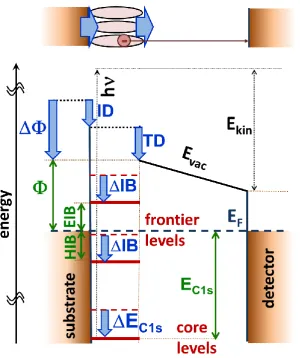
Figure 1: Schematics of the energy landscape of a metal-SAM interface and an XPS experiment (disregarding the bias voltage applied between substrate and detector). The interface electronic structure is characterized by the work function, Φ, by the alignment of the frontier levels determining electron- and hole-injection barriers, EIB and HIB, and by the energetic positions of the core levels, here exemplarily denoted as EC1s. The shift of the electrostatic energy due to the interface dipole, ID, determines the changes in the injection barriers, DIB, and the core-level shifts, DEC1s. The work-function change, DΦ, is additionally influenced by the energetic shift due to the tail-group dipole, TD. Absorption of an X-ray photon with energy hν creates a photoelectron, which at the position of the detector has a with kinetic energy Ekin. Additional positive potentials (not included in the plot) applied to the detector relative to the substrate increase the measured kinetic energy of the photoelectron. The top panel sketches the metal-SAM interface, whose properties are determined by the interface- and the tail-group dipole. In passing we note that the actual situation can be further complicated, when additional dipoles are contained along the backbones of the molecules.[15,17,19–22]
dipole should result in a shift of the positions of the core levels relative to the Fermi-level of the substrate, EC1s, that is equivalent to IB. This shift is directly translated into a modification of the
kinetic energies of the electrons, Ekin, and, thus, in a shift of the XP spectra.
In this context it is important to stress that the above considerations disregard energetic shifts due to interfacial charge transfer processes, which could significantly modify the energies of strongly localized orbitals (i.e., the core levels). Indeed, for the atoms in a SAM that are in the immediate vicinity of the interface, this typically modify the core-level binding energies,[67–69,110,125,126] an effect that has also been observed for simulations on SAMs.[108] In experiments on extended, upright standing molecules it will, however, be inconsequential for the measured spectra, as the atoms in the immediate vicinity of the interface affected by these “chemical” shifts hardly contribute
to the measured spectra. This is a consequence of the finite escape depth of the photoelectrons.
Finally, it should be mentioned that in the absence of an energetic shift due to a tail group dipole (or when comparing differently docked systems with identical tail-group dipoles), the above considerations imply that SAM-induced changes of the substrate work-function should directly correlate with shifts in core-level binding energies. Below, we will test under which circumstances such a situation is encountered at a metal-SAM interface.
3.2. Investigated Systems
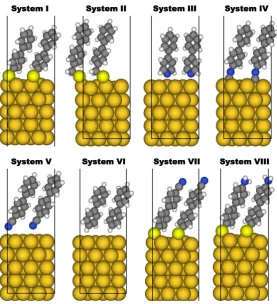
Figure 2. Front view of the unit cells investigated in the present study. The self-assembled monolayers are all derived from a biphenyl backbone and bear different docking groups (systems I to VI) or different tail groups (system VII and VIII). The SAMs are bonded to a Au(111) metal slab consisting of 5 layers of gold atoms. The docking groups comprise thiolate (system I), methyl-thiolate (system II), pyridine (system III), isocyanide (system IV) and cyanide (system V). System VI is an upright standing biphenyl layer not bearing any docking group. Systems VII and VIII are both bonded via thiolates, but contain different (polar) tail groups (a nitrile in the case of system VII and an amine in the case of system VIII). The molecules are arranged in a herringbone pattern, as can be seen in the top views of the unit cell shown in the Supporting Information. Color code: dark yellow: Au, bright yellow: S, grey: C, green: N, and white: H.
3.3. Calculated core-level binding energies, XP spectra, and work-function changes
3.3.1. Energetic shifts due to variations in the interface dipole
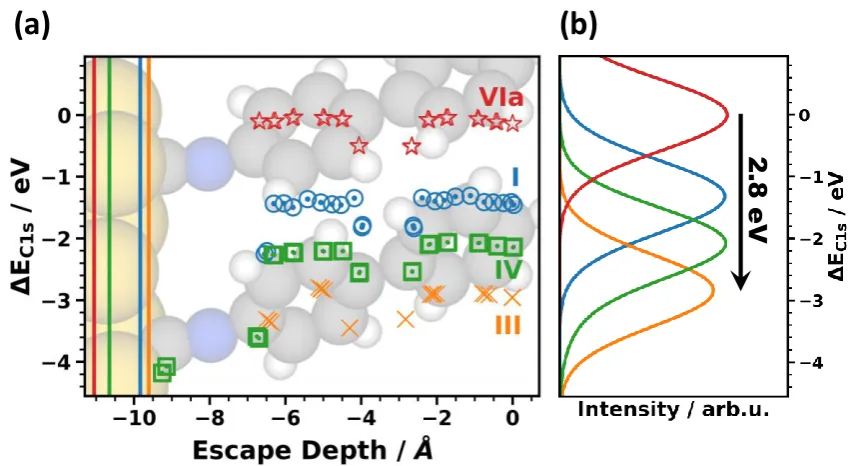
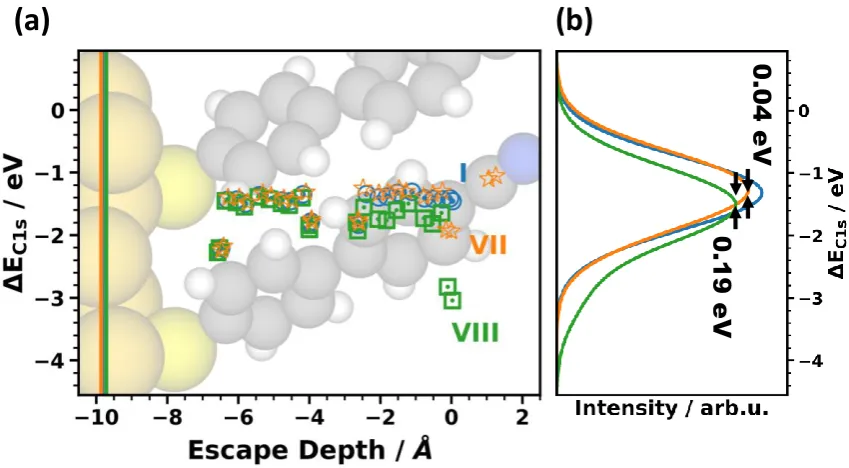
In Figure 3, we show the core-level binding energies and XP spectra of systems I, III, V, and VIa as prototypical examples for the impact of the docking groups on the core-level binding energies. In
the following, the “vacuum level alignment” system VIa is used as energy reference for the work-function as well as for the core-level binding energies (for the absolute values of the reference energies see Methods section). This directly yields EC1s and (i.e, the quantities shown in Figure 1). As far
as the systems not displayed in Figure 3 are concerned, the data points for II essentially coincide with those of I and (apart from chemical shifts for the carbon atoms directly bonded to nitrogen atoms) the binding energies of III and V are also similar. System VI is similar to VIa with binding energies shifted to higher values by 0.34 eV. The corresponding data can be seen in the Supporting Information, where we show a (somewhat busy) plot analogous to Figure 3 containing values for all investigated systems. Compared to System VIa, the core-level binding energies in all chemically bonded SAMs are shifted to higher (more negative) binding energies by several eV. The effect is largest for III, for which the
System I System II System III System IV
shift amounts to 2.8 eV (see black arrow). Even between docked systems, the peak positions vary by 1.6eV with the smallest value (-265.2 eV) for the methyl thiolate and the largest (-266.8 eV) for the pyridine. This is exactly the situation one would expect according to Figure 1 for varying interface dipoles as a consequence of collective electrostatic effects.[31,40,45,46,64]
Superimposed on these electrostatic shifts of the XPS peaks, one can also identify the chemical shifts due to the differently bonded carbon atoms (cf. Figure 2a). For example, the carbon atoms connecting the two benzene rings are shifted by ~0.5 eV relative to the other carbon atoms of the rings. Also the carbon atoms attached to the docking groups are chemically shifted, resulting in distinct variations of the binding energies. This is, however, rather inconsequential for the positions and shapes of the XP spectra as a consequence of the finite escape depth of the photoelectrons. This is well visible, for example, for the isocyanide-docked SAM (system IV), where the lowest carbon atoms are shifted by ~2 eV relative to the ones in the rings. The latter still rather exclusively determine the position of the peak in the corresponding XP spectrum.
Figure 3. (a) Simulated shifts of carbon 1s orbital energies, DEC1s, as a function of the escape depth of the electrons for the prototypical systems I, III, IV, and VIa; (b) corresponding XP spectra generated from the calculated energy levels. The energies scale is chosen relative to the position of the peak in the XP spectrum for the vacuum-level aligned system VIa. The escape depth defined as the distance from the topmost carbon atom is chosen as the parameter on the x-axis considering that the highest atoms primarily determine the XP spectra. As the extent of the SAMs between the bottom ring and the metal substrate varies due to the different docking groups, this choice of the x-axis also largely aligns biphenyls in the different systems. System IV is shown in the background as an example of the structure of one of the SAMs considered in the plot. Due to the different SAM thicknesses, we included vertical lines in panel (a), which designate the positions of the centers of the atoms of the topmost Au layer. The large number of data points for each system is a consequence of the two inequivalent molecules per unit cell.
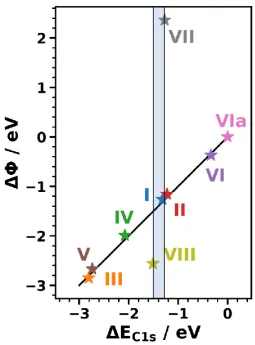
Provided that the primary core-level shifts are truly a consequence of collective electrostatic effects caused by interface dipoles they should directly correlate with the SAM-induced changes in the work function for systems I to VIa. To test that, we plotted as a function of EC1s for all
investigated SAMs in Figure 4. Indeed, the data for all SAMs without polar tail group substituents align perfectly along a straight line with a slope of 1 passing through the origin. This supports the assessment that in these systems core-level shifts and work-function changes have the same origin (namely the interface dipole). In passing we note that the dipole due to the terminal C-H bond of the
2.8 eV
biphenyl cancels out for the evolution of vs. EC1s (at least for similar coverages and tilt angles),
as the non-interacting biphenyl monolayer is used as the reference for both quantities.
Figure 4: Correlation between the change in work function, DF, and the shift in binding energy,DEC1s, for all systems relative to system VIa (as non-interacting reference system in which no interface dipole occurs) The black line indicates a linear curve with a slope of 1 through the origin. The shaded area represents the range over which the values for DEC1s vary between systems I, VII, and VIII.
3.3.2. Influence of Different Tail Groups on the XP-spectra
This raises the question, what would happen if the SAM-forming molecules were substituted with tail-groups bearing dipoles significantly different from the terminal C-H bond of a phenyl ring. According to Figure 1, this should (significantly) modify the work-function shift, while leaving the core-level binding energies essentially unchanged, with the exception of chemical shifts experienced by carbon atoms in or directly bonded to the substituents. To test that hypothesis, we simulated systems VII and VIII containing -CN and -NH2 tail groups. As far as the simulated core-level binding
that for all systems considered in the present study, the position of the peak in the C1s spectrum is a valid measure for the interface dipole.
As shown in Figure 4, in sharp contrast to the core-level spectra, the work-function changes for VII and VIII differ significantly from that of I (by 3.63 eV for VII and by -1.30 eV for VIII). This is again fully consistent with the model described in section 2.
Figure 5. (a) Simulated shifts of carbon 1s orbital energies, DEC1s, as a function of the escape depth of the electrons for the equally docked systems I, VII, and VIII; (b) corresponding XP-spectra generated from the calculated energy levels. As the substituents significantly impact the extent of the SAMs above the top ring, but its volume density is rather low, the topmost carbon atom of the benzene ring was chosen as the origin of the axis. In this way, the axis is consistent with the x-axis of Figure 4 and the carbon rings are aligned at essentially the same positions. The large number of data points for each system is a consequence of the two inequivalent molecules per unit cell.
3.3.3. Coverage Dependence
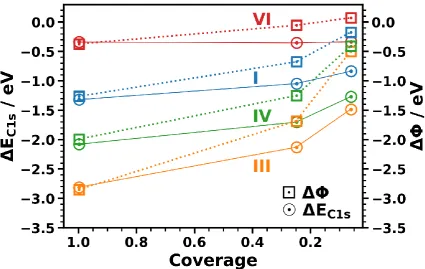
As a last aspect it should be addressed to what extent the above conclusions hold for less densely packed polar layers at the interface.[42,113] To assess that, in a gedankenexperiment we constructed hypothetical low-coverage systems with upright-standing molecules (for details see Methods section and Supporting Information). Based on the Helmholtz solution to the Poisson equation, one would expect a linear dependence of the dipole density and, thus, of and EC1s on coverage. The actual
coverage-dependence of and EC1s is shown in Figure 6 for the same systems that had already
been considered in Figure 3. Interestingly, one observes that changes much more strongly at low than at high coverages. This is a consequence of depolarization effects. These strongly reduce the interface dipoles at high coverages.[138–146] Therefore, work-function changes at full coverages are strongly reduced compared to what one would expect based on the dipoles associated with the adsorption of a single molecule.[147]
(a)
(b)
0.04
eV
0.1
9 e
Figure 6: Core-level shift, DEC1s, (circles) and work-function change DF (square symbols) for systems I, III, IV, and VI as a function of coverage (varied between full, a quarter and 1/16 coverage, where the latter approaches the single molecule limit, see Supporting Information). All energies are reported relative to the values of the non-interacting reference system VIa.
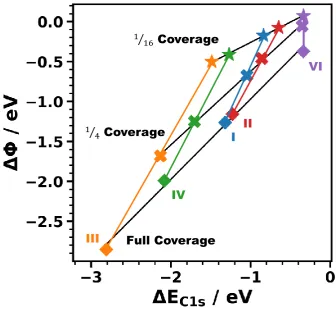
Another observation in Figure 6 is that the coverage-dependence of the core-level binding energies (circles full line) is much weaker than that of (squares and dotted line). This is particularly obvious for system VI, for which there is almost no change of EC1s with coverage, while
the work function still changes by ~0.5 eV. Qualitatively, the behavior is, however, the same for all studied systems, as shown in Figure 7. There, one sees that the energy range covered by the values is significantly larger than that for EC1s. As a result, the slope of the linear fit to the dependence of
Figure 7. Core-level shift as a function of the work-function change for system I (blue), system II (red), system III (orange), system IV (green), and system V (violet). Results for full, ¼ and 1/16 coverage are compared. The black lines are fits to all systems for specific coverages, while the colored lines were fitted to the coverage-dependence for a specific system.
The main consequence of this observation is that at low dipole densities (in contrast to the full-coverage case, see above) EC1s is no longer a direct measure for the interface dipole. This can be
explained by the different degrees of locality with which and EC1s probe the electronic structure
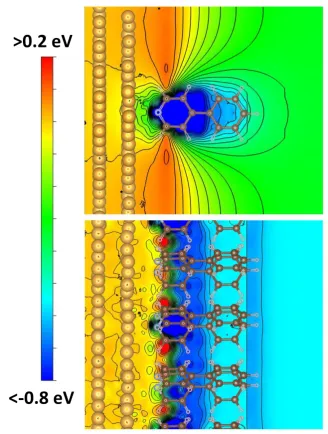
of the interface:[48,146,148] The value of is determined by the energy difference between the Fermi level and the vacuum level far above the surface, i.e., in the far field. Conversely, core-level binding energies probe the electrostatic energy in the immediate vicinity of the atom whose core electron is excited.47 The latter is comparably close to the interface dipole at the bond between the
molecule and the substrate. Thus, the shift in the electrostatic energy due to the dipole is still relevant, even if it is strongly reduced due to the drop of the shift with the inverse of the third power of the distance between atom and dipole. This is illustrated in Figure 8, where we show the change in electrostatic energy due to the formation of the bond between the pyridine-docked SAM and the metal substrate. consequently, Figure 8 does not actually reflect the impact of the entire interface dipole, but only of the part resulting from the bond dipole. This quantity, can, however, be calculated conveniently by subtracting the electrostatic energies of the sub-systems from that of the bonded interface, which is not possible for the full interface dipole. It is also well suited to qualitatively illustrate the difference between the local and the far-field situation, even if one cannot expect quantitative agreement with the data from Figures 6 and 7, which are still determined by the entire interface dipole. For the full coverage system in the bottom panel of Figure 8, the main drop in electrostatic energy occurs at the immediate metal-pyridine interface and the electrostatic energy in the region of the top ring is essentially the same as far above the sample (despite a minor potential variation at the distance of the topmost C-H bond). Conversely, at 1/16 coverage the far-field electrostatic energy far above the interface (relevant for the work function) is several tenths of an eV higher than in the region of the upper carbon atoms (determining the position of the XPS peak).
III
IV
I II
VI
Full Coverage Coverage
Figure 8. Contour plot of the change in the electrostatic energy due to metal-SAM bonding, i.e., due to the bond dipole (as part of the interface dipole) for system III. The potential is plotted for a plane defined by the plane of one of the molecules in the unit cell (see Supporting Information. The top (bottom) panel contains the result for 1/16 (full) coverage. Isolines are shown in steps of 0.05 eV.
4. Conclusions
In the present contribution it is shown that X-ray photoelectron spectroscopy is a suitable tool for determining interface dipoles in densely-packed self-assembled monolayers. This is shown via simulations on a number of biphenyl-based monolayers bonded to a Au(111)-substrate by a broad range of different docking groups. The varying interface dipoles in these systems result in shifts of the core-level binding energies by more than one eV, concomitantly shifting also the associated XP spectra. For SAMs not bearing polar tail groups the electrostatically triggered core-level shifts directly correlate with SAM-induced work-function changes. This correlation is broken, when work functions are further modified by polar tail-group substituents. Nevertheless, even in these cases the XP spectra are a direct measure for the interface dipoles. The situation changes, when the dipole density at the interface is reduced. Then core-level binding energies are still determined by the local electrostatic
>0.2 eV
energy at the atoms from which the photoelectrons are excited. This energy is, however, no longer directly representative of the magnitude of the interface dipole, as it is strongly influenced, for example, by the distance of the excited atom from the location of the dipole. As a result, also the direct equivalence between core-level shifts and work-function changes is lost at reduced coverages, even though XPS still is suited for probing the local electrostatic energy (at least as long as chemical shifts, e.g., due to interfacial charge transfer are not superimposed on the electrostatic ones).
Supplementary Materials: Additional information on the computational methodology, additional computational results and views of unit cells and supercells are available online at www.mdpi.com/xxx/s1.
Author Contributions: Thomas Taucher has performed all calculations, analyzed the results, compiled most figures, and wrote a first draft of the manuscript. Egbert Zojer, guided and supervised the research, contributed to the analysis of the data, compiled Figure 1, and revised the manuscript.
Funding: This research was funded by the Austrian Science Fund (FWF): P28051-N36. The quantum mechanical calculations have been performed using the Vienna Scientific Cluster (VSC3).
Conflicts of Interest: The authors declare no conflict of interest.
References
1. Casalini, S.; Bortolotti, C.A.; Leonardi, F.; Biscarini, F. Self-assembled monolayers in
organic electronics. Chemical Society Reviews 2017, 46, 40–71,
doi:10.1039/C6CS00509H.
2. Halik, M.; Hirsch, A. The Potential of Molecular Self-Assembled Monolayers in
Organic Electronic Devices. Advanced Materials 2011, 23, 2689–2695,
doi:10.1002/adma.201100337.
3. Chua, L.-L.; Zaumseil, J.; Chang, J.-F.; Ou, E.C.-W.; Ho, P.K.-H.; Sirringhaus, H.;
Friend, R.H. General observation of n-type field-effect behaviour in organic
semiconductors. Nature2005, 434, 194–199, doi:10.1038/nature03376.
4. Kobayashi, S.; Nishikawa, T.; Takenobu, T.; Mori, S.; Shimoda, T.; Mitani, T.;
Shimotani, H.; Yoshimoto, N.; Ogawa, S.; Iwasa, Y. Control of carrier density by
self-assembled monolayers in organic field-effect transistors. Nature Materials 2004, 3,
317–322, doi:10.1038/nmat1105.
5. Pernstich, K.P.; Haas, S.; Oberhoff, D.; Goldmann, C.; Gundlach, D.J.; Batlogg, B.;
Rashid, A.N.; Schitter, G. Threshold voltage shift in organic field effect transistors by
dipole monolayers on the gate insulator. Journal of Applied Physics2004, 96, 6431–
6438, doi:10.1063/1.1810205.
6. Pacher, P.; Lex, A.; Proschek, V.; Etschmaier, H.; Tchernychova, E.; Sezen, M.;
Scherf, U.; Grogger, W.; Trimmel, G.; Slugovc, C.; et al. Chemical Control of Local
Doping in Organic Thin-Film Transistors: From Depletion to Enhancement. Advanced
Materials2008, 20, 3143–3148, doi:10.1002/adma.200800058.
7. Aghamohammadi, M.; Rödel, R.; Zschieschang, U.; Ocal, C.; Boschker, H.; Weitz,
R.T.; Barrena, E.; Klauk, H. Threshold-Voltage Shifts in Organic Transistors Due to Self-Assembled Monolayers at the Dielectric: Evidence for Electronic Coupling and
Dipolar Effects. ACS Appl. Mater. Interfaces 2015, 7, 22775–22785,
8. Campbell, I.H.; Rubin, S.; Zawodzinski, T.A.; Kress, J.D.; Martin, R.L.; Smith, D.L.; Barashkov, N.N.; Ferraris, J.P. Controlling Schottky energy barriers in organic
electronic devices using self-assembled monolayers. Physical Review B 1996, 54,
R14321–R14324, doi:10.1103/PhysRevB.54.R14321.
9. Campbell, I.H.; Kress, J.D.; Martin, R.L.; Smith, D.L.; Barashkov, N.N.; Ferraris, J.P.
Controlling charge injection in organic electronic devices using self-assembled
monolayers. Applied Physics Letters1997, 71, 3528–3530, doi:10.1063/1.120381.
10. Yan, H.; Huang, Q.; Cui, J.; Veinot, J.G.C.; Kern, M.M.; Marks, T.J. High-Brightness Blue Light-Emitting Polymer Diodes via Anode Modification Using a Self-Assembled
Monolayer. Advanced Materials2003, 15, 835–838, doi:10.1002/adma.200304585.
11. de Boer, B.; Hadipour, A.; Mandoc, M.M.; van Woudenbergh, T.; Blom, P.W.M.
Tuning of Metal Work Functions with Self-Assembled Monolayers. Advanced
Materials2005, 17, 621–625, doi:10.1002/adma.200401216.
12. Jang, Y.; Cho, J.H.; Kim, D.H.; Park, Y.D.; Hwang, M.; Cho, K. Effects of the permanent dipoles of self-assembled monolayer-treated insulator surfaces on the
field-effect mobility of a pentacene thin-film transistor. Applied Physics Letters 2007, 90,
132104, doi:10.1063/1.2457776.
13. Kitamura, M.; Kuzumoto, Y.; Kang, W.; Aomori, S.; Arakawa, Y. High conductance
bottom-contact pentacene thin-film transistors with gold-nickel adhesion layers. Appl.
Phys. Lett.2010, 97, 033306, doi:10.1063/1.3465735.
14. Schulz, P.; Schäfer, T.; Zangmeister, C.D.; Effertz, C.; Meyer, D.; Mokros, D.; Zee, R.D. van; Mazzarello, R.; Wuttig, M. A New Route to Low Resistance Contacts for
Performance-Enhanced Organic Electronic Devices. Advanced Materials Interfaces
2014, 1, 1300130, doi:10.1002/admi.201300130.
15. Kim, J.; Rim, Y.S.; Liu, Y.; Serino, A.C.; Thomas, J.C.; Chen, H.; Yang, Y.; Weiss, P.S. Interface Control in Organic Electronics Using Mixed Monolayers of
Carboranethiol Isomers. Nano Letters2014, 14, 2946–2951, doi:10.1021/nl501081q.
16. Fenwick, O.; Van Dyck, C.; Murugavel, K.; Cornil, D.; Reinders, F.; Haar, S.; Mayor,
M.; Cornil, J.; Samorì, P. Modulating the charge injection in organic field-effect
transistors: fluorinated oligophenyl self-assembled monolayers for high work function
electrodes. Journal of Materials Chemistry C 2015, 3, 3007–3015,
doi:10.1039/C5TC00243E.
17. Petritz, A.; Krammer, M.; Sauter, E.; Gärtner, M.; Nascimbeni, G.; Schrode, B.; Fian, A.; Gold, H.; Cojocaru, A.; Karner-Petritz, E.; et al. Embedded Dipole Self-Assembled Monolayers for Contact Resistance Tuning in p-Type and n-Type Organic Thin Film
Transistors and Flexible Electronic Circuits. Advanced Functional Materials2018, 28,
1804462, doi:10.1002/adfm.201804462.
18. Borchert, J.W.; Peng, B.; Letzkus, F.; Burghartz, J.N.; Chan, P.K.L.; Zojer, K.; Ludwigs, S.; Klauk, H. Small contact resistance and high-frequency operation of
flexible low-voltage inverted coplanar organic transistors. Nature Communications
2019, 10, doi:10.1038/s41467-019-09119-8.
molecular packing, orientation, and surface wetting properties. J. Am. Chem. Soc.1991,
113, 4121–4131, doi:10.1021/ja00011a010.
20. Cabarcos, O.M.; Shaporenko, A.; Weidner, T.; Uppili, S.; Dake, L.S.; Zharnikov, M.; Allara, D.L. Physical and Electronic Structure Effects of Embedded Dipoles in Self-Assembled Monolayers: Characterization of Mid-Chain Ester Functionalized
Alkanethiols on Au{111}. The Journal of Physical Chemistry C 2008, 112, 10842–
10854, doi:10.1021/jp801618j.
21. Abu-Husein, T.; Schuster, S.; Egger, D.A.; Kind, M.; Santowski, T.; Wiesner, A.; Chiechi, R.; Zojer, E.; Terfort, A.; Zharnikov, M. The Effects of Embedded Dipoles
in Aromatic Self-Assembled Monolayers. Advanced Functional Materials 2015, 25,
3943–3957, doi:10.1002/adfm.201500899.
22. Gärtner, M.; Sauter, E.; Nascimbeni, G.; Wiesner, A.; Kind, M.; Werner, P.; Schuch, C.; Abu-Husein, T.; Asyuda, A.; Bats, J.W.; et al. Self-Assembled Monolayers with
Distributed Dipole Moments Originating from Bipyrimidine Units. J. Phys. Chem. C
2020, 124, 504–519, doi:10.1021/acs.jpcc.9b08835.
23. Baghbanzadeh, M.; Belding, L.; Yuan, L.; Park, J.; Al-Sayah, M.H.; Bowers, C.M.;
Whitesides, G.M. Dipole-Induced Rectification Across Ag TS /SAM//Ga
2 O 3 /EGaIn
Junctions. J. Am. Chem. Soc.2019, 141, 8969–8980, doi:10.1021/jacs.9b02891.
24. Kang, J.F.; Ulman, A.; Liao, S.; Jordan, R. Mixed Self-Assembled Monolayers of
Highly Polar Rigid Biphenyl Thiols. Langmuir 1999, 15, 2095–2098,
doi:10.1021/la9813883.
25. Zehner, R.W.; Parsons, B.F.; Hsung, R.P.; Sita, L.R. Tuning the Work Function of
Gold with Self-Assembled Monolayers Derived from X−[C 6 H 4 −C⋮C−] n C 6 H 4
−SH ( n = 0, 1, 2; X = H, F, CH 3 , CF 3 , and OCH 3 ). Langmuir1999, 15, 1121–1127,
doi:10.1021/la981114f.
26. Ganzorig, C.; Kwak, K.-J.; Yagi, K.; Fujihira, M. Fine tuning work function of indium tin oxide by surface molecular design: Enhanced hole injection in organic
electroluminescent devices. Appl. Phys. Lett. 2001, 79, 272–274,
doi:10.1063/1.1384896.
27. Heimel, G.; Romaner, L.; Brédas, J.-L.; Zojer, E. Interface Energetics and Level Alignment at Covalent Metal-Molecule Junctions: π-Conjugated Thiols on Gold.
Physical Review Letters2006, 96, doi:10.1103/PhysRevLett.96.196806.
28. Sun, Q.; Selloni, A. Interface and Molecular Electronic Structure vs Tunneling
Characteristics of CH 3 - and CF 3 -Terminated Thiol Monolayers on Au(111). J. Phys.
Chem. A2006, 110, 11396–11400, doi:10.1021/jp064905w.
29. Yip, H.-L.; Hau, S.K.; Baek, N.S.; Ma, H.; Jen, A.K.-Y. Polymer Solar Cells That Use
Self-Assembled-Monolayer- Modified ZnO/Metals as Cathodes. Advanced Materials
2008, 20, 2376–2382, doi:10.1002/adma.200703050.
30. Demirkan, K.; Mathew, A.; Weiland, C.; Yao, Y.; Rawlett, A.M.; Tour, J.M.; Opila, R.L. Energy level alignment at organic semiconductor/metal interfaces: Effect of polar
self-assembled monolayers at the interface. The Journal of Chemical Physics 2008,
31. Heimel, G.; Romaner, L.; Zojer, E.; Bredas, J.-L. The Interface Energetics of
Self-Assembled Monolayers on Metals. Accounts of Chemical Research2008, 41, 721–729,
doi:10.1021/ar700284q.
32. Malicki, M.; Guan, Z.; Ha, S.D.; Heimel, G.; Barlow, S.; Rumi, M.; Kahn, A.; Marder, S.R. Preparation and Characterization of 4′-Donor Substituted Stilbene-4-thiolate
Monolayers and Their Influence on the Work Function of Gold. Langmuir2009, 25,
7967–7975, doi:10.1021/la9004104.
33. Yoon, H.J.; Bowers, C.M.; Baghbanzadeh, M.; Whitesides, G.M. The Rate of Charge Tunneling Is Insensitive to Polar Terminal Groups in Self-Assembled Monolayers in Ag TS S(CH 2 ) n M(CH 2 ) m T//Ga 2 O 3 /EGaIn Junctions. J. Am. Chem. Soc.2014,
136, 16–19, doi:10.1021/ja409771u.
34. Lee, H.J.; Jamison, A.C.; Lee, T.R. Surface Dipoles: A Growing Body of Evidence
Supports Their Impact and Importance. Accounts of Chemical Research 2015, 48,
3007–3015, doi:10.1021/acs.accounts.5b00307.
35. Vilan, A.; Cahen, D. Chemical Modification of Semiconductor Surfaces for Molecular
Electronics. Chemical Reviews 2017, 117, 4624–4666,
doi:10.1021/acs.chemrev.6b00746.
36. Lindell, L.; Vahlberg, C.; Uvdal, K.; Fahlman, M.; Braun, S. Self-assembled monolayer engineered interfaces: Energy level alignment tuning through chain length
and end-group polarity. Journal of Electron Spectroscopy and Related Phenomena
2015, 204, 140–144, doi:10.1016/j.elspec.2015.04.006.
37. MacLeod, B.A.; Horwitz, N.E.; Ratcliff, E.L.; Jenkins, J.L.; Armstrong, N.R.; Giordano, A.J.; Hotchkiss, P.J.; Marder, S.R.; Campbell, C.T.; Ginger, D.S. Built-In Potential in Conjugated Polymer Diodes with Changing Anode Work Function:
Interfacial States and Deviation from the Schottky–Mott Limit. J. Phys. Chem. Lett.
2012, 3, 1202–1207, doi:10.1021/jz300283h.
38. Schmidt, C.; Witt, A.; Witte, G. Tailoring the Cu(100) Work Function by Substituted
Benzenethiolate Self-Assembled Monolayers. The Journal of Physical Chemistry A
2011, 115, 7234–7241, doi:10.1021/jp200328r.
39. Heimel, G.; Romaner, L.; Zojer, E.; Brédas, J.-L. Toward Control of the Metal−Organic Interfacial Electronic Structure in Molecular Electronics: A First-Principles Study on Self-Assembled Monolayers of π-Conjugated Molecules on Noble
Metals. Nano Letters2007, 7, 932–940, doi:10.1021/nl0629106.
40. Natan, A.; Kronik, L.; Haick, H.; Tung, R.T. Electrostatic Properties of Ideal and
Non-ideal Polar Organic Monolayers: Implications for Electronic Devices. Advanced
Materials2007, 19, 4103–4117, doi:10.1002/adma.200701681.
41. Wang, L.; M. Rangger, G.; Ma, Z.; Li, Q.; Shuai, Z.; Zojer, E.; Heimel, G. Is there a
Au–S bond dipole in self-assembled monolayers on gold? Physical Chemistry
Chemical Physics2010, 12, 4287–4290, doi:10.1039/B924306M.
42. Zojer, E.; Taucher, T.C.; Hofmann, O.T. The Impact of Dipolar Layers on the
Electronic Properties of Organic/Inorganic Hybrid Interfaces. Adv. Mater. Interfaces
43. Alloway, D.M.; Hofmann, M.; Smith, D.L.; Gruhn, N.E.; Graham, A.L.; Colorado, R.; Wysocki, V.H.; Lee, T.R.; Lee, P.A.; Armstrong, N.R. Interface Dipoles Arising from Self-Assembled Monolayers on Gold: UV-Photoemission Studies of Alkanethiols and Partially Fluorinated Alkanethiols. 10.
44. Rusu, P.C.; Brocks, G. Surface Dipoles and Work Functions of Alkylthiolates and
Fluorinated Alkylthiolates on Au(111). The Journal of Physical Chemistry B 2006,
110, 22628–22634, doi:10.1021/jp0642847.
45. Cahen, D.; Naaman, R.; Vager, Z. The Cooperative Molecular Field Effect. Advanced
Functional Materials2005, 15, 1571–1578, doi:10.1002/adfm.200500187.
46. Monti, O.L.A. Understanding Interfacial Electronic Structure and Charge Transfer: An
Electrostatic Perspective. The Journal of Physical Chemistry Letters 2012, 3, 2342–
2351, doi:10.1021/jz300850x.
47. Ishii, H.; Sugiyama, K.; Ito, E.; Seki, K. Energy Level Alignment and Interfacial
Electronic Structures at Organic/Metal and Organic/Organic Interfaces. Advanced
Materials1999, 11, 605–625, doi:10.1002/(SICI)1521-4095(199906)11:8<605::AID-ADMA605>3.0.CO;2-Q.
48. Hehn, I.; Schuster, S.; Wächter, T.; Abu-Husein, T.; Terfort, A.; Zharnikov, M.; Zojer, E. Employing X-ray Photoelectron Spectroscopy for Determining Layer Homogeneity
in Mixed Polar Self-Assembled Monolayers. The Journal of Physical Chemistry
Letters2016, 7, 2994–3000, doi:10.1021/acs.jpclett.6b01096.
49. Gärtner, M.; Sauter, E.; Nascimbeni, G.; Petritz, A.; Wiesner, A.; Kind, M.; Abu-Husein, T.; Bolte, M.; Stadlober, B.; Zojer, E.; et al. Understanding the Properties of Tailor-Made Self-Assembled Monolayers with Embedded Dipole Moments for
Interface Engineering. J. Phys. Chem. C 2018, 122, 28757–28774,
doi:10.1021/acs.jpcc.8b09440.
50. Braun, S.; Salaneck, W.R.; Fahlman, M. Energy-Level Alignment at Organic/Metal
and Organic/Organic Interfaces. Advanced Materials 2009, 21, 1450–1472,
doi:10.1002/adma.200802893.
51. Venkataraman, N.V.; Zürcher, S.; Rossi, A.; Lee, S.; Naujoks, N.; Spencer, N.D. Spatial Tuning of the Metal Work Function by Means of Alkanethiol and Fluorinated
Alkanethiol Gradients. The Journal of Physical Chemistry C 2009, 113, 5620–5628,
doi:10.1021/jp809156a.
52. Lange, I.; Reiter, S.; Pätzel, M.; Zykov, A.; Nefedov, A.; Hildebrandt, J.; Hecht, S.; Kowarik, S.; Wöll, C.; Heimel, G.; et al. Tuning the Work Function of Polar Zinc Oxide Surfaces using Modified Phosphonic Acid Self-Assembled Monolayers.
Advanced Functional Materials2014, 24, 7014–7024, doi:10.1002/adfm.201401493. 53. Kim, B.; Choi, S.H.; Zhu, X.-Y.; Frisbie, C.D. Molecular Tunnel Junctions Based on
π-Conjugated Oligoacene Thiols and Dithiols between Ag, Au, and Pt Contacts: Effect
of Surface Linking Group and Metal Work Function. J. Am. Chem. Soc. 2011, 133,
19864–19877, doi:10.1021/ja207751w.
in 4,4′-Bipyridine Single-Molecule Junctions. Nano Lett. 2014, 14, 794–798, doi:10.1021/nl404143v.
55. Egger, D.A.; Rissner, F.; Zojer, E.; Heimel, G. Polarity Switching of Charge Transport
and Thermoelectricity in Self-Assembled Monolayer Devices. Advanced Materials
2012, 24, 4403–4407, doi:10.1002/adma.201200872.
56. Egger, D.A.; Liu, Z.-F.; Neaton, J.B.; Kronik, L. Reliable Energy Level Alignment at
Physisorbed Molecule–Metal Interfaces from Density Functional Theory. Nano
Letters2015, 15, 2448–2455, doi:10.1021/nl504863r.
57. Obersteiner, V.; Egger, D.A.; Heimel, G.; Zojer, E. Impact of Collective Electrostatic
Effects on Charge Transport through Molecular Monolayers. J. Phys. Chem. C 2014,
118, 22395–22401, doi:10.1021/jp5084955.
58. Obersteiner, V.; Huhs, G.; Papior, N.; Zojer, E. Unconventional Current Scaling and
Edge Effects for Charge Transport through Molecular Clusters. Nano Letters2017, 17,
7350–7357, doi:10.1021/acs.nanolett.7b03066.
59. Xie, Z.; Bâldea, I.; Smith, C.E.; Wu, Y.; Frisbie, C.D. Experimental and Theoretical Analysis of Nanotransport in Oligophenylene Dithiol Junctions as a Function of
Molecular Length and Contact Work Function. ACS Nano 2015, 9, 8022–8036,
doi:10.1021/acsnano.5b01629.
60. Xie, Z.; Bâldea, I.; Frisbie, C.D. Determination of Energy-Level Alignment in Molecular Tunnel Junctions by Transport and Spectroscopy: Self-Consistency for the
Case of Oligophenylene Thiols and Dithiols on Ag, Au, and Pt Electrodes. J. Am.
Chem. Soc.2019, 141, 3670–3681, doi:10.1021/jacs.8b13370.
61. Xie, Z.; Bâldea, I.; Frisbie, C.D. Energy Level Alignment in Molecular Tunnel Junctions by Transport and Spectroscopy: Self-Consistency for the Case of Alkyl
Thiols and Dithiols on Ag, Au, and Pt Electrodes. J. Am. Chem. Soc. 2019, 141,
18182–18192, doi:10.1021/jacs.9b08905.
62. Vilan, A.; Aswal, D.; Cahen, D. Large-Area, Ensemble Molecular Electronics:
Motivation and Challenges. Chemical Reviews 2017, 117, 4248–4286,
doi:10.1021/acs.chemrev.6b00595.
63. El-Sayed, A.; Borghetti, P.; Goiri, E.; Rogero, C.; Floreano, L.; Lovat, G.; Mowbray, D.J.; Cabellos, J.L.; Wakayama, Y.; Rubio, A.; et al. Understanding Energy-Level
Alignment in Donor–Acceptor/Metal Interfaces from Core-Level Shifts. ACS Nano
2013, 7, 6914–6920, doi:10.1021/nn4020888.
64. Taucher, T.C.; Hehn, I.; Hofmann, O.T.; Zharnikov, M.; Zojer, E. Understanding Chemical versus Electrostatic Shifts in X-ray Photoelectron Spectra of Organic
Self-Assembled Monolayers. The Journal of Physical Chemistry C2016, 120, 3428–3437,
doi:10.1021/acs.jpcc.5b12387.
65. Cabarcos, O.M.; Schuster, S.; Hehn, I.; Zhang, P.P.; Maitani, M.M.; Sullivan, N.; Giguère, J.-B.; Morin, J.-F.; Weiss, P.S.; Zojer, E.; et al. Effects of Embedded Dipole
Layers on Electrostatic Properties of Alkanethiolate Self-Assembled Monolayers. The
66. Siegbahn, K. ESCA. Atomic, Molecular and Solid State Structure Studied by Means of Electron Spectroscopy. By Kai Siegbahn [and Others], Etc. [With Illustrations.].; Nova acta Regiae Societatis Scientiarum Upsaliensis. ser. 4. vol. 20; 1967;
67. Benesh, G.A.; King, D.A. Core-level shift spectroscopy for adsorbates: ionic, covalent
or metallic bonding? Chemical Physics Letters 1992, 191, 315–319,
doi:10.1016/0009-2614(92)85307-V.
68. Bagus, P.S.; Ilton, E.S.; Nelin, C.J. The interpretation of XPS spectra: Insights into
materials properties. Surface Science Reports 2013, 68, 273–304,
doi:10.1016/j.surfrep.2013.03.001.
69. Bagus, P.S.; Ilton, E.; Nelin, C.J. Extracting Chemical Information from XPS Spectra:
A Perspective. Catal Lett2018, 148, 1785–1802, doi:10.1007/s10562-018-2417-1.
70. Ulman, A. Formation and Structure of Self-Assembled Monolayers. Chemical
Reviews1996, 96, 1533–1554, doi:10.1021/cr9502357.
71. Schreiber, F. Structure and growth of self-assembling monolayers. Progress in Surface
Science2000, 65, 151–257, doi:10.1016/S0079-6816(00)00024-1.
72. Heister, K.; Zharnikov, M.; Grunze, M.; Johansson, L.S.O. Adsorption of Alkanethiols and Biphenylthiols on Au and Ag Substrates: A High-Resolution X-ray Photoelectron
Spectroscopy Study. The Journal of Physical Chemistry B 2001, 105, 4058–4061,
doi:10.1021/jp010127q.
73. Love, J.C.; Estroff, L.A.; Kriebel, J.K.; Nuzzo, R.G.; Whitesides, G.M. Self-Assembled Monolayers of Thiolates on Metals as a Form of Nanotechnology.
Chemical Reviews2005, 105, 1103–1170, doi:10.1021/cr0300789.
74. Shaporenko, A.; Cyganik, P.; Buck, M.; Terfort, A.; Zharnikov, M. Self-Assembled
Monolayers of Aromatic Selenolates on Noble Metal Substrates. J. Phys. Chem. B
2005, 109, 13630–13638, doi:10.1021/jp050731r.
75. Käfer, D.; Bashir, A.; Witte, G. Interplay of Anchoring and Ordering in Aromatic
Self-Assembled Monolayers. The Journal of Physical Chemistry C 2007, 111, 10546–
10551, doi:10.1021/jp073010w.
76. Merzlikin, S.V.; Tolkachev, N.N.; Strunskus, T.; Witte, G.; Glogowski, T.; Wöll, C.; Grünert, W. Resolving the depth coordinate in photoelectron spectroscopy – Comparison of excitation energy variation vs. angular-resolved XPS for the analysis
of a self-assembled monolayer model system. Surface Science 2008, 602, 755–767,
doi:10.1016/j.susc.2007.12.005.
77. Beccari, M.; Kanjilal, A.; Betti, M.G.; Mariani, C.; Floreano, L.; Cossaro, A.; Di Castro, V. Characterization of benzenethiolate self-assembled monolayer on Cu(100)
by XPS and NEXAFS. Journal of Electron Spectroscopy and Related Phenomena
2009, 172, 64–68, doi:10.1016/j.elspec.2009.03.004.
78. Vericat, C.; Vela, M.E.; Benitez, G.; Carro, P.; Salvarezza, R.C. Self-assembled monolayers of thiols and dithiols on gold: new challenges for a well-known system.
Chemical Society Reviews2010, 39, 1805, doi:10.1039/b907301a.
79. Zaba, T.; Noworolska, A.; Bowers, C.M.; Breiten, B.; Whitesides, G.M.; Cyganik, P. Formation of Highly Ordered Self-Assembled Monolayers of Alkynes on Au(111)
80. Euti, E.M.; Vélez Romero, P.; Linarez Pérez, O.; Ruano, G.; Patrito, E.M.; Zampieri, G.; Leiva, E.P.M.; Macagno, V.A.; Cometto, F.P. Electrochemical, HR-XPS and SERS study of the self-assembly of biphenyl 4,4′-dithiol on Au(111) from solution
phase. Surface Science2014, 630, 101–108, doi:10.1016/j.susc.2014.07.021.
81. Ossowski, J.; Nascimbeni, G.; Żaba, T.; Verwüster, E.; Rysz, J.; Terfort, A.; Zharnikov, M.; Zojer, E.; Cyganik, P. Relative Thermal Stability of Thiolate- and
Selenolate-Bonded Aromatic Monolayers on the Au(111) Substrate. J. Phys. Chem. C2017, 121,
28031–28042, doi:10.1021/acs.jpcc.7b09685.
82. Kang, J.F.; Liao, S.; Jordan, R.; Ulman, A. Mixed Self-assembled Monolayers of Rigid
Biphenyl Thiols: Impact of Solvent and Dipole Moment. J. Am. Chem. Soc.1998, 120,
9662–9667, doi:10.1021/ja981187l.
83. Rong, H.-T.; Frey, S.; Yang, Y.-J.; Zharnikov, M.; Buck, M.; Wühn, M.; Wöll, C.; Helmchen, G. On the Importance of the Headgroup Substrate Bond in Thiol
Monolayers: A Study of Biphenyl-Based Thiols on Gold and Silver. Langmuir2001,
17, 1582–1593, doi:10.1021/la0014050.
84. Azzam, W.; Fuxen, C.; Birkner, A.; Rong, H.-T.; Buck, M.; Wöll, C. Coexistence of
Different Structural Phases in Thioaromatic Monolayers on Au(111). Langmuir2003,
19, 4958–4968, doi:10.1021/la020868y.
85. Shaporenko, A.; Terfort, A.; Grunze, M.; Zharnikov, M. A detailed analysis of the photoemission spectra of basic thioaromatic monolayers on noble metal substrates.
Journal of Electron Spectroscopy and Related Phenomena 2006, 151, 45–51, doi:10.1016/j.elspec.2005.10.008.
86. Cyganik, P.; Buck, M.; Strunskus, T.; Shaporenko, A.; Wilton-Ely, J.D.E.T.; Zharnikov, M.; Wöll, C. Competition as a Design Concept: Polymorphism in
Self-Assembled Monolayers of Biphenyl-Based Thiols. J. Am. Chem. Soc. 2006, 128,
13868–13878, doi:10.1021/ja0640647.
87. Stoycheva, S.; Himmelhaus, M.; Fick, J.; Korniakov, A.; Grunze, M.; Ulman, A. Spectroscopic Characterization of ω-Substituted Biphenylthiolates on Gold and Their
Use as Substrates for “On-Top” Siloxane SAM Formation. Langmuir2006, 22, 4170–
4178, doi:10.1021/la0531188.
88. Krzykawska, A.; Ossowski, J.; Żaba, T.; Cyganik, P. Binding groups for highly
ordered SAM formation: carboxylic versus thiol. Chem. Commun. 2017, 53, 5748–
5751, doi:10.1039/C7CC01939D.
89. Blum, V.; Gehrke, R.; Hanke, F.; Havu, P.; Havu, V.; Ren, X.; Reuter, K.; Scheffler,
M. Ab initio molecular simulations with numeric atom-centered orbitals. Computer
Physics Communications2009, 180, 2175–2196, doi:10.1016/j.cpc.2009.06.022. 90. Havu, V.; Blum, V.; Havu, P.; Scheffler, M. Efficient integration for all-electron
electronic structure calculation using numeric basis functions. Journal of
Computational Physics2009, 228, 8367–8379, doi:10.1016/j.jcp.2009.08.008.
91. Marek, A.; Blum, V.; Johanni, R.; Havu, V.; Lang, B.; Auckenthaler, T.; Heinecke, A.; Bungartz, H.-J.; Lederer, H. The ELPA library: scalable parallel eigenvalue solutions
for electronic structure theory and computational science. J. Phys.: Condens. Matter
92. Togo, A.; Tanaka, I. Spglib: a software library for crystal symmetry search.
arXiv:1808.01590 [cond-mat]2018.
93. Yu, V.W.; Corsetti, F.; García, A.; Huhn, W.P.; Jacquelin, M.; Jia, W.; Lange, B.; Lin,
L.; Lu, J.; Mi, W.; et al. ELSI: A unified software interface for Kohn–Sham electronic
structure solvers. Computer Physics Communications 2018, 222, 267–285,
doi:10.1016/j.cpc.2017.09.007.
94. Perdew, J.P.; Burke, K.; Ernzerhof, M. Generalized Gradient Approximation Made
Simple. Physical Review Letters 1996, 77, 3865–3868,
doi:10.1103/PhysRevLett.77.3865.
95. Perdew, J.P.; Burke, K.; Ernzerhof, M. ERRATA: Generalized Gradient
Approximation Made Simple [Phys. Rev. Lett. 77, 3865 (1996)]. Physical Review
Letters1997, 78, 1396–1396, doi:10.1103/PhysRevLett.78.1396.
96. Ruiz, V.G.; Liu, W.; Zojer, E.; Scheffler, M.; Tkatchenko, A. Density-Functional Theory with Screened van der Waals Interactions for the Modeling of Hybrid
Inorganic-Organic Systems. Physical Review Letters 2012, 108,
doi:10.1103/PhysRevLett.108.146103.
97. Tkatchenko, A.; Scheffler, M. Accurate Molecular Van Der Waals Interactions from
Ground-State Electron Density and Free-Atom Reference Data. Physical Review
Letters2009, 102, doi:10.1103/PhysRevLett.102.073005.
98. Neugebauer, J.; Scheffler, M. Adsorbate-substrate and adsorbate-adsorbate
interactions of Na and K adlayers on Al(111). Physical Review B 1992, 46, 16067–
16080, doi:10.1103/PhysRevB.46.16067.
99. Freysoldt, C.; Eggert, P.; Rinke, P.; Schindlmayr, A.; Scheffler, M. Screening in two dimensions: G W calculations for surfaces and thin films using the repeated-slab
approach. Phys. Rev. B2008, 77, 235428, doi:10.1103/PhysRevB.77.235428.
100. Verwüster, E.; Hofmann, O.T.; Egger, D.A.; Zojer, E. Electronic Properties of
Biphenylthiolates on Au(111): The Impact of Coverage Revisited. The Journal of
Physical Chemistry C2015, 119, 7817–7825, doi:10.1021/acs.jpcc.5b00992.
101. Vackář, J.; Hyt’ha, M.; Šimůnek, A. All-electron pseudopotentials. Physical Review B
1998, 58, 12712–12720, doi:10.1103/PhysRevB.58.12712.
102. Methfessel, M.; Fiorentini, V.; Oppo, S. Connection between charge transfer and
alloying core-level shifts based on density-functional calculations. Phys. Rev. B2000,
61, 5229–5236, doi:10.1103/PhysRevB.61.5229.
103. Morikawa, Y.; Hayashi, T.; Liew, C.C.; Nozoye, H. First-principles theoretical study
of alkylthiolate adsorption on Au (111). Surface science2002, 507, 46–50.
104. Heimel, G.; Romaner, L.; Brédas, J.-L.; Zojer, E. Organic/metal interfaces in self-assembled monolayers of conjugated thiols: A first-principles benchmark study.
Surface Science2006, 600, 4548–4562, doi:10.1016/j.susc.2006.07.023.
105. Giesbers, M.; Marcelis, A.T.M.; Zuilhof, H. Simulation of XPS C1s Spectra of
Organic Monolayers by Quantum Chemical Methods. Langmuir2013, 29, 4782–4788,
106. Pueyo Bellafont, N.; Illas, F.; Bagus, P.S. Validation of Koopmans’ theorem for
density functional theory binding energies. Phys. Chem. Chem. Phys.2015, 17, 4015–
4019, doi:10.1039/C4CP05434B.
107. Ishiwari, F.; Nascimbeni, G.; Sauter, E.; Tago, H.; Shoji, Y.; Fujii, S.; Kiguchi, M.; Tada, T.; Zharnikov, M.; Zojer, E.; et al. Triptycene Tripods for the Formation of Highly Uniform and Densely Packed Self-Assembled Monolayers with Controlled
Molecular Orientation. J. Am. Chem. Soc. 2019, 141, 5995–6005,
doi:10.1021/jacs.9b00950.
108. Sauter, E.; Nascimbeni, G.; Trefz, D.; Ludwigs, S.; Zojer, E.; Wrochem, F. von; Zharnikov, M. A dithiocarbamate anchoring group as a flexible platform for interface
engineering. Phys. Chem. Chem. Phys. 2019, 21, 22511–22525,
doi:10.1039/C9CP03306H.
109. Pueyo Bellafont, N.; Bagus, P.S.; Illas, F. Prediction of core level binding energies in density functional theory: Rigorous definition of initial and final state contributions
and implications on the physical meaning of Kohn-Sham energies. The Journal of
Chemical Physics2015, 142, 214102, doi:10.1063/1.4921823.
110. Viñes, F.; Sousa, C.; Illas, F. On the prediction of core level binding energies in
molecules, surfaces and solids. Phys. Chem. Chem. Phys. 2018, 20, 8403–8410,
doi:10.1039/C7CP08503F.
111. Kirchhuebel, T.; Monti, O.L.A.; Munakata, T.; Kera, S.; Forker, R.; Fritz, T. The role
of initial and final states in molecular spectroscopies. Phys. Chem. Chem. Phys.2019,
21, 12730–12747, doi:10.1039/C8CP07318J.
112. Taucher, T.C.; Hofmann, O.T.; Zojer, E. Final-State Simulations of Core-Level Binding Energies at Metal-Organic Hybrid Interfaces: Artifacts Caused by Spurious
Collective Electrostatic Effects. submitted2020.
113. Jackson, J.D. Classical electrodynamics; 3rd ed.; Wiley: New York, 1999; ISBN
978-0-471-30932-1.
114. Neaton, J.B.; Hybertsen, M.S.; Louie, S.G. Renormalization of Molecular Electronic
Levels at Metal-Molecule Interfaces. Phys. Rev. Lett. 2006, 97, 216405,
doi:10.1103/PhysRevLett.97.216405.
115. Lamont, C.L.; Wilkes, J. Attenuation length of electrons in self-assembled monolayers
of n-alkanethiols on gold. Langmuir1999, 15, 2037–2042.
116. van der Walt, S.; Colbert, S.C.; Varoquaux, G. The NumPy Array: A Structure for
Efficient Numerical Computation. Comput. Sci. Eng. 2011, 13, 22–30,
doi:10.1109/MCSE.2011.37.
117. Hunter, J.D. Matplotlib: A 2D Graphics Environment. Comput. Sci. Eng.2007, 9, 90–
95, doi:10.1109/MCSE.2007.55.
118. Stukowski, A. Visualization and analysis of atomistic simulation data with OVITO–
the Open Visualization Tool. Modelling and Simulation in Materials Science and
Engineering2010, 18, 015012, doi:10.1088/0965-0393/18/1/015012.
119. Momma, K.; Izumi, F. VESTA 3 for three-dimensional visualization of crystal,
volumetric and morphology data. J Appl Crystallogr 2011, 44, 1272–1276,
120. The GIMP Development Team GIMP; 2019;
121. Sze, S.M.; Ng, K.K. Physics of semiconductor devices; 3rd ed.; Wiley-Interscience:
Hoboken, N.J, 2007; ISBN 978-0-471-14323-9.
122. Stähler, J.; Rinke, P. Global and local aspects of the surface potential landscape for
energy level alignment at organic-ZnO interfaces. Chemical Physics 2017, 485–486,
149–165, doi:10.1016/j.chemphys.2016.11.017.
123. Heimel, G.; Rissner, F.; Zojer, E. Modeling the Electronic Properties of π-Conjugated
Self-Assembled Monolayers. Advanced Materials 2010, 22, 2494–2513,
doi:10.1002/adma.200903855.
124. Natan, A.; Zidon, Y.; Shapira, Y.; Kronik, L. Cooperative effects and dipole formation
at semiconductor and self-assembled-monolayer interfaces. Physical Review B 2006,
73, doi:10.1103/PhysRevB.73.193310.
125. Egelhoff, W.F. Core-level binding-energy shifts at surfaces and in solids. Surface
Science Reports1987, 6, 253–415, doi:https://doi.org/10.1016/0167-5729(87)90007-0.
126. Bagus, P.S.; Nelin, C.J.; Zhao, X.; Levchenko, S.V.; Davis, E.; Weng, X.; Späth, F.; Papp, C.; Kuhlenbeck, H.; Freund, H.-J. Revisiting surface core-level shifts for ionic
compounds. Phys. Rev. B2019, 100, 115419, doi:10.1103/PhysRevB.100.115419.
127. Vericat, C.; Vela, M.E.; Corthey, G.; Pensa, E.; Cortés, E.; Fonticelli, M.H.; Ibañez, F.; Benitez, G.E.; Carro, P.; Salvarezza, R.C. Self-assembled monolayers of thiolates
on metals: a review article on sulfur-metal chemistry and surface structures. RSC Adv.
2014, 4, 27730–27754, doi:10.1039/C4RA04659E.
128. Ma, Z.; Rissner, F.; Wang, L.; Heimel, G.; Li, Q.; Shuai, Z.; Zojer, E. Electronic structure of pyridine-based SAMs on flat Au(111) surfaces: extended charge
rearrangements and Fermi level pinning. Phys. Chem. Chem. Phys. 2011, 13, 9747,
doi:10.1039/c0cp02168g.
129. Hofmann, O.T.; Deinert, J.-C.; Xu, Y.; Rinke, P.; Stähler, J.; Wolf, M.; Scheffler, M. Large work function reduction by adsorption of a molecule with a negative electron
affinity: Pyridine on ZnO(101¯0). The Journal of Chemical Physics2013, 139, 174701,
doi:10.1063/1.4827017.
130. Hébert, P.; Le Rille, A.; Zheng, W.Q.; Tadjeddine, A. Vibrational spectroscopic study of the adsorption of pyridine at the Au(111)-electrolyte interface by in situ difference
frequency generation. Journal of Electroanalytical Chemistry 1998, 447, 5–9,
doi:10.1016/S0022-0728(98)00035-7.
131. Stadler, R.; Thygesen, K.S.; Jacobsen, K.W. Forces and conductances in a
single-molecule bipyridine junction. Phys. Rev. B 2005, 72, 241401,
doi:10.1103/PhysRevB.72.241401.
132. Kamenetska, M.; Quek, S.Y.; Whalley, A.C.; Steigerwald, M.L.; Choi, H.J.; Louie, S.G.; Nuckolls, C.; Hybertsen, M.S.; Neaton, J.B.; Venkataraman, L. Conductance and
Geometry of Pyridine-Linked Single-Molecule Junctions. J. Am. Chem. Soc. 2010,
133. Obersteiner, V.; Egger, D.A.; Zojer, E. Impact of Anchoring Groups on Ballistic
Transport: Single Molecule vs Monolayer Junctions. The Journal of Physical
Chemistry C2015, 119, 21198–21208, doi:10.1021/acs.jpcc.5b06110.
134. Smith, C.E.; Xie, Z.; Bâldea, I.; Frisbie, C.D. Work function and temperature dependence of electron tunneling through an N-type perylene diimide molecular
junction with isocyanide surface linkers. Nanoscale 2018, 10, 964–975,
doi:10.1039/C7NR06461F.
135. Tsunoi, A.; Lkhamsuren, G.; Mondarte, E.A.Q.; Asatyas, S.; Oguchi, M.; Noh, J.; Hayashi, T. Improvement of the Thermal Stability of Self-Assembled Monolayers of
Isocyanide Derivatives on Gold. J. Phys. Chem. C 2019, 123, 13681–13686,
doi:10.1021/acs.jpcc.9b02256.
136. Bagus, P.S.; Staemmler, V.; Wöll, C. Exchangelike Effects for Closed-Shell
Adsorbates: Interface Dipole and Work Function. Physical Review Letters 2002, 89,
doi:10.1103/PhysRevLett.89.096104.
137. Mizushima, H.; Koike, H.; Kuroda, K.; Ishida, Y.; Nakayama, M.; Mase, K.; Kondo, T.; Shin, S.; Kanai, K. Effect of physisorption of inert organic molecules on Au(111)
surface electronic states. Physical Chemistry Chemical Physics 2017, 19, 18646–
18651, doi:10.1039/C7CP04232A.
138. Macdonald, J.R.; Barlow, C.A. Work Function Change on Monolayer Adsorption. J.
Chem. Phys.1963, 39, 412–422, doi:10.1063/1.1734263.
139. Maschhoff, B.L.; Cowin, J.P. Corrected electrostatic model for dipoles adsorbed on a
metal surface. J. Chem. Phys.1994, 101, 8138–8151, doi:10.1063/1.468241.
140. Gershevitz, O.; Sukenik, C.N.; Ghabboun, J.; Cahen, D. Molecular Monolayer-Mediated Control over Semiconductor Surfaces: Evidence for Molecular
Depolarization of Silane Monolayers on Si/SiOx. J. Am. Chem. Soc.2003, 125, 4730–
4731, doi:10.1021/ja029529h.
141. De Renzi, V.; Rousseau, R.; Marchetto, D.; Biagi, R.; Scandolo, S.; del Pennino, U. Metal Work-Function Changes Induced by Organic Adsorbates: A Combined
Experimental and Theoretical Study. Phys. Rev. Lett. 2005, 95, 046804,
doi:10.1103/PhysRevLett.95.046804.
142. Fukagawa, H.; Yamane, H.; Kera, S.; Okudaira, K.K.; Ueno, N. Experimental estimation of the electric dipole moment and polarizability of titanyl phthalocyanine
using ultraviolet photoelectron spectroscopy. Phys. Rev. B 2006, 73, 041302,
doi:10.1103/PhysRevB.73.041302.
143. Cornil, D.; Olivier, Y.; Geskin, V.; Cornil, J. Depolarization Effects in Self-Assembled
Monolayers: A Quantum-Chemical Insight. Advanced Functional Materials2007, 17,
1143–1148, doi:10.1002/adfm.200601116.
144. Sushko, M.L.; Shluger, A.L. Intramolecular Dipole Coupling and Depolarization in
Self-Assembled Monolayers. Advanced Functional Materials 2008, 18, 2228–2236,
doi:10.1002/adfm.200701305.
145. Piacenza, M.; D’Agostino, S.; Fabiano, E.; Della Sala, F. Ab initio depolarization in self-assembled molecular monolayers: Beyond conventional density-functional theory.
146. Blumenfeld, M.L.; Steele, M.P.; Monti, O.L.A. Near- and Far-Field Effects on
Molecular Energy Level Alignment at an Organic/Electrode Interface. J. Phys. Chem.
Lett.2010, 1, 145–148, doi:10.1021/jz9000517.
147. Wang, L.; Rangger, G.M.; Romaner, L.; Heimel, G.; Bučko, T.; Ma, Z.; Li, Q.; Shuai, Z.; Zojer, E. Electronic Structure of Self-Assembled Monolayers on Au(111) Surfaces:
The Impact of Backbone Polarizability. Advanced Functional Materials 2009, 19,
3766–3775, doi:10.1002/adfm.200901152.
148. Koller, G.; Winter, B.; Oehzelt, M.; Ivanco, J.; Netzer, F.P.; Ramsey, M.G. The
electronic band alignment on nanoscopically patterned substrates. Organic Electronics