C A S E S E R I E S
Corpus callosotomy might have reduced epileptic
seizure-induced repetitive shoulder joint
dislocation in two patients with medically
intractable epilepsy who were not focus resection
candidates
This article was published in the following Dove Press journal:
Therapeutics and Clinical Risk Management
Kazuki Sakakura Ayataka Fujimoto Naoki Ichikawa Keishiro Sato Hideo Enoki Tohru Okanishi
Comprehensive Epilepsy Center, Seirei Hamamatsu General Hospital, Hamamatsu Japan
Purpose: Treatment options appear lacking for patients with epileptic seizure-induced
shoulder dislocations who are not candidates for shoulder and focus resection surgeries. To reduce shoulder joint dislocations caused by epileptic seizures and simultaneously reduce the frequency and intensity of seizures, we performed corpus callosotomy for two patients with medically intractable epilepsy that induced repetitive shoulder joint dislocations.
Materials and methods: A 21-year-old man (Patient 1) with bilateral temporal lobe
epilepsy [Focal onset impaired awareness seizure (FIAS), 1/month; focal to bilateral tonic-clonic seizure (BTCS), 1/2–3 months], autism and intellectual disorder and a 34-year-old man (Patient 2) with left multi-lobar epilepsy (BTCS, 3–4/month; status epilepticus, 1/2– 3 months), autism and intellectual disorder had suffered from repetitive seizure-induced shoulder dislocations (1/2–3 months for Patient 1; 3–4/month for Patient 2). Due to frequent seizures and uncooperativeness, they were not candidates for shoulder joint dislocation surgery. They were also not candidates for focus resection surgery due to multiple foci and uncooperativeness for invasive monitoring. We performed corpus callosotomy for both patients.
Results:Postoperatively, frequencies of both shoulder dislocations (2 in 5 years of follow-up
for Patient 1; 1 in 5 months of follow-up for Patient 2) and epileptic seizures were drastically reduced.
Conclusions: For patients who are not candidates for focus resection and shoulder joint
surgeries but who suffer from frequent shoulder joint dislocations, corpus callosotomy could be a treatment of last resort.
Keywords: shoulder dislocation, corpus callosotomy, Bankart repair, Bristow procedure,
medically intractable epilepsy
Introduction
Epileptic seizure has been reported to cause shoulder joint dislocation.1 When a convulsing patient in a lateral decubitus position places their body weight on afixed arm, the excessive force applied to the shoulder can result in dislocation.2This may lead to significant bone loss from the glenoid and humeral head, creating a situation in which repetitive shoulder dislocations may occur.3Generally, procedures such as
Correspondence: Ayataka Fujimoto Seirei Hamamatsu General Hospital, 2-12-12 Sumiyoshi, Nakaku, Hamamatsu, Shizuoka 430-8558, Japan
Tel +81 53 474 2222 Fax +81 53 475 7596 Email [email protected]
Therapeutics and Clinical Risk Management
Dove
press
open access to scientific and medical research
Open Access Full Text Article
Therapeutics and Clinical Risk Management downloaded from https://www.dovepress.com/ by 118.70.13.36 on 27-Aug-2020
Bankart repair or the Bristow procedure are considered for the treatment of shoulder joint dislocation.4,5 However, surgical strategies for shoulder joint dislocation require post-operative rehabilitation. In addition, these regimens require prevention of dislocation for a certain period of time.6,7 Patients with medically refractory epilepsy and intellectual disability and/or autism are predicted to be uncooperative in terms of postoperative treatment. Moreover, intellectual disorder is one of the risk factors for surgical site infection.8 Surgical intervention for shoulder joint dislocation thus might not be a treatment option for such patients. Although many reports have described shoulder joint dislocation caused by epileptic seizures, little has been discussed regarding solutions.2,9 As repetitive shoulder joint dislocations are considered to be underestimated,2,3,10 patients with epilepsy may fre-quently experience shoulder joint dislocations with severe pain and visit emergency rooms on every occasion simply for manual repositioning. However, longer-term treatment options appear lacking for patients with epileptic seizure-induced shoulder joint dislocations who are not candidates for shoulder and focus resection surgeries.
Patients with generalized seizure could be candidates for corpus callosotomy (CC).11 This procedure reduces generalized tonic-clonic seizures and might turn them into focal onset seizures.12
We encountered two patients with repetitive shoulder joint dislocation due to medically refractory bilateral tonic-clonic seizures (BTCS) who were not considered candidates for shoulder surgery due to possible postopera-tive uncooperapostopera-tiveness and frequent BTCS. We hypothe-sized that CC might reduce the frequency and intensity of BTCS along with the frequency of shoulder joint dislocations.
Case series
Case 1
Patient 1 was a 21-year-old, right-handed man with bilat-eral temporal lobe epilepsy, autism and intellectual disor-der (Tanaka-Binet intelligence scale: 7 years 1 month old). He exhibited focal onset impaired awareness seizures (FIAS) and focal to BTCSs at 8 years old, both of which proved medically intractable (FIAS, 1/month; BTCS, 1/2– 3 months). Electroencephalography (EEG) showed epilep-tiform discharges over bilateral temporal regions. Brain magnetic resonance imaging (MRI) showed no abnormal-ities except for relative atrophy for his age. He was
currently on lacosamide (LCM) and levetiracetam (LEV). He had previously been administered topiramate, carba-mazepine and lamotrigine. He had undergone vagus nerve stimulation therapy that had not prevented BTCS and had suffered frequent shoulder joint dislocations.
Case 2
Patient 2 was a 34-year-old, right-handed man with left multi-lobar epilepsy, autism and intellectual disorder (Tanaka-Binet intelligence scale, 5 years 10 months old) who exhibited BTCS at 29 years old. At first, since sei-zures were brief and appeared on an annual basis, he had not been on any medications. However, as seizures exa-cerbated in intensity and frequency, LEV was started. As seizuresfinally reached daily frequency, LCM was added. However, seizures were medically intractable, and he also had started exhibiting status epilepticus (SE). EEG for Patient 2 showed independent epileptiform discharges over bilateral frontal, temporal and parietal lobes, with a left predominance.
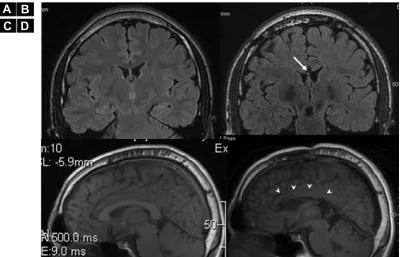
As seizures in both patients caused right shoulder dis-location every time, they had visited the emergency room for shoulder repositioning, sometimes requiring general anesthesia (Figure 1). Their orthopedic surgeons did not regard either patient as a candidate for shoulder surgery due to the relatively high frequency of seizures and likely uncooperativeness after shoulder surgery. Discussions regarding epilepsy surgery were held in our case confer-ences, where the patients were considered unsuitable for focus resection surgery due to the multiple foci and pre-dicted uncooperativeness with invasive monitoring. To reduce BTCS in both patients and SE in Patient 2, we performed total CC for Patient 1 (Figure 2) and anterior callosotomy for Patient 2, as these procedures were con-sidered to have the possibility of preventing shoulder dis-location. The reason for anterior callosotomy in Patient 2 was simply the preference of patient’s family, as they were concerned about the risks of disconnection syndrome.13
The etiology of epilepsy was unclear in both patients. However, as both were patients with autism spectrum disorder and epilepsy, shared underlying neurobiological mechanisms might have been involved,14 such as genetic issues15or mammalian target of the rapamycin pathway.16
Results
After the CC, FIAS remained in both patients, but BTCS became rare and SE disappeared in Patient 2, even though we did not change any medications post-operatively. Right
Therapeutics and Clinical Risk Management downloaded from https://www.dovepress.com/ by 118.70.13.36 on 27-Aug-2020
after the callosotomy, intra-operative electrocorticography (ECoG) strip electrodes in bilateral frontal cortices showed reductions in epileptiform discharges for both patients. Generalized discharges were only seen in Patient 2, and were drastically reduced and lateralized to the left
hemisphere (Figure 3). Clinically, seizure frequency and intensity were reduced, but seizure semiology itself did not change after the callosotomy. As of the time of writing, Patient 1 has experienced only three BTCS events with two shoulder joint dislocations within the 5 years after CC,
A
B
C
Figure 1Shoulder dislocation in Patient 2. A normal glenoid cavity conforms to the red circle. The anterior edge of the glenoid cavity is straightened (white arrow) indicating bone defect, at the 2:00–6:00 position (A). The humeral head (yellow arrow) is displaced downward (B). The humeral head has been repositioned and returned to its original position (C).
A B
C D
Figure 2MRI pre- and post-corpus callosotomy for Patient 1. Preoperative coronal (A), sagittal (B), postoperative coronal (C) and sagittal (D) MRI FLAIR of Patient 1.fi. The arrows show that the corpus callosum is totally removed (BandD).
Therapeutics and Clinical Risk Management downloaded from https://www.dovepress.com/ by 118.70.13.36 on 27-Aug-2020
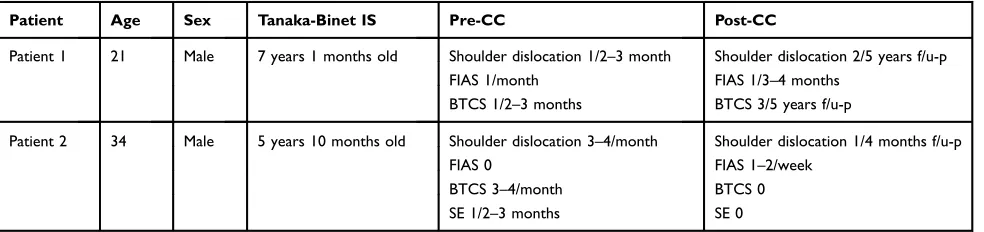
whereas previously he had experienced shoulder disloca-tions once every 2–3 months. Patient 2 has experienced no BTCS for the 5 months since CC, although one spontaneous shoulder joint dislocation was seen within the same period; previously he had experienced shoulder dislocations 3–4 times/month (Table 1). Before CC, even though both patients had used shoulder-immobilizing braces, BTCSs had induced shoulder dislocation. After CC, immobilization therapy using shoulder immobilizer braces allowed each patient to maintain their shoulder in the correct position due to the reduced occurrence of BTCSs. Both were also able to perform range of motion and muscle-strengthening exercises, which required shoulder joint immobilization for
at least several weeks. No neurological abnormalities were seen except for transient alien’s hand in Patient 1 and transient mutism in both patients.
Discussion
As both patients obtained reductions in seizure fre-quency and intensity, the occurrence of shoulder joint dislocation was reduced. Patients with medically intract-able epilepsy currently benefit from epilepsy focus resection surgery. However, if severe intellectual disor-ders are present, both epilepsy focus resection surgery and shoulder joint surgery may become much more difficult. These patients thus need to attend the
B
A
Left
Right
Figure 3Electro Corticography (ECoG) of Pre- and post-corpus callosotomy for Patient 2. (A) Pre-corpus callosotomy ECoG monitoring from bilateral frontal lobe cortices shows generalized poly-spikes. (B) Post-corpus callosotomy ECoG shows reduced generalized poly-spikes lateralized to the left hemisphere. The epileptiform discharges on the right side are eleminated (arrow). As scalp EEG showed epileptiform discharges predominantly in the left hemisphere, we used an 8-contact strip on the left hemisphere and a 6-contact strip on the right hemisphere.
Table 1Clinical information and data between pre- and post-callosotomy
Patient Age Sex Tanaka-Binet IS Pre-CC Post-CC
Patient 1 21 Male 7 years 1 months old Shoulder dislocation 1/2–3 month Shoulder dislocation 2/5 years f/u-p
FIAS 1/month FIAS 1/3–4 months
BTCS 1/2–3 months BTCS 3/5 years f/u-p
Patient 2 34 Male 5 years 10 months old Shoulder dislocation 3–4/month Shoulder dislocation 1/4 months f/u-p
FIAS 0 FIAS 1–2/week
BTCS 3–4/month BTCS 0
SE 1/2–3 months SE 0
Abbreviations:CC, corpus callosotomy; IS, intelligence scale; f/u-p, follow-up period; FIAS, focal onset impaired awareness seizure; BTCS, focal to bilateral tonic-clonic seizure; SE, status epilepticus.
Therapeutics and Clinical Risk Management downloaded from https://www.dovepress.com/ by 118.70.13.36 on 27-Aug-2020
emergency room for shoulder repositioning, which could reduce quality of life for both patients and caregivers. Shoulder joint dislocation caused by epileptic seizures is said to be underestimated.2,3,10 Many patients suffer from shoulder joint dislocation due to frequent seizures without any treatments being suggested. For patients who are unsuitable for shoulder and focus resection surgeries and who suffer from frequent shoulder dislo-cation, CC could offer a good treatment of last resort.
Conclusion
For patients who are not candidates for focus resection or shoulder-repositioning surgeries and who are suffering from frequent shoulder dislocations, corpus callosotomy could represent a good last-resort treatment.
Acknowledgement
No funding was received for this case series. We are grateful to Dr. Masayuki Abe from the Department of Orthopedic Surgery for advice regarding shoulder disloca-tion and manuscript preparadisloca-tion.
Ethics approval
The parents of the patients who were not considered capable of providing legal consent, provided written informed consent for publication of these case details. The ethics committee at Seirei Hamamatsu General Hospital approved this study.
Author contributions
Neurosurgical operation: AF, NI. Acquisition of data: TO, KS and AF. Analysis and interpretation of data: AF, TO, and HE. All authors contributed to data analysis, drafting and revising the article, gavefinal approval of the version to be published, and agree to be accountable for all aspects of the work.
Disclosure
The authors report no conflicts of interest in this work.
References
1. Buhler M, Gerber C. Shoulder instability related to epileptic seizures.
J Shoulder Elbow Surg. 2002;11(4):339–344. doi:10.1067/ mse.2002.124524
2. DeToledo JC, Lowe MR. Seizures, lateral decubitus, aspiration, and
shoulder dislocation: time to change the guidelines? Neurology.
2001;56(3):290–291. doi:10.1212/wnl.56.3.290
3. Thangarajah T, Lambert S. The management of recurrent shoulder
instability in patients with epilepsy: a 15-year experience.J Shoulder
Elbow Surg.2015;24(11):1723–1727. doi:10.1016/j.jse.2015.04.008 4. Donohue MA, Mauntel TC, Dickens JF. Recurrent shoulder
instabil-ity after primary Bankart repair. Sports Med Arthrosc. 2017;25
(3):123–130. doi:10.1097/JSA.0000000000000159
5. Kawasaki T, Hasegawa Y, Kaketa T, et al. Midterm clinical results in
rugby players treated with the Bristow procedure.Am J Sports Med.
2018;46(3):656–662. doi:10.1177/0363546517740567
6. Givon U, Oran A, Blankstein A, Pritsch M. Use of botulinum neu-rotoxin injections to treat recurrent shoulder dislocations in a patient
with severe epilepsy: a case report.J Bone Joint Surg Am.2011;93
(19):e112(111–113). doi:10.2106/JBJS.J.00419
7. Fedorka CJ, Mulcahey MK. Recurrent anterior shoulder instability: a review of the Latarjet procedure and its postoperative
rehabilita-tion. Phys Sportsmed. 2015;43(1):73–79. doi:10.1080/
00913847.2015.1005543
8. Toth R, Szanto P, Prodan Z, et al. Down syndrome and postoperative complications after paediatric cardiac surgery: a propensity-matched
analysis. Interact Cardiovasc Thorac Surg. 2013;17(4):691–697.
doi:10.1093/icvts/ivt267
9. Gosens T, Poels PJ, Rondhuis JJ. Posterior dislocation fractures of the
shoulder in seizure disorders–two case reports and a review of
litera-ture.Seizure.2000;9(6):446–448. doi:10.1053/seiz.2000.0418
10. Schulz TJ, Jacobs B, Patterson RL Jr. Unrecognized dislocations of
the shoulder.J Trauma.1969;9(12):1009–1023.
11. Graham D, Tisdall MM, Gill D. Corpus callosotomy outcomes in
pediatric patients: a systematic review.Epilepsia.2016;57(7):1053–
1068. doi:10.1111/epi.13408
12. Ono T, Baba H, Toda K, Ono K. Hemispheric asymmetry of callosal neuronal participation in bilaterally synchronous epileptiform
dis-charges.Seizure.2009;18(1):7–13. doi:10.1016/j.seizure.2008.05.005
13. Jea A, Vachhrajani S, Widjaja E, et al. Corpus callosotomy in
chil-dren and the disconnection syndromes: a review.Childs Nerv Syst.
2008;24(6):685–692. doi:10.1007/s00381-008-0626-4
14. Keller R, Basta R, Salerno L, Elia M. Autism, epilepsy, and
synap-topathies: a not rare association.Neurol Sci.2017;38(8):1353–1361.
doi:10.1007/s10072-017-2974-x
15. Stafstrom CE, Benke TA. Autism and epilepsy: exploring the
rela-tionship using experimental models.Epilepsy Curr.2015;15(4):206–
210. doi:10.5698/1535-7511-15.4.206
16. Russo E, Follesa P, Citraro R, et al. The mTOR signaling pathway and neuronal stem/progenitor cell proliferation in the hippocampus are altered during the development of absence epilepsy in a genetic
animal model. Neurol Sci. 2014;35(11):1793–1799. doi:10.1007/
s10072-014-1842-1
Therapeutics and Clinical Risk Management
Dove
press
Publish your work in this journal
Therapeutics and Clinical Risk Management is an international, peer-reviewed journal of clinical therapeutics and risk management, focusing on concise rapid reporting of clinical studies in all therapeutic areas, outcomes, safety, and programs for the effective, safe, and sustained use of medicines. This journal is indexed on PubMed Central, CAS,
EMBase, Scopus and the Elsevier Bibliographic databases. The manuscript management system is completely online and includes a very quick and fair peer-review system, which is all easy to use. Visit http://www.dovepress.com/testimonials.php to read real quotes from published authors.
Submit your manuscript here:https://www.dovepress.com/therapeutics-and-clinical-risk-management-journal
Therapeutics and Clinical Risk Management downloaded from https://www.dovepress.com/ by 118.70.13.36 on 27-Aug-2020