Licensed under Creative Common Page 325
http://ijecm.co.uk/
ISSN 2348 0386
FACTORS AFFECTING PERFORMANCE OF PROCUREMENT
FUNCTION AMONG PUBLIC TECHNICAL TRAINING
INSTITUTIONS IN KISUMU COUNTY, KENYA
Sylvia Chilikona Wanyonyi
Msc. Student, Jomo Kenyatta University of Agriculture and Technology, Kenya [email protected]
Willy Muturi
Lecturer, Jomo Kenyatta University of Agriculture and Technology, Kenya [email protected]
Abstract
Public procurement has increasingly become prominent in both public and private sector. This
study’s general objective is to evaluate the factors affecting the performance of the procurement
function among public technical training institutions in Kisumu County Kenya. The study focused
on the specific objectives of analyzing three main methods of public procurement, which are:
effects of information technology on performance of procurement function in public technical
training institutions, establishment of extent in which competency of staff influence performance
of procurement functions and to enumerate the ethical issues affecting decision making in
performance of procurement functions in public technical training institutions. Primary data was
collected by using questionnaires. Data was analyzed using quantitative analysis by employing
both descriptive and inferential statistics. The study concludes that information technology,
ethics and staff competency have a positive effect on performance of the procurement function
in technical training institutions. It therefore recommends that the use of information technology
in the two institutions be enhanced so as to deliver success in the performance of procurement
functions, competence of employees should be promoted in both institutions and work ethics
being a fundamental in the success of any organizations performance should be observed in all
procurement departments.
Licensed under Creative Common Page 326
INTRODUCTION
All procurements irrespective of monetary valuation must follow a standard sequence of actions as specified in the Public Procurement and Disposal Act 2007. In order to realize the objectives of the procurement function the process has to follow the laid down procedures and this eliminates the possibility of poor performance. In the entire world, every business organization depends on conversion of inputs (goods/services) into outputs both tangible and intangible that must be put in place in an effective logistical system to ensure its operations run effectively and efficiently. Despite the importance of public procurement, limited scientific research has been undertaken to examine factors that influence performance of the procurement function in technical training institutes in Kenya. Kabaj (2003) concludes that an efficient public procurement system is vital to the advancement of all countries and is a concrete expression of their national commitments to making the best possible use of public resources. Non-adherence to standardized procurement processes culminates in poor co-ordination within various departments and enhances presence of leakages of financial resources, which turns out to be costly component to the whole management process of the procurement function (Knight, 2010). The logistical system has to give emphasis to two key elements; product sourcing and timely acquisition by the ultimate consumer. Of these two elements, this paper concentrated on the first one; sourcing of inputs which is a line departmental functionality strategically placed at the whims of procurement department.
Statement of the Problem
Licensed under Creative Common Page 327
Public procurement has important economic and political implications by ensuring that the process is efficient and economical. This has a requirement that the main actors including stakeholders, professional associations, academic entities and the general public understand the whole process of procurement. Unfortunately, in many public institutions the process is still shrouded with secrecy, inefficiency and corruption (Nyakundi, E., Kombo, C., Omari, R., Mongare, O. 2012). This prompted the researchers to conduct this research study with a view to establish factors affecting performance of the procurement function among public technical training institutions in Kisumu county, Kenya.
Objectives
The study had the following specific objectives;
i. To determine effect of Information Technology on performance of the procurement function in public Technical Training Institutions in Kisumu County, Kenya.
ii. To establish the extent in which competency of staff influence the performance of the procurement function in public Technical Training Institutions in Kisumu County, Kenya.
iii. To enumerate how ethical issues effect decision making in performance of the procurement function in public Technical Training Institutions in Kisumu County, Kenya.
LITERATURE REVIEW
Information Technology in Procurement
Information Technology is a term that encompasses all forms of technology used to create, store, exchange and use of information in its various forms. According to Davila, Gupta and Palmer (2003), any technology designed to facilitate the acquisition of goods over the Internet can be defined as e-procurement.
In Kenya, manual systems have been a source of major inefficiencies in the regulation and operations of the procurement function. Therefore there is need to adopt ICT in order to ensure proper functioning of the procurement system. To meet today’s operating challenges,
Licensed under Creative Common Page 328
Competency of staff in Procurement Process
Competency is defined as a capability, ability or an underlying characteristic of an individual, which is casually related to effective or superior performance. For purposes of this study, competency is used to refer to applied knowledge and skills, performance delivery, and the behaviour required to get things done very well (Armstrong and Baron, 1995). Competencies are divided into two categories; technical and behavioural competency. Public procurement professionals have to strive to achieve three competing demands of meeting commercial interests with key themes of value for money, economy, efficiency and effectiveness; the regulatory interests with key themes of competition, transparency, equality and compliance and the social interests whose key themes include public interest, employment concerns, social exclusion, economic development and environment policy (Errigde & Mcllroy, 2002). In an effort to attain these demands, organizations constantly look for employees who have skills necessary to deal with the wide variety of tasks faced by purchasing professionals (Monczka et al, 1998). Procurement professionals need a set of flexible skills due to changing local government contexts. No single skill can be adequate to manage the procurement portfolio of great complexity in local government systems. Procurement tasks demand professionals with high-level strategic, tactical as well as operational skills. These skills should potentially take a broader supply chain multi-disciplinary and integrative approach.
Ethics in Procurement Process
Ethics are the moral principles or values that guide officials in all aspects of their work. Ethical behaviour encompasses the concepts of honesty, integrity, probity, diligence, fairness, trust and respect. Ethical behaviour includes avoiding conflicts of interest, and not making improper use of an individual’s position (Wee 2002). Ethical behaviour supports openness and accountability
in procurement with the result that suppliers have confidence in participating in the Government marketplace. It also reduces the cost of managing risks and enhance trust in public administration. Ethical behavior is important in public procurement as it involves the expenditure of public money, and is subject to public scrutiny. Public officials should always behave ethically and fairly in their business undertakings. Ethical behavior supports openness and accountability in a procurement process and gives suppliers confidence to participate in the Government marketplace. Ethical behavior can also reduce the cost of managing risks associated with fraud, theft, corruption, and other improper behavior; and enhance confidence in public administration (Karanja and Mugo, 2010)
Licensed under Creative Common Page 329
legislation are established, understood and followed from the outset. These procedures need to consider the legitimate interests of suppliers and ensure that all potential suppliers are treated equitably (Wee 2002). An important and effective way to maintain ethics awareness in agencies is to provide training for employees (Amos and Weathington, 2008). Ethics training and seminars can be provided, along with training in more specific areas, such as procurement procedures, record keeping, records management, and accountability and administrative law. Regular reviews or audits of procurement processes can be done to ensure probity is being considered and achieved (Amos and Weathington, 2008).
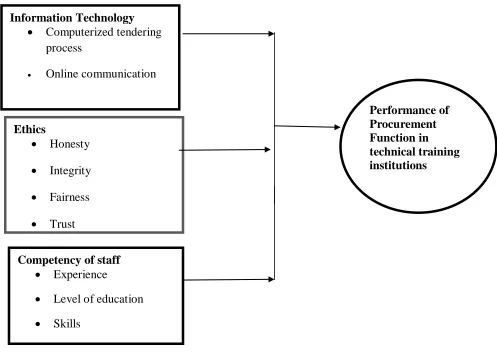
Figure 1: Conceptual Framework
Independent variables dependent variable
Ethics
Honesty
Integrity
Fairness
Trust
Competency of staff
Experience
Level of education
Skills
Information Technology
Computerized tendering
process
Online communication
Licensed under Creative Common Page 330
METHODOLOGY
Research Design
The study employed descriptive survey design. Descriptive survey is conducted to describe the present situation, what people currently believe and what people are doing at the moment (Baumgartner, Strong and Hensley 2002). According to Kothari (2004), descriptive survey design includes surveys and fact-finding enquiries of different kinds. The major purpose of descriptive research design is description of the state of affairs as it exists at present (Kothari 2004). Descriptive studies are essential in many situations especially when using qualitative data in understanding the phenomena. The study focused on two public the two public technical institutions found within Kisumu County.
Sampling
The study population was 30, whereby each institution had 15 members from the procurement function. All of them were interviewed during the study. This was determined using the saturated sampling technique since the population was relatively small (Mugenda and Mugenda, 2003).
Research Instruments
Questionnaires containing structured and unstructured questions were used to gather the necessary data. The questionnaires were prepared thematically on the basis of research questions and they were divided into five sections which are as follows: Section A captured the personal information of the respondents, Section B captured information on information technology, Section C captured information on competency of staff, Section D captured information on staff work ethics whereas Section E captured information on procurement function performance. Structured questionnaires were used to collect quantitative data while unstructured questionnaires were used to collect qualitative data. Questionnaires were used because they are cheap, easy to administer, collect a lot of information and are fast. The questionnaires did have both open and close ended questions and Likert Scale was used to measure the responses from respondents.
ANALYSIS AND RESULTS
Regression Analysis
Licensed under Creative Common Page 331
regression model had a correlation coefficient of R = 0.714 indicating that the dependent variable and independent variable had a high degree of correlation.
The model also showed that 50% of the variation in performance of procurement functions was explained by the variation in information technology, competence of employees and work ethic of employees. This was shown by the coefficient of determination value of R2=0.509. The adjusted coefficient of determination (Adj R Squared) was less than the un adjusted Coefficient of determination as it should always be (Adj R Squared=0.250 < R Squared = 0.509). This implied that about 25% of the variation in performance of procurement functions was actually explained by the variations in information technology, competence of employees and work ethics of employees. See Table 1 below.
Table 1. Regression Model Summary Regression
Model
Correlation Coefficient
Coefficient of Determination
Adjusted Coefficient of Determination
Standard Error
1 0.714 0.509 0.2507 2.306
The analysis of variance results predicted the dependent variable by illustrating how the regression best fits the model. The results showed that the significance probability value of P=0.00196 of the regression model was less than the level of significance of 0.01 at 95% confidence levels indicating that the regression model is significant. See Table 2 below.
Table 2. Analysis of Variance Test Results for Regression Model
Sum of Squares Degrees of Freedom Mean Square F Statistic Significance of Probability
Regression 31 3 10.43041
0.00196
Residual 138 26
Total 170 29
Licensed under Creative Common Page 332
Information Technology
The study sought to determine effect of Information Technology on the performance of the procurement function in public Technical Training Institutions in Kisumu County, Kenya. The study established that the two technical training institutes adopted Information Technology in their procurement department. It established that information technology generally improved performance of the procurement function. The study established that advertisement of tenders was done online which led to computerized selection of suppliers thus improvement of flow of information and decision-making. The study also established that information technology helped in reducing ordering time and follow up. Online communication, online tender advertising and computerized tendering process has an influence on performance of the procurement function as it offers smoother and faster process flow and efficient distribution of information. This enables an institution to know when to make an order.
Competency of Staff
The study sought to establish whether every new employee receives induction training on procurement processes. Most of the respondents were in agreement. These findings indicated that both institutions were keen on induction to every new employee so that they can be in line with the procurement processes. This had to be done in order to realize that every employee understood the internal situation and act accordingly.
The study sought to establish whether the members of the procurement team were well acquitted with the Procurement Act of 2009. Most of the respondents were in agreement. This implies that the procurement teams in both institutions are well acquitted with the procurement Act 2009. Since procurement tasks demand professionals with high-level strategic, tactical as well as operational skills which are needed to improve performance of the procurement function. The study sought to establish whether the procurement staffs are qualified personnel capable of performing tasks, most of the respondents were in agreement. This implies that the procurement staff had both the professional and experience in handling the function. Procurement professionals need a set of flexible skills due to changing behavior of the customers and suppliers. No single skill can be adequate to manage the procurement portfolio of great complexity in technical training institutions.
Ethics
Licensed under Creative Common Page 333
bids. Ethical issues are known to affect the procurement process especially where there is conflict of interest and not making proper use of an individual’s position. In this case the study
found out that there is an effort by the institutions to access suppliers across the country by advertising the tenders from all suitable suppliers.
The study sought to establish whether the procurement staff practices professionalism, accountability and efficiency in the procurement process. Most of the respondents agreed. This indicates that the procurement process in both institutions conforms to the expected standards of integrity, uprightness and honesty. Here clear procedures are consistent with Government policies and are understood and followed from the outset. Potential suppliers are easily reached and are given a chance where they actually qualify to carry out the task.
SUMMARY OF THE FINDINGS
The procurement function plays a pivotal role in the operations of the technical training institutions. With proper management and monitoring, the institutions are assured of better performance and efficient service delivery. The main purpose of this study was to establish factors affecting performance of procurement function among public technical training institutions in Kisumu County, Kenya. The study was conducted using a descriptive design with a target population of 30 which was substantial based on the fact that the two Education institutions had few employees who are involved in procurement functions and processes. Data was collected using structured questionnaire. The information collected also centered on gender of respondents, duration of service of the respondent in the institution and department in which the respondent served in the Education institution.
The first study objective was to determine effect of Information Technology on the performance of the procurement function in public Technical Training Institutions in Kisumu County, Kenya. The study measured how the respondents rated the list of information provided based on information technology on a five point Likert scale ranging from strongly disagreeing, disagreeing, neutral, agree and finally strongly agree. The respondents indicated that Information Technology had a positive effect on performance of the procurement function. It indicates that IT entails heavy investment in IT, use of IT in procurement, advertisement and reduction in ordering time. It enhances the process of effective tendering through advertising, and greater awareness of new development. It also enables an institution to provide excellent service to their suppliers in a transparent manner.
Licensed under Creative Common Page 334
provided based on competency of employees on a five point Likert scale ranging from strongly disagreeing, disagreeing, neutral, agree and finally strongly agree. The study also sought to establish the effect of competence of staff on the performance of procurement f unctions in the two organizations. Most of the respondents therefore agreed that there is a positive effect of staff competency on performance of procurement function among public technical training colleges.
The third and final objective was to enumerate the ethical issues effecting decision making in the performance of the procurement function in public Technical Training Institutions in Kisumu County, Kenya. The study measured how the respondents rated the list of information provided based on work ethics of employees on a five point Likert scale ranging from strongly disagreeing, disagreeing, neutral, agree and finally strongly agree. Most of the respondents therefore were in agreement that there is a positive effect of work ethics on performance of procurement function among public technical training colleges.
CONCLUSIONS
The findings of the study investigated the factors affecting the performance of procurement functions among public technical training institutions in Kisumu County in Kenya. 73% of the respondents were in agreement that information technology positively affects the performance of procurement functions in the two institutions as well as the items used that formed the basis of the questions on this variable in the questionnaire. This study established that online advertising and computerized tendering process had a positive influence on performance of procurement function in technical training institutes in Kisumu County, Kenya.
For the case of competency of staff, the main areas that were observed to be the key contributors to staff competence included the training of new employers in the procurement departments, enhancing team work of procurement staff, acquaintance of the procurement act of 2009 by the procurement team and employing qualified and competent personnel in the procurement departments among others. It was established from the results that competency of staff/employees affects positively the performance of procurement functions in the two institutions.
Licensed under Creative Common Page 335
RECOMMENDATIONS
1. The use of Information Technology in the procurement processes in the two institutions should be enhanced so as to deliver success in the performance of procurement functions.
2. The two institutions should strive to promote competence of staff/employees in all departments with emphasis in the procurement department. This should be so for all the procurement department employees in the two institutions.
3. Work ethics is fundamental in the success of organizational performance. The two institutions should ensure that ethical practices are observed in the procurement departments. Stringent measures that deal with unethical practices by the procurement staff in the two institutions should be formulated and adhered to.
SCOPE FOR FURTHER RESEARCH
This study sought to assess factors affecting performance of the procurement function in Kisumu County, Kenya. However, the study cannot be used to generalize in other counties due to demographic and economic factors. The study therefore recommends further studies in; Factors affecting the effectiveness of the procurement functions among public technical training institutions in Kisumu County Kenya, Factors influencing the effective implementation of E-Procurement among public institutions in public technical training institutions in Kisumu County Kenya and Factors affecting effective management of procurement functions among public technical training institutions in Kisumu County in Kenya.
REFERENCES
Amemba, S. C (2013). Challenges affecting public procurement performance process in Kenya. PhD Jomo Kenyatta University of Agriculture and Technology. Nairobi.
Armstrong M. and Baron, (1995) Job Evaluation Handbook. London. Institute of Personnel Development Achuora, J., Arasa, R., & Ochiri, G.(2010). Precursors to Effectiveness of Public Procurement Audits for Constituency Development Funds (CDF) in Kenya. European Scientific Journal, November ed. Vol 8 No. 25 1857-7431.
Amos, E., Worthington, B. (2008). "An analysis of the relation between employee-organization value congruence and employee attitudes", Journal of Psychology, Vol. 142 No.6, pp.615-32.
Andreasen, P. (2012). The Dynamics of Procurement Management: A Complexity Approach. Frederiksberg: Copenhagen Business School (PhD Series; No. 1.2012).
Barasa, H. W. (2014). Procurement Practices Affecting Effective Public Projects Implementation in Kenya: A Case Study of Kenya Civil Aviation Authority. European Journal of Business and Management ISSN 2222-2839 (Online).
Licensed under Creative Common Page 336 Benton, W. C. and Maloney, Michael (2005). The influence of power driven buyer-seller relationships on supply chain satisfaction. Journal of Operations Management. Volume 23. pp. 1-22.
Borg, D., & Gall, R. (2007). Educational Research: An Introduction. Boston: Pearson Education.
Chandran, E. (2004) Research Methods: A Qualitative Approach with Illustrations from Christian Ministries. Nairobi: Daystar University.
Errigde, A. & Mcllroy, J. (2002). ‘Public procurement and supply management strategies’, Public policy and administration, volume 17, No.1, spring, pp 52-71.
Gronhaug, P. G. (2005). Research Methods for Business Studies: A Practical Guide (3rd ed). Prentice Hall.
Hagén, H.-O., Zeed, J. (2005). Does ICT Use Matter for Firm Productivity? Yearbook on Productivity 2005, Statistics Sweden, Stockholm.
Jensen, M. C. and W.H. Meckling, (1976). Theory of the firm: managerial behavior, agency costs, and ownership structure, Journal of Financial Economics, 3, 305–360.
Kabaj, O. (2003). The Challenge of African Development. Oxford, UK: Oxford University Press.
Karanja, N. and Mugo, W (2010) Internal Factors Affecting Procurement Process of Supplies in the Public Sector; A Survey of Kenya Government Ministries. Nairobi. Jomo Kenyatta University of Agriculture and Technology.
Kiage, J. O. (2013). Factors Affecting Procurement Performance: A Case of Ministry of Energy.
International Journal of Business and Commerce. Vol. 3, No. 1: Sep 2013 [54-70]
Kimenyi, S. (2005). Efficiency and Efficacy of Kenya’s Constituency Development Fund: Theory and
Evidence. Working paper 45, University of Connecticut, USA.
Kioko, J. N., Were S. (2014). Factors Affecting Efficiency of the Procurement Function at the Public Institutions in Kenya (A Case of Supplies Branch in Nairobi). Nairobi: Jomo Kenyatta University of Agriculture and Technology Press.
Kothari, C. (2004). Quantitative Techniques. New Delhi, New Age International Publishers.
Lankford, W., M. (2004). Supply chain management and the Internet. Online Information Review 28, 4, 301-305
Leksomo, C., Young, J., Muriuki, H. (2006) Informal Traders Lock Horns with the Formal Milk Industry; The Role of Research in Pro-poor Dairy Policy Shift in Kenya. Available at: http://www.epository.ipb.ac.id/. [accessed 16th February 2015]
Leukel, J., & Maniatopoulos, G. (2005). A Comparative Analysis of Product Classification in Public vs. Private E-procurement. The Electronic Journal of e-Government, 3(4): 201-212.
Lloyd, R. E. (2004). Enahncing Procurement Practices: Comprehensive Approach to Acquring Complex Facilities and Projects (Book Review). The Journal of Public Procurement, 4 (3), 471-477.
Mahmood, S. A. I. (2010). Public Procurement and Corruption in Bangladesh. Confronting the Challenges and Opportunities: Journal of public administration and policy research, 2(6), 103-111: University of Maine, Orono.
Manasseh, P. N. (2007). A Text Book of Principles of Auditing. Nairobi: McMore Accounting Books. Mayenze, N. (2013). Procurement Performance in Public Universities, Unpublished Thesis, University of Nairobi.
Mburu, S. Njeru, A. (2014). Factors Affecting Procurement Performance in the Milk Processing Firms in Kiambu County. International Journal of Science and Research. ISSN (Online): 2319-7064
Monson, T. S. (2007). Feedback. In L. Charles A. Coonrald, The Game of Work (pp. 178-187).
Licensed under Creative Common Page 337 Mugenda, O.M. and Mugenda, A.G. (2003): Research Methods: Quantitative & Qualitative Approaches. Nairobi: ACTS Press.
Ngina, E. K (2013). Procurement Performance Measurement in Commercial Banks in Kenya. Unpublished Thesis. University of Nairobi.
Nyakundi, E., Kombo, C., Omari, R., Mongare, O. (2012). Challenges Facing Procurement Committees in Implementing the Procurement Act; A Case Study of Secondary Schools Procurement Committees in Kisii County, Kenya. Elixir International Journal 9186-9191
Nyamwoya, E. (2011). Factors Affecting Implementation of Projects: A case Study of Ministry of Roads.
Retrieved from Jomo Kenyatta University of Agriculture and Technology, Department of Entrepreneurship and Procurement
PPOA, (2007). Assessment of the Procurement System in Kenya Report: A report by Public Procurement Oversight Authority, Nairobi.
Sekaran, U. (2003). Research Methods for Business. New York: John Wiley & Sons Inc.
Schoeffler, S., 1983, The PIMS program, in: K. Albert (ed.), The Strategic Management Handbook (New York, McGraw-Hill) pp.23.1–23.10.
Thai, K. V. (2010). Towards New Horizons in Public Procurement. Towards Horizons in Public Procurement Pr Press.
Triantafillou, P. (2007). Benchmarking in the Public Sector: A Critical Conceptual Framework. Public Administration Journal, 8(4), 17-32
Van Weele, A. J. (2006). Purchasing and Supply Chain Management: Analysis, Strategy, Planning and Practice (4th Ed.) Australia Thomson.
Waters, D. (2004). Introduction to Supply Chain Management, (2rd Edition), Pal grave Macmillan, London.