Analysis Of Difficulty Learning Calculus Subject
For Mathematical Education Students
Siti Fatimah, Yerizon
Abstract: The low result of student learning for calculus subjects are the background of this study. This study aims to analyze student learning difficulties with calculus subjects. This study uses a descriptive method with the qualitative approach. The technique of data analysis uses the Miles and Huberman models with the type of data presentation. The subject of this study is IAIN Bukittinggi students of the 2018 Mathematics Education Study Program which consists of 1 class which amounts to 37 people. The results of the study stated: 1) student difficulties in general, namely drawing the function graphs and doing trigonometric manipulations, 2) student difficulties specifically obtained for material functions (determining domain and range), limit material (mastering rules in determining the values of limit function), derivative material (determining the maximum and minimum values in the story matter), and integral material (errors using integral rules that are often used derivative rules, differentiating using substitution and partial integral techniques and also error in the final completion of the volume of rotary objects).
Keyword: Learning Difficulties, Calculus
————————————————————
1.
INTRODUCTION
Mathematics subjects are studied at each level of education, starting from elementary school (SD), junior high school (SMP), seniorhigh school (SMA) and even college level. In addition to the special majors in mathematics, a number of other majors with natural scientific nuances in higher education generally at level 1 studying mathematics, namely calculus subjects. The department is in the fields of physics, chemistry, biology, various engineering majors, and various other majors. The Mathematics Education Study Program is a study program that explores mathematical sciences with educational nuances. This study program has the output of an education graduate who focuses on becoming a mathematics teacher. This study program is organized by the universities such as: State University, State Islamic Institute (IAIN), Teacher Training College (STKIP), and other universities. Calculus subjects are subjects must be studied by students of mathematics education study programs. Calculus subjects are divided into 4 parts namely calculus differential, calculus integral, calculus multivariate 1 and calculus multivariate 2. Implementation of this subject is closely related to each other because students can take integral calculus subject after passing differential calculus subject, students can take calculus multivariate 1 subject after passing calculus integral subject, and so on. Subjects of calculus differential and calculus integral are studied by students at level 1. There are colleges that make these two subjects put together into a subject that studied in semester 1, it is called calculus subject, but there are also colleges that keep separating them into two subject, namely differential calculus are studied in semester 1 and calculus 2 is studied in semester 2. These conditions occur naturally based on the policy of the university. Information obtained from the IAIN Bukittinggi mathematics education study program regarding student learning outcomes. Based on the final score obtained by the students in the differential calculus subject, it was found that student learning outcomes were quite low. The acquisition of the student is only around 35% in the category above or equal to B with the remaining 65% of students in the category below B. Less than 50% of students obtain grades above or equal to category B. This condition has occurred in the last few years at IAIN Bukittinggi. The various efforts have been made by lecturers to solve these problems. One of them is by
81 Bukittinggi, information was obtained that there were
several factors that caused students feel difficult to learn calculus. These factors are: 1) The students do not master the prerequisite material for the material to be studied, even some students still have experience obstacles in basic mathematical operations, 2) The laziness of students who do not want to read the material to be studied, even though they have been asked by lecturers to read the material that will be studied later, 3) The students who are less able to learn independently still use the memorization method 4) The students are less careful in answering the questions. Observations on students were also conducted in knowing student learning difficulties. In general, the main problems of students are in line with those delivered by lecturers. The students do not master the prerequisite material for the material to be studied, even some students still get obstacles in basic mathematical operations. The students have difficulty in completing simple functions and some of them have misconceptions in completing them. Difficulties experienced by students must be minimized so that the learning process of calculus subjects takes place well and students better understand the concepts explained by the lecturer. If the learning difficulties are not understood by the lecturer, there will be more and more incomplete material and many students do not complete the calculus subject. Based on this description, the need to extract information about the factors that cause difficulties for students to learn calculus. Information gathering focused on the difficulties of students' initial knowledge of calculus material they had learned at high school level.
2.
METHOD
This research is a descriptive study with a qualitative approach. The place of research at IAIN Bukittinggi. The time of the research was August to September 2018. This research used the subject of the Bukittinggi IAIN students of the 2018 Mathematics Education Study Program which consisted of 1 class which consisted of 37 people. Researchers take the subject using a purposive sampling technique. The focus of this study is an analysis of student learning difficulties in understanding calculus material that students have learned at high school level. Interviews were held for students before students learn calculus with the aim of finding out the difficulties students have in calculus material they have learned in high school. The students are given 4 questions and ask them to describe the answer in detail. The question concerns students' difficulties in material functions, limit functions, derivative functions and integrals. The data analysis technique uses the Miles and Huberman models. There are three qualitative data analysis techniques, namely data reduction, data presentation, and taking the conclusion [5]. The analysis technique chosen to use is the presentation of data. Presentation of data is an activity when a set of information is compiled, thus giving a possibility of taking the conclusions. The form of data presentation is in the form of narrative text (interview results). The students' answers to one question are described in terms of percent. With the initialization N is the number of students who have the same answer and P is the percentage of the number of student answers from 30 students interviewed.
3.
RESULT
Interviews were done at the beginning of calculus learning with regard to the difficulties students had with the calculus mathematics material they had learned in high school. The answers presented are taken in general student answers. The essence of the answer with different languages is considered the same answer. The first question that was asked to students regarding the difficulties of student learning functions. Function material consisting of: 1) Definition of functions; 2) Domain, codomain, and range; 3) Types of functions; 4) Inverse and Composition Functions and; 5) Function Graph. The students’ answers can be seen from table 1.
Table 1: The Students’ Difficulties of Learning Functions
Answer N P
Difficulty drawing graph functions. 30 81 Difficulty in determining the
domain and range of functions. 20 54 Difficulty completing questions
about functions related to story problems.
10 27
Difficulty in solving complex
problems. 5 13,5
Based on the above table, it is obtained information that in general students experience obstacles in the high school level with regard to material functions are drawing graphs of functions which are as many as 30 people (81%) and determine the domain and range of functions that are as many as 24 people (54%). The second question was asked to students regarding the difficulty of students learning limit functions. The studensts’ answers can be seen from table 2.
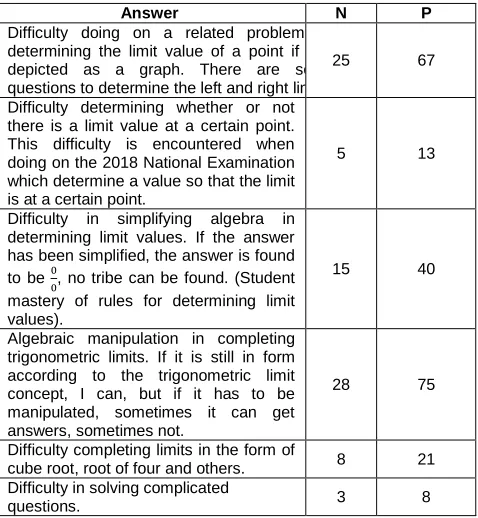
Table 2: The Students’ Difficulties of Learning Limit Function
Answer N P
Difficulty doing on a related problem by determining the limit value of a point if it is depicted as a graph. There are some questions to determine the left and right limits.
25 67
Difficulty determining whether or not there is a limit value at a certain point. This difficulty is encountered when doing on the 2018 National Examination which determine a value so that the limit is at a certain point.
5 13
Difficulty in simplifying algebra in determining limit values. If the answer has been simplified, the answer is found to be , no tribe can be found. (Student mastery of rules for determining limit values).
15 40
Algebraic manipulation in completing trigonometric limits. If it is still in form according to the trigonometric limit concept, I can, but if it has to be manipulated, sometimes it can get answers, sometimes not.
28 75
Difficulty completing limits in the form of
cube root, root of four and others. 8 21 Difficulty in solving complicated
Based on the table above, information is obtained that in general students experience obstacles at the high school level with regard to material limits quite diverse. The biggest percentage of student difficulties was algebraic manipulation in completing trigonometry limits which was around 75% (28 people). Furthermore, the difficulty of students in determining the limit value of a point on the graph is around 67% (25 people). The third question that was asked to the students is related to the difficulty of students learning derivative functions. The students’ answers can be seen from table 3.
Table 3: The Students’ Difficulties of Derivative Learning
Answer N P
Difficulties in determining the simplification of
the final results. 6 16
Determination of trigonometric derivatives, for their already complex functions. The solution is the multiplication rules and the distribution.
20 53
Determine the maximum or minimum value of
the story issue. 30 81
Determine the initialization in determining the settlement of derivative story problems. If the function is known, students do not get difficulties, but if the function is unknown, such as finding the maximum volume of the tube if the area of the base is known, students experience difficulties.
3 8
Section curve tangents that have to do with
lines that are parallel and perpendicular. 10 27 Graph functions using derivative concept 27 72
Based on the table above, information is obtained that in general students experience obstacles at the high school level with regard to derivative material quite diverse. The biggest percentage of student difficulties is determining the maximum or minimum value of the story problem, which is around 81% (30 people). Furthermore, the difficulty of students in charting functions using derivative concepts is around 72% (27 people). Furthermore, a large enough percentage is the determination of the trigonometric derivative of the function has been complex, the solution has a multiplication rule and the division is as much as 53% (20 people). The fourth question asked to students is related to the difficulties of students in integral learning. The sttudents’ answers can be seen from table 4.
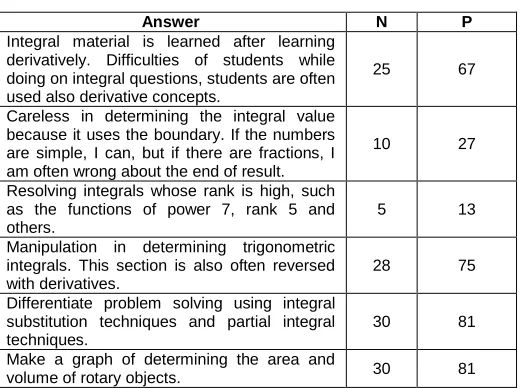
Table 4: The Students’ Difficulties of Learning Integral
Answer N P
Integral material is learned after learning derivatively. Difficulties of students while doing on integral questions, students are often used also derivative concepts.
25 67
Careless in determining the integral value because it uses the boundary. If the numbers are simple, I can, but if there are fractions, I am often wrong about the end of result.
10 27
Resolving integrals whose rank is high, such as the functions of power 7, rank 5 and others.
5 13
Manipulation in determining trigonometric integrals. This section is also often reversed with derivatives.
28 75
Differentiate problem solving using integral substitution techniques and partial integral techniques.
30 81
Make a graph of determining the area and
volume of rotary objects. 30 81
Determination of boundaries and functions of the area of a rotary object if the area is limited by two or more curves.
12 32
The final completion of the volume of the rotating object due to the long completion of the problem, I often find it difficult to solve it and the results are often wrong. This condition sometimes makes me often what it is to solve the problem related to the volume of the
rotating object.
22 59
Based on the table above, information is obtained that in general students get obstacles at the high school level with regard to integral material quite diverse. The biggest percentage of student difficulties is distinguishing problem solving using integral substitution techniques and partial integral techniques, which is about 81% (30 people). Furthermore, with the same percentage of student difficulties in making a graph of determining the area and volume of the rotating object. Furthermore, a fairly large percentage is manipulation in determining trigonometric integrals, this part is also often reversed with derivatives that is as much as 75% (28 people). A significant percentage of learning difficulties are because the derivative and integral material are sequentially ordered. When integral learning is often used also the concept of derivatives or often back and forth. The students get difficulties as much as 67% (25 people). The fifth question asked of students regarding the difficulty of students drawing graphs of functions. The students’ answers can be seen from table 5.
Table 5: The Students’ Difficulties in Drawing Graph Functions
Answer N P
Determine the points passed by the graph. 25 67 Difficulty in mastering the special features of
each function graph. 29 78
Difficulty in determining the asymptote of the graph at the exponential function and the logarithm function.
10 27
Carelessness or inaccuracy in mathematical calculations. Calculation of the value of the wrong function so that the point obtained is also wrong.
15 41
Placement of coordinate points that are often not thorough, especially for the point in the form of fractions.
20 54
Based on the table above, it is obtained information that in general the difficulties of students in high school with regard to drawing functions are mastering the special characteristics of each function graph, namely as much as 67% (25 people). Furthermore, the placement of coordinate points that are often not thorough, especially for the point in the form of fractions, is as much as 54% (20 people).
DISCUSSION
83 1. Drawing Graphs of Functions and Understanding
the Elements
Based on the 4 questions posed to students, namely the difficulty in the material functions, limits, derivatives and integrals, each question has the answer to the difficulty of the function graph and has a fairly high percentage. Function material with a percentage of 80%. Limit function material with a percentage of 67% of categories determines the limit value of a point if a graph is drawn. The derivative material functions with a percentage of 72% categories graph functions using derivative concepts. Integral material with a percentage of 81 categories creates a graph of determining the area and volume of a rotating object. The percentage shows that more than 50% of students get obstacles at the high school level regarding function graphics, especially drawing them. Based on the answer to the 5th question, the difficulty of students in drawing a function graph is the difficulty in mastering the special characteristics of each function graph and determining the points passed by the graph. One of the factors that causes difficulties for students to draw a function graph because drawing a function graph is an activity that requires high accuracy and concentration. This opinion is in line with Nola's opinion [6], which states that painting manually to produce images that are able to provide the right solution requires not a little time. Painting also requires precision and high concentration. Furthermore, a similar opinion is explained by Umi [7], there are difficulties encountered by students in drawing graphs of straight line equations and determining the gradient of line equations.
2. Trigonometric Manipulation
Trigonometry seems to be a classic problem of student difficulties in learning mathematics. Some students avoid learning mathematics because of trigonometric material. Trigonometric material is integrated into all the main calculus material, namely trigonometric limits, trigonometric derivatives, and trigonometric integrals. Based on the 3 questions that given to students with regard to the difficulties students face in limit, derivative, and integral learning, a sufficiently large percentage of students answer difficulties in trigonometric manipulation. Limit function material with a percentage of 75%, derivative material as much as 53%, and integral material as much as 75%. Each material has a difficulty level of more than 50%. The student difficulty category in the material above is trigonometric manipulation. The students already know trigonometry and they can complete it for simple question. The problem here is that students have difficulty doing manipulation. Difficulties in trigonometric manipulation are in line with Mua’wiya's opinion [8], which states students feel difficulties in making changes (trigonometric manipulation) and trigonometric problem solving processes. This opinion is in line with Zainal [9], stating that the difficulties of students in learning trigonometry are characterized by a principle error caused by a lack of students' understanding of the concepts contained in trigonometric material.
3. Difficulties based on material characteristics a. Function
Function material is material that is quite broad in scope. In simple terms at the high school level students have studied several types of functions, namely: constant functions,
linear functions, quadratic functions, polynomial functions, trigonometric functions, exponential functions and logarithmic functions. A large percentage other than drawing a function graph is to determine the domain (area of origin) and range (area of results) of the function, which is as much as 54%.
b. Limit
Limit function material is material that is sufficiently analyzed if viewed from its understanding, but in its completion it is quite simple. There are some rules that must be mastered in solving the problem. A large percentage of students have difficulty mastering the rules for determining limit values, which is 40%.
c. Derivative
Derived material deals with limit functions. The students' understanding of the definition of derivatives must be initiated first with the mastery of students on limit function material. The difficulties of students in this material specifically are determining the maximum or minimum value of the story matter.
d. Integral
Integral material is material that is strongly related to derivatives. At the high school level, integral material is learned after learning derivatively. Student learning difficulties at the high school level in integral material are more than derivative material and limit functions. The difficulty when they were doing the questions about integral but the derivative concept is often used back and forth, the difficulty is around 67%. Furthermore, the students find difficulty to distinguish the completion of the problem using an integral or partial integral technique, which is around 81%. The solution to the problem in determining the volume of rotary objects is also a difficult material for students, which is around 59%. The students get difficulties in using substitution and partial integration techniques. This opinion is in line with Andika [10], stating that students experience difficulties in integration techniques so that the material is deemed necessary to truly be understood as basic material. Furthermore, according to Iiham [11], states the difficulty of students learning calculus which is characterized by: 1) Error integrating negative-level functions; 2) Error integrating fractional functions; 3) Error in the process of decreasing the assumed function; 4) Errors change the form of the results of the results into the form needed by the original question and; 5) Substitution errors in the form of the original question form of the results.
CONCLUSION
From the results of the research, it can be concluded that student learning difficulties regarding the mathematics material in the calculus field that students meet at the high school level are:
1. In general, student difficulties are
a. Creating and analyzing elements in the graph of the function, the graphical relationship functions with limit, derivative and integral material
2. Specifically the difficulties students have with the material:
a. In the material function of students it is difficult to determine the domain and range.
b. In the derivative material students have difficulty in determining the maximum and minimum values of the story matter.
c. In the integral material students begin to turn back and forth to solve questions between the use of derivative or integral concepts, distinguish problem solving using substitution and partial integral techniques, and the final solution to the problem regarding the volume of rotating objects.
This research describes the difficulties of students in calculus mathematics material that has been studied in high school. It is expected that lecturers who will teach calculus subjects, by reading this article will get a picture of students' learning difficulties on calculus material that students have previously studied in high school. Obtained an initial description of the student's learning difficulties, lecturers can look for specific strategies in teaching students about certain materials in accordance with the difficulties students face.
BIBLIOGRAPHY
[1]. Dalyono. (2009). Psikologi Pendidikan. Semarang: PT. RinekaCipta.
[2]. Suwarto. (2013). Pengembangan Tes Diagnostic Dalam Pembelajaran. Yogyakarta: PustakaPelajar (Anggota IKAPI).
[3]. Irham, M., &Wiyani, N, A. (2013). Psikologi Pendidikan: Teori dan Aplikasi Dalam Proses Pembelajaran. Yogyakarta: Ar-ruz Media.
[4]. Ristiyani, E., &Bahriah, E. S. 2016. Analisis Kesulitan Belajar Kimia siswa di SMAN X Kota Tangerang Selatan. Jurnal Penelitian dan Pembelajaran IPA (JPPI).
[5]. Sugiyono. 2011. Metode Penelitian kuantitatif, Kualitatif, dan R&D. Bandung: Alfabeta.
[6]. Nari, Nola. 2017. Penggunaan Software Geogebra Untuk Perkuliahan Geometri. International Seminar on Education.
[7]. Farihah, Umi. 2015. Pengaruh Program Interaktif Geogebra pada Materi Grafik Persamaan Garis Lurus. Jurnal Pendidikan dan Pembejaran Matematika. Vol.1, No 1.
[8]. Usman, Mua’wiya Harunna. 2017. Analysis of Students’ Error in Learning of Trigonometry Among Senior Secondary School Students in Zaria Metropolis, Nigeria.IOSR Journal of Mathematics. Volume 13.
[9]. Abidin, Zainal. 2012. Analisis Kesalahan Mahasiswa Prodi Pendidikan Matematika FakultasTarbiyah IAIN Ar-Ranirydalam MataKuliah
Trigonometri dan Kalkulus. Jurnal Ilmiah DIDAKTI. Vol. XIII, No. 1.
[10]. Lestari, Andika Setyo Budi. 2015. Analisis Kesulitan Mahasiswa Program Studi Pendidikan Matematika STKIP PGRI Pasuruan Pada Pokok Bahasan Teknik Pengintegralan. Jurnal Psikologi. Vol. III, No.1.