431
Effects Of Moderating Variables On Audit Tenure
And Audit Quality
Riswan, Nurdiono, Einde Evana, dan Agrianti
Abstract: A problem of public accountant profession is that public accountant profession is perceived to fail in conducting its role as independent auditor, after the disclosure of several scandals such as the case of Enron Corporation, WorldCom, Kanebo Limited, Waste Management.Inc, Saytam Computer Service, and PT. Telkom, involving a number of public accountants, even The big-five accounting firm. This study aims to (1) predict that the shorter period of audit tenure, the more it positively affects quality of audit result; (2) predict that the larger Public Accountant Firm, the more audit tenure positively affects audit quality with the shorter period of audit tenure, the better audit quality; (3) to predict that the greater fee audit received by auditor, the more audit tenure negatively affects audit quality with shorter period of audit tenure, the less qualified audit result will be. Data used are audited financial report of manufacturing company that is listed in Indonesian Stock Exchange (IDX) during period of 2009-2014. Testing is conducted with multiple linear regression. From the result of statistic testing, it is proven that: (1) Short Audit Tenure (3 years) has positive and is significant towards audit quality. It means that short period of audit tenure can give qualified audit result; (2) contingency effect of APF scale (big four APF) with short audit tenure affects positively and is significant towards audit quality. Meanwhile, the size of APF (Non big four APF) on Audit Tenure affects negatively and is significant towards audit quality; (3) Contingency effect of fee audit on Audit Tenure affects negatively and is significant towards audit quality.
Index Terms: Audit quality, Audit Tenure, APF scale, Fee audit.
—————————— ——————————
1 INTRODUCTION
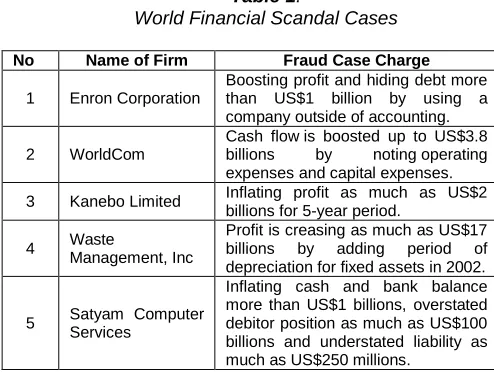
Profession of public accountant is a community trusted profession. To be able to run its function and duty well, an auditor must be able to produce qualified audit. Therefore, Public Accountant profession has a great role in supporting the realization of economy that is healthy, efficient, and transparent. The disclosure of financial scandal has created skepticism of community relating to the inability public accountant profession in keeping its independency. Community attention is led to auditor behavior in facing a client that is perceived to fail in conducting its role as independent auditor. Independent auditor in conducting function and duty of profession, auditor will always face audit conflict (Tsui, 1996) when auditor finding result is not in line with expectation of client. Audit conflict will grow to be a dilemma when auditor is required to make decision that contradicts with his/her independency and integrity with economic reward that might occur (Tsui and Gul, 1996). Auditor independency is the main key of audit profession, including evaluating equity of financial report. If auditor fulfills client’s demand, it means that he/she breaks the standard of inspection, and it can affect audit quality. Audit result can be said qualified when it fulfill auditing provision or standard (Watkins et al. 2004). An interesting issue in fraud of financial report is the involvement of public accountant, even involves the role of auditor Arthur Andersen who is an owner of the big-five public accounting firm (Choi et al., 2010). In investigatin scale of APF, many previous studies found difference of audit quality between large APF and small APF, but there were some studies that did not support difference of audit quality, for example, DeAngelo (1981), Davidson and Neu (1993), Dye (1993), Becker et al. (1998), and Lennox (1999) in Kusharyanti (2003) that found positive relationship between scale of APF and audit quality. Large APFs produce higher audit quality because they have more sources. Moreover, large APFs have had wide client network so that they do not depend on clients (DeAngelo (1981). The world financial scandal cases are shown on Table 1.Table 1.
World Financial Scandal Cases
No Name of Firm Fraud Case Charge
1 Enron Corporation
Boosting profit and hiding debt more than US$1 billion by using a company outside of accounting.
2 WorldCom
Cash flow is boosted up to US$3.8 billions by noting operating expenses and capital expenses.
3 Kanebo Limited Inflating profit as much as US$2 billions for 5-year period.
4 Waste
Management, Inc
Profit is creasing as much as US$17 billions by adding period of depreciation for fixed assets in 2002.
5 Satyam Computer Services
Inflating cash and bank balance more than US$1 billions, overstated debitor position as much as US$100 billions and understated liability as much as US$250 millions.
Source: http://bizcovering.com/history/10-major-accounting-scandals/
432 IJSTR©2020
statement (Deis and Giroux, 1992). Study done by Ghosh and Moon (2003) resulted a finding that audit quality is increasing along with longer audit tenure. Meanwhile, studi of Mai et al. (2008) found that the longer audit tenure, the lower its audit quality. Other factor that is also important in affecting auditor independency is fee audit. Fee audit is scale received by the auditor in conducting his/her duty. This besaran fee sometimes make an auditor in dilemmatic position, on one side auditor must be independent in giving opinion on financial report equity relating to the interest of many parties, however, on the other side, auditor also has to fulfill the requirement wanted by by a client paying fee for his/her service, in order to satisfy the client with his/her work and to keep using the service in the future (Ng dan Tan 2003). Competition among PAFs enables them to offer lower price. With this lower fee, PAF has tendency to cutdown several job vacancies, for example by not conducting certain auditing procedure. Empirically fee audit has proven that that variable very affects audit quality. Several study results found the existence of relationship between audit quality and audit service fee, for example a study conducted by Abdul et al. (2006) and Dhaliwal et al. (2008) that found a proof that fee audit significantly affects audit quality. Problems of audit quality become global issues, for instance International Forum of Independent Audit Regulators (IFIAR). IFIAR is an international organization from regulators of Public Accountant and Public Accountant Firm assistance and supervisor that are independent towards profession. Regulators attending are led by executive chairmen from institutions that have the authority in assisting and supervising Public Accountant and Public Accountant Firm, while audit firms who attend are chairmen of Price Waterhouse Coopers, Ernst & Young, Delloite from each country of ASEAN. Moreover, there is observer from Global Public Policy Committee-Regulatory Working Group (GPPC-RWG) that is a group of six leaders of global audit firms. In this meeting, the main issue is about Audit Quality Indicators that is an instrument to evaluate a qualified audit. This study analyzes the Effect of Contingency on Audit Tenure and Audit Quality. The problem investigated can be formulated as the: (a) does audit tenure affect audit quality? (b) does audit tenure have effect on audit quality through the size of public account firm as moderating variable? (c) does audit tenure have effect on audit quality through the amount of fee audit as moderating variable? The objective of study is to examine contingency effect (the size of PAF or fee audit) on audit tenure as well as its implication with audit quality. This study is addressed to give advantage to various parties, among others, companies, academicians, government, and community about contingency effect (the size of PAF or fee audit) on audit tenure as well as its implication with audit quality.
2
THEORETICAL
FRAMEWORK
AND
HYPOTHESIS
DEVELOPMENT
2.1. Audit in Agency Theory
Agency theory is a theory that gives explanation on the relationship between principal and agent. Agency relationship is known as a contract where a party as principal bonding another party as agent to conduct a job for principal’s importance, that is followed by delegation of decision making authority by principal to agent (Jensen dan Meckling, 1976). Conflict of interest between principal and agent will be
minimalized by conducting a supervisory mechanism that can limit the opportunity of agent to do opportunistic behavior. Audit is one form of supervising done in minimalizing agency conflict conducted by management as a mean to do beneficial action for themselves or group (Jensen and Meckling, 1976, and Watts and Zimmerman, 1983). Audit done by independent party enables to verify numbers in financial report made by management in order to be spared from misleading financial information.
2.2. Audit Quality
Audit quality is a component of auditor independency that really has to be maintained by professional public accountant. Independency, in this matter, means that public accountant prioritizes more on public benefit over management benefit or auditor herself/hiself in making audited report. DeAngelo (1981), use public accountant firm size approach as a benchmark of audit quality, while Bedard and Michelene (1993), use outcome oriented approach and process oriented approach as a benchmark of audit quality. Based on the explanation of the approach, process oriented approach is more capable to give illustration on how auditor conduct his/her job for producing an audit quality that can be measured. Li (2004), shows a measure used in process oriented approach which is submission of auditor to Public Accountant Professional Standard (PAPS).Coram et al. (2008) defined that audit quality is how much the possibility of an auditor in finding the existence of unintentional/intentional error from corporate financial report, and how much the possibility of the finding to be reported and listed in his/her audit opinion. Coram et al. (2008) also claimed that the low accounting information quality usually causes a serious economic consequence, and what is worse, it will generate greater management fraud in the future. In this matter, it is described how important the role of qualified audit is in reducing fraud. Theoretically, high quality of audit must be able to control the possibility of fraud to appear, and otherwise. Meanwhile, Silver et al. (2008) stated that it is necessary to be more emphasized on the responsibility of audit committee for conducting prevention, detection, and correction towards the emergence of fraud, when the responsibility of the audit committee runs well, then, it likely will help to maintain external audit quality in the future.
2.3. Audit Tenure
433 financial report from an entity done by PAF, the longest is for
consecutive 6 (six) years of accounting and by a public accountant, the longes is for consecutive 3 (three) years of accounting. Accountant public and accountant by a public accountant are allowed to receive tenure again after one year of accounting and do not give audit service to the client above.
2.4. The Scale of Public Accountant Firm (PAF)
The size of audit firm according to Deis and Giroux (1992) is measured from the number of clients and percentage of audit fee in its effort to keep its clients from not moving to other PAFs. Meanwhile, Guy et.al. (2002) clarified that PAF based on its operation area is divided into: International PAF, National PAF, Regional PAF, and local PAF. Several studies using the size of Public Accountant Firm are based on the reputation of PAF that is categorized as the following (1) Big-four PAF, and (2) Non Big-four PAF. The business form of PAF in Indonesian law is divided into 2 forms, which are (1) PAF in the form of private business, and (2) PAF in the form of cooperation business with partner. Sekar (2002) stated that studies on PAF in Indonesia often use the terms of affiliating and non-affiliating with foreign accountant firm, it is also claimed that investor perceives auditor who affiliates with foreign accountant has high quality because the auditor has characteristic that can be related to quality. It is supported by the study of Goetz, et.al
(1991) that quality of auditor is increased along with the size of PAF.
2.5. Fee Audit
Fee audit is the amount of audit service received by auditor with consideration of assignment risks and various complexity of service given, level of skills needed to conduct the service. Indonesian Accountant Ethical Code (SPAP, 2011), has organized that professional service reward is not allowed to depend on result or finding on the implementation of service, however, several study results found the existence of relationship between audit quality and the scale of audit service fee. Simunic (1980) argued that audit fee is determined by how big or small the company being audited is, audit risk, and audit complexity. The study result from Simunic (1980) found that market generally is competitive. Big 5 PAFs charge lower fee compared to small audit firm (it is consistent with economic scale of big firm). Meanwhile, DeAngelo (1981) argued that audit fee is income that its number is varied depending on several factors in audit assignment such as the size of client’s company, audit service complexity faced by auditor, audit risk taken by auditor from client as well as the name of Public Accountant Firm conducting audit service. On the other side, Simon et al.
(1986) conducting study in India and Hongkong found the result that there is a significant relationship between the size of company and audit fee.
2.6. The Effect of Audit Tenure on Audit Quality
Audit tenure is the duration of the auditor consecutively having conducted audit work in a company. The study result of Davis
et al. (2009) found that long audit tenure can decrease audit quality in the form of audit report because the long relationship between auditor and client may lower the level of auditor independency. Otherwise, several reseachers found that long audit tenure (above 9 years) will increase auditor competence to conduct audit process, so it can reduce the ability of management to conduct accrual-based management earnings
(Gul et al. 2009). The study result of Johnson et al. (2002) found the evidence that short audit tenure (2-3 years) has higher unexpected accrual level compared to middle tenure, but they did not find any evidence that middle-term audit tenure (4-8 years) has lower unexpected accrual compared to long audit tenure (more than 9 years). Study result from Johnson et al. (2002) did not found any evidence that longer audit tenure will reduce the quality of financial reporting. Meanwhile, the study result of Mansi et al. (2004) found evidence that longer audit tenure will reduce conservatism in financial reporting. The other evidence found by Mansi et al. (2004) is that the longer audit tenure, the greater cost of debt will be borne by the company. Several newest research results mostly stating that audit tenure that has contradictive result, among others is Ghosh and Moon (2003) resulted finding that audit quality is increasing along with longer audit tenure. However, it contradicts with the study of Mai et al. (2008) finding evidence that the longer audit tenure, the lower its audit quality. Study conducted by Fargher et al. (2008) found evidence that in early years of new audit tenure period (tenure period), quality of accountancy policy is decreasing, however, when rotation occurs, quality of accountancy policy is increasing in the beginning of the year. Carcello and Nagy (2004) actually found evidence that audit fraud will be found more in short audit tenure when it is compared to long audit tenure. Myers et al. (2003) also found evidence that earnings quality will increase when audit tenure is longer. Based on the above explanation and the prior studies, then, hypothesis can be formulated as the following:
H1: Audit tenure affects positively on audit quality
The above hypothesis predicts that shorter audit tenure more positively affects qualified audit result.
2.7. The effect of Audit Tenure on Audit Quality through the Scale of PAF as Moderating Variable
434 IJSTR©2020
as the measure of audit quality. Meanwhile, Boon et al. (2008) conducted study about attributes of audit quality. The study result of Boon et al. (2008) found evidence that the most important attributes in evaluating audit quality are skill, experience, technical competence, quality, ethical standard, and due care, while in professionalism attributes and size of audit firm are found not significant. Based on the above explanation and prior studies, the hypothesis can be formulated as the following:
H2: The size of PAF has important role in affecting Audit
tenure towards audit quality.
The hypothesis above predicts that the larger Public Accountant Firm, the more positively affects audit tenure towards audit quality, as well as, the shorter audit tenure is, the better audit quality will be.
2.8. The Effect of Audit Tenure on Audit Quality through Fee Audit as Moderating Variable
Audit is one form of supervision in minimalizing conflict between principle and agent. To minimalize contradicting interest, public accountant is expected to produce qualified audited report that can be used by all parties. Fee problem is a dilemmatic problem because auditor receives fee from the company (client) that being audited. Where on one side, auditor must be independent to give opinion, but on the other side, auditor also receives reward from the client over the job that has been done. The study result of Jong-Hag, et al
(2010), found that great fee audit can make auditor to agree on pressure from the client, and it affects audit quality that is resulted. Study result of Abdul et al. (2006) found evidence that fee audit significantly affects audit quality. Study result of Abdul et al. (2006) is in line with study result of Dhaliwal et al. (2008) found evidence that fee audit significantly affects audit quality. Meanwhile, Hoitash et al. (2007) found evidence that when auditor negotiating with management about the amount of fee must be paid by management towards job result of audited report, reciprocal concessions that will reduce quality of audited report, most likely occur. Carrera et al. (2007) found evidence that most negotiations of auditor-client really affect quality of audited report. It means that indirectly unethical actions from negotiation process will reduce audit quality in making opinion on client’s financial report. Gul et al.
(2007) found evidence that the decreased amount of higher audit fee is probably caused by financial report bias for company with long audit rotation. This result is consistent with a view that longer audit rotation facilitates higher audit quality so that auditor gets deep knowledge about business operation, process, and corporate system of auditee. The study result also found evidence that long appointment of auditor gives more effective supervision. On the other side, higher amount of fee non-audit charged by auditor with shorter audit tenure can show that effectiveness of auditor supervision is reduced to please their client’s company. Based on the explanation and study result before, the next hypothesis can be formulated as the following:
H3: Fee audit has an important role in affecting audit
tenure towards audit quality.
Hypothesis above predicts that the greater fee audit received by auditor, the more negatively affects audit tenure towards audit quality with shorther audit tenure so that audit result is more unqualified..
3 RESEARCH
METHOD
3.1. Population and Sample
Population and sample in this study are manufacturing companies that are listed in Indonesian Stock Exchange (IDX) during period of 2012 - 2017. Base of sample selecting determination is sample that fulfills data completion. Sampling method used is purposive sampling. Purposive sampling method is a sampling method based on study objective. Requirement of sample used in this study is sample that presents complete information in the form of financial report and name of PAF auditing the company of auditee in period of t-1.
Table 2.
Sample Selection (Sampling)
Criteria Total
Manufacturing companies listed in Indonesian Stock Exchange in period of 2012-2017
146 (584) Manufacturing companies presenting incomplete audited
financial report information
94 (376) Total of all sample (manufacturing companies audited by
Non-Big Four PAF and Big Four PAF)
52 (208) Manufacturing companies audited by Non-Big Four PAF 31 Manufacturing companies audited by Big Four PAF 21
3.2. Researh Variable and Definition of Operational Variable
3.2.1. Dependent Variable
Audit quality is as the possibility that auditor will find and report violation in accounting system of the client (Deis dan Giroux, 1992). Audit quality is measured by using total accrual. The use of total accrual as proxy of audit quality is also done by Chih- Ying et al. (2008), Hoitash et al. (2007), and Jackson et al. (2008) as the following:
TAt = ΔCAt - ΔCasht - ΔCLt + ΔDCLt – DEPt
Information:
ΔCAt : is the changing of current assests year t; Δcasht : is the cash changing and cash equivalent year t ΔCLt : is the changing of current liabilities year t
ΔDCLt : is the changing of debt including hutang lancar year t DEPt : is beban depreciation and amortization year t
3.2.2. Independent Variable: Audit Tenure
Audit tenure is the period of employment from PAF in giving audit service for auditee’s company. In this study, audit tenure is duration of auditor from PAF that is similar, used consecutively more than 3 years by auditee’s company. The measure of Audit Tenure uses interval measure scale. If employment period from PAF is used consecutively more than 3 years, its score is (3); if employment period from PAF is used consecutively no longer than 2 years, its score is (2); if employment periode from PAF is used consecutively no longer than a year, its score is (1).
3.2.3. Moderating Variable: The size of PAF
435 is audited by a non Big Four PAF, it is given score 0. As for
auditors including in the group of Big Four are (a) Deloitte Touche Tohmatsu (DTT) affiliating with Osman, Ramli, Satrio and partners, (b) Ernst & Young (EY) affiliating with Sarwoko, Purwantono, and Sandjaja, (c) Klynveld Peat Marwick Goerdeler (KPMG) affiliating with Siddharta dan Widjaja, and (d) Price water house Coopers(PWC) affiliating with Haryanto Sahari and partners.
3.2.4. Moderating Variable
Fee audit is the amount of fee received by auditor with the consideration of tenure risk and various service complexities given, level of skill needed for conducting the service. Fee audit in this study is measured by proxy of auditee’s company size as conducted by Simunic (1980), DeAngelo (1981), and Simon et al. (1986). The size of auditee’s company in this study uses the number of assests owned by the company based on annual report.
3.3. Linear Regression Model and Hypothesis Testing
To investigate the effect of contingency of Public Accountant Firm Size (UBK) and Audit Fee (AF) on the relationship between Audit Tenure (AT) and Audit Quality (KA). The model of hypotheses 2 and 3 testing shows the relationship between the changing of AT towards the changing of KA (effect AT on
KA). Derivate result of AT and KA relationship is the function of AT/KA = f (UBK, AF) or in other words, variable UBK and AF moderate the relationship between AT towards KA. The analysis instrument used to test the hypothesis is model of multiple regression model. Multiple regression model can explain and relate one dependent variable to several independent variables. This study uses linear regression model as the following:
3.3.1. Hypothesis 1 Testing Model
To test the first hypothesis (H1) in order to see the effect of Audit Tenure towards audit quality, analysis of linear regression will done with the model as the following:
3.3.2. Hypothesis 2 Testing Model
To test the second hypothesis (H2) in order to see the contingency effect of PAF size towards Audit Tenure and audit quality, multiple linear regression will be done with the model as the following:
UBK = Big Four PAF, it will be given score 1
UBK = Non Big Four PAF, it will be given score 0
3.3.3. Hypothesis 3 Testing Model
To test the third hypothesis (H3) in order to see the contingency effect of audit fee (the amount of auditor service) towards audit tenure and audit quality, multiple linear regression analysis will be done with the model as the following:
4 CITATIONS
Descriptive Statistic Analysis
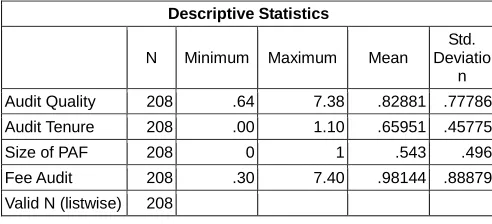
This analysis is used to give description on variables of study (Audit Quality, Audit Tenure, PAF Size, and Fee Audit) as seen on Table 3.
Table 3. Descriptive Statistical Analysis
Based on Table 3 above, it seems that audit quality poxied by total accrual has the average of 0.82881 with deviation standard of 0.77786. Meanwhile, audit tenure has the average of 0.65951 with deviation standard of 0.45775, while the size of PAF has the average of 0.543 with deviation standard of 0.496, and fee audit has the average of 0.98144 with deviation standard of 0.88879.The testing result on classical assumption of each variable can be concluded that normality test with Smirnov-Kolmogorov test on residual value of regression model shows that the result scores of audit quality and fee audit are 0.062 and 0.126. Multicollinearity testing is done by looking at the value of Variance Inflation Factor (VIF) on each variable that less than 10 and tolerance value more than 0.10, so it can be concluded that there is no multicollinearity among independent variables in regression model. Heteroscedasticity is tested with scatter plot graphic among dependent variable scores (ZPRED) with their residual scores (SRESID). Decision taken if clear pattern and spots that are scattered above and below 0 on axis Y do not occur, is that heteroscedasticity does not occur. Meanwhile, autocorrelation testing done with Watson test (DW-test) obtain that score of
Durbin-Watson is 1.463, DW score = 1.463, less than dl and du (1.463 < 1.738 < 1.779). Therefore, each variable has fulfilled classical assumption consisting of normality, multicollinearity, heteroscedasticity, and autocorrelation tests.
4.2. Multiple Linear Regression Model and Hypothesis Testing
4.2.1. Multiple Linear Regression Model
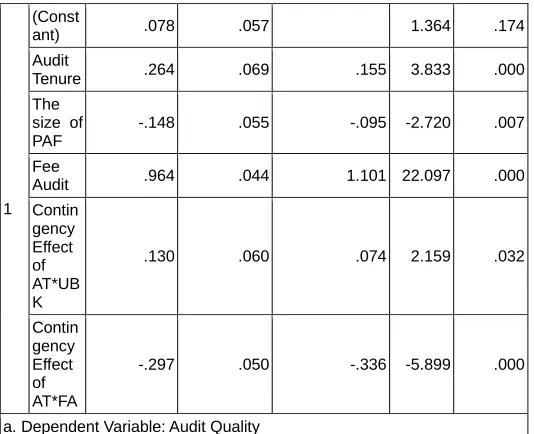
From the analysis result of multiple linear regression model (Table 4), the equation obtained is as the following:
Table 4.
Multiple Linear Regression Model
Coefficientsa
Model
Unstandardized Coefficients
Standardized
Coefficients t Sig. B Std. Error Beta
Descriptive Statistics
N Minimum Maximum Mean
Std. Deviatio
n Audit Quality 208 .64 7.38 .82881 .77786 Audit Tenure 208 .00 1.10 .65951 .45775
Size of PAF 208 0 1 .543 .496
Fee Audit 208 .30 7.40 .98144 .88879 Valid N (listwise) 208
e AF AT b AF b AT b b
KA 0 1 2 3 *
e AF AT b UBK AT b FA b UBK b AT b b
KA 0 1 2 3 4 * 5 *
e AT b b
KA 0 1
e UBK AT b UBK b AT b b
KA 0 1 2 3 *
UBK AT b AT b b e UBK AT b b AT b b
KA 0 1 2(0) 3 * 0 1 3 *
UBK AT b AT b b b e UBK AT b b AT b b
KA 0 1 2(1) 3 * ( 0 2) 1 3 *
297 . 0 130 . 0 964 . 0 148 . 0 264 . 0 078 .
0 b1 b2 b3 b4 b5
436 IJSTR©2020
1 (Const
ant) .078 .057 1.364 .174
Audit
Tenure .264 .069 .155 3.833 .000
The size of PAF
-.148 .055 -.095 -2.720 .007
Fee
Audit .964 .044 1.101 22.097 .000
Contin gency Effect of AT*UB K
.130 .060 .074 2.159 .032
Contin gency Effect of AT*FA
-.297 .050 -.336 -5.899 .000
a. Dependent Variable: Audit Quality
4.2.2. Hypothesis Testing
Based on Table 4 above, multiple linear regression model obtains that regression coefficient score of Audit Tenure variable on audit quality is 0.078 with positive direction. The testing result of Audit Tenure effect on audit quality shows that calculated t score is 3.833 with significance of 0.000. The significance score of the testing is less than significance level of α = 0.05. Therefore, Audit Tenure affects positively and is significant towards audit quality. It means that hypothesis 1 is accepted. Regression coefficient score of contingency effect of PAF size on Audit Tenure and audit quality obtains the score of 0.130 with positive direction. The testing result of PAF size contingency effect on Audit Tenure and audit quality shows calculated t score of 2.159 with significance of 0.032. The testing significance score is less than significance level of α = 0.05. Therefore, contingency effect of PAF size on Audit Tenure positively affects and is significant towards audit quality. It means than hypothesis 2 is accepted. Regression coefficient score of fee audit contingency effect on Audit Tenure and audit quality is 0.297 with negative direction. The testing result of fee audit contingency effect on Audit Tenure and audit quality shows calculated t score of -5.899 with significance of 0.00. The testing significance score is less than significance level of α = 0.05. Therefore, contingency effect of fee audit on Audit Tenure negatively affects and is significant towards audit quality. It means that hypothesis 3 is accepted. Next, regression model testing on contingency effect of PAF size and fee audit towards Audit Tenure and audit quality is done with distribution F. The testing result of PAF size contingency effect and fee audit towards Audit Tenure and audit quality shows calculated F score of 169.373 with significance of 0.00 (Table 5). The testing significance score is less than significance level of α = 0.05. Therefore, regression model on contingency effect of PAF size and fee audit simultaneously affects significantly on Audit Tenure and quality.
Table 5.
Testing of Multiple Linear Regression Model
ANOVAb
Model Sum of Squares df Mean
Square F Sig.
1
Regression 101.128 5 20.226 169.373 .000a
Residual 24.122 202 .119
Total 125.250 207
a. Predictors: (Constant), Contingency Effect of AT*FA , The Size of PAF, Contingency Effect of AT*UBK, Audit Tenure, Fee Audit
b. Dependent Variable: Audit Quality
Determination coefficient (R²) score obtained is 0.807 (Table 6). It means that 80.7 % of variable KA can be explained by variables UBK, FA, contingency effect of UBK and FA, while the rest is 19.3 % is affected by other factors that are not included in the model of study.
Table 6. Testing of Determination Coefficient Model (R²)
Model Summaryb
Model R R Square Adjusted R Square Std. Error of the Estimate
1 .899a .807 .803 .34556
a. Predictors: (Constant), Contingency Effect of AT*FA , The Size of PAF, Contingency Effect of AT*UBK, Audit Tenure, Fee Audit
b. Dependent Variable: Audit Quality
4.4. Discussion
Study result of Ghosh and Moon (2003) produced finding that audit quality is increasing along with longer audit tenure because auditor has understood and known business environment of client. Hypothesis 1 examines the effect of audit tenure on audit quality in order to predict that shorter audit tenure more positively affects quality of audit result. Testing results obtained that short audit tenure (3 years) has positive effect and is significant towards audit quality. It means that short audit tenure can give qualified audit result. This result supports the study of Johnson et al. (2002), Carcello and Nagy (2004), Mai et al. (2008), and Davis et al. (2009). Johnson et al. (2002) found evidence that short audit tenure (2-3 years) has higher level of unexpected accrual compared to middle tenure, but they did not find evidence that middle audit tenure (4-8 years) has lower level of unexpected accrual compared to long audit tenure (more than 9 years). Study result of Johnson et al. (2002) did not find evidence that longer audit tenure will decrease more the quality of financial reporting. Carcello and Nagy (2004) found evidence that audit fraud will be found more in short audit tenure compared to long audit tenure. Mai et al. (2008) found evidence that the longer audit tenure, the lower its audit quality, while Davis et al. (2009) found that long audit tenure can decrease audit quality in the form of audit report. Otherwise, study of Ghosh and Moon (2003) produced finding that audit quality is increasing along with the length of audit tenure. Hypothesis H2 examines
437 tenure on audit quality with shorter audit tenure, then, audit
quality is better. Testing result obtained that contingency effect of large PAF (Big Four PAF) with shorter audit tenure positively affects and is significant towards audit quality. Meanwhile, the size of PAF (Non Big Four PAF) towards Audit Tenure negatively affects and is significant towards audity quality. This result supports the study of Law (2008), Francis and Yu (2009), and Nieschwietz and Woolley (2009). Study result of Law (2008) found evidence that Big Four PAF is more independent than Non-Big Four PAF. Big Four PAF has more reputations compared to Non-Big Four PAF, then, it can be said that reputation of auditor affects audit quality. Francis and Yu (2009) found evidence that Big Four PAF often tends to issue going concern opinion more than non-Big Four PAF. Meanwhile, Nieschwietz and Woolley (2009) found evidence that perception of investor on quality of big four PAF is way higher than on non-Big Four PAF. Problems of fee audit amount and short audit tenure sometimes put an auditor in dilemmatic position, in one side auditor must be independent in giving opinion on financial report equity, but in the other side auditor also must fulfill the demand wanted by the client. Otherwise, lower fee audit tends to reduce a number of job vacancies, for example does not conduct certain audit procedure that really affects audit quality. Testing result obtained that contingency effect of fee audit on audit tenure negatively affects and is significant towards audit quality. Hypothesis H3 examines the contingency effect (fee audit) on
audit tenure and audit quality, in the other words, fee audit has important role in affecting audit tenure towards audit quality in order to predict that the greater fee audit received by auditor, the more negatively affects audit tenure towards audit quality with shorter audit tenure, then, audit result is less qualified. Testing result obtained that contingency effect of fee audit on audit tenure negatively affect and is significant towards audit quality. This result supports the study of Carrera et al. (2007, Gul et al. (2007, and Jong-Hag, et al (2010). Study result of Carrera et al. (2007) found evidence that most of negotiations of auditor-client really affect audited report quality. It indirectly means that non ethical behavior from negotiation process will reduce audit quality in making opinion on client’s financial report. Meanwhile, Gul et al. (2007) found evidence that amount reduction of higher audit fee is possibly caused by financial report bias for company with long audit rotation. While study result of Jong-Hag, et al (2010), found that large fee audit can make auditor agree on pressure form client, and it affects on the quality of resulted audit.
5
CONCLUSION,
LIMITATION,
AND
IMPLICATION
OF
STUDY
From the testing result, conclusions obtained are as the followings: (1) Audit Tenure affects positively and is significant towards audit quality in order to predict that the shorter audit tenure, the more positively affects qualified audit result. Testing result obtained that short audit tenure (3 years) has positive effect and is significant towards audit quality. It means that short audit tenure can give qualified audit result; (2) Continggency effect of PAF size on Audit Tenure affects positively and is significant towards audit quality in order to predict that the larger Public Accountant Firm, the more positively affects audit tenure towards audit quality with shorter audit tenure, then, audit quality is better. Testing result obtained that contingency effect of PAF size (big four PAF) with short audit tenure positively affects and is significant
towards audit quality. Meanwhile, the size of PAF (Non big four PAF) on audit tenure negatively affects and is significant towards audit quality; (3) Contingency effect of fee audit on audit tenure negatively affects and is significant towards audit quality in order to predict that the greater fee audit received by auditor, the more negatively affects audit tenure towards audit quality with shorter audit tenure, then, audit result is less qualified; (4) Regression model on contingency effect of PAF size and fee audit simultaneously significantly affects audit tenure and quality; and (5) Contingency effect of UBK and FA (80.7 % of variable KA can be explained by variables AT, UBK, FA) while the rest of 19.3 % is affected by other factors that are not included in study model. Limitation of this study focuses on manufacturing listed in Indonesian Stock Exchange in period of 2012-2017. Audit quality is measured by proxy of total accrual, while fee audit is proxied by the size of auditee’s company. The limitation of this study is expected to be developed in the next study by adding several variables such as audit risk, education level, auditor commitment, audit committee, and independent commissioners. Expected implication from this study is to give important contribution both to auditor and Public Accountant Firm as well as other parties who concern, among others are Indonesian Accountant Association (IAA), companies, academicians, government, and community.
6
REFERENCES
[1]. Abdul, A. B., N. E. Abdul, W. S. Mustapha, & H. Mohammad. 2006. ―Auditor-client relationship: The Case of Audit Tenure and Auditor Switching in Malaysia.‖ Managerial Auditing Journal 21(7): 737 [2]. Baidaei, M.C. 2000. ―Penerapan Kode Etik Profesi.‖
Makalah pada Kongres Luar Biasa dan KNA IV IAI. Jakarta, 5-7 September
[3]. Bedard, Jean dan Michelene Chi T.H. 1993. ―Expertise in Auditing.‖. Journal of Accounting Practice & Theory, 12: 21-45.
[4]. Boon, K., J. McKinnon. dan P. Ross. 2008. ―Audit Service Quality in Compulsory Audit Tendering: Preparer Percep- Tions and Satisfaction.‖ Accounting Research Journal 21(2): 93-122.
[5]. Carcello, J. V. dan A. L. Nagy. 2004. ―Audit Firm Tenure and Fraudulent Financial Reporting. ― Auditing 23(2): 57-71.
[6]. Carrera, N., N. Gomez-Aguilar, C. Humphrey, dan E. Ruiz-Barbadillo. 2007. Mandatory Audit Firm Rotation in Spain: A Policy That Was Never Applied. Accounting, Auditing & Accountability Journal 20(5): 671 - 701.
[7]. Chih-Ying, C., L. Chan-Jane, dan L. Yu-Chen. 2008. ―Audit Partner Tenure, Audit Firm Tenure, and Discretionary Accruals: Does Long Auditor Tenure Impair Earnings Quality?.‖ Contemporary Accounting Research 25(2): 415-445.
[8]. Choi, J., F. Kim, J. Kim, and Y. Zang. 2010. ―Audit office size, audit quality and audit pricing‖. Auditing: A Journal of Practice & Theory 29(1): 73-97.
[9]. Coram, P., A. Glavovic, N. Juliana, dan D.R. Woodliff. 2008. ―The Moral Intensity of Reduced Audit Quality Acts.‖ Auditing 27(1): 127-149.
438 IJSTR©2020
Earnings Forecasts.‖ Contemporary Accounting Research 26 (2): 517-48
[11]. DeAngelo, L. E., 1981. ―Auditor Size and Audit Quality.‖ Journal of Accounting & Economics 3: 783-801.
[12]. Deis, Donald R. Jr., dan Gary A. Giroux. 1992. ―Determinants of Audit Quality in the Public Sector.‖ The Accounting Review 67(3): 462-479
[13]. Dhaliwal, D. S., C. A. Gleason, S. Heitzman, dan K. D. Melendrez. 2008. ―Auditor Fees and Cost of Debt.‖ Journal of Accounting, Auditing & Finance 23(1): 1-22.
[14]. Fargher, N., H. Y. Lee, dan V. Mande. 2008. ―The Effect of Audit Partner Tenure on Client Managers' Accounting Discretion.‖ Managerial Auditing Journal 23(2): 161-186.
[15]. Francis, J. R., dan M. D. Yu. 2009. ―Big 4 Office Size and Audit Quality.‖ Accounting Review 84(5): 1521-1552.
[16]. Ghosh, A., dan DcMoon. 2003. ―Does Auditor Tenure Impair Audit Quality?.‖ Working paper, Security Exchang Commission.
[17]. Goetz ,Joe F., Morrow, Paula C., And McElroy ,James C. , 1991. ―The effect of accounting firm size and member rank on professionalism.‖ Accounting Organizations and Society 16(2): 159-165.
[18]. Gul, F. A., B. L. Jaggi, dan G. V. Krishnan. 2007. ―Auditor Independence: Evidence on The Joint Effects of Auditor Tenure and Nonaudit Fees.‖ A Journal of Practice & Theory 26(2): 117-142.
[19]. Gul, F. A., Fung, S. Y. K., and Jaggi, B. (2009). ―Earning Quality: Some Evidence on The Role of Auditor Tenure and Auditors’s Industry Expertise.‖ Journal of Accounting and Economics. 47: 265-287. [20]. Guy, Dan M., C. Wayne Alderman, Alan J. Winters,
2002 ―Auditing‖ Jilid 1, Edisi Kelima, Erlangga, Jakarta
[21]. Hakim, F. & A. Omri. 2010. ―Quality Of The External Auditor, Information Asymmetry, And Bid-Ask Spread; Case of The Listed Tunisian Firms. ― International Journal of Accounting and Information Management 18(1): 5-18.
[22]. Hoitash, R., A. Markelevich, dan C. A. Barragato. 2007. ―Auditor Fees and Audit Quality.‖ Managerial Auditing Journal 22(8): 761 - 786.
[23]. Jensen, M.C. dan W.H. Meckling. 1976. ―Theory of the Firm: Managerial Behavior, Agency Cost and Ownership Structure." Journal of Financial and Economics 3(4): 305–360.
[24]. Johnson, V. E., I. K. Khurana, dan J. K. Reynolds. 2002. ―Audit-Firm Tenure and The Quality of Financial Reports.‖ Contemporary Accounting Research 19(4): 637-660.
[25]. Jong-Hag Choi, Jeong-Bon Kim, dan Yoonseok Zan. 2010. ―Do Abnormally High Audit Fees Impair Audit Quality?‖ Auditing: A journal of Practice & Theory 29(2): 115-140.
[26]. Kusharyanti. 2003. ―Temuan Penelitian Mengenai Kualitas Audit dan Kemungkinan Topik Penelitian di Masa Datang.‖ Jurnal Akuntansi dan Manajemen 14 (3): 25 – 61.
[27]. Law, P. 2008. An Empirical Comparison of Non-Big 4 and Big 4 Auditors' Perceptions of Auditor
Independence. Managerial Auditing Journal 23(9): 917 - 934.
[28]. Li Dang (2004). ―Assessing Actual Audit Quality‖ Thesis in Drexel University.
[29]. Mai, D., S. Mishra, dan K. Raghunandan. 2008. ―Auditor Tenure and Shareholder Ratification of The Auditor.‖ Accounting Horizons 22(3): 297-314
[30]. Mansi, S. A., W. F. Maxwell, dan D. P. Miller. 2004. Does Auditor Quality and Tenure Matter to Investors? Evidence from the Bond Market.‖ Journal of Accounting Research 42(4): 755-793
[31]. Media Akuntansi. 2002. ―Kartu Merah Buat 10 KAP Papan Atas.‖ Penerbit PT. Intama Artha Indonusa, Jakarta. Edisi 27/Juli Agustus; hal 5.
[32]. Media Akuntansi. 2003. ―DPN IAI Panggil Auditor PT Telkom.‖ Penerbit PT. Intama Artha Indonusa, Jakarta. Edisi 34/Juni-Juli; hal 6.
[33]. Menteri Keuangan, 2003, Keputusan Menteri Keuangan Nomor 423/KMK.06/2002 jo 359/KMK.06/2003 tentang ―Jasa Akuntan Publik‖, Jakarta.
[34]. Myers, J. N., L. A. Myers, dan T. C. Omer. 2003. ―Exploring The Term of The Auditor-Client Relationship and The Quality of Earnings: A Case for Mandatory Auditor Rotation?.‖ Accounting Review 78(3): 779-799.
[35]. Nagy, A. L. 2005. ―Mandatory Audit Firm Turnover, Financial Reporting Quality, and Client Bargaining Power: The Case of Arthur Andersen.‖ Accounting Horizons, 19(2): 51-367
[36]. Nieschwietz, R. J. dan D. J. Woolley. 2009. ―Perceptions of Auditor Independence: Evidence from Cpas', Loan Officers, and The General Public.‖ Academy of Accounting and Financial Studies Journal 13(3): 93-106
[37]. Ng dan Tan. 2003. ―Pengaruh Lamanya Waktu Audit terhadap Fee Audit.‖ Juraksi 13(1):
[38]. Sekar Mayangsari, 2002, ―Bukti empiris pengaruh spesialisasi industri auditor terhadap earning response coefficient‖, Proceeding Simposium Nasional Akuntansi ke V, Semarang.
[39]. Silver, S. E., A. S. Fleming, dan R. A. Riley, Jr. 2008. Preventing and Detecting Collusive Management Fraud. The CPA Journal 78(10): 46-48.
[40]. Simon, D. T., R. Ramanan, and A. Dugar. 1986. The market for audit services in India: An empirical examination. International Journal of Accounting 21 (2): 27–35
[41]. Simunic, Dan A. 1980. ―The Pricing of Audit Services : Theory and Evidence‖. Journal of Accounting Research 18: 161-189.
[42]. Standar Profesional Akuntan Publik, 2011 ―Institut Akuntan Publik Indonesia.‖ Penerbit Salemba Empat, Jakarta.
[43]. Tsui, J.S.L., 1996. ―Auditors’ Ethical Reasoning: Some Audit Conflict and Cross Cultural Evidence‖. The International Journal of Accounting 31(1): 121 - 133. [44]. Tsui, J.S.L. dan F.A. Gul., 1996. ―Auditors’ Behavior in
an Audit Conflict Situation: A Research Note on the Role of Locus of Control and Ethical Reasoning‖, Accounting, Organizations and Society 21(1): 41 - 51. [45]. Watkins, Ann. L, William Hillison and Susan E.
439 Theory And Empirical Evidence‖. Journal of
Accoounting Literature 23(4): 153-19
[46]. Watts, R.L. dan J.L. Zimmerman. 1983. ―Agency Problem, Auditing, and the Theory of the Firm.‖ Journal of Law and Economics 26(3): 613–633 [47]. Wooten, T. C. 2008. ―Research About Audit Quality.‖