www.orientjchem.org
An International Open Free Access, Peer Reviewed Research Journal
2017, Vol. 33, No. (1): Pg. 17-28
Predicting ESR Peaks in the 4d and 5d Transition Metal Ion
Complexes by NMR, ESR and NQR Parameters: A DFT Study
M.L. SEHGAL
1, AMIT AGGARwAL
2, K.N. KAUL
3and MD. IRSHAD AHMAD
4*
1Fmr. Head, Department of Chemistry, D.A.V. College, Jalandhar-144008, India.
2Department of Natural Sciences, LaGuardia Community College of The City University of the New York,
31-10 Thomson Avenue, Long island City, 11101, New York, USA.
3K. N. Kaul, Department of Chemistry,D .A.V. University,Jalandhar-144012, India.
4Department of Biochemistry, Faculty of Life Sciences, Aligarh Muslim University,
Aligarh, 202002, Uttar Pradesh, India.
*Corresponding author E-mail: [email protected]
http://dx.doi.org/10.13005/ojc/330103
(Received: January 20, 2017; Accepted: February 08, 2017)
AbSTRACT
Computational chemistry was used to predict the number of ESR peaks in the 2nd and
3rd transition metal ion complexes by applying DFT implemented in ADF 2012.01.Only a limited
experimental ESR research had been carried out in this field because high values of spin orbit coupling constants of these metal ions which provide an important energy transfer mechanism would adversely affect the values of ESR and NMR parameters (especially Aten) of their complexes. Therefore, theoretical predictions were useful. ESR (Aten) and NQR (NQCC,h) parameters of transition
metal ions and the coordinating atoms of ligands were obtained from the ESR/EPR program while their shielding constants (s) and chemical shifts (d) were obtained from the NMR/EPR program after optimization of the complexes. Ligands whose coordinating atoms (CA) possessed the same values of the five parameters (Aten, NQCC, d,h, s)were expected to be spatially equivalent and would undergo the same hyperfine interaction with the central metal ion. 34 complexes of 10 metal ions consisting of five congeners: Zr (III), Hf (III); Nb (IV) ,Ta(IV) ; Tc (II), Re (II); Ru (III) ,Os(III) ;Rh (IV), Ir (IV) were selected to predict the number of ESR peaks.
Keywords: Chemical Shift, Total NMR Shielding Tensor, Nuclear Quadrupole Coupling Constant, Effective Spin Hamiltonian, Asymmetric Coefficient.
INTRODUCTION
Only a limited research work had been done in the experimental determination of number of ESR
peaks in complexes of 4d and 5d metal ions1-5 like
Zr (III)6-8 ,Hf (III)7-9 ; Nb (IV)10-12, Ta (IV)9 ; Tc (II)9, 13, 14
, Re (II) 15-17; Ru (III)18-24 ,Os (III)18-20,24; Rh (IV)25-27 ,Ir
(IV)26,27which formed five congeners of 2nd and 3rd
transition series.
ion complexes, we tried DFT implemented in ADF
2010.01 to 34 complexes such as [ZrX6]3-(X= F, Cl ,
Br), [HfX6]3- (X=F, Cl, Br), [Hf (NH
3)6]3+, [NbX6]2- (X=F,
Cl, I, NCS ), [Nb (NH3)6]4+, [TaX
6]2-(X=Cl, Br), [TcBr6]4-,
[Tc (NH3)6]2+, [ReX
6]4-(X=Cl, Br), [Re(NH3)6]2+,[RuX6]
3-(X=F, Cl , Br), [OsX6]3- (X=F, Cl ,Br), [Os (NH
3)6]3+,
[RhX6]2- (X=F, Cl, Br), [Rh (NH
3)6]4+, [IrX6]2- (X=F,
Cl ,Br), [Ir (NH3)6]4+ belonging to 10 metal ions
of the 2nd and 3rd transition series. All these six
coordinate complexes containing either weak halo or comparatively stronger (ammine and thiocyanato
-N) ligands belonged to five congeners of the 2nd and
3rd transition series. They, invariably, possessed one
unpaired electron because their large Crystal Field Stabilization Energies (CFSE) would cause pairing of electrons even with the week ligands.
Need of the Study
There were two main reasons which tempted us to take up the present study:
(i) Only a limited research work had been done in
the experimental determination of number of ESR peaks in 4d and 5d metal ion complexes because their authentic 10 Dq values were difficult to determine experimentally due to their high values of spin orbit coupling
constants (lM n+ ) which, in turn, would
adversely affect ESR parameters (especially
Aten).
(ii) ESR transitions energies falling in microwave
region, generally, needed cryogenic conditions which were difficult to obtain and cumbersome to maintain.
Methodology
ADF (Amsterdam Density Functional) software was installed on Windows XP platform as “ADF jobs”. A new directory was created using “File menu” of ADF jobs. After optimization of the complexes, different commands were filled into
the software to obtain ESR, NQR28-30 and NMR31-33
parameters which were discussed in detail in our
previous publications28-33.
With these to the specific set of commands, the ADF software would give one ESR {Hyperfine
Coupling Constants (Aten)}, two NQR {Nuclear
Quadrupole Coupling Constant (NQCC), Asymmetric
Coefficient (h)}28-30 and two NMR parameters
{Shielding Constant (s) , Chemical Shift (d) }31-33.
These five parameters (Aten, NQCC, h, s, d) together
were, then, used to predict the number of ESR
peaks in the 2nd and 3rd transition series metal ion
complexes.
RESULTS
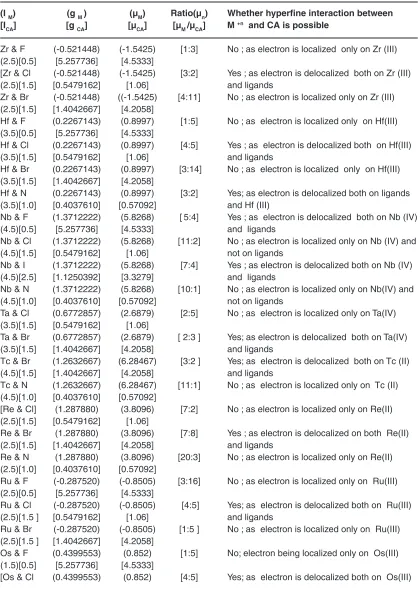
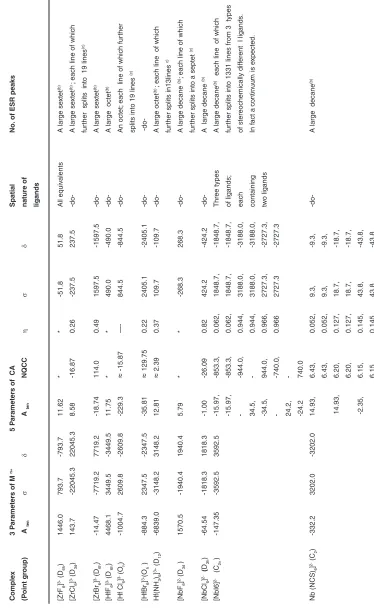
Results for 34 complexes of 10 metal ions were tabulated in Tables: 1-2.
Table: 1 contained values of IM, IC A, g M and
g CA as well as µM and µCA (in terms of bn) and ratios
of mM and mCA to predict the possibility of hyperfine
interaction between metal ions and ligands.
Table: 2 contained Aten,s, d values of metal
ions and Aten, NQCC, h, s, d andCA of ligands,
number of spatially different ligands along with the theoretically predicted number of ESR peaks in these complexes.
DISCUSSION
It was taken up under the following headings:
basis for prediction of number of ESR peaks
Five parameters (Aten, NQCC, h, s, d)
of metal ions and coordinating atoms (CA) of ligands were obtained from the software by giving it certain commands. A metal ion possessed only
one value of each one of these 5 parameterswhile
the values of the parameters might differ in case of the coordinating atoms (CA) of ligands. When, the ligands possessed the same or nearly the same
values of these 5 parameters, itindicated that all
the ligands were spatially equivalent. The relative magnitudes of the values of the parameters of metal ion and CA would also be taken into account while predicting ESR peaks of the complexes.
Relation to Calculate of nuclear magnetic moment ((µM) in terms of bn
After knowing the values of nuclear spin quantum numbers and g factors of metals
(IM, g M) and of coordinating atoms (CA) of ligands
(ICA , g CA) from the literature, we could calculate
nuclear magnetic moments of both the metal (µM)
and coordinating atoms (µCA) of ligands in terms of
µM=g M [IM (IM+1)] 1/2
µCA =g CA [ICA (ICA+1)] 1/2 ...(a*)
Knowing whether hyperfine interaction was possible or not
From [µ M/µ CA] ratio called µn ratio, we could
draw the following conclusions:
(a) A comparable µn ratio for isotopes with I >0
having appreciable % natural abundance would mean that the unpaired electron was delocalized both on the metal and the ligands. So the hyperfine interaction between the metal ion and the ligands was most probable. The peaks would arise both from the ligands and
the metal ion.
(b) Very small or very large ratios implied that
µn of ligands and metal differ largely. In such
a case, no hyperfine interaction between the metal and the ligands was possible. Electron would remain localized on the metal irrespective of the values of I and the % abundance.
The peaks would arise only from the metal ion.
*Analogous to an electronic spin: me=ge [s (s+1)] 1/2
Predicting the number of ESR peaks
(I) Assuming IM andICA the nuclear spinsof themetal
and [CA] respectively:
Number of ESR peaks given by a metal ion was
2IM +1 ...(b)
(II) Number of ESR peaks arising from ligands was predicted from their spatial
arrangement as follows:
(i) When all the n ligands were spatially equivalent,
then each ESR line of metal ion would be split up into the lines:
(2 n ICA+1) ...(c)
(ii) If n1ligands were spatially of one type; n2 are of the
other type and so on, then the total number of lines into which one line of the metal ion would be split:
(2 n1 ICA+1)(2n2 ICA+1)(2 n3 ICA + 1 ) ...(d)
(iii)If all the ligands were nonequivalent, one line of metal ion would split into:
(2 ICA+1) n ...(e)
(IV) If metal ion possessed higher Aten than the
coordination atoms (CA) of ligands, we should first calculate number of lines obtained from metal ion.
Each line of the metal ion might ,further, split into
more number of lines depending upon whether the ligands could undergo hyperfine with the metal ion or not. Conversely, if the coordinating atoms of ligands
had higher Aten values, then first calculate number
of lines from ligands. Each line of ligands should, then, split by metal ion if the hyperfine interaction was possible.
(V) There might occur overlapping of ESR lines from different factors. So experimentally observed number of lines might be less than the theoretically predicted lines. Also, when the predicted number of lines
was large and Aten value/s of species undergoing
hyperfine interaction was/were very small, the lines
would merge to give a continuum.
The ESR peaks of the following 34 complexes were theoretically predicted.
The metal wise discussion was subdivided into ten headings (5.2-5.11).
Prediction of number of ESR peaks in Zr (III) Complexes
ESR spectra of [ZrX6]3- (X=F, Cl, Br) were
discussed in two parts:
(a) [ZrX6]3- (X=F, br)
Theyshowed the following features:
(1) The six F or Br possessed same values of
A ten, NQCC, h, s, d respectively so that all the
ligands were spatially equivalent.
(2) Aten value of Zr (III) was more than F but lesser
than Br.
(3) With small µn ratios, the unpaired electron was
localized only on Zr(III).
Their ESR spectra gave only a large sextet (b) from
Z r (III) [2*5/2+1].
(b) [ZrCl6]3-
It showed the following features:
(1) As the six Cl had the same Aten, NQCC, h,
s, dvalues respectively, they should be spatially
equivalent.
and Cl as their µn ratio was comparable3. A
ten value
of Zr (III)was more than those of the six Cl.
Its ESR spectrum would give a large sextet
(b) from Zr (III) [2*5/2+1] with each line further splitting
into19 lines(c) by the hyperfine interaction of Zr (III)
and six equivalents Cl [2*6*3/2+1].
Prediction of number of ESR peaks in Hf (III) Complexes
Complexes like [HfX6]3- (X=F, Cl, Br) and [Hf
(NH3)6]3+ were studied as follows:
(a) [HfX6] 3- (X=F, br)
They showed the following common features: (1) The six F or Br were spatially equivalent as
they showed the same Aten, NQCC, h, s, d values
respectively.
(2) As their µn ratios were small, the unpaired
electron would remain localized only on Hf (III) with no hyperfine interaction.
(3) Aten value of Hf (III)was more than those of the
F and the Br.
Their ESR spectra should give only an octet
(b) from Hf (III) [2*7/2+1].
(b)[HfCl6]3- and [Hf (NH 3)6]3+
Both showed the following features:
(1) The six Cl or NH3 ligands were spatially equivalent
with same Aten, NQCC, h, s, d values respectively.
(2) Unpaired electron was delocalized both on Hf (III)
and Cl or NH3 as their µn ratios were comparable.
(3) Aten of Hf (III) was more than Cl or N of NH3.
Their spectra showed a large octet(b) from
Hf (III) [2*7/2+1] with each line further splitting into
19 (c) or13 lines(c) by the hyperfine interaction of Hf
(III) and the six equivalents Cl [ 2*6*3/2+1] or six N
of six NH3 ligands [2*6*1+1] respectively.
Prediction of number of ESR peaks in Nb (IV) Complexes
The study included 5 complexes such as:
[NbX6]2- (X=F, Cl, I, N CS) and [Nb (NH
3)6]4+. Their
ESR discussion was divided into four parts:
(a) [NbF6]
2-It showed the following features:
(1) With the same Aten, NQCC, h, s, d values
respectively,all the ligands were equivalent.
(2) With comparable µn ratio, the unpaired electron
was delocalized both on Nb (IV)and the F.
(3) Aten of Nb (IV) was more than those of the F
ligands.
Its spectrum gave a large decane (b) from
Nb (IV) [2*9/2+1]with each line splitting into a smaller
septet(c) by the hyperfine interaction of Nb (IV) and
the six F [2*6*1/2+1].
(b) [NbCl6]2- and [Nb (NH 3)6]4+
Both showed the following features:
(1) Six Cl or NH3 had same values of Aten, NQCC, h,
s, drespectively. So, all the ligands were spatially
equivalent respectively.
(2) Unpaired electron was localized on Nb (IV) but not on ligands.
(3) A ten value of Nb (IV) was more than those of Cl
or NH3.
ESR spectra would give only a large decane
(b) from Nb (IV) [2*9/2+1] with no hyperfine interaction
between Nb (IV) and Cl or NH3 as their µn ratios were
large.
(c)[Nb I6]2-
It showed thefollowing features:
(1) There were three sets of Aten, NQCC, h, s, d
values respectively for the iodo ligands; each set having two values. So there were three types of stereo chemically different ligands respectively. (2) Unpaired electron was delocalized both on Nb (IV)
and ligands as µn ratio of Nb and I was comparable
respectively.
(3) Aten value of Nb (IV) was more than those of the
iodo ligands respectively.
Its spectrum showed a large decane (b)
from Nb (IV) [2*9/2+1] with each line splitting into
1331 lines [2*2*5/2+1]3 from hyperfine interaction
between Nb (IV) and the six iodo ligands. In fact, its
ESR spectrum would exhibit a continuum.
(d) [Nb (NCS) 6]2-
It showed thefollowing features:
(1) There were three sets of Aten, NQCC, h, s, d
values respectively for the isothiocyanato ligands; each set having two values. So there were three types of stereo chemically different ligands.
Table 1: Prediction of Hyperfine Interaction between Metals and Ligands
(I M) (g M ) (µM) Ratio(µn) whether hyperfine interaction between [ICA] [g CA] [µCA] [µM /µCA] M +n and CA is possible
Zr & F (-0.521448) (-1.5425) [1:3] No ; as electron is localized only on Zr (III)
(2.5)[0.5] [5.257736] [4.5333]
[Zr & Cl (-0.521448) (-1.5425) [3:2] Yes ; as electron is delocalized both on Zr (III)
(2.5)[1.5] [0.5479162] [1.06] and ligands
Zr & Br (-0.521448) ((-1.5425) [4:11] No ; as electron is localized only on Zr (III)
(2.5)[1.5] [1.4042667] [4.2058]
Hf & F (0.2267143) (0.8997) [1:5] No ; as electron is localized only on Hf(III)
(3.5)[0.5] [5.257736] [4.5333]
Hf & Cl (0.2267143) (0.8997) [4:5] Yes ; as electron is delocalized both on Hf(III)
(3.5)[1.5] [0.5479162] [1.06] and ligands
Hf & Br (0.2267143) (0.8997) [3:14] No ; as electron is localized only on Hf(III)
(3.5)[1.5] [1.4042667] [4.2058]
Hf & N (0.2267143) (0.8997) [3:2] Yes; as electron is delocalized both on ligands
(3.5)[1.0] [0.4037610] [0.57092] and Hf (III)
Nb & F (1.3712222) (5.8268) [5:4] Yes ; as electron is delocalized both on Nb (IV)
(4.5)[0.5] [5.257736] [4.5333] and ligands
Nb & Cl (1.3712222) (5.8268) [11:2] No ; as electron is localized only on Nb (IV) and
(4.5)[1.5] [0.5479162] [1.06] not on ligands
Nb & I (1.3712222) (5.8268) [7:4] Yes ; as electron is delocalized both on Nb (IV)
(4.5)[2.5] [1.1250392] [3.3279] and ligands
Nb & N (1.3712222) (5.8268) [10:1] No ; as electron is localized only on Nb(IV) and
(4.5)[1.0] [0.4037610] [0.57092] not on ligands
Ta & Cl (0.6772857) (2.6879) [2:5] No ; as electron is localized only on Ta(IV)
(3.5)[1.5] [0.5479162] [1.06]
Ta & Br (0.6772857) (2.6879) [ 2:3 ] Yes; as electron is delocalized both on Ta(IV)
(3.5)[1.5] [1.4042667] [4.2058] and ligands
Tc & Br (1.2632667) (6.28467) [3:2 ] Yes; as electron is delocalized both on Tc (II)
(4.5)[1.5] [1.4042667] [4.2058] and ligands
Tc & N (1.2632667) (6.28467) [11:1] No ; as electron is localized only on Tc (II)
(4.5)[1.0] [0.4037610] [0.57092]
[Re & Cl] (1.287880) (3.8096) [7:2] No ; as electron is localized only on Re(II)
(2.5)[1.5] [0.5479162] [1.06]
Re & Br (1.287880) (3.8096) [7:8] Yes ; as electron is delocalized on both Re(II)
(2.5)[1.5] [1.4042667] [4.2058] and ligands
Re & N (1.287880) (3.8096) [20:3] No ; as electron is localized only on Re(II)
(2.5)[1.0] [0.4037610] [0.57092]
Ru & F (-0.287520) (-0.8505) [3:16] No ; as electron is localized only on Ru(III)
(2.5)[0.5] [5.257736] [4.5333]
Ru & Cl (-0.287520) (-0.8505) [4:5] Yes; as electron is delocalized both on Ru(III)
(2.5)[1.5 ] [0.5479162] [1.06] and ligands
Ru & Br (-0.287520) (-0.8505) [1:5 ] No ; as electron is localized only on Ru(III)
(2.5)[1.5 ] [1.4042667] [4.2058]
Os & F (0.4399553) (0.852) [1:5] No; electron being localized only on Os(III)
(1.5)[0.5] [5.257736] [4.5333]
(1.5)[1.5 ] [0.5479162] [1.06] and ligands
Os & Br (0.4399553) (0.852) [1:5] No; as electron is localized only on Os(III)
(1.5)[1.5] [1.4042667] [4.2058]
Os & N (0.4399553) (0.852) [3:2] Yes; as electron is delocalized both on Os(III)
(1.5)[1.0] [0.4037610] [0.570692] and ligands
Rh & F (-0.176800) (-0.1531) [1:30] No; as electron is localized only on Rh(IV)
(0.5)[0.5] [5.257736] [4.5333]
Rh & Cl (-0.176800) (-0.1531) [1:7] -do-
(0.5)[1.5] [0.5479162] [1.06]
Rh & Br (-0.176800) (-0.1531) [1:27] -do-
(0.5)[1.5] [1.4042667] [4.2058]
Rh & N (-0.176800) (-0.1531) [2:7] -do-
(0.5)[1.0] [0.4037610] [0.570692]
Ir & F (0.1091333) (0.2113) [1:22] No ; as electron is localized only on Ir (IV)
(1.5)[0.5] [5.257736] [4.5333]
Ir & Cl (0.1091333) (0.2113) [1:5] -do-
(1.5)[1.5 ] [0.5479162] [1.06]
Ir & Br (0.1091333) (0.2113) [1:20]
-do-(1.5)[1.5] [1.4042667] [4.2058]
Ir & N (0.1091333) (0.2113) [3:8] -do-
(1.5)[1.0] [0.4037610] [0.57092]
ratio of Nb and N of NCS1-was small.
(3) Aten value of Nb (IV) was more than N of
ligands.
Its spectrum should give only a large decane
(b) from Nb (IV) [2*9/2+1] with no hyperfine interaction
between Nb (IV) and the six isothiocyanato
ligands.
Prediction of number of ESR peaks in Ta (IV) Complexes
Two complexes such as [Ta X6]2- (X= Cl, Br)
were studied
(a) [Ta Cl6]2-
It showed the following features:
(1) Six chloro ligands were equivalent as they
possessed the same Aten, NQCC, h, s, d values
respectively.
(2) As their µn ratio was small, the unpaired electron
remained localized only on Ta (IV) with no hyperfine interaction.
(3) Aten of Ta (IV) was more than those of six
equivalent chloro ligands.
So its ESR spectrum would give a large octet (b) from
Ta (IV) [2*7/2+1] only.
(b) [Tabr6]
2-It showed the following features:
(1) Six bromo ligands were equivalent with
same A ten, NQCC, h, s, d values respectively.
(2) With comparable mn ratio, the unpaired
electron was delocalized both on ligands and Ta (IV).
(3) A ten of Ta (IV) was more than the bromo
ligands.
Thus its spectrum would give a large octet
(b) from Ta (IV) [2*7/2+1] whose each line split into
19 lines(c) by the hyperfine interaction between Ta(IV)
and six equivalents Br [2*6(3/2+1].
Prediction of number of ESR peaks in Tc (II) Complexes
The complexes like [Tc Br6]4-and [Tc
(NH3)6]2+ were studied.
(a) [Tcbr6]
4-It showed the following features:
(1) With same A ten, NQCC,h, ó, ä values
respectively, the six bromo ligands were equivalent.
(2) With comparable µn ratio, unpaired electron
was delocalized both on Tc (II)and Br ligands.
(3) Aten of Tc (II) was more than the Br
Tab
le 2:
Prediction of Number of ESR peaks in Comple
xes
Comple
x
3 P
arameter
s of M
n+
5 P
arameter
s of CA
Spatial
No.
of ESR peaks
(P oint gr oup) A ten σ δ
A ten
NQCC η σ δ nature of ligands [ZrF 6 ]
3- (D
6h ) 1446.0 793.7 -793.7 11.62 * * -51.8 51.8 All equiv alents
A large se
xtet
(b)
[ZrCl
6
]
3- (D
3d ) 143.7 -22045.3 22045.3 8.58 -16.87 0.26 -237.5 237.5
-do-A large se
xtet
(b)
; each line of which
fur
ther splits into 19 lines
(c)
[ZrBr
6
]
3- (D
6h ) -14.47 -7719.2 7719.2 -18.74 114.0 0.49 1597.5 -1597.5
-do-A large se
xtet
(b)
[HfF
6
]
3- (D 6h ) 4468.1 3449.5 -3449.5 11.75 * * 490.0 -490.0
-do-A large octet
(b)
[Hf Cl
6
]
3- (O
h ) -1004.7 2609.8 -2609.8 -229.3 ≈ -15.87 —-844.5 -844.5 -do-An octet;
each line of which fur
ther
splits into 19 lines
(c) [HfBr 6 ] 3-(O h ) -884.3 2347.5 -2347.5 -35.81 ≈ 129.75 0.22 2405.1 -2405.1 -do-Hf(NH 3 )6 ]
3+ (D
12 ) -6839.0 -3148.2 3148.2 12.81 ≈ 2.39 0.37 109.7 -109.7
-do-A large octet
(b)
; each line of which
fur
ther splits in13lines
c)
[NbF
6
]
2- (D
3d ) 1570.5 -1940.4 1940.4 5.79 * * -268.3 268.3
-do-A large decane
(b); each line of which
fur
ther splits into a septet
(c) [NbCl 6 ] 2- ( D3h ) -64.54 -1818.3 1818.3 -1.00 -26.09 0.82 424.2 -424.2
-do-A large decane
(b)
[NbI6]
2- (C
2v ) -147.35 -3592.5 3592.5 -15.97, -853.3, 0.062, 1848.7, -1848.7, Three types
A large decane
(b)
each line of which
-15.97, -853.3, 0.062, 1848.7, -1848.7, of ligands; fur
ther splits into 1331 lines from 3 types
- -944.0, 0.944, 3188.0, -3188.0, each
of stereochemically diff
erent I ligands
. 34.5, - 0.944, 3188.0, -3188.0, containing In f act a contin uum is e xpected. -34.5, 944.0, 0.966, 2727.3, -2727.3, tw o ligands - -740.0, 0.966 2727.3 -2727.3 24.2, - -24.2 740.0 Nb (NCS) 6 ]
2- (C
2 ) -332.2 3202.0 -3202.0 14.93, 6.43, 0.052, 9.3, -9.3,
-do-A large decane
- 2.35, - 6.74, - 6.74
Nb(NH
3
)6
]
4+ (D
12 ) 361.4 -4335.8 4335.8 - 5.80 -1.84 0.18 194.4 -194.4 All equiv alents —do— [T aCl 6 ] 2- (D3h ) 1287.7 -1059.5 1059.5 ≈ 16.23 ≈ -30.5 —-466.9 -466.9
-do-A large octet
(b) [T aBr 6 ] 2- (O h ) -1031.6 139.9 -139.9 - 47.59 ≈ 138.6 —-1815.5 -1815.5
-do-A large octet
(a)
;
each line of which fur
ther
splits into 19 lines
(c)
[TcBr
6
]
4- (D
6h ) -15.59 -1240.6 1240.6 ≈ 5.8 ≈ 204.7 0.083 ≈ 2628.0 -2628.0
-do-A large decane
(b) ;
each line of which
fur
ther splits in19 lines
(c)
[Tc(NH
3
)6
]
2 (D
6 ) 305.7 -3058.4 3058.4 ≈ -8.3 -2.263 0.43 252.1 -252.1
-do-A large decane
(b)
[ReCl
6
]
4- (O
h ) 535.84 -5950.6 5950.6 7.14 -21.53 0.04 1152.5 -1152.5
-do-A large se
xtet
( b)
[ReBr
6
]
4- (O
h ) 531.74 -6658.6 6658.6 11.95 170.0 ≈ 0.0 2997.3 -2997.3
-do-A large se
xtet
(b); each line of which
splits into 19 lines
(c)
Re(NH
3
)6
]
2+ (D
6 ) 467.90 -4566.7 4566.7 -2.5 -2.54 0.54 260.8 -260.8
-do-A large se
xtet ( b) [RuF 6 ] 3- (Oh ) 600.68 -8735.5 8735.5 21.52 * * 601.8 -601.8 -do-[RuCl 6 ] 2- (O h ) 549.02 -5199.8 5199.8 19.71 -32.36 ≈ 0.0 990.8 -990.8
-do-A large se
xtet
( b)
; each line of which
splits into19 lines
( c)
[RuBr
6
]
2- (O
h ) 5 13.39 -5029.6 5029.6 32.58 ≈ 256.7 ≈ 0.0 2558.4 -2558.4
-do-A large se
xtet ( b) [OsF 6 ] 3- (Oh ) 668.95 -8827.7 8827.7 18.19 * * 600.4 -600.4
-do-A large quar
tet ( b) [OsCl 6 ]
3- (D
6h ) -80.93 -2443.6 2443.6 ≈ 0.85 -34.92 0.06 792.3 -792.3
-do-A large quar
tet
( b)
; each line fur
ther
splits into19 lines
(c)
[Os Br
6
]
3- ( Oh ) 637.72 -4059.6 4059.6 27.09 258.94 ≈ 0.0 2649.4 -2649.4
-do-A large quar
tet ( b) [Os(NH 3 )6 ] 3 + (D12 ) 781.87 -35899.7 35899.7 -2.61, -2.77, 0.346, 226.0, -226.0, Three types
A large quar
tet;
each line splits into 125
(d) -4.0, -2.72, 0.384, 239.2, -239.2,
of ligands ;
lines b
y h
yper fine inter
action of Os
+3and - - 0.345, 246.7, -246.7, tw o belong N ha ving compar ab le m n ratio; a contin uum 2.56, 2.78, 0.346, 226.0, -226.0,
to each type
is e
xpected. -4.0, -2.77, 0.384, 239. 2, -239.2, -2.61, -2.72, - 2.78 0.345 246.7 -246.7 -2.56 [RhF 6 ]
2- (O
h ) 532.79 -7418.6 7418.6 29.99 * * 380.5 -380.5 All equiv alents
A largedoub
let ( b) [RhCl 6 ] 2- (O h ) 892.32 -3939.2 3939.2 197.15 -46.67 ≈ 0.0 335.2 -335.2 -do-[RhBr 6 ] 2- (Oh ) 426.45 -6658.6 6658.6 52.03 342.63 0.05 2997.3 -2997.3 -do-[Rh(NH 3 )6 ]
4+ (D
4.4,
and
1686.0,
-1686.0,
equiv
alents
15.1,
tw
o
1285.0,
-1285.0,
6.5,
≈
0.73
1840.7,
-1840.7,
9.
9
1254.9
-1254.9
[IrF
6
]
2-
(O
h
)
711.34
-7657.8
7657.8
25.43
*
*
437.8
-437.8
All equiv
alents
A large quar
tet
(b)
[IrCl
6
]
2-
(O
h
)
892.32
-3939.2
3939.2
28.25
-47.20
≈
0.0
512.0
-512.0
-do-[IrBr
6
]
2- (O
h
)
603.73
-97.8
97.8
48.82
367.23
≈
0.0
2990.9
-2990.9
-do-[Ir(NH
3
)6
]
4+ (D
12
)
980.68
-12930.0
12930.0
≈
1.38
0.80
≈
0.2
256.2
-256.2
-do-*With I=1/2, F possesses neither h nor NQCC
Its spectrum showed a large decane (b) from
Tc (II) [2*9/2+1].Each line of this decane would,
further, split into smaller 19lines(c) due to hyperfine
interaction between Tc (II) and six stereo chemically equivalent bromo ligands [2*6*3/2+1].
(b)[Tc (NH3)6]2+
It showed the following features:
(1) With the same Aten, NQCC, h, s, dvalues
respectively, six NH3 ligands were equivalent.
(2) As their µn ratio was large, the unpaired
electron was localized on Tc (II)only.
(3) Aten value of Tc (II) was less than those of
N of NH3 ligands.
Its ESR spectrum would give only a large
decane (b) from Tc (II) [2*9/2+1] with no hyperfine
splitting between Tc (II) and NH3 ligands as their
mn ratio was large.
Prediction of number of ESR peaks in Re (II) Complexes
It included three complexes such as: [Re
X6]4- (X=Cl, Br) and [Re (NH
3)6]2+.
(a) [Re Cl6]4- and [Re (NH
3)6]2+
Both showed the following features:
(1) With the same Aten, NQCC, h, s, dvalues
respectively, the six Cl and the NH3 ligands were
equivalent.
(2) Unpaired electron was localized only on Re
(II) as there was no hyperfine interaction between Re
(II) and ligands due to large µn ratios respectively.
(3) A ten of Re (II) was more than those of Cl or
N of NH3.
Their ESR spectra showed only a large
sextet (b) from Re (II) [2*5/2+1].
(b) [Re Br6]
4-It showed the following features:
(1) With the same Aten, NQCC, h, s, d
values respectively, the six bromo ligands were equivalent.
(2) Unpaired electron was delocalized both
on Re (II) and stereo chemically equivalent bromo
ligands as their µn ratio was comparable.
(3) A ten of Re (II) was more than those of bromo
Its ESR spectrum would show a large sextet
(b) from Re (II) [2*5/2+1]. Each line of this sextet,
further, split up into a smaller 19 line(c) pattern due
to hyperfine interaction between Re (II) and six equivalents Br [2*6*3/2+1].
Prediction of number of ESR peaks in Ru (III) Complexes
Three complexes such as [RuX6]3- (X= F,
Cl, Br) were included.
(a) [RuF6]3-(X=F, Br)
They showed the following features:
(1) With the same A ten, NQCC, h, s, d values
respectively, all the ligands were equivalent.
(2) The unpaired electron was present only on
Ru (III) because with small µn ratios, there was no
hyperfine interaction between Ru (III) and F or Br.
(3) Aten of Ru (III)was more than the F or the
Br.
Their ESR spectra gave only large sextet
(b) from Ru (III) [2*5/2+1].
(b) [RuCl6]3-
It showed the following features:
(1) With the same Aten, NQCC, h, s, dvalues
respectively, the six Cl were equivalent.
(2) With comparable µn ratio, the unpaired
electron was delocalized both on Ru (III) and six Cl.
(3) Aten of Ru (III)was more than those of the
ligands.
Its ESR spectrum showed a large sextet (b)
from Ru (III) [2*5/2+1] with each line of which would,
further, split into smaller 19 lines (c) by the hyperfine
interaction of six Cl [2*6*3/2+1] and Ru (III).
Prediction of number of ESR peaks in Os (III) Complexes
It included four complexes such as [Os
X6]3- (X= F, Cl, Br) and [Os (NH
3)6]3+
(a) [OsX6]3- (X=F, Br)
Both the complexes showed the following common features:
(1) With same Aten, NQCC, h, s, dvalues, all
the ligands were equivalent.
(2) Unpaired electron was localized on Os
(III).
(3) Aten of Os (III) was more than the F or the
Br.
Their ESR spectra gave a large quartet (b)
from Os (III) [2*3/2+1] as there was no hyperfine interaction between Os (III) and the F or the Br due
to small µn ratio.
(b) [OsCl6]3-
It showed the following features:
(1) With same Aten, NQCC, h, s, d values
respectively, the six Cl were equivalent. (2) The unpaired electron was delocalized on both Os (III) and the six equivalents Cl.
(3) The A ten value of Os (III) was more than
those of the six Cl.
Its ESR spectrum showed a large quartet(b)
from Os (III) [2*3/2+1].Each line of this quartet further
split up into 19 lines(c) from six spatially equivalents
Cl [2*6*3/2+1] due to hyperfine interaction as their
µn ratio was comparable.
(c) [Os (NH3)6]3+
It showed the following features:
(1) There were three sets of Aten, NQCC, h, s,
dvalues respectively for the six N of the six NH3 ;
each set having two values. So there were present three types of stereo chemically different ligands respectively.
(2) Unpaired electron was delocalized both on
Os (III) and the six NH3 as µn ratio of Os and Nwas
comparable.
(3) A ten value of Os (III) was more than those
of the ligands.
Its spectrum would give a large quartet
(b) from Os (III) [2*3/2+1] whose each line would,
further, split into 125(d) lines[2*2*1+1]3 from 3 types
of stereochemically different NH3 by the hyperfine
interaction between Os(III) and the ligands. Infact,
its ESR spectrum would exhibit a continuum.
Prediction of number of ESR peaks in Rh (IV) Complexes
It included four complexes:[RhX6]2- (X= F,
features:
(1) With the same Aten, NQCC, h, s, dvalues
respectively, the ligands like F, Cl, Br, NH3 were
equivalent.
(2) The unpaired electron was present only on
Rh (IV).
(3) Aten of Rh (IV) was more than the F, Cl or
Br or N of NH3.
Their ESR spectra should give only a large
doublet (b) from Rh (IV)[2*1/2+1] with no hyperfine
interaction between Rh (IV)and any one of the
four different types of ligands due to small µn ratios
between Rh (IV) and the ligands respectively.
Prediction of number of ESR peaks in Ir (IV) Complexes
It included four complexes: [IrX6]2- (X= F,
Cl, Br) and [Ir (NH3)6]4+ which showed the following
features:
(1) With the same Aten, NQCC, h, s, dvalues
respectively, the ligands like F, Cl, Br, NH3 were
equivalent.
(2) The unpaired electron was present only on
Ir (IV) (3) A
ten of Ir (IV) was more than the F, Cl or
Br or N of NH3.
Their ESR spectra would give only a
large quartet (b) from Ir (IV) [2*3/2+1] because no
hyperfine interaction between Ir (IV)and any one of
four different types of ligands due to small µn ratios
between Ir(IV) and ligands respectively.
CONCLUSION
Simply by knowing I and gn of metals
and coordinating atoms (CA) of the ligands from the literature; calculating their nuclear magnetic
moments and thus their relative µn ratios, we
could predict the number or ESR lines in a vast
number of complexes of 10 metal ions of 2nd and 3rd
transition series which, hitherto, seemed tenacious experimentally.. In addition, there lies a future use of this study in predicting the number of ESR peaks in complexes containing a very large variety of spatially different NMR and ESR active both quadrupolar and nonquadrupolar coordinating nuclei because the software allows us to select or ignore the interacting nuclei at our choice. This clearly makes the DFT a very powerful diagnostic tool at the hands of the theoretical Chemists to deduce the future applications of transition metal complexes.
ACKNOwLEDGEMENTS
Authors gratefully acknowledge the kind and willing cooperation of Mr. Sunil Chawla [sunil@ seascapelearning.com] of ADF (http://www.scm. com).They feel indebted to Mr. S.R. Heer, Chief Engineer (Retd.), North Zone, Doordarshan, New Delhi (India) for his invaluable cooperation in the installation and smooth working of the ADF software.
REFERENCES
1. Orio, M.; Pentazis, M. D.; Neese, A. F.
Photosynthesis Res.2009, 102, 443-53.
2. Autschbach, J., Zheng, S.; Schurko, R. W.
Concepts in Magnetic Resonance, Part A.
2010, 36 A, 84–126.
3. Saladino, A. C.; Larsen, S. C.Catalysis Today.
2005, 105, 122–33.
4. Pantazis, D. A.; Chen, X. Y.; Landis, C. F.;
Neese, F. J. Chem. Theory Comput. 2008, 4,
908–19.
5. Fritscher, J.; Hrobárik, P.; Kaupp, M. J. Phys.
Chem. B.2007, 111, 4616-29.
6. Yang, S. Y.; Ziegler, T. Organometallics.2006,
25, 887-900.
7. Fischer, H. Inorganic Radicals, Metal
Complexes and Nonconjugated Carbon
Centered Radicals. Part 2.26 A, 2006, 1-6.
8. Kaim, W.; Schwederski, B. Landolt-Borstein-
GroupII Molecules and Radicals pp 1-63
Radicals in metal complexes. Ch- 3.5: Vol.
26A2.
9. Irikura, K. K.; Goddard, W. A.J. Amer. Chem.
Soc. 1994, 116,8733–40.
10. Oltmanns, P.; Rehder, D. J. Org. Chem. 1988,
345, 87-96.
11. Wong, E. W.; Walsby, C. J.; Storr. T.; Leznoff,
D. B. Inorg. Chem. 2010, 49, 3343-50.
2000, 122, 3506–16.
13. Yoshimura, T.; Ikai, T.; Takayama, T.; Sekine,
T.; Kino, Y.; Shinohara, A. Inorg. Chem. 2010,
49, 5876-88.
14. Kudo, T.; Tsuchihashi, N.; Ogata, T.
Radioanalytical and Nuc. Chem. 1987, 118,
169-75.
15. Kozlova, S. G.; Gabuda, S. P.; Brylev, K. A.;
Mironov,Y. V.; Fedorov, V. E. J. Phys. Chem.
2004, 108, 10565 –67.
16. Gancheff, J. S.; Denis, P. A. Phys. Chem. A.
2011, 115, 211-18.
17. Pacheco, M.; Cuevas, A.; González-Platas,
J.; Faccio, R.; Lloret, F.; Julve, M.; Kremer,
C.Dalton Trans.2013, 42, 15361-71.
18. Esteves, M. C.; Vugman, N. V.; Leitão, A. A.;
Bielschowsky, C. E.J. Phys. Chem. A.2007,
111, 7218–22.
19. Liao, M. S.; Scheiner, S. Chem. Phys., 2002,
285, 195-206.
20. Baraldo, L. D.; Olabe, L. M. Inorg. Chem.,
2001, 40, 5704 –07.
21. Vrieze, K.; Koten. G. V. Inorg. Chim. Acta.
1985, 100, 79-96.
22. Gancheff, J. S.; Denis, P. A.; Drescher, M.;
Rainer, W. F.; Rigaut, S. Organometallics,
2010, 29, 5912-18.
23. Kowalski, K.; Rainer, M. L.; Winter, F.; Zabel,
M.; Zalis, S.; Kelm, H.; Kroger, H. J.; Sarkar,
B; Kaim, W. Organometallics,2009, 14,
4196-4209.
24. Sakaki, S.; Yanase, Y.; Hagiwara, N.; Takeshita,
T.; Naganuma, H.; Ohyoshi, A.; Ohkubo, K. J.
Phys. Chem., 1982, 86, 1038–43.
25. Seuret, P.; Cicoira, F.; Ohta, T.; Doppelt, P.;
Hoffmann, P.; Weber, J.; Wesolowski, T. A.
Phys. Chem., 2003, 5, 268–74.
26. Tsung, W.Thesis,:Thesis,”Tris(guanidinat
o)complexes of iridium and rhodium in the oxidation states +III and +IV: synthesis, characterization, and reactivity,” University
of Iowa . 2011.
27. Adams, C. J.; Anderson, K. M.; Charmant, J.
P.; Connelly, N. G.; Field, B. A.; Hallett, A. J.;
Horne, M.Dalton Trans. 2008, 28, 2680-92.
28. Singh, H.; Bhardwaj, A. K.; Sehgal, M. L.;
Mittal, S. K. Int. J. Current Res. Rev. 2012, 4,
12-28
29. Singh, H.; Bhardwaj, A. K.; Sehgal, M. L.;
Mittal, S. K. Int. J. Current Res. Rev.
2013, 5, 13-31
30. Singh, H.; Bhardwaj, A. K.; Sehgal, M. L.;
Mittal, S. K. Int. J. Current Res. Rev 2013, 5,
71- 88.
31. Sharma, S.; Chander, S.; Sehgal, M. L.;
Ahmad, I. Oriental J.Chem. 2015, 31,
1417-27.
32. Singh, H.; Bhardwaj, A. K.; Sehgal, M. L.;
Ahmad, I. Oriental J.Chem.2015, 31,
671-79.
33. Singh, H.; Bhardwaj, A. K.; Sehgal, M. L.;
Javed, M.; Ahmad, I. Oriental J.Chem. 2015,