FACTORS THAT IMPROVE THE IMPACT
RESPONSES OF UKAM PLANT FIBRE
REINFORCED COMPOSITE
C.C. Ugoamadi
Department of Mechanical Engineering, Michael Okpara University of Agriculture, Umudike, Umuahia, Abia State. Nigeria. Email: cardoso [email protected]
Abstract
Natural fibres around us have mechanical properties capable of making them pete effectively with synthetic fibres in the development of fibre reinforced com-posites. Synthetic fibres (such as glass fibres) and resins (such as polyester resin) have long been used in the development of structural components for car bodies, boat buildings, house and aircraft constructions. This project is concerned with the preparation of cashew nut shell liquid resin (natural resin) and the collection of Ukam plant fibres (natural fibres) and using them in the development of fibre reinforced plastic composites. Factors that improve their impact responses were considered in the development processes. These are fibre volume fractions, fibre treatment, fibre length, fibre orientation and the application of additives. Fifty different test specimens which involved the synthetic and the natural composites were developed using the hand lay-up method. The specimens were subjected to pendulum or notched Izod impact tests using ASTM D256 impact testing machine. The results of the impact tests show that: (1) Natural composites can withstand impact strengths like the synthetic ones, (2) Impact response of composites im-proves when the five factors indicated above are taken into consideration in com-posite development. Among these factors, the introduction of 20% by resin weight of additives yielded the best impact response for both natural and synthetic com-posites. For example at 40% fibre volume fraction, the natural composite test sam-ple with additives developed an impact response of 86.4kJm-2 against 78.9kJm-2 impact response of the natural composite test sample without additives. This op-timum impact response improvement was also observed with synthetic composite test samples with values of 96.5kJm-2 and 94.8kJm-2 for samples with additives and without additives respectively. From these results, it is obvious that structural components such as car bumpers could be developed from natural composites
Keywords: natural fibres, synthetic fibres, impact responses, mechanical properties, composite specimens
1. Introduction
Impact resistance in composites is the study of damage induced by striking of a foreign
body on a material and the factors affect-ing it, which are generally recognised as the most severe threat to composite structures
(Kroschwitz 2005). This includes the study of the failure modes, initiation, development and extent of impact damage. Impact dam-age is normally initiated in laminated compos-ites as a transverse matrix cracking, followed by delamination, fibre/matrix debonding and fibre fracture. Damage due to impact sub-stantially reduces the residual strength after impact of a composite structure, even when damage cannot be visually observed(Sebe et al., 2000). For this reason, residual mechan-ical properties after impact are often mea-sured. The principal mechanism of compres-sive strength reduction is local buckling of the sub-laminates formed in the delaminated area, whilst in tensile loading the strength reduc-tion mechanism is dominated by fibre fracture (Hyper, 2008).
Two approaches are used to predict im-pact damage on laminated composites rein-forced with man-made fibres (E-glass, carbon, Kevlar). The former is based on estimating the overall size of impact-damaged area, con-sidering stress distribution in the area sur-rounding the impact points, and the latter on the detection of the appearance of the first matrix crack, followed by the study of the initiation and propagation of delamina-tion. When dealing with plant fibre compos-ites, both these approaches appear viable, at least in principle: however, a number of diffi-culties can be perceived in their application. First, the measurement of impact-damaged area can be considered particularly difficult, as an effect of the fibres becoming loose and suffering early debonding around the compos-ites.
The objectives of this work are:
i) To determine the factors that are favourable for impact responses of Ukam plant fibers- a brand of natural fibers. ii) To show that natural fibers have suitable
mechanical properties capable of making them compete effectively with the con-ventional synthetic fibers.
2. Literature Review
There are very many situations in engineer-ing where no sengineer-ingle material will be suitable to meet a particular design requirement. How-ever, two materials in combination may pos-sess a feasible solution to the materials selec-tion problem.
The principle of composite materials is not new. The use of straw in the manufacture of dried mud bricks, and the use of hair and other fibres date back to ancient civilizations [John, 1972].
A typical composite material is a system of materials composing of two or more materials (mixed and bonded) on a microscopic scale. For example, concrete is made up of cement, sand, stones and water. If the composition oc-curs on a microscopic scale (molecular level), the new material is then called an alloy for metals or a polymer for plastics [Nick et al., 2004].
Generally, a composite material is com-posed of reinforcements (fibres, particles, flakes, and/or fillers) embedded in a matrix (polymers, metals, or ceramics). The ma-trix holds the reinforcements to form the de-sired shape while the reinforcements improve the overall mechanical properties of the ma-trix. When designed properly, the resulting material exhibit better strength than the con-stituent materials (Terry, 1987).
Improving Impact Responses Of Ukam Plant Fibre Reinforced Composite
Fibres with well known chemical, physical, mechanical, electrical and optical properties can be assembled alone or in combination with other materials, into well defined structures with effective engineering properties. Glass fibres, which are the most abundant, exist in many forms chopped fibres, chopped strand mat, woven rovings, surface tissues, continu-ous strand mat and woven cloth webbing.
In fibre reinforced composites, high-strength fibres are incased within a tough ma-trix. The functions of the matrix are to bond the fibres together, protect them against dam-ages and transmit load from fibre to another. According to Harris 1986, the stresses induced in the fibres and matrix are related to the fi-bre volume fraction for each composite .this is given by:
σc =σmVm+σfVf (1)
Harris 1986, also developed a relationship be-tween the Youngs Modulus of the entire com-posite and the fibre volume fraction and this is given by:
Ec=EmVm+EfVf (2)
Where σm is the failure stress of the matrix,
σf is the tensile strength of the fibres, Vm is
the volume fraction of the matrix, Vf is the
volume fraction of the fibres, Em and Ef are
the Modulus values for the matrix and fibres respectively.
3. Experimental Procedure
First of all, two sets of fibres were obtained these were the Ukam plant (natural) fibres and the E-glass (synthetic) fibres. The im-pact responses of the natural composites was to be compared with that of the synthetic ones and the factors that improve this mechanical property were to be determined. The factors investigate are:
(a) Fibre condition (treated and untreated) (b) Application of additives (crushed stone
particle)
(c) Fibre length (short and long)
(d) Fibre orientation (bi-directional and uni-directional)
(e) Fibre volume fraction.
3.1. Ukam plant fibre extraction
The Ukam plant fibres were sourced from Ikem in Isi-Uzo Local Government Area of Enugu State, and were soaked in sodium hy-droxide (NaOH) solution for about 3 hours to prepare the surface of the fibres for lam-ination. Treatment with saline solution (6% ethanol + 4% water) aided in ridding the fibres of cellulose. The fibres were then washed with dilute tetra-oxosulphate (vi) acid (H2SO4) to neutralize the base. Rinsing with
water followed, and then fibres were dried and ready for matting.
3.2. Test samples
The materials used for the development of test samples consisted of polyester resin rein-forced with layers of woven roving E-glass and Ukam plant fibres.
The test specimens were cut approximately to the dimensions of 300mm length; 20mm width 3mm thickness (fig. 1). Five identi-cal test specimens were prepared and tested. Each sample composition was prepared at am-bient temperature of 27◦C in the laboratory under dry condition. Average data for the five specimens for each of the impact responses were then computed for each point of Fig.4 through Fig.14.
3.3. Impact testing
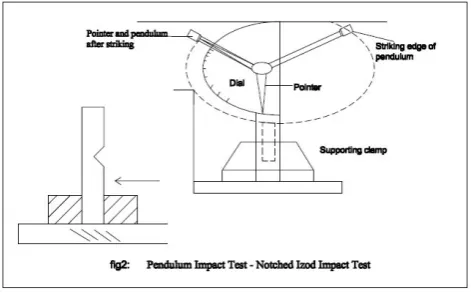
The impact properties of the material are directly related to the overall toughness which is defined as the ability to absorb applied en-ergy. Area under the stress-strain curve is proportional to the toughness of a material. Nevertheless, impact strength is a measure of toughness. In this research, pendulum impact test – Notched Izod Impact Test was utilized as shown in Fig. 2.
Figure 1: Impact testing specimens of Ukam plant fibre reinforced specimens.
Figure 2: Pendulum Impact Test – Notched Izod Impact Test.
Figure 3: Relation of Vise, Specimen and Striking Edge to Each Other for Izod Test Method A in ASTM D256.
According to ASTM D256, test method A (Izod type) was used for testing. The ap-paratus involved was Cantilever Beam (Izod Type) Impact Machine and the specimens were notched. Notching was done because it provides a stress concentration area that promotes a brittle rather than a ductile fail-ure. Furthermore, notching also drastically reduces the energy loss due to the plastic de-formation.
In the testing, specimens were clamped ver-tically as a cantilever beam and then struck by a single swing of the pendulum released from a fixed distance from the specimen clamp. The line of initial contact is at a fixed distance from the specimen clamp and from the cen-terline of the notch and on the same face of the notch.
Figure 3 shows the relation of vise, speci-men and striking edge to each other for Izod Test. A total of five consistent testing results were selected for each fibre loading in cashew nut shell resin matrix. In this research work, RAY-RAN Universal Pendulum Impact Sys-tem for Izod-Charpy-Tension and Puncture were used to measure the work of fracture for fibre reinforced composite. There are a few parameters that are set according to the stan-dard for instances, Hammer Velocity = 3.46 m/s and Hammer Weight = 0.905 kg.
4. Results and Discussions
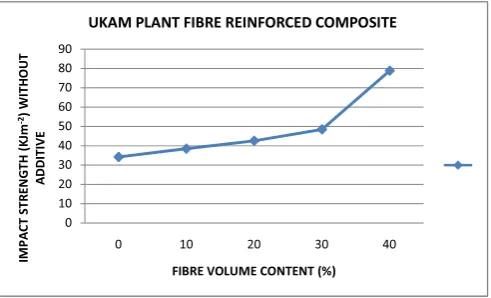
The results of the various factors that de-termine the impact responses of the natural composites are presented in Figs 4-14. The impact strength increases as the fibre volume fraction increases. It improves with increase in fibre volume fractions, fibre treatment, fi-bre length, fifi-bre orientation and the addition of additives. Of all these favourable condi-tions for energy absorption capacity per unit volume of composites, the introduction of par-ticles of stones (additives) yielded the highest impact strengths for both the natural and syn-thetic composites. However, the energy ab-sorption mechanism of fracture built in
Improving Impact Responses Of Ukam Plant Fibre Reinforced Composite . . (. /. 0. ). *. 1. 2. 3.
. . (. /. 0.
!" !
Figure 4: Graph of Impact Strength against Fibre volume content for a treated Ukam plant fibre reinforced composite. . . (. /. 0. ). *. 1. 2.
. . (. /. 0.
! !" !
. . (. /. 0.
Figure 5: Graph of Impact Strength against Fibre volume content for an untreated Ukam plant fibre reinforced composite.
posite include utilization of energy required to debond the fibres and pull them completely out of the matrix using a weak interface be-tween fibres and matrix (Enetanya 2000) . In practical interest, a significant part of energy absorption during impact takes place through the fibre pullout process.
5. Conclusion
Natural fibres and resins were obtained readily at low cost and the production of the composites required minimum tooling. The fi-bres could be used to develop Fibre reinforced plastic composite components in use in engi-neering applications. . . (. /. 0. ). *. 1. 2. 3. ..
. . (. /. 0.
!"
Figure 6: Graph of Impact Strength against Fi-bre volume content for a Glass fiFi-bre reinforced composite. . . (. /. 0. ). *. 1. 2. 3. ..
. . (. /. 0.
' !" !
. . (. /. 0.
Figure 7: Graph of Impact Strength against Fibre volume content for Ukam plant fibre reinforced composite with additives.
. . (. /. 0. ). *. 1. 2. 3.
. . (. /. 0.
' ! !" !
Figure 8: Graph of Impact Strength against Fibre volume content for Ukam plant fibre reinforced composite without additives.
. . (. /. 0. ). *. 1. 2. 3. ..
. . (. /. 0.
' !
. . (. /. 0.
Figure 9: Graph of Impact Strength against Fibre volume content for Glass fibre reinforced compos-ite with additives.
. . (. /. 0. ). *. 1. 2. 3. ..
. . (. /. 0.
' ! !"
Figure 10: Graph of Impact Strength against Fi-bre volume content for Glass fiFi-bre reinforced com-posite without additives.
. . (. /. 0. ). *. 1. 2. 3.
. . (. /. 0.
* !" !
Figure 11: Graph of Impact Strength against Fi-bre volume content for Short Ukam plant fiFi-bre reinforced composite. . . (. /. 0. ). *. 1. 2.
. . (. /. 0.
) * * !" !
Figure 12: Graph of Impact Strength against Fi-bre volume content for Long Ukam plant fiFi-bre reinforced composite. . . (. /. 0. ). *. 1. 2. 3.
. . (. /. 0.
!" !
. . (. /. 0.
Figure 13: Graph of Impact Strength against Fi-bre volume content for a bi-directional Ukam plant fibre reinforced composite.
. . (. /. 0. ). *. 1. 2.
. . (. /. 0.
! !" !
Figure 14: Graph of Impact Strength against Fi-bre volume content for a unidirectional Ukam plant fibre reinforced composite.
Improving Impact Responses Of Ukam Plant Fibre Reinforced Composite
In this article, the recommended production technique is the hand-lay-up method. It is a labour intensive method and requires no ex-pensive tooling. It is however, suitable for a developing country like Nigeria for the pur-pose of poverty alleviation.
Light weight, low modulus and low strength plastics reinforced with natural fibres have been proved to posses mechanical properties capable of making them compete effectively with the synthetic ones. Various factors im-prove the impact response of fibre reinforced composites. These include fibre volume frac-tion, fibre condifrac-tion, application of 20% by resin weight of additives, fibre length and ply sequence. The application of additives how-ever, yielded the best result in terms of impact response on the account that the presence of additives increases the compressive strength of any fibre reinforced plastic composites.
Steel castings are widely used in the design and production of engineering structures and components. At low speed impact the perfor-mance of plastics is superior to that of metals. Large deflections of plastics recover without permanent damage (Enetanya, 2000). This means that in the near future , natural fibre reinforced plastic composites will even be pre-ferred to steel castings in terms of important engineering applications such as automobile, boat and air craft constructions.
Acknowledgement
I am particularly grateful to my mentor, Engr.(Dr) O. Onuba for guiding me in the course of carrying out this research. My pro-found gratitude also goes to the Technologist, Engr. Ugochukwu Okenwa for his assistance in conducting various test in the Mechanical Engineering laboratory.
References
1. Kroschwitz, J. I. (2005) High performance
polymer composites John Wiley and sons,
New York.
2. Sebe G, Cetin, N. S, Hill, C. S. A and Hughe (2000). RTM Hemp Fibre-Reinforced Polyester Composites, Applied Composite Materials (in press)
3. Hyper, M. W. (2008)Stress Analysis of fibre reinforced composite materials. Mc Graw-Hill companies, Inc. USA.
4. John, V.B. (1972) Intoduction to
Engineer-ing materials The English Language Book
Society, London.
5. Nick, I. and Mark, J. (2004). Low
environ-mental impact polymers. Int. Automotive
Research Center, University of Warwick.
6. Terry, R (1987)Composites: A design guide. Industrial press Inc. 200 Madison Avenue New York.
7. Wood, R. (1980) Car Body Works in Glass
reinforced Plastics Pentech Press:
Ply-mouth, London.
8. Harris, Bryan (1986)Engineering composite materials The institute of Metals: London.
9. Enetanya, A. N (2000) Improving the pressive strengths of hand-lay up GRF com-posites. Global Journal of Mechanical Engi-neering vol.2 (page 7-18)