461
Analysis The Sentiments Of Amazon Reviews
Dataset By Using Linear SVC And Voting
Classifier
Sandeep Singh Sikarwar, Dr.Nirupma Tiwari
Abstract: Any opinion of a person that can convey emotions, attitudes, or opinions is known as a sentiment. The data analyzes that are collected from media reports, consumer ratings, social network posts, or microblogging sites are classified as opinion mining research. Analysis of sentiment should be viewed as a way of evaluating people for particular incidents, labels, goods, or businesses. The amount of views exchanged by people in micro-logging sites often increases, which makes nostalgic interpretations more and more common today. All sentiments may be categorized as optimistic, negative, or neutral under three groups. The characteristics are derived from the document term matrix using a bi-gram modeling technique. The sentiments are categorized among positive and negative sentiments. In this analysis, the Python language is used to apply the classification algo for the data obtained. The detailed accomplishment of LinSVC demonstrates greater precision than other algos.
Keywords: Sentiment Analysis, Classification Techniques, Naïve Bayes, Voting, Linear SVC , NLP,Data mining, amazon product review dataset.
————————————————————
1.
INTRODUCTION
The current Internet era has been an enormous cyber database that houses vast amounts of data that users generate or use. The database has expanded at an unprecedented rate, generating a digital market of consumers sharing their opinions on Facebook, Twitter, Rotten Tomatoes, and Foursquare. Opinions shared as comments offer new study tools to recognize the mutual desires or dislikes of cyber societies. The category of analysis that impacts everyone from the viewer, film reviewers to the production team, is one of these areas of reviews. The film reviews on the blogs are not systematic reports, but rather casual and unstructured. The viewpoints conveyed in film reviews represent quite accurately the sentiment transmitted. The inclusion of such broad usage of words to describe the revisions inspired us to evaluate the polarity of the film in such terms of feeling. Sentiment Analysis is a technology that will be relevant over the next few years. With opinion processing, we can differentiate bad content from high-quality material. Through current technology, we will learn if a film has better views or poor views and why these views are good or negative. In this area, a significant proportion of early work centered on user feedback, such as feedback on Amazon.com[1], describing sentiments as favorable, negative, or neutral. The majority of sentiment analysis studies currently rely on social networking sites like IMDB, Twitter [2] & Facebook, which need the correct methods to satisfy through text demand. In comparison, the study of the sentences in film reports is a difficult task. Research Sentiment Mining is a process focused on the NLP or information extraction (IE) approaches to review a broad variety of documents such that the views of different writers can be collected[3]. This method includes a variety of techniques, including machine etymology and IR [4]. The fundamental principle of sentiment analysis is to recognize and define the polarity of text or short messages. True, "negative," or "impartial" (neutral) opinion polarity is classified. It must be emphasized that emotion mining may be carried out in the following three stages. [5]:
Classification of sentiment at a document level: at this point, a text may completely be categorized as "positive" or "neutral."
Classification of sentences: Each sentence shall be categorized as 'yes,' 'no' or 'unbiased.'
Sensitivity classification of dimension or type of features: at this point, phrases/documents may be categorized as « positive », « negative » or « non-party » provided those aspects of sentences/archives but generally recognized as « view grouping of the viewpoint stage.
2.
REVIEW
OF
LITERATURE
methods for the quest for minimum cuts in graphs; this significantly favors the fulfillment of cross sentences semantic constraints, which offer an excellent means of combining conceptual knowledge at an interdenticle level for conventional word dictionaries. Singh et al. [10]Present the theoretical research on the SentiWordNet results assessment method for classifying film reviews and blog posts on documentary feelings. Similar to two common machine-learning methods they made improvements in semantic functions, ranking schemes, and thresholds of the SentiWordNet method. Comparative outcomes in film reviews and forum posts are demonstrated by normal precision, F-measure, or Entropy efficiency assessment measures. Chunxu Wu [11]Proposed a system for integration of context-dependent views semantic by WordNet. To order to assess opinion by way of semantic closeness tests, the approach suggested is used. This methodology depends on these steps to assess the subject of feedback where inadequate knowledge is accessible. Taboada et al. [12]Used a strategy of lexicon-dependent identification and interpretation of documents depending on their emotions. Strong or derogatory lexicons have been used to do this correctly. Furthermore, the simulator of semantic orientation (SO-CAL) focused on intensifiers and negations is introduced. This method has reached an accuracy of 76.37 percent in film reviews. Zagibalov et al. [13]Addressed the problem of classifying the feelings in consumers in Chinese written goods. Their method relied on unattended classification under which the vocabulary seed was born. Initially, there was only one (good) term identified as optimistic. The first seed was retrained iteratively to identify emotions. The criteria for opinion density is then used to measure the feels ratio for a paper. The tests demonstrated that after 20 iterations, the qualified classifier obtained an 87% FSR for dramatic polaritydetection. Tripathy et al. [14]Tried to distinguish feedback by polarity with supervised learning algos like Naïve Bayes, SVM, random forest, or linear discriminant analysis. In achieving so, four phases were included in the solution suggested. The first step was to delete stopping words, mathematical characters, and individual characters. Second, text comments have been translated into a numerical matrix. Thirdly, vectors created for four different classifiers were used as inputs. Various parameters were then measured to assess the efficiency of the proposed n method, e.g. precision, alert, f-measurement, or classification accuracy. The random forest classifier surpassed many classifiers for Polarity & IMDb datasets. Saleh et al. [15]To distinguish paper evaluations, the SVM was applied to 3 separate datasets. To determine the effect of the SVM in classification papers, many n-gram schemes have been used. The researchers used three weighing methods to produce vectors of function: Term Frequency, Conditional Occurrence, and Term Frequency Inverse Document Frequency (TFIDF).
3.
PROPOSED
METHODOLOGY
The algo works with probabilistic, and the algo works with different measures. The data collection will be evaluated before analysis so each sentence in the dataset is split into terms so each word's polarity will be evaluated. The term polarity may be viewed as positive or negative in a tabulated form as seen in figure 1. The algorithm is introduced to the dataset following this procedure. Word level research is the
strongest as it is most likely to produce reliable information. The next step is to implement algo suggested as each term is measured in two groups (positive or negative) with both positive and negative probability. The higher probability classification is defined as corresponding sentence probability.
Figure 1. Visualization of the polarity of words as positive and negative
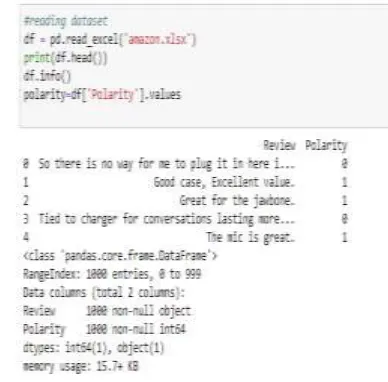
Dataset Collection:This dataset contains user ratings and Amazon documentation as shown in figure 2. This data collection includes comments (ratings, text, votes for helpfulness), product metadata (descriptions, details in category, size, brand, or images) or links (also seen or bought graphs).
Figure 2. Representation of amazon dataset
Preprocessing:
463
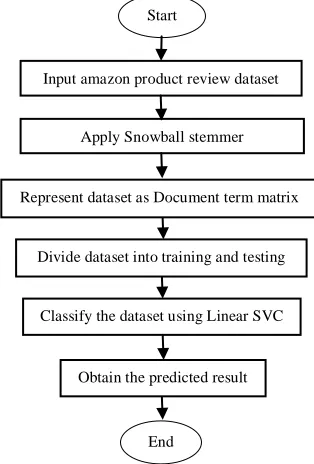
root term from "flying." "flying" is a verb, and the suffix is an "ing" "ing." This suffix is used to build a separate term from the initial. The word matrix of a concept is then defined as The term frequency for each word is recorded in each case by concept term. We begin with the Words Sack, which displays the documents and then count the number of occasions a word appears within each text. The next step is to split the data between preparation and assessments by splitting the data collection between 90% or 10%. The evaluation of data collection would be evaluated. The next step is to submit the classification algorithm and get the results. A vote is one of the easiest ways to merge several learning algos with predictions. Voting classification is not a classifier but a wrapper for different ones that have been equipped and rated concurrently to take advantage of the distinct characteristics of each algo.
Figure 3 Voting Classifier
Linear SVC: A Linear SVC aims to match the data you have and return the "right fit" hyperplane, which separates or classifies the information. This is also the intention of a Linear SVC classification algo. You should then feed some elements into your classifier after getting hyperplane and see what "predicted" type is. This renders this specific algo more appropriate for our use.
Figure 4 Flow diagram of the proposed methodology
4.
RESULTS
AND
DISCUSSION
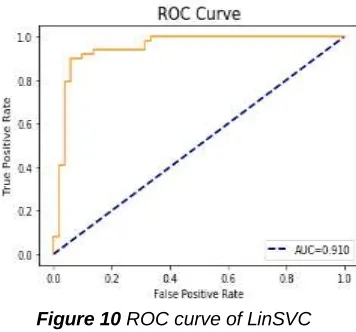
Precision or recall levels are measured, and 91.66% or 89.79% of meaning are collected. The average accuracy is 91%. The precision of 91 percent indicates that LinSVC algo is higher than the other two algos in classification.
Figure 5 Result visualization of Naïve Bayes
AUC — ROC is a classification problem output calculation at various levels. ROC is a chance curve and AUC is a degree or separability metric. This asks how many models will discriminate between groups. As AUC is larger, the stronger the pattern is 0s as zero and 1s as 1s.
Figure 6 ROC curve of Naïve Bayes
Start
Input amazon product review dataset
product review dataset
Apply Snowball stemmer
Represent dataset as Document term matrix
Divide dataset into training and testing
Classify the dataset using Linear SVC
End
Figure 7 Result visualization of Voting
Figure 8 ROC curve of Voting
Figure 9 Result visualization of LinSVC
Figure 10 ROC curve of LinSVC
Table 1 showsperformance measurement of all classification algos which clearly emphasizes the performance of all algos.
Table 1. Comparison among NB, Voting, and LinSVC Algorithm/
Performance measure
Naïve
Bayes Voting
Linear SVC
Accuracy 88.00% 90.00% 91.00%
Precision 86.79% 85.41% 91.66
Recall 90.19% 93.18% 89.79
F1 measure 88.46% 89.13% 90.72%
Figure 11 indicates the LinSVC's maximum false-positive rate in a study of three classification algos. That is a percentage between the number of adverse outcomes mistakenly defined as positive (false positive) and the total amount of true negative incidents (unless the rating is considered)
Figure 11 Comparison graph of classification algorithms for FPR
CONCLUSION
465
REFERENCES
[1] Gregory, Michelle L., et al. "User-directed sentiment analysis: Visualizing the affective content of documents." Proceedings of the Workshop on Sentiment and Subjectivity in Text. Association for Computational Linguistics, 2006.
[2] Pak, Alexander, and Patrick Paroubek. "Twitter as a Corpus for Sentiment Analysis and Opinion Mining." LREC. Vol. 10.
[3] R. Xia, C. Zong, and S. Li, "Ensemble of feature sets and classification
algorithms for sentiment classification," Information
Sciences, vol. 181,
no. 6, pp. 1138-1152, 2011/03/15/ 2011.
[4] R. Sharma, S. Nigam, and R. Jain, "Opinion mining of
movie reviews at
document level," arXiv preprint arXiv:1408.3829, 2014. [5] R. Sharma, S. Nigam, and R. Jain, "Polarity detection at
the sentence level," International Journal of Computer Applications, vol. 86, no. 11, 2014.
[6] Baccianella, Stefano, Andrea Esuli, and FabrizioSebastiani. "SentiWordNet 3.0: An Enhanced Lexical Resource for Sentiment Analysis and Opinion Mining." LREC. Vol. 10. 2010.
[7] Godbole, Namrata, ManjaSrinivasaiah, and Steven Skiena. "Large-Scale Sentiment Analysis for News and Blogs." ICWSM 7 (2007): 21.
[8] Annett, Michelle, and GrzegorzKondrak. "A comparison of sentiment analysis techniques: Polarizing movie blogs." Advances in artificial intelligence. Springer Berlin Heidelberg, 2008. 25-35.
[9] Pang, Bo, Lillian Lee, and ShivakumarVaithyanathan. "Thumbs up?: sentiment classification using machine learning techniques." Proceedings of the ACL-02 conference on Empirical methods in natural language processing-Volume 10. Association for Computational Linguistics, 2002.
[10]Pang, Bo, and Lillian Lee. "A sentimental education: Sentiment analysis using subjectivity summarization based on minimum cuts." Proceedings of the 42nd annual meeting on Association for Computational Linguistics. Association for Computational Linguistics, 2004.
[11]C. Wu, L. Shen, and X. Wang, "A new method of using contextual
information to infer the semantic orientations of context-dependent
opinions," in Artificial Intelligence and Computational Intelligence,
2009. AICI'09. International Conference on, 2009, vol. 4:
IEEE, pp.
274-278.
[12]M. Taboada, J. Brooke, M. Tofiloski, K. Voll, and M. Stede, "Lexiconbased methods for sentiment analysis," Computational linguistics, vol. 37, no. 2, pp. 267-307, 2011.
[13]T. Zagibalov and J. Carroll, "Unsupervised classification
of sentiment
and objectivity in Chinese text," in Proceedings of the Third
International Joint Conference on Natural Language Processing: Volume-I, 2008.
[14]A. Tripathy and S. K. Rath, "Classification of the sentiment of reviews
using supervised machine learning techniques," International Journal of Rough Sets and Data Analysis (IJRSDA), vol. 4, no. 1, pp. 56-74, 2017.
[15]M. R. Saleh, M. T. Martín-Valdivia, A. Montejo-Ráez, and L. UreñaLópez, "Experiments with SVM to classify opinions in different domains," Expert Systems with Applications, vol. 38, no. 12, pp. 14799-
14804, 2011
Authors Profile
MR. SANDEEP SINGH SIKARWAR (M.tech.Scholar), in Dept. of CSE ,from SRCEM ,RGPV BHOPAL Madhya Pradesh, India. Area of Interest Data Mining, Machine Learning and Deep Learning. I am student of CSE & IT Department in SRCEM , RGPV BHOPAL. I have received B.E. degree in Information Technology from MITS Gwalior. I am Qualified,Exams GATE-2018, GATE-2020 AND UGC-NET 2019.