IJSRR, 7(4) Oct. – Dec., 2018 Page 2498
Research article
Available online www.ijsrr.org
ISSN: 2279–0543
International Journal of Scientific Research and Reviews
Synthesis and Characterization of bidentate Schiff base transition
metal complexes of Co(II), Ni(II) and Cu(II).
Singh Kamlesh Kumar *
Department of Chemistry, G.S. College Maharajganj, Siwan Bihar, India – 841238 Email Id – [email protected]
ABSTRACT
Vinillin which is a naturally ocuring. Food component Found in plants is used for the
manufacture of Schiff base chelates. Schiff bases are versatile ligands which are synthesized from
the condensation of an amino compound with carbonyl compounds. A novel series of transition
metal complexes of Co(ll) , Ni(ll) and Cu(ll), with Schiff base ligand derived from condensation of
vanillin with aniline were synthesized in alcolic medium. The ligand and its complexes were
characterized on the basis of elemental analysis, conductivity, solubility, magnetic susceptibility
measurements, IR and electronic spectral studies. The complexes were formed in moderate yields
and they are various colours and have sharp melting points. The purity and composition of the Schiff
base and the metal (ll) complexes were established by elemental analysis which suggests a metal:
ligand ratio of 1:2 . The I.R spectra revealed that the complexes coordinatd through azomethine
nitarogen and methoxy oxygen of the ligand. Further conclusive evidence of the coordination of the
Schiff bases with the metal ions was shown by the appearance of new bands due to (M-N) and
(M-O) in the metal complexes. Based on the electronic spectral transition, an octahedral structure has
been assigned to all the metal (II) complexes.
KEYWORDS
:-
Schiff base, vanillin, aniline metal (II) complexes and synthesis.*Corresponding author
Dr. Kamlesh Kumar Singh
Department of Chemistry,
G.S. College Maharajganj, Siwan
IJSRR, 7(4) Oct. – Dec., 2018 Page 2499 Email Id – [email protected]
1.
INTRODUCATION :-
Metal chelation is involved in many important biological processes where the coordinaton
can occur between a veriety of the metal ions and a wide range of ligands. Schiff base metal
complexes have been widely studied because they have industrial, antifungal and biological
applications. They serve as models for biological catalytic reactions. Chelating ligands containing O
and N donor atoms show broad biological activity and are of special interest because of the variety of
ways in which they are bonded to metal ions. The synthesis of Schiff base ligands and their metal
complexes have been extensively studied because of their interesting biological activities. Schiff
bases have been reported to possess antimicrobial, antiviral, anticancer and anti-inflammatory
activity. The imine functional functional group (HC=N) is believed to be responsible for the
biological avtivity of Schiff base compounds. Vanillin is a phenolic aldehyde organic compound
with the molecular formula C8H8O3. Schiff bases are one of the most prevalent and important of the
mixed donar system in the field of co-ordination chemistry. Schiff bases are condensation products
of primary amines with carbonyl compounds and they were first synthesized by Hugo Schiff in 1864.
These compounds containing a general formula where R and are alkyl, aryl, cycloalkyl or hetrocyclic groups are also known as anils, imines or azomethines. Schiff bases of
aliphatic aldehydes are relatively unstable and readily polymerisable, while those of aromatic
aldehydes having effective conjugation are more stable in general, aldehydes react faster than
ketones in condensation reactions, leading to the formation of Schiff bases as the reaction centre of
aldehydes are less sterically hindered than the of ketone. The extra carbon of ketones donate electron
density to the azomethine carbon and thus makes the ketone less electrophilic compared to
aldehydes. Schiff bases are generally bidentate, tridentate, tetradentate and polydentate ligands
capable of forming very stable complexes with transition metals. They can only act as coordinationg
ligands if they bear a functional group, usually the hydroxyl, sufficiently near the site of
condensation in such a way that a five or six memberedring can be formed when reaction with a
metal ion. Schiff bases derived form aromatic amines and aromatic aldehydes have a wide variety of
applications in many fields like biological, inorganic and analytical chemistry. Schiff bases are used
in optical and electrochemical sensors, as well as in various chromatographic methods to enable
detection of enhanced selectivity and sensitivity. Schiff bases are widely applicable in analytical
determination using reactions of condensation of primary amines and carbonyl compounds in which
the azomethine bond is formed. Schiff base metal complexes have been widely studied because they
have industrial, antifungal, antibacterial and anticancer applications. Vanillin is the primary
IJSRR, 7(4) Oct. – Dec., 2018 Page 2500 polyvalent metal ions. Condensation product of vanillin with amines confers biological activity; as
well as having good complexation ability with metal ions. I report here the synthesis and
characterization of transition metal complexes of Co (II), Ni (II) and Cu (II) containing bidentate
Schiff base, derived from the condensation of aniline and vanillin.
Vanillin synthesis from 4- hydroxybenzldehyd
:-
The developed a convenient two stepsynthesis of vanillin using electrophilic aromatic substitution, followed by an organometallic
methoxylation procedure using copper bromide and sodium methoxide.
Vanillin
Vanilla Bean
Characteristic/Property Data Molecular Formula: C8H8O3 Common Synonyms
4-hydroxy-3-methoxybenzaldehyde; methyl-B Protocatechuic aldehyde; vanillic Aldehydes; 3-
Methoxy-4-hydroxybenzaldehyde Chemical Structure (CH3O) C6H3 (OH) CHO Physical State white or slightly
yellow nee Melting Point: 178-181 ° F Vapor Density: data unavailable Specific Gravity: 1.056 at
68.0 ° F. Boiling Point: 545.0 ° F at 760 mm Hg. Molar mass 152.15 g mol−1 Exact mass
152.047344122 g mol-1 Odor Floral, pleasant Acidity (pKa) 7.781 Basicity (pKb) 6.216 Crystal
structure Monoclinic Water Solubility 1 g/100 ml Density 1.056 g/mL Vapor Density (air = 1) 5.2
KOC not found Log KOW not found Vapor Pressure 2.2 x 10⁻³ mm Hg Reactivity can react
violently with bromine, potassium Tert-butoxide, tert-chlorobenzene + NaOH, Formic acid + Tl
(NO3)3 and perchloric acid Flammability not found Flash Point not found Dissociation Constant
IJSRR, 7(4) Oct. – Dec., 2018 Page 2501
2.
EXPERIMENTAL
2.1
Chemicals and Reagents :-
All the chemicals and reagents used were of analytical grade and were used without
purification. They are vanillin, aniline, CoCl2 . 6H2O, NiCl2.6H2O, Cu (CH3COO)2.H2O and solvents
(methanol, ethanol, petroleum ether, Chloroform, benzene and acetone)
2.2
Physical Measurements :-
The percentage (%) of Co, Ni and Cu were determined by EDTA complexometric titration16.
The elemental analysis of C, H, and N was performed by using a perkin-Elmer elemental analyzer.
The m.p of all compounds were determined using Griffin melting point apparatus. The solubility of
the complexes was determined in some polar and non polar solvents like water, methamol, ethanol
petroleum ether, chloroform, benzene and acetone, Molar Conductivity were determined by using
DMF as a solvent in digital conductivity meter at 250c. The I.R. spectra of ligand and metal
complexes were taken on perkin-Elmer model 577 spectophotometer using KBr disc. The magnetic
susceptibility data were measured by Gouy method using Hg [Co(NCS)4] as a calibrant, Electronic
spectra of the complexes were recorede in DMF on carry 2390 spectrophotometer.
2.3
Synthesis of Schiff base ligand (HL):-
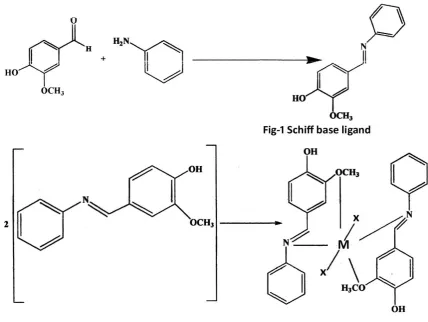
The ligand 2-methoxy-4-(Phenyliminomethyl) phenol was prepared by condensation of
equimolar ratio of vanillin (3.043 g, 20 mmol) with aniline (1.86 g, 20 m mol) in 40 ml ethanol (1:1
molar ratio). The reaction mixture was refluxed for 4h. A black precipitate was obtained. This
precipitate was filtered and washed with distilled water, dried and preserved in desiccator containg
CaCl2.
2.4
Synthesis of the metal (II) complexes :-
The complexes of M(II) were synthesized by mixing 25 ml of ethanolic solution of Schiff
base (1.362 g, 6mmol) with 25ml of ethanolic solution of CoCl2.6H2O(0.714g, 3mmol)
Cu(CH3COO)2.H2O(0.59g, 3mmol and NiCl2.6H2O(0.713g, 3mmol). Keeping ligand-metal (II) ratio
(2:1). The reaction mixture was refluxed for 4 h on water bath. The precipitate formed was filtered
and washed with distilled water and ether. Finally, the precipitate was dried in a vacuum over CaCl2.
( ) ( ) ( )
IJSRR, 7(4) Oct. – Dec., 2018 Page 2502
3.
RESULTS AND DISCUSSION
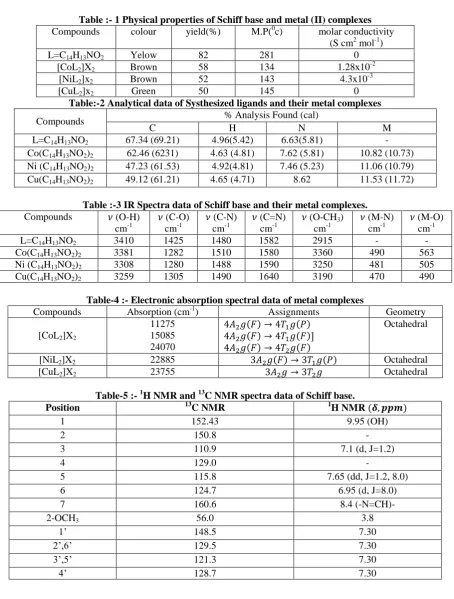
The Co(II), Ni(II) and Cu(II) complexes were obtained with moderate yields (50-58%,
table-1). The complexes vary in colour depending on metal (II) ions and are soluble in most organic
solvents except water and petroleum ether. Cu(II) complexes were soluble in petroleum ether. The
lower value of molar conductivity indicates non electrolytic nature of metal (II) complexes the
analytical data of the ligands and their metal (II) complexes are presented in table-2.
The m.p of the free ligand and its complexes was found to be the range of 134-2810c.
Elemental analysis revealed the observed and calculated values for H, C and N compositions of the
Schiff base and its metal complexes are in good agreement with the proposed structure.
IR Spectra of Schiff base ligand :-
The IR spectrum of free ligand was compared with that of complexes in order to determine
the coordination site. (table-3). A very strong band at 1582cm-1 is characteristics of the azomethine
nitrogen (>C=N) present in the schiff base ligand. This was shifted to 1580-1640cm-1 in the
complexes, which indicates the bonding of the metal to the azomethine nitrogen. The metal
complexes showed broad peaks at 3259-3381 cm-1. This suggests that the oxygen atom of the
phenolic –OH group does not participate in coordination. The IR Spectrum of free Schiff base ligand
showed strong band at 1480cm-1 which is characteristics of (C-N) stretching vibration. This was
shifted to 1488-1510cm-1 region in all the complexes. The spectral bands of the complexes at
1280-1305cm-1 were assigned to (C-O) which did not show shift from the region 1425cm-1 of the ligand.
This suggests that oxygen atom of terminal methoxy and –OH group are not coordinated to the metal
ions. The appearance of new band between 490-470cm-1 and 563-490cm-1 are indicate the formation
of M-N and M-O bond in the complexes.
Electronic Spectra of Metal Complexes :-
The electronic absorption spectra (Table-4) of metal (II) complexes were recorded in the
range of 300-700 nm using methanol as a solvent the electronic spectra of the Co(II) Complex shows
three bands at 11275, 15085 and 24070cm-1 assigned for ( ) ( ) ( )
( ) ( ) ( ). Which suggest the octahedral geometry of Co(II) complex. The Ni (II) complex show a band at 22885cm-1 assigned to ( ) ( ) suggest octahedral geometry.
The electronic spectra of Cu(II) complex exhibited band at 23755cm-1, which assigned
IJSRR, 7(4) Oct. – Dec., 2018 Page 2503
Table :- 1 Physical properties of Schiff base and metal (II) complexes
Compounds colour yield(%) M.P(0c) molar conductivity
(S cm2 mol-1)
L=C14H13NO2 Yelow 82 281 0
[CoL2]X2 Brown 58 134 1.28x10⁻²
[NiL2]x2 Brown 52 143 4.3x10⁻³
[CuL2]x2 Green 50 145 0
Table:-2 Analytical data of Systhesized ligands and their metal complexes
Compounds % Analysis Found (cal)
C H N M
L=C14H13NO2 67.34 (69.21) 4.96(5.42) 6.63(5.81) -
Co(C14H13NO2)2 62.46 (6231) 4.63 (4.81) 7.62 (5.81) 10.82 (10.73)
Ni (C14H13NO2)2 47.23 (61.53) 4.92(4.81) 7.46 (5.23) 11.06 (10.79)
Cu(C14H13NO2)2 49.12 (61.21) 4.65 (4.71) 8.62 11.53 (11.72)
Table :-3 IR Spectra data of Schiff base and their metal complexes.
Compounds (O-H)
cm-1 (C-O) cm-1 (C-N) cm-1 (C=N) cm-1
(O-CH3)
cm-1
(M-N) cm-1
(M-O) cm-1
L=C14H13NO2 3410 1425 1480 1582 2915 - -
Co(C14H13NO2)2 3381 1282 1510 1580 3360 490 563
Ni (C14H13NO2)2 3308 1280 1488 1590 3250 481 505
Cu(C14H13NO2)2 3259 1305 1490 1640 3190 470 490
Table-4 :- Electronic absorption spectral data of metal complexes
Compounds Absorption (cm-1) Assignments Geometry
[CoL2]X2
11275 15085 24070 ( ) ( ) ( ) ( ) ( ) ( ) Octahedral
[NiL2]X2 22885 ( ) ( ) Octahedral
[CuL2]X2 23755 Octahedral
Table-5 :- 1H NMR and 13C NMR spectra data of Schiff base.
Position 13C NMR 1H NMR ( )
1 152.43 9.95 (OH)
2 150.8 -
3 110.9 7.1 (d, J=1.2)
4 129.0 -
5 115.8 7.65 (dd, J=1.2, 8.0)
6 124.7 6.95 (d, J=8.0)
7 160.6 8.4 (-N=CH)-
2-OCH3 56.0 3.8
1’ 148.5 7.30
2’,6’ 129.5 7.30
3’,5’ 121.3 7.30
IJSRR, 7(4) Oct. – Dec., 2018 Page 2504
Fig. 2: Proposed structure of M(II) complexes M=Co, Ni & Cu
4. CONCLUSION
A novel Schiff base ligand was synthesized by the reaction of vanillin and aniline in
equimolar ration with a molecular formula of C14H13NO2. The complexes of Co(II), Ni(II) and Cu(II)
were synthesized by direct reaction of the synthesized ligand with metal salt both in 2:1 ratio. In the
present work Co(II), Ni(II) and Cu(II) complexes were synathesized and characterized by analytical
and spectroscopic techniques. The Schiff base acts as bidentate ligand. The M(II) Coordinated
through the nitrogen atom of azomethine group and oxygen atom of methoxy group of vanillin. This
is supported by infrared spectral data. The electronic spectral band observed are consistent with an
octahedral geometry for Co(II), Ni(II) and Cu(II) complexes. The molar conductivity data of the
complexes in methanol indicated that they are non electrolytes. All the complexes are air stable and
soluble in protic solvents like methanol and ethanol. They in vitro antimicrobial study shows that the
complexes have higher activities compared to the free ligand.
IJSRR, 7(4) Oct. – Dec., 2018 Page 2505 The author is grateful thank to P.G. Department of Chemistry Rajendra College, Chapra for
providing laboratory facilities.
REFERENCES :-
1. F.A. Cotton & G. Wilkinson : Adv. Inorg. Chem. Interscience, Publication, New York, 1967.
2. Figgis, B.N. & Nyholm, R.S. : J. Chem. Soc., 1954; 12.
3. Ranade, A.C. & Rao, V.V. Subha : Ind. J. Chem., 1996; 4: 42.
4. V. Algarsamy, R Giridhar, M.R. Yadav, R. Revati, K. Ruckmani and E. De. Chercq, India J.
Pharm. Sci., 2007; 69: 304
5. A.G.A El-Helby, Acta Pharm, 2003; 53: 127
6. N.M. Raghwendra, P.P. Thampi and P.M. Gurubasavarajswamy, E-J. Chem., 2008; 5: 23
7. S.T. Pai and M.W. Platt, Lett, Appl. Microb., 1994; 20: 14
8. P.A.J. Janseen, J. coordiovase Pharmacol., 1985; 7: 52
9. D.P. Gupta, S. Ahmad, A. Kumar and K. Shankar, India J. Chem. 27B, 1988; 1060
10.B/R. Vogt and L.M. Simpkins, Ger. Pat. Offen, 1979; 2: 916: 992 Chem., Abstr., 1980; 92:
111052
11.E. Berenyi, E. Szirt, P. Gorog, L. Petocz. I. Kosoczky, A. Kovasc and G. Urmos, Ger. Pat
Offen, 1980; 3, 0199 Chem., Abstr., 1981; 94: 156963
12.E.J. Alexander, U.S. Pat. 1976; 4(105):766, Chem. Abstr., 1979; 90: 87505
13.T. Singh, S. Sharma, V.K. Shrivastava and A. Kumar, Indian J. Chem., 2006; 45B: 2558
14.S.R. Pattan, V.V.K Reddy, F.V. Manvi, B.G. Desai and A.R. Bhat, Indian J. Chem, 2006;
45B: 1778