Abstract: Relative to the rest of the EU, Ireland is especially vulnerable to the fallout from Brexit, both economically and politically. With increasing frustration over the reaction from Brussels, some are suggesting that an Irish exit from the EU would benefit the nation. A key argument for this is that it would allow for reintegration with the UK, thus reinstating close ties with one of its largest trading partners. Using a structurally estimated general equilibrium model, we estimate that such a move would substantially worsen the impacts of Brexit, with lower-skill and agricultural workers being disproportionately affected. This is due to the fact that while the UK is one of Ireland’s most important trading partners, trade with the rest of the EU is much more important.
F
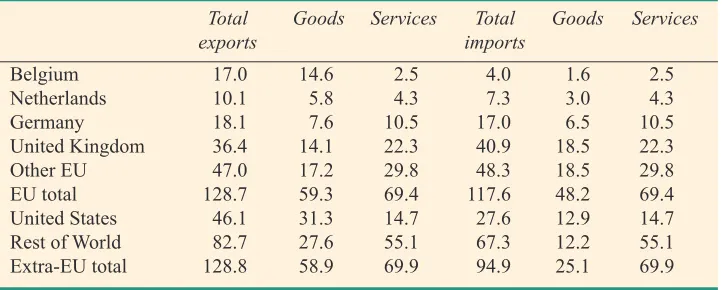
ew countries have responded to the UK’s decision to exit the European Union with as much concern as Ireland. There are clear-cut reasons for Irish worries. First, the UK’s overall role in Irish trade is larger than that of any other single EU nation. In 2016, the UK received 14.1 per cent of Irish goods and services exports, second only to the US (17.9 per cent), and provided 19.2 per cent of Irish imports, with the US in second place at 13.0 per cent (Eurostat, 2018a). At the same time, the relative importance of the UK has been changing (see Table 1 and Table 2). Belgium passed the UK as the single most important export destination for Irish455
POLICY PAPER
Making the Worst of a Bad Situation: A Note on Irexit
Ronald B. Davies* University College Dublin
Joseph Francois
University of Bern, World Trade Institute
Acknowledgements: We thank the editor and an anonymous referee for helpful feedback. All errors in this paper are our own, however, the policy errors discussed are not our fault.
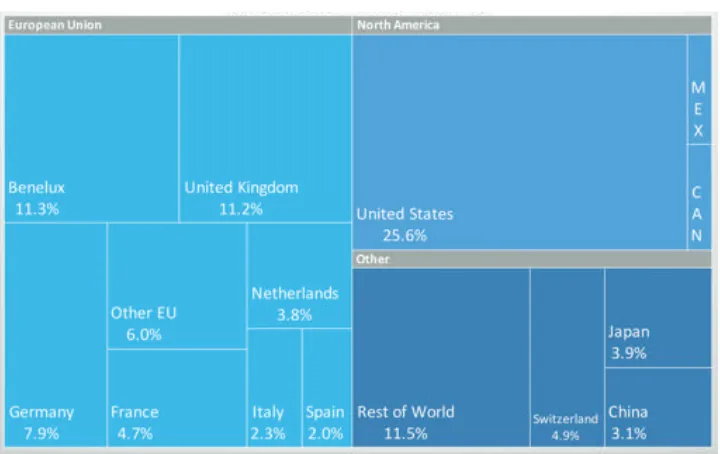
goods exports in 2016 (12.3 per cent vs 11.9 per cent). This shift has happened as chemicals and pharmaceuticals have grown steadily more important in total Irish exports.1 Thus, while the UK accounts for 16.4 per cent of all Irish trade (exports and imports of goods and services), the EU26 (the EU less the UK and Ireland) accounts for 36.0 per cent. Similarly, aggregating across the EU’s FTA partners (including Korea, Turkey, the EEA, and new agreements with Canada and Japan) shows that these destinations are more important for Irish goods exports than is the UK. Likewise, the US is almost as important a trading partner to the Irish economy as the UK, receiving far more merchandise exports even without an EU-US FTA (again see Table 1 and Table 2 as well as Figure 1).
Table 1: Irish Trade, 2016, € billion
Total Goods Services Total Goods Services exports imports
Belgium 17.0 14.6 2.5 4.0 1.6 2.5 Netherlands 10.1 5.8 4.3 7.3 3.0 4.3 Germany 18.1 7.6 10.5 17.0 6.5 10.5 United Kingdom 36.4 14.1 22.3 40.9 18.5 22.3 Other EU 47.0 17.2 29.8 48.3 18.5 29.8 EU total 128.7 59.3 69.4 117.6 48.2 69.4 United States 46.1 31.3 14.7 27.6 12.9 14.7 Rest of World 82.7 27.6 55.1 67.3 12.2 55.1 Extra-EU total 128.8 58.9 69.9 94.9 25.1 69.9 Source data are from Eurostat (2018a, 2018b). Services trade is on a BPM6 amended basis. Goods transformation services are excluded to avoid double counting with goods trade data, and to match National Accounts based activity data.
Table 2: Irish Merchandise Exports, 2013-2016, € billion
All Goods Exports 2013 2014 2015 2016
Belgium 11.2 11.7 14.4 14.6 Netherlands 4.0 3.7 4.9 5.8 Germany 6.4 5.7 7.3 7.6 United Kingdom 13.4 13.0 14.9 14.1 Other EU 15.3 15.9 18.4 17.2 EU total 50.3 50.1 59.8 59.3 United States 18.2 20.1 26.6 31.3 Rest of World 19.4 21.0 25.9 27.6 Extra-EU total 37.6 41.1 52.6 58.9 Source data are from Eurostat (2018a).
Aside from economic linkages, another prominent feature of the landscape is the complicated and at times bloody history that ties the UK and Ireland together, a past most parties sincerely hope was laid to rest in 1998 with the Good Friday Agreement (GFA). The GFA established power sharing in Northern Ireland and an open border on the island of Ireland. Indeed, the joint position of Ireland and the UK within the Single Market has been critical to the framing and working of the GFA (McCrudden, 2018). This co-existence, however, has come under threat from Brexit, as it is difficult to imagine how the open border can be maintained short of a customs union between the UK and the EU. It also remains extremely unclear whether a combination of soft Brexit and technical solutions can be implemented to maintain the open border agreed to by the GFA while permitting differential trade regimes. Current discussions have gone as far as proposing a shift of the customs border from between Ireland and the North to between the island of Ireland as a whole and the rest of the UK, a move that would in essence remove Northern Ireland from the UK internal market. Given such fundamental issues and limited time before the clock runs out and the UK formally exits the EU (as of this writing, without extension, this is set for 29 March 2019) the prospect of a hard Brexit involving reinstatement of most-favoured nation tariffs, border checks, and non-tariff regulatory barriers seems disturbingly possible.
Figure 1: Irish Merchandise Exports by Destination, 2016
Source: COMTRADE HS92 trade data; MIT media labs, atlas.media.mit.edu.
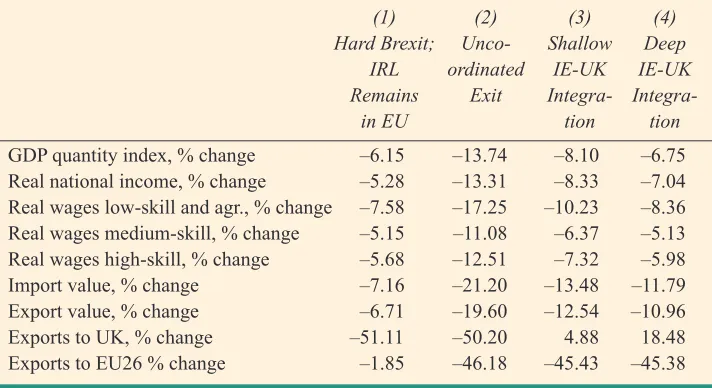
The very real possibility of a sharp and hard Brexit suggests a rather grim economic forecast for Ireland, with a recent structural general equilibrium study by Thelle et al. (2018) indicating that a hard Brexit could result in a 5.3 per cent loss to Irish national income.2 To put this in context, the long-run losses for the UK are expected to run as high as 9.5 per cent (Dhingra, et al., 2016a). The EU27, on the other hand, is projected to lose only 0.5 per cent, highlighting Ireland’s vulnerability (Emerson, et al., 2017). As shown in Table 4, the Irish loss is driven by steep declines in trade, particularly in that with the UK (although there are knock-on effects for Irish-EU trade as well due to the UK’s place in Irish global value chains (GVCs)). Furthermore, the losses are particularly severe for low-skill and agricultural workers because of increased barriers to agricultural trade (where GVCs involving the UK are especially important).
One consequence of growing worries over these possibilities is that, as in many other countries over the past two years, Ireland has seen a push towards nationalism including a growing movement supporting Irish exit from the EU – Irexit. Most notably, this was embodied in the founding of the pro-Irexit Freedom Party in September 2018. With Dublin speeches by notable Brexiteers including Nigel Farage, the pro-Irexit camp has called for the nation to reject EU control, especially given what is seen as the likelihood for the EU-UK negotiations to overlook or “smooth over” the particular vulnerability of Ireland. While this viewpoint is still firmly in the minority, with a European Movement Ireland (2017) poll in April of last year showing that only 16 per cent of Irish people support exiting the EU, polls prior to the Brexit referendum or the 2016 US election show that nationalist movements can do much better in the voting booth than polls would suggest. In particular, given that Ireland rejected the Treaty of Lisbon in 2008 (before passing it in a second referendum a year later) and a continuing popular belief that austerity following the 2009 Euro crisis inequitably impacted the Irish in order to save the currency zone, dismissing the Irexit supporters out of hand is unwise.
In order to provide some quantitative underpinning to the discussion on Irexit, in this note we extend the Thelle et al. (2018) hard Brexit baseline, where the UK reverts to most favoured nation (MFN) tariffs, to consider three Irexit scenarios.3 Our model-based estimates are reported in Table 4. Column 1 shows annual projected losses in 2030 from a hard Brexit in which Ireland remains part of the EU. This corresponds to the Thelle, et al. hard Brexit baseline. As can be seen (and
2 The long-run level of GDP is predicted to fall by 6.1 per cent in that study. However, here we focus on national income, which reflects the welfare of Irish consumers, due to the large role foreign multinationals play in Irish GDP.
as is discussed there) Brexit is likely to have significant negative effects on the Irish economy. This is because of the massive decline in exports to the UK, where the projection is that by 2030 trade will be half of what it otherwise would have been. One notable feature of this is that trade to the EU26 is also projected to fall slightly. This is because of the role Ireland plays in GVCs that include the UK; as Irish-UK
Table 3: Irish Trade, 2016, Shares of Categories
Total Goods Services Total Goods Services exports imports
Belgium 6.6 12.3 1.8 1.9 2.2 1.8 Netherlands 3.9 4.9 3.1 3.5 4.1 3.1 Germany 7.0 6.4 7.5 8.0 8.9 7.5 United Kingdom 14.1 11.9 16.0 19.2 25.3 16.0 Other EU 18.3 14.6 21.4 22.7 25.3 21.4 EU total 50.0 50.2 49.8 55.3 65.8 49.8 United States 17.9 26.5 10.6 13.0 17.6 10.6 Rest of World 32.1 23.4 39.6 31.7 16.6 39.6 extra-EU total 50.0 49.8 50.2 44.7 34.2 50.2 TOTAL 100.0 100.0 100.0 100.0 100.0 100.0 Source data are from Eurostat (2018a, 2018b). Services trade is on a BPM6 amended basis. Goods transformation services are excluded to avoid double counting with goods trade data, and to match National Accounts based activity data.
Table 4: Projected Changes for Ireland, % Change from 2030 Benchmark
(1) (2) (3) (4) Hard Brexit; Unco- Shallow Deep
IRL ordinated IE-UK IE-UK Remains Exit Integra- Integra- in EU tion tion
GDP quantity index, % change –6.15 –13.74 –8.10 –6.75 Real national income, % change –5.28 –13.31 –8.33 –7.04 Real wages low-skill and agr., % change –7.58 –17.25 –10.23 –8.36 Real wages medium-skill, % change –5.15 –11.08 –6.37 –5.13 Real wages high-skill, % change –5.68 –12.51 –7.32 –5.98 Import value, % change –7.16 –21.20 –13.48 –11.79 Export value, % change –6.71 –19.60 –12.54 –10.96 Exports to UK, % change –51.11 –50.20 4.88 18.48 Exports to EU26 % change –1.85 –46.18 –45.43 –45.38
trade in intermediates is impacted post-Brexit, this hampers Ireland’s ability to compete in continental markets as well. This has a particularly large effect on low-skill and agricultural workers due to their involvement in these GVCs (as well as their sensitivity to price hikes following increases in import prices). Indeed, the estimates of Lawless and Studnicka (2017) suggest that Irish agri-food exports to the UK could fall by half following a hard Brexit.
Columns 2 through 4 build on this scenario by including forms of a hard Irexit from the EU with varying degrees of integration with the UK. Column 2 considers a situation in which Ireland reverts to MFN tariffs with both the EU and the UK. This then represents an uncoordinated exit by both Ireland and the UK. As can be seen, the primary impact this has is on Irish trade with the EU26. Comparable to a hard Brexit, this reduces Ireland’s exports to the continent by nearly 50 per cent. Furthermore, this cuts deeply into Ireland’s imports where the decline is thrice that in the no Irexit results of Column 1. The rationale here is clear: as shown in Figure 1, although Ireland trades more with the UK than any other single EU nation, Irish trade with the UK is dominated 2.2 to 1 by total Irish-EU26 trade; while for goods, exports to the EU26 dominate exports to the UK 3.2 to 1. Thus, erecting barriers to trade with the continent would have a massive impact on Irish global economic integration. While the burden of this would fall on all shoulders, with the losses roughly 2.5 times as large as under Brexit alone, as in Column 1 the low-skill workers are hurt the most. Again, this is due to the role of this group in disrupted GVCs and their exposure to price increases via reduced imports.
The latter two columns entertain the possibility of (partially) coordinated exits. Column 3 again considers a hard Irexit from the EU but a modest free trade agreement with the UK in which trade mimics a Norwegian-EU level of integration. Finally, Column 4 considers a deep agreement between Ireland and the UK that maintains the current level of integration between the two countries. Given Ireland’s small size, this scenario amounts to one in which London dictates policy, i.e. that Ireland has effectively re-joined the UK for the sake of economic policy decisions. Note that this latter scenario is the only situation which resolves the issues surrounding the border with the North and satisfies the constraints of the Good Friday Agreement, assuming that the UK itself undergoes a hard exit from the EU (which as of the time of this writing is as likely a scenario as any). As one would expect, conditional on Irexit, the best economic outcomes are found when barriers between Ireland and the UK are at their lowest, i.e. under the deep integration of Column 4. There, the joint Irish/British hard exit results in a national income loss of 7 per cent. Nevertheless, this is still 1.5 per cent worse than when Ireland remains in the EU due to the relatively greater importance to Ireland of the EU26 as a group in comparison to the UK. Put simply, increased Irish-UK trade cannot compensate for the lost trade with the EU26.
all economic analysis, are conditional on the data and the model used. As discussed by Manski (2015), official statistics must be taken with a grain of salt as the numbers are often subject to sizable revisions. In addition, the projections are sensitive as they rely on the underlying model and parameters. As such, as Manksi (2011) describes, this can lead to an “incredible certitude”, that is, selling the results without acknowledging their reliance on the data and methodology. This holds in our analysis as well. That said, certain matters feel quite certain: Brexit and Irexit will raise trade barriers, trade barriers reduce trade, and those reductions lower average income (particularly for certain groups of workers). Thus, given the relative importance of the EU26 as a trading partner relative to the UK, it is fairly credible to conclude that even in the best case scenario, trade diversion to the UK is unable to overcome the lost continental trade. Furthermore, since agricultural barriers are most likely to rise and low-income workers are most susceptible to price increases, these negative effects will be most severe for low-skill and agricultural workers (who, perversely, are generally perceived as those most supportive of the current global trend towards nationalism). Thus, the economics of the situation seem clear-cut – Irexit in any form is likely to make a bad situation worse, particularly for the most vulnerable members of Irish society. Even the best scenario here, in which Ireland remains in the EU, yields an Irish outcome likely to be far worse than for the EU overall where the projections of Emerson, et al. (2017) indicate annual losses of well below 1 per cent of GDP for the EU as a whole. This highlights the relative vulnerability of Ireland.
As a final caveat, it is possible to argue that the figures here represent an overly optimistic view of Irexit. First, recognise that these estimates rest on an assumption that Ireland and the UK (either jointly or individually) are able to maintain their current agreements with the rest of the world.4 In particular, given the currently bellicose position of the US on trade issues, such a possibility may be unlikely. When compounded by Ireland’s small size and proportionally low bargaining power, it may be increasingly important to remain part of the jointly-negotiating EU to keep trade as free as possible. Second, our analysis only discusses the trade implications of Irexit. In addition to this, an exit from the EU would likely have a significant negative impact on inward foreign direct investment (FDI). In their analysis of FDI into the UK, Dhingra, et al. (2016b) project that FDI into the UK will decline by 28 per cent over the next decade, leading to a 3.4 per cent loss in real income. In the UK, the inward FDI stock relative to GDP stood at 61.2 per cent in 2017 (OECD, 2018). In comparison, FDI into Ireland relative to its GDP was 269 per cent in the same year. Thus a comparable decline in FDI following Irexit would have much more dire consequences than in the UK. This is another indication that the predictions here are likely best scenario outcomes. Nevertheless, despite
these caveats, our hope is that these projections can inform discussions in Ireland and Brussels and push the debate in a direction that avoids some of the worst economic, political and social consequences of Brexit for Ireland.
REFERENCES
Bekkers, E., J. Francois and H. Rojas-Romagosa, 2018. “Melting Ice Caps and the Economic Impact of Opening the Northern Sea Route”, The Economic Journal, 128(610), pp. 1095-1127. Central Statistics Office, 2017. Goods Exports and Imports. Dublin: Central Statistics Office. Dhingra, S., G. Ottaviano, T. Sampson and J. van Reenen, 2016a. “The Consequences of Brexit for
UK Trade and Living Standards”, CEP Brexit Analysis No. 2.
Dhingra, S., G. Ottaviano, T. Sampson and J. van Reenen, 2016b. “The Impact of Brexit on Foreign Investment in the UK”, CEP Brexit Analysis No. 3.
Emerson, M., M. Busse, M. Di Salvo, D. Gros and J. Pelkamsn, 2017. “An Assessment of the Economic Impact of Brexit on the EU27”, European Parliment IP/A/IMCO/2016-13.
European Movement Ireland, 2017. “Ireland’s Commitment to EU Membership Undiminished by Brexit”, European Movement Ireland Ref. 161115.
Eurostat, 2018a. Trade by Partner Country and NACE Rev. 2 Activity (ext\_tec03), downloaded 18 September 2018.
Eurostat, 2018b. International Trade in Services (Since 2010) (BPM6) (bop\_its6\_det), downloaded 18 September 2018.
Lawless, M. and Z. Studnicka, 2017. “Potential Impacts of WTO Tariffs on Cross-border Trade”, Dublin: InterTrade Ireland.
Manski, C., 2011. “Policy Analysis with Incredible Certitude”, The Economic Journal 121(554), pp. 261-289.
Manski, C., 2015. “Communicating Uncertainty in Official Economic Statistics: An Appraisal Fifty Years after Morgenstern”, Journal of Economic Literature, Vol.53, No. 3, pp. 631-653. McCrudden, C., 2018. “The Belfast-Good Friday Agreement, Brexit, and Rights”, Royal Irish
Academy – British Academy Brexit Briefing Paper Series, Forthcoming. Also published as U of Michigan Public Law Research Paper No. 577, Queen’s University Belfast Law Research Paper No. 2018-04.
OECD, 2018. “OECD International Direct Investment Statistics”, https://stats.oecd.org/index.aspx Accessed 28 November 2018.