Neutron Multiplication Factor Calculation for PWR MOX
Fuel Pin Cells with WIMS-D5 Code
Riham M. Refeat*, Esmat A. Amin
Safety Engineering Department, Egyptian Nuclear and Radiological Regulatory Authority (ENRRA), Cairo, Egypt
Abstract
Thermal reactor physics lattice cell code WIMS-D5 is widely used in many laboratories for thermal research reactor and power reactor calculations. It uses the Wigner-Seitz approximation for the pin cell calculations. This approximation had been extensively applied to UO2 pin cells but it was pointed out in previous studies that it can produce erroneous results if it is used for a pin cell in MOX fuel. The present paper investigates the use of WIMS-D5 code to calculate the neutron multiplication factor for MOX fuel pin cells. The data used are derived from the Burn-up Credit Benchmark (Phase IV-A) conducted by the Nuclear Energy Agency (NEA). The calculations are performed using the updated WIMS-D libraries. An outer scattering boundary condition is proposed to overcome the effect of the Wigner-Seitz approximation deficiency in case of MOX fuel. The results obtained are compared with the mean calculated neutron multiplication of the benchmark and with results obtained using other versions of WIMS code and other nuclear data libraries. The results of the present work showed that most of the results obtained using WLUP-69 and endfb70gx are better than the other libraries. However, the maximum difference obtained from these libraries compared to the reference mean is of order 500 pcm. On the other hand, the addition of an outer scattering boundary improved the results obtained using WLUP-172 and endfb6gx to a great extent and caused slight improvement for other libraries. This indicates that by using the appropriate library and the addition of a scattering outer boundary, the Wigner Seitz approximation for the MOX pin cell in WIMS-D5 can produce reasonably accurate results.Keywords
Wigner-Seitz approximation, WIMS-D5 code, MOX fuel1. Introduction
The Nuclear Energy Agency (NEA) of the Organization for Economic Cooperation and Development (OECD) conducted in 1998, the Burn-up Credit Benchmark (Phase IV-A) [1, 2] that describes calculations to be performed for the analysis of mixed-oxide (MOX) fuel pins in a two-dimensional, infinite lattice configuration. The benchmark included 63 criticality calculation studies of three fuel types: Case A that is reference (first generation) MOX derived from Light Water Reactor UO2 recycle, Case B that is MOX enrichment based on disposition of weapons-grade Plutonium, and Case C that is later-generation MOX that would result from MOX recycling. For each fuel type, calculations were performed for specific isotopic compositions predicted for various burnup states and cooling times, with different sets of nuclides present. They were chosen to cover combinations of the following parameters for the three MOX fuel types:
* Corresponding author:
[email protected] (Riham M. Refeat) Published online at http://journal.sapub.org/jnpp
Copyright © 2016 Scientific & Academic Publishing. All Rights Reserved
1) Burn-up: – Fresh fuel. – 20 GWd/teHM. – 40 GWd/teHM. – 60 GWd/teHM. 2) Cooling:
– One year. – Five years. 3) Fuel representation:
– Major and minor actinides. – Actinides and fission products.
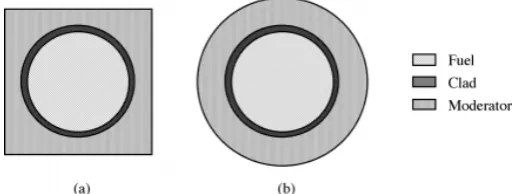
Figure (1). Geometrical specification of MOX fuel pin cell for PWR
In the present paper the neutron multiplication factor for the MOX fuel pin cell is calculated for most of the 63 cases using WIMS-D5 code [3], which was released in 1998 from the OECD/NEA data bank. This version supersedes WIMS-D4 with some major improvements in machine portability and a few minor corrections. The WIMS library associated with WIMSD5 code is the 1986 library while that associated with WIMSD4 code is the 69-group library that was generated in 1981. During the WLUP project, modifications were made to the details of WIMSD-5 code. These modifications are related to the increased number of materials, resonant nuclides and the use of the new 172-group WIMD-libraries.
Three sets of nuclear data libraries are used in the present calculations. The first set includes the updated WIMS-D libraries WLUP-69 and WLUP-172 groups which are based mainly on ENDF/B-VI rev. 8, JENDL-3.2 and JEF-2.2 evaluated nuclear data libraries [4]. The second set includes endfb6 and endfb6gx which are 69-group and 172-group WIMSD-formatted libraries based on the ENDF/B-VI rev. 8 evaluated nuclear data library [5]. The third set includes endfb70 and endfb70gx which are 69-group and 172-group WIMSD-formatted libraries based on the ENDF/B-VII.0 evaluated nuclear data library [5].
Furthermore, an outer scattering boundary condition is considered to overcome the effect of the Wigner-Seitz approximation. It contains water with the same atomic densities that constitutes the moderator surrounding the pin cell. The thickness of the outer boundary varies for the different libraries used in the calculations.
2. WIMS-D Library Update Project
(WLUP)
In the early 1990s, the WIMS-D Library Update Project (WLUP) was initiated [4]. This project was supported by the International Atomic Energy Agency (IAEA) and consisted of a large number of participants. The objective of WLUP was to provide updated working nuclear data libraries compatible with the WIMS-D family of codes and the other thermal reactor lattice cell codes. This would enable scientists and reactor designers to use the updated evaluated nuclear data files for research and power thermal reactor calculations. Two libraries were produced namely; WIMSD-IAEA-69 group cross section library (WLUP-69) and WIMSD-IAEA-172 group cross section library (WLUP-172). The libraries are based mainly on ENDF/B-VI rev. 8, JENDL-3.2 and JEF-2.2 evaluated nuclear data libraries. The new libraries (WLUP-69 and WLUP-172) represent an improvement in several aspects [4]; the number of materials increased to 173 and a library containing 172 energy groups is generated in addition to the standard 69 group library. Moreover, improvements in the evaluation of cross sections and related parameters, and burnup chains are performed.
In 2002 corrected WIMSD libraries are considered on the frame of WLUP [5] namely endfb6 and endfb6gx which are 69-group and 172-group WIMSD-formatted libraries. The two libraries are based only on the ENDF/B-VI rev. 8 evaluated nuclear data library.
released [6], it contains data primarily for reactions with incident neutrons, protons and photons on almost 400 isotopes, based on experimental data and theory predictions. There are several advances over the previous ENDF/B-VI library like:
(1) New cross sections for U, Pu, Th, Np and Am actinide isotopes, with improved performance in integral validation criticality and neutron transmission benchmark tests;
(2) More precise standard cross sections for neutron reactions on H, Li, B, Au and for U fission;
(3) Improved thermal neutron scattering;
(4) An extensive set of neutron cross sections on fission products;
(5) Extension of many neutron and proton induced evaluations up to 150 MeV;
On the bases of the ENDF/B-VII.0 evaluated nuclear data library, new WIMSD libraries were added to WLUP [5] namely endfb70 and endfb70gx which are 69-group and 172-group WIMSD-formatted libraries.
3. Wigner Seitz Approximation
The Wigner-Seitz approximation [7] uses a cylindrical outer boundary and white boundary conditions to replace the square moderator boundary associated with a fuel pin. The exact geometry of a square pin cell is shown in Figure (2a), while the Wigner-Seitz approximation is shown in Figure (2b). The radius of the outer cylindrical boundary for the equivalent Wigner-Seitz cell is chosen such that the volume of the moderator is precisely the same as in the exact pin cell. Due to computational difficulties associated with applying reflective boundary conditions on a cylindrical outer boundary, White boundary conditions are applied in the approximate model. This approximation has been found to be acceptable for UO2 fuel pin-cell modeling, but in previous studies [1] it was found that this approximation can produce erroneous results for MOX fuel pin-cell modeling.
4. Results and Discussions
In order to investigate the capability of WIMS-D5 code to be used with MOX fuel pin cell, the calculations are performed on two phases.
Phase 1:
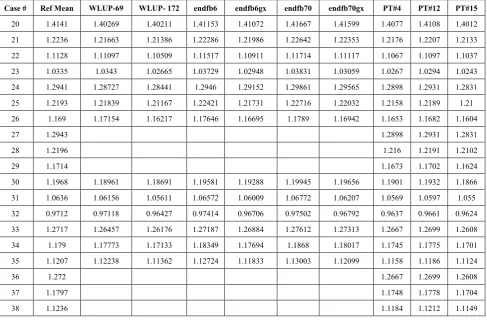
The neutron multiplication factor for most of the 63 cases specified in the original benchmark is calculated using the three sets of nuclear data libraries. The first set includes WLUP-69 and WLUP-172, the second set includes endfb6 and endfb6gx and the third set includes endfb70 and endfb70gx. The cases that include curium are not executed because the libraries used in this work do not include the cross section data for the curium-245 isotope. For the other cases, no nuclides are substituted or omitted from the calculations. The results are compared with the mean calculated neutron multiplication obtained from 37 individual contributions participated in the benchmark. Also, the results are specifically compared with those of participants (4 and 12) who used WIMS7B code and JEF2.2 nuclear data library, and participant (15) who used WIMS/ABBN code and FOND-2 nuclear data library. The results obtained are shown in tables (1, 2 and 3).
Tables (1), (2) and (3) show that most of the results obtained using WLUP-69 and endfb6gx are better than the other libraries. The maximum difference obtained from these libraries compared to the reference mean is equal to 575 and 470 pcm which is acceptable when compared to those obtained from participants 4, 12 and 15, which are equal to 1114, 761 and 1610 pcm respectively. There is no actual verification data such as critical experiments or core tracking exists for the specified benchmark problem, so the true solution is not known. It is shown in reference (1) that there is a large spread in the results obtained from the 37 participants, for example the difference of results obtained for case B20 from the reference mean ranges from 20 pcm to 651 pcm. So the value obtained for this case using WLUP-69 (575 pcm) lies within this range.
Phase 2:
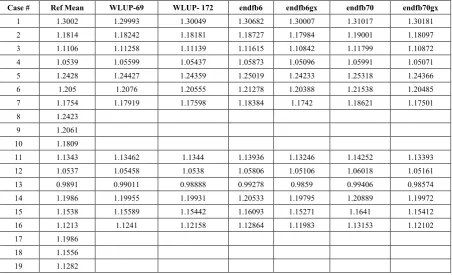
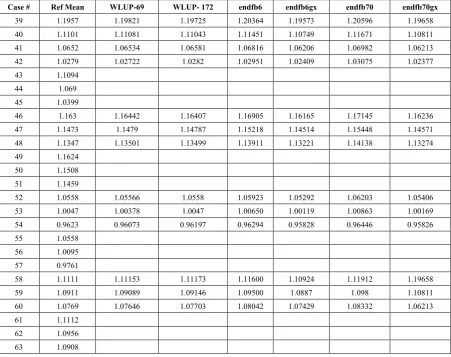
An outer scattering boundary is added to the MOX pin cell, it contains water with atomic densities similar to those of the moderator. The neutron multiplication factor for most of the 63 cases specified in the original benchmark is calculated using the three sets of nuclear data libraries (WLUP-69 and WLUP-172), (endfb6 and endfb6gx) and (endfb70 and endfb70gx). The thickness of the proposed boundary is equal to 0.08538cm in case of WLUP-69, endfb6 and endfb70. In case of WLUP-172 it is equal to 0.0966cm. Finally in cases endfb6gx and endfb70gx it is equal to 0.088cm. The results obtained are shown in tables (4, 5 and 6). They are compared with the mean calculated neutron multiplication of the benchmark.
Table (1). Multiplication factors for MOX composition A
Case # Ref Mean WLUP-69 WLUP- 172 endfb6 endfb6gx endfb70 endfb70gx PT#4 PT#12 PT#15
1 1.3002 1.30005 1.29128 1.30693 1.29795 1.31028 1.30141 1.2961 1.2998 1.2893
2 1.1814 1.18253 1.17319 1.18738 1.17785 1.19012 1.1806 1.1758 1.1793 1.172
3 1.1106 1.11269 1.10309 1.11625 1.1065 1.11809 1.10837 1.1041 1.1074 1.1013
4 1.0539 1.05609 1.04655 1.05882 1.04915 1.06 1.05037 1.0464 1.0495 1.0437
5 1.2428 1.24439 1.23453 1.2503 1.24025 1.2533 1.24327 1.2386 1.2423 1.2327
6 1.205 1.2077 1.19687 1.21287 1.20188 1.21547 1.20448 1.2003 1.2038 1.1951
7 1.1754 1.17925 1.16777 1.18392 1.17232 1.18629 1.17465 1.1708 1.1741 1.1657
8 1.2423 1.2384 1.2421 1.2325
9 1.2061 1.2015 1.205 1.1962
10 1.1809 1.176 1.179 1.1701
11 1.1343 1.13473 1.12596 1.13947 1.13051 1.14263 1.13357 1.1276 1.131 1.1253
12 1.0537 1.05468 1.04592 1.05816 1.04925 1.06028 1.05128 1.046 1.0492 1.0446
13 0.9891 0.99021 0.98173 0.99287 0.98425 0.99414 0.98544 0.9808 0.9837 0.9794
14 1.1986 1.19967 1.19029 1.20544 1.19587 1.209 1.19934 1.1933 1.1969 1.1891
15 1.1538 1.15599 1.14587 1.16103 1.15074 1.16419 1.15375 1.1482 1.1516 1.1446
16 1.1213 1.12417 1.11357 1.12873 1.11798 1.13162 1.12068 1.1155 1.1187 1.112
17 1.1986 1.1932 1.1969 1.189
18 1.1556 1.1500 1.1534 1.1463
19 1.1282 1.1220 1.1253 1.1182
Table (2). Multiplication factors for MOX composition B
Case # Ref Mean WLUP-69 WLUP- 172 endfb6 endfb6gx endfb70 endfb70gx PT#4 PT#12 PT#15
20 1.4141 1.40269 1.40211 1.41153 1.41072 1.41667 1.41599 1.4077 1.4108 1.4012
21 1.2236 1.21663 1.21386 1.22286 1.21986 1.22642 1.22353 1.2176 1.2207 1.2133
22 1.1128 1.11097 1.10509 1.11517 1.10911 1.11714 1.11117 1.1067 1.1097 1.1037
23 1.0335 1.0343 1.02665 1.03729 1.02948 1.03831 1.03059 1.0267 1.0294 1.0243
24 1.2941 1.28727 1.28441 1.2946 1.29152 1.29861 1.29565 1.2898 1.2931 1.2831
25 1.2193 1.21839 1.21167 1.22421 1.21731 1.22716 1.22032 1.2158 1.2189 1.21
26 1.169 1.17154 1.16217 1.17646 1.16695 1.1789 1.16942 1.1653 1.1682 1.1604
27 1.2943 1.2898 1.2931 1.2831
28 1.2196 1.216 1.2191 1.2102
29 1.1714 1.1673 1.1702 1.1624
30 1.1968 1.18961 1.18691 1.19581 1.19288 1.19945 1.19656 1.1901 1.1932 1.1866
31 1.0636 1.06156 1.05611 1.06572 1.06009 1.06772 1.06207 1.0569 1.0597 1.055
32 0.9712 0.97118 0.96427 0.97414 0.96706 0.97502 0.96792 0.9637 0.9661 0.9624
33 1.2717 1.26457 1.26176 1.27187 1.26884 1.27612 1.27313 1.2667 1.2699 1.2608
34 1.179 1.17773 1.17133 1.18349 1.17694 1.1868 1.18017 1.1745 1.1775 1.1701
35 1.1207 1.12238 1.11362 1.12724 1.11833 1.13003 1.12099 1.1158 1.1186 1.1124
36 1.272 1.2667 1.2699 1.2608
37 1.1797 1.1748 1.1778 1.1704
Table (3). Multiplication factors for MOX composition C
Case # Ref Mean WLUP-69 WLUP- 172 endfb6 endfb6gx endfb70 endfb70gx PT#4 PT#12 PT#15
39 1.1957 1.19837 1.18855 1.20378 1.19376 1.2061 1.19624 1.1913 1.1952 1.1827
40 1.1101 1.11095 1.10205 1.11464 1.1056 1.11684 1.10779 1.1028 1.1065 1.0973
41 1.0652 1.06547 1.05745 1.06829 1.06016 1.06995 1.0618 1.057 1.0605 1.0521
42 1.0279 1.02735 1.02003 1.02963 1.02223 1.03088 1.02345 1.0186 1.022 1.014
43 1.1094 1.1026 1.1064 1.0971
44 1.069 1.0605 1.0641 1.055
45 1.0399 1.0299 1.0335 1.0237
46 1.163 1.16457 1.15517 1.1692 1.15964 1.17159 1.16202 1.1571 1.161 1.1497
47 1.1473 1.14804 1.13897 1.15231 1.14311 1.15461 1.14536 1.1405 1.1443 1.1333
48 1.1347 1.13514 1.12621 1.13923 1.13021 1.1415 1.13239 1.1276 1.1312 1.1206
49 1.1624 1.1567 1.1606 1.1492
50 1.1508 1.1432 1.147 1.1355
51 1.1459 1.1375 1.1413 1.129
52 1.0558 1.0558 1.04765 1.05937 1.05107 1.06215 1.05375 1.0476 1.0512 1.0436
53 1.0047 1.00391 0.99679 1.00663 0.99939 1.00876 1.00139 0.9955 0.9989 0.9921
54 0.9623 0.96086 0.95447 0.96306 0.95658 0.96458 0.95797 0.9524 0.9555 0.9491
55 1.0558 1.0478 1.0514 1.0437
56 1.0095 1.0001 1.0036 0.9962
57 0.9761 0.9656 0.9689 0.961
58 1.1111 1.11167 1.10294 1.11614 1.10725 1.11926 1.11023 1.1039 1.1077 1.0982
59 1.0911 1.09103 1.08274 1.09514 1.08672 1.09813 1.08952 1.0833 1.087 1.0778
60 1.0769 1.07659 1.06849 1.08055 1.07234 1.08345 1.07501 1.0689 1.0724 1.0636
61 1.1112 1.1039 1.1077 1.0982
62 1.0956 1.0873 1.091 1.0814
63 1.0908 1.0812 1.0849 1.0747
Table (4). Multiplication factors for MOX composition A with outer boundary
Case # Ref Mean WLUP-69 WLUP- 172 endfb6 endfb6gx endfb70 endfb70gx
1 1.3002 1.29993 1.30049 1.30682 1.30007 1.31017 1.30181
2 1.1814 1.18242 1.18181 1.18727 1.17984 1.19001 1.18097
3 1.1106 1.11258 1.11139 1.11615 1.10842 1.11799 1.10872
4 1.0539 1.05599 1.05437 1.05873 1.05096 1.05991 1.05071
5 1.2428 1.24427 1.24359 1.25019 1.24233 1.25318 1.24366
6 1.205 1.2076 1.20555 1.21278 1.20388 1.21538 1.20485
7 1.1754 1.17919 1.17598 1.18384 1.1742 1.18621 1.17501
8 1.2423
9 1.2061
10 1.1809
11 1.1343 1.13462 1.1344 1.13936 1.13246 1.14252 1.13393
12 1.0537 1.05458 1.0538 1.05806 1.05106 1.06018 1.05161
13 0.9891 0.99011 0.98888 0.99278 0.9859 0.99406 0.98574
14 1.1986 1.19955 1.19931 1.20533 1.19795 1.20889 1.19972
15 1.1538 1.15589 1.15442 1.16093 1.15271 1.1641 1.15412
16 1.1213 1.1241 1.12158 1.12864 1.11983 1.13153 1.12102
17 1.1986
18 1.1556
Table (5). Multiplication factors for MOX composition B with outer boundary
Case # Ref Mean WLUP-69 WLUP- 172 endfb6 endfb6gx endfb70 endfb70gx
20 1.4141 1.40264 1.41065 1.41149 1.41274 1.41663 1.41642
21 1.2236 1.21656 1.22201 1.22279 1.22178 1.22636 1.22392
22 1.1128 1.1109 1.11255 1.11512 1.11086 1.11708 1.11152
23 1.0335 1.03424 1.03333 1.03722 1.03105 1.03825 1.03089
24 1.2941 1.2872 1.29282 1.29453 1.2935 1.29855 1.29604
25 1.2193 1.21832 1.21926 1.22414 1.21909 1.2271 1.22068
26 1.169 1.17148 1.16897 1.17640 1.16854 1.17885 1.16974
27 1.2943
28 1.2196
29 1.1714
30 1.1968 1.18954 1.19494 1.19574 1.19477 1.19939 1.19695
31 1.0636 1.06149 1.06318 1.06565 1.06175 1.06766 1.06239
32 0.9712 0.97113 0.9703 0.97407 0.96847 0.97497 0.96819
33 1.2717 1.2645 1.27018 1.27180 1.27082 1.27606 1.27353
34 1.179 1.17766 1.17885 1.18343 1.1787 1.18674 1.18052
35 1.1207 1.12233 1.12025 1.12718 1.11989 1.13 1.12129
36 1.272
37 1.1797
38 1.1236
Table (6). Multiplication factors for MOX composition C with outer boundary
Case # Ref Mean WLUP-69 WLUP- 172 endfb6 endfb6gx endfb70 endfb70gx
39 1.1957 1.19821 1.19725 1.20364 1.19573 1.20596 1.19658
40 1.1101 1.11081 1.11043 1.11451 1.10749 1.11671 1.10811
41 1.0652 1.06534 1.06581 1.06816 1.06206 1.06982 1.06213
42 1.0279 1.02722 1.0282 1.02951 1.02409 1.03075 1.02377
43 1.1094
44 1.069
45 1.0399
46 1.163 1.16442 1.16407 1.16905 1.16165 1.17145 1.16236
47 1.1473 1.1479 1.14787 1.15218 1.14514 1.15448 1.14571
48 1.1347 1.13501 1.13499 1.13911 1.13221 1.14138 1.13274
49 1.1624
50 1.1508
51 1.1459
52 1.0558 1.05566 1.0558 1.05923 1.05292 1.06203 1.05406
53 1.0047 1.00378 1.0047 1.00650 1.00119 1.00863 1.00169
54 0.9623 0.96073 0.96197 0.96294 0.95828 0.96446 0.95826
55 1.0558
56 1.0095
57 0.9761
58 1.1111 1.11153 1.11173 1.11600 1.10924 1.11912 1.19658
59 1.0911 1.09089 1.09146 1.09500 1.0887 1.098 1.10811
60 1.0769 1.07646 1.07703 1.08042 1.07429 1.08332 1.06213
61 1.1112
62 1.0956
It is shown from the above tables that the addition of an outer boundary in case of using WLUP-172 has improved the results obtained to a great extent. While for endfb6gx, 80% of the results are improved with the addition of an outer boundary. However, in the other libraries there is a slight improvement and the maximum difference obtained from these libraries compared to the reference mean is still of order 500 pcm.
5. Conclusions
The present paper investigated the use of WIMS-D5 code to calculate the neutron multiplication factor for MOX fuel pin cells. The data used are derived from the Burn-up Credit Benchmark (Phase IV-A) conducted by the Nuclear Energy Agency (NEA). The calculations are performed using the updated WIMS-D libraries based on the ENDF/B-VI.8 and ENDF/B-VII.0 nuclear data libraries, namely; WLUP-69, WLUP-172, endfb6, endfb6gx, endfb70 and endfb70gx. An outer scattering boundary condition is proposed to overcome the effect of the Wigner-Seitz approximation. The results obtained are compared with the mean calculated neutron multiplication of the benchmark and with results obtained using other versions of WIMS code and other nuclear data libraries.
The results of the present work showed that most of the results obtained using WLUP-69 and endfb70gx are better than the other libraries. However, the maximum difference obtained from these libraries compared to the reference mean is of the order 500 pcm. On the other hand, the addition of an
outer scattering boundary improved the results obtained using WLUP-172 and endfb6gx to a great extent and caused a slight improvement for the other libraries. This indicates that by using the appropriate library and the addition of a scattering outer boundary, the Wigner Seitz approximation for the MOX pin cell in WIMS-D5 can produce reasonably accurate results.
REFERENCES
[1] “Burn-up Credit Criticality Benchmark Phase IV-A: Reactivity Prediction Calculations for Infinite Arrays of PWR MOX Fuel Pin Cells”, OECD, 2003.
[2] Bowden, R. L., Thorne, P. R., “Problem Specification for the OECD/NEA NSC Burn-Up Credit Benchmark Phase IV-A: Mixed Oxide (MOX) Fuels,” Version 1, 1998.
[3] M. J. Roth, J.D. Macdougall and P.B. Kemshell, “The Preparation of Input Data for WIMS, AEEW-R538”, Winfrith, 1967.
[4] “WIMS-D library update”, International Atomic Energy Agency, Vienna, 2007.
[5] http\\WIMS-D Library Update Project (WLUP).html
[6] Chadwick M.B., et.al, "ENDF/B-VII.0: Next generation evaluated nuclear data library for nuclear science and technology", Nuclear Data Sheets 107, 2006.