Developing a
Bacteroides
System for Function-Based
Screening of DNA from the Human Gut Microbiome
Kathy N. Lam,
a*
Eric C. Martens,
bTrevor C. Charles
aaDepartment of Biology, University of Waterloo, Waterloo, Canada
bDepartment of Microbiology and Immunology, University of Michigan, Ann Arbor, Michigan, USA
ABSTRACT
Functional metagenomics is a powerful method that allows the isolation of
genes whose role may not have been predicted from DNA sequence. In this approach,
first, environmental DNA is cloned to generate metagenomic libraries that are
main-tained in
Escherichia coli
, and second, the cloned DNA is screened for activities of
inter-est. Typically, functional screens are carried out using
E. coli
as a surrogate host,
al-though there likely exist barriers to gene expression, such as lack of recognition
of native promoters. Here, we describe efforts to develop
Bacteroides
thetaiotaomi-cron
as a surrogate host for screening metagenomic DNA from the human gut. We
construct a
B. thetaiotaomicron
-compatible fosmid cloning vector, generate a fosmid
clone library using DNA from the human gut, and show successful functional
com-plementation of a
B. thetaiotaomicron
glycan utilization mutant. Though we were
unable to retrieve the physical fosmid after complementation, we used genome
se-quencing to identify the complementing genes derived from the human gut
micro-biome. Our results demonstrate that the use of
B. thetaiotaomicron
to express
met-agenomic DNA is promising, but they also exemplify the challenges that can be
encountered in the development of new surrogate hosts for functional screening.
IMPORTANCE
Human gut microbiome research has been supported by advances in
DNA sequencing that make it possible to obtain gigabases of sequence data from
metagenomes but is limited by a lack of knowledge of gene function that leads to
incomplete annotation of these data sets. There is a need for the development of
methods that can provide experimental data regarding microbial gene function.
Functional metagenomics is one such method, but functional screens are often
car-ried out using hosts that may not be able to express the bulk of the environmental
DNA being screened. We expand the range of current screening hosts and
demon-strate that human gut-derived metagenomic libraries can be introduced into the gut
microbe
Bacteroides thetaiotaomicron
to identify genes based on activity screening.
Our results support the continuing development of genetically tractable systems to
obtain information about gene function.
KEYWORDS
Bacteroides thetaiotaomicron
, anaerobic sulfatase maturating enzyme,
chondroitin sulfate utilization, fosmid library, functional metagenomics, functional
screening, gut microbiota, human gut microbiome, metagenomic library, surrogate
host
A
s the microbes that live within the human body are implicated in a growing
number of human disease states, there has been corresponding growing interest
in the role of the different organisms that comprise the gut microbiota. This interest has
been supported by advances in DNA sequencing technology that allow the generation
of large metagenome sequence data sets, and yet, study of the human gut microbiota
is hampered by a lack of knowledge of gene function that makes annotation of those
data sets incomplete; for example, approximately 50% of genes identified in Human
Received19 November 2017Accepted23
February 2018Published27 March 2018
CitationLam KN, Martens EC, Charles TC. 2018.
Developing aBacteroidessystem for function-based screening of DNA from the human gut microbiome. mSystems 3:e00195-17.https:// doi.org/10.1128/mSystems.00195-17.
EditorRobert G. Beiko, Dalhousie University
Copyright© 2018 Lam et al. This is an
open-access article distributed under the terms of theCreative Commons Attribution 4.0 International license.
Address correspondence to Kathy N. Lam, [email protected].
*Present address: Kathy N. Lam, G. W. Hooper Foundation, University of California, San Francisco, San Francisco, California, USA.
Novel Systems Biology Techniques
crossm
on September 8, 2020 by guest
http://msystems.asm.org/
Microbiome Project (HMP) stool samples lacked a functional assignment using standard
(GO, EC, or homology-based) annotation methods (1). As research on the microbiota
continues, there will be an increased need for effective methods that can provide
knowledge of microbial gene function (2). Functional metagenomics is an approach in
which environmental DNA is cloned to generate metagenomic libraries that are
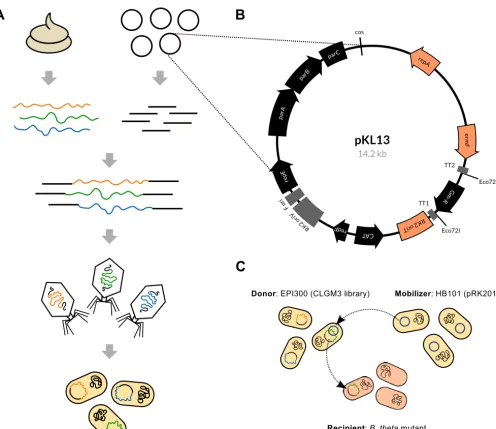
main-tained in
Escherichia coli
(Fig. 1A) and the cloned DNA is screened en masse for specific
functions of interest. This powerful approach allows the isolation of genes whose roles
may not have been predicted based on their DNA sequence alone (3), but crucially, the
method is dependent on the ability to express cloned metagenomic DNA in a surrogate
host.
The human gut microbiota is dominated by members of the
Firmicutes
and
Bacte-FIG 1 Overview of the functional metagenomics approach and development of aB. thetaiotaomicron-compatible system to screen gut-derived DNA. (A) Metagenomic library construction using DNA from the human gut: high-molecular-weight DNA is isolated from feces and ligated to a vector with acossite, allowing lambda phage packaging and transduction ofE. colito generate the library. Clones comprising the metagenomic library are typically pooled and saved as frozen stocks for future screening. Figure is adapted from reference 10. (B) Vector map of pKL13, a mobilizableB. thetaiotaomicron-compatible fosmid vector. Map generated using AngularPlasmid. (C) Depiction of the triparental conjugation to transfer a metagenomic library fromE. colito aB. thetaiotaomicron recipient for functional complementation of a mutant trait. The pKL13 fosmid is not self-mobilizable. The helper plasmid pRK2013, expressingtragenes, is transferred from the mobilizer strain to the donor strain, allowing the subsequent transfer of the library from the donor strain to the recipient strain.B. theta, B. thetaiotaomicron.
on September 8, 2020 by guest
http://msystems.asm.org/
roidetes
phyla, with the
Bacteroides
genus often the most abundant (4). Though
E. coli
,
a member of the
Gammaproteobacteria
, is often used as a surrogate host to screen
gut-derived DNA, there is evidence of a barrier to the expression of
Bacteroides
genes
at the level of transcription (5), due to differences in promoter consensus recognition
between the
Bacteroidetes
primary sigma factor and that of
E. coli
(6). The development
of a more suitable host will likely improve hit rates from activity screens (7), and in
particular, a
Bacteroides
host would offer an array of potentially selectable glycan
utilization phenotypes (8, 9) that are less feasible in
E. coli
. The human gut symbiont
Bacteroides thetaiotaomicron
is a natural choice as a surrogate host to screen gut
metagenomic DNA, given that molecular genetic methods for this organism are
reasonably well developed. Here, we describe our attempt to develop
B.
thetaiotaomi-cron
for functional metagenomics, through the construction of a
B. thetaiotaomicron
-compatible fosmid cloning vector, generation of a human gut metagenomic library,
and screening of the library to achieve functional complementation of a
B.
thetaiotao-micron
glycan utilization mutant.
RESULTS
Construction of a
Bacteroides
-compatible human gut metagenomic library.
To
be able to screen a library in a
B. thetaiotaomicron
host, the library must be constructed
using a vector that is able to replicate in
B. thetaiotaomicron
. To construct a suitable
library cloning vector, we chose to build on pCC1FOS, a commercial fosmid vector that
has been widely used for constructing metagenomic libraries from diverse
environ-ments (10). Although cosmid vectors for
B. thetaiotaomicron
have been constructed
in the past using pBR322 and RSF1010 origins (11, 12), we desired the potentially
increased insert stability offered by a single-copy F-based vector, as cloned
Bacteroides
DNA may be unstable in
E. coli
(12) and instability may be exacerbated by maintenance
at a higher copy number (13). We chose to use a self-replicating rather than an integrating
vector because the former allows fosmid DNA to be isolated from
B. thetaiotaomicron
cells by plasmid minipreparation, facilitating DNA sequencing of the complementing
insert. A fosmid vector was especially desirable for two reasons: (i) lambda packaging
to generate fosmid clone libraries is very efficient and (ii) large-fragment libraries would
be suitable for capturing the polysaccharide utilization loci of
Bacteroides
, which may
contain over 20 genes (9).
pCC1FOS was modified by the addition of an origin of transfer (
oriT
) to allow
plasmid conjugation from
E. coli
to
B. thetaiotaomicron
, as well as plasmid replication
elements (
repA
) and an erythromycin-selectable marker (
ermF
) for
B. thetaiotaomicron
.
The constructed
B. thetaiotaomicron
-compatible vector was designated pKL13 (Fig. 1B)
and used to generate a human gut metagenomic library, called CLGM3, that contained
over 100,000 unique clones with an estimated average insert size of 26
⫾
10 kb. To
assess the level of transfer from
E. coli
to
B. thetaiotaomicron
, a triparental conjugation
was carried out (Fig. 1C), resulting in conjugation efficiencies (relative to recipient) of
2.6
⫻
10
⫺2for the vector alone and 1.1
⫻
10
⫺2for the CLGM3 metagenomic library.
Though transfer into
B. thetaiotaomicron
was not as efficient as that for other surrogate
hosts, such as the legume symbiont
Sinorhizobium meliloti
(14), it was sufficient for
initial attempts at functional complementation.
Proof-of-principle functional complementation of a
B. thetaiotaomicron anSME
mutant.
As a host for a proof-of-principle functional complementation, we chose a
B. thetaiotaomicron
Δ
anSME
mutant, also called the Δ
chuR
mutant (15). The 1,245-bp
chuR
/
anSME
gene (BT_0238) was first identified through transposon mutagenesis as a
r
egulator of
ch
ondroitin sulfate and heparin
u
tilization (16). Knocking out this gene
renders
B. thetaiotaomicron
unable to grow on the glycan chondroitin sulfate or
heparin as a sole carbon source. It was later characterized as an
an
aerobic
s
ulfatase
m
aturating
e
nzyme: the breakdown of these glycans by
B. thetaiotaomicron
requires the
action of sulfatase enzymes that must be modified posttranslationally by the product
of the
anSME
gene (17); without this modification, the sulfatases are inactive. The
mutant phenotype being dependent on the single
anSME
gene, as well as the clean
on September 8, 2020 by guest
http://msystems.asm.org/
phenotype of the Δ
anSME
mutant on chondroitin sulfate (Fig. 2A), made it a good
candidate for functional complementation.
To screen the CLGM3 metagenomic library for genes able to complement the
anSME
mutant, the library was conjugated from
E. coli
EPI300 into the
B. thetaiotaomicron
Δ
anSME
strain, selecting on minimal medium with chondroitin sulfate as the sole
carbon source. As a positive control, a
B. thetaiotaomicron
genomic library (constructed
using
B. thetaiotaomicron
VPI 5482 DNA; called BT3) was screened simultaneously.
Colonies arising on the selective medium were streak purified to confirm the restored
phenotype, providing evidence that the mutant’s ability to grow on chondroitin sulfate
was restored by complementation with clones from the
B. thetaiotaomicron
genomic
library or the gut metagenomic library (Fig. 2B or C, respectively).
Possible fosmid clone recombination into the
B. thetaiotaomicron
host
ge-nome.
Plasmid DNA can be prepared from
B. thetaiotaomicron
cultures using standard
alkaline lysis, and we confirmed that plasmid preparations of empty vector DNA from
B. thetaiotaomicron
can be used to successfully transform
E. coli
EPI300. We applied this
same strategy to obtain the fosmid DNA from cultures of the complemented
anSME
mutant; however, plasmid minipreparations followed by transformation of EPI300
yielded no transformants for the samples, indicating that there was no fosmid DNA
isolated from these cultures despite the restored ability to use chondroitin sulfate as
the sole carbon source. We hypothesized that the
anSME
-complementing fosmid DNA
may have recombined into the host genome, an unfortunate scenario as the screening
of pooled-clone metagenomic libraries hinges on being able to retrieve the
comple-menting DNA for sequence analysis.
To test this hypothesis, we isolated genomic DNA from 5 clones from the BT3
complementation and 7 clones from the CLGM3 complementation and used the DNA
as the template in a PCR to test for the presence of the fosmid’s
oriT
sequence. As
suspected, the genomic DNA preparations from all clones were positive for the
oriT
(Fig. 3A). We also confirmed the
anSME
mutant background; this mutant strain carries
a deletion of the ~1,200-bp
anSME
open reading frame (ORF), and primers designed to
300 bp upstream and 300 bp downstream of the ORF amplify only 600 bp from the
mutant versus ~1,800 bp from the wild type. As expected, genomic DNA preparations
from all of the BT3- and CLGM3-complemented clones carried the mutant
anSME
genomic context (Fig. 3B).
We next asked whether the metagenomic fosmid clones were carrying DNA from
B. thetaiotaomicron
or closely related species, which may explain the propensity for
homologous recombination. To answer this, we performed PCR for the
anSME
ORF
using primers based on the
B. thetaiotaomicron
VPI 5482
anSME
sequence, which would
likely amplify only exact or close matches to
B. thetaiotaomicron
. All clones from the
FIG 2 Functional complementation ofB. thetaiotaomicron anSMEmutant on chondroitin sulfate as sole carbon source. (A) Comparison ofB. thetaiotaomicron VPI 5482 wild-type and ΔanSMEphenotypes on chondroitin sulfate as sole carbon source. (B and C) Streak-purified complementing clones in theanSME background, isolated from aB. thetaiotaomicrongenomic library (BT3) and a human gut metagenomic library (CLGM3), respectively.
on September 8, 2020 by guest
http://msystems.asm.org/
B. thetaiotaomicron
BT3 library produced PCR products (Fig. 3C), which was expected as
this library was constructed using
B. thetaiotaomicron
DNA. From the CLGM3
meta-genomic library, all but clone 2 showed amplification, confirming our suspicion that
most complementing clones were probably closely related to the host. We purified and
Sanger sequenced the PCR products, finding that 5 of the 6 metagenomic
anSME
sequences were an exact match to VPI 5482. The last of the 6 products, from CLGM3
clone 5, was not identical but highly similar (see Fig. 5).
FIG 3 PCR analysis of genomic DNA isolated fromanSME-complementedB. thetaiotaomicronclones. As controls, genomic DNAs from the wild-type (WT) B. thetaiotaomicronVPI 5482 and the ΔanSMEmutant were included, as well as plasmid DNA for the pKL13 fosmid. PCR was carried out to amplify theoriT sequence of the fosmid vector backbone (~800 bp) (A), a product corresponding to 300 bp upstream and 300 bp downstream of theanSMEORF (~1,800 bp for VPI 5482 and 600 bp for ΔanSME) (B), theanSMEORF (~1,200 bp for VPI 5482) (asterisks indicate products confirmed as identical toB. thetaiotaomicronVPI 5482 by Sanger sequencing) (C), and theanSMEORF plus 300 bp downstream (~1,500 bp for VPI 5482) (D).
on September 8, 2020 by guest
http://msystems.asm.org/
The result of the PCR for the
anSME
ORF and flanking region (Fig. 3B) was surprising
in that the BT3 library clones did not exhibit both the 600-bp and 1,800-bp bands—the
former from the
B. thetaiotaomicron
Δ
anSME
background and the latter from the
complementing fosmid DNA carrying the
B. thetaiotaomicron anSME
gene. To
deter-mine if the smaller product may be preferentially amplified in PCR, we designed primers
to the
anSME
locus such that the smaller PCR product was not possible, amplifying the
anSME
ORF plus 300 bp downstream (Fig. 3D). The ~1,500-bp product of this PCR
confirmed that indeed the complementing
anSME
locus was present in the clones
carrying VPI 5482 DNA (BT3 clones) or closely related metagenomic DNA (CLGM3
clones).
Genome sequencing of
B. thetaiotaomicron
⌬
anSME
complemented with
met-agenomic DNA.
We were interested in further characterizing CLGM3 clone 2 and clone
5; these derived from the metagenomic library and appeared to be carrying DNA
distinct from VPI 5482. We decided to carry out genome sequencing in the hope that
we could (i) gain insight into the sequence similarity between fosmid clone and host
that may contribute to recombination and (ii) identify the complementing
anSME
gene
from clone 2, which we were unable to retrieve using PCR (Fig. 3C). After sequencing,
we first aligned reads to the
B. thetaiotaomicron
VPI 5482 genome; second, we
de novo
assembled reads to identify pKL13 vector DNA and the complementing
anSME
genes.
By mapping reads from clone 2 back to VPI 5482, we were able to confirm the
Δ
anSME
mutant background through the zero read depth observed at the cleanly
deleted
anSME
ORF (Fig. 4A). Assembly of reads resulted in a fosmid-sized 45-kb contig
that included the pKL13 vector backbone and the complementing
anSME
gene
(Fig. 4B). The insert carried by the fosmid had 99% nucleotide identity to
Bacteroides
vulgatus
ATCC 8482 and was sufficiently different from VPI 5482 to enable essentially
complete assembly; this dissimilarity also validates the lack of an amplicon from PCR
using primers that were designed against the VPI 5482
anSME
sequence (Fig. 3C and D).
Interestingly, the ends of this contig share sequence similarity with regions that flank
a gene annotated as a transposase in the host genome, suggesting a possible
integra-tion mechanism and/or locus, although there exist other regions along the contig of
lower similarity to the host genome (see Fig. S1 in the supplemental material).
When we mapped reads from clone 5 back to VPI 5482, we found that there were
reads with high-enough similarity to map to the VPI 5482
anSME
locus. However, the
higher read depth at that locus as well as the low identity observed indicated a foreign
source of DNA; perhaps most tellingly, the stretch of low identity was consistent with
the size of a typical fosmid insert (Fig. 4C). The high sequence similarity between the
fosmid insert and host genome likely also contributed to a fragmented
de novo
assembly: a fosmid-sized contig was not assembled, although the pKL13 vector and
anSME
sequence were found on smaller contigs (Fig. 4D). The sequences adjacent to
the vector (on both ends) as well as the contig carrying the
anSME
gene exhibited high
nucleotide identity to
B. thetaiotaomicron
VPI 5482 (84 to 99%). Due to the fragmented
nature of assembly and the high similarity between metagenomic DNA and host DNA,
it was difficult to speculate on possible integration loci for this clone.
Gut-derived
anSME
genes identified by functional complementation.
Using
functional complementation, we were able to identify two
anSME
gene sequences from
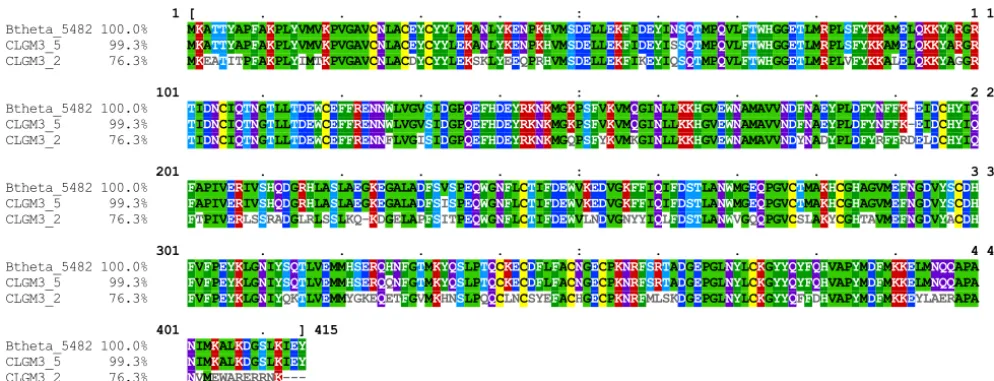
a gut metagenomic library (Fig. 4B and D). Comparison of the translated sequences to
the VPI 5482
anSME
415-residue protein sequence revealed a number of changes at the
amino acid level (Fig. 5), none of which were in the three conserved cysteine clusters
thought to be involved in the ability of the
anSME
gene product to mature sulfatase
enzymes (17).
The
anSME
gene of clone 2 was identical to
B. vulgatus
ATCC 8482, whereas the
anSME
gene of clone 5 appeared to be novel though nearly identical to
B. thetaiotaomicron
VPI
5482. The identification of
anSME
genes from a human gut metagenomic library that are
different in sequence from the
B. thetaiotaomicron
VPI 5482 host used for screening
indicates that functional screening of metagenomic libraries using
B.
on September 8, 2020 by guest
http://msystems.asm.org/
FIG 4 Genome sequencing andde novoassembly results forB. thetaiotaomicronΔanSMEcarrying CLGM3 clone 2 and clone 5. (A and C) Mean read depth per 5,000 bp after mapping reads to VPI 5482 genome. (Pullout) Read depth and percent identity per base pair at theanSMElocus; red lines delineateanSMEopen reading frame. (B and D) Relevant contigs fromde novoassembly; pKL13 vector sequence and complementinganSMEgene are indicated in red.B. theta,B. thetaiotaomicron.
on September 8, 2020 by guest
http://msystems.asm.org/
cron
is a promising strategy, although the issue of possible clone recombination will
need to be addressed.
DISCUSSION
In this study,
B. thetaiotaomicron
was chosen as a host for screening gut-derived
metagenomic DNA because it is anticipated to be able to express a greater fraction of
the cloned DNA than would
E. coli
. Previous work on the
B. thetaiotaomicron
16S rRNA
gene operon showed that while the
B. thetaiotaomicron
ribosome-binding site was
recognized by
E. coli
, the barrier to gene expression was due to lack of promoter
recognition (5). Though there have been reports in the literature of functional screens
in
E. coli
yielding positive clones carrying
Bacteroides
-derived DNA (18–22), these hits
may be due to spurious transcription of foreign DNA in
E. coli
rather than transcription
from native
Bacteroides
promoters.
To develop a system that may be better suited for screening gut metagenomic
libraries, we generated
B. thetaiotaomicron
-compatible fosmid libraries with which we
demonstrated successful functional complementation of a
B. thetaiotaomicron anSME
mutant. Analysis of the complemented mutants, however, indicated that
recombina-tion may have occurred between the host genome and the DNA carried on the fosmid
clones, suggesting high sequence similarity between the host genome and
comple-menting DNA. Consistent with this, we found that nearly all complecomple-menting
anSME
genes from the metagenomic library were exact or close matches to
B.
thetaiotaomi-cron
, which may not be surprising given that
B. thetaiotaomicron
is often a dominant
species in the human distal gut (23). We carried out full genome sequencing on 2 of the
7 metagenomic clones to obtain the complementing
anSME
genes and found both
deriving from
Bacteroides
species. It is possible that recombination may be due to
instability of the pKL13 vector backbone; however, we did confirm that empty vector
could be introduced into and reisolated from
B. thetaiotaomicron
.
To demonstrate that
B. thetaiotaomicron
can be used as a screening host, we chose
a Δ
anSME
mutant for the simplicity of its phenotype being dependent on a single gene.
In retrospect, this choice may have limited the diversity of hits obtained. Although
functional metagenomics is an approach that can uncover novel genes, here we found
that the
anSME
-complementing genes obtained from the gut were either identical or
closely related to
B. thetaiotaomicron
VPI 5482. To enrich for more diverse hits, it may
be useful to choose a target with a larger known sequence space, including multigene
operons; indeed, the strength of the functional metagenomic approach is that the large
inserts of
cos
-based vectors can carry entire operons involved in polysaccharide
utili-FIG 5 Multiple sequence alignment of theB. thetaiotaomicronVPI 5482anSMEgene and the metagenomicanSMEgenes from CLGM3 library clones 2 and 5. Translated nucleotide sequences were aligned to theB. thetaiotaomicronVPI 5482 protein sequence using MUSCLE version 3.8 (38) and visualized with MView (39). Percent identity is indicated on the left; residues differing from VPI 5482 are indicated in white. Btheta,B. thetaiotaomicron.
on September 8, 2020 by guest
http://msystems.asm.org/
zation. Here, we showed that an ~45-kb fosmid carrying human gut metagenomic DNA
can be successfully conjugated into
B. thetaiotaomicron
, demonstrating that large,
multigene operons characteristic of polysaccharide utilization loci can be transferred for
functional complementation.
Although the propensity for homologous recombination presents difficulties for the
screening of pooled-clone metagenomic libraries, it is not a barrier to the functional
metagenomics approach. One possible solution is to use arrayed libraries in which
clones are stored and conjugated into the recipient individually, enabling clone
track-ing and eliminattrack-ing the need for clone DNA retrieval. Individual conjugations may also
be advantageous over en masse conjugations if the relatively low conjugation
effi-ciency is a bottleneck for transferring large clone libraries into a
B. thetaiotaomicron
recipient. Screening of arrayed libraries containing hundreds of thousands of clones,
however, often requires specialized equipment to achieve the necessary throughput.
Another possible solution may be to use a recombination-deficient
B. thetaiotaomicron
strain, although a
B. thetaiotaomicron recA
mutant has been reported to have increased
sensitivity to oxygen (24).
Our results show that the development of a
B. thetaiotaomicron
system for
func-tional screening was not as straightforward as hoped; however, the genetic tractability
of
B. thetaiotaomicron
and the generation of genetic tools with which to manipulate it
(25) provide support for continued efforts. In addition, a more quantitative comparison
between
E. coli
and
B. thetaiotaomicron
as expression hosts for metagenomic library
screening would be valuable. Although the development of a
B. thetaiotaomicron
expression host may offer an advantage over
E. coli
for screening DNA derived from the
Bacteroidetes
,
B. thetaiotaomicron
would not be ideal for screening DNA from other
phyla present in the gut, particularly
Firmicutes
. A comprehensive screening strategy
will likely require the use of multiple expression hosts. Indeed, expanding the range of
screening hosts will be important for the functional metagenomics field and for the
characterization of microbial genes with currently unknown function. The fosmid vector
that we have described in this report, and the strategy for functional complementation
via conjugal transfer, will provide a strong foundation for further refinements.
MATERIALS AND METHODS
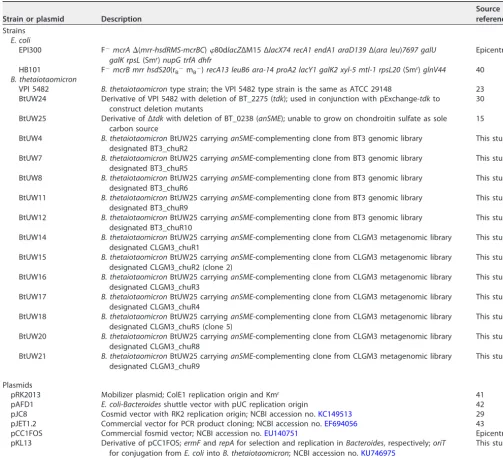
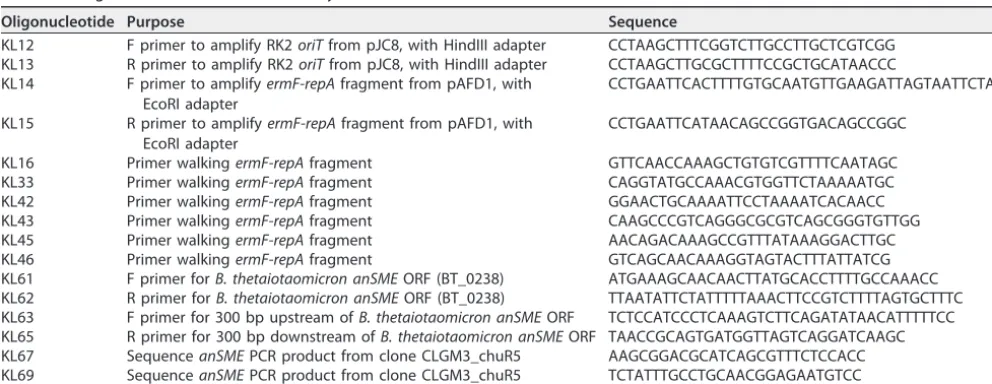
Bacterial strains, plasmids, and oligonucleotides.The bacterial strains and plasmids used in this study are provided in Table 1. Oligonucleotide names and sequences are provided in Table 2.
Culture of E. coli.E. coliwas routinely cultured in LB broth or agar at 37°C with appropriate antibiotics. Antibiotics used in solid medium were chloramphenicol (10g/ml), ampicillin (100g/ml), kanamycin (25g/ml), and tetracycline (10 g/ml); antibiotic concentrations were halved for liquid culture.
Culture ofB. thetaiotaomicron.B. thetaiotaomicronwas routinely cultured in broth using brain heart infusion medium (BD Biosciences), supplemented with 1.2 M histidine, 1.9 M hematin, 1g/ml menadione, and 500 g/ml cysteine (BHI⫹). B. thetaiotaomicron was cultured in liquid using the pyrogallol method (26): after inoculation, a cotton ball was inserted into the mouth of the culture tube and set aflame; after the flame was extinguished, 200l of 20% (wt/vol) NaCO3and 200l of 35%
(wt/vol) pyrogallol were added to the cotton, and the tube was immediately plugged with a rubber stopper. Cultures ofB. thetaiotaomicronwere incubated at 37°C, without shaking. Typically, resazurin was added to the liquid medium as an indicator of oxidizing/reducing conditions (1-g/ml final concentra-tion). B. thetaiotaomicronwas cultured on complex medium agar plates using brain heart infusion medium, supplemented with 10% defibrinated horse blood (Bio-Media Unlimited) (BHIH). Minimal medium agar with chondroitin sulfate as the sole carbon source was prepared by dissolving chondroitin sulfate (Sigma-Aldrich or Toronto Research Chemicals) completely in distilled water (for a 5-g/liter final concentration) and autoclaving with agar, followed by adding salts and supplements as previously described (27) as well as trace elements (1,000⫻stock solution; concentrations per liter: 0.247 g H3BO3,
0.1 g CuSO4·5H2O, 0.338 g MnSO4·H2O, 0.282 g ZnSO4·7H2O, 0.056 g CoSO4·7H2O, and 0.048 g
Na2MoO4·2H2O) and the appropriate antibiotics. Antibiotics used in solid medium were gentamicin
(200g/ml), kanamycin (200g/ml), nalidixic acid (25g/ml), and erythromycin (10g/ml); antibiotic concentrations were halved for liquid culture. Agar plates were incubated in airtight containers with GasPak EZ anaerobe sachets (BD Biosciences).
Construction of pKL13 fosmid vector. The fosmid cloning vector pCC1FOS was modified for screening in aB. thetaiotaomicronhost. Briefly, the RK2oriTfragment was amplified from pJC8 using primers KL12/KL13 and KOD Hot Start DNA polymerase (Novagen) according to the manufacturer’s recommendations and then digested and cloned into the HindIII site. The ermF-repAfragment was amplified from pAFD1 using primers KL14/KL15, cloned into the intermediate vector pJET1.2 (Thermo
on September 8, 2020 by guest
http://msystems.asm.org/
Fisher), and then digested and subcloned into the EcoRI site. The ~4-kbermF-repAfragment was sequenced at the Centre for Applied Genomics (Toronto, Canada) to compile the complete sequence for the constructed vector pKL13, using primers KL14, KL16, KL33, KL42, KL43, KL45, and KL46 (Table 2). The vector was further modified to include transcriptional terminators (TTs) that flank the Eco72I cloning site to reduce insert-borne transcription, with both terminators fromE. coliMG1655; the TT proximal toermF incorporates theilvGEDA terminator and the TT proximal to the RK2oriT incorporates thernpB T1 terminator (28). Finally, pKL13 contains a stuffer in the Eco72I site that aids in complete digestion of the restriction enzyme site.
Construction of genomic and metagenomic fosmid libraries. The metagenomic library was constructed using DNA extracted from a human fecal sample pooled from seven volunteers, obtained with clearance from the Office of Research Ethics of the University of Waterloo. The metagenomic library was designated CLGM3, and the genomic library constructed using genomic DNA fromB. thetaiotao-micronVPI 5482 was designated BT3. Library construction was based on methods described previously (29). Briefly, DNA was extracted from either feces or a pure culture ofB. thetaiotaomicronVPI 5482 and size selected (~40 to 70 kb) by pulsed-field gel electrophoresis. The insert DNA was electroeluted from the gel fragment, end repaired, and purified for ligation. The fosmid vector pKL13 was prepared by Eco72I digestion followed by dephosphorylation. The insert and vector were ligated, and the ligation products were packaged into lambda phage heads using Gigapack III XL packaging extract (Stratagene). The phage were used to transduce EPI300, and transductants were recovered on LB supplemented with
TABLE 1 Bacterial strains and plasmids used in this study
Strain or plasmid Description
Source or reference
Strains
E. coli
EPI300 F⫺mcrA⌬(mrr-hsdRMS-mcrBC)80dlacZΔM15 ΔlacX74 recA1 endA1 araD139Δ(ara leu)7697 galU galK rpsL(Smr)nupG trfA dhfr
Epicentre
HB101 F⫺mcrB mrr hsdS20(r
B⫺mB⫺)recA13 leuB6 ara-14 proA2 lacY1 galK2 xyl-5 mtl-1 rpsL20(Smr)glnV44 40
B. thetaiotaomicron
VPI 5482 B. thetaiotaomicrontype strain; the VPI 5482 type strain is the same as ATCC 29148 23 BtUW24 Derivative of VPI 5482 with deletion of BT_2275 (tdk); used in conjunction with pExchange-tdkto
construct deletion mutants
30
BtUW25 Derivative of Δtdkwith deletion of BT_0238 (anSME); unable to grow on chondroitin sulfate as sole carbon source
15
BtUW4 B. thetaiotaomicronBtUW25 carryinganSME-complementing clone from BT3 genomic library designated BT3_chuR2
This study
BtUW7 B. thetaiotaomicronBtUW25 carryinganSME-complementing clone from BT3 genomic library designated BT3_chuR5
This study
BtUW8 B. thetaiotaomicronBtUW25 carryinganSME-complementing clone from BT3 genomic library designated BT3_chuR6
This study
BtUW11 B. thetaiotaomicronBtUW25 carryinganSME-complementing clone from BT3 genomic library designated BT3_chuR9
This study
BtUW12 B. thetaiotaomicronBtUW25 carryinganSME-complementing clone from BT3 genomic library designated BT3_chuR10
This study
BtUW14 B. thetaiotaomicronBtUW25 carryinganSME-complementing clone from CLGM3 metagenomic library designated CLGM3_chuR1
This study
BtUW15 B. thetaiotaomicronBtUW25 carryinganSME-complementing clone from CLGM3 metagenomic library designated CLGM3_chuR2 (clone 2)
This study
BtUW16 B. thetaiotaomicronBtUW25 carryinganSME-complementing clone from CLGM3 metagenomic library designated CLGM3_chuR3
This study
BtUW17 B. thetaiotaomicronBtUW25 carryinganSME-complementing clone from CLGM3 metagenomic library designated CLGM3_chuR4
This study
BtUW18 B. thetaiotaomicronBtUW25 carryinganSME-complementing clone from CLGM3 metagenomic library designated CLGM3_chuR5 (clone 5)
This study
BtUW20 B. thetaiotaomicronBtUW25 carryinganSME-complementing clone from CLGM3 metagenomic library designated CLGM3_chuR8
This study
BtUW21 B. thetaiotaomicronBtUW25 carryinganSME-complementing clone from CLGM3 metagenomic library designated CLGM3_chuR9
This study
Plasmids
pRK2013 Mobilizer plasmid; ColE1 replication origin and Kmr 41
pAFD1 E. coli-Bacteroidesshuttle vector with pUC replication origin 42 pJC8 Cosmid vector with RK2 replication origin; NCBI accession no.KC149513 29 pJET1.2 Commercial vector for PCR product cloning; NCBI accession no.EF694056 43 pCC1FOS Commercial fosmid vector; NCBI accession no.EU140751 Epicentre pKL13 Derivative of pCC1FOS;ermFandrepAfor selection and replication inBacteroides, respectively;oriT
for conjugation fromE. coliintoB. thetaiotaomicron; NCBI accession no.KU746975
This study
on September 8, 2020 by guest
http://msystems.asm.org/
chloramphenicol (10 g/ml). Colonies were counted to estimate library size and then resuspended, pooled, aliquoted to generate the CLGM3 and BT3 library stocks, and stored at⫺80°C.
Triparental conjugation fromE. colitoB. thetaiotaomicron.The triparental conjugation protocol was adapted from a biparental protocol (30). Matings were carried out using 5 ml of each of the donor, mobilizer, and recipient strains. TheE. colidonor and mobilizer were cultured in 5 ml LB supplemented with the appropriate antibiotics, and theB. thetaiotaomicronrecipient was cultured in 5 ml BHI⫹; all were grown to an optical density at 600 nm (OD600) of ~0.4 (Spectronic Spec 20 D). Cells were pelleted by
centrifugation at 7,000⫻gat room temperature for 5 min. The supernatant was removed, and the cells were resuspended in either BHI⫹or 1⫻Bt salts [per liter: 13.6 g KH2PO4, 0.875 g NaCl, 1.125 g (NH4)2SO4;
pH 7.2 (27)]. Donor, mobilizer, and recipient were mixed in a final volume of 1 ml, and the mixture was swirled evenly over the surface of a BHIH plate. The plate was dried for several minutes in a laminar flow hood and then incubated aerobically overnight with the agar side down. Overnight mating lawns were scraped and resuspended in 2 ml BHI⫹or 1⫻Bt salts. Typically, serial 10-fold dilutions were made from 10⫺1to 10⫺3, and 100l of each dilution was plated on BHIH supplemented with appropriate antibiotics
to select for transconjugants; typically, kanamycin or nalidixic acid was used to select againstE. coliand erythromycin was used to select for the vector. If the mating was plated on minimal medium, then the mating resuspension was washed to remove complex medium components by three repetitions of centrifugation and resuspension in 1⫻Bt salts.
Genomic DNA minipreparation ofB. thetaiotaomicron.The minipreparation protocol is based on the method described by Charles and Nester (31). Briefly,B. thetaiotaomicronwas cultured in 10 ml of liquid medium with the appropriate antibiotics, and the cell pellets were recovered after centrifugation at 7,000⫻gfor 5 min at room temperature. Cells were resuspended in 400l buffer (10 mM Tris [pH 8.0], 25 mM EDTA), 50l 5 M NaCl and 10l 10-mg/ml RNase A were added, and the tube was inverted several times. Twenty-five microliters of 20% SDS was added, and the sample was incubated at 65°C for 1 to 2 h. Two hundred sixty microliters of 7.5 M ammonium acetate was added, and the sample was incubated on ice for 20 min to precipitate proteins. The mixture was centrifuged at 21,000⫻gfor 20 min, the supernatant was decanted into a new microcentrifuge tube, and the mixture was extracted with chloroform in a 1:1 volume. The DNA was precipitated with 800 l isopropanol and pelleted by centrifugation at 21,000⫻gfor 5 min. The pellet was washed with 100l 70% ethanol and centrifuged at 21,000⫻gfor 1 min, the supernatant was removed, and the pellet was allowed to dry. Finally, the pellet was allowed to dissolve in 50l Tris-EDTA (TE) overnight at 4°C, and the genomic DNA was gel quantified against a dilution series of bacteriophageDNA (Thermo Fisher) using the software ImageJ (32).
PCR analysis. Genomic DNA was isolated from the B. thetaiotaomicronclones carryinganSME -complementing fosmid DNA and used as the template.Taq-based 2⫻PCR master mix (Thermo Fisher) was used according to the manufacturer’s recommendations, with the exception that RNase A was added to remove RNA contamination (25-g/ml final concentration). The touchdown PCR protocol used was 95°C for 3 min; 11 cycles of 95°C for 30 s, 60°C for 30 s (decrease of 1°C per cycle), and 72°C for 1 min/kb; 20 cycles of 95°C for 30 s, 50°C for 30 s, and 72°C for 1 min/kb; and 72°C for 5 min. PCR products chosen for Sanger sequencing were gel extracted, dissolved in binding buffer (140 mM 2-[N-morpholino]ethanesulfonic acid [MES]-NaOH [pH 7.0], 20 mM EDTA, 5.5 M guanidine isothiocyanate [33]) at 65°C for 5 min, applied to a silica spin column (BioBasic), washed several times (10 mM Tris-HCl [pH 7.5], 80% ethanol), and eluted in TE buffer. Sanger sequencing was completed at the Centre for Applied Genomics (Toronto, Canada).
Genome sequencing and analysis.Genome sequence data were generated on an Illumina MiSeq platform using 250-base paired-end sequencing. Sequence data were aligned to theB. thetaiotaomicron VPI 5482 reference genome (NCBI accession no.NC_004663.1for the chromosome andNC_004703.1for
TABLE 2 Oligonucleotides used in this study
Oligonucleotide Purpose Sequence
KL12 F primer to amplify RK2oriTfrom pJC8, with HindIII adapter CCTAAGCTTTCGGTCTTGCCTTGCTCGTCGG KL13 R primer to amplify RK2oriTfrom pJC8, with HindIII adapter CCTAAGCTTGCGCTTTTCCGCTGCATAACCC KL14 F primer to amplifyermF-repAfragment from pAFD1, with
EcoRI adapter
CCTGAATTCACTTTTGTGCAATGTTGAAGATTAGTAATTCTATTC
KL15 R primer to amplifyermF-repAfragment from pAFD1, with EcoRI adapter
CCTGAATTCATAACAGCCGGTGACAGCCGGC
KL16 Primer walkingermF-repAfragment GTTCAACCAAAGCTGTGTCGTTTTCAATAGC KL33 Primer walkingermF-repAfragment CAGGTATGCCAAACGTGGTTCTAAAAATGC KL42 Primer walkingermF-repAfragment GGAACTGCAAAATTCCTAAAATCACAACC KL43 Primer walkingermF-repAfragment CAAGCCCGTCAGGGCGCGTCAGCGGGTGTTGG KL45 Primer walkingermF-repAfragment AACAGACAAAGCCGTTTATAAAGGACTTGC KL46 Primer walkingermF-repAfragment GTCAGCAACAAAGGTAGTACTTTATTATCG KL61 F primer forB. thetaiotaomicron anSMEORF (BT_0238) ATGAAAGCAACAACTTATGCACCTTTTGCCAAACC KL62 R primer forB. thetaiotaomicron anSMEORF (BT_0238) TTAATATTCTATTTTTAAACTTCCGTCTTTTAGTGCTTTC KL63 F primer for 300 bp upstream ofB. thetaiotaomicron anSMEORF TCTCCATCCCTCAAAGTCTTCAGATATAACATTTTTCC KL65 R primer for 300 bp downstream ofB. thetaiotaomicron anSMEORF TAACCGCAGTGATGGTTAGTCAGGATCAAGC KL67 SequenceanSMEPCR product from clone CLGM3_chuR5 AAGCGGACGCATCAGCGTTTCTCCACC KL69 SequenceanSMEPCR product from clone CLGM3_chuR5 TCTATTTGCCTGCAACGGAGAATGTCC
on September 8, 2020 by guest
http://msystems.asm.org/
the plasmid) using Bowtie 2 version 2.2.6 (34). Sequence data werede novoassembled using SPAdes version 3.8.0 (35), and functional annotations were obtained for contigs of interest using RAST (36). Regions of similarity between host and clone DNA were identified using Mauve (37). Data analyses were performed in R, including packagesRsamtools,Gviz,ape, andgenoPlotR.
Data availability.Raw sequence data have been deposited at the NCBI Sequence Read Archive under accession numbersSRX3141910(CLGM3 clone 2) andSRX3141914(CLGM3 clone 5). Sequence data and other data may be accessed online athttp://www.cm2bl.org/~data, including the raw data, alignment files, genome assemblies, and sequences of theanSMEORFs andermF-repAfragment, as well as ab1 files from Sanger sequencing. The sequence of the constructedB. thetaiotaomicron-compatible vector, designated pKL13, may be found under NCBI accession no.KU746975. The metagenomic library designated CLGM3 may be found at NCBI BioSample accession no.SAMN04505233, and the genomic library constructed using genomic DNA fromB. thetaiotaomicronVPI 5482, designated BT3, may be found at NCBI BioSample accession no.SAMN04505228.
SUPPLEMENTAL MATERIAL
Supplemental material for this article may be found at
https://doi.org/10.1128/
mSystems.00195-17
.
FIG S1,
EPS file, 0.6 MB.
ACKNOWLEDGMENTS
We are grateful to Nadja Shoemaker and Abigail Salyers (University of Illinois at
Urbana-Champaign) for sharing
B. thetaiotaomicron
plasmids, to Nicole Koropatkin
(University of Michigan) for sharing
B. thetaiotaomicron
strains, and to Jiujun Cheng and
John Heil (University of Waterloo) for helpful suggestions.
This work was supported by an NSERC Discovery Grant and NSERC Strategic Projects
Grant to T.C.C. K.N.L. was supported by a CIHR Frederick Banting and Charles Best CGS
Doctoral Scholarship and a CIHR Michael Smith Foreign Study Supplement held at the
University of Michigan.
K.N.L. and T.C.C. conceived the ideas. K.N.L., E.C.M., and T.C.C. designed the
exper-iments. K.N.L. performed the experiments, analyzed the data, made the figures, and
wrote the manuscript. E.C.M. and T.C.C. provided constructive criticism, revised the
manuscript, and provided reagents and materials.
REFERENCES
1. Joice R, Yasuda K, Shafquat A, Morgan XC, Huttenhower C. 2014. Deter-mining microbial products and identifying molecular targets in the human microbiome. Cell Metab 20:731–741.https://doi.org/10.1016/j .cmet.2014.10.003.
2. Alivisatos AP, Blaser MJ, Brodie EL, Chun M, Dangl JL, Donohue TJ, Dorrest-ein PC, Gilbert JA, Green JL, Jansson JK, Knight R, Maxon ME, McFall-Ngai MJ, Miller JF, Pollard KS, Ruby EG, Taha SA, Unified Microbiome Initiative Con-sortium. 2015. A unified initiative to harness Earth’s microbiomes. Science 350:507–508.https://doi.org/10.1126/science.aac8480.
3. Culligan EP, Sleator RD, Marchesi JR, Hill C. 2014. Metagenomics and novel gene discovery: promise and potential for novel therapeutics. Virulence 5:399 – 412.https://doi.org/10.4161/viru.27208.
4. Arumugam M, Raes J, Pelletier E, Le Paslier D, Yamada T, Mende DR, Fernandes GR, Tap J, Bruls T, Batto JM, Bertalan M, Borruel N, Casellas F, Fernandez L, Gautier L, Hansen T, Hattori M, Hayashi T, Kleerebezem M, Kurokawa K, Leclerc M, Levenez F, Manichanh C, Nielsen HB, Nielsen T, Pons N, Poulain J, Qin J, Sicheritz-Ponten T, Tims S, Torrents D, Ugarte E, Zoetendal EG, Wang J, Guarner F, Pedersen O, de Vos WM, Brunak S, Doré J, MetaHIT Consortium, Weissenbach J, Ehrlich SD, Bork P. 2011. Enterotypes of the human gut microbiome. Nature 473:174 –180.https:// doi.org/10.1038/nature09944.
5. Mastropaolo MD, Thorson ML, Stevens AM. 2009. Comparison ofBacteroides thetaiotaomicronandEscherichia coli16S rRNA gene expression signals. Microbiology 155:2683–2693.https://doi.org/10.1099/mic.0.027748-0. 6. Vingadassalom D, Kolb A, Mayer C, Rybkine T, Collatz E, Podglajen I. 2005.
An unusual primary sigma factor in the Bacteroidetes phylum. Mol Micro-biol 56:888 –902.https://doi.org/10.1111/j.1365-2958.2005.04590.x. 7. Uchiyama T, Miyazaki K. 2009. Functional metagenomics for enzyme
discovery: challenges to efficient screening. Curr Opin Biotechnol 20: 616 – 622.https://doi.org/10.1016/j.copbio.2009.09.010.
8. Martens EC, Koropatkin NM, Smith TJ, Gordon JI. 2009. Complex glycan catabolism by the human gut microbiota: the Bacteroidetes Sus-like
paradigm. J Biol Chem 284:24673–24677. https://doi.org/10.1074/jbc .R109.022848.
9. Koropatkin NM, Cameron EA, Martens EC. 2012. How glycan metabolism shapes the human gut microbiota. Nat Rev Microbiol 10:323–335. https://doi.org/10.1038/nrmicro2746.
10. Lam KN, Cheng J, Engel K, Neufeld JD, Charles TC. 2015. Current and future resources for functional metagenomics. Front Microbiol 6:1196. https://doi.org/10.3389/fmicb.2015.01196.
11. Guiney DG, Bouic K, Hasegawa P, Matthews B. 1988. Construction of shuttle cloning vectors forBacteroides fragilisand use in assaying foreign tetracycline resistance gene expression. Plasmid 20:17–22.https://doi .org/10.1016/0147-619X(88)90003-0.
12. Shoemaker NB, Barber RD, Salyers AA. 1989. Cloning and characteriza-tion of aBacteroidesconjugal tetracycline-erythromycin resistance ele-ment by using a shuttle cosmid vector. J Bacteriol 171:1294 –1302. https://doi.org/10.1128/jb.171.3.1294-1302.1989.
13. Kim UJ, Shizuya H, de Jong PJ, Birren B, Simon MI. 1992. Stable propa-gation of cosmid sized human DNA inserts in an F factor based vector. Nucleic Acids Res 20:1083–1085.https://doi.org/10.1093/nar/20.5.1083. 14. Friedman AM, Long SR, Brown SE, Buikema WJ, Ausubel FM. 1982. Construction of a broad host range vector and its use in the genetic analysis of Rhizobium mutants. Gene 18:289 –296.https://doi.org/10 .1016/0378-1119(82)90167-6.
15. Benjdia A, Martens EC, Gordon JI, Berteau O. 2011. Sulfatases and a radical S-adenosyl-L-methionine (AdoMet) enzyme are key for muco-sal foraging and fitness of the prominent human gut symbiont,Bacteroides thetaiotaomicron. J Biol Chem 286:25973–25982.https://doi.org/10.1074/jbc .M111.228841.
16. Cheng Q, Hwa V, Salyers AA. 1992. A locus that contributes to coloni-zation of the intestinal tract byBacteroides thetaiotaomicroncontains a single regulatory gene (chuR) that links two polysaccharide utilization
on September 8, 2020 by guest
http://msystems.asm.org/
pathways. J Bacteriol 174:7185–7193.https://doi.org/10.1128/jb.174.22 .7185-7193.1992.
17. Benjdia A, Subramanian S, Leprince J, Vaudry H, Johnson MK, Berteau O. 2008. Anaerobic sulfatase-maturating enzymes, first dual substrate rad-ical S-adenosylmethionine enzymes. J Biol Chem 283:17815–17826. https://doi.org/10.1074/jbc.M710074200.
18. Lakhdari O, Cultrone A, Tap J, Gloux K, Bernard F, Ehrlich SD, Lefèvre F, Doré J, Blottière HM. 2010. Functional metagenomics: a high throughput screening method to decipher microbiota-driven NF-B modulation in the human gut. PLoS One 5:e13092.https://doi.org/ 10.1371/journal.pone.0013092.
19. Tasse L, Bercovici J, Pizzut-Serin S, Robe P, Tap J, Klopp C, Cantarel BL, Coutinho PM, Henrissat B, Leclerc M, Doré J, Monsan P, Remaud-Simeon M, Potocki-Veronese G. 2010. Functional metagenomics to mine the human gut microbiome for dietary fiber catabolic enzymes. Genome Res 20:1605–1612.https://doi.org/10.1101/gr.108332.110.
20. Pope PB, Denman SE, Jones M, Tringe SG, Barry K, Malfatti SA, McHardy AC, Cheng JF, Hugenholtz P, McSweeney CS, Morrison M. 2010. Adap-tation to herbivory by the tammar wallaby includes bacterial and gly-coside hydrolase profiles different from other herbivores. Proc Natl Acad Sci U S A 107:14793–14798.https://doi.org/10.1073/pnas.1005297107. 21. Gong X, Gruninger RJ, Qi M, Paterson L, Forster RJ, Teather RM,
McAl-lister TA. 2012. Cloning and identification of novel hydrolase genes from a dairy cow rumen metagenomic library and characterization of a cel-lulase gene. BMC Res Notes 5:566.https://doi.org/10.1186/1756-0500-5 -566.
22. Yoon MY, Lee KM, Yoon Y, Go J, Park Y, Cho YJ, Tannock GW, Yoon SS. 2013. Functional screening of a metagenomic library reveals operons responsible for enhanced intestinal colonization by gut commensal microbes. Appl Environ Microbiol 79:3829 –3838.https://doi.org/10 .1128/AEM.00581-13.
23. Xu J, Bjursell MK, Himrod J, Deng S, Carmichael LK, Chiang HC, Hooper LV, Gordon JI. 2003. A genomic view of the human-Bacteroides thetaiotaomicron symbiosis. Science 299:2074 –2076.https://doi.org/10 .1126/science.1080029.
24. Cooper AJ, Kalinowski AP, Shoemaker NB, Salyers AA. 1997. Construction and characterization of a Bacteroides thetaiotaomicron recA mutant: transfer ofBacteroidesintegrated conjugative elements is RecA indepen-dent. J Bacteriol 179:6221– 6227.https://doi.org/10.1128/jb.179.20.6221 -6227.1997.
25. Mimee M, Tucker AC, Voigt CA, Lu TK. 2015. Programming a human commensal bacterium,Bacteroides thetaiotaomicron, to sense and re-spond to stimuli in the murine gut microbiota. Cell Syst 1:62–71.https:// doi.org/10.1016/j.cels.2015.06.001.
26. Holdeman LV, Cato ED, Moore WEC. 1977. Anaerobe laboratory manual. Virginia Polytechnic Institute and State University Anaerobe Laboratory, Blacksburg, VA.
27. Martens EC, Chiang HC, Gordon JI. 2008. Mucosal glycan foraging en-hances fitness and transmission of a saccharolytic human gut bacterial symbiont. Cell Host Microbe 4:447– 457.https://doi.org/10.1016/j.chom .2008.09.007.
28. Cambray G, Guimaraes JC, Mutalik VK, Lam C, Mai QA, Thimmaiah T, Carothers JM, Arkin AP, Endy D. 2013. Measurement and modeling of
intrinsic transcription terminators. Nucleic Acids Res 41:5139 –5148. https://doi.org/10.1093/nar/gkt163.
29. Cheng J, Pinnell L, Engel K, Neufeld JD, Charles TC. 2014. Versatile broad-host-range cosmids for construction of high quality metagenomic libraries. J Microbiol Methods 99:27–34.https://doi.org/10.1016/j.mimet .2014.01.015.
30. Koropatkin NM, Martens EC, Gordon JI, Smith TJ. 2008. Starch catabolism by a prominent human gut symbiont is directed by the recognition of amylose helices. Structure 16:1105–1115. https://doi.org/10.1016/j.str .2008.03.017.
31. Charles TC, Nester EW. 1993. A chromosomally encoded two-component sensory transduction system is required for virulence ofAgrobacterium tumefaciens. J Bacteriol 175:6614 – 6625.https://doi.org/10.1128/jb.175 .20.6614-6625.1993.
32. Schneider CA, Rasband WS, Eliceiri KW. 2012. NIH Image to ImageJ: 25 years of image analysis. Nat Methods 9:671– 675. https://doi.org/10 .1038/nmeth.2089.
33. Kim YC, Morrison SL. 2009. A rapid and economic in-house DNA purifi-cation method using glass syringe filters. PLoS One 4:e7750.https://doi .org/10.1371/journal.pone.0007750.
34. Langmead B, Salzberg SL. 2012. Fast gapped-read alignment with Bow-tie 2. Nat Methods 9:357–359.https://doi.org/10.1038/nmeth.1923. 35. Bankevich A, Nurk S, Antipov D, Gurevich AA, Dvorkin M, Kulikov AS,
Lesin VM, Nikolenko SI, Pham S, Prjibelski AD, Pyshkin AV, Sirotkin AV, Vyahhi N, Tesler G, Alekseyev MA, Pevzner PA. 2012. SPAdes: a new genome assembly algorithm and its applications to single-cell sequenc-ing. J Comput Biol 19:455– 477.https://doi.org/10.1089/cmb.2012.0021. 36. Overbeek R, Olson R, Pusch GD, Olsen GJ, Davis JJ, Disz T, Edwards RA, Gerdes S, Parrello B, Shukla M, Vonstein V, Wattam AR, Xia F, Stevens R. 2014. The SEED and the Rapid Annotation of microbial genomes using Subsystems Technology (RAST). Nucleic Acids Res 42:D206 –D214.https:// doi.org/10.1093/nar/gkt1226.
37. Darling AE, Mau B, Perna NT. 2010. progressiveMauve: multiple genome alignment with gene gain, loss and rearrangement. PLoS One 5:e11147. https://doi.org/10.1371/journal.pone.0011147.
38. Edgar RC. 2004. MUSCLE: a multiple sequence alignment method with reduced time and space complexity. BMC Bioinformatics 5:113.https:// doi.org/10.1186/1471-2105-5-113.
39. Brown NP, Leroy C, Sander C. 1998. MView: a web-compatible database search or multiple alignment viewer. Bioinformatics 14:380 –381.https:// doi.org/10.1093/bioinformatics/14.4.380.
40. Boyer HW, Roulland-Dussoix D. 1969. A complementation analysis of the restriction and modification of DNA inEscherichia coli. J Mol Biol 41: 459 – 472.https://doi.org/10.1016/0022-2836(69)90288-5.
41. Figurski DH, Helinski DR. 1979. Replication of an origin-containing de-rivative of plasmid RK2 dependent on a plasmid function provided in trans. Proc Natl Acad Sci U S A 76:1648 –1652.https://doi.org/10.1073/ pnas.76.4.1648.
42. Salyers AA, Shoemaker N, Cooper A, Elia JD, Shipman JA. 1999. Genetic methods forBacteroidesspecies. Methods Microbiol 29:230 –249. 43. Lubys A. October 2014. Vectors comprising toxic genes for cloning and
expression. European patent EP2011878B1.