Volume 2007, Article ID 25308,8pages doi:10.1155/2007/25308
Research Article
Breaking the BOWS Watermarking System:
Key Guessing and Sensitivity Attacks
Pedro Comesa ˜na and Fernando P ´erez-Gonz ´alez
Signal Theory and Communications Department, University of Vigo, 36310 Vigo, Spain
Correspondence should be addressed to Pedro Comesa˜na, [email protected]
Received 11 May 2007; Accepted 31 August 2007
Recommended by A. Piva
From December 15, 2005 to June 15, 2006, the watermarking community was challenged to remove the watermark from 3 different 512×512 watermarked images while maximizing thepeak signal-to-noise ratio(PSNR) measured by comparing the watermarked signals with their attacked counterparts. This challenge, which bore the inviting name ofBreak Our Watermarking System(BOWS), had as its main objective to enlarge the current knowledge on attacks to watermarking systems. In this paper, the main results obtained by the authors when attacking the BOWS system are presented and compared with strategies followed by other groups. Essentially, two different approaches have been followed:exhaustive search of the secret keyandblind sensitivity attacks.
Copyright © 2007 P. Comesa˜na and F. P´erez-Gonz´alez. This is an open access article distributed under the Creative Commons Attribution License, which permits unrestricted use, distribution, and reproduction in any medium, provided the original work is properly cited.
1. INTRODUCTION
In the last decade, with the spreading of the Internet as an impressive communication tool and the appearance of ad-vanced editing tools which can be used by almost any non-trained user, the need of new technical solutions to the prob-lems of copyright protection, authentication, fingerprinting, or annotation of digital contents has soared. Digital water-marking has been widely recognized as a potentially pow-erful instrument against piracy, illegal modification, or im-proper use of contents. Nevertheless, experience has shown that the challenge of designing a watermarking method ro-bust against an active attacker is extremely difficult. Even without considering geometrical attacks (which can be re-garded as some of the most harmful attacks against wa-termarking techniques), the range of strategies an attacker could envisage to remove the watermark from a water-marked content is virtually as diverse as the attackers them-selves.
We believe that challenging the watermarking commu-nity (and the public in general) to break a certain watermark-ing system is valuable for a number of reasons: (1) the contest serves to pinpoint the weaknesses of state-of-the-art meth-ods, and likely, promote new research aimed at improving those methods; (2) the inherent applicability of the attacks serves as a benchmark to test results developed under more
theoretical conditions; (3) the existence of independent at-tackers acts in a way as a “Monte Carlo” testing of the algo-rithms.
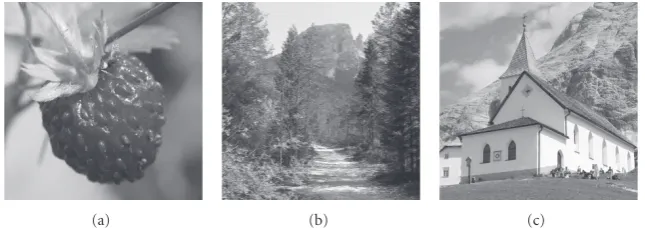
could be useful for devising a better attacking strategy, BOWS was divided into two different stages: for the first three months, just three 512×512 watermarked images (see
Figure 1) and three binary detectors (one per image) were provided; later, and for the next three months, the water-marking method was made public. Moreover, at the very be-ginning the number of calls to the detector per day was lim-ited, trying to avoid oracle attacks.
Within this framework, we tried to remove the water-mark from the provided images in two different circum-stances.
(1) The attacker completely lacks any knowledge of the used watermarking method and only has access to a detector, that he feeds with an image, and provides a binary output. This situation corresponds to the first stage of the BOWS challenge.
(2) The attacker knows all the details about the water-marking scheme, except for a secret parameter, the se-cret key, which is only shared by embedder and detec-tor.
For the first case, we used the blind sensitivity attack pre-viously published in [6], whereas for the second one, we fol-lowed a strategy based on a exhaustive search on secret key space.
Nevertheless, due to the large number of calls to the de-tector that would be needed for performing a successful blind sensitivity attack, we decided to attack the system in the re-verse order of that assumed by the organization. Thus, we first attacked BOWS trying to learn the secret key to later perform the blind sensitivity attack. Such blindness implied that information regarding the actual watermarking scheme, such as the embedding domain, the used DCT coefficients, or the perceptual shaping of the watermark, was totally dis-regarded. Our own objective here was to show the feasibility of attacking a watermarking system without knowing any a priori information about it. Needless to say, this assumption could be considered as quite pessimistic for the attacker, for most of this information could be actually learned by a smart attacker, as it was practically shown by other participants in the BOWS contest [10–12].
Detailed information on our two approaches to breaking BOWS is given in Sections2and3, respectively; approaches followed by other groups are outlined inSection 4, and the obtained results are compared inSection 5.
2. GUESSING THE SECRET KEY
Given that one of us was member of the steering commit-tee, we did not directly participate in the contest. It is im-portant to remark, however, that our knowledge about the watermarking scheme was exactly the same as that publicly available during the second stage of the contest: the used al-gorithm was the well-known data-hiding method by Miller et al. [2]. This means that we did not use any additional in-formation on the algorithm implementation (including the version number). Interestingly, other groups were able to get
is based on the use of trellis codes for performing the source and channel coding, being parameterized by some of the properties of the used trellis (number of states and number of arcs per state), as well as the spreading factor.
Still one open question for the attacker (and for us) was to figure out how the original data-hiding scheme had been adapted to this particular application, since Miller et al.’s al-gorithm was intended to work in decoding (i.e., multiple bit watermarking) scenarios instead of detection (i.e., one-bit watermarking) ones. We thought that probably the most straightforward way to carry out this adaptation would be to compare the decoded message with a secret reference (which is the actual embedded message); if they were identical, the watermark could be said to be present in the received signal, and absent otherwise. In order to test our conjecture on the BOWS system available at [3] and decide if the three pro-vided images were watermarked with both the same key and the same reference message, we input those images to the de-tectors corresponding to the other two images. As a result, although very small PSNRs were obtained, the watermark could still be detected, thus confirming our intuition. No-tice that at this stage, the three available images were the only inputs to the webpage detectors.
(a) (b) (c)
Figure1: The three watermarked signals provided by the organization.
embedded bit should be smaller than 240, a choice which would not afford much robustness against conventional sig-nal processing attacks. In view of these considerations, we decided to implement the exhaustive search represented in
Figure 2. After 9 days of computation of a PERL script ver-ifying if the decoded messages for different secret keys and message lengths were the same for all the three images, run on a shared computer with 2 Intel Pentium Xeon processors at 3.06 GHz and 2 GB RAM (be aware that the time require-ment could be lightened if this process was paralleled), the authors found a pair of values (θ,M) =(7168, 5) verifying the condition introduced above, that is, the decoded message for all the three images was the same (‘BOWS∗’).
Once the secrets of the system have been completely learned, the attacker has to devise how this information can be used to produce signals as close as possible to the pro-vided watermarked ones, but where the watermark has been removed, that is, where the decoded message is no longer the reference one. The optimal way of doing so is to per-form a search over the trellis looking for the boundary to the codeword related to a message different to the embedded one (BOWS∗’) which is closer to the provided image. Partial re-sults on this optimization were presented by Andreas West-feld in theSecurity, Steganography and Watermarking of Mul-timedia Contents IX Conference celebrated in January 2007 in San Jose (Calif, USA).1 In our case, we followed a sim-pler but nonoptimal strategy: we watermarked the provided signals with the same keyθ, but with a different message of lengthM. In fact, taking into account the trellis nature of the used code, we only changed the last bit of the reference mes-sage to ‘BOWS+,’ assuming that in that way the distance be-tween the originally embedded codeword and the newly ob-tained one would be close to the minimum; this reasoning is based on the trellis structure of the codebook. Nevertheless, be aware that this strategy is not necessarily the optimal one, due to both the heuristic nature of the embedding algorithm, and the fact that there could be a codeword associated to a message different from BOWS+’ that is closer to the original codeword. In any case, computing the new signal in the de-scribed way, and considering the linear convex combinations
1Andreas Westfeld obtained the secret key from the organizers after the two
stages of the contest ended.
of this signal and the provided one, we were able to produce signals that were really close to the latter, but where the wa-termark had been removed; this procedure is illustrated in
Figure 3. The PSNRs obtained for the three proposed images are, respectively, 53.5051 dB, 56.1106 dB, and 56.9275 dB.
3. BLIND SENSITIVITY ATTACKS
Once both the secret key and the embedded message were correctly guessed, we were able to perform in our local com-puters as many calls to the detector as we wished, skipping the initial constraint on the number of calls imposed by BOWS rules, and circumventing the communication delays with the server where the detectors were hosted.
As we previously mentioned, by performing the sensi-tivity attack we tried to show that an attacker without any knowledge of the watermarking scheme (not even any inten-tion to gain such knowledge) would be able to obtain very good results, by just applying a method already presented by the authors in [6] and termedBlind Newton Sensitivity At-tack(BNSA). For this reason, although this method could be modified to reduce the number of calls to the detector [5], we decided to use the basic version described in [6]. Further-more, note that given that our algorithm assumes no prior knowledge of the watermarking technique, it complies with the rules established for the first stage of BOWS.
The chosen algorithm, which has shown to be effective against a wide range of watermarking methods, has the fol-lowing characteristics that make it suitable for the BOWS setup:
(i) it does not require any knowledge about the detection function;
(ii) it just needs to know the binary output of the detection function for a given input (not the actual value of the detection function);
(iii) it can be highly paralleled, in such a way that sev-eral attackers can work together, each of them using a different detector (or a set of them). In any case, be aware that this characteristic could not be applied in the BOWS setup, as only one detector was available; (iv) a full iteration of the algorithm is not necessary for
z1
z2
z3
Decoder
Decoder
Decoder
b1
b2
b3
b1=b2=b3 True/false
Figure2: Block diagram of the exhaustive search of the secret key approach. We checked 1 ≤ M ≤25 for increasing values ofθ ∈ N, untilb1 =b2 =b3. The source code of the decoder is publicly
available in [4].
Y
Z
Z
Figure3: Diagram describing the generation of the attacked sig-nalZfrom the watermarked signalY, and the signalZobtained by
embedding a message different of the reference one into the water-marked content.
Furthermore, as we will explain later, it is not required to compute exactly the Hessian matrix nor the gradient in order to be able to produce a descent direction of the target func-tion. In fact, we will show that some gradient components are enough to obtain high-quality signals where the water-mark is already removed. A basic block diagram of BNSA, depicting its iterative nature, is plotted inFigure 5.
3.1. Blind Newton Sensitivity Attack
The BNSA [6] is based on formalizing the target of the at-tacker as
arg min
t:g(y+t)≤ηdy(t), (1)
wheredy(t) quantifies the distortion introduced by the
at-tacking vectorton the watermarked signaly,g(·) is the de-tection function, andηis a threshold which determines the detection region, in such a way that the detector will decide that the watermark is present if and only ifg(y)> η. Given that in our problem the objective is to maximize the PSNR,
Therefore, the BNSA tries to iteratively solve this problem by using a surjectionhy, that projects the attacking vectors on
the decision boundary and should verify some specific char-acteristics (see [6] for further information about these partic-ulars), yielding an update of the algorithm with the generic form
sk+1=sk−ξk·B−1·∇
dy◦hy
sk
, (2)
whereξkis the stepsize of the update,dy(·) is the constraint
ofdy(·) to the points on the boundary of the decision region,
∇(dy◦hy)(sk) is the estimate of the gradient of (dy ◦hy)(sk), and itsith component is computed as
∇dy◦hy
sk
i=
dy ◦hy
sk+δei
−dy◦hy
sk
δ ,
(3)
withδ > 0 an arbitrarily small positive number. This com-putation requires also to estimatehy(·), which is not known
by the attacker. The proposed strategy is to usehy(s)=α∗·s,
whereα∗is a scaling factor computed using a bisection algo-rithm.
Concerning the matrixB, different possibilities can be considered; probably the best choice would be to use an ap-proximation of the Hessian, but due to computing limita-tions, we have preferred to useB =IL×L, that is, the iden-tity matrix of size L. For a small-enoughξk, this choice of B guarantees a decrease of the target function as long as (∇( dy ◦hy)(sk))
T
·∇(dy◦hy)(sk)> 0, where the last con-dition is based on the Taylor series expansion of the objective function. In order to verify this condition, the attacker does not need to compute all the components of the estimate of the gradient; instead it is enough to calculate a small num-ber of them and set the remaining to 0. Obviously, better results will be obtained when all the components are avail-able, but the former strategy allows the attacker to stop the algorithm whenever he has obtained a suboptimal solution which yields a satisfactory (following his quality criterion) attacked image; of course, adopting such strategy will reduce the computational cost of his attack.
Finally, the computation of the step length [7,8] of the kth iterationξkwas performed following Armijo’s rule, due to its simplicity.
3.2. Pseudocode
For the sake of clarity, next we give a pseudocode description of the used implementation of the BNSA; this implementa-tion slightly differs with the later one presented in [9], and that was debugged after close interaction with Prof. Barni’s group in the University of Siena. In the following descrip-tion we assume that the provided watermarked signal y is arranged as a vector.
(1) Generate an i.i.d. zero-mean Gaussian random vector t, with the same size as the watermarked signalyand varianceσ2
(2) Compute a scaling factorβsuch thaty+β·tis on the detection boundary. The squared Euclidean norm of the vectorβ·tis denoted byγstart.
(3) For each component of the vectort,
(a) slightly modify the vectort, obtainingti = t+
1·ei, whereeiis theith vector of the canonical basis and1=10−3.
(b) compute a scaling factorβsuch thaty+β·tiis on the detection boundary. The squared Euclidean norm of the vectorβ·tiis denoted byγi.
(4) Estimate the gradient of the squared Euclidean norm of the vector necessary for obtaining a nonwatermarked signal, when the vectortis consid-ered. Theith component of the gradient is estimated as∇[ i]=(γi−γstart)/1.
(5) Look for a step size providing a decrease in the objec-tive function as follows
(a)ξ=10. (b)tnew=t−ξ·∇.
(c) Compute a scaling factorβsuch thaty+β·tnew is on the detection boundary. The squared Eu-clidean norm of the vectorβ·tnew is denoted by γafter.
(d) Whileγstart< γafter,
(i) ξ=0.7·ξ; (ii) tnew=t−ξ·∇;
(iii) Compute a scaling factor β such that y+ β·tnew is on the detection boundary. The squared Euclidean norm of the vectorβ·tnew is denoted byγafter.
(6) If the resulting signaly2=y+β·tnewverifies the quality criteria established by the attacker, theny2is the solu-tion. Otherwise, the algorithm is iterated again from point 2 witht=tnew.
3.2.1. Computation of a scaling factorβsuch thaty+β·t0
is on the detection boundary
(1) t=t0.
(2) If y+tis out of the detection region, thenvout = t andvin =0. Otherwise, ify−tis out of the detection region, thenvout= −tandvin=0.
(3) If bothy+tandy−tare in the detection region,
(a) while bothy+tandy−tare in the detection region,t=2·t.
(b) Ify+tis out of the detection region, thenvout=t andvin = t/2. Otherwise, ify−tis out of the detection region, thenvout= −tandvin= −t/2.
(4) Whilevout−vin>2(=10−3),
(a)vmiddle=(vout+vin)/2.
(b) Ify+vmiddleis in the detection region, thenvin= vmiddle; otherwise,vout=vmiddle.
(5) v=vout.
(6) The scaling factor β such that y + β·t0 is non-watermarked is given by the ratio between the value of any component of vectorsv andt0, that is, β = v[i]/t0[i], which is the same for any component.
3.3. Results
After one iteration of the BNSAperformed in the pixel domain of the three provided images, the PSNR obtained for the first image is 56.3410 dB, for the second 56.9559 dB, and for the third one is 58.1586 dB, and the resulting images are plotted inFigure 6. Nevertheless, as pointed out by a reviewer, when those images are captured from the document in pdf format and the resulting image is fed to the detector, the watermark is still present (in the tests we performed, this was the case for images 1 and 3). Although the obtained result will obvi-ously depend on the sequence of operations performed for capturing the images (e.g., type of the file images inserted in the paper, conversion of file types, etc.), the fact that we had been able to reproduce these striking results obtained by the reviewer led us to try to find a plausible explanation. In try-ing to do this, we considered the energy of the three attack-ing signals for each 8×8 block-DCT frequency, as well as the ratio between the energy of the captured image and the energy of the watermarked one for each frequency. In that way we realized that whereas the power of the attacking sig-nal is approximately constant for the frequencies considered by the detector algorithm, the capturing process can be mod-eled as low-pass. This is not rare, if one considers the small size of the images in the paper, which made one suspicious about the fact that the image could have undergone a process of down-sampling and interpolation. Notice that this could imply that the filtering undergone by the image is affecting more the attacking signal than the watermarked one.
This reasoning would also explain why this phenomenon is not observed for the images attacked after the exhaustive search of the secret key (Figure 4). In order to provide a fur-ther argument supporting our hypothesis, we performed the Wiener filtering of the three images attacked by BNSA, and in all three cases, the watermark was recovered.
Furthermore, we think that is particularly interesting the fact that acceptably good results are achieved even when a full iteration of the BNSA is not completed. To illustrate,Figure 7
shows the PSNR achieved versus the number of actually com-puted gradient components. One can see that the PSNR ob-tained for 4096 computed coefficients of the gradient is al-ready larger than 40 dB for all the three images, meaning that a quite reduced amount of computations would be required for obtaining high-quality contents where the watermark is removed. Furthermore, be aware that when the number of considered gradient components is large enough (for val-ues larger than approximately 2048), the PSNR grows almost linearly with the number of components, meaning that the reduction in the attacking distortion (in dB) grows linearly with the logarithm of the number of available components of the gradient.
(a) (b) (c)
Figure4: The three signals obtained using the attack based on the exhaustive search of the secret key.
Y
BNSA Y+T Detector Present/not present
Figure5: Block diagram of the BNSA.
were not watermarked in all their frequency components, but just in a subset of them, as most of the algorithms in the liter-ature use that kind of strategy. Indeed, after performing some tests, the attacker could realize that the watermark was only embedded in 12 out of the 64 coefficients of an 8×8 block-DCT [10–12]. Using that information, the attacker could speed up the attack more than 5 times, by just focusing on estimating the gradient of those block DCT coefficients that he knows (or assumes) that they are being used by the water-marking method. Even though we did not pursue this line, we have determined the PSNR needed for removing the wa-termark from the provided images using the attacking vec-tors already computed with the BNSA in the spatial domain, and setting to 0 those 52 8×8-DCT components which are not used in each block. Remarkably, the results only show a small improvement on the obtained PSNR, yielding val-ues of 57.5496, 57.8056, and 60.0081 dB, respectively, indi-cating that BNSA already succeeded in alloindi-cating almost all the power in those DCT coefficients that were really used, even when it was performed in the pixel domain.
4. APPROACHES FOLLOWED BY OTHER GROUPS
In this section, we summarize the strategies followed by some other groups involved in BOWS contest, discussing the sim-ilarities and differences with our approach. The first three strategies were applied during the first stage, whereas the fourth one corresponds to the second stage, where the wa-termarking algorithm was disclosed.
4.1. Le Guelvouit et al. [12]
In this paper, the authors claim to have used their social en-gineering skills (very remarkable indeed) to learn the water-marking scheme that was actually used. Once in possession of such information, several attacks are explored as follows:
(i) using a different version of the third image which was previously published, they managed to remove the wa-termark from that image with a PSNR of 37.35 dB; (ii) a new attack, based on setting to zero some DCT
coefficients and randomly shuffling other ones, was proposed, yielding respective PSNRs of 30.39 dB, 31.21 dB, and 30.22 dB;
(iii) using an adaptation of a previous work [13] on data hiding game theory, they compute the SAWGN (Scal-ing and Additive White Gaussian Noise) attack min-imizing the capacity of a spread spectrum-based sys-tem, and apply it to the provided watermarked images to remove the watermark. After taking into account the perceptual considerations made in [2], they reached respective PSNRs of 34.95 dB and 34.04 for the first two images.
4.2. Earl [5]
Earl proposed a sensitivity analysis algorithm similar to that in [6], with some modifications aimed at speeding-up con-vergence. According to Earl, the main differences between this new scheme and BNSA lie in
(i) how and when the surjection function is computed; (ii) the approximate nature of the minimization;
(iii) the selection of a perceptually scaled basis on which to search.
In fact, in view of the presented results, it seems that the per-ceptual considerations have a major role in the reduction of the number of calls to the detector needed by the proposed method. Following this strategy, the author achieved respec-tive PSNRs of around 38 dB, 35 dB, and 36 dB with a number of detector calls slightly larger than 1500.
4.3. Craver et al. [11]
(a) (b) (c)
Figure6: The three signals obtained attacking the system with BNSA.
102 103 104 105 106
Number of components of the gradient 20
25 30 35 40 45 50 55 60
PSNR
(dB)
Image 1 Image 2 Image 3
Figure7: PSNR obtained as a function of the number of computed components of the gradient.
introduced by the authors issuper-robustness, which they de-fine asthe property of a watermarking algorithm to survive se-lect types of quality degradation far beyond what any reason-able person would expect, constitutingin fact a security weak-ness.
4.4. Westfeld [1,10]
Westfeld also managed to determine that the watermark was embedded in 12 low-frequency coefficients per block of 8×8 DCT. The author then developed a sensitivity attack and a postprocessing step, whichmodifies the pixel values in the spa-tial domain before they are rounded to integer levels of grey. The impressive PSNRs obtained with this method are, re-spectively, 60.74 dB, 57.05 dB, and 57.29 dB.
5. CONCLUSIONS
In this paper, we have presented two approaches for breaking the watermarking scheme employed in the BOWS contest: a key guessing attack and a sensitivity attack. Even though
both approaches lead to similar results, only the former re-lies on certain a priori knowledge about the watermarking system, while the latter is totally blind. This entails a much larger computational load for the sensitivity-based attack.
An important remark is that complete key disclosure was possible in this case due to its small length. This only ratifies the well-known requirement of a large enough key space for preventing exhaustive search attacks. In this sense, the size of the space of the watermaked signal is not so important, as the attacker can focus his attack on the usually smaller key space. This is especially important, as the disclosure of the secret key does not only allow to obtain signals where the watermark is not detected with an excellent quality, but also allows the at-tacker to generate falsely watermarked signals (also known as forgeries) in all cases with almost no extra cost for successive contents, as the attack needs to be performed once per secret key (not per content).
Another important conclusion regarding the BNSA is that it is possible to tradeoffthe final PSNR and the com-putational load; this compromise is achieved by reducing the number of gradient components that are actually computed. Compared with the results obtained by other groups and recorded in the BOWS webpage [3], we can see that the re-sults achieved by our two attacks are only comparable with those obtained by Westfeld [1] in the stage of the contest where the watermarking method was publicly known. On the first stage, when that method was still undisclosed, the winner was the team led by Scott Craver, who achieved much smaller PSNRs. These results clearly show the effectiveness of the proposed attacks for “black-box” detectors.
Finally, we would like to congratulate the organizers of the BOWS contest, Drs. Barni and Piva, for the success of this challenge. We definitely believe that these initiatives dramati-cally contribute to the advancement of our discipline. Trying to break BOWS was not only a lot of fun but also allowed us to perfect our blind attack.
ACKNOWLEDGMENTS
ECRYPT disclaimer: the information in this paper is pro-vided as is, and no guarantee or warranty is given or implied that the information is fit for any particular purpose. The user thereof uses the information at its sole risk and liability.
REFERENCES
[1] A. Westfeld., “Lessons from the BOWS contest,” inProceedings of the 8th Workshop on Multimedia and Security, pp. 208–213, Geneva, Switzerland, September 2006.
[2] M. L. Miller, G. J. Do¨err, and I. J. Cox, “Applying informed coding and embedding to design a robust high-capacity wa-termark,”IEEE Transactions on Image Processing, vol. 13, no. 6, pp. 792–807, 2004.
[3] http://lci.det.unifi.it/BOWS.
[4] http://www.adastral.ucl.ac.uk/∼gwendoer/dptWatermarking. [5] J. W. Earl, “Tangential sensitivity analysis of watermarks using
prior information,” inSecurity, Steganography and Watermark-ing of Multimedia Contents IX, E. J. Delp III and P. W. Wong, Eds., vol. 6505 ofProceedings of SPIE, pp. 12 pages, San Jose, Calif, USA, January 2007.
[6] P. Comesa˜na, L. P´erez-Freire, and F. P´erez-Gonz´alez, “Blind newton sensitivity attack,”IEE Proceedings on Information Se-curity, vol. 153, no. 3, pp. 115–125, 2006.
[7] J. Nocedal and S. J. Wright,Numerical Optimization, Springer, New York, NY, USA, 1999.
[8] D. P. Bertsekas, Nonlinear Programming, Athena Scientific, Nashua, NH, USA, 1995.
[9] M. Barni, F. P´erez-Gonz´alez, P. Comesa˜na, and G. Bartoli, “Putting reproducible signal processing into practice: a case study in watermarking,” inProceedings of IEEE International Conference on Acoustics, Speech, and Signal Processing (ICASSP ’07), vol. 4, pp. 1261–1264, Honolulu, Hawaii, USA, April 2007.
[10] A. Westfeld, “Tackling bows with the sensitivity attack,” in Se-curity, Steganography and Watermarking of Multimedia Con-tents IX, E. J. Delp III and P. W. Wong, Eds., vol. 6505 of Pro-ceedings of SPIE, pp. 11 pages, San Jose, Calif, USA, January 2007.
[11] S. Craver, I. Atakli, and J. Yu, “How we broke the bows water-mark,” inSecurity, Steganography and Watermarking of Mul-timedia Contents IX, E. J. Delp III and P. W. Wong, Eds., vol. 6505 ofProceedings of SPIE, pp. 8 pages, San Jose, Calif, USA, January 2007.
[12] G. Le Guelvouit, T. Furon, and F. Cayre, “The good, the bad, and the ugly: three different approaches to break their water-marking system,” inSecurity, Steganography and Watermarking of Multimedia Contents IX, E. J. Delp III and P. W. Wong, Eds., vol. 6505 ofProceedings of SPIE, pp. 8 pages, San Jose, Calif, USA, January 2007.