© Swiss Society of Economics and Statistics 2010, Vol. 146 (1) 341–345 a I thank Marlene Amstad for useful comments. The views expressed herein are those of the
author and do not necessarily represent the views of the Federal Reserve Bank of New York or the Federal Reserve System.
“Interest Rate Dynamics and Monetary Policy Implementation in Switzer-land” by Puriya Abbassi, Dieter Nautz and Christian J. Offermanns
Antoine Martina
The paper by Abbassi, Nautz, and Offermanns (ANO) provides a very good description of the Swiss National Bank’s (SNB) monetary policy implementa-tion framework. It carefully explains some aspects of this framework that could be surprising, such as the role of rate expectations, and it includes a statistical analysis of interest rate dynamics before and during the crisis. Overall this is a nice paper.
In my comments, I will focus on what we learn from ANO on the SNB’s choice of monetary policy implementation framework and on how we could interpret the results of their statistical analysis. The results suggest that the SNB’s imple-mentation framework has been successful, particularly during the crisis. They also suggest that the SNB is a credible institution, which may be an important factor in its success. My comments borrow from some current work I am doing with Marlene Amstad (Amstad and Martin, 2009).
as their operating target. The SNB’s framework is interesting to study in part because it is an exception in choosing a 3 month rate as its target.
In their Figure 1 and Table 1, ANO show that the SNB has kept a tight con-trol over its operating target, both before and during the crisis. This suggests that choosing a longer term rate as a target has not created a communication problem for the SNB. This impression is reinforced by the statistical analysis described in Table 3.
In Table 3, ANO distinguish between two channels through which the SNB can influence the 3M Libor. The expectation adjusted Libor spread corresponds to the “word” channel; by telling the markets what it wants the 3M Libor to do, the SNB can influence that rate. The term spread corresponds to the “deeds” channel; by changing the 1W repo rate, the SNB can “mechanically” influence the 3M Libor. Table 3 suggests that the SNB influences the 3M Libor with its words but that its deeds have little effect. This pattern is what we would expect from a very credible central bank: the SNB does not need to act very much because its words carry a lot of weight.
As Table 2 in ANO suggests, this does not mean that the SNB is inactive. Indeed, it does adjust the 1W repo rate to changes in the expectation adjusted Libor spread and the term spread. These actions, however, do not translate into statisti-cally significant effects on the 3M Libor. One interpretation is that these changes serve to communicate to financial markets the fact that the SNB is vigilant.
Consider the following analogy. If you are walking your dog on a leach, you can tell the dog where to go, or you can pull on the leach. If the threat to pull the leach is credible, and if the dog is well trained, verbal communication can be sufficient and you will not need to pull on the leach: your words will matter more than your deeds. Nevertheless, you may want to wiggle the leach a little bit, occasionally, to signal to the dog that you are still there. The wiggles do not steer the dog, but send the message that you are vigilant.
From this, we learn that the SNB has a tight control over its target. This tight control appears to be related to the credibility of the SNB. From the perspective highlighted earlier, the SNB seems to have lost little from the fact that it targets a 3 months rate, rather than an overnight rate. It is thus natural to ask what the SNB might have gained by this choice.
1 Amstad and Martin (2009) provide more details.
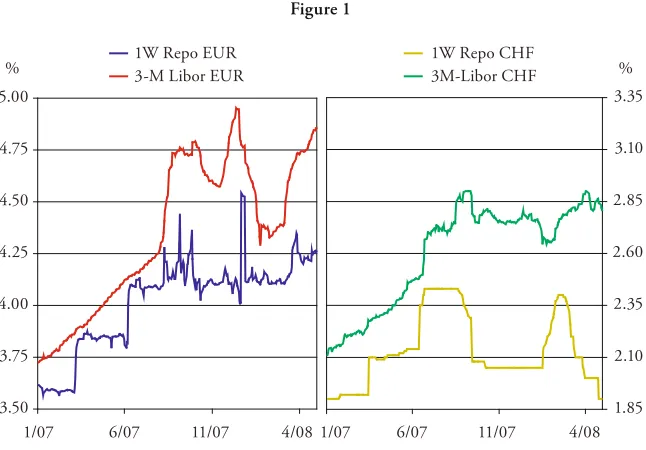
Figure 1 illustrates a reason why the SNB’s monetary policy implementation framework may have helped during the crisis.1 The Figure shows the 1W repo rate and the 3M Libor for the ECB and the Euro, on the one hand, and for the CHF and the SNB on the other hand. In the case of the ECB and the Euro, the 1W repo rate is fairly stable, but the 3M Libor exhibits large swings. In con-trast, the 1W repo rate fluctuates a lot in the case of the CHF and the SNB, but the 3M Libor is much more stable. Because of its monetary policy implementa-tion framework, the SNB, was able to stabilize the more economically relevant 3 month rate. For the ECB to do something comparable, it would have had to make important changes to the way it communicates with financial markets, which may have created considerable confusion.
Table 3 in ANO also describes how the SNB influenced the 3M Libor during the crisis. During this period, both the “words” and the “deeds” channel are statistically significant. This suggests that the SNB is still credible, in that in can steer markets by communicating its intentions, but that it also needs to
Figure 1
3.50 3.75 4.00 4.25 4.50 4.75 5.00
1/07 6/07 11/07 4/08 1W Repo EUR
3-M Libor EUR %
1.85 2.10 2.35 2.60 2.85 3.10 3.35
1/07 6/07 11/07 4/08 1W Repo CHF
2 See also Goodfriend and McCallum (2007).
“mechanically” affect the markets through the use of its instrument, the 1W repo rate.
Looking at Table 2, in ANO, we see that during the crisis the term spread is no longer significant. This is consistent with the interpretation I gave earlier that changes in the 1W repo rate before the crisis are mainly a communication device. During the crisis, when the SNB is actively “mechanically” steering the 3M Libor rate through movements in the 1W repo rate, this rate does not react to short term movements in the term spread like it did before the crisis.
So what do we learn from ANO’s statistical analysis? Not surprisingly, the SNB appears less credible during the crisis. It can no longer count only on steering markets through words. Nevertheless, its words are still affecting the market and, through both “words” and “deeds,” the SNB was able to keep it’s the CHF 3M Libor relatively stable; much more stable than the Euro 3M Libor, for example.
Does that mean that the SNB should declare victory? The evidence provided by ANO suggests that the SNB’s monetary policy implementation framework has many nice properties. The SNB did not seem to find it too difficult to con-trol its objective, both before, but also during the crisis. In addition, the SNB’s ability to steer the 3M Libor appears to have been a stabilizing factor during the crisis. However, it is hard to translate changes in interest rate spreads into changes in welfare and we need better theories to help us think of how to best implement monetary policy.
Curdia and Woodford (2009) take a first step in the direction of provid-ing a theory that can help us think of the benefits of the SNB’s monetary policy implementation framework.2 They enhance a standard DSGE model to allow heterogeneous spending opportunities. This gives a role to financial intermedia-tion and introduces a measure of interest rate spread in the model. They study the effects of several policy rules in the face of different types of shocks. One of the policy they consider is a spread adjusted Taylor-rule, proposed by Taylor (2008), which resembles the SNB’s policy. They show that this type of policy is likely to produce good outcomes in the face of “pure financial” shocks, modeled as a deterioration in the quality of the loans extended by the financial intermediation sector. However, even for such shocks, the optimal degree of adjustment depends on other factors, such as the expected persistence of the shock. In addition, this type of policy does not work as well in the face of other types of shocks.
that this framework has served the SNB very well, especially during the recent financial crisis. Nevertheless, it may not yet be time to declare victory. The aca-demic literature is still evolving, but while the current framework has worked well, it may be possible to improve upon it.
References
Amstad M., and A. Martin (2009), “Monetary Policy Implementation During the Crisis: The Case of Switzerland”, manuscript.
Curdia, V., and M. Woodford (2009), “Credit Spreads and Monetary Policy”, NBER working paper No. 15289.
Goodfriend, M. and B. T. McCallum (2007), “Banking and Interest Rates in Monetary Policy Analysis: A Quantitative Exploration”, Journal of Monetary
Economics, 54, pp. 1480–1507.