IJSRR, 8(1) Jan. – Mar., 2019 Page 1027
Research article Available online www.ijsrr.org
ISSN: 2279–0543
International Journal of Scientific Research and Reviews
Thinking styles: A study on secondary school students
Trixy Elizabeth John
*and Benny Thomas
1*
CHRIST (Deemed to be University), Bengaluru, India
1
CHRIST (Deemed to be University), Bengaluru, India
ABSTRACT
Thinking Styles is a concept used in cognitive psychology to describe the way individuals think, perceive, and remember information. Styles should not be confused with abilities. Style is the way we prefer to use the abilities to process information, solve problems etc. The article is based on Sternberg’s theory of mental self-government. The objectives of the study were to find out the preferred thinking styles of secondary school students under the five dimensions namely functions, forms, levels, scope, and leaning and also to find out whether there was any significant difference in thinking styles based on gender. The thirteen styles are legislative, executive and judicial functions; hierarchic, monarchic, oligarchic, and anarchic forms; global and local levels; internal and external scopes; and liberal and conservative leanings. The results showed that under each dimension, a particular style of thinking was preferred. The study revealed executive, hierarchic, local, external and conservative thinking styles as more preferred under the dimensions of functions, forms, level, scope and leanings respectively. The styles of thinking were also influenced by the demographic factor gender. The preference for each style varied for boys and girls. The study was done with an intention of making the students aware of the styles that help them to gain a sense of self-efficiency and also to help the teachers to teach students to capitalize upon their strengths and take steps to remediate and compensate for their weaknesses.
KEYWORDS
: Thinking Styles, Mental Self-Government, Functions, Form, Scope, Level,Leanings
*Corresponding Address
Trixy Elizabeth John
Furniture & Bills Section, General Administration Wing, H.O. Annexe, 3rd floor, Dwarakanath Bhavan 29,
KK Road, Basavangudi, Bengaluru-560 004 Bengaluru, Karnataka
IJSRR, 8(1) Jan. – Mar., 2019 Page 1028
INTRODUCTION
Education worldwide is changing, and thus the preference given to classroom learning alone has been replaced by constructive learning in which learners are not just passive listeners. Although human beings share many important characteristics, they also differ from one another in significant ways. To understand, or apply one has to employ the powers of thinking. The way in which an individual thinks or perceives a problem has come across a drastic change due to the rapid growth of science and technology. Innovations, new developments and solution to issues emerge as a result of creativity and curiosity-driven approaches. Individuals vary along such dimensions as intelligence, ability, gender, styles of thinking and learning etc. The more the world becomes modern, the more complicated it becomes for the educators to bring out the best education model.
Need and significance of the study
Every individual has his or her own preferred way of thinking and learning which psychologists referred to as styles. All styles are adaptive under the right circumstances. Styles are preferences not fixed modes of behaviour. Since a typical classroom contains students who exhibit several styles of thinking, teachers must be flexible and must learn to address every students’ style. This will help the teachers to address individual differences. By knowing the preferred styles, a teacher can give differentiated instruction using different learning materials, instructional strategies and activities. Research from developmental and cognitive psychologists had found that high school students can handle more abstract and complex tasks and have a strong need of both autonomy and social contact. It is important to foster the perception that the purpose of education is personal development. Therefore, a special effort to establish a supportive atmosphere in which students can meet their social, emotional and cognitive needs is essential. If education in schools, fail to provide students with an intellectually challenging environment, the result is a negative effect on motivation. Mastery goals have been associated with awareness and positive feelings about one’s abilities, style preferences etc. The secondary school years mark the period of changes and development. Cognitively, students become more capable. By knowing their style of thinking, a teacher can help them to develop and adopt different ways of thinking as the situation demands. The identification of one’s preferred styles helps the individuals to capitalise on their strengths, compensate for their weaknesses, learn how to adapt, to decide accurately, to be motivated and to achieve success.
Theoretical framework
IJSRR, 8(1) Jan. – Mar., 2019 Page 1029
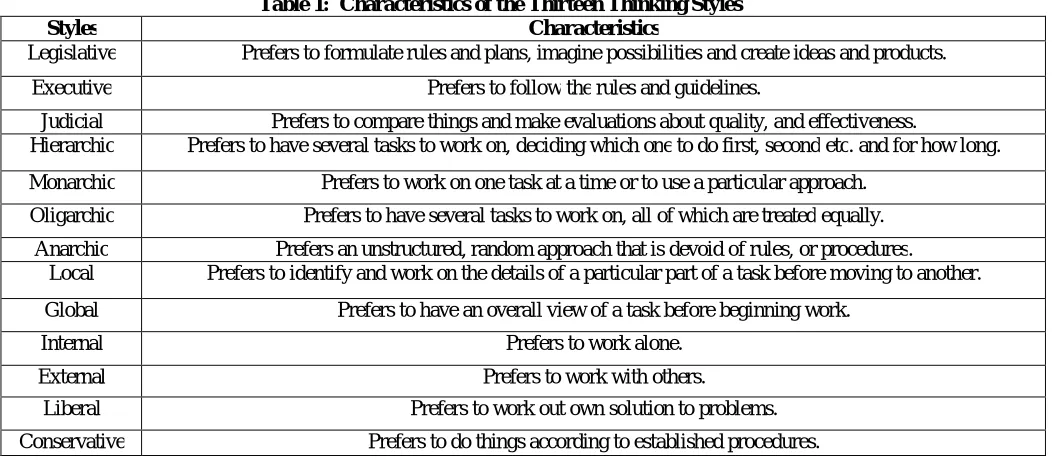
theory comprises of thirteen mental self-government styles which fall into one of the five categories namely functions, forms, levels, scope and leaning. The thirteen styles are legislative, executive and judicial functions; hierarchic, monarchic, oligarchic, and anarchic forms; global and local levels; internal and external scopes; and liberal and conservative leanings. Each person prefers a style within each category. The teachers can adopt the type of instruction students prefer and assign activities accordingly thereby giving the opportunity to use all styles at one time or another. The main characteristics of each style are briefly described below.
Table 1: Characteristics of the Thirteen Thinking Styles
Styles Characteristics
Legislative Prefers to formulate rules and plans, imagine possibilities and create ideas and products.
Executive Prefers to follow the rules and guidelines.
Judicial Prefers to compare things and make evaluations about quality, and effectiveness.
Hierarchic Prefers to have several tasks to work on, deciding which one to do first, second etc. and for how long.
Monarchic Prefers to work on one task at a time or to use a particular approach.
Oligarchic Prefers to have several tasks to work on, all of which are treated equally.
Anarchic Prefers an unstructured, random approach that is devoid of rules, or procedures.
Local Prefers to identify and work on the details of a particular part of a task before moving to another.
Global Prefers to have an overall view of a task before beginning work.
Internal Prefers to work alone.
External Prefers to work with others.
Liberal Prefers to work out own solution to problems.
Conservative Prefers to do things according to established procedures.
OBJECTIVES
1. To find out the most preferred thinking styles of secondary school students under the five dimensions namely functions, forms, levels, scope and leaning.
2. To find out whether there is a significant difference in thinking styles based on gender.
EXPERIMENTAL SECTION
Methodology
IJSRR, 8(1) Jan. – Mar., 2019 Page 1030
reliability coefficients (0.69 - 0.97) and validity coefficients (0.59 – 0.72) for each of the component thinking style was found to be sufficient enough for the tool to be used for studying the thinking styles. The inventory as a whole has no total score.
Using statistical techniques, data was analysed. The thinking styles were studied using the mean, standard deviation and t-test for comparison of thinking styles between boys and girls.
Findings
The preferred thinking style was found out under each of the five dimensions using mean, standard deviation scores and comparing the mean score of thinking styles (paired t-test) under each dimension. The t-test was used to find whether there is any significant difference between boys and girls among the components of thinking styles.
Table 2: Mean, and Standard Deviation scores of thirteen component thinking styles under the five dimensions.
Dimension Thinking Style Mean Standard Deviation
Function
Legislative 2.94 1.731
Executive 4.50 1.460
Judicial 2.58 1.357
Forms
Hierarchic 3.90 1.488
Monarchic 3.74 1.549
Oligarchic 1.26 1.006
Anarchic 1.10 1.055
Level
Local 16.34 5.208
Global 15.54 5.183
Scope
Internal 14.42 4.803
External 25.58 4.803
Leanings
Liberal 19.64 3.942
Conservative 20.30 3.845
Table 3: Scores of paired comparisons of means of components of thinking styles under each dimension
Dimension Paired variables Paired
Difference in Mean
t
Sig(2-tailed)
Function Executive-Legislative 1.560 3.793 .000
Legislative-Judicial 0.360 0.927 .358
Executive-Judicial 1.920 6.139 .000
Form Hierarchic-Monarchic 0.160 0.422 .675
Hierarchic – Oligarchic 2.640 9.160 .000
Hierarchic –Anarchic 2.800 9.610 .000
Monarchic-Oligarchic 2.480 8.343 .000
Monarchic-Anarchic 2.640 8.588 .000
Oligarchic-Anarchic 0.160 0.760 .451
Levels Global-Local 0.800 0.545 .588
Scope External-Internal 11.160 8.216 .000
IJSRR, 8(1) Jan. – Mar., 2019 Page 1031 Table 4: Mean, standard deviation and the score of comparison of thinking styles of boys and girls
Mean Standard Deviation
Dimension Thinking
Styles
Boys Girls Boys Girls t Sig(2-tailed)
Function
Legislative 3.50 2.68 1.461 1.804 1.594 0.118
Executive 4.56 4.47 1.504 1.461 0.206 0.838
Judicial 1.94 2.88 0.929 1.431 2.407 0.020
Form
Hierarchic 3.94 3.88 1.692 1.409 0.121 0.904
Monarchic 3.81 3.71 1.276 1.679 0.225 0.823
Oligarchic 1.19 1.29 1.047 1.001 0.346 0.731
Anarchic 1.06 1.12 0.854 1.149 0.171 0.865
Levels
Local 12.75 18.03 5.235 4.317 3.511 0.002
Global 19.00 13.91 5.317 4.302 3.615 0.001
Scope
External 23.81 26.41 5.659 4.179 1.827 0.074
Internal 16.19 13.59 5.659 4.179 1.827 0.074
Leanings
Liberal 18.69 20.09 13.156 4.231 1.177 0.245
Conservative 21.31 19.82 3.156 4.086 1.286 0.205
Interpretation of Results
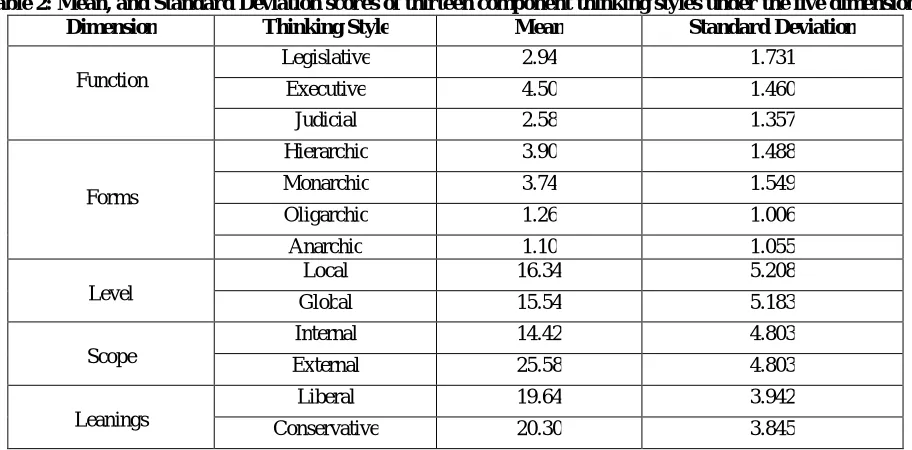
Table 2 shows the mean and standard deviation scores of the thinking styles from which the preferred thinking style in students of class IX is found out using the data, mean ± standard deviation from each of the five dimensions.
Under the dimension of function, results show that the preferred style is the executive thinking style (4.50±1.460) and the least preferred is judicial style (2.58±1.357). The most preferred thinking style in the dimension, form is the hierarchic style (3.90±1.488), and the least is anarchic (1.10±1.055). The order of preference is hierarchic, monarchic, oligarchic and anarchic. Local thinking style (16.34±5.208) was found to be the predominant style over global thinking style (15.54±5.183) in the dimension, level. The fourth dimension, the scope has external thinking style (25.58±4.803) as the most preferred than internal thinking style (14.42±4.803). The preference for the thinking style under the dimension leanings was found to be for conservative thinking style (20.30±3.845) over liberal thinking style (19.64±3.942).
Table 3 shows the result of the paired comparison of means of the component thinking styles under the five dimensions.
IJSRR, 8(1) Jan. – Mar., 2019 Page 1032
hierarchic-oligarchic (t=9.160,p<.05), hierarchic-anarchic (t=9.610,p<.05), monarchic-oligarchic (t=8.343,p<.05), monarchic-anarchic (t=8.588,p<.05), and internal-external (t=11.160,p<.05) since the level of significance was found to be less than 0.05.
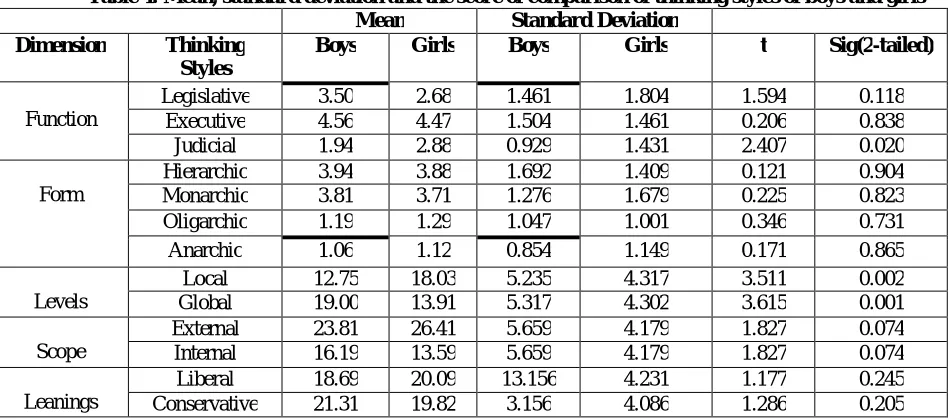
Table 4 shows the mean, standard deviation and the result of comparison of thinking styles boys and girls of students of class IX.
Test of significance of the difference between means (t-test) is used to compare boys and girls with respect to their thinking styles. Boys preferred legislative (3.50±1.461), and executive thinking style (4.56± 1.504) more than that of girls but the difference was not statistically significant (t for legislative=1.594 & t for executive=0.206, p>.05). Judicial thinking style was preferred by girls (2.88± 1.431) and less preferred by boys (1.94±0.929) and was statistically significant (t=2.407, p<.05)). Boys preferred hierarchic and monarchic thinking styles while girls preferred oligarchic and anarchic styles more than that of boys. There existed no significant gender difference in the preference for hierarchic (t=0.121, p>.05), monarchic (t=0.225, p>.05), oligarchic (t=0.346, p>.05), and anarchic forms of thinking (t=0.171, p>.05). Girls preferred the local level of thinking (18.03 ±4.317) while boys preferred the global level of thinking (19.00±5.317)) and were found to be statistically significant since p<0.05. The gender difference was not significant in external and internal thinking styles (p>0.05). Both boys and girls preferred external thinking style over internal thinking style. Girls preferred liberal thinking styles (20.09± 4.231) while boys preferred conservative thinking styles (21.21±3.156) but the difference is not statistically significant (t=1.286).
DISCUSSION
IJSRR, 8(1) Jan. – Mar., 2019 Page 1033
development among university students in Hong Kong. Students who reasoned at a higher cognitive, developmental level used a wide range of thinking styles than students who reasoned at a lower cognitive developmental level. Are achievement motivation and thinking styles related? Indian senior secondary students had a significantly stronger preference for legislative and conservative thinking style and a lower preference for global and external thinking (Verma 2004). The study conducted by Verma and Monika, (2006) reported that gender had a significant influence on executive, anarchic, and external thinking styles. Gafoor and Lavanya (2008) explored the thinking styles of senior secondary school students and in its relation to achievement in Physics. The study revealed that the students preferred legislative, hierarchic, local level and external thinking more. The external type of thinking favours achievement more. A visit among Chinese University students, a study conducted by Fan and Zhang (2009) revealed that the more creativity generated and complex thinking styles correlated more positively with achievement motivation. Ayhan Dikicia (2014) examined the role of demographic traits of Turkish teachers on the relationship between thinking styles and creativity fostering behaviours. The results revealed that both the teachers’ branch and the amount of work experience were significant mediators of the relationships between thinking styles and creativity fostering behaviours.
The review revealed that achievement or academic success which is pivotal for the educational development of a child was influenced by a style one chooses. Especially, cognitive abilities play essential roles. Even to understand, appreciate or apply, we have to employ our powers of thinking. Individuals approach the problems before them in different ways. They adopt different styles of thinking. The review, as well as the present study, revealed that individuals prefer different styles of thinking and gender differences was also evident from the results. Existing studies indicated the contribution of different thinking styles on academic achievement. Each individual has a set of unique characteristics. This diversity leads to differences in their quality of performance. Without considering the individual difference, it is not possible to provide them with healthy learning experiences. The analysis of thinking styles on a much wider sample rather than just sticking to secondary school students and the inclusion of other demographic variables apart from gender can help in the deeper understanding of the concept of thinking styles.
CONCLUSION
IJSRR, 8(1) Jan. – Mar., 2019 Page 1034
established procedures which indicates that external and conservative styles are more predominant under the dimensions of scope and leanings respectively. As the study reveals, the styles of thinking are also influenced by the demographic factor gender.
The study can help teachers in finding out the style that has positive and negative effects on the individual. Students who follow a structured approach and who likes to work with others can be benefitted more from the constructivist approach that a teacher follows and accordingly they can be given adequate activities. Pupils who follow an unstructured approach can be given more attention and guidance to help them to improve their styles.
Researchers’ in the educational field have been proposing that a large number of factors are associated with the students’ performance. The more the world becomes modern, the more complicated it becomes for the educators to bring out the best education model. In the changing scenario, with the outburst of technology, the way of thinking or perceiving a problem has changed. It becomes essential to develop and foster one’s thinking styles to provide them with a healthy, positive environment. It’s the duty of the teachers and school authorities to provide the students with constructive student-centred learning experiences taking into consideration the individual differences. The analysis of thinking style can provide us an indication about the strategies and activities that is best suited for each individual. To achieve and maintain mastery of the subjects, it is essential to deliver the instruction in such a way that it matches best to each learner’s way of acquiring information.
The study thus is of immense educational importance to students, teachers, administrators, counsellors etc. An understanding of the existence of different thinking styles can assist teachers in using several techniques and methods to facilitate effective learning. Awareness of their style can help the student to identify one’s own preferred styles, learn how to capitalize on their strengths, compensate for their weaknesses learn how to adapt, to decide accurately, to be motivated and to achieve success. It will help the teachers to foster the thinking styles which will help the individuals and also can provide them with a healthy positive environment and learning activities. Considering the changing educational scenario, the perception of individuals, and the individual differences, the knowledge of thinking styles that each student prefer can be of utmost importance to the educational scenario which includes the student, teachers, and administrators.
REFERENCES
1. Snowman, J., & McCown, R. Psychology applied to teaching. Wadsworth Cengage Learning
2012
IJSRR, 8(1) Jan. – Mar., 2019 Page 1035
3. Gafoor, A.K., & Lavanya, M.P. Thinking styles and achievement of higher secondary students. Edutracks, 2008; 8(2)38-43.
4. Sternberg, R.J., & Grigorinko, E.L. Styles of thinking in school. European Journal of High
Ability, 1995; 6(2), 1-18.
5. Cilliers, C.D., & Sternberg, R.J. Thinking styles: Implication for optimizing learningand teaching in university education. South African Journal of Higher Education, 2001; 15(1), 13-24
6. Zhang, L.F., & Sachs, J. Assessing thinking styles in the theory of mental self-government: A Hong Kong validity study. Psychological Reports, 1997; 81: 915-928.
7. Verma, S. A study of Thinking styles in tertiary students.Psycho-Lingua, 2001; 31(1); 15- 19. 8. Zhang Thinking styles: Their relationships with modes of thinking and academic
performance. An International Journal of Experimental Educational Psychology 2002; 22(3): 331-348.
9. Zhang, L.F. Thinking styles: University students preferred teaching styles and the conceptions of effective teachers. The Journal of Psychology 2002; 138: 233-252.
10.Zhang, L.F. Revisiting the productive power of thinking styles for academic performance.
The Journal of Psychology, 2004; 138(4): 351-370.
11.Verma, B.P. A cross-cultural comparison of thinking styles of Indian and Tibetan students.
Psycho-lingua, 2004; 34(2): 118-121.
12.Verma, B.P., & Sood, Monika. Creativity gender and thinking styles. Psycho-Lingua, 2006;
36(1), 3-10
13.Fan, W., Zhang, L.F. Are achievement motivation and thinking styles related? A visit among Chinese University students. Learning and Individual Differences, 2009; 19(2): 299-303. 14.Dikici, A. Relationships between thinking styles and behaviours fostering creativity. An
exploratory study for the mediating role of certain demographic traits. Educational Sciences:
Theory and Practice, 2014; 14(1): 179-201.
15.American Psychological Association. Publication manual. (5th ed.). Washington, DC:Author
2002
16.Best, J.W., & Kahn, J.V. Research in education (10th ed.). New Delhi: Prentice Hall 2008
17.Garrett, H.E. Statistics in psychology and education. New Delhi: Prentice Hall of India
Private Limited. 2007
18.Mangal, S.K. Advanced educational psychology (2nd ed.). New Delhi: PHI Learning Private