United Kingdom Vol. V, Issue 4, April 2017
Licensed under Creative Common Page 560
http://ijecm.co.uk/
ISSN 2348 0386
METHODICAL ISSUES OF FORMATION AND ESTIMATION
OF INVESTMENT CLIMATE
Naima Khashimova
Candidate of Economic Sciences/ Associate professor Tashkent State Technical University, Uzbekistan
Abstract
The article considers the features of formation and assessment of the investment climate. The
concepts of investment climate, investment attractiveness and investment activity are analyzed.
Also, the main approaches to the definition and assessment of the investment climate have
been analyzed, and on their basis an author's approach based on an integrated assessment
has been proposed. Based on this analysis, the components of the investment activity system
are defined. Investment attractiveness is characterized from the perspective of prospects,
profitability, efficiency and minimization of the risk of investing in its development. At the same
time, the factors of investment attractiveness at the macro level are presented and justified. We
recommend a methodology for assessing the state of the investment climate at the macro level
by constructing an integral analysis of the factors determining investment attractiveness and
activity.
Keywords: Investments, investment climate, investment potential, investment activity,
investment appeal
INTRODUCTION
Licensed under Creative Common Page 561 The investment climate is understood as «financial, political and other conditions that affect the activity of investments in the economy of the country. The stability of the government, the existence of a well-developed regulatory framework that determines the rights of investors, contribute to the establishment of a favorable investment climate» (Thomas, 2010).
These very vague definitions to some extent make it possible to represent the breadth and diversity of the concept of the investment climate, and apparently, therefore, in the works of Uzbek scientists we did not find a more precise definition of the category of the investment climate. Even in such large-scale works as «Uzbekistan is a business partner (transformation potential, investment climate)» and «Investments in Uzbekistan» (Samarkhodzhaev, 2003), there is no clear definition of the investment climate. Only in the text can be understood that this definition can be close to the above. One thing is clear, the investment climate includes the entire set of conditions and factors operating in the country.
THEORETICAL FRAMEWORK
The uncertainty of the concept of the investment climate gradually led to the appearance in the economic literature of a new concept - investment attractiveness. A feature of this concept is an attempt to measure it by a certain set of indicators.
Considering this problem, some authors interpret the concepts of investment climate and investment attractiveness as identical. Others believe that the investment climate is a broader and more capacious concept than investment attractiveness. For example, according to V. Kiryukhin investment potential and a certain degree of investment risk form the investment attractiveness, which determines the investment activity (Kiryukhin, 2006). In his opinion, the investment climate is determined by investment activity and investment attractiveness (Figure 1).
Figure 1. Scheme of investment climate formation
Investment climate
Degree of implementation of investment attractiveness (Е)
(ratio of investment activity to investment attractiveness, E=Y/X)
Investment activity (result, Y) Investment attractiveness
(generalized factorial
Licensed under Creative Common Page 562 From this it is clear that the adherents of this direction in the interpretation of these concepts define the investment climate as a set of conditions (factors) influencing the investor's desire to make investments, i.e. investment activity is an effective indicator not only for investment attractiveness, but also for the investment climate.
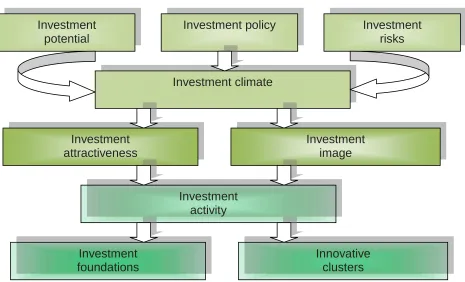
The third group of authors considers investment attractiveness as one of the resulting indicators for assessing the investment climate. They believe that the investment climate includes the objective capabilities of enterprises, industries, regions (investment potential) and the investor's conditions of investment (investment risk), which allows us to compare these concepts. They conclude that if investment potential exceeds investment risk, one can talk about its investment attractiveness (Nadyrkhanov, 2011). As already mentioned, investment attractiveness has in the economic literature a number of similar concepts: «investment climate», «investment image». But they are not identical. The term «investment climate» is usually understood to mean the totality of economic, political, financial conditions that affect the flow of domestic and foreign investment in the economy of the country, and the investment image is represented as a complex reflection of various aspects of the investment climate in the views of investors (Johan, 2012). From here it is visible, that, the system of investment activity includes following elements (Figure 2).
Figure 2. Interrelations of the elements of the investment activity system
Investment
potential
Investment policy
Investment
risks
Investment climate
Investment
attractiveness
Investment
image
Investment
activity
Investment
foundations
Licensed under Creative Common Page 563 Different interpretations of the concept of investment attractiveness inevitably lead to different approaches in determining its internal components, reflecting either the stability of the financial condition of the enterprise, the profitability of capital, the stock price and the level of dividends paid. In the second, it is the economic (or socio-economic) expediency of investing, based on the coordination of the interests and possibilities of the investor and recipient of investments, which ensures the achievement of the objectives of each of them at an acceptable level of profitability and investment risk.
Investment attractiveness is characterized from the standpoint of prospects, profitability, efficiency and minimization of the risk of investing in its development. In this case, as a rule, the investment attractiveness at the macro level is determined by the following factors:
Political stability and its predictability in the country;
Basic macroeconomic indicators (inflation rate, GDP growth rates, production volumes of
the most important types of industrial products, budget deficit, etc.) and their outlook for the
future;
Presence and degree of perfection of normative acts in the field of investment activity;
Degree of perfection of the tax system;
Degree of investment risk, etc. (Imomov, 2011).
Licensed under Creative Common Page 564 the statics of the process, and therefore cannot fully meet the needs of assessing the investment climate in countries with economies in transition, including Uzbekistan.
REVIEW AND FINDINGS
The definitions of the investment climate given by us are based on the need to create certain conditions. In this case, the term «condition» is interpreted as: «the situation in which occurs, something is realized» and «the circumstance from which something depends». These definitions confirm the dual nature of the investment climate - its statics (situation) and dynamics (circumstances). But the environment and circumstances are created with the aim of «activating investments», «inflow of domestic and foreign investments», which means that the conditions of a favorable investment climate should ensure the attractiveness of investment.
It seems to us that this conclusion is one of the most important methodological approaches in the study of investment potential and it says that the basis for the formation and building up of investment potential is a favorable investment climate that provides a system of investment attractiveness. The state of the investment climate is one of the main qualitative characteristics of the investment field.
Determining factors and conditions for the attractiveness of investment in countries with economies in transition should still be considered the process of reform of both the state and domestic and foreign investors (Fedyasheva, 2014).
As a result of consistent economic reform in Uzbekistan, a gradual, gradual, favorable investment climate was formed. A special feature of its construction was a purposeful policy to increase the attractiveness of investing in the economy (The decree of the President of the Republic of Uzbekistan on «Additional measures to stimulate the attraction of foreign direct investment», 2012).
At each stage, the priorities that are appropriate to the emerging economic conditions were formulated, playing the role of investment attractors for both domestic and foreign investors.
Assessment of the investment climate can be carried out by various methods. They can be divided into three groups:
- economic and mathematical methods; - methods of factor analysis;
- methods of expert evaluation.
Licensed under Creative Common Page 565 estimates of the investment climate of the same countries. This indicates the need to improve the methodology for assessing and accounting for various factors in the analysis.
CONCLUSION
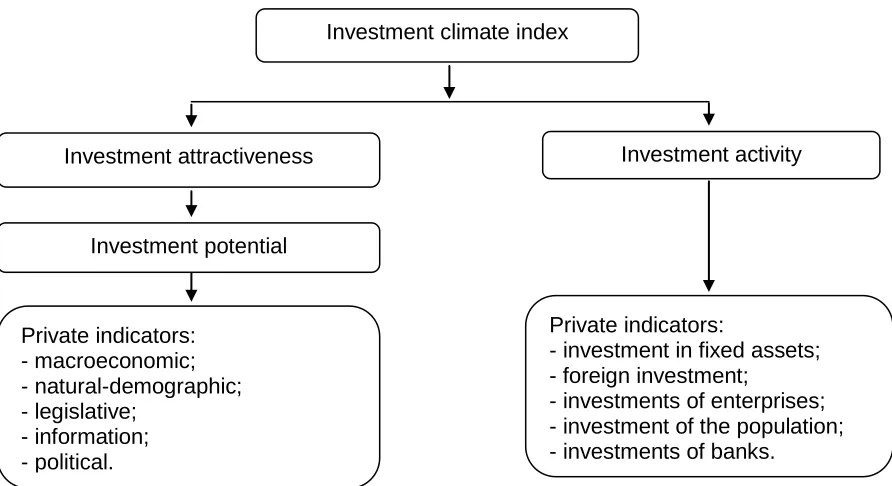
A critical analysis of existing methods, based on the proposed definition of investment potential, has shown that a quantitative assessment of the investment climate should be carried out through calculations of the integral indicator. We recommend a methodology for assessing the state of the investment climate at the macro level, by constructing an integral analysis of factors that determine investment attractiveness and activity (Figure 3). The composite index of the investment climate is calculated in three steps.
First step. For each individual indicator, they are brought into a uniform form using the multidimensional mean method. For each indicator, the arithmetic mean
(𝐗 𝐣 = 𝟏, 𝟐 … 𝐧)𝐣, which gives the average value of the indicator for all years under consideration
(k):
𝑿𝒋
=𝟏
𝒌 𝑿𝒊,𝒋
𝒌 𝒊=𝟏
Second step. For each private indicator, the indicator is summarized by year, which is calculated using the geometric mean.
Figure 3. The scheme for determining the composite index of the investment climate
Source: Compiled by author Investment climate index
Private indicators: - macroeconomic; - natural-demographic; - legislative;
- information; - political.
Private indicators:
- investment in fixed assets; - foreign investment;
- investments of enterprises; - investment of the population; - investments of banks.
Investment potential
Licensed under Creative Common Page 566 The third step. The index of the investment climate is calculated using a geometric mean based on composite indicators for each component.
Calculation of this composite index will allow assessing the degree of change in the dynamics of the investment climate in the country for a certain period of time. This will make it possible to identify bottlenecks that impede the development and improvement of the country's investment climate, comparison with international standards and foreign countries, and identify opportunities for further improving investment attractiveness and activity.
REFERENCES
Fedyasheva, G. (2014). Accumulation of investment potential and its effective use. Market, money and credit, №8, p.56.
Imomov, Х.X. (2011). Financial basis for improving the investment environment and increasing investment attractiveness. In (p.24). Abstract of the dissertation of the candidate of economic sciences.
Johan, E. Eklund. (2012). Theories of Investment: A Theoretical Review with Empirical Applications. In (р.56-57). Swedish Entrepreneurship Forum and Jonkoping International Business School.
Kiryukhin, V.V. (2006). Investment risk in the analysis of investment attractiveness. Problems of the modern economy, №3 (19).
Nadyrkhanov, U.S. (2011). Foreign direct investment in Uzbekistan: experience, problems, growth prospects. Tashkent: Publishing house «Fan va texnologiya».
Samarkhodzhaev, B. (2003). Investments in Uzbekistan. In (p.34). Tashkent: Publishing house «Akademiya».
The decree of the President of the Republic of Uzbekistan of 10.04.2012 on «Additional measures to stimulate the attraction of foreign direct investment».
Thomas, Pistorius. (2010). The Rhetoric of Investment Theory. In (p.76-94). Erasmus Universiteit Rotterdam; Bourreau.