3238
Identifying The Influence Of Anxiety And
Self-Reliance In Learning Towards Mathematics
Learning Performance Of Elementary School’s
Students Grade V
Nur Aisyah S, Irwan Akib, Agustan SyamsuddinAbstract: This research paper aims to identify the influence of learning anxiety and self-reliance in learning towards mathematics learning performance of fifth grade elementary school students. Therefore, researchers chose research with an ex-post facto approach to explore this. The research data were obtained from the filling out the learning anxiety questionnaire, self-reliance questionnaire and solving the learning performance test involving 172 fifth grade elementary school students as the research sample. The research sample was determined using a disproportionate stratified random sampling technique that involved 35 elementary schools and private primary schools. Data obtained through the instruments used were further analyzed using descriptive and inferential statistical analysis. Descriptive analysis techniques include frequency distribution and percentage of categories. Inferential analysis used multiple linear regression analysis. From the results of the data analysis, it was obtained information that student learning anxiety was in the low category while self-reliance in learning and mathematics learning performance of students were in the fair category. There is a significant positive influence between students’ self-reliance in learning towards student mathematics learning performance. Conversely there is a significant negative effect between students’ anxiety towards students’ mathematics learning performance. In addition, it can be stated that there is a significant influence between students’ learning anxiety and self-reliance towards the mathematics learning performance of fifth grade elementary school students.
Index Terms: Anxiety, Self-reliance, Mathematics Learning Performance.
—————————— ——————————
1 INTRODUTION
School as one of the formal educational institutions plays an important role in organizing quality education to develop the optimal potential of students in order to achieve national education objectives. One indicator of the school’s in producing a high quality of its graduates can be seen from the learning achievement of the students. Students' learning achievements are quite diverse considering their different characteristics that require different treatment in improving their learning performance [1]. Syah [2] stated that learning achievement is the success rate of students to achieve the objectives set in a program. This was later emphasized by Arifin [3] which said that the learning performance is generally concerned with aspects of knowledge, while the learning achievement include aspects of the creation of students' character. Assessment of the learning performance aims to determine the progress of learning process has been implemented by seeing the real grade or scores of students after working on the given tests. The performance of learning in each subject should always be the main concern especially in mathematics because mathematics subjects can practice students’ mindset in order to solve problems in critical, logical and exact way [4]. This is in line with the purpose of learning mathematics in schools that put pressure on reasoning and the establishment of students' attitudes in applying mathematics [5]; [6].
Students' mathematics learning performance is influenced by several factors. According to Djaali [7] one factor that can affect a person's mathematics learning ability is student learning anxiety. Students with high levels of learning anxiety tend to have low academic achievement [8]. In contrast, Spielberger [9] states that learners with low levels of anxiety will achieve better than learners with high levels of anxiety. This anxiety arises due to the condition that makes the student's feel uncomfortable during the learning process [10]. Therefore, a comfortable atmosphere is highly necessary so that students can control themselves and open up their self with their uncomfortable feeling, so it will reduce the anxiety experienced by students [11]. One of the ways teachers can do in order to reduce the anxiety of students is by inviting students to the discussion regarding to how to solve the previous question and a good way of solving the questions [12]. In addition to anxiety learning, the factors that can influence students' mathematics learning achievement are self-reliance learning. The word ―independent‖ has emerged as one of our national education objectives outlined in LAW No. 20 of 2003 so that the handling requires special attention [5]. Hidayat & Sumarmo [13] stated that independence is also one of the factors that affects learning that there is an attitude that allows one to act freely, doing something on his own encouragement and self-regulating ability in accordance with their rights and obligations to resolve and be responsible for all their decisions. On the other hand, Hamalik [14] stated that self-reliance is an important aspect for individuals in the process of learning to teach and positively impacting the quality of individual learning because it concerns individual initiatives. Students with high self-reliance will have confidence, an original nature, do not expect direction of others, and try themselves what they want to develop. Based on the explanation above, researchers are trying to explore whether there is an influence of anxiety and self-reliance in learning towards math learning performance in elementary school students grade V.
————————————————
• Agustan Syamsuddin, Magister of Elementary Education, Universitas
Muhammadiyah Makassar, Indonesia. E-mail:
• Nur Aisyah S, Magister of Elementary Education, Universitas
Muhammadiyah Makassar, Indonesia E-mail:
• Irwan Akib, Magister of Elementary Education, Universitas
Muhammadiyah Makassar, Indonesia. E-mail:
3239
2 METHOD
Ex post facto research was chosen to study the influence of anxiety and self-reliance in learning mathematics towards mathematics learning performance. Data obtained from the filling the questionnaire conducted by 172 Elementary School’s students grade V which is involved as sample research. The sampling technique used is random sampling techniques of less proportional strata (disproportionate stratified random sampling). This research was conducted in the Tamalate Sub-district of Makassar, involving 35 elementary schools and private primary schools. The instruments used are student anxiety questionnaire, self-reliance questionnaire and mathematics learning performance test.
Before using the instrument, it was first validated by an expert validator in the field of evaluation. The aspect assessed by the validator is the indicator, the use of language and presentation. The assessment criteria conducted by the validator is based on the Likert scale by using a score of 1-4, where the score is based on the statements given with the following description: 1 = poor; 2 = fair; 3 = good and 4 = excellent. Furthermore, determining the scale range of the scoring criteria can be obtained by means of the highest score range minus the lowest score divided by the maximum score. Based on the determination of the range, obtained range 0.75. The feasibility criteria for analysis of the average value used are presented in Table 1 below.
TABLE 1.
CRITERIA FOR VALIDITY OF THE AVERAGE VALUE ANALYSIS
Average Validity Category
3,26 – 4,00 Valid
2,51 – 3,25 Valid Enough
1,76 – 2,50 Valid Less
1,00 – 1,75 Invalid
Based on the results of the assessment from the validator acquired the average learning anxiety questionnaire assessment and the self-reliance questionnaire of 3.8. Whilst, for the test instrument of learning performance, obtained the average value of the validator’s assessment of 4.00. Thus, it can be concluded that the three instruments are valid and feasible to be used as research instruments. The Data obtained from the instruments used are subsequently analyzed using a descriptive and inferential statistical analysis. For descriptive analytical techniques, it includes frequency distribution and category percentation. Moreover, the distance of the interval class score in learning anxiety questionnaire is (highest value – Lowest value): The number of categories, so it is obtained (74 – 50): 5 = 4.8. Meanwhile, for the self-reliance in learning, it is acquired (highest value – lowest): number of categories. Hence obtained: (72 – 50): 5 = 4.4. Thus to determine the category of anxiety level of the students used the following table.
TABLE 2.
CATEGORY OF LEARNING ANXIETY LEVELS OF STUDENTS
Score Interval Category
89-99 Very high
78-88 High
67-77 Fair
55-65 Low
44-54 Very low
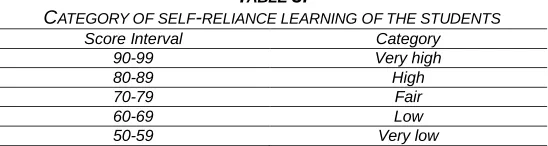
Furthermore, to determine the category of self-reliance level in learning students are used as follows.
TABLE 3.
CATEGORY OF SELF-RELIANCE LEARNING OF THE STUDENTS
Score Interval Category
90-99 Very high
80-89 High
70-79 Fair
60-69 Low
50-59 Very low
For the inferential analysis, multiple linear regression analyses used because researchers wanted to test if there was an influence on anxiety and self-reliance in learning towards students' mathematical achievements. To facilitate the calculation process, researchers use SPSS 20.0 for wondows. In detail, it will be traced one by one variable that is examined in this study i.e. (a) an influence of anxiety on learning achievement; (b) the influence of self-reliance in learning on learning achievement; and (c) the influence of anxiety and self-reliance in learning to jointly influence learning achievement. To determine whether there is an influence on points (a) and (b) the test is done with t-Test. The criteria used are learning anxiety variables affects the learning achievement if the t-count < t-table with the significance value gained < Alpha value 0.05. This also applies to the self-reliance learning case that the self-reliance variable affects the learning achievement if t-count the < t-table with the significance value gained < Alpha value 0.05. For points (c), this can be identified by conducting test-F, i.e. variable anxiety and self-reliance in learning influence the learning achievement if count > F-table with significance value gained < significant value alpha 0.05. Before analysed, the data obtained first tested the normalities and its homogeneity. Normality test aims to determine whether the spread of data in independent variables or dependent variables is normal distribution or not. While homogeneity tests are performed to view the spread of data on two independently-distributed, homogeneous variables. To know the homogeneous data then used a test of similarity variance (homogeneity) with Levene's Test on the level of significance 0.05 (5%) with the rules that the probability or sig > 0.05, then the data that has the same variance (homogeneous), otherwise if it is < 0.05, then the data obtained comes from a variance that is not the same (not homogeneous). Based on the results of the analysis of data conducted, then obtained the description of test results of normality and homogeneity of the variable independent and dependent as follows.
a. Normality Test 1. Anxiety
3240
significance 0.238 > 0.05 so that the distributed data is normal.
2. Self-reliance
Based on the table above, in the Kolmogorov-Smirnov column acquired significance 0.200 > 0.05 so that the distributed data is normal whereas the Shapiro-Wilk column obtained significance 0.050 = 0.05 so that the distributed data is normal.
3. Learning Performance
Based on the table above in Kolmogorov-Smirnov column, acquired significance 0.200 > 0.05 so that the distributed data is normal whereas the Shapiro-Wilk column obtained significance 0.084 > 0.05 so that the distributed data is normal.
b. Homogeneity Test
Based on the table above, shows that all data is homogeneous because significance acquired in the anxiety variable is 0.276 > 0.05 and self-reliance in learning variables is 0.282 > 0.05. It can therefore be concluded that the data obtained by normal distribution and data is homogeneous.
3 RESULTS
Here are presented general overview of learning anxiety, students’ self-reliance and Mathematics learning achievement of students grade V at elementary School (SD) in the Tamalate district of Makassar.
1. Learning anxiety
Based on the results of research that has been conducted, data on students' anxiety has frequency distribution and percentage of students' anxiety category in elementary school in Tamalate district of Makassar.
TABLE 4.
FREQUENCY AND PERCENTAGE OF STUDENTS’ LEARNING ANXIETY LEVEL IN ELEMENTARY SCHOOL IN TAMALATE DISTRICT OF MAKASSAR
Anxiety group
Frequency Percent Valid Percent
Cumulative Percent
Valid
44.55 24 14.0 14.0 14.0
55.66 67 39.0 39.0 52.9
67.77 55 32.0 32.0 84.9
78.88 23 13.4 13.4 98.3
89.99 3 1.7 1.7 100.0
Total 172 100.0 100.0
From the table above, it can be concluded that the results of questionnaire of the students show the tendency of learning anxiety levels of students grade V in elementary school in Tamalate district is in low category.
2. Self-reliance
Based on the data obtained, the following presented an overview of students' self-learning through frequency distribution and a percentage of students' self-reliance level category in elementary school in Tamalate district of Makassar in the table below.
TABLE 5.
FREQUENCY AND PERCENTAGE OF SELF-RELIANCE LEVEL CATEGORY FOR STUDENTS IN ELEMENTARY SCHOOL IN TAMALATE DISTRICT OF
MAKASSAR
Frequency Percent Valid Percent
Cumulative Percent
Valid
46.55 18 10.5 10.5 10.5
55.66 68 39.5 39.5 50.0
67.77 64 37.2 37.2 87.2
78.88 22 12.8 12.8 100.0
Total 172 100.0 100.0
From the table above it can be figured out that the self-reliance scores of students in elementary school in Tamalate district tend to be in fair category where the most percentages are at that level.
3. Learning performance
Based on the results of the research, obtained data about the math learning performance which is the highest score is 90 and the lowest score is 65, the average math learning performance is 75, median of 75 and a mode of 78. Frequency distribution and the percentage of students learning performance in elementary School at Tamalate district of Makassar is described in the table below.
TABLE 6.
FREQUENCY AND PERCENTAGES OF STUDENTS’ PERFORMANCE ON MATHEMATICS CATEGORY IN ELEMENTARY SCHOOL IN TAMALATE
DISTRICT OF MAKASSAR
Score interval Frequency Percent Category
50.59 60.69 70.79 80.89
14 8.1 Very low
40 23.3 Low
72 41.9 Fair
3241 90.99
Total
7 4.1 Very high
172 100.0
Based on the table above, it can be known that students' mathematical learning performance data is in fair category where the highest percentage is at the level is 41.9%.
4. The influence of anxiety and self-reliance in learning towards learning achievement
The results of the study illustrate that in general, students’ learning anxiety is in low category. Meanwhile, students’ self-reliance in learning is in fair category. Likewise, a description of students learning achievement os students grade V in Elementary School in Tamalate district of Makassar is in fair category. Further, to identify the influence of anxiety and students’ self-reliance in learning towards students’ learning performance, then performed inferential analysis by using a double regression analysis. The results of analysis obtained presented in the table below.
TABLE 7.
THE RESULTS OF THE T-TEST ANALYSIS RELATED TO SELF-RELIANCE
AND STUDENTS’ LEARNING ANXIETY TOWARDS MATHEMATICS LEARNING PERFORMANCE
Model Unstandardized Coefficients
Standardized
Coefficients t Sig.
B Std. Error Beta B Std.
Error
(Constant) 46,016 7,155 6,431 ,000
Anxiety -,161 ,059 -,179 -2,733 ,007
Self-reliance ,570 ,073 ,509 7,788 ,000
a Dependent Variable: Learning performance
From the table above, it can be explained that the learning anxiety variables obtained t-count -2.733 < 1.9741 with a significance of 0.007 < 0.05 so that it can be concluded that anxiety affects the learning performance. While for self-reliance in variables obtained t-count 7.788 > 1.9741 with significance 0.000 < 0.05 so that it can be concluded that the independence of learning affects the learning achievement. Furthermore, testing was conducted to see if there was a co-influence of anxiety and self-reliance in learning towards student learning performance. From the results of the analysis obtained the following description presented in the form of table Anova.
TABLE 9.
RESULTS OF TEST-F ANALYSIS RELATED TO SELF-RELIANCE AND STUDENT LEARNING ANXIETY ON MATHEMATICS LEARNING
PERFORMANCE
Model Sum of
Squares df
Mean
Square F Sig.
Regression 5252,241 2 2626,121 44,934 ,000(a)
Residual 9876,986 169 58,444
Total 15129,227 171
a. Predictors: (Constant), Self-relience in learning, Anxiety b. Dependent Variable: Learning performance
According to the table above, it can be explained that F-count 44,934 > F-table 3.049468 with the significance
0,000 of < 0.05 so that it can be concluded that self-reliance in learning and students’ learning anxiety jointly affects learning performance.
4 DISCUSSION
The results of student self-reliance analysis when associated with previous hypothesis testing illustrate that there is a positive and significant influence of self-reliance learning towards mathematical learning performance, self-reliance in learning is necessary to increase the spirit of students in achieving maximum learning performance. Students who have high self-reliance learning, will always learn, pay attention to every material delivered by the teacher, and always do their task. Thus students can master a competency by the knowledge of competency gained from self-study [15].
3242
creativity of teachers to accommodate both aspects of mathematics learning so that students can learn with a comfortable atmosphere and their competency knowledge can be enhanced.
5 CONCLUSION
Based on the data analysis results outlined, it can be concluded that the students' learning anxiety is in the low category while the students' self-reliance is in fair category. There is a significant positive influence between the students self-reliance in learning towards students' mathematical learning performance. Conversely, there is a significant negative influence between learning anxiety students with student mathematics learning performance. In addition, it can be said that there is a significant influence between learning anxiety and students’ self-reliance towards mathematics learning performance of students’ grade V elementary school.
6
ACKNOWLEDGMENT
We would like to express our deepest appreciation to all those who provided us the possibility to complete this report. A special gratitude we give to Kemenristek dikti and LLDIKTI Wilayah IX who had funded this research in the scheme ―Penelitian Tesis Magister‖ based on decree number 7/E/KPT/2019 and agreement/contract number No.115/SP2H/LT/DRPM/2019; No.1632/L9/AK/2019 and No.001/KONTR-PENL/V/1440/2019, May 15, 2019.
7
REFERENCES
[1] Syamsuddin, A. (2019). The impact of implementing of INSTAD model toward student’s mathematics learning outcome for 5th grade elementary school students. In Journal of Physics: Conference Series (Vol. 1318, No. 1, p. 012021). IOP Publishing. [2] Syah, M. (2008). Psikologi Pendidikan dengan
Pendekatan Baru Edisi Revisi. Bandung: PT. Remaja Rosdakarya.
[3] Arifin, Z. (2009). Evaluasi Pembelajaran (Vol.152). Bandung: PT Remaja Rosdakarya.
[4] Agustan, S., Juniati, D., & Siswono, T. Y. E. (2017, August). Profile of male-field dependent (FD) prospective teacher's reflective thinking in solving contextual mathematical problem. In American Institute of Physics Conference Series (Vol. 1867, No. 2).
[5] Nasional, D. P. (2003). Sistem pendidikan nasional. Jakarta (ID): Depdiknas.
[6] Soedjadi, R. (2007). Masalah kontekstual sebagai batu sendi matematika sekolah. Surabaya: Pusat Sains dan Matematika Sekolah UNESA.
[7] Djaali (2015) Psikologi Pendidikan. Jakarta. PT Bumi Aksara.
[8] Sarason, I. G. (1984). Stress, anxiety, and cognitive interference: reactions to tests. Journal of personality and social psychology, 46(4), 929.
[9] Spielberger C. D, Gorsuch R. L. & Lushene R. E. 1972 Manual for the State-Trait Anxiety Inventory Self-Evaluation Questionnaire (Palo Alto, CA: Consulting Psychologists Press).
[10]Khatoon, T., & Mahmood, S. (2010). Mathematics anxiety among secondary school students in India and its relationship to achievement in
mathematics. European Journal of Social Sciences, 16(1), 75-86.
[11]Mammad, K., Ahami, A., Azzaoui, F. Z., Boulbaroud, S., Idrissi, S. W., Karjouh, K., & Fofana, L. (2017). Diagnosis of anxiety disorders in university students through the early maladaptive schemas and Beck’s inventory. Psychology, 8(13), 2114
[12]Serrano Pintado, I., Llamazares, E., & del Camino, M. (2014). Description of the general procedure of a stress inoculation program to cope with the test anxiety. Psychology. 5(8), 956-965.
[13]Hidayat, W., & Sumarmo, U. (2013). Kemampuan Komunikasi dan Berpikir Logis Matematika serta Kemandirian Belajar. Jurnal Delta-fi, 2(1).
[14]Hamalik, O. (2008). Psikologi Belajar dan Mengajar. Bandung. Sinar Baru Algensindo.
[15]Mujiman, H. (2011). Manajemen Pelatihan Berbasis Belajar Mandiri. Yogyakarta: Pustaka Pelajar.
[16]Lilik, S., Djannah,W., & Wagimin. (2013). Tingkat Penguasaan Self-Regulated Learning Skills Ditinjau Dari Segi Prestasi Belajar dan Lama Studi Pada Mahasiswa FKIP UNS. Jurnal Conselium, 1 (1). [17]Hargis, J. (2000). The self-regulated learner
advantage: Learning science on the internet. Electronic Journal of science education, 4(4). [18]Sumarmo, U. (2004). Kemandirian belajar: apa, mengapa, dan bagaimana dikembangkan pada peserta didik. In Makalah pada Seminar Tingkat Nasional. FPMIPA UNY Yogyakarta (Vol. 8).
[19]Holstein, H. (2000). Murid Belajar Mandiri: Situasi Belajar Mandiri dalam Pelajaran Sekolah. Bandung : Remaja Karya.
[20]Leonard, L & US, S. (2010). Pengaruh Konsep Diri, Sikap Siswa pada Matematika dan Kecemasan Siswa terhadap Hasil Belajar Matematika. Jurnal Exacta. 1(3), 341-352.
[21]Richardson, F. C., & Suinn, R. M. (1972). The mathematics anxiety rating scale: psychometric data. Journal of counseling Psychology, 19(6), 551. [22]Ashcraft, M. H. (2002). Math anxiety: Personal,
educational, and cognitive consequences. Current directions in psychological science, 11(5), 181-185.