Effect of Strength Properties on Concrete by
Partial Replacement of Coarse Aggregate with
Waste Cuddapah Stones
Rajendra D [1], H Gokulram [2]
[1]
(PG Student, Dept of Civil Engineering, CSI College of Engineering, Ketti, The Nilgiris, Tamilnadu, India.
[2]
(Assistant Professor, Dept of Civil Engineering, CSI College of Engineering, Ketti, The Nilgiris, Tamilnadu, India.
ABSTRACT
Cement, fine aggregate, coarse aggregate and water are important constitutes of concrete that are obtained naturally. So we can replace new materials instead of natural sources such as M Sand, fly ash, Metakaolin, etc.Aim of this project is to study the strength properties of the concrete by partially replacing coarse aggregate by waste Cuddapah stones and cement (OPC) with Fly ash. This thesis covers the properties of materials and mix proportions, preparation of concrete with waste Cuddapah stones, hardened state characteristics, and influence of various parameters on hardened state concrete and utilization of various materials in the structural members. Waste Cuddapah stones (WCS) were partially replaced as coarse aggregates in 20%, 40% and 60% respectively and fly ash (FA) was partially replaced with cement by 20% respectively are casted and tested for 7 and 28 days.Fresh and hardened concrete properties are evaluated by workability test, compressive strength and split tensile test with a fixed water cement ratio 0.4. The test results were compared with the conventional concrete properties and show that there is an increase in strength of the concrete.
Keywords: cement, coarse aggregate,Cuddapah waste, fly ash, partial replacement, water.
1. INTRODUCTION
Concrete is a material synonymous with strength and longevity has emerged as the dominant construction material for the infrastructure needs of the present situation. Due to the vast usage of concrete in this century, concrete ingredients are in depleting stage. There is an interest mounting up to the handling of waste materials as different aggregates and significant research was performed on the use of many different materials as aggregate substitute such as waste Cuddapah and other industrial wastes.There is an interest mounting up to the handling of waste materials as different
aggregates and significant research was performed on the use of many different materials as aggregate substitute such as waste Cuddapah and other industrial wastes. These waste materials can solve few problems like lack of aggregates in construction sites and environmental problems. In the last decade, construction industry has been conducted various researches on the utilization of waste products in concrete in order to reduce the utilization of natural resources.Layer stone (Cuddapah slab) is utilizing for roof and floor works. During processing of finished product, waste is generating and this waste is dumping in and around the places where they are cut as per customer’s requirements. Concrete production achieves innovations in substitution of different materials in the place of natural coarse and the fine aggregates.This Paper Presents the experimental study undertaken to investigate the influence of partial substitution of cement (OPC) with Fly ash and partial substitution of coarse aggregate by waste Cuddapah stones and as a method to improve normal concrete for special applications. The tested hardened properties of M30 grade concrete will consist of compressive strength, split tensile and flexural strength.
2. LITERATURE REVIEW
regression analysis of experimental results [2]. Natural aggregate had been replaced with the waste shabath stone in four different percentages namely 10, 20, 30 &40 %. A comparison was made between the specimens of partially replaced coarse aggregate and the same set of specimens admixed with supaflo. Test results indicated that the replacement of coarse aggregate by 30% had attained a good strength in the two cases mentioned above [3]. This study explores the possibility of replacing part of fine aggregate with fly ash as a means of incorporating significant amounts of fly ash.Eggshell is generally thrown away as a waste. The egg shell also creates some allergies when kept for a longer time in garbage. If the waste cannot be disposed properly it will lead to social and environmental problem. [4].Concrete is the material that can be used in any type of construction works. Hence demand of concrete and concrete materials has been increased time by time due to the limited quantity of supplying of concrete materials. Workability of concrete mix decreased with replacement of natural aggregate with bethamcherla marble stone aggregate. But up to some extent even replaced concrete mixes got optimum results [5]. Fly ash is a byproduct of burnt coal from the Thermal power plants, Marble dust is a waste product from marble industries and stone dust is a waste product from crusher plants. Waste disposal is an important issue in the present time and utilization of industrial waste like fly ash, stone dust and marble dust in concrete making studied to investigate the improvement in the properties of concrete and presenting their use as an alternative material[6]. The reduction in the sources of natural sand and the requirement for reduction in the cost of concrete production has resulted in the increased need to identify substitute material to sand as fine aggregates in the production of concretes. Slab dust, a by-product from polishing process during stone dressing activities. In recent days there were also been many attempts to use fly ash, an industrial by product as partial replacement for cement to have higher workability, long-term strength etc. This work is an attempt to use slab dust in various percentages (0%, 25%, 50%,75%) as partial replacement for sand in concrete building material in the world. Conventionally concrete is mixture of cement, sand and aggregates [7].In general the construction works are building with reinforced cement concrete (RCC) material. The Cement concrete is composition of cement, coarse and fine aggregate, water and some admixtures. For many works the coarseaggregate is brought from granite stone. Geographically the Tadpatri, Anantapur (District), Andhra Pradesh
works. Duringprocessing of finished product, waste is generating and this waste is dumping in and around the town (Tadpatri).Thepaper presents the feasibility of utilization of stone waste for construction works. The primary lab tests showed thepotentiality of waste for construction.
3. EXPERIMENTAL INVESTIGATION
3.1. Materials
Cement:Portland cement and similar materials are made by heating limestone (a source of calcium) with clay and/or shale (a source of silicon, aluminum and iron) and grinding this product (called clinker) with a source of sulfate (most commonly gypsum). The extremely high temperatures and long periods of time at those temperatures allow cement kilns too efficiently and completely burn even difficult-to-use fuels. OPC 53 grade sample is used. Specific gravity of cement was 3.15.
Fly ash:Two classes of fly ash are defined: Class F fly ash and Class C fly ash as per ASTM C618. In this investigation Class F fly ash is used. This fly ash is pozzolanic in nature, contains less than 7% lime (CaO) and is collected from the burning of harder, older anthracite and bituminous coal. Specific gravity of fly ash was 2.20.
Fine Aggregate:Fine aggregate is a naturally occurring granular material composed of finely divided rock and mineral particles. The fine aggregate used in the manufacturing of concrete should be free from debris, fungi and chemical attack.In this recent investigation, the river sand which was available nearby was used as fine aggregate and the tests were carried out on sand as per IS 2386 – 1963 part(I), (III) and (IV). Specific gravity of fine aggregate was 2.66 and Fineness modulus was 2.64.
Coarse Aggregate:Coarse aggregates are produced by disintegration of rocks and by crushing rocks. These are available in many different sizes. Coarse aggregates are usually those particles which are retained on an IS 4.75mm sieve. In the recent investigation, coarse aggregate of size 20mm and locally available crushed granite stone aggregate is used. Various tests were carried out as per IS 2386 – 1963 part (III) and (IV) and obtained Specific gravity as 2.66 and Fineness modules as 3.1.
purposes as the stone is more resistant than most other sedimentary rocks which is used in place of natural coarse aggregate in the range of20%, 40% and 60%.Specific gravity of Cuddapah stone was 2.7and Fineness modules was 3.05.
3.2. Mix Proportion
In this investigation, M30 grade of concrete was adopted with water cement ratio of 0.4. The percentage replacement of cement by fly ash (FA)
was constantly 20% and coarse aggregate by Waste Cuddapah stones (WCS) was 20%, 40% and 60%. This was done to determine the proportion that would give the most favorable result. Concrete mix proportioning is mentioned in the table.1. The mix was designed as per IS 10262 – 2009 and IS 456 – 2000. The mix ratio of M30 is1:2.70:3.33 and water
– cement ratio is 0.4.
Table – 1. Mix Proportion for M30 concrete with fly ash and WCS
Mix
Replacement %
Fly ash (20%) Kg/m3
Cement Kg/m3
Fine aggregate Kg/m3
Coarse aggregate
Kg/m3
WCS Kg/m3
M1 0 0 341 933.33 1136.14 0
M2 20 68.2 272.8 933.33 908.91 227.23
M3 40 68.2 272.8 933.33 681.95 454.46
M3 60 68.2 272.8 933.33 455.06 681.08
4. RESULTS AND DISCUSSION
4.1. Casting
The concrete is prepared in laboratory. The concrete is poured into the mould in 3 layers by 25 strokes with tamping rod.The cast specimens are removed after 24 hours and these are immersed in a water tank. After curing 7 and 28 days the specimens are removed and these are tested for Workability, Compression, and Split tensile strength is found out for concrete which was replaced with Cuddapah stone in the proportion of 20%, 40%, and 60%. This was to be partial replacement of coarse aggregate and cement. The results compared with conventional concrete.
4.2. Workability
Slump test and compacting factor tests are the most widely used workability tests for concrete. The degree of workability of concrete depends on the values of test results obtained from slump test and compacting factor tests as in the Table – 2.
Slump Value: Slump Value =h1− h2, where h1 is Initial height of the cone which is 280 mm and h2 is height of the concrete after removal of the mould.
Table – 2. Slump value and Compaction factor
Concrete Mix W/c ratio Slump Value Compaction Factor
Conventional concrete 0.4 3 0.89
20% CWS + 20% fly ash 0.4 3 0.95
40% CWS + 20% fly ash 0.4 2 0.93
60% CWS + 20% fly ash 0.4 2 0.93
4.3. Compressive Strength Test
Table – 3. Compressive strength for 7 & 28 days
Concrete Mix 7 days (N/mm2) 28 days (N/mm2)
Conventional concrete 19.28 29.64
20% CWS + 20% fly ash 20.14 30.96
40% CWS + 20% fly ash 21.03 32.31
60% CWS + 20% fly ash 22.62 34.69
Fig – 1. Compressive strength for 7 & 28 days
4.4. Split tensile Strength Test
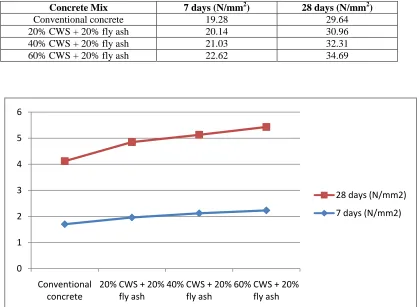
The split tensile strength of different mixes for 7 and 28 days are shown in Table – 4. Conventional concrete and different mixes of partial replacement of CWS and fly ash concrete compressive strength results are compared by plotting graphs shown in Figure 2.
Table – 4. Split tensile strength for 7 & 28 days
Concrete Mix 7 days (N/mm2) 28 days (N/mm2)
Conventional concrete 1.70 2.42
20% CWS + 20% fly ash 1.96 2.89
40% CWS + 20% fly ash 2.12 3.01
60% CWS + 20% fly ash 2.23 3.20
0 1 2 3 4 5 6
Conventional concrete
20% CWS + 20% fly ash
40% CWS + 20% fly ash
60% CWS + 20% fly ash
28 days (N/mm2)
Fig – 2. Split tensile strength for 7 & 28 days
CONCLUSION
Based on the results obtained from the experiment the following conclusions are drawn:
Compared to conventional concrete, the compressive strength of Cuddapah stone replaced coarse aggregate concrete was gradually increased up to 4.45%,9% and 17.03% in 20%, 40% and 60% of coarse aggregate by CWSand 20% cement by fly ash was replaced. Hence, replacement of coarse aggregate with Cuddapah stone achieved excellent strength. Effect on compression with 60% replacement of aggregate has been found to be achieving higher compressive strength. Using Cuddapah stones as paver aggregate is most suitable for building paver blocks. This method can also be used in heavy weight concrete as it gives better strength than natural aggregate.
REFERENCE
[1] A R NihithChowdary and E PremaLatha, Experimental Studies on Partial Replacement of Shabath Waste as Coarse and Fine Aggregate, International Journal of Innovative Research in Science,Engineering and Technology, Vol. 5, Issue 2, February 2016.
[2] V Giridhar, HSudarsana Rao and Vaishali G Ghorpade,
Development of regression models for strength of ceramic waste aggregate concrete, International Journal of Emerging Trends in Engineering and Development, Vol.1, Issue 5, Dec – Jan 2015.
[3] G Murali, K R Jayavelu, et al., Experimental investigation on concrete with partial replacement of coarse aggregate, International Journal of Engineering Research and Applications, Vol.2, Issue 2, Mar – Apr 2012.
[4] Shaik AkhilMastan and V.R.Prasath Kumar, Experimental Study on Concrete by Partial Replacement of Fine Aggregate with Fly Ash and Egg Shell Powder, International Journal & Magazine of Engineering,Technology, Management and Research, Volume 2, Issue 2, February 2015.
[5] C Naresh, B Ajitha, et al., Workability Studies on Fibre Reinforced Concrete Using Bethamcherla Marble Stone as a Replacement of Natural Aggregate, International Research Journal of Engineering and Technology, Volume 2, Issue 4, July 2015.
[6] Lokesh Kumar and GautamBhadoriya, Ash and Fine Aggregate by Marble Dust, Stone Dust on Concrete Properties, International Journal of Science Technology & Engineering, Volume 2, Issue 6, December 2015.
[7] V Madhava, P Mani and N P N Murthy, Effect of Strength Properties on Concrete using Stone Polish Dust as Partial Replacement of Sand, International Journal of Advanced Technology and Innovative Research, Volume 7, Issue 16, November 2015.
[8] N VenkataRamana, C Sashidhar, et al., A technical feasibility approach to utilize the stone waste for construction works, International Journal of Innovative Research in Science,Engineering and Technology, Volume 2, Issue 8, August 2013.
[9] IS: 383-1970, Specification for Coarse and Fine Aggregate from Natural Sources for Concrete—Bureau of Indian Standards, New Delhi.
[10] IS: 516-1959, Methods of Tests for Strength of Concrete, Bureau of Indian Standards, New Delhi.
[11] IS: 5816-1970, Methods of Test for Splitting Tensile of Concrete Cylinders, Bureau of Indian Standards, New Delhi
0 10 20 30 40 50 60 70
Conventional concrete
20% CWS + 20% fly ash
40% CWS + 20% fly ash
60% CWS + 20% fly ash
28 days (N/mm2)