An Empirical Study On The Effectiveness Of CIDA
Form Of Construction Adjudication; Disputants’
Perspective
Chandana Jayalath
University of Vocational Technology, Department of Quantity Surveying, 100, Kadawala Road, Ratmalana, Sri Lanka, PH-00941 12630700
Abstract: The Construction Industry Development Authority (CIDA) Act of 2013 in Sri Lanka came into force with provisions for adjudication to be available to the required parties to seek recourse in a dispute. Consequently, CIDA launched a pool of construction adjudicators and a code of conduct with the ground rules applicable for adjudication. Standard Bidding Documents also mandate adjudication as a form of dispute resolution. These altogether provide an initial benchmark for a formal non-adhoc adjudication practice in Sri Lanka. Its’ perceived success has not however been researched in detail for further improvements. Therefore, a desk review was carried out to identify the benchmarks established 5 years ago. A questionnaire survey was conducted to gauge the individual perception of the contractors and employers on CIDA adjudication. Mann Whitney Utest was used to measure differences of opinion. It was found that many of the criticisms within the literature review are not ill-founded. The majority of respondents contended that adjudication is disadvantaged by not adhering to its own directives given in the adjudication guideline.
Keywords: Construction adjudication, Construction industry, Dispute, Mann-Whitney U test
1.
Introduction
Globally, the incidences of disputes in the construction industry have had different consequences on construction projects which range from delay in progress to abandonment of construction projects [1]. Disputes have been associated with many other factors such as inferior quality of end product, delay in deliverables, disputing rates for varied works, payment delays etc [2]. Unfortunately, this situation has portrayed the construction industry with a bad reputation of being ineffective, contentious and adversarial. Particularly on public sector projects, this situation is often acute, due to lack of effective alternative dispute resolution mechanisms in place of courts [3]. The ultimate result is cost and time overrun, delay in beneficial use, opportunity costs etc [4]. Thus, the frustration associated with litigation and sometimes arbitration has necessitated an increased demand for other alternatives, one of which is adjudication. The requirement of new legislation in the form of Housing Grants, Construction and Regeneration Act 1996 had been reported by many scholars [5], [6]. This Act provided for adjudication to be available to the parties on the majority of construction contracts. Adjudication is now a well-established construction dispute resolution process in UK [7] and its perceived success is well documented. Lately, however, there have been criticisms. These criticisms include issues such as ambush by the claiming party [8]. In Sri Lanka, there is no precise definition for adjudication in the Construction Industry Development Authority (CIDA) Act; however there are certain features which help identify it. Standard bidding documents also incorporate adjudication with reference to a code of conduct and ethics. With this backdrop, the concept of adjudication is no longer new in the Sri Lankan construction industry. Several pioneer works have given particular emphasis on adjudication [9], [10]. More particularly in a context where adjudicators are not trained in any professional entities in Sri Lanka, it became imperative to keep a close eye on what is happening under the label of adjudication. Under circumstances, CIDA set up a pool of construction adjudicators and introduced guidelines. These
guidelines delineate, in a generic fashion, the professional and ethical responsibilities of members of dispute adjudication boards. Therefore it would seem appropriate to carry out a survey amongst those who are most directly involved and affected by adjudication and see whether the directives cited in the guideline have been followed up and adhered to in the last 5 years.
2.
Research Aim
The aim of this research is to offer empirical evidence on the current level of effectiveness of adjudication as a dispute resolution mechanism in the Sri Lankan construction industry against the initial directives cited in the CIDA Guideline of Construction Adjudicators.
3.
Research Objectives
• Identify the benchmarks held in 2013 along with the introduction of the CIDA pool of construction adjudication and adjudication guideline
• Gauge the firsthand experience of the contractors and employers as to overall effectiveness of adjudication • Suggest improvements of adjudication and its way
forward
4. Research Methodology
against a criterion on five-point Likert scale. Mann-Whitney
Utest is used to examine whether there were significant differences of response between these two independent groups on a continuous ordinal scale. This statistical test was adopted on the basis that it does not require large normally distributed samples to compare two independent groups.
5. Research Limitations
The opinion of contractors and employers involved in adjudication are only part of the overall picture and that more research on this topic needs to be done, especially of the adjudicators and academics as well as in medium and smaller projects where adjudication seems ad-hoc.
6. Novelty of the Research
This paper seeks to bridge any gap by evaluating the CIDA form of adjudication against its own stated aims and helps establish the strategic direction towards the next decade. There are four objectives of the CIDA guideline of adjudication that was published in the year 2013 and each objective has a criterion. It is time to test whether these objectives have been satisfactorily achieved 5 years after its inception and suggest improvements.
7. Literature Survey
There is a dearth of research on statutory adjudication indicating that the professionals involved in the construction industry have overall average level of satisfaction on the current practice of adjudication and believe that adjudication is an effective mechanism for dispute resolution rather than arbitration. Adjudication appears to have found acceptance in the South African construction industry, but it was found that the industry is not yet able to realize the full potential of adjudication, the main reason for this being a lack of knowledge [11]. Although many research papers of foreign countries stated that their success with the DAB, adjudication is locally found ad-hoc [10]. 71% (out of 92) of disputes referred to adjudication in Sri Lanka were unsuccessful where neither party was satisfied with the final outcome [10]. 94% of those disputes were subsequently resolved amicably on the basis of adjudicators’ determination while the remaining 6% were referred to arbitration [10]. This suggests that although adjudication is being practiced as a resolution method, it is not that effective [9]. Certain limitations have affected its effectiveness [10]. Key limitations include lack of awareness among industry practitioners, absence of legal ascent, and lack of competent adjudicators to resolve complex disputes. Their findings further indicate that the meager enthusiasm among the practitioners toward enactment is due to the inability to ascertain the extent of enforcement and failure to understand the benefits of statutory adjudication [12]. The procedural requirements of adjudication in general were also investigated [13]. Another research was that the effectiveness of the statutory adjudication legislation against its stated aims in Western Australia [14]. A questionnaire survey amongst construction professionals, lawyers, arbitrators/adjudicators and clients was conducted in order to establish the role of adjudication in the U.K. construction industry and to examine whether the criticisms leveled against adjudication are in essence widely held views [15]. In nutshell, disputes are not uncommon within the industry [16]. Disputes have a significant effect and impacts on
legislation to back up the adjudication practice. At present,
there is a concerted effort within the Sri Lankan construction industry to shift from contract based to statute based adjudication practices. The Sri Lankan construction industry alone has contributed 6.6% in 2009 to 8.7% in 2017 towards the overall GDP, as per the Central Bank of Sri Lanka Annual Reports, 2009-2018, thus playing a vital role in Sri Lanka’s economic and social development. The unpredictability of payments has in certain instances resulted in an extremely negative environment. As such, disputes are not uncommon within the industry [16]. Disputes have a significant effect and impacts on growth negatively and performance of the industry. In addition, the traditional means of resolving the construction disputes have not helped at all as the time and cost associated with litigation make the process undesirable. The CIDA Act No 33 of 2014 has, in a couple of provisions, introduced a way of settling disputes in the form of a hierarchical gauntlet. Accordingly, if the parties so desire any dispute relating to a contract for construction works, if it is not provided for in the contract, may be settled through adjudication. However, there is 'ha-ho' among industry personnel on the lack of care, misconduct and competency of the adjudicators. Among the allegations against them are the failure to attend to an agreed time frame and incompetence, causing the parties to walk off at will. Complaints also include incorrect judgment, failure to prevent the parties making an unfair or unworkable agreement or failing to disclose to a party that they were threatened with harm in circumstances where it would be reasonable to expect disclosure. Another complaint is that the adjudicator made unnecessary interference, applied duress or misled a party in some material way. CIDA has been a nominating agency to nominate adjudicators as stated in the Standard Bidding Documents. More particularly in a context where adjudicators are not trained in any professional entities in Sri Lanka, it became imperative, in the public interest, to keep a close eye on what is happening under the label of adjudication. Under circumstances, CIDA set up a pool of construction adjudicators and introduced guidelines. These guidelines delineate, in a generic fashion, the professional and ethical responsibilities of members of dispute adjudication boards. Given the wide variety of settings in which dispute boards are called upon to adjudicate, it is recognized that not all provisions in the guidelines will prove to be appropriate at all times. However, these guidelines will serve as a model which can be adapted to fit the particular mandate. The Steering Committee for Publications in CIDA recommended the use of these guidelines and considered it a 'living' aid that would be amended periodically. The setting up of the pool of adjudicators and the introduction of the adjudicator guidelines is considered as a significant landmark in the history of construction adjudication in Sri Lanka particularly when a statute to govern the practice of adjudication does not exist.
8. Desk Review
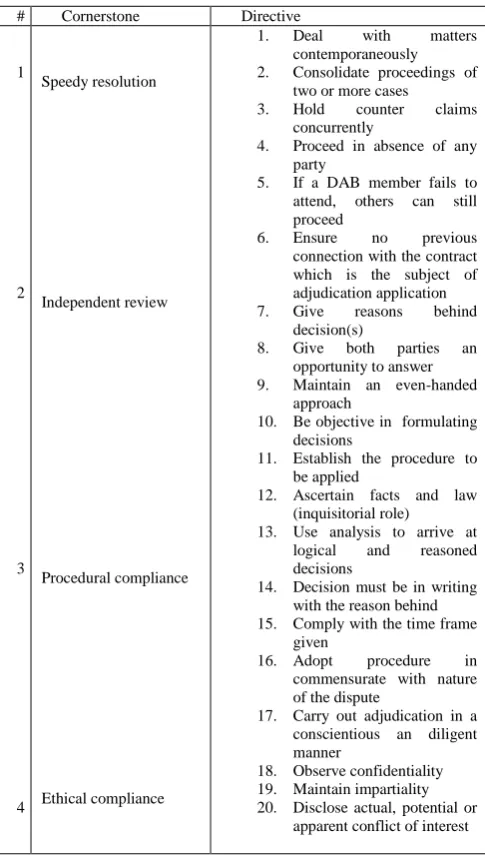
Desk research is basically aimed at in collating, organizing and synthesizing data from existing resources. Desk research is used to describe and tracking down the useful existing pre-published information and in this research, it is namely the Guideline for CIDA enlisted construction adjudicators. The adjudicators should conduct proceedings in the way most likely to deliver the objectives of the guideline that is quick,
independent review of disputes within a procedural and ethical framework. Table 1 shows the directives given.
Table 1: CIDA directives on the conduct of adjudication
# Cornerstone Directive
1
2
3
4
Speedy resolution
Independent review
Procedural compliance
Ethical compliance
1. Deal with matters contemporaneously 2. Consolidate proceedings of
two or more cases 3. Hold counter claims
concurrently
4. Proceed in absence of any party
5. If a DAB member fails to attend, others can still proceed
6. Ensure no previous connection with the contract which is the subject of adjudication application 7. Give reasons behind
decision(s)
8. Give both parties an opportunity to answer 9. Maintain an even-handed
approach
10. Be objective in formulating decisions
11. Establish the procedure to be applied
12. Ascertain facts and law (inquisitorial role) 13. Use analysis to arrive at
logical and reasoned decisions
14. Decision must be in writing with the reason behind 15. Comply with the time frame
given
16. Adopt procedure in commensurate with nature of the dispute
17. Carry out adjudication in a conscientious an diligent manner
18. Observe confidentiality 19. Maintain impartiality 20. Disclose actual, potential or
apparent conflict of interest
9. Findings and Discussion
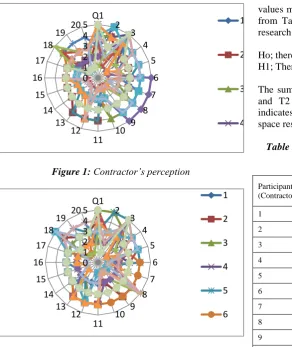
Figure 1: Contractor’s perception
Figure 2: Employer’s perception
The next step is to adopt the Mann-Whitney Utest (MWU test) in order to testify the differences of group opinion if any. MWU test is basically a nonparametric statistical significance ranked test for determining whether two independent samples were drawn from a population with the same distribution. MWU test is one of the most powerful non‐parametric tests [28] where the statistical power corresponds to the probability of rejecting a false null hypothesis. This test has thus good probabilities of providing statistically significant results when the alternative hypothesis applies to the measured reality [29]. It is noticeable that these variables are characterized by the existence of two independent groups, where it does not warrant large normally distributed samples [29]. This test has the great advantage of possibly being used for small samples of subjects (5 to 20 participants) [29]. Given the higher efficiency of parametric tests for normal data, non-parametric tests such as the WMU test should be applied more often, especially when the sample size is not very large [30]. In order for the Mann-Whitney U test to be applied, values need to be measurable on an ordinary scale and comparable in size. The two samples are combined and rank ordered together. The default assumption or null hypothesis is that there is no difference between the distributions of the data samples. Rejection of this hypothesis suggests that there is likely some difference (in terms of perception, experience and opinion in this survey) between the samples (two groups; contractors and employers). More specifically, the test determines whether it is equally likely that any randomly selected observation from one sample will be greater or less than a sample in the other distribution. If violated, it suggests differing distributions. Subject to condition that the Ustat
values must be equal or lesser than Ucritical values obtained from Tables (Two tail tests) the hypothesis set out in the research is as follows;
Ho; there is no statistical difference between the groups H1; There is a statistical difference between the groups
The sum of ranks assigned in each category is given as T1 and T2 for the purpose of Ustat calculations. Table 2 indicates the individual calculation of Directive 1 only due to space restriction of this research paper.
Table 2: Ranking of Perception on the Implementation of Directive 1
Participant
(Contractor) Rating Rank
Participant
(Employer) Rating Rank
1 3 10.5 1 3 10.5
2 4 19 2 4 19
3 4 19 3 5 27
4 5 27 4 2 4
5 2 4 5 3 10.5
6 3 10.5 6 2 4
7 3 10.5 7 2 4
8 5 27 8 5 27
9 1 1 9 3 10.5
10 2 4 10 4 19
11 4 19 11 3 10.5
12 5 27 12 4 19
13 4 19 13 3 10.5
14 4 19 14 4 19
15 5 27 15 5 27
T 243.5 221.5
Mathematically, the MWU statistics are defined by the following, for each group:
Ux = nxny + ((nx(nx + 1))/ 2) − Rx (1) Uy = nxny + ((ny (ny + 1))/ 2) − Ry (2)
where nx is the number of observations or participants in the first group, ny is the number of observations or participants in the second group, Rx is the sum of the ranks assigned to the first group and Ry is the sum of the ranks assigned to the second group. Table 3 depicts the final results of the MWU tests conducted for 20 directives that help decide either accept (A) or reject (R) the given hypothesis. 5% is the statistically tested significance.
Table 3: Mann Whitney U Test Results
Perception T1 T2 Ustat 5% Ho
Deal with matters contemporaneously Consolidate proceedings of two or more cases Hold counter claims concurrently
Proceed in absence of any 243.5
268
255
264
221.5
197
235
200
86.5
62
75
65.5 No
Yes
No
No A
R
A
A
0 1 2 3 4
5 Q1 2
3 4
5
6
7 8 9 10 11 12 13 14 15 16
17 18
19 20
1
2
3
4
0 1 2 3 4
5 Q1 2
3 4
5
6
7 8 9 10 11 12 13 14 15 16
17 18
19 20
1
2
3
4
5
party
If a DAB member fails to attend, others proceed
Ensure no previous connection with the contract which is the subject of adjudication application
Give reasons behind decision(s) Give both parties the opportunity to answer Maintain an even-handed approach
Be objective in formulating decisions
Establish the procedure to be applied
Ascertain facts and law (inquisitorial role) Use analysis to arrive at logical and reasoned decisions
Decision must be in writing with the reason behind
Comply with the time frame given
Adopt the procedure in commensurate with nature of the dispute Carry out adjudication in a conscientious an diligent manner Ensure confidentiality is observed
Maintain impartiality Disclose actual, potential or apparent conflict of interest 242 278.5 263.5 243.5 243 233.1 192.5 193 189.5 194 199.5 222.5 212.5 220 220.5 236 223 183.5 201.5 221.5 222 220.2 272.5 277 275.5 271 265.5 242.5 252.5 245 244.5 235 88 51.5 66.5 86.5 87 96.9 57.5 53 54.5 59 64.5 87.5 77.5 85 85.5 94 No Yes No No No No Yes Yes Yes Yes No No No No No No A R A A A A R R R R A A A A A A
(Note; For n1=15 and n2=15 the critical value of U is 64 and 51 for two tailed test at the 0.05 and 0.01 significance
levels respectively)
It was found that the perception of two groups against each directive is not that poles apart. Ustat values are greater than Ucritical values in most of the cases. It can therefore be safely concluded that there is no significant difference between the ratings of two groups. Respondents were asked the extent to which they agreed that this was an advantage and it is perhaps not surprising that respondents are very much positive with the conduct of adjudication in terms of directive 1, 2 3 and 18. The majority of respondents expressed their agreement given that it was part of the speedy resolution (Deal with matters contemporaneously, Consolidate proceedings of two or more cases and Hold counter claims concurrently). Both contractors and employers strongly agree that the adjudicators ensure confidentiality. The majority is of the 3rd circle (Neutral position) in terms of many a directive. The neither agree nor disagree. Meanwhile, a considerable portion of outer circles (4 and 5 scales) is empty. This poses a dilemma as to why both contractors and employers are neutral whilst there is an opportunity to stand by Agree and Strongly Agree. They purposely evade this positive region apparently on the fact that they are not satisfactory with the overall conduct of adjudication. This supports the assertion [10] that
adjudication is not effectively undertaken in the local dispute arena. The results were somewhat inconclusive in this regard; however 74% respondents (11/15) agreed 70% (14/20) directives in terms of implementation during adjudication. This implies that fears expressed by earlier researches on this matter are further supported and that contractors and employers equally feel that there is disadvantage through lack of independence, procedural compliance and ethical compliance.
10. Conclusions and Recommendations
The literature reveals that adjudication is no longer new in Sri Lanka. In anticipation of a better performance of adjudication in Sri Lanka, the aims cited in the adjudication guideline must be revisited. However, the public sector has not been tapped into the advantages of this mechanism. There are sufficient adjudication provisions in the forms of contracts capable of mitigating disputes among the public sector contracting parties. The contractors and employers have to address its own experience and confront its limitations if it really needs to exploit the potential of adjudication. The study adds to the body of knowledge by creating an insight into the potential of adjudication in resolving disputes among public sector contracting parties in Sri Lanka. The study also alerts the industry to give adequate consideration to factors that can promote more effective usage of adjudication provisions. In line with the plan to introduce statutory adjudication in Sri Lanka, the CIDA has a pivotal role. Adjudication regulations must be gazetted for public comments. Once enacted, adjudication would carry legal enforcement within the Sri Lankan construction industry. However, the potential inherent in the process of statutory adjudication would only be realized if the constraining factors to its effective usage are recognized and appropriate application measures are put in place. The findings of the questionnaire survey indicate that many of the criticisms within the literature review are not ill-founded. For example, a majority of respondents contended that the adjudication is disadvantaged by not adhering to directives given in the adjudication guideline. Although the results were somewhat inconclusive regarding the suitability of adjudication for complex, technical disputes the results of the above statements would suggest that it is suitable for these types of disputes. However the majority of respondents agreed with a major criticism, that it requires ethical inclination too.
References
[1] Harmon, K. M. J. (2003) Effectiveness of Dispute Review Boards, Journal of Construction Engineering and Management 129, 674-679.
[2] Kumaraswamy, M. M. (1997) Common Categories and Causes of Construction Claims, Construction Law Journal, 13 (1), 21-34.
[3] Barrett, J. T. and J. P. Barrett, (2004) A History of Dispute Resolution: The Story of a Political, Cultural, and Social Movement. San Francisco: Jossey-Bass
[5] Latham, Sir Michael (1994) Constructing the Team,
Joint Review of Procurement and Contractual Arrangements in the United Kingdom Construction Industry, HMSO, London
[6] Egan, Sir John (1998) Rethinking Construction: Report of the Construction Task Force, HMSO, London.
[7] Bingham, T (2002) www.tonybingham.co.uk article 26.07.02, accessed June 2, 2019.
[8] Holder, L. (2000) Statutory Adjudication: the success of Rough Justice, Construction Act Time for Review.
[9] Abeynayake, M, (2008) Dispute Adjudication Board as an ADR Method in the Construction Industry of Sri Lanka URI: http://dl.lib.mrt.ac.lk/handle/123/11219 MSc thesis, University of Moratuwa.
[10] Harshi M and Thanuja R (2016) Adjudication Practice and Its Enforceability in the Sri Lankan Construction Industry, Journal of Legal Affairs and Dispute Resolution in Engineering and Construction /Volume 8 Issue 1 - February 2016.
[11] N C Maiketso; M J Maritz (2012) Adjudication as an alternative dispute resolution method in the South African construction industry, Journal of the South African Institution of Civil Engineering, On-line version ISSN 2309-8775 Print version ISSN 1021-2019 J. S. Afr. Inst. Civ. Eng. vol.54 n.2 Midrand Jan. 2012.
[12] M. Abeynayake, C. Weddikkara (2012) A Critical Analysis On Success Factors Of Adjudication And Arbitration Practices In The Construction Industry Of Sri Lanka, Proceedings of International Conference on Business Management Vol 9 (2012) .
[13] A Ranasinghe and J C Korale (2011) Adjudication in Construction Contracts, ENGINEER - Vol. XXXXIV, No. 02, pp. [73-81], 2011, The Institution of Engineers, Sri Lanka.
[14] Ping Yung, Kieran Rafferty, (2015) "Statutory adjudication in Western Australia: adjudicators’ views", Engineering, Construction and Architectural Management, Vol. 22 Issue: 1, pp.54-72.
[15] Bowes, D (2007) Practitioners’ perception of adjudication in UK construction, in: Boyd, D (Ed) Procs 23rd Annual ARCOM Conference, 3-5 September 2007, Belfast, UK, Association of Researchers in Construction Management, 117-125.
[16] David Chappell, Vincent Power-Smith & John Sims (2005) Building Contract Claims, Wley Blackwell, 5th Edition.
[17] Palmer and Roberts (2008) Dispute Processes, ADR and the Primary Forms of Decision Making, Cambridge.
[18] Homer Burgess Ltd v Chirex (Annan) Ltd [1999 ScotCS 264 (10 November 1999).
[19] Multiplex Constructions Pty Ltd v Luikens and Anor [2003 NSWSC 1140 (4 December 2003).
[20] Macob Civil Engineering Ltd. v. Morrison Construction Ltd., a 1999 TCC.
[21] Daniel Misteravich, (1992) "Limits of Alternative Dispute Resolution: Preserving Judicial Function", 70 U.Det.Mercy L.Rev 46.
[22] F. Sander, H. Allen and D. Hensler, (1996) “Judicial (Mis) Use of ADR? A Debate”, 27 U. Tol. L. Rev. 885.
[23] Turner, D. and Turner, A. (1999) Building Contract Claims and Disputes Harlow: Addison (2nd Ed.), Longman Limited, Wesley.
[24] Gaitskell, R. (2007) Current Trends in Dispute Resolution, Arbitration, Vol. 71, No. 4.
[25] Kennedy, P., Morrison, A. and Mline, D. O. (1997) “Conflict between Main Contractors and Sub-contractors: The resolution of Disputes arising from the application of Set off”, Construction Management and Economics, 15 (6), 527-537.
[26] Kennedy, P. Miligan, J, Catttanach, L. and McCluskey, E. (2010) The Development of Statutory Adjudication in the UK and its Relationship with Construction Workload; COBRA proceedings of The Construction, Building and Real Estate Research Conference, RICS.
[27] Hill, T. and Wall, C. J. (2008) Adjudication: Temporary Binding and Tiered Dispute Resolution in Construction and Engineering: Hong Kong Experience.
[28] Landers, J. (1981) Quantification in History, Topic 4 Hypothesis Testing II‐Differing Central Tendency, Oxford : All Souls College.
[29] Nadim N (2008) The Mann‐Whitney U: A Test for Assessing Whether Two Independent Samples Come from the Same Distribution, Tutorials in Quantitative Methods for Psychology 2008, vol. 4(1), p. 13‐20.