Australian and International Journal of
Rural Education
FROM ACUTE DISSONANCE TO AUTHENTIC PRACTICE: AN
INTERN TEACHER’S CRITICAL REFLECTION AND
TRANSFORMATIVE LEARNING IN A RURAL INTERNSHIP
Margeurite Jones, University of New England, Australia. [email protected]
Abstract
Increasingly prescribed teacher standards dictate what graduates will know and be able to do, yet little heed is taken of how they learn. In light of this situation a two-phased study was undertaken. Based on Rasch analysis of initial efficacy scales, 26 intern teachers were
interviewed. The data was analysed using NVivo and LEARnT, an a priori framework developed by the author. This article reports on one case from the qualitative study of intern teachers in rural schools. Autonomy and critical reflection were significant to transformative learning. Contrary to the literature, authenticity was a more significant source of efficacy than those previously understood including: mastery experience, social modeling (vicarious experience), social persuasion, and psychological responses. Implications exist for academic coursework and professional experience supervision that serve as accreditation frameworks.
Keywords: Intern teacher, dissonance, non-critical reflection, critical reflection, transformative learning
Introduction
When I was first seconded to lecture in teacher education in 2005, I became aware of the
expectations of reflection in assignments and seminars, and the assessment of such thinking and writing in academic coursework. Teacher education students appeared anxious about these expectations one of the reasons being, that they were unsure of what was expected. It appeared that a deliberate pedagogy of reflection was omitted in the undergraduate teacher education course. In addition, although the term ‘critical’ reflection was commonly used, there appeared to be a lack of clarity regarding degrees of criticality or non-criticality that delineate various forms of reflection and depths of learning. I undertook a qualitative study to investigate how, in spite of the seeming limitations of preparing for deliberate reflective practice, one cohort of Bachelor of Education (Primary) teacher education students engaged in reflection during a ten-week
internship. The internship was the final professional experience before transitioning into the profession.
(Wyatt-Smith, Alexander, Fishburn & McMahon, 2017). Pedagogical reflection is elemental to this process.
Immediately prior to the Internship, these intern teachers had completed a semester long unit entitled, The Graduate Teacher. Development of the Unit was in response to Sidoti’s
‘Recommendations: National inquiry into rural and remote education’ (2000) undertaken by the Human Rights and Equal Opportunity Commission, and also by findings from the House of Representatives Standing Committee on Education and Vocational Training, Top of the class: Report on the inquiry into teacher education (2007). As it evolved the Unit has also been informed and enriched by understandings from the Renewing Rural and Regional Teacher Education Curriculum (RRRTEC) project funded by the Australian Learning and Teaching Council (2009). As Kline, White & Lock (2013) state the latter project advocated for “developing a curriculum specifically to prepare graduates for rural and remote contexts, including knowledge and understanding of rurality, place, and rural teachers’ work and identity” (p. 6). In addition to these key content areas, it became increasingly clear that the intra-personal qualities of the teacher education student and graduate teacher impact the extent to which the professional learning alone can fully address the needs of the novice in rural and remote contexts.
With these priorities in mind, the Graduate Teacher unit was developed with modules including, teaching in rural and remote contexts, multi-grade/ multi-stage teaching, teachers’ work and culture, casual teaching, and communicating and relating to parents and carers. Lectures, informed by current research, were delivered by academics in the first week of each module. In the second week, guest speakers with immediate experience of teaching in the above contexts were facilitated. In addition a panel of graduate teachers who had transitioned into rural schools in the previous two years, and a panel of parents and carers from a wide range of cultural
backgrounds and education systems presented their experiences and insights, and answered the myriad of questions posed by the teacher education students. Through these approaches, the intern teachers in the study were provided with multiples sources of knowledge to draw from to understand the nature and challenges of undertaking an internship in a rural or remote context.
Furthermore, development of the academic unit was informed by the necessity to develop intra-personal attributes, including the capacity to reflect, critically reflect and thereby develop ‘resilience’ (Beltman, Mansfield & Price, 2011; Mansfield, Beltman, Price & McConney, 2012) in the face of potential discipline problems, poor administrative support and poor overall school culture (Boser, 2000). To this end the teacher education students had been provided with a Reflection Scaffold (Jones, 2008, see Appendix 1), from which they could develop an understanding of the reflective process and self-question when faced with significant challenge.
In the final weeks of the Internship, the intern teachers were interviewed to gather data on their most challenging experience. The key purpose was to listen to and analyse the interns’ reflective thinking and approaches to learning in the face of significant challenges in their teaching. To do this, the LEARnT theoretical framework was synthesised (Jones, 2009) from key aspects of Mezirow’s (1981) transformative learning, Korthagen’s and Vasalos’s (2005) core reflection, and Bandura’s (1997) conceptualisation of self-efficacy belief. The framework provided a priori for analysing intern teachers’ interview data.
implications, highlighting processes that support transformative learning in teacher education and the possibilities of authentic practice through critical reflection.
Review of the literature
A deliberate pedagogy of reflection is required in initial teacher education. The quality of intern teacher’ reflection determines the depth of their professional and intrapersonal learning. If “the outcome of reflection is learning” (1981, p. 3) then the depth of reflection from non-critical to critical (Mezirow, 1991) informs the depth of learning. The former serving to bring the emotions under control in the face of significant dissonance; and the latter, involving critique of the fundamental premises upon which the individual is operating. These understandings inform discussion of the literature, the case, and the conclusions made in this paper. Cranton (1994, 2006) built on Mezirow’s understandings in her conceptualisation of content, process and premise reflection . My research questions align with those presented by Cranton (2006, p.34) to differentiate each form of reflection:
• Content reflection examines the content or description of a problem by asking such
questions as, What is happening here? What is the problem?
• Process reflection is characterised by checking the problem-solving strategies used by asking, How did this come to be?
• Premise reflection occurs when the problem itself is interrogated, Why is this important? Why is this a problem?
Content and Process reflection are non-critical forms of reflection which engender technical and instrumental (Habermas, 1984) learning. For the intern teacher the process is akin to ‘single loop’ learning (Argyris & Schön, 1978), in which solutions are sought within existing meaning
perspectives and habits of mind, for example, through the assimilation of the points of view of others. Pope and Denicolo (2001) raise the concern that reflection in teacher education is primarily focused upon process and that very little deeper examination takes place. Premise reflection, on the other hand, creates ‘communicative and emancipatory’ learning (Habermas, 1984), since it involves critical self-reflection and/or critical judgment of underlying value systems. Premise reflection has the potential to transform meaning perspectives, habits of mind and points of view (Kitchenham, 2008) of the teacher education student.
In similar vein to content, process and premise reflection, Korthagen (2004) conceptualises core reflection, incorporating non-critical reflection at the ‘outer levels’ and critical reflection at the ‘inner levels’ (Korthagen, 2004, p. 79) of ones’ meaning perspective. Maintaining meaning perspectives is safe (Cranton, 2006, p. 23), however, challenging them is not. Dissonance, inevitable for the intern teacher impacts meaning perspective causing them to become
“emotionally charged, and often strongly defended” (Mezirow, 2000b, p. 18). Reflection at the outer levels involving a focus on the environment and, the behaviours, and competencies, of self-and/or others, plays an important role in bringing the emotions under control, and creating a greater sense of stability, community and identity (Mälkki, 2010) in the face of challenge. Significant understandings for teacher education students undertaking professional experience include the realisation that dissonance and anxiety are legitimate emotions that serve as a catalyst for reflection and learning (Galman, 2009). Particularly relevant is developing the capacity to move from outer (non-critical) to inner (critical) levels of reflection.
(Mezirow, 2003). There is the potential in intern teacher critical reflection for core qualities to be actualised, as demonstrated in the following case. The process is understood to enable the intern teacher to critically questioning what is right, more effectively align their actions and core beliefs, and contribute to the development of genuine relationships in the school context (Cranton & Carusetta, 2004). Critical reflection is fundamental to transformative learning, authentic practice, and the empowerment of the self-efficacy beliefs of the intern teacher. The capacity to transition from non-critical to critical reflection is an “ongoing developmental process” (Cranton, 2006, p. 19), which for the intern teacher requires a particular disposition and set of skills.
In terms of intern teacher learning, both non-critical reflection at the outer levels, and critical reflection at the inner-levels, of the meaning perspective are necessary. The capacity to move to from one form to the other is essential. Cranton and King (2003) warn that individuals who do not critically reflect are in danger of becoming “nothing more than automatons following a dubious set of principles … that are unlikely to be relevant in the ever-changing, complex context of teaching and learning” (p. 32). Likewise there is the inclination to “turn to tradition,
thoughtlessly seize explanations by authority figures, or resort to various psychological mechanisms, such as projection and rationalisation, to create imaginary meanings” (Mezirow, 2000b, p. 3). In holding fast to dubious underlying beliefs (Spillane, Reiser, & Reimer, 2002) intern teachers or the supervising teacher can be constrained in the way they see themselves and relationships in the school context. The end effect may be nullifying what has been taught (Hargreaves, 2010), and entrenching beliefs and practices often diametrically opposed to teaching and learning presented in teacher education (Korthagen, 2004).
Relationship between reflection and self-efficacy belief
Reflection and self-efficacy beliefs are intrinsically inter-related (Jones, 2012). The quality and depth of intern teachers’ reflection informs the potency of the belief they have in their own capability to organise and execute specific courses of action, that is, their self-efficacy. Self-efficacy judgments are an important determinant of individual behavior (Bandura, 1997), and form the foundation of human agency (Pajares, 2004). Self-efficacy belief, Pajares maintained almost thirty years ago, is informed by mastery, vicarious experiences, verbal persuasion and physiological states (1997). In addition, Jones determined that efficacy is also positively bolstered by the capacity to align core beliefs and actions (2012). Gibbs (2003) attests that to transform teacher education students into innovative and resilient graduates, “less attention must be placed on developing skills and knowledge … and more on enabling them to develop expertise in exercising self-efficacy and thought control of action” (p. 7).
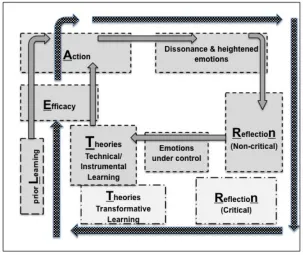
The LEARnT conceptual framework (see Figure 1), was synthesised from the literature discussed . It provides an a priori template with which to view, examine and understand the reflection and learning of the intern teacher presented in the case that follows.
The conceptual framework
the meaning perspective can serve to bring the emotions under control, enabling reflection at the inner level (critical); and, the ensuing evolution of Theories, understood as transformative learning.
Figure 1: LEARnT conceptual framework
The following section describes the methodology of the study and the way in which I used the LEARnT conceptual framework as an a priori template of codes to analyse the intern teachers’ interview data in the case.
Methodology
The qualitative case study method discussed hereto, is from a larger two-phased study
investigating Bachelor of Education intern teachers’ at a regional university in New South Wales. The study examined the interns’ approaches to learning as ascertained through listening to their firsthand ‘storied experiences’ (White & Moss, 2003). In Phase 1, 66 teacher education students completed the Teacher Sense of Efficacy Scale (Tschannen-Moran & Woolfolk Hoy, 2001) and the Learner Self-Efficacy Beliefs Survey (Jones, 2008). In Phase 2, 26 of the teacher education students, undertaking their final professional experience (a ten-week internship) were interviewed, using in-depth semi-structured telephone interviews. The case of Emma
One case: Emma
Emma was a 31-year-old mature age intern teacher with a Science degree and a previous career in natural resource management. She undertook her internship in a large rural public school of 550 students. The school had the highest proportion of Aboriginal students of all schools in the region. Emma described her context.
It was a Year 6 … I had 30 in my class … the ability levels were amazingly diverse … One young guy should have been in some gifted and talented program … other kids were having a lot of trouble reading … Other teachers were saying, ‘It was a very tricky one, it wasn’t even a matter of separating kids with problems, but of how many were going into each class. Even the Behaviour Management counsellor said … ‘They’re a work in progress’ … It was the toughest class I’ve ever had … There were two occasions when I came home and burst into tears and that’s never happened to me before.
It appears that Emma, in this particularly challenging context, would benefit from access to school community and university support. Kline, White & Lock (2013, p. 7) suggest these support structures impacts the “extent to which teacher education students were able to realise their full potential”. Wenger and Dinsmore (2005) identify such a partnering as vital to successful
professional experience for teacher education students.
LEARnT is now used as an apriori framework for analysing Emma’s dialogue with the researcher in which dissonance is articulated, and non-critcal and critical reflection as well as transformative learning are construed in the dialogue of the interview between the researcher and the intern.
Prior Learning
Emma held a theory of the importance of getting to know her students and developing respect as she settled in with the class. She appears to draw on strategies in the Reflection Proforma (Jones, 2008) as she reflects on the anticipated outcomes of the effort she has expended in developing a rapport with the students.
[I knew I had] a short window of time to earn respect … You can’t go past having that relationship before you start trying to demand … their attention and respect … I bring in colourful science experiments … I show them that what I have to teach is interesting and that I’m interested in getting to know them … It’s also a great carrot … my reward for good behaviour.
Efficacy and Action
I’d been teaching in my own right for about three days … it felt like I was just putting out fires, I didn’t teach anything the whole day. I was constantly trying to keep everyone on the straight and narrow. It felt like such a fruitless, frustrating day! … That afternoon I’d had trouble with one boy in particular… My supervising teacher said, ‘Tell the Acting Deputy Principal about it’ … I was feeling a little bit delicate but I spoke to her and she told me to contact the child’s mother … I was totally taken aback … I just didn’t feel, at that stage of my internship, it was actually my role … I spoke to my supervising teaching … she was absolutely horrified that I would have been told that it was my job! … It seemed the whole hierarchy of leadership was out of whack!
Here it seems there is a mix of the metacognitive and affective, as thoughts and feelings overlay one another. Although the behaviour of the students created a significant degree of discomfort for Emma, she appears to experience an acute state of cognitive dissonance in response to a perceived lack of support by the Acting Deputy Principal. Such a situation is problematic, however, in time Emma is able to draw on questioning strategies that have been taught in the Reflection Proforma during The Graduate Teacher unit. Although she may not have been
consciously eliciting the scaffold, Emma, appears to have both experienced conflicting emotions and in time, brought to the fore metacognitive resolve.
Non-critical Reflection: bringing the emotions under control
These circumstances proved to be the catalyst for non-critical, then critical, reflection as Emma resolved the dilemma she faced.
I came home and spent that afternoon sitting doing nothing … I thought, ‘If I had a day like this once a fortnight for the rest of my career, I don’t want to do it!’ … It shocked me that at this stage in my fourth year … I could be shaken enough to think, ‘Am I on the right course?’ … For a few hours I questioned myself but I had come out of a tricky prac [professional experience] before … if I had had all perfect pracs I’m sure this one would have shaken me, … but I thought back, ‘I had had quite a challenging third-year prac … I used some key strategies to bring a few of the trickier kids around … it was a spectacular victory in the end!’ … So I drew on that experience. I thought, ‘Even the bad days will eventually turn out to be OK! … Look, it’s not always going to be like this! I’ve managed through that, and I can get through the next challenge as well!’ … I knew I would pull out of it, I had before and I knew I could do it again!
Emma’s thoughts (cognition) and emotions (Mälkki, 2010, p. 49) interweave, each informing the other, as she attempts to make sense of her anxiety through content and process reflection. Her ‘sense of mission’ at the core of her meaning perspective is in question and she appears to vacilate between a sense of despair and making deliberate links to previous positive resolutions. As Emma reflects with the researcher she demonstrated an evolving meta-cognitive capacity to manage her emotions, and insights into the knowledge, skills and efficacy to take control of the significant challenge she faced.
Critical Reflection: Restoration of Efficacy: renewed Action
I think you’ve got to leave today and look at tomorrow with fresh eyes … it’s incredibly important not to bring yesterday’s problems back to school the next day, so I went in with a bright smile and a cheery hello and asked them what we could do to change things.
The class sponsors a kid through World Vision … and in part of our unit, Global and Social Issues, we were looking at the global world and the village … As a class we decided to do something at a ‘village’ level to help support the World Vision kid … the students actually came up with the idea of running a cake stall … I was actually advised not to try this … they said, ‘Look it’s just not worth the hassle’, but I went ahead and did it anyway! It was a resounding success! Everyone was involved … even the trickier kids, I gave them some responsibility, they were on the money tin and I’m sure that every single cent made it into that tin … It showed that if you’re game enough to give them a little bit of trust they will often delight you! … No one let me down! … I was quite relieved that I had pulled it off (laugh) ’cause I proved the other teachers wrong!
It is interesting to note that Emma does not appear, in this instance, to be supported by a professional community in which she is mentored, to undertake structured dialogic reflection, nor does she appear to enjoy institutional backup and support. Kline, White & Lock (2013) suggest 20% of early career teachers have similar experiences. However, in spite of this she avoids the temptation to “thoughtlessly seize [the] explanations of authority figures” (Cranton, 2003, p.32), and steers her own course. What could become problematic for Emma, and for intern teachers though, is the danger of “proving other teachers wrong”.
Theories
Critical reflection, central to transformative learning appeared to enable inner and outer levels of change (Korthagen, 2004, p. 79) within Emma’s meaning perspectives. The process enhanced the capacity to enact a more authentic practice (Cranton, 2001; Cranton & Carusetta, 2004) by
strengthening the symbiotic relationship (Korthagen & Vasalos, 2005) between her beliefs, her words and her actions (Brookfield, 1990; Cranton, 2006). In addition, Emma in the context of the interview, critiqued the fixed assumptions and expectations of the experienced teachers
regarding the students and her proposed approach to restoring a relationship with the students. The capacity to transition from non-critical to critical reflection appeared to be an “ongoing developmental process” (Cranton, 2006, p. 19) enabling Emma to critically question her theories of what she believed to be right, more effectively align her actions and core beliefs, and develop genuine relationships (Cranton & Carusetta, 2004) within the school context.
For Emma, the process of developing the capacity for authentic practice ensured the ongoing evolution of her teaching style, the development of genuine relationships with the students, and a clarification of what she believed was right (Cranton & Carusetta, 2004), irrespective of the view of the experienced teachers. In this instance Emma demonstrated self-awareness (Mezirow, 2000b) and the capacity to individuate herself (Dirkx, 2000) from the staff. In so doing, this intern teacher appears to have fostered the growth and development of her students and herself.
It can be argued that the depth of Emma’s learning from the challenge she faced was determined by her reflection. Non-critical reflection meant that she could bring her emotions under control. Critical reflection ensured more open, better-justified and self-authored frames of reference (Cranton, 2006). Authentic teaching practice for Emma was related to her demonstrating as Kreber and Klampfleitner describe, “consistency between values and action; pursuing moral questions; having a sense of care for the subject and students; engaging students with the subject; and, to some extent, striving toward greater self-knowledge” (2012, p. 58). In these ways the intern teacher capable of taking charge of her own professional learning, will be further empowered to not only survive but thrive in the face of challenge.
Implications
There are a number of implications from this case worthy of consideration. These include an understanding of the relationship between intra-personal qualities and professional
competencies, the capacity for non-critical and critical reflection, and the place of dissonance and the emotions in intern teacher professional learning in rural school contexts. Firstly, there is a clear distinction between professional competencies and the intra-personal qualities that underpin and inform them. As Korthagen and Vasalos attest, “qualities come from the inside, while competencies are acquired from the outside” (2005, p. 56). The qualities demonstrated by Emma, such as empathy, compassion, flexibility, creativity and decisiveness speak to us of the need to better understand and enhance the development of the core qualities of the teacher education student (Korthagen & Vasalos, 2005). Teaching is far more than a craft or technical occupation (Kalantzis, 2002), and the teacher, far more than an “instructional technician who unquestioningly implements the policies and procedures of others” (White & Moss, 2003, p. 5). The findings of this research highlight the value of a holistic approach to teacher education course-work and professional experience/ internship supervision. There is a concern that a technical–rational epistemology of practice, as articulated by a set of professional competencies, may constitute a very limited view of teachers’ work (Kalantzis, 2002; White & Moss, 2003). A more holistic standpoint takes in the perspective of the intrapersonal.
The case of Emma demonstrates that, intrapersonal qualities underpin and empower professional competencies. In light of this, a fundamental paradigm of teacher education, including during professional experience and internships in schools, needs to involve valuing and supporting qualities such as those demonstrated by Emma. For example: open-mindedness, whole-heartedness and responsibility (Dewey, 1960); emotional maturity and clear thinking (Mezirow, 2000b); readiness for change (Taylor, 2000); and the capacity to keep an open mind, listen empathetically, bracket premature judgment, and seek common ground (Mezirow, 2003). In prioritising these qualities university and school-based teacher educators may better prepare intern and graduate teachers with the potential to thrive as autonomous learners, rather than barely survive in the face of significant challenge and inevitable dissonance in rural school settings.
Secondly, it is clear that the intern teacher does not learn simply by engaging in experiences, but from critically reflecting upon that experience. Developing the capacity for transformative learning and autonomous thinking is an important core goal of teacher education. The findings suggest that teacher education course work and professional experience is, and may be further, enhanced with modeled, guided and independent opportunities for non-critical reflection, as well as, critical reflection and transformative professional learning. It is desirable that teacher
catalysts for critical reflection and transformative professional learning. In this way the intern teacher is more likely to develop autonomy, professional competence and resilience.
In terms of critical reflection, it is important to acknowledge that this is not always an interpersonal dialogic process. Emma transformed the significant challenge she faced into learning through inner critique and reframing, which then shaped her implementation of more socially just, democratic practices. Although the supervising teacher played a role in supporting Emma to bring her emotions and sense of chaos under control, it appeared that Emma engaged in deeper levels of reflection by herself. This capacity to critically reflect is important to the process of transforming times of discomfort and dissonance into opportunities for professional learning, and at times the intern teacher may choose to do this through an internal reflective dialogue. This being the case, it is key that the individual has the knowledge and skills of critical reflection so as to stave off the possibility of disillusionment and attrition. Provision of
opportunities and scaffolding such as the Reflection Proforma (Jones, 2009) may be embedded in coursework and shared with supervising teachers who have oversight of teacher education students and intern teachers.
A third implication from this examination lies in a deeper understanding of the relationship between intern teacher critical reflection and self-efficacy beliefs and how this might inform teacher education. Although it is well acknowledged that self-efficacy is established through mastery, vicarious experiences, verbal/ social persuasion, and psychological and emotional states (Pajares, 1997), for Emma, self-efficacy was most powerfully restored and confirmed through achieving what can be described as authenticity (Cranton, 2001; Cranton & Carusetta, 2004). Understanding how, and supporting intern teachers, to strengthen the symbiotic relationship (Korthagen & Vasalos, 2005) between their words (theories) and actions (Brookfield, 1990; Cranton, 2006; Ray & Anderson, 2000) through core reflection (Korthagen & Vasalos, 2005) requires a deliberate pedagogy and practice. This very much aligns with the stance of Mezirow’s (1997, p. 5) who claims that the “cardinal goal of adult education” should be developing the capacity for transformative learning and autonomous thinking.
A final implication resulting from this case is that, although developing a pedagogy of critical reflection and transformative professional learning may sound straightforward, we need to fully appreciate that it “is not an easy or purely rational process” (Mälkki, 2010, p. 47). Transformative learning as Illeris (2003, p. 402) explains, exacts:
personality changes and is characterized by simultaneous restructuring in the cognitive, the emotional and the social-societal dimensions, a break of orientation … as the result of a crisis-like situation … making it necessary to change oneself in order to get any further.
How teacher educators, in university coursework and in school contexts, equip intern teachers to engage in reflection on professional experience is not simply an examination of practice, but an examination of the self (Moore, 2003). The process requires teacher educators, supervising teachers and teacher education students to understand the nature of the emotions and the entangled and inseparable (Damasio, 1999) “interconnections between cognition and emotion” (Mälkki, 2010, p. 49). Likewise, there is the imperative to develop within the teacher education student, the meta-cognitive capacities to manage their emotions, and thereby the problem (Salzberger-Wittenberg, Williams, & Osborne, 1999). Vital intra-personal qualities and requisite professional competencies of intern teachers could be more fully realised through the
development of an evidence informed understanding of how to teach the meta-cognitive
This may, for some, be a significant shift from traditional teacher education course work and professional experience approaches. Since there is known to be a “positive correlation between pre-service teachers who indicated they were supported by both the university and the school-community and those who take up a rural or remote appointment” (Kline, White & Lock, 2015, p. 10), this shift is an important one.
Future research
Further research is proposed that examines the experiences of differing groups of intern teachers, for example, those who experience dissonance and critically reflect, in contrast to those who experience dissonance and engage in non-critical reflection, and those who without dissonance experience catalysts that prompt criticality. Likewise it would be highly informative to the field to understand further the relationship between critical reflection, transformative
professional learning, resilience and levels of attrition for intern and graduate teachers. In addition, it would be informative to examine the types of reflection supervising teachers do undertake with intern teachers, to ascertain their professional learning needs regarding levels of reflection, and likewise understanding how these educators might adapt scaffolds used in coursework to suit their classroom/ school context. Research of this kind may inform future professional learning and support for supervising teachers in rural settings, and enhance the professional relationship of learning between the intern and the supervisor.
Conclusion
Reflective pedagogical practices in ITE programs typically incorporte content and process reflection, this paper argues the need for deeper level reflective practices. The LEARnT
conceptual framework (Figure 1) provides a tool for critical and non-critical reflective practice for preservice teachers.
In this paper I have provided an account of one intern teacher’s approach to traversing the rural educational terrain from acute dissonance in the face of significant challenge, to transformative learning and authentic practice through critical reflection. Teacher education is not simply preparation for teaching, but for ongoing teacher learning in response to the realities of
classroom and school contexts, in which much is outside the control of the intern teacher..Within university and school based teacher education there is a responsibility to enable teacher
education students and intern teachers working in rural settings to realise authentic practices. For this to occur, teacher education students need to be equipped with the meta-cognitive nous and emotional stamina to take charge of that which lies within their control, and undertake non-critical and non-critical reflection and transformative learning. In this way intern teachers may be sustained and stimulated in their professional practice through the realisation of communicative and emancipatory- learning, and thus more fully empowered as resilient, persistent,
References
Argyris, C., & Schön, D. A. (1978).
Organizational learning: A theory of action perspective
.
Reading
, Mass: Addison Wesley.
Australian Bureau of Statistics. (2012). Remoteness structure. Retrieved from
http://www.abs.gov.au/websitedbs/D3310114.nsf/home/remoteness+structure
Bandura, A. (1997).
Self-efficacy: The exercise of control
. New York: Freeman.
Boser, U. (2000). A picture of the teacher pipeline: Baccalaureate and beyond.
Education
Week: Quality Counts 2000
,
19
(18), 16-17.
Brookfield, S. D. (1990).
The skillful teacher
. San Francisco: Jossey-Bass.
Cranton, P. (1994).
Understanding and promoting transformative learning: A guide for
educators of adults
. San Francisco: Jossey-Bass.
Cranton, P. (2001).
Becoming an authentic teacher in higher education
. Malabar, FL:
Krieger.
Cranton, P. (2006).
Understanding and promoting transformative learning: A guide for
educators of adults
. San Francisco: Jossey-Bass.
Cranton, P., & Carusetta, E. (2004). Perspectives in authenticity in teaching.
Adult
Education Quarterly, 55
(5), 5-22.
Cranton, P., & King, K. P. (2003). Transformative learning as a professional development
goal. Retrieved August 30, 2011, from Wiley Periodicals, Inc
http://onlinelibrary.wiley.com/doi/10.1002/ace.97/pdf
Damasio, A. R. (1999).
The feeling of what happens: The body and emotion in the making of
consciousness
. New York: Hart Court Brace.
Dewey, J. (1960).
How we think: A restatement of the relation of reflective thinking to the
educative process
. Chicago: DC Heath.
Dirkx, J. (2000).
After the burning bush: Transformative learning as imaginative
engagement with every-day experience.
Paper presented at the Third International
Conference on Transformative Learning, New York.
Galman, S. (2009). Doth the lady protest too much? Pre-service teachers and the
experience of dissonance as a catalyst for development.
Teacher and Teacher
Education, 25
, 468-481.
Gibbs, C. (2003). Explaining effective teaching: Self-efficacy and thought control of
action.
Journal of Education Enquiry, 4
(2), 1-14.
Habermas, J. (1984). The theory of communicative action. In T. McCarthy (Ed.),
Reason
and the rationalisation of society
(Vol. 1). Boston: Beacon Press.
Hargreaves, J. (2010). Voices from the past. In H. Bradbury, N. Frost, S. Kilminster & M.
Zukas (Eds.),
Beyond reflective practice: New approaches to professional lifelong
learning
(pp. 83-95). London: Routledge.
Illeris, K. (2003). Towards a contemporary and comprehensive theory of learning.
International Journal of Lifelong Education, 22
(4), 396-406. doi:
10.1080/02601370304837
Jones, M. A. (2008).
Learner Self-Efficacy Beliefs Survey
. School of Education, University of
New England. Armidale, New South Wales, Australia.
Jones, M. A. (2009). Transformational learners: Transformational teachers.
Australian
Journal of Teacher Education, 34
(2), 15-27.
Kitchenham, A. (2008). The evolution of John Mezirow's transformative learning theory
[sic].
Journal of Transformative Education, 6
, 104-123.
Korthagen, F. A. J. (2004). In search of the essence of a good teacher: Towards a more
holistic approach in teacher education.
Teaching and Teacher Education, 20
, 77-97.
Korthagen, F. A. J., & Vasalos, A. (2005). Levels in reflection: Core reflection as a means
to enhance professional growth.
Teachers and Teaching: Theory and practice, 11
(1),
47-71.
Kreber, C., & Klampfleitner, M. (2012). Construing the meaning of authenticity in
university teaching: Comparing explicit to implicit theories.
Journal of
Constructivist Psychology
,
25
(1), 34-69.
Mälkki, K. (2010). Building on Mezirow's theory of transformative learning: Theorising the
challenges to reflection.
Journal of Transformative Learning, 8
(1), 42-62. doi:
10.1177/1541344611403315
Mezirow, J. (1981). A critical theory of adult learning and education.
Adult Education,
32
(1), 3-24.
Mezirow, J. (1997). Transformative learning: Theory to practice.
New directions in Adult
and Continuing Education, 74
, 5-12.
Mezirow, J. (2000a).
Learning as transformation: Critical perspectives on a theory in
progress
. San Francisco: Jossey-Bass.
Mezirow, J. (2000b). Learning to think like an adult: Core concepts of transformation
theory. In J. Mezirow & Associates (Eds.),
Learning as transformation: Critical
perspectives on a theory in progress
(pp. 3-33). San Francisco: Jossey-Bass.
Mezirow, J. (2003). Transformative learning as discourse.
Journal of Transformative
Education, 1
(1), 58-63.
Moore, R. (2003). Re-examining the field experiences of pre-service teachers.
Journal of
Teacher Education, 54
(1), 31-41.
Pajares (2002).
Self-efficacy beliefs in academic contexts: An outline
. Retreived month, day,
year, from http://des.emory.edu/mfp/efftalk.html
Pajares, F. (1997).
Current directions in self-efficacy research
. Greenwich, CT: JAI Press.
Pope, M., & Denicolo, P. (2001).
Transformative education
. London: Whurr.
Ray, P., & Anderson, S. (2000).
The cultural creatives
. New York: Three Rivers Press.
Salzberger-Wittenberg, I., Williams, G., & Osborne, E. (1999).
The emotional experience of
learning and teaching
. London: Karnac.
Spillane, J. P., Reiser, B., & Reimer, T. (2002). Policy implementation and cognition:
Reframing and refocusing implementation research.
Review of Educational
Research, 72
, 387-431.
Taylor, E. W. (2000). Analysing research on transformative learning theory. In J. Mezirow
& Associates (Eds.),
Learning as transformation: Critical perspectives on a theory in
progress
. San Francisco: Jossey-Bass.
Tschannen-Moran, M., & Woolfolk Hoy, A. E. (2001). Teacher efficacy: Capturing an
elusive construct.
Teacher and Teacher Education, 17
(7), 783-805.
White, J., & Moss, J. (2003).
Professional paradoxes: Context for development of beginning
teacher identity and knowledges.
Paper presented at the International Education
Research Conference AARE-NZARE.
Wyatt-Smith, C., Alexander, C., Fishburn, D., & McMahon, P. (2017). Standards of practice
to standards of evidence: developing assessment capable teachers.
Assessment in
Appendix 1.
Reflection Proforma (Jones, 2008)
Reflection is both a meta-cognitive (thinking about thinking) and an affective (thinking about feelings) process. In reflections, thoughts and feelings experienced are expressed. Use this proforma to prompt, when reflecting upon teaching and learning experiences. Choose several of the meta-cognitive and affective prompts in any one reflection.
Name: Date: Teaching/ learning experience:
Meta-cognitive (thoughts) prompts.
* A conscious awareness of your ‘self-talk’, will give you an insight into your thoughts.
Ask yourself some of the following questions. What were my thoughts:
• as I anticipated this experience? • as I was engaged in the experience? • after I had completed the experience?
• as I encountered the unexpected? How did I
deal with this?
• as I encountered difficulties? How did I deal
with these? Did I act or react:
• as I encountered a greater depth of enthusiasm and engagement than I had expected? How did I deal with this?
•
• as I remembered being in a similar positive/ negative situation in the past? How did I deal with this?
•
• What thinking strategies did I use? Are these helpful? Why? Who or what may help me to develop more constructive thinking?
•
• What have I learnt about myself as a person through this experience?
•
• What have I learnt about myself as an emerging professional teacher through this experience?
Meta-cognitive (feelings) prompts.
* A conscious awareness of your physical reactions (affect) will give you insight into your feelings.
Ask yourself some of the following questions. What were my feelings:
• as I anticipated this experience? • as I was engaged in the experience? • after I had completed the experience?
• as I encountered the unexpected? How did I
deal with this?
• as I encountered difficulties? How did I deal
with these feelings? Did I act or react:
as I encountered a greater depth of enthusiasm and engagement than I had expected? How did I deal with these feelings?
• as I remembered being in a similar positive/
negative situation in the past? How did I deal with this?
•
• What feelings arose/ Are these helpful/ Why? Who or what may help me to develop ways of dealing with or changing these feelings?
• What do I feel about myself as a person having been through this experience?
• What do I feel about myself as an emerging professional teacher, having been through this experience?
What are the implications of these reflections