The structure and influence of different flying high
front kick techniques on the achieved height on the
example of taekwon-do athletes
Jacek Wąsik
Institute of Physical Education, Jan Długosz University, Poland
Source of support:
Departmental source
Received:
19 May 2011;
Accepted:
2 February 2012;
Published online:
26 March 2012
Abstract
Background
The aim of this paper is to establish biomechanical optimization of the high-flying front kick (in taekwon-doter-minology referred to as twimyo nopi ap chagi), which would result in developing a more effective method of
execut-ing this particular kick.
Material/Methods:
The study analysed movements of 14 ITF taekwon-do athletes (age: 16.5±0.7 years; weight 64.1±7.0 kg; height 176.5±4.6 cm). A system of complex analysis of movement called Smart-D made by the Italian company BTS Spa was used for the tests. For the purpose of the experimental part of the study the study participants were asked to adopt the same initial stance (in taekwon-do terminology called Niunja So Palmok Degi Maki) and perform the high-flying front kick in two different techniques – using the traditional technique (scissors) and the natural tech-nique (non-scissors).Results:
In case of the natural technique used for executing this kick the COG usually starts from the height of 0.9 m. After 0.5 sec. the COG is lowered by 0.1 m so that the athlete can take off having developed the required velocity. At the maximum height of the flight the COG reaches 1.54 m (having risen by 0.64 m), and this is the moment when the knee extension for kick completion occurs. In the traditional technique the COG is located at 0.9 m at the start and then lowers by 0.1 m. When leaping up at take-off the velocity increases immediately and at the flight maximum the COG reaches 1.46 m. This is also the height when the landing stage starts. The local maximum is marked at the height of 1.40 m, which corresponds to the moment of the knee extension needed to complete the kick.Conclusions:
The observation shows that there are four main elements which influence the height achieved by an athlete in his jump and these include the height of the centre of gravity at take-off, the flight height of the COG as well as the height determined by the length of the lower limb and the angle formed between the plane perpendicular to the board and the limb. In the natural technique the athletes managed to raise their COG by an average of 74 mm higher than in the traditional technique (p<0.01).Key words: analysis of movement • jumping techniques • martial arts • special techniques • taekwon-do
Author’s address: Jacek Wąsik, Institute of Physical Education, Jan Długosz University, Armii Krajowej 13/15, 42-200 Częstochowa, Poland; e-mail: [email protected]
B
ackgroundPersons doing martial arts have various needs. Martial arts progress in at least three spheres of human activ-ity: recreation, sports and utilitarian activities. As a form of recreation they make a significant component
of the society’s physical activities. Martial arts are rec-ommended because their competent use beside sports in the education of young people improves social func-tioning and respecting ethical standards [1–3]. In sport they are an element of increasing an individual’s physical fitness through competition. A majority of well-known
and Study Aim:
Authors’ Contribution:
A Study Design B Data Collection C Statistical Analysis D Manuscript Preparation
E Funds Collection
Asian martial arts have adopted a system of sports com-petition. Some of them have been included in the pro-gramme of the Olympic Games (judo, taekwon-do) [4–6]. Finally, as utilitarian activities, they are used to prepare the police, army and antiterrorist units to fight for human life and health [7].
All these activities are based on learning the technique and the tactics of disabling, punching and kicking the opponent. A range of these techniques also includes flying kicks.
The kicks applied in martial arts can be divided into three groups: linear, circular and spinning [8]. The front kick has already been analysed in a few aspects [9]: a) pat-terns of hip, knee and ankle muscular torques, b) dom-inant muscle group activity sequence, c) contraction types of the muscles, d) segmental motion ranges rela-tive to the effecrela-tive muscle torques. It was found that in the high front kick thigh deceleration is caused by the motion dependent on the motion initiated by the lower limb, and not the efficiency of deceleration [10].
Tokarski describes his first contact with Taekwon-do as follows [11]: “For the first time I saw this martial art in 1976 in Nice (…) I was astonished to see rather short Koreans jumping very high and breaking wooden boards with their feet over the head of a tall Frenchman. (…) The air parades looked like aerialists’ shows. The acro-batic manoeuvre of the turning body kick was so quick that it resembled a speeded-up silent movie, and photo-graphed, its traces looked very much like ghosts rushing in a spirit-rapping séance.” This quotation describes one of the events in Taekwon-do sports competition, name-ly special techniques. Special techniques, an event char-acteristic of Taekwondo ITF (International Taekwon-do Federation) sports competition [12–14], involves execu-tion of chosen flying kicks which aim at breaking a board hung at the height ranging from 2 to 3 m (or even higher).
The main reason for commencing this research was the motivation to win in special techniques events in sports competitions. Another important reason is the fact that this specific event maintains the utilitarian tradition of the flying kicks. Originally, they were intended to be used to throw a rider off his horse, to knock a gun out of the hand of a marksman standing on some kind of a raised platform or to help a colleague or a friend fighting for life on such platform. Special military units usually consist of a few individuals who are experts in their own field. One, for example, is particularly good at throwing knives, another one is a fantastic marksman and yet an-other one is a specialist in hand-to-hand fighting, etc. Hence, the ability to perform a kick high enough de-termines the success in protecting other people’s lives.
The present research paper aims at establishing biome-chanical optimization of the flying high front kick (in
Taekwon-do terminology referred to as twimyo nopi ap
chagi), which would result in developing a more effec-tive method of executing this particular kick.
The following research questions were posed: 1. What biomechanical parameters influence the
effi-ciency of kick execution?
2. How the kick technique does employed influence the achieved height?
Addressing the last question necessitated determining the kinetic values of the technique.
M
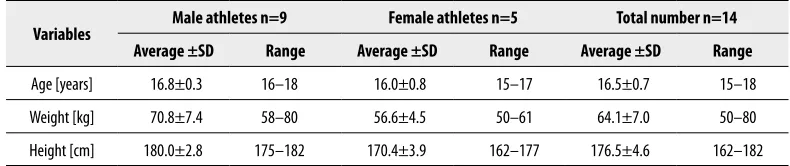
ethodsThe study was based on 14 Taekwon-do ITF athletes comprising 5 female athletes and 9 male athletes (age: 16.5±0.7 years; weight 64.1±7.0 kg; height 176.5±4.6 cm). The researched group included European Junior Champions, Polish Junior Champions and other ath-letes who had practised Taekwon-do for a minimum of 3 years. They all practiced taekwon-do 3 to 5 times a week.
For the purpose of the experimental part of the study they were asked to adopt the same initial stance (in Taekwon-do terminology called Niunja So Palmok Degi Maki) and perform the flying high front kick in two different techniques – using the traditional tech-nique (scissors) and the natural techtech-nique (non-scis-sors). The structures of these techniques are presented in Figures 1 and 2. The point at which the kick impact was aimed was a board hung at a height between 240 and 270 cm placed on a special stand called special tech-niques machine [15], which is used in Taekwon-do ITF sports competition events in order to reveal the winner. In the task the athletes were asked to execute the flying high front kick twice (using the traditional technique and the natural technique) in their own most typical and motivated way.
Smart-D system for complex movement analysis made by Italian company BTS SpA was used in the research. The system consisted of six cameras reflecting the emit-ted infrared radiation which in real time identified the location of the markers fixed in 14 characteristics points on the athlete’s body. This made it possible to record the picture of the moving body of each researched ath-lete and to evaluate the kinematic parameters obtained. The recording was made with accuracy of 0.3–0.45 mm and frequency of 120 Hz. Type 9812C Kiestler piezo-electric force platform was used for recording ground re-action forces at take-off. For the purpose of this analy-sis the movement of the athlete’s body was divided into
Taekwon-do – a Korean martial art based mainly on punches and kicks.
Special techniques – a sports event in taekwon-do ITF.
Twimyo nopi ap chagi – flying high front kick technique used in the event of special techniques in taekwon-do ITF.
the following phases: the starting posture, take-off, flight and landing [16–19].
On the basis of the recorded signals the following were determined: COG height given in [mm], ground reaction forces (R) in [N] and average duration of take-off (t) in [s]. Both average values and standard deviations were calculated for all the parameters obtained. Moreover, correlation coefficients between the maximum ground reaction force and the maximum COG height were also determined. The correlation was verified at the signif-icance level of p<0.05. The analysis of the differences between the average values obtained for kick execution in both the natural and traditional versions in this case study was calculated on the basis of t-test for two av-erage values obtained for the two dependent groups at the significance level of p<0.01 (Table 1). Additionally, force impulse values at take-off were calculated for the two versions of kick execution. Their errors were calcu-lated with the use of exact differential. All the statisti-cal statisti-calculations were done by way of using Excel 2000 (Microsoft, USA).
r
esultsFigures 1 and 2 show the average location of the cen-tre of gravity (COG) and the average path covered by the kicking leg when executing twimyo nopi ap chagi. Figure 1 presents the natural technique used for execut-ing this kick. In this case the COG usually starts from the height of 0.9 m. After 0.5 sec. the COG is lowered by 0.1 m so that the athlete can take off having devel-oped the required velocity. At the maximum height of the flight the COG reaches 1.54 m (having risen by 0.64 m), and this is the moment when the knee exten-sion for kick completion occurs. After 1.8 s the land-ing phase starts.
Figure 2 presents the traditional technique of perform-ing twimyo nopi ap chagi. Similar to the natural tech-nique in this techtech-nique at the start the COG is locat-ed at 0.9 m and then lowers by 0.1 m. When leaping up at take-off the velocity increases immediately and at the flight maximum the COG reaches 1.46 m. This is also the height when the landing stage starts. The lo-cal maximum is marked at the height of 1.40 m, which
corresponds to the moment of the knee extension need-ed to complete the kick (Table 2).
d
iscussionThe observation shows that there are four main elements which influence the height achieved by an athlete in his jump and these include the height of the centre of grav-ity (COG) at take-off, the flight height of the COG as well as the height determined by the length of the low-er limb and the angle formed between the plane plow-er-
per-pendicular to the board and the limb (marked as f in
Figures 1 and 2). The height of flight also depends on the velocity obtained at run-up and the angle at take-off. The angle at take-off is determined by the horizon-tal velocity obtained at run-up combined with the ver-tical velocity achieved at take-off:
x y
c
v
v
arctan
(1)where:
a – angle at take-off,
ny – COG vertical velocity,
nx – COG horizontal velocity.
The faster the run-up is, the shorter is the contact which the foot has with the floor at take-off, but then, the horizontal velocity achieved by an athlete is unfortu-nately also lower. Hence, each athlete himself needs to find the optimum speed at take-off in order to be able to control the take-off and to achieve the maximum height possible [20].
A careful study of Figures 1 and 2 suggests the follow-ing regularity expressed by equation:
) ( tan
tan
o c Dh h
d H
(2)
where:
H – height of kick,
ho – height of Centre of Gravity (COG),
h – height of take-off,
Variables Male athletes n=9 Female athletes n=5 Total number n=14
Average ±SD Range Average ±SD Range Average ±SD Range
Age [years] 16.8±0.3 16–18 16.0±0.8 15–17 16.5±0.7 15–18 Weight [kg] 70.8±7.4 58–80 56.6±4.5 50–61 64.1±7.0 50–80 Height [cm] 180.0±2.8 175–182 170.4±3.9 162–177 176.5±4.6 162–182
Table 1. Characteristics of the Taekwon-do male and female athletes taking part in the study.
D – horizontal distance from the place of take-off to the vertical line drawn from the place of impact, d – distance the COG travelled from the place of
take-off to the place of impact;
a – take-off ankle,
ac – COG take-off ankle.
Mathematical dependence 2 allows us to carefully spec-ify the place of take-off. Table 2 presents the values
ob-tained in the studied executions of twimyo nopi ap chagi.
Significant differences in the obtained parameter val-ues can be noted in the two different techniqval-ues of the kick execution. The kicks executed in the traditional
technique achieve ground reaction force greater by 177 N. Therefore, it can be assumed that this way of exe-cuting the flying high front kick will make it possible to achieve greater impact force. In this case, however, lon-ger time (on average of 0.024 s) is needed to achieve greater impact force than in the kick performed using the natural technique and this is reflected in the height of the flight. In the natural technique the athletes man-aged to raise their COG by an average of 74 mm high-er than in the traditional technique. Thus, the relative height of the jump performed in the natural technique significantly increases, which actually can be seen in the graphic representation in Figure 3.
11
Figure 1. Structure of movement in twimyo nopi ap chagi – natural technique (“non-scissors
technique”),
where: H – height of the kick/impact, h– height of the Centre of Gravity (COG), ho – height of
the take-off, D – horizontal distance from the place of take-off to the vertical line drawn from
the place of impact, d – distance the COG traveled from the place of take-off to the place of
impact,
– take-off angle,
c– COG take-off angle,
- the angle formed between the plane
perpendicular to the board and the limb, v
x– horizontal velocity at take-off, v
y– vertical
velocity at take-off
Figure 2. Structure of movement in twimyo nopi ap chagi – traditional technique (“scissors
technique”)
Figure 1. Structure of movement in twimyo nopi ap chagi – natural technique (“non-scissors technique”), H – height of
the kick/impact, h– height of the Centre of Gravity (COG), ho – height of the take-off, D – horizontal distance
from the place of take-off to the vertical line drawn from the place of impact, d – distance the COG traveled
from the place of take-off to the place of impact, α – take-off angle, αc – COG take-off angle, f – the angle
formed between the plane perpendicular to the board and the limb, vx – horizontal velocity at take-off, vy –
vertical velocity at take-off.
11
Figure 1. Structure of movement in twimyo nopi ap chagi – natural technique (“non-scissors
technique”),
where: H – height of the kick/impact, h– height of the Centre of Gravity (COG), h
o– height of
the take-off, D – horizontal distance from the place of take-off to the vertical line drawn from
the place of impact, d – distance the COG traveled from the place of take-off to the place of
impact,
– take-off angle,
c– COG take-off angle,
- the angle formed between the plane
perpendicular to the board and the limb, vx – horizontal velocity at take-off, vy – vertical
velocity at take-off
Figure 2. Structure of movement in twimyo nopi ap chagi – traditional technique (“scissors
technique”)
Figure 2. Structure of movement in twimyo nopi ap chagi – traditional technique (“scissors technique”).
Reaching lower COG heights in the traditional technique results from the fact that when attaining the maximum height of the flight the athlete is not yet ready to straight-en his/her leg as the momstraight-ent of shifting the lower limbs takes time. At the very moment of impact the athlete is already descending, thus losing a few precious centimetres.
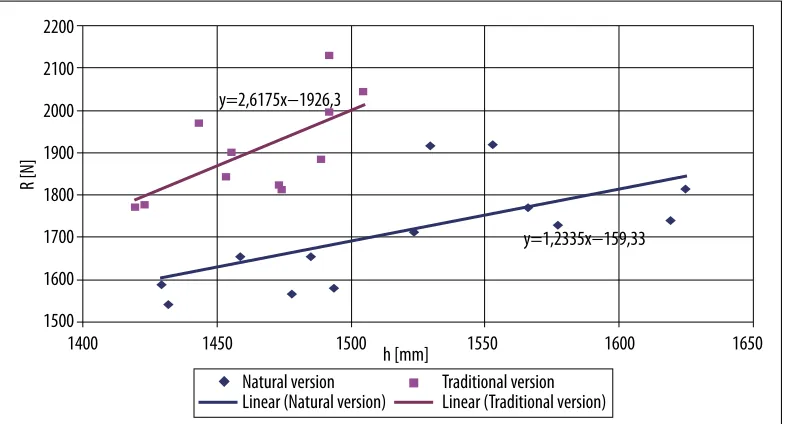
Figure 4 shows a correlation between the maximum ground reaction forces and the maximum height of the Centre of Gravity depending on the technique of exe-cuting the flying high front kick. The correlation fac-tor for the traditional technique is r=0.70 and for the natural technique r=0.63 (p<0.05). This dependence clearly shows that for similar COG heights, there are higher values of ground reaction forces obtained in the traditional version of kick execution. Moreover, the in-clination of the trend line is also higher in the tradition-al version being ctradition-alculated at a=2.61 than in the natu-ral version at a=1.23.
For this reason the natural technique produces small-er loads on the joints of the take-off foot, thus reduc-ing the probability of possible injuries to the joints. The force which is being applied should be integrated with the length of time in which it is being applied as it is provided for in the definition of impulse [16]. The force impulse value in the case of the natural version
was calculated at 409±45.11 N·s, whereas for the
tra-ditional version it was 497±75.65 N·s. A higher value
of the impulse of the force during the take-off in the traditional technique informs us of a greater change of the momentum of the kicking foot.
Variables Traditional Natural T-test
Average ±SD Average ±SD
Height of COG [mm] 1467.0±43.4 1541.0±53.6 p<0.01 Ground reaction force [N] 1890.64±108.52 1713.47±23.87 p<0.01 Take-off duration [s] 0.263±0.025 0.239±0.023 p<0.01
Table 2. Average values of the athletes’ characteristic values measured at execution of twimyo nopi ap chagi.
Medium high [mm]
Twimyo nopi ap chagi
Natural version
Traditional version
1600
1550
1500
1450
1400
1350
1300
Figure 3. Difference in the average values of the maximum COG height in the natural and traditional techniques of executing twimyo nopi ap chagi.
2200
2100
2000
1900
1800
1700
1600
1500
R [N]
1400
1450
1500
h [mm]
1550
1600
1650
y=2,6175x−1926,3
y=1,2335x−159,33
Natural version
Linear (Natural version)
Traditional version
Linear (Traditional version)
Summing up the present study it can be suggested that from the point of view of biomechanics the natural tech-nique used in the execution of the flying high front kick allows the athlete to achieve greater height of the jump and also results in considerably less load on the joints of the take-off foot. However, the traditional technique allows the athlete to produce a more powerful kick at impact. Other preliminary studies confirm the validity of this thesis [21,22].
The above discussion shows that the presented meth-od of analysis of the techniques used in taekwon-do as well as other Eastern combat sports enables researchers to obtain precise information on the movement process. It will allow competent coaches and athletes to benefit from it and optimize the training process. The present-ed method makes it possible to choose a more efficient technique, to determine the values of the factors affecting the impact, and subsequently to improve these values.
This study, however, does not ultimately cover the sub-ject, but covers only one of a whole range of issues. The results presented herein can be used for other studies and indicate some of the issues to be researched in fur-ther studies.
c
onclusionsThe following conclusions have been made on the ba-sis of the above observations:
1. The height of the jump twimyo nopi ap chagi is
deter-mined by the following three elements, i.e. the height of the centre of gravity (COG) at take-off, the flight height of the COG and the height reached by the kicking foot.
2. The flying high front kick executed in the natural technique is biomechanically more efficient.
1. Kalina R: Teoria sportów walki. COS. Warszawa, 2000 [in Polish]
2. Kalina R: Utilitarny wymiar współzawodnictwa w sportach walki. Trening, 2001; 3: 90–96 [in Polish] 3. Maroteaux R, Cynarski W: O filozofii Japońskich
sztuk walki – pytania i odpowiedzi. Ido-Ruch dla Kultury/Movement for Culture (IRK-MC), 2002; 3: 48–55 [in Polish]
4. Cynarski W, Momola I: Dalekowschodnie sztuki walki – ewolucja celów i metod nauczania. Sport Wyczynowy, 2005; 3–4: 48–53 [in Polish] 5. Bujak Z: Wybrane aspekty treningu w taekwon-do.
AWF Warszawa ZWWF Biała Podlaska, 2004 [in Polish]
6. Lee KM, Nowicki D: Taekwondo. Almapress, Warszawa, 1988 [in Polish]
7. Ashkinazi S, Jagiełło W, Kalina RM et al: The im-portance of hand-to-hand fights for determining psychomotor competence of antiterrorists. Archives of Budo, 2005; 1: 8–12
8. Bercades L, Pieter W: A Biomechanical analysis of the modified taekwondo axe kick. Journal of Asian Martial Arts, 2006; 15(4): 8–19
9. Hwang IS: Analysis of the kicking leg in tae-kwondo. In Terauds J, Gowitzke B, Holt L. (eds.), Biomechanics in sports III & IV. Proceedings of ISBS, Del Mar, CA: Academic Publishers, 1987 10. Sørensen H, Zacho M, Simonsen EB et al: Dynamics
of the martial arts high front kick. Journal of Sports Sciences, 1996; 14(6): 483–95
11. Tokarski S: Sztuki walki. Ruchowe formy ekspresji filozofii wschodu. Glob, Szczecin, 1989 [in Polish] 12. Choi HH: Encyklopedia of Taekwon-do, International Taekwon-do Federation, Canada, 1983
13. Choi HH: Taekwon-do. The Korean Art of Self-Defence. ITF, New Zealand, 1995
14. Choi JH, Bryl A: Taekwon-do. Koreańska sztuka samoobrony. SC Iglica, Wrocław, 1990 [in Polish] 15. Wąsik J: Modern machines for special technique
event in taekwon-do ITF, IDO-Ruch dla Kultury/ Movement of Culture; 2009; 9: 226–30 16. Hay James G: “The biomechanics of sport
tech-niques” Prentice Hall Englewood Cliffs, New Jersey 07632, 1993
17. Wąsik J: Performance of the twimyo nopi ap cha-gi test. Archives of Budo, 2006; 2: 15–18
18. Wąsik J: The physical parameters that describe Taekwon-do’s the rising kick. Archives of Budo, 2006; 2: 28–30
19. Wąsik J: Structure of movement of a turning tech-nique used in the event of special techtech-niques in Taekwon-do ITF. Archives of Budo, 2009; 5: 111–15
20. McNeill AR: Optimum take-off techniques for high and long jumps. Philosophical transcations of the Royal Society of London, series B, 1990; 329: 3–10
21. Wąsik J: The analysis of twimio nopi ap chagi kicking styles. In Szopa J, Gabryś T (eds.), Sport training in interdisciplinary scientific reserches, T WWZPCz, Częstochowa, 2004; 332–35
22. Wąsik J, Juras G, Sobota G: The attempt of us-ing the BTS smart system for the purpose of an-alyzing a chosen flying kick, one of taekwon-do’s special techniques. In: Sadowski J, Niźnikowski T (eds.), Coordination Motor Abilities in Scientific Research, AWF Warszawa, 2008; 334–39