Exercise based evaluation of cardiac function
improvement
Dimpal P. Khambhati#1
#Department of Biomedical Engineering, Govt. Engineering College, Gandhinagar, Sec-28
Gujarat Technological University India
Abstract— Heart rate, Blood Pressure and Rate pressure product are important physiological parameters that can be utilized to analyze the physical condition of the human body. However, the step-by-step analysis on the changes of ECG waveforms and RPP before and after regular exercise has been presenting in this paper. This proposed work examines the Changes of ECG waveforms after regular exercise. Rate pressure product results can be calculated based on HR and SBP after 12-minute running exercise in three weeks with the 10 healthy subjects. In these study determines the regular three weeks of exercise changes the recovery of HR which is the main evolution parameter of the cardiovascular fitness. RPP is an important indicator of the ventricular function. HR, SBP and RPP increases with strenuous exercise which provide the adequate blood supply to the myocardium. Thus, according to Brody effect, amplitude of R-peak in ECG at rest increased, will most likely is caused by the LV volume increased with improvement of heart function. In this experiment measurement of amplitude features of ECG like RQ, SQ, and TQ which represent the difference of amplitude between R-, S-, T-, and Q- wave respectively. After the final results showed that the 100% of subject’s HR at rest condition has continuously decreased and 100% of R peak amplitude at rest increased during the three weeks of experiment. Moreover, RQ/SQ/HR and TQ/RQ/HR at rest 80% and 90% decreased during the experiment duration respectively; while, 70% of RQ/SQ/HR decreased, 50% of TQ/RQ/HR increased immediately after exercise and also 100% of RPP at rest decreased which indicating increased MVO2 at rest. According to the
Variation of these parameters, it indicated that cardiac function enhanced.
Keywords—ECG; SBP; RPP; Amplitude features; Brody effect; LV volume; 12-minute running; MVO2
I. INTRODUCTION
ECG and systolic blood pressure results have been taken as guides to judge the physical condition of human body. The exercise is the best medicine in the world which is based on the number of medical conditions that can be improved as a result of exercise being a substantial part of the treatment. Exercise evaluation is a non-invasive; it evaluates the condition of subject‟s cardiovascular fitness
state. Exercise can be defined as a subset of physical activity that is planned, structured, repetitive and purposeful in the sense that improvement of physical fitness is the main objective. Regular exercise yields a modest but beneficial effect on blood pressure [6]. There are basically three types of muscular contraction methods which can be applied in form of stress to cardiovascular system: static (isometric), dynamic (isotonic), and resistance (combination of static and dynamic). In dynamic exercise, which defined as a muscular contraction resulting in movement and it provides a volume load to the LV whereas, static exercise defined as a muscular contraction without movement and imposes to greater pressure than volume load on LV [7]. Oxygen uptake quickly increases when dynamic exercise is begun or increased. Thus, MVO2 is the best measure of
cardiovascular fitness and exercise capacity. MVO2
can be easily calculated by indirect methods like Fick‟s Principle, stroke work, tension time index and Rate Pressure Product (RPP) [9]. The proposed system is based on treadmill exercise stress testing. Physiological parameter measurement before and after the exercise and based on that parameters calculating Rate Pressure Product (RPP), analysis on heart rate recovery, R peak improvement in ECG signal and also the measurement of feature extraction of ECG signal upto three weeks. 12-minute running time is chosen for the experimental exercise with the healthy subjects who had no history of cardiovascular disease, non-smoking, no chest pain and not participated in regular sports training[1].
II. SYSTEMCONFIGURATION
[Figure 1: Flow diagram of Proposed System] The proposed system consists of mainly two steps for the parameter measurement: ECG measurement system and Blood pressure measurement system.
A. ECG measurement system
In constructing the experimental setup, a treadmill is used for the strenuous exercise. Fig.2 shows a schematic diagram of experimental setup.
[Figure 2: Experimental Setup]
Exercise stress test was performed on treadmill, which is the most commonly used device for the dynamic exercise test. The subject was subjected to graded exercise according to the Bruce protocol. This protocol dictates the slope and precise speed of the treadmill. The subject was run on treadmill till exhaustion [10]. In the ECG measurement system block consist of clamp electrodes, Instrumentation amplifier, Signal conditioning circuit, and summing amplifier. In that the electrodes work as a transducer which picks up the ECG signal from the body. INA126 instrumentation amplifier is used for the low level of amplification. The gain of amplifier
is 13. After the low level of amplification, the signal conditioning circuit is used for the removal of noise and getting the better signal of ECG. The frequency range of signal conditioning circuit is 0.5-30 Hz. After that summing amplifier is used for the signal has been summed in the range of 0-5v. Thus, the ECG signal is getting at the stage of summing amplifier from the range of 0-5v. The data acquisition system block comprises the ADC0804, AT89c51 microcontroller, MAX232 and RS232 to USB connector. Output of the summing amplifier is fed to the data acquisition system and with the use of RS232 to USB connector, data logging with PC using National Instrumentation LabVIEW software for the real time acquisition of ECG signal. The complete ECG acquisition system is shown in fig.3.
[Figure 3: Complete ECG acquisition system]
B. Blood pressure measurement system
resistance (PR) and Blood volume. Thus, after any physical activity the blood volume will change that time blood pressure will change and recovery of BP after some time. Recovery period of BP will vary from subject to subject and it depends on subject‟s fitness.
C. Measurement parameter:
After the regular three weeks of exercise, the parameter measurement based on HR from ECG and Blood pressure results.
1) Rate Pressure Product (RPP):
RPP is the product of heart rate and systolic blood pressure which is used in the exercise physiology and cardiology to indirectly determine the MVO2 and also determination of cardiovascular
risk to the subjects. It is also known as double product or cardiovascular product. It is an easily measurable index, and it defines the response of the coronary circulation to myocardial metabolic demands. It correlates to the myocardial oxygen consumption, and hence it is used to measure the workload or oxygen demand of the heart [9].
RPP increases with the workload increases on the heart. So, it is to provide the adequate blood supply to the myocardium during the exercise. In healthy people, rate pressure product changes according to the increased blood flow in myocardium and oxygen consumption during exercise. The internal myocardial work performed is represented by RPP and external myocardial work performed is generally expressed as stages of exercise [10]. The low value of RPP indicates the sufficient oxygen consumption by myocardium and decreased left ventricular function.
2) ECG analysis in LabVIEW:
After three weeks of regular exercise, the signal acquired in PC has some noise, hence to eliminate these noises or baseline wandering two steps are performed for the better signal analysis: 1) ECG signal Pre-processing and 2) ECG feature extraction.
A. ECG signal pre-processing:
The recorded ECG signal is contaminated by various noise and artefacts. We need to extract the useful information from the noisy signal, thus we have to processes the ECG signal by using the wavelet transform.
Baseline wandering usually comes from the respiration frequency. So, it can be removed by a wavelet transform. Wavelet transform is used to remove the baseline wandering by eliminating the trend of the ECG signal. Advanced signal processing toolkit in LabVIEW provides the WA Detrend which removes the Low frequency of trend in the signal.
Trend Level =
Where, t = Sampling Duration
N = the Number of Sampling Points
The data used here has a sampling duration of 6 sec and 5000 sampling points in total; therefore the trend level is 0.29 according to the above equation. Trend level specifies the number of levels of the wavelet decomposition, which is approximately, Number of decomposition level=
Here, Daubechies (db02) wavelet is used because this wavelet is similar to the real ECG signal. After removing the baseline wandering the resulting ECG signal is more stationary and explicit than the original signal. However, some other types of noise might still affect feature extraction of ECG signal. Thus, to remove such type of wideband noise by using the wavelet denoise express block in LabVIEW. The VI Block diagram is shown in figure 4.
[Figure 4: VI diagram to remove the baseline wandering and Noise]
[Fig (a): Original ECG Signal after Exercise]
[Fig (b): Baseline wander Removed using WA detrend]
[Fig (c): Denoise Signal using WA Denoise] [Figure 5: WA of ECG Signal using WA detrend
and WA denoise (subject 7)]
B. ECG feature extraction:
The aim of ECG signal analysis is to extract all the primary ECG parameters [8]. The parameter extraction starts with the detection of QRS complex. The main extract are QRS complex, P wave, and T wave amplitude and duration. Multiresolution express in LabVIEW is used for the peak detection. And WA multiscale peak detection is used in peak detecting mode to detect P, R, and T points by specifying proper width and threshold [5]. The QRS detection is achieved by first find out the maximum spatial velocity of an ECG and after that setting a threshold at 40% of the maximum value. If spatial velocity value is greater than threshold value then the R peak detected. Based on R peak finding the RR intervals and calculate the HR in Beats per minute. We have used LabVIEW feature extractor VI of Biomedical toolkit for extracting various parameters. Amplitude features are calculated relative to the amplitude of R peak. Thus, finding out the RQ, SQ, and TQ represent the amplitude difference between R-Q, S-Q and T-Q waves of ECG. Finally, the normalization is an important issue to obtain the consistent features with change in HR [11]. The HR varies cause of change in pressure inside the heart and also the ventricular volume. Change in HR consequently changes the amplitude of Q, S and T wave and also the Intervals
of ECG wave. Thus, the amplitude features are normalized by dividing them to the Heart Rate. Therefore, two characteristic parameters RQ/SQ/HR and TQ/RQ/HR were calculated in this paper for the comparison of ECG wave after the three week of experimental period. Front panel of ECG feature extraction VI is shown in figure 6.
[Figure 6: Front panel of ECG feature extraction (subject 7 in resting state of 1st week result)]
III.RESULTS
A. Heart rate of ECG and RPP
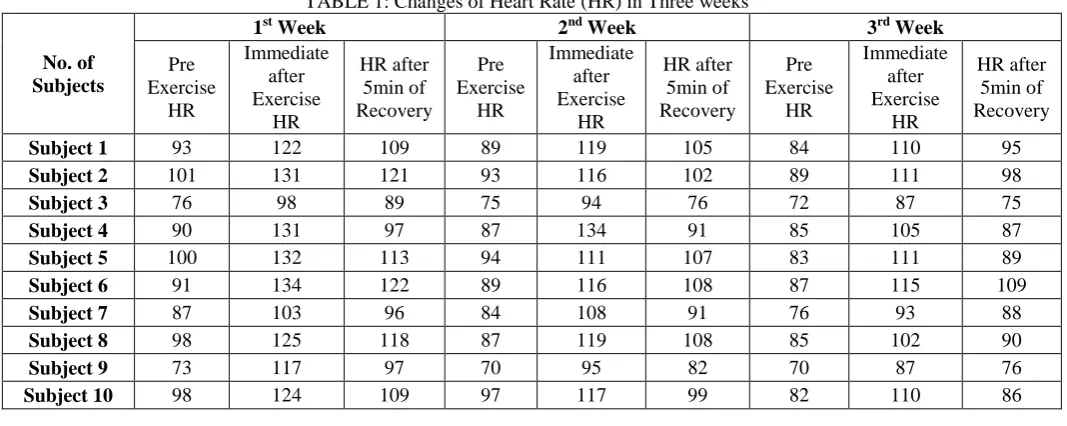
In this paper, heart rate is calculated by the average RR interval, while rate pressure product (RPP) is calculated by the product of HR and SBP. 10 healthy subjects resting condition heart rate is shown in fig 7. It indicates obviously that the HR at rest has become lower after three weeks of regular exercise.
TABLE 1: Changes of Heart Rate (HR) in Three weeks
No. of Subjects
1st Week 2nd Week 3rd Week
Pre Exercise
HR
Immediate after Exercise
HR
HR after 5min of Recovery
Pre Exercise
HR
Immediate after Exercise
HR
HR after 5min of Recovery
Pre Exercise
HR
Immediate after Exercise
HR
HR after 5min of Recovery
Subject 1 93 122 109 89 119 105 84 110 95
Subject 2 101 131 121 93 116 102 89 111 98
Subject 3 76 98 89 75 94 76 72 87 75
Subject 4 90 131 97 87 134 91 85 105 87
Subject 5 100 132 113 94 111 107 83 111 89
Subject 6 91 134 122 89 116 108 87 115 109
Subject 7 87 103 96 84 108 91 76 93 88
Subject 8 98 125 118 87 119 108 85 102 90
Subject 9 73 117 97 70 95 82 70 87 76
Subject 10 98 124 109 97 117 99 82 110 86
TABLE 2: Rate Pressure Product (RPP) changes in three weeks
Subject No. 1
st
Week 2nd Week 3rd Week
Pre Immediate Post Pre Immediate Post Pre Immediate Post
Subject 1 11811 16470 12535 10858 15351 11655 9828 13310 10640
Subject 2 12625 18078 14641 11346 16124 11220 11481 14985 10290
Subject 3 10944 14798 11214 8700 14476 9576 8496 12963 9525
Subject 4 11340 18078 12028 10614 17554 10465 10965 13230 10701
Subject 5 12200 18084 13221 11186 13986 12412 9960 13542 10769
Subject 6 11739 19162 16226 11214 15312 13824 11049 14835 13298
Subject 7 10266 12875 10752 9996 13932 10920 8892 11439 10472
Subject 8 11662 16250 14396 10527 15232 12852 9945 12546 10530
Subject 9 8541 14859 11640 8540 12160 10250 8470 10875 9272
Subject 10 12348 16988 14061 12028 15210 12474 9840 13860 10492
All subjects before exercise HR, Immediately after exercise HR and after five minutes of recovery HR were recorded in table 1 in three weeks of experimental period. Recording data shows that the three kinds of HR in 3rd week are smaller than in the 1st week of HR. 100% of subjects HR at rest decreased during the experiment period, while one subject HR stable at resting condition after third week of exercise. The decrement of heart rate between first week and second week is larger than it between second week and third week, which means that the heart rate decreased more sharply in the first half period than in second [1]. Table 2 shows the changes of RPP at resting condition, immediate after exercise and after five minute of recovery condition. The peak RPP is an accurate reflection of
the myocardial oxygen demand and workload. The rate pressure product increase during the immediate after exercise which indicates that the very large stress on heart with its regard to oxygen delivery needs. The results of table 2 indicate that the RPP at rest significantly decreased. In after immediate exercise results shows that the RPP has increased greater than 10000 which not indicate the higher risk of cardiac disease but it mainly due to increase in SBP which indicates the increase in myocardial activity.
B. ECG Characteristic parameter measurement
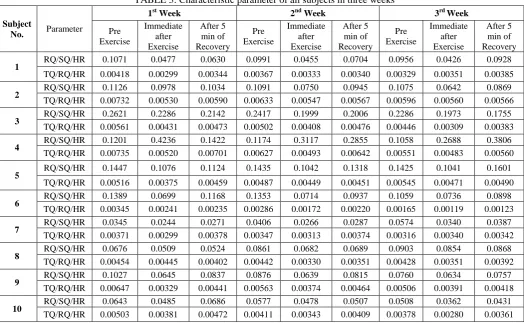
TABLE 3: Characteristic parameter of all subjects in three weeks
Subject
No. Parameter
1st Week 2nd Week 3rd Week
Pre Exercise
Immediate after Exercise
After 5 min of Recovery
Pre Exercise
Immediate after Exercise
After 5 min of Recovery
Pre Exercise
Immediate after Exercise
After 5 min of Recovery
1 RQ/SQ/HR 0.1071 0.0477 0.0630 0.0991 0.0455 0.0704 0.0956 0.0426 0.0928
TQ/RQ/HR 0.00418 0.00299 0.00344 0.00367 0.00333 0.00340 0.00329 0.00351 0.00385
2 RQ/SQ/HR 0.1126 0.0978 0.1034 0.1091 0.0750 0.0945 0.1075 0.0642 0.0869
TQ/RQ/HR 0.00732 0.00530 0.00590 0.00633 0.00547 0.00567 0.00596 0.00560 0.00566
3 RQ/SQ/HR 0.2621 0.2286 0.2142 0.2417 0.1999 0.2006 0.2286 0.1973 0.1755
TQ/RQ/HR 0.00561 0.00431 0.00473 0.00502 0.00408 0.00476 0.00446 0.00309 0.00383
4 RQ/SQ/HR 0.1201 0.4236 0.1422 0.1174 0.3117 0.2855 0.1058 0.2688 0.3806
TQ/RQ/HR 0.00735 0.00520 0.00701 0.00627 0.00493 0.00642 0.00551 0.00483 0.00560
5 RQ/SQ/HR 0.1447 0.1076 0.1124 0.1435 0.1042 0.1318 0.1425 0.1041 0.1601
TQ/RQ/HR 0.00516 0.00375 0.00459 0.00487 0.00449 0.00451 0.00545 0.00471 0.00490
6 RQ/SQ/HR 0.1389 0.0699 0.1168 0.1353 0.0714 0.0937 0.1059 0.0736 0.0898
TQ/RQ/HR 0.00345 0.00241 0.00235 0.00286 0.00172 0.00220 0.00165 0.00119 0.00123
7 RQ/SQ/HR 0.0345 0.0244 0.0271 0.0406 0.0266 0.0287 0.0574 0.0340 0.0387
TQ/RQ/HR 0.00371 0.00299 0.00378 0.00347 0.00313 0.00374 0.00316 0.00340 0.00342
8 RQ/SQ/HR 0.0676 0.0509 0.0524 0.0861 0.0682 0.0689 0.0903 0.0854 0.0868
TQ/RQ/HR 0.00454 0.00445 0.00402 0.00442 0.00330 0.00351 0.00428 0.00351 0.00392
9 RQ/SQ/HR 0.1027 0.0645 0.0837 0.0876 0.0639 0.0815 0.0760 0.0634 0.0757
TQ/RQ/HR 0.00647 0.00329 0.00441 0.00563 0.00374 0.00464 0.00506 0.00391 0.00418
10 RQ/SQ/HR 0.0643 0.0485 0.0686 0.0577 0.0478 0.0507 0.0508 0.0362 0.0431
TQ/RQ/HR 0.00503 0.00381 0.00472 0.00411 0.00343 0.00409 0.00378 0.00280 0.00361
Feature extraction is concerned to the detection of differences in voltages in the myocardial cells that occur during depolarization and repolarization [11]. RQ, SQ, and TQ are the amplitude difference between R and Q wave, S and Q wave and T and Q wave respectively shown in fig 8. These all are the raw features of ECG. Changes of heart rate during the three weeks of exercise, so normalization is required. Thus, we have to calculate the RQ/SQ/HR and TQ/RQ/HR features for the measurement of three weeks of ECG shape variation.
[Figure 8: RQ, SQ and TQ of ECG wave]
After three weeks of exercise, not only the ECG
shape variation but it also the interval and amplitude of ECG also reduced. Table 3 shows the variance of RQ/SQ/HR and TQ/RQ/HR of a subject in three weeks, it indicates 100% of variance have downward trend in three weeks. Thus, the results showed that the variability of ECG waves has significant reduced during the exercise period.
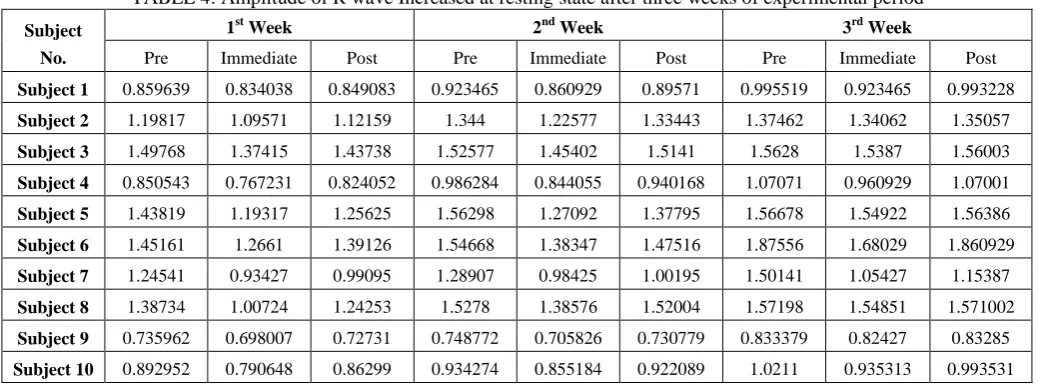
TABLE 4: Amplitude of R wave Increased at resting state after three weeks of experimental period
Subject No.
1st Week 2nd Week 3rd Week
Pre Immediate Post Pre Immediate Post Pre Immediate Post
Subject 1 0.859639 0.834038 0.849083 0.923465 0.860929 0.89571 0.995519 0.923465 0.993228
Subject 2 1.19817 1.09571 1.12159 1.344 1.22577 1.33443 1.37462 1.34062 1.35057
Subject 3 1.49768 1.37415 1.43738 1.52577 1.45402 1.5141 1.5628 1.5387 1.56003
Subject 4 0.850543 0.767231 0.824052 0.986284 0.844055 0.940168 1.07071 0.960929 1.07001
Subject 5 1.43819 1.19317 1.25625 1.56298 1.27092 1.37795 1.56678 1.54922 1.56386
Subject 6 1.45161 1.2661 1.39126 1.54668 1.38347 1.47516 1.87556 1.68029 1.860929
Subject 7 1.24541 0.93427 0.99095 1.28907 0.98425 1.00195 1.50141 1.05427 1.15387
Subject 8 1.38734 1.00724 1.24253 1.5278 1.38576 1.52004 1.57198 1.54851 1.571002
Subject 9 0.735962 0.698007 0.72731 0.748772 0.705826 0.730779 0.833379 0.82427 0.83285
Subject 10 0.892952 0.790648 0.86299 0.934274 0.855184 0.922089 1.0211 0.935313 0.993531
IV.DISCUSSIONSANDCONCLUSIONS
The results of this study confirm and extend the past observations of the changes of ECG behavior and RPP data before and after exercise in normal healthy subjects. Heart rate, Rate pressure product, RQ/SQ/HR, TQ/RQ/HR, and R peak amplitude noticeable changes which indicate that the ECG waveform changes after regular exercise.
Heart rate of each subject at rest has significant difference between 1st week and last week of exercise, which means that the heart rate decreased obviously. Heart rate is one of the most important physical signs in the cardiovascular disease prevention [1], it reflects the cardiac reserve, and HR at rest is a most important parameter related to the subject‟s health condition.
In the previous study, ECG waves (Q-, R-, S-, and T-) are most important indicator for exercise studies [4]. Thus, we have to calculate two characteristic parameters, RQ/SQ/HR and TQ/RQ/HR, to characterize the changes of ECG waves and in this heart rate are dividing for the normalization purpose. Systolic Blood pressure is also a common index to monitoring the vascular condition during the experiment period.
Heart rate and systolic blood pressure are the most important variables for determining the changes in myocardial oxygen consumption between the resting state and exercise period. HR, SBP and RPP increase with increases the workload on the heart which has to provide the adequate blood supply to the myocardium during exercise.
The increased RPP during exercise shows that individual not only has an increased risk of heart disease but also has a very large stress on the heart with regard to the oxygen delivery needs [9]. In healthy people, RPP decreased at rest after the regular exercise which indicates that the sufficient oxygen provides to the myocardium. RPP changes according to the increased myocardial blood flow and oxygen consumption during exercise. Thus, the RPP changes to exercise which is an indirect measure and good indicator of MVO2 could be used
for the early detection of cardiac dysfunction [9]. Therefore, after running 12-minutes, the T- and S-wave increased and the R-wave decreased after the immediate exercise, which had proved that the T-wave shape changes with the Heart rate [1].
Thus, the final results showed that the 100% of subject‟s HR at rest condition has continuously decreased and 100% of R peak amplitude at rest increased during the three weeks of experiment. Moreover, 80% of RQ/SQ/HR and 90% of TQ/RQ/HR at rest decreased during the experiment duration; while, 70% of RQ/SQ/HR decreased, 50% of TQ/RQ/HR increased immediately after exercise and also 100% of RPP at rest decreased which indicating increased MVO2 at rest. Thus, the HR,
the amplitude of R-wave has positive correlation with the LV volume.
As results shows that the amplitude of R-wave at rest increased, will most likely is caused by the left ventricular volume increased with the heart function enhanced [1]. According to the variation of this parameter, the 12-minute running has improved the cardiac function.
ACKNOWLEDGMENT
This work is supported by the Government Engineering College, sec-28, Gandhinagar, Gujarat. I would like to express my sincere thanks to all the people who supported me.
I would like to sincere thanks to Mr. Manish shah, Fitness centre at Valsad who supported my project work and data collection.
REFERENCES
[1] Lisheng Xu1,2, Yue Zhong1, Sainan Yin1, Yuemin Zhang3, „ECG and Pulse Variability Analysis for Exercise Evaluation‟ Proceeding of the IEEE, International Conference on Automation and Logistics, Chongqing, China, August 2011.
[2] J Garcia, P Serrano, R Bailbn, E Gutierrez, A del Rio, JA Casasnovas, IJ Ferreira, P Laguna, „Comparison of ECG-Based Clinical Indexes During Exercise Test‟ Communications Technology Group, CPS, University of Zaragoza, Spain, IEEE,2000.
[3] J. Mateo, P. Serrano, R. Bailón, J. García, A. Ferreira, A. Del Río, I. J. Ferreira, P. Laguna, „heart rate variability measurements during exercise test may improve the diagnosis of ischemic heart disease‟, 23rd Annual EMBS International Conference Istanbul, Turkey, October,2001 [4] R A Wolthuis, V F Froelicher, A Hopkirk, J R Fischer
and N Keiser, „Normal electrocardiographic waveform characteristics during treadmill exercise testing‟, Journal of the American Heart Association,1979.
[5] Channappa Bhyri, Kalpana.V, S.T.Hamde, and L.M.Waghmare, “Estimation of ECG features using LabVIEW”, International Journal of Computing Science and Communication Technologies, VOL. 2, NO. 1, July 2009.
[6] Roy J. Shephard and Gary J. Balady, “Exercise as cardiovascular therapy”, Journal of American Heart Association, 1999.
[7] Gerald F. Fletcher, Gary J. Balady, Ezra A. Amsterdam, Bernard Chaitman, Robert Eckel, Jerome Fleg, Victor F. Froelicher, “Exercise Standards for Testing and Training” Journal of American Heart Association, October 2, 2001. [8] Channappa BHYRI, Satish T. HAMDE, Laxman M.
WAGHMARE, “ECG Acquisition and Analysis System for Diagnosis of Heart Diseases”, Sensors & Transducers Journal, Vol. 133, Issue 10, October 2011.
[9] Rajalakshmi R, Vijaya Y. Vageesh and Nataraj S. M., “ Myocardial oxygen consumption at rest and during submaximal exercise: effects of increased adiposity”, Physiological Society of Nigeria, June 2013.
[10]Sangeeta nagpal, lily walia, hem lata, naresh sood and G.K.. ahuja, “Effect of exercise on Rate pressure product in premenopausal and postmenopausal women with coronary artery disease”, Indian J Physiol Pharmacol 2007.
[11]Yogendra Narain Singh and Phalguni Gupta, “ECG to Individual Identification”, august 2011.
[12]Iffat Ara, Md. Najmul Hossain, Md. Abdur Rahim, “ECG Signal Analysis Using Wavelet Transform”, International Journal of Scientific & Engineering Research, Volume 5, Issue 5, May-2014.
[13]L. Wang, S.W. Su and B.G. Celler, „Time constant of heart rate recovery after low level exercise as a useful measure of cardiovascular fitness‟, Proceedings of the 28th IEEE, EMBS Annual International Conference, New York City, USA, Aug 30-Sept 3, 2006.
Books:
1. R S Khandpur, Handbook of Biomedical Instrumentation, 12th Reprint, Tata Mc-Grew hill company Ltd, 2008. 2. Ramakant A Gayakwad, “Op-amps and linear integrated
circuits”, prentice Hall, 2000.
3. JOHN G. WEBSTER, "Medical Instrumentation, Application and Design".