http://www.sciencepublishinggroup.com/j/ajese doi: 10.11648/j.ajese.20170103.14
Case Report
Basis for the Analysis of Plans for the Comprehensive
Management of Municipal Solid Waste: A Collaborative
Assessment in Two Mexican Universities
Conrado Ruiz-Hernández, Alma Delia Lupercio-Lozano, Thalía Ameyatzin Bernal-González,
Francisco José Torner-Morales
Unit of Interdisciplinary Research of Health and Education Sciences, FES-Iztacala, National Autonomous University of Mexico (UNAM-Iztacala), Tlalnepantla, Mexico
Email address:
[email protected] (C. Ruiz-Hernández), [email protected] (A. D. Lupercio-Lozano), [email protected] (T. A. Bernal-González), [email protected] (F. J. Torner-Morales)
To cite this article:
Conrado Ruiz-Hernández, Alma Delia Lupercio-Lozano, Thalía Ameyatzin Bernal-González, Francisco José Torner-Morales. Basis for the Analysis of Plans for the Comprehensive Management of Municipal Solid Waste: A Collaborative Assessment in Two Mexican Universities. American Journal of Environmental Science and Engineering. Vol. 1, No. 3, 2017, pp. 85-89. doi: 10.11648/j.ajese.20170103.14
Received: March 9, 2017; Accepted: April 18, 2017; Published: June 13, 2017
Abstract:
The seriousness of current environmental problems underlie the importance and urgency of environmental education in higher learning institutions, which need better tools for evaluating environmental programs. This study is based on an evaluation card used to assess the performance of two management programs of municipal solid waste (MSW) implemented in two different universities. The study was conducted during mutual visits between researchers of the two universities. University A has more than ten years of experience with its solid waste management program; university B has two years of experience. The results show the need of an Environmental Institutional Plan that supports and support to guide the short- and long - term, this is where, in addition to the technical and engineering aspects, has strategic value environmental education supported strategies that promote and facilitate the correct disposal and proper management of MSW generated in universities.Keywords:
Evaluation, Management Programs, Municipal Solid Waste, Environmental Education, Higher Education, Institutional Plan, Environmental Collaborative Assessment1. Introduction
The generation, transportation and disposal of municipal solid waste (MSW), are among the most serious problems facing today's society. These problems are a consequence of rapid urban growth, technological and industrial development and the inefficient consumption of products and resources [6]. In Mexico, a series of regulations on the management and revaluation of MSW have been developed over the years. The definition of MSW includes the waste generated by households (from domestic activities, the consumption of products and the disposal of packaging) and by any other activity that takes place in urban establishments or in public roads and that generates household-type waste, or that is collected thorough the cleaning of roads and public places [9]. Thus, the composition of MSW will vary depending on the
geographical area, annual season, socioeconomic factors, consumer habits and collection systems.
Given the existing legal framework, it is necessary to know the amount and composition of MSW to create management plans that aim to integrate waste products into the production process as raw materials (recycling) while complying with the law.
In Mexico the main waste products food and garden residues, paper, cardboard, plastic and metal packaging, and waste related to personal hygiene, among others. Removal reusable or recyclable materials from the garbage flow would volume its volume and the amount of waste being sent to final disposal, benefiting the environment [11].
contribute to this, reducing the economic, social and environmental impact caused by the generation of waste on a daily basis. This would necessarily involve an educational process.
In this sense, environmental education involves not only to expand our knowledge about the main elements of the environment and the effect of human activities on it, but also to emphasize the changes in values and behaviors that are acquired in a given context. Environmental education involves theoretical and empirical levels. At the theoretical level, environmental educators have to main objectives: a) to establish the general framework of a research program, and b) to aid in the correct interpretation of results. It is essential to complement the theoretical aspects with empirical research [2].
In Mexico, the inclusion of environmental issues in higher education began in the 1990s with the creation of graduate and postgraduate programs related to the environment [3]. However, only a few higher education institutions have environmental programs involving planning, development, implementation and ongoing evaluation in which the student population participates in the fulfillment of environmental objectives with clear results linked to pedagogical processes [17].
It is important to recognize that higher education institutions face their own environmental challenges, as they usually include complex infrastructure that make them akin to micro cities, with shops, restaurant services, cafeterias, libraries, offices, printing and photocopying services, as well as sport, cultural and academic venues. With these demographic and structural characteristics, they have the dual responsibility of providing society with environmental education and, at the same time, to fulfill their own environmental requirements.
While higher education institutions are committed to sustainable development goals, this should be reflected in sustainable management practices that integrate the school community through continuous and critical participation; this is a complex task that requires time, organization, negotiation and willingness of those involved.
Ideally, involving university students in these kind of activities will turn them into environmentally conscious professionals.
2. College Environmental Programs
Several strategies have been developed to tackle the problems of waste generation and management in various universities. There are several examples of successful programs that aimed to make colleges adopt sustainable principles and practices. The first environmental program adopted by a higher education institution was developed by Brown University in the United States in 1972. This country has regulations that require schools and universities to have programs to reduce and recycle waste.
At Massey University, the implementation of the "zero waste program" [10], included discussion forums and groups,
the formation of a committee, academic research and administrative support to identify the strengths and areas of opportunity of such a program.
Most studies emphasize the importance of knowing the composition of the generated waste for the implementation of an efficient Integrated Management Plan [16].
In Mexico, some universities have implemented management programs of MSW. A recent national congress, organized by the Autonomous Metropolitan University (UAM) Azcapotzalco in 2015, invited discussion on the waste management programs of different universities, but they showed few concrete results. What was clear is that the comprehensive management of MSW within higher education institutions is a subject of interest not only for its environmental importance, but also for the training of environmentally conscious professionals.
One of the first of this programs in Mexico is the University Program for the Environment (PUMA-UNAM), created in 1991, which promotes the formation and training of human resources with emphasis on environmental policies and processes.
The present study will focus on two Mexican higher education institutions that have spent years developing a program of integrated management of MSW:
The UAM Azcapotzalco has implemented several such programs since October 2003, including an Energy Saving Program, a program for the Protection and Care of Green Areas, the construction of a Wastewater Treatment Plant, and a "Green" Shopping Program. In the same date, it also launched a program for the comprehensive management of solid waste called "Waste sorting for a better environment", aimed at raising awareness among the campus community on the issue of waste and promote waste sorting to comply with the national and regional municipal solid waste legislation. This program included an integrated "Management plan" (MP) that established a set of actions and procedures to facilitate the collection and disposal of consumer products that turn into municipal solid waste (MSW) [7, 8].
Between 2002 and 2003, the National Autonomous University of Mexico (UNAM) designed a project for the characterization and quantification of solid waste in the University Campus, through the Environmental Management Unit of the Faculty of Chemistry and General Works Directorate (Dirección General de Obras). The main objectives were, on the one hand, to evaluate the flows of generated waste in different areas of the campus (school zone, cultural center, stadium, sports areas, research institutes), and, on the other hand, to determine the percentage of waste with reuse potential and identify the most viable alternatives for UNAM to design waste management plans that comply with the current law and available technology [1]..
3. Evaluation as One Component of
Environmental Education
and universities can and should become permanent and intrinsic promoters of the culture of sustainability, not only in the classrooms through direct discussion of the subject, but also in their daily functioning, addressing practical issues such as waste management, sustainable consumption, air, water and soil pollution, deforestation and erosion, ecological management and climate change [18, 5].
Environmental plans are essential tools, although not indispensable, for environmental programs; these plans aim mainly to promote changes in institutional structure and dynamics so that institutions are able to address countrywide environmental problems [5].
In Mexico, the implementation of Institutional Environmental Plans (PAI) was promoted during the administration of former Secretary of the Environment J. Carabias (1994-2000) [3].
Regarding the educational aspects of environmental programs, evaluation should be part of the teaching-learning process, but it should also be focused on the structure of the programs and serve as a guide to understand the different and complex environmental, social and economic dimensions involved.
Recently, there has been much emphasis on institutional evaluation programs as part of the need for quality education. In the case of higher education, there are alternative accreditation and certification systems.
According to some studies [4], educational institutions should create a culture of evaluation in which it is conceived as a mechanism for improvement and accountability to the community, involving three aspects:
(1)Institutional evaluation and auto-evaluation aimed at identifying the strengths and weaknesses of the institution from the perspective of the major agents in the educational process.
(2)External evaluation, an extra-institutional evaluation carried out by peers and focused on the analysis of educational programs or the substantive functions of the institution. There are two levels: a diagnostic evaluation to improve the quality of education in the institution, and an accreditation process aimed at strengthening education and accountability to society.
(3)Certification of processes, which aims to improve the efficiency of the institution through the Quality Management System ISO 90001: 2000 [4].
Evaluation processes, therefore, are an essential part of an educational institution, providing relevant information to
improve the teaching-learning process and the management practices of the institution.
This multi-level evaluation process can be applied to environmental education programs, which are closely linked to the social purposes of education.
This study describes two moments of the application of a primer [12, 14] to evaluate specific items of two environmental education programs at two higher education institution called A and B.
Institution A has extensive experience in the handling of MSW and in studies focused on waste generation. In 2003, it started several environmental programs: energy saving, protection and care of green areas, a wastewater treatment plant, "green" shopping and sorting of MSW. In 2010, this institution won the National Environmental Merit Award.
Institution B started in August 2014 a Program for Integrated Waste Management, managed a Committee, which classified waste into organic, inorganic, recyclable, PET and sanitary residues. Previously, there had been initiatives for reusing waste, such as the collection of PET and office paper [13].
4. Procedures and Results
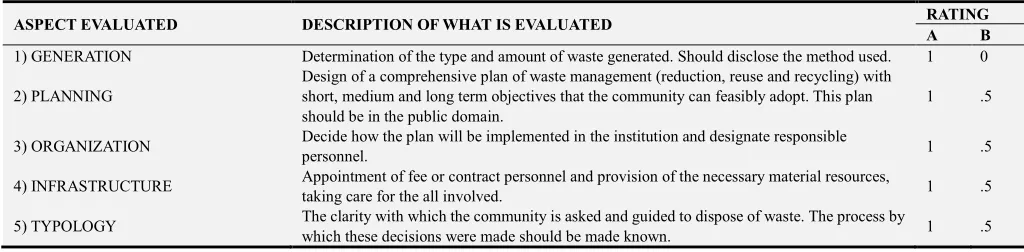
A primer was designed [12] and applied at two Mexican universities for the evaluation of institutional programs of integrated management of municipal solid waste.
The primer considers ten basic aspects that can be used to evaluate different situations and adapted to other educational institutions (upper secondary or basic education).
To carry out the diagnostic evaluation of the environmental management programs of MSW with the primer, it was necessary to integrate a team of evaluators that included representatives of the institution A and external specialists, in this case from the other institution B that participated in this study.
The application of the primer consisted in first place in bringing together the university personnel directly related to the managing of waste (A), and the evaluators from the other university (B). The personnel were asked to provide information on the location of the places where waste was collected, how the containers were sorted, written records related to the program, web pages, and their experience in the management of the program. Afterwards, the personnel and the evaluators discussed the evaluation of the different aspects of the program and assigned commonly agreed values to each of the. The same activity was performed in in the other university.
Table 1. Evaluation primer applied in institutions A and B.
ASPECT EVALUATED DESCRIPTION OF WHAT IS EVALUATED RATING
A B
1) GENERATION Determination of the type and amount of waste generated. Should disclose the method used. 1 0
2) PLANNING
Design of a comprehensive plan of waste management (reduction, reuse and recycling) with short, medium and long term objectives that the community can feasibly adopt. This plan should be in the public domain.
1 .5
3) ORGANIZATION Decide how the plan will be implemented in the institution and designate responsible
personnel. 1 .5
4) INFRASTRUCTURE Appointment of fee or contract personnel and provision of the necessary material resources,
taking care for the all involved. 1 .5
5) TYPOLOGY The clarity with which the community is asked and guided to dispose of waste. The process by
ASPECT EVALUATED DESCRIPTION OF WHAT IS EVALUATED RATING
A B
6) IMPLEMENTATION/MONITORING Implementation and monitoring of the waste management plan. 1 0 7) EDUCATION/TRAINING Well-designed educational interventions to provide the skills required by a culture of recycling. 1 0 8) EVALUATION Measuring, as objectively as possible, the knowledge and motivation acquired by the
community. This information should serve as feedback for the program. 1 0 9) TRANSPARENCY Mechanisms through which the community is provided with extensive information about the
program's progress and the problems to be solved. 0 0
10) ACCOUNTABILITY Reliable information on the financial and material resources assigned to the program and the
way they are used. 0 0
Note: Each aspect is evaluated with 1 point when the institution is clearly addressing it; 0.5 points when it has been incompletely addressed, but with notable progress; and 0 when necessary measures have just started to be considered or the aspect has been neglected. In the final score the institution A obtain eight points, and the institution B obtained two points.
The design, implementation and improvement of this type of assessment tools can serve to recognize what specific aspects are being properly attended and where is there room for improvement.
The two institutions evaluated showed different degrees of progress that reflect interest, commitment and hard work by the program coordinators; however, there is still need for better strategies and regular evaluation to determine the progress and setbacks in the implementation of the various stages of the programs in question.
Institution A showed continuous and systematic work in the creation of adequate spaces and infrastructure for the operation of its waste-collection program; however, the program still has deficiencies in some strategic and fundamental aspects to make it sustainable with the support of the community, independently of institutional support.
In institution B, teachers and students have carried out some studies on the flow of waste generation within the institution; however, these studies have not been carried out systematically, and is thus not possible to use them to set realistic short- and medium-term goals. There is no historical data because the waste management program in its first stages.
5. Conclusions
This type of comparative and co-participatory evaluation is an original approach in MSW management programs.
It is evident that these evaluated programs have different degrees of progress in their design and implementation, which is reflected in their respective grade obtained.
Including the accreditation of educational environmental programs in the current context of institutional evaluation in higher education institutions would be a breakthrough for environmental education. These evaluations should include external actors, since the internal certification processes implemented by some universities do not usually encourage self-criticism and can thus be a vehicle for self-indulgence.
Each institution usually has a unilateral perspective of its own environmental, limiting the scope for improvement.
Studies like the one carried out here promote a critical analysis of the results of environmental educational programs and collaboration between different institutions, which favors the sharing of knowledge and experience, actions and processes related to the implementation, development and
structure of an environmental program.
Institution A has in place an Environmental Institutional Plan that governs and gives meaning to the program of waste management; it is based on the theoretical and epistemological basis that have been specifically developed for the institution and allows to have a clear sense of where to go, why, and, especially, the environmental objectives to be achieved.
Institution B has a fledgling waste recovery program but has not yet developed an Environmental Institutional Plan that supports and directs environmental actions, which may delay the environmental goals of the institution, which is evident in the evaluation performed in this study. The creation and development of an institutional plan could serve as a guideline for the waste recovery program, and would open the possibility of addressing other environmental aspects and create complementary programs to save electricity, water, etc.; it would also allow to link the program with teaching and research activities, promoting the participation of the school population.
There have been several studies on the generation and recycling of waste materials in universities [1, 7, 15] that give us an instrumental perspective of the feasibility and usefulness of such studies.
This study investigated basic elements of the implementation of environmental programs in Mexican universities through a qualitative tool that provides general information about the progress and/or stage of such programs. The participation of members of another university in the evaluation of these programs offers the possibility of objectively assessing the progress and deficiencies of such programs and the ways in which they could be improved. Environmental programs should be evaluated institutionally, as is done in other areas; these would encourage the development and improvement of environmental care programs in higher education. This type of comparative and co-participatory evaluation is an original approach in MSW management programs.
References
[2] Alfie, M. Medio ambiente y universidad: retos y desafíos ambientales en la Universidad Autónoma Metropolitana-Azcapotzalco. El Cotidiano, 2003, 19 (122): 86-92.
[3] Ávila, L. (2014). Los programas ambientales universitarios en México. Entre el discurso ambiental y negocios verdes, Sociedad y amiente, 2014, 1 (3): 26-52.
[4] Barrera, M. y G. Aguado (2007). La evaluación integral de programas y procesos: un camino hacia la calidad, Educere, 2007, 37: 209-215.
[5] Bravo, M. Los planes ambientales en la educación superior en México. Construyendo sentidos en la sustentabilidad (2002-2007). SEMARNAT, México, 2007.
[6] Castrillón, O. Puerta, S. Impacto del manejo integral de los residuos sólidos en la corporación universitaria lasallista. Revista Lasallista de Investigación, 2004. Available at: http:// www.redalyc.org/articulo.oa?id=69511003.
[7] Espinosa V. R. M., Turpin M. S., Polanco S. G., de la Torre V. A., Delfín A. I. y Raygoza M. I. Integral urban solid waste management program in a mexican university. Waste Manage, 2008, 28: 27-32.
[8] Espinosa V. R., Turpin M. S., Vázquez S. R., Vázquez M. A., Cisneros R. A., de la Torre V. A., García. G. B. La gestión ambiental en una institución de educación superior asociada a las prácticas de separación y recuperación de residuos. Revista Internacional de Contaminación Ambiental, 2013, 29 (3) 49-57.
[9] LGPGIR. Ley General para la Prevención y Gestión Integral de los Residuos, Última reforma publicada DOF 22-05. 2015, 2015 Available at:
http://www.diputados.gob.mx/LeyesBiblio/pdf/263_220515.p df.
[10] Mason I. Brooking A. Oberender A. Hardford J. Horsley P. Implementation of a cero waste program at a university campus. Resources, Conservation and Recycling, 2003, 38: 257-269.
[11] Orta, M., Saucedo, G. y Tovar, L. Composición y generación de residuos sólidos urbanos de la ciudad de México durante 2008-2009, UAM-Iztapalapa, 2014.
[12] Ruiz, C, Torner, F., Lupercio, A, y T. Bernal. Auditoría ambiental participativa. Cartilla de RSU, Ciencia y Desarrollo, 2015, 41 (275): 34-35.
[13] Ruiz, C. y A. Lupercio. Auditoría ambiental participativa sobre manejo de RSU en dos universidades mexicanas: Prospección preliminar. Memoria del 1er encuentro académico sobre manejo de residuos en universidades, UAM Azcapotzalco, México, 2015.
[14] Ruiz, C., Lupercio, A., Muñoz, J. Torner, F. y T. Bernal (2015). Residuos sólidos urbanos: Normatividad y cumplimiento de metas, Derecho Ambiental y Ecología, 2015, 68 (12): 92-96.
[15] Ruiz, M. Caracterización de residuos sólidos en la universidad Iberoamericana, Ciudad de México, Revista Internacional de Contaminación Ambiental, 2012, 28 (1): 93-97.
[16] Smyth, P. D.; Fredeen, A. L.; Booth, A. L. (2010). Reducing solid waste in higher education: The first step towards ‘greening’ a university campus. Resources, Conservation and Recycling, 2010, 54: 1007-1016.
[17] The Mexican Consortium of University Programs for Sustainable Development (Complexus) was established in 2000. It currently consists of 18 universities throughout the Mexican Republic www.complexus.org.mx.