© 2018 IJSRST | Volume 4 | Issue 1 | Print ISSN: 2395-6011 | Online ISSN: 2395-602X Themed Section: Science and Technology
A Study on Vulnerabilities, Applications, Advantages and Routing
Protocols in MANET
Sugandhi Maheshwaram
Senior Full Stack Developer, National Association of Insurance Commissioners (NAIC), Kansas City, Kansas
ABSTRACT
In wired networks; we have actually firewall programs as well as safeguarded portals as a defense system for safe interaction. In the situation of wireless Mobile Ad-hoc networks (MANET), the nodes are self- arranging, framework much less, vibrant geography and also no central authority. A Mobile Adhoc Network (MANET) is a contenting collection of mobile phones, the cordless network can reconfigure on its own contending team of mobile phones. This network can function with no set framework, the nodes in the networks function as a router along with the host. This paper gives understanding a detailed review of Mobile Impromptu networks. This paper additionally evaluates the different features, difficulties, applications of MANETS. In addition, the routing method for MANET has actually existed in this paper. Each mobile node is cost-free to relocate separately in any kind of instructions as well as transforms its web link to various other tools often. In this paper, we review different susceptibilities, applications, benefits, as well as routing protocols in MANET.
Keyword : Routing Protocols, Mobile Ad-Hoc Networks, ZRP
I. INTRODUCTION
With the arising mobile modern technology, cordless interaction is ending up being prominent nowadays. This results from the laptop computers and also cordless interaction tools such as cordless modems as well as cordless LANs. There are two primary methods for allowing cordless interaction in between hosts. First is making it possible for mobile facilities to bring information as well as voice, however it present an issue as it is restricted to areas where the mobile information network exists. 2nd method is ad-hoc networking in between individuals to connect with each various other. It is restricted in variety however has a number of benefits over mobile network. A Mobile Ad-hoc Network is a self-organizing mobile network in which each gadget is cost-free to relocate separately in any kind of instructions as well as alter
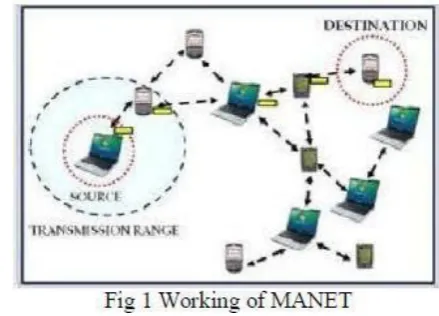
its web links to various other tools regularly. They can be released on areas where there is no facilities. Fig 1 shows working of MANET.
node 2 acts as a router and these three nodes together form an ad-hoc network.
II. MANET Characteristics
1. Dispersed Procedures: There is no central authority and also the control is dispersed amongst the nodes. Each node needs to comply and also interact with each various other. The node might apply features such as routing and also protection.
2. Multi-jump routing: When a node attempts to send out the info to various other nodes that run out the interaction variety after that the package should be sent through intermediate nodes.
3. Independent terminal: In MANET, each node is independent as well as might operate as a router as well as a host.
4. Dynamic geography: Nodes relocate easily in the network as well as might transform the web link to various other tools. The nodes dynamically develop routing amongst themselves as they circumnavigate developing their very own network.
5. Light-weight terminals: The nodes are mobile with much less CPU ability, reduced power storage and also much less memory dimension.
6. Shared Physical tool: The cordless interaction tool comes to any type of entity with suitable tools and also ample sources. There is no limitation to access the network.
7. Diversification: MANET can be developed utilizing a range of tools such as laptop computers, automobiles, rescues, smartphones and so on.
III. MANET Applications
Several of the common applications [1] consists of: 1. Armed forces battleground: MANET would certainly permit the army to keep a details network in between soldiers, automobiles, as well as army details head office.
2. Neighborhood degree: Ad-Hoc networks can autonomously connect an immediate as well as short-term multimedia network utilizing a laptop to spread out details amongst individuals at a seminar or class. 3. Individual location network as well as Bluetooth: An individual location network is a brief variety, a local network where nodes are normally related to a provided individual. Bluetooth can streamline the inter
4. interaction between numerous nodes such as laptop computer and also cellphone.
Industrial field: Ad-hoc network can be made use of in rescue/ alleviation procedures such as fire, floodings, as well as quake.
IV. VULNERABILITIES IN MANET
VULNERABILITY[1] can be called a weak point in the protection system. A system might be susceptible to unapproved information control since the system does not validate customer ‟ s identification. MANET is extra susceptible than a wired network. The complying with are the susceptibilities:
1. Absence of central monitoring: MANET does not have actually systematized display server. The lack of administration makes the discovery of assaults hard due to the fact that it is challenging to check the web traffic in an extremely vibrant and also large ad-hoc network.
3. No predefined limit: We can not exactly specify a physical limit of the network. The nodes operate in a nomadic setting as the nodes sign up with and also leave the network. As quickly as the foe is available in the radio variety of a node it will certainly have the ability to interact with that said node.
4. Enemy inside the network: The mobile nodes within the MANET can openly sign up with and also leave the network. The nodes might additionally act maliciously. This is difficult to discover that the behavior of the node is destructive.
5. Minimal power supply: The nodes in the MANET demand to think about limited power supply The nodes might act in a self-centered fashion where it is locating that there is just a restricted power supply.
V. ROUTING IN MANET
Ad-Hoc routing protocols are commonly divided into three main classes; Proactive, reactive and Hybrid protocols. The fig 3 shows the routing protocols [4].
Proactive protocols:
It is likewise referred to as table driven protocols. They preserve the routing table of whole network regularly. Each node needs to keep several tables to save routing details as well as action to adjustments in network geography by broadcasting and also circulating. The routing tables are upgraded frequently whenever the network geography adjustments in order to have a regular sight. Each node in the
network sends out a program message to the whole network if there is any type of adjustment in the network geography. This results in upkeep of the routing table since the entrances have to be upgraded and also need to offer the real details of the whole network. For a big network, positive routing protocols are not advised as it brings about overloading of the routing table and also even more data transfer usage. Instances are DV (range vector), DSDV( Location sequenced range vector), OLSR (ideal web link state routing) as well as WRP (cordless routing method). OLSR (Optimized link state routing)
OLSR [12] procedure does hop-by-hop routing; that is, each node in the network utilizes its latest details to course a package. Thus, also when a node is relocating, its packages can be effectively supplied to it. The routing can be enhanced in two means: OLSR lowers the dimension of the control packages for a specific node by proclaiming just a part of relate to the node ‟
s next-door neighbors that are its multipoint relay selectors, rather than all web links in the network. Second of all, it decreases flooding of the control website traffic by utilizing just the chosen nodes, called multipoint relays to share info in the network. As just multipoint relay sofanode can retransmit its broadcast messages, this method dramatically decreases the variety of re-transmissions in a flooding or program treatment.
DSDV (Dynamic Destination- Sequenced Distance Vector Routing)
updates could either be routine or occasion- driven. DSDV procedure calls for each mobile node in the network to promote its very own routing table to its present next-door neighbors. The promotion is done either by relaying or by multicasting. With ads, the adjoining nodes can learn about any kind of modification that has actually happened in the network as a result of the activities of nodes. .
Reactive protocols:
It is additionally referred to as on-demand routing protocols. They preserve or find paths just as needed. A control message is swamped to the courses to uncover the proper course. A path is developed just when a node in the network wishes to send out a message to one more node in the network. It has a benefit since the routing table is not strained yet there is a lengthy hold-up in developing the course. Instances are DSR (Dynamic resource routing), AODV (Ad-hoc as needed range vector routing), LAR (area helped to route) and also TORA (temporally gotten routing algorithm).
1) AODV (Ad-hoc On Demand Distance Vector) [6] It develops a path just as needed. It can uncast, program as well as multicast routing. It makes use of series numbers on course updates. It responds promptly to the topological adjustments and also updates just those hosts that might be influenced by the modification making use of RREQ message. The RREQ as well as RREP messages are accountable for course exploration. The fig 4 reveals routing in AODV.
2) Advantages:
1.
Does not require any inner organizational method to handle routing process.2.
Establishes route on demand and destination sequence numbers are applied to find the latest route to the destination.3.
Connection set up delay is lower.4.
Loop free and avoid counting to infinity problem.5.
At mostone route per destination maintained at each node.3) Disadvantages:
1.
Leads to heavy control overhead.2.
Unnecessary bandwidth consumption.VI. CONCLUSION
The current paper includes seven sections which deal with the mobile ad hoc network which is includes: the types of Wireless network, the characteristics, the applications, challenges, advantages, disadvantages, and routing protocol of MANET. Mobile ad hoc network is decentralized, self-organize, “anywhere,
anytime” network, and provides cheap
network and several challenges as there are still many challenges confronting wireless ad hoc networks. It also presents a brief but sound account of the advantages and disadvantages of the MANET. This paper also presents the classification of MANET routing protocols: proactive, reactive and hybrid of routing protocolspaper, we discuss MANET and its characteristics, challenges, applications and vulnerabilities. We have also classified routing protocols into three classes as proactive, reactive and hybrid. We understood the comparison of the routing protocols.
VII.
REFERENCES
[1]. Priyanka Goyal, Vinti Parmar, Rahul Rishi “
MANET: Vulnerabilities, Challenges, Attacks,
Application” in proceedings of IJCEM
International Journal of Computational Engineering & Management, Vol. 11, January 2011.
[2]. Loay Abusalah, Ashfaq Khokhar, and Mohsen
Guizani “A Survey of Secure Mobile Ad Hoc Routing Protocols” in proceedings of IEEE
communications surveys & tutorials, vol. 10, no. 4, fourth quarter 2008.
[3]. Yau P.-W., Mitchell C.J., “Security
Vulnerabilities in Ad Hoc Networks”, In Proc.
of the 7th Int. Symp. on Communications Theory and Applications, pp. 99-104, 2003. [4]. HumayunBakht, “Survey of Routing Protocols
for Mobile Ad- hoc Network”, International
Journal of Information and
Communication Technology Research, 258-270, October 2011.
[5]. Mohit Kumar and Rashmi Mishra “An Overview
of MANET: History, Challenges and
Applications” , Indian Journal of Computer
Science and Engineering (IJCSE), Vol. 3 No. 1 Feb-Mar 2012.
[6]. C. Perkins, E. Belding-Royer and S. Das, “Ad -Hoc On-Demand Distance Vector (AODV)
Routing”, RFC3561, July 2003
[7]. Naveen Bilandi and Harsh K Verma
“Comparative Analysis of Reactive, Proactive
and Hybrid Routing Protocols in MANET”
International Journal of Electronics and Computer Science Engineering 1660 ISSN- 2277-1956.
[8]. Perkins CE, Bhagwat P (1994) Highly Dynamic Destination-Sequenced Distance- Vector Routing (DSDV) for Mobile Computers. Proceedings of ACM SIGCOMM 1994:234–244.