© 2016 IJSRST | Volume 2 | Issue 4 | Print ISSN: 2395-6011 | Online ISSN: 2395-602X Themed Section: Science and Technology
Evaluation of Resource Needs and Service Delivery of Performance
Contracting in Public Primary Teachers Training Colleges in Kenya
Simon K Kipkenei
1, Judah Ndiku
2Julius Maiyo
3Rodgers Cherui
4 1 & 2Masinde Muliro University of Science and Technology P.O. Box 190, Kakamega Ministry of Education, Western Province
3
Kibabii University, PO Box 1699, Bungoma, Kenya 4
Tambach Teacher Training College, P.O Box Private Bag, Tambach
ABSTRACT
Performance contract as a branch of management science refers to a management control systems which is a contractual agreement to execute a service according to an agreed upon terms, within an established time period and with a stipulated use of resources and performance standards. The government of Kenya introduced performance contract signing in 2004. The aim was to improve service delivery and resource utilization in public institutions among other objectives. The introduction of performance contracting in public primary teachers training colleges was an effort to institute a framework of accountability and enhance service delivery in Kenya. This study sought to establish the availability of resources for implementing Performance contracting with an aim of improving service delivery to the public. It employed descriptive survey design. The target population was 2270 employees and 783 members of the students’ councils of Public Primary Teachers Training Colleges. Purposive sampling, simple random sampling and stratified random sampling were used to identify the sample population. A total of 429 respondents formed the sample size representing 30% of the study population. The study revealed several challenges in the implementation process which included lack of funds, lack of training and capacity building of employees regarding performance contracting, ambiguity in the process and resistance by personnel to participate in the process hence these challenges had hindered the successful implementation of Performance contracts in PPTTCs. It is recommended that performance contracting strategy should be strengthened with the availing of more financial resources to ensure that the required learning and teaching resources are all made available.
Keywords : Ranking, Resources, Targets, Tutors, Service Delivery, Training.
I.
INTRODUCTION
The term performance contracting can be traced from France in the late 1960s and in other countries including India, Pakistan and Korea (OECD, 1997). Kenya Sensitization Training Manual (2004), defines performance contract as a freely negotiated performance agreement between Government Organizations and individuals on one hand and the Agencies on the other hand. Gathai (2012), looks at performance contract as a branch of management science referred to as management control systems which is a contractual agreement to execute a service according to an agreed upon terms, within an established time period and with a stipulated use of resources and performance standards. From the above definitions, it can be concluded that performance contracting is all about
mutual agreement between two or more groups where one party acts as the owner or representative of the Public Agency and the management of the Agency on the other hand agreeing to perform well in a contractual activity at hand.
performance contracts are based on the premise that-: “what gets measured gets done; if you cannot see and measure success you cannot reward it, if you cannot recognize failure, you cannot correct it and if you can demonstrate results, you can win public support” (Darma, 2013).
Darma looks at performance contract as a method of establishing defined expectations, accountability and consequences for meeting or not meeting a set standard of execution excellence. Two or more parties agree on the actions the performer will execute and the expected results from implementing those actions. He continue to explain that in the absence of a national development intervention within the context of a result based framework, performance cannot be defined and measured hence tracking performance and measuring results is next to impossible. The introduction of performance contacts in Nigeria was aimed at enabling the federal government of Nigeria to measure performance of Ministries, Department and Agencies (MDAs) in a fair, objective and comprehensive manner and to create a results- oriented public service delivery mechanism. Many other African countries have adopted the practice of performance contract and they include South Africa, Gambia, Mali and Botswana among others. Performance contract has been found to be quite successful in these countries.
Performance contract was introduced in Kenya on 1st October, 2004, in 16 largely commercial state corporations. This would see institutions freely negotiate performance agreement with the Government every year. Regular monitoring of the implementation of the contract agreed upon has been a vital aspect for its success. The institution provides feedback by forwarding quarterly reports and taking corrective action where necessary. Kenya is still at the first stage of development and was ranked number 93 in the Global competitive index with a score of 3.84, in 2009, compared with countries such as Singapore which was ranked number 5 with a score of 1.53 according to the world Economic Forum (2008-2009). In 2007, the Government of Kenya published Kenya vision 2030 as its long term strategy for achieving global competitiveness and prosperity. The country also aims at linking reforms and economic growth to actual quality
of life of Kenyans, increase customer satisfaction with government services and to build trust in the government. Thus, one of the foundations of the Kenya vision 2030 is an efficient, motivated and well trained public service. Among the key strategies should be to link result based management and performance contracting to the implementation of the visions’ goals making it easier to reward public servants on merit and performance.
In order to be effective in conducting business or rendering services, organizations need to implement management procedures and practices that will yield the desired results. Under PCs, targets are set and although the areas of concern are the outcomes rather than the processes, the processes do determine the outcomes. A performance contract is anchored on two items, the strategic plan and service delivery charter. The development of strategic plans is one of the things that state corporations are required to do before entering into performance contacts. A strategic plan enables an organization to be better focused on its core business. It also helps the organization to clearly set out its objectives and action plans that will enable it achieve the objectives. In effect what the institutions are called to do is to plan performance, thus the development of strategic plans (Republic of Kenya 2005).
clients. From previous evaluation results, it had been observed that most tertiary institutions were performing poorly in annual evaluation results. Whereas the general public and even some high ranking public servants may very much welcome the idea of performance contracting and measuring performance, it might not have been readily accepted by everybody. In state corporations and tertiary institutions, there is a general feeling that it is unfair to grade state corporations operating in different sectors of the economy together with tertiary institutions which function below the expected amount of resources supposed to be allocated to them annually. Another challenge is the applications of the composite score which allows for comparisons of different ministries and state corporations. Some ministries and even state corporations prefer to be grouped and ranked differently citing their uniqueness emerging from the areas of service delivery, size in terms of turnovers, number of employees and even their mandate (Obong’o, 2009).
Performance contracting is a system that operates on the premise that resources for development would be available in good time. However, due to a myriad of reasons, these resources are not always available as envisaged. The affected institutions therefore feel disadvantaged and would not comfortably identify with the outcome of PC. Government services are meant to be available to all citizens throughout the country as it imparts a sense of national belonging in that citizen. The critical argument from several quarters is the disparities in allocation of the available resources and yet the evaluation measurement is the same for all institutions. The study therefore attempted to find out from college employees whether resource reasons could have contributed to their low ranking in the National performance evaluation results of the first seven years after the signing of Performance contracting took effect in PPTTCs in Kenya.
II.
METHODS AND MATERIAL
A. Statement of the problem
The survival of an organization, its increased productivity and high profit margins are dependent on resources and in particular human resource. Without proper resources, even the best designed organization
that is guided by well made plans with necessary equipment cannot achieve its performance potentials. It is the people who supply the organization with their human efforts and work. Workers use their talent to creatively combine and utilize the equipment, machines, tools and other non-human resources which include facilities, structures, time, technology, land, transportation, the organization climate, geographical orientation and information (Umunadi, 2012). The introduction of performance contracting in Kenya was aimed at among other things to bring about a radical transformation in resource utilization in public institutions.
performance contracts for the sole purpose of improving service delivery in Teacher Training Colleges in Kenya.
B. Objective of the Study
The objective guiding the study was:
To assess the adequacy of resources for implementing performance contract to improve service delivery in Public Primary Teachers Training Colleges in Kenya.
C. Research Design and Methodology
This study adopted a descriptive survey design. Surveys are used in preliminary and exploratory studies to allow researchers to gather information, summarize, present and interpret data for the purpose of clarifications (Orodho, 2002). This approach was also to enable the researcher to establish the feelings, opinions and perceptions of tutors teachers training colleges about performance contracting and its impact on teaching/learning resources’ utilization. The design was used by the researcher because it enabled him collect information on the subject of the study in its current state. It was also to enable the researcher to receive detailed information from respondents who are either directly or indirectly involved in issues of performance contracting in Public Primary Teachers Training Colleges. It helped in getting their opinions about other components like performance assessment, performance targets and performance rewards. That enabled the researcher to find out the impact performance contracts had on resource utilization.
D. The Study Location
The study was carried out in Public Primary Teachers Training Colleges in Kenya. These institutions were found to have been ranked way below other tertiary institutions in most annual PC evaluation by the Government. Ranking depends on evaluation matrix where marks are awarded depending on the level of achievements of targets. There are 21 PPTTCs and these are Igoji, Kamwenja, Machakos, Kilimambogo, Thogoto, Kigari, Bondo, Mosoriot, Migori, Asumbi, Tambach, Kaimosi, Shanzu, Garissa, Murang’a, Baringo, Meru, Kitui, Narok, Eregi, and Kericho.
E. The Target Population
In this study, the target population consisted of teacher trainees, Tutors (Principals, Deputy Principals, Deans, PC committee members and the rest of the teaching staff) and members of the Non-teaching staff of PPTTCs in Kenya. The respondents were targeted because of the structure of college administrations where there are service providers and service recipients. PC committees who are part of the teaching staff oversee the implementation process of Performance contracts and the College Principals who are the chief executive officers of their institutions and chairs PC meetings were in a position to explain the success of PC implementation in their colleges. The respondents were 1414 tutors (Principals, Deputy Principals, Deans, Heads of Departments and the rest of the teaching staff) and 856 Non- teaching staff together with all Heads of sections and a total of 783 members of the student councils.
F. Sample Size and Sampling Procedures
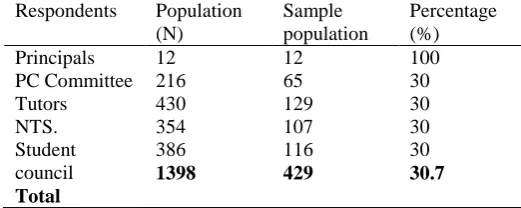
Table 1: Sample Size Distribution for The Study
Respondents Population (N) Sample population Percentage (%) Principals PC Committee Tutors NTS. Student council Total 12 216 430 354 386 1398 12 65 129 107 116 429 100 30 30 30 30 30.7
Source: Field Data (2014)
Stratified random sampling technique was used to group the teaching staff and student councils according to their departments and areas of operation respectively. Each college has 8 departments but the population of the teaching staff in each department varies from institution to institution depending on the population of the students. A sample of 129 members of the teaching staff was selected to participate from a population of 430 and a sample of 116 members of the student council was also selected from a population of 386. Simple random sampling was used to select members of the Non-teaching staff were 107 participants were expected to respond to the questionnaires. A total of 41 questionnaires were returned while 44 participate through interviews making a total of 85 respondents representing 80% of the expected responses from this group which was a representative sample enough to give findings that can be generalized. O’Connor (2011) argued that there are formulas for determining sample size, but the main thing is to be practical and for a small population of interest, you would most likely need to sample about 30% of the population. The study considered utilizing this formula to obtain the sample population. The rationale for this study was informed by poor evaluation results posted by PPTTCs in all PC evaluation results since its signing in 2007.
III.
RESULT AND DISCUSSION
A. Findings
Resource allocation for performance contract activities
The objective of this study was to establish whether the level of availability of resources was a contributor to poor performance in annual performance contacting evaluation in Public Primary Teachers Training Colleges
in Kenya. Previous annual evaluation result show that PPTTCs were not at bar with other tertiary institutions under the same category when it comes to PC annual evaluation of all tertiary institutions. The Principals pointed out that proper utilization of learning and teaching resources were hindered by scarcity of financial resources. The lack of finances made some of the resources not to be availed in time or not to be procured at all hence hindering the impact of PC on the ground. Some tutors claimed that there was no much change on the ground as far as the availability of teaching and learning resources were concerned. They claimed PC as a strategy was hampered by too much paper work and lack of enough training in resource utilization for its impact to be strongly felt on the ground. Heads of Departments however indicated that the utilization of resources was hindered by the fact that the teaching staffs were not properly prepared to implement the planned performance strategy that had in turn made them not to appreciate the strategy positively. Performance contract system makes the strategy of a department clear to all its operational units and above all spells out the resources that will be made available for achieving the targets they have formally undertaken to meet. Teachers training colleges suffer from inadequate, old and poorly maintained transport facilities which affect some of the PC target areas such as teaching practices for teacher trainees. The study intended to find out from the groups of respondents whether the resources available in their institution could help meet the set PC targets to enable them get a good ranking. Table 2 indicates the responses of employees on this matter.
Table 2 : Employees’ responses on adequacy of resources for PC implementation
Respondents Stro n g ly ag ree Ag ree Neu tr al Dis ag ree Stro n g ly d is ag ree
Principals 3(25
%)
1(8.3% 0
0 5(41.7
%) 3(25 %) PC Committee 2(3.1 %) 28(43. 1%) 12(18. 5%) 14(21. 5%) 8(12.3 %) Non- teaching staff 5(12. 2%) 14(34. 1%) 12(29. 3%) 6(14.6 %) 2(4.9 %)
As to whether colleges have adequate resources for the implementation of PC the table above indicates the results from all participants where 4(33.3%) of the Principals agreed that resources were adequate but 8(66.7%) disagreed meaning this is one of the challenges affecting the success of PC in PPTTCs in Kenya. On the same question, 46.2% of PC Committees were in agreement while 46.3% of the Non-teaching staffs agreed that PC had adequate resource for PC implementation in their institutions meaning there was a likelihood that lack of clarity existed in the use of resources. Interviews conducted revealed that NTS were not aware of what was being contracted as they claimed that their routine work had remained the same. According to Kobia and Mohammed (2006), stability of resources enhances the Motivating effect of the contract and yet organizations still experience challenges such as the lack of adequate resources, resources not being released on time; some performance targets being highly ambitious and unplanned transfer of staff. When resources are not available or availed late, the staff involved gets frustrated.
Hooker (2011) and Umunadi (2012) argue that the survival of an organization, its increased productivity and high profit margins are dependent on resources and in particular human resource. The researchers’ interviews and observations revealed that PPTTCs suffer from low funding especially at their learning resource centers. It was also found that Teacher trainees are trained on the use of modern technology in lesson presentation. There was inadequate ICT infrastructure equipment and materials which affected ICT programs in the training of teachers. Currently computer lessons and the use of computers by both pupils and teachers seem to be the way forward in copying with changes in technology. Respondents’ suggestions were that one way to mitigate the problem of resource scarcity was to encourage creativity and innovative practices internally within an institution. Utilization of allocated funds ensures that funds are applied to programs, projects and activities for which they were appropriated and were planned for. Allocated funds include financial resources from outside the exchequer, including donor funds. This links the process of budgeting to performance target setting. The PC committees explained that variance analysis was always carried out on all budget items to establish conformity and absorption capacity. The study
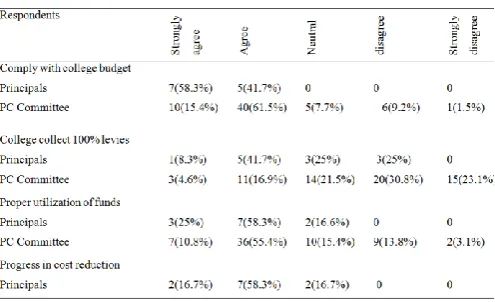
wanted to find out if compliance to the set budget, 100% collection of levies, proper utilization of funds and cost savings and reduction was being adhered to as expected. The most difficult of all these is fee collection from students as majority of them are believed to be coming from humble backgrounds. This makes 100% collection of fees as a target next to impossible hence affecting most target areas which depend on money paid in terms of fees. The findings had mixed reactions from employees of different colleges. The table below provides this information.
Table 3 : Responses of Principals and PC Committees on finance
Source: field data 2014
From Table 3 above 100% of the principals and 76.9% of PC committee agreed that college administrators do comply with college budgets. Both the Government and PC guidelines require all college principals to strictly adhere to the planned budget and spend 100% of all collected levies. Colleges are expected to collect 100% levies from various sources. This is shown through audited financial reports or accounts, showing all monies collected from fees, house rent and seminars among others during any given financial year. For example, from Table 3 above, 100% of the principals agreed that it was possible to comply with the set targets in PC. This is a confirmation that setting of targets was within the means and the ability of any institution. The findings also indicate that 50% of the principals and 21.5% of PC committees were able to collect 100% of their levies.
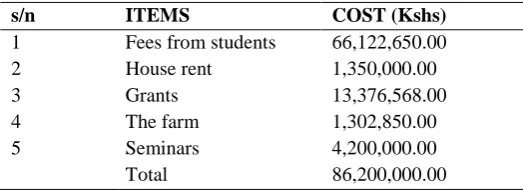
provide authenticated proof of reasons for partial and/or non-compliance and the authorization so as to be evaluated using the standard criteria for PC. That is if they have to be said they complied with the set budget. Majority of the institutions had evidence showing their expenditure as was found in the document analysis. The study also found out that 75% of the principals agreed that PC had made them experience reduction in cost of goods and services. In this case of cost savings and reduction, institutions must show by way of evidence the savings such as costs reduced through bulk purchases, discount given by suppliers and the official communication between the Agency and the suppliers, comparative cost for purchases made at different times during the financial year in question. Table 4 below is a practical example of one of the institutions which had documented the way they planned to spend their expected income 2014/2015 financial year.
Table 4 : A Colleges’ expected income for 2014/2015 financial year in on PPTTC
s/n ITEMS COST (Kshs)
1 Fees from students 66,122,650.00
2 House rent 1,350,000.00
3 Grants 13,376,568.00
4 The farm 1,302,850.00
5 Seminars 4,200,000.00
Total 86,200,000.00
Source: Field Data 2015
The table indicates a classic example of the sources of income for most PPTTCs in Kenya. The guidelines expected the institution concern to collect 100% of all the indicated monies which in normal cases may be not possible within the period in question. Colleges do not allocate any money to PC activities as a vote head. However, the PC activities are footed under the general college vote. It should be noted that all activities to be undertaken by the college are evaluated under performance contracting. Information on PC activities can be obtained in commitments’ manual of the board of management in every institution under PC. The BoM is accountable to the membership base to adopt the best possible practices of Governance, management and operations in order to ensure and provide the best possible experience for service users (GoK 2011). It is therefore necessary for college administrators to fully involve all employees in the activities of performance
contracting. This will make them understand well the content of agreement, what they are expected of, and what their clients expects from them and to strictly adhere to the planned institutional budget of the year. According to U.S Department of education retrieved on 7th April 2015, a major element of financial data activity rests in the act of budgeting. Budgeting is the process of allocating finite resources to the prioritized needs of an institution. In most cases, for a Governmental entity, the budget represents the legal authority to spend money. Adoption of a budget in the public sector implies that a set of decisions has been made by the Governing board and administrators that culminates in matching a Government's resources with the entity's needs. As such, the budget is a product of the planning process. The budget also provides an important tool for the control, evaluation and the uses of resources.
Using the accounting system to enact the will of the Governing body, administrators are able to execute and control activities that have been authorized by the budget and to evaluate financial performance on the basis of comparisons between budgeted and actual operations. Thus, the budget is implicitly linked to financial accountability and relates directly to the financial reporting objectives. Client visiting the institution face some challenges at some point and therefore they need to be assisted. This brings about the necessity of a customer care desk and complains handling department.
Table 5 indicates the responses of employees on how problems relating to customers are handled. Service delivery begins at the entrance of any institution and clients are given direction at a reception room or desk. From the reception area, clients are able to access the service delivery charters and gauge how long they are likely to be served in that particular institution.
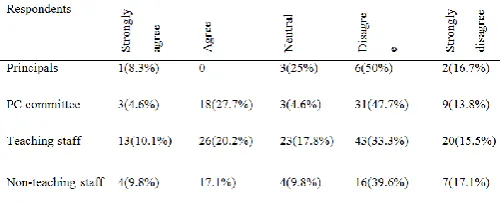
Table 5 : Availability of customer desk and a complains handling department
The results in Table 5 above shows that 91.7% of the principals were in agreement that customer desk and a department for handling complain was available in their institutions. On the contrary only 36.5% of the teaching staff, 36.6% of the Non-teaching staff and 35.4% of the student council were in agreement of the same indicating that majority of the employees do agree that the resource was not available. The observation schedule showed that majority of the institutions visited had a customer desk only. None of them had complains handling department. From this result, the important aspect of quality service delivery at a point of service level is the existence of easily accessible, acceptable and transparent complains handling mechanisms to which customers can have recourse to if they are dissatisfied with the services received. This can only happen if the resources mentioned above are available. It is therefore prudent for institutions to use friendly customer complains handling mechanisms which are consistent with the promises contained in the service delivery charters in every institution. The study sought to find out whether the respondents had been trained on Performance Contract or not. Human resource is a very important element in any organization. This kind of resource should be well equipped with the right kind of skills needed in that particular organization.
Table 6 below indicate the responses of college employees on the training of staff in PC activities from the period PC was signed by the college administration as part of a college program to the time this research was being undertaken.
Table 6 : PPTTCs Staff have been train on PC activities
Source; field data 2014
According to the findings, 8.3% of the principals indicated that they had trained staff on Performance Contract while 66.7% of these respondents indicated that they had not trained their staff. Majority 61.5% of PC Committee in answering the question on training of staff
disagreed that there is any training given to the staff while 30.3% were in agreement. Form this results it is possible to conclude that this could be one of the reasons why PPTTCs are tailing in PC annual evaluation. The study findings revealed also that 48.8% of the Teaching staff disagreed that there was any kind of PC training in their institution and only 30.3% agreed while 17.8% remain uncommitted. This could be another cause of poor achievements as lack of training is a thread to implementation process. At least all PC committee should have been trained on PC activities. On the same item, 56.7% of the NTS disagreed that staff had been trained on PC while 26.9% agreed. This is an indication that training is necessary in PPTTCs if at all there is need for proper PC implementation. This is an indication that majority of the respondents have no idea on how to go about PC activities. It is therefore necessary for PPTTCs to improve on their human resource. The research findings gave a clear indication that most employees were not trained and therefore BoM should intensify the training of all employees on PC. OECD (1999) identifies training as a key determinant in Performance Contracting related activities. Training improves management capabilities and abilities to take advantage of the opportunities that can add value to the institutions’ day to day operations. Training on PC is of great importance because it would deepen the understanding of PC concept. The fact that training had not been done for the majority of the employees was something to get worried of the researcher tested the objective of the study to find out whether there was any relationship between resource allocation and service delivery in PPTTCs in Kenya. Resource allocation here includes both human and material resource necessary for the implementation of PC in PPTTCs. The objective stated as: Ho3: There is no significant relationship
between availability of adequate resources for implementing performance contract and service delivery in Public Primary Teachers Training Colleges in Kenya.
Table 7: X2 results of adequacy of resources and service delivery in PPTTCs
From table 7 above, it is evident that chi-square test has all values of P < .05 hence the hypothesis above was rejected in favor of an alternative hypothesis. The results indicate that there is a significant relationship between availability of adequate resources for PC implementation and service delivery. The implication of these results is that for service delivery to improve there must be adequate resources for the program. Availability of resources will also eliminate excuses for non-performance. We can conclude that resource availability will improve service delivery in PPTTCs.
B. Discussions of the Findings
Performance Contract is a challenging program full of complex activities. In some cases, it may be difficult to identify concrete outcomes or results for a service. For example, training and education services might be provided with the goal of disseminating information and modifying people’s behavior. However, it may be difficult or impossible to track participants and determine whether the training helped them to think and act differently. In these cases, the development of / or output measures such as the number of people served or the number of training sessions or outcome measures to evaluate the impact of the training effort such as pre or post test scores should be developed. This requires well trained personnel to undertake the program. If a department is unable to identify performance outcomes for a specific service type, a meeting with head of the section and other departments may be useful to stimulate new ideas and share best practices (Korir, 2005). The Government exaggerates its expectations especially in relation to funding projects within a contract period. Government funds are not released on time while at the same time Students pay fees when they are about to do exams. This delays the achievement of set targets in the contract period as PC is evaluated quarterly. In giving their general views on PC, employees agreed that signing of Performance contract should be done in conjunction with provision of all the resources; finances, facilities and staff motivation. Professor Guest of United Kingdom College concurs with the above argument in that good performance management involves ensuring that people have the resources for accomplishing set goals in a contract period. Republic of Kenya (2010) asserts that Government officers are being publicly challenged to account for public resources entrusted to them on a day-to-day basis as the bar of achievement is
raised each year. This implies that the Government dictates the goals in the contract period and also raising the bar of achievement every year and does not provide funding on time as claimed by majority of the administrators who participated in the research.
Opondo (2004) claim that an institution with employees who are specialized will achieve targets more than those with little training. This implies that staffs that do not have the necessary knowledge regarding PC are likely to miss out of their target and therefore there is need for training so that they get the necessary knowledge and skills on PC. Effective training and sensitization on PC to all employees of PPTTCs is therefore a critical aspect that needs to be urgently addressed so that there is synergy in the implementation of PC (Gatere, 2013). The principal factor which is clearly seen to be impacting negatively on quality of services offered by various institutions are inadequate preparation, lack of proper supervision at both department or section and institution level and sensitization of employees on the role and importance of PC and the need to participate fully by enabling them to cope up with the changes in service delivery systems and information technology. Another factor is unavailability of adequate resources and physical facilities, inadequate mechanisms for assessing customer satisfaction and limited professional commitment to quality service provision by some employees. For customers to be served well, a customer desk must be available to address the challenges facing those who are seeking services in various sections of an institution. Complain handling department must also be set so as to address challenges facing clients at all times.
without targeting PC indicator areas simply because they are not aware. Afolabi (2005) observes that no matter how beautiful the programs and assets of an institution are, without a well-trained academic staff and availability of other resources, attainment of institutional goals and objectives would prove abortive. This is because human resources constitute a workforce in an institution.
Guven and Gulbaher (2008), observes that the integration of ICT as a resource has the potential to help revitalize teachers and students. This could help to improve and develop the quality of education by providing curricular support in difficult subject areas. The study findings also found out that there is inadequate ICT infrastructure equipment and materials to incorporate ICT programs in the training of teachers. The use of ICT in all areas of teaching and learning and other service areas in Colleges should be made mandatory as this can be the only sure way of improving service delivery and improving transparency. The research findings indicated that all Public Primary Teachers Training Colleges operate on vote-head based budgets and therefore faces serious constraints at the resource level to implement the various commitments in the contract. Moreover, fees chargeable to Students are seldom collected 100% since students cannot be send home for fees as it is also the ministry of educations’ policy to ensure that there is a 100% completion rates by all the students enrolled in public learning institutions was achieved. In general the research findings revealed that 8(66.7%) of the principals disagreed that resource were available to implement PC activities. Resources here mean other support mechanisms other than monetary support. At the same time 46.3% of the Non-teaching staff agreed that PC had improved utilization of the available resources in their institutions. It was also found that it is possible to comply with set budgetary levels according to 76.9% of the PC Committees. If this is to be true then college administrators have to comply and reduce wastage so as to improve their service provision and raise their ranking. Majority 83.3% of the principals accepted that utilization of funds from their institutions were of the required standards. This means most of the principals were accountable for the funds they receive in their institutions. Clients expect quick solutions to their problem. Solutions to problems are one of the best indicators of quality service delivery. On the
part of the teaching staff, the study revealed that 36.5% of them agreed that they had both a customer care desk and complains department.
Efficiency and transparency in management of public resources has been the desire of every citizen all over the world and especially in Kenya, (AAPAM, 2005). Principals of Colleges have failed to complete the automation program as expected in PC manual. Automation has been proven to lead to a more competitive and customer oriented employees’ Service delivery. It also improves employees’ accountability and transparency in an institution. The findings of this study through observation check list indicated that service charters where available in most PPTTCs but what was lacking in all of them was an office or department where users would seek redress in case of dissatisfaction. Service charter is therefore not an option for an institution. Performance contracting is anchored on strategic plans and service charters. Less than 50% of the employees think that service charters and strategic plans are adhered to which is a worrying trend.
IV.
CONCLUSION
The study reveals that most PPTTCs have not trained their human resource on PC implementation process; therefore, most of them end up working so hard but without targeting PC indicator areas simply because they are not aware. Opondo (2004) claim that an institution with employees who are specialized will achieve targets more than those with little training. This implies that staffs that do not have the necessary knowledge regarding PC are likely to miss out of their target and therefore there is need for training so that they get the necessary knowledge and skills on PC. The research findings gave a clear indication that most employees were not trained and therefore BoM should intensify the training of all employees on PC. The research findings also indicates that all Public Primary Teachers Training Colleges operate on vote-head based budgets and therefore faces serious constraints at the resource level to implement the various commitments in the contract. The study found out that Principals of Colleges have failed to complete the automation program as expected in PC manual. Automation has been proven to lead to a more competitive and customer oriented employees’ Service delivery. It also improves employees’ accountability and transparency in an institution. It is because of this reason that none of the 21 PPTTCs qualifies to be ISO certified. The findings of this study through observation check list reveals that service charters where available in most PPTTCs but what was lacking in all of them was an office or department where users would seek redress in case of dissatisfaction. Colleges were not able to collect levies as expected. The Government expects institutions to collect 100% levies from various sources under their mandate. This is difficult because a number of students enrolled in PPTTCs cannot afford to pay fees because of their humble background. Government funds are not also released on time which includes bursaries for students while at the same time students pay fees when they are about to do exams. This delays the achievement of set targets as PC is evaluated quarterly. Colleges do not allocate any money to PC activities as a vote head. However, the PC activities are footed under the general college vote. It should be noted that all activities to be undertaken by the college are evaluated under performance contracting. This means the colleges must have enough funds to run all activities under PC
evaluation otherwise the PC activity area without resources will score the least mark. HoDs, however indicated that the utilization of resources was hindered by the fact that the teaching staffs were not properly prepared to implement the planned performance strategy that had in turn made them not to appreciate the strategy positively.
V.
RECOMMENDATIONS
1. Colleges should partner with the Government in
providing adequate resources.
2. A vote head should be designed for PC program.
3. Board of Managements should intensify the training
of all employees on PC
VI.
REFERENCES
[1]. Abdulkaram A, Fasasi V, Akinubi O (2011). Human Resource Utilization & Internal Efficiency in State owned Universities in Nigeria. Int. J. Acad. Res. Bus. Soc. Sci. 1(1).
[2]. Afolabi S. O (2005). 'Influence of Resource Utilization on Organizational Effectiveness in Kwara State Government Owned Tertiary Institutions.' Unpublished P.hD thesis. Retrieved online on 10/11/2012.
[3]. Carmines, E. G and Zeller, R.G (1999). Reliability and Validity assessment. Bevery Hills, CA: Sage publications.
[4]. Darma, N.A (2013). Examining performance contract in Nigeria: Retrieved on 24th July 2013, posted on March 9, 2013.
[5]. Gathai, E.W et al (2012).Analysis of factors that influence implementation of performance contracts in state corporations (A case of Kenya civil Aviation Authority) international journal of Humanities and social sciences Vol2 No. 17 Nairobi Kenya.
[6]. GOK (2005). Office of the president: Performance contract steering committee, sensitization manual, Government printers, Nairobi, Kenya.
[7]. GOK (2005). Information booklet on performance contracts in the public service. Directorate of personnel management.
[9]. GOK (2012). Report on Evaluation of the performance of public agencies for the financial year 2010/2011 Government Printer; Nairobi. [10]. Hardina, D, Middleton, J, Montana, S and
Simpson, R. A (2007).An empowering approach to managing social service organizations. Springer publishing company, New Nerk.
[11]. Kobia, M & Mohammed, N (2006).The Kenyan experience with performance contracting. Discussion paper, 28th AAPAM .Annual roundtable conferences Tanzania 4th-8thDec 2006.Arusha, Tanzania.
[12]. Korir, P.K.(2006). The impact of performance in state corporations. The case of East Africa Portland Cement. An unpublished MBA Management Project. University of Nairobi, Nairobi.
[13]. Mugenda, and Mugenda, A (1999). Research Methods, qualitative approaches; Acts press, Nairobi.
[14]. Musa, M (2001). Economic Recovery Strategies for wealth and employment creation 2003-2007. Civil service reform Agenda Africa.
[15]. Nyongesa, W.J, Sewe, T. and Naiange, A. (2012). Challenges facing the implementation of performance contracts in state corporations in Kenya: Unpublished: Masai Mara University. Narok, Kenya.
[16]. Obongo, S.O (2000). Transferring new public management to development countries. The case of civil service reforms in Kenya. Manchester, U.S.A.
[17]. Obongo, O. S (2009). Implementation of performance contracting in Kenya. International Public Management Review. Electronic Journal at http:// www.ipmr.net Vol. 10.Issue 2009.
[18]. O’Connor, T. (2011). “Sampling,” megalinks in criminal justice. Retrieved from http://www.drtomoconnor.com/3760/lec03.htm. October 10, 2015.
[19]. OECD (1997). Issues and development in pubic management. Paris, France.
[20]. Omboi, B.M (2011). Factors affecting implementation of performance contract initiative at Municipal council of Maua- Kenya. Research journal of Finance and accounting Vol 1. Kenya Methodist University, Kenya.
[21]. Orodho (2002, 2003). Essentials of educational and Social Sciences Research method. Masola Publishers, Nairobi.
[22]. Pablo, T. S (1993). An institutional theory of public contracts; Regulatory implications. Website; http://www.nber.org/papers/w14152. [23]. Performance Contracts Steering Committee,
Kenya, (2004): Sensitization/Training Manual on Performance Contracts in the Public Service. [24]. Republic of Kenya, (2003). Economic Recovery
strategy for wealth and Employment creative (2003-2007). Nairobi. Office of the president. [25]. Republic of Kenya, (2005). Sensitization/ Training
Manual on performance contracts in the public service. Government Printer. Nairobi
[26]. RoK (2007). State corporations ranking evaluation: Office of the president. Government printers, Nairobi, Kenya.
[27]. Republic of Kenya (2010). Review of performance contracting in the public sector, Government Printers Nairobi.
[28]. Republic of Kenya (2014). Report on evaluation of the performance of public agencies, Government Printers, Nairobi.
[29]. RoK (2012). Performance contracting guidelines on the vision 2030 project indicators. Government printers, Nairobi Kenya.
[30]. Scott, W.R (2001). Institute and organizations. (2nded.) Sage publication inc.California.