www.orientjchem.org
An International Open Free Access, Peer Reviewed Research Journal
2018, Vol. 34, No.(3): Pg. 1312-1316
This is an Open Access article licensed under a Creative Commons Attribution-Non Commercial-Share Alike 4.0 International License (https://creativecommons.org/licenses/by-nc-sa/4.0/), which permits unrestricted Non Commercial use, distribution and reproduction in any medium, provided the original work is properly cited.
Manganite Synthesis By Different Methods
MUKHAMETKALI MUSAGALIEVICH MATAEV
1, SIDDHARTH (MONTU) SAXENA
2,
GENNADY SEMENOVICH PATRIN
3, ZHANAR YLIASOVNA TURSINOVA
1*,
ASSEL TAUPYKOVNA KEZDIKBAYEVA
4, MARZHAN ABDYZHAPAROVNA
NURBEKOVA
1and GAUKHAR UMIRALIEVNA BAITASHEVA
11Kazakh state women's teacher training university, 050000, Aiteke bi, 99, Almaty, Kazakhstan. 2University of Cambridge, Madinley Road, Cambridge, CB3 0HE, United Kingdom.
3Siberian Federal University, Svobodny pr. 79, Krasnoyarsk, Russia. 4The Karaganda State University of the name of academician E.A.Buketov,
Universitetskaya 28, Karaganda, Kazakhstan. *Corresponding author E-mail: [email protected]
http://dx.doi.org/10.13005/ojc/340315
(Received: January 30, 2018; Accepted: February 28, 2018)
ABSTRACT
Nanostructural dysprosium manganite doped with bismuth, synthesized by three methods: solid-phase, sol-gel and citrate-nitrate. The composition of the synthesized powders was compared to determine the optimal technique. Using X-ray diffraction, the influence of annealing conditions on the structure of manganite was studied. The result of XRD showed that manganite, synthesized variants of methods has orthorhombic structure.
Keywords: Dysprosium orthomanganite, Sol-gel combustion, Citrate-nitrate combustion,
structure, X-ray.
INTRODUCTION
Preparation of materials in the form of various sediments1-3 is referred to the family of the
wet synthesis procedures known from a number of advantages compared with traditional high temperature solid state processing methods, such as excellent control of stoichiometry of the final powders with the possibility to obtain uniformity and
mixing in atomic scale, the distribution of narrow particles, minor contamination of the product during the homogenization of the source connections, low energy consumption, low aging time and simple equipment4.
Research described in5, showed that the
1100 °C. Such particles are large in size and form large agglomerates. Therefore, it is worthwhile to seek alternative methods to synthesize weakly agglomerated nanoparticles Bi0,1Dy0,9MnO3 using organic compounds. It is possible to single out such methods as the citrate-nitrate synthesis and sol-gel. In these cases, the formation of nanoparticles will happen either during the decomposition of previously formed organic-inorganic complexes (precipitation and sol-gel method), or the isolated volume (trace elements); the parameters of which can be controlled by selection of various organic compounds. Therefore, the aim of this study was the synthesis of nanoparticles of manganite dysprosium-bismuth (BDMO) using different methods and the composition correction by radiography of the obtained nanoparticles.
EXPERIMENTAL
Three different methods of obtaining manganite BDMO were used in the work.
Solid-state reaction
In solid-phase reactions the source materials and the final products are in solid state, therefor the oxides may be mixed with the stoichiometric ratios. The manganite was synthesized by solid state reaction in the manner of mixing oxides of metal ions Bi3+, Dy3+ and Mn3+ corresponding to
the formula of the perovskite Bi0,1Dy0,9MnO3 (BDMO), in the required proportion to obtain the final product with the desired composition.
Solid-phase synthesis of complex oxides based on manganite was made of a mixture of initial oxides in accordance with the following scheme of reactions.
0,1Bi2O3+0,9Dy2O3+Mn2O3 = 2Bi0,1Dy0,9MnO3
Stoichiometric amounts of oxides were mixed and triturated in an agate mortar to obtain a homogeneous mixture. Then the mixtures were subjected to repeat annealing in a furnace in the temperature range of 600-1100 °C with increase temperature in every 100 °C. Annealing was made in 6 stages: I stage – 600 0C, II - stage – 700 0C,
III - stage 8000C, IV - stage 900 0C, V - stage
1000 0C, VI - stage 1100 0C with a total duration of
39 hours5. Intermediate grinding was made after
each synthesis stage. Upon completion of the synthesis, the furnace was turned off, and cooling of the obtained compound was in the cooling mode of the muffle furnace. The composition of the final products was controlled by the method of X-ray.
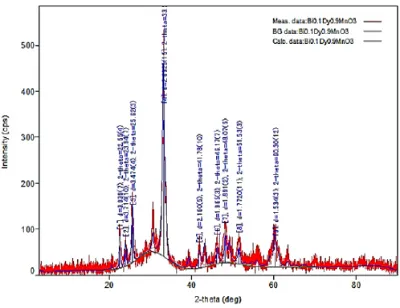
By the results of the manganite diffraction pattern (Fig. 1), it can be seen that the resulting manganite is multiphase. In addition, it is necessary to note several shortcomings of this method. a. Duration of synthesis (39 hours).
b. High synthesis temperature above 1000 °C. c. Multiphase product.
The sol-gel method using a polyatomic alcohol glycerol
In this method of synthesis metal oxides were used too. The required amount of oxides was dissolved in distilled water. Citric acid and glycerol (2:3) were added to the obtained solution as gelling agents. Then the solution was heated using an electric stove with constant stirring at 80 °C to remove excess water and obtain viscous gels. The gel was dried at 250 °C and annealed at 500 °C for 10 h, to obtain the desired powder. The powders were crushed in an agate mortar to obtain a homogenous mixture. Then they were placed in crucibles and annealed at temperatures of 600-1000 °C for 19 hours.
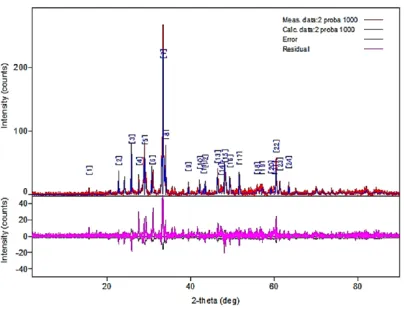
In Fig. 2 the peaks marked in blue indicate peaks before improvement phase and the peaks marked with pink are the remaining after the refinement of the phase by the Rietveld method.
Citrate-nitrate method
Perovskite type of BDMO was received by the citrate-nitrate method using as source oxides Dy2O3 (b.p.), Bi2O3 (b.p.), Mn2O3 (b.p.). Same as in the
second method, the mixture of oxides was dissolved in distilled water. 2M nitric acid as a precipitating agent was added to the obtained solution. Citric acid in the ratio of the oxides 1:2 was used as the reaction medium. Chelating effect is favorable for pH value. Thus an adequate volume of 2M of solution HNO3
were added to increase the pH value of the mixtures up to 7. The obtained mixture was evaporated using an electrical plate at 80 °C and continuous stirring to remove the excess solvent before formation of the dry semi-product and annealed at 500 °C for 10 h to obtain the desired powder.
The presence of the source oxide in the mixture is maintained at a temperature of 700-800 °C. At this with increasing temperature the manganese is rapidly recovered, being in a sample composition in the form of a mixture of oxides with different degree of oxidation. The bismuth oxide is finally included in the structure of solid solution based on dysprosium manganite at 800-900 °C, the dysprosium oxide remains in the form of oxide or hydroxide up to 900 °C, and then reacts. Final heat treatment of the precursors was performed in a muffle furnace at different temperatures (900, 1000 °C) for 21 h, in a muffle furnace. Formation of the new phase is completed at a temperature of 1000 °C.
In Fig. 3, the peaks marked in blue indicate peaks before improvement of the phase and the
peaks marked with pink are the remaining after the refinement of the phase by the Rietveld method.
RESULTS AND DISCUSSION
The formation of new phases was controlled by the method of x-ray phase analysis produced by X-ray diffractometer Miniflex 600 (Rigaku) using CuKα-radiation filtered by the Ni filter (U = 30 kV, J = 10 MA, the rotation speed of 1000 pulses per second, time constant = 5 sec., the range of angles 2θ from 5 to 900). Radiographs of the synthesized polycrystalline powders were indicated by the homology method (homologue is a distorted structure type of perovskite). The density of manganites were determined by the pycnometric method according to GOST 2211-65. Toluene served as indifferent liquid. The density of the manganite was measured 4 – 5 times and data were averaged.
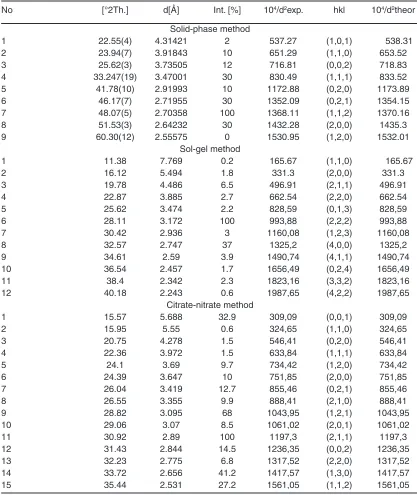
The results of the synthesized manganite radiograph indexing by different methods show that the manganites have the orthorhombic structure with the following unit cell parameters (Table 2).
The reliability of the indexing results is controlled by a satisfactory coincidence of experimental and calculated values of the inverse squares of the interplanar spacing’s (104/d2), and the coincidence degree of the x-ray and pycnometric densities values of the studied compounds.
Thus, the double bismuth– manganite BDMO was synthesized by various methods. Using the ceramic technology, considering the Tamman’s conditions, the authors defined temperature regime of the synthesis of the dual mixed manganite BDMO. The type of crystal system and unit cell parameters Fig. 2. The diffraction pattern of the manganite
synthesized by the sol-gel method
were determined by the radiographic method. It is established that a complex mixed manganite is crystallized in the orthorhombic crystal system; the correctness of the results of x-ray studies of the manganite is confirmed by the good concordance between the experimental and calculated values (104/d2), concordance between the values of x-ray
and pycnometer densities. The comparative analysis of parameters between the lattice parameters of the source δ-Bi2O3 shows that the values of the parameters «a» and «b» satisfactorily coincide with the lattice parameters δ- Bi2O3, the parameter «c» is distorted from the value of the «a» parameter on √2.
Table 1: The results on indexing of radiographs of manganites synthesized with different methods
No [°2Th.] d[Å] Int. [%] 104/d2exp. hkl 104/d2theor
Solid-phase method
1 22.55(4) 4.31421 2 537.27 (1,0,1) 538.31
2 23.94(7) 3.91843 10 651.29 (1,1,0) 653.52
3 25.62(3) 3.73505 12 716.81 (0,0,2) 718.83
4 33.247(19) 3.47001 30 830.49 (1,1,1) 833.52
5 41.78(10) 2.91993 10 1172.88 (0,2,0) 1173.89
6 46.17(7) 2.71955 30 1352.09 (0,2,1) 1354.15
7 48.07(5) 2.70358 100 1368.11 (1,1,2) 1370.16
8 51.53(3) 2.64232 30 1432.28 (2,0,0) 1435.3
9 60.30(12) 2.55575 0 1530.95 (1,2,0) 1532.01
Sol-gel method
1 11.38 7.769 0.2 165.67 (1,1,0) 165.67
2 16.12 5.494 1.8 331.3 (2,0,0) 331.3
3 19.78 4.486 6.5 496.91 (2,1,1) 496.91
4 22.87 3.885 2.7 662.54 (2,2,0) 662.54
5 25.62 3.474 2.2 828,59 (0,1,3) 828,59
6 28.11 3.172 100 993,88 (2,2,2) 993,88
7 30.42 2.936 3 1160,08 (1,2,3) 1160,08
8 32.57 2.747 37 1325,2 (4,0,0) 1325,2
9 34.61 2.59 3.9 1490,74 (4,1,1) 1490,74
10 36.54 2.457 1.7 1656,49 (0,2,4) 1656,49
11 38.4 2.342 2.3 1823,16 (3,3,2) 1823,16
12 40.18 2.243 0.6 1987,65 (4,2,2) 1987,65
Citrate-nitrate method
1 15.57 5.688 32.9 309,09 (0,0,1) 309,09
2 15.95 5.55 0.6 324,65 (1,1,0) 324,65
3 20.75 4.278 1.5 546,41 (0,2,0) 546,41
4 22.36 3.972 1.5 633,84 (1,1,1) 633,84
5 24.1 3.69 9.7 734,42 (1,2,0) 734,42
6 24.39 3.647 10 751,85 (2,0,0) 751,85
7 26.04 3.419 12.7 855,46 (0,2,1) 855,46
8 26.55 3.355 9.9 888,41 (2,1,0) 888,41
9 28.82 3.095 68 1043,95 (1,2,1) 1043,95
10 29.06 3.07 8.5 1061,02 (2,0,1) 1061,02
11 30.92 2.89 100 1197,3 (2,1,1) 1197,3
12 31.43 2.844 14.5 1236,35 (0,0,2) 1236,35
13 32.23 2.775 6.8 1317,52 (2,2,0) 1317,52
14 33.72 2.656 41.2 1417,57 (1,3,0) 1417,57
Table 2: The unit cell parameters of the manganite obtained by different methods
No Obtaining method a b c Vun.cell., Å3 Z P
X-ray Ppyc.
g/cm3 g/cm3
1 Solid-state reaction 5.294 5.839 7.410 229 4 7.648 7.651 2 Sol-gel method 5.2793 5.83 7.382 227.26 4 7.765 7.761 3 Citrate-nitrate method 5.832 5.278 7.386 227.38 4 7.758 7.76
CONCLUSION
BDMO manganite nanoparticles were synthesized in three ways. When using a solid-phase method multiphase manganite has been received. The use of sol-gel and citrate-nitrate methods made it possible to obtain single-phase crystalline nanoparticles in comparison with the solid-phase method. The solid-phase synthesis method is
not optimal for obtaining dysprosium-bismuth manganite.
ACKNOWLEDGMENT
This article was prepared with the financial support of the grant of the Ministry of Education and Science of the Republic of Kazakhstan No 05130165 “Development and physical basis of new crystal systems in the class of multiferroics”.
REFERENCES
1. Yener, D. O.; Giesche, H. J. Am. Cer. Soc., 2001, 84(9), 1987-1995.
2. Natarajan, U.; Handique, K.; Mehra, A.; Bellare, J. R.; Khilar, K.C. Langmuir., 2003, 2, 2670 – 2678.
3. Uskokovic, V.; Drofenik, M. Mat. Sci. Forum., 2004, 453(4), 225 – 230.
4. Uskokovic, V.; Drofenik, M. J.Magn.Magn. Mat., 2006, 303, 214 – 220.