© 2017 IJSRST | Volume 3 | Issue 6 | Print ISSN: 2395-6011 | Online ISSN: 2395-602X Themed Section: Science and Technology
Comparative Study on Static and Dynamic Analysis of
Multistoried Building Using ETABS
B. S. Yashaswini
1, A. B. S. Dadapeer
2*1M.Tech Student, St.Mark Educational Institutions Society Group of Institutions, Anantapur, Andhra Pradesh, India
2Assistant Professor and Head of the Civil Engineering Department, Chiranjeevi Reddy Institute of Engineering & Technology, Anantapur,
Andhra Pradesh, India
ABSTRACT
Reinforced concrete frame buildings are most common type of construction in urban India, which is subjected to several types of forces during their life time such as static forces and dynamic forces due to wind and earthquakes. The static loads are constant with time, while dynamic loads are time varying, causing considerable inertia effects .It depends mainly on location of building, importance of its use and size of the building. Its consideration in analysis makes the solution more complicated and time consuming and its negligence may sometimes become the cause of disaster during earthquake. So it is growing interest in the process of designing civil engineering structures capable to withstand dynamic loads. The behaviour of building under dynamic forces depends upon its mass and stiffness properties, whereas the static behaviour is solely dependent upon the stiffness characteristics. Hence an attempt is made in the project by “Comparitive Study on Static and Dynamic Analysis of Multistoried Building Using Etabs”. Keywords: Static Analysis, Dynamic Analysis, Natural Period of Vibration.
I.
INTRODUCTION
A disruptive disturbance, that causes shaking of the surface of the earth due to underground movement along a fault plane or from volcanic activity is called earthquake. Earthquake, a natural calamity has taken toll of millions of lives through the ages. The earthquake ranks as one of the most destructive events recorded so far in India in terms of death toll & damage to infrastructure. The major cities affected by the earthquake are Bhuj, Gandhidham, and Rajkot etc. Every earthquake leaves a trail of misery because of the loss of life and destruction.
ETABS stands for Extended Three dimensional Analysis of Building Systems. ETABS is commonly used to analyze: Skyscrapers, parking garages, steel & concrete structures, low and high rise buildings, and portal frame structures. Modelling of 15-storeys R.C.C. framed building is done on the ETABS software for analysis. Structural analysis means determination of the general shape and all the specific dimensions of a particular structure so that it will perform the function for which it
is created and will safely withstand the influences which will act on it throughout its useful life. ETABS was used to create the mathematical model of the Burj Khalifa, designed by Skidmore, Owings and Merrill LLP (SOM). The order of reference in the running text should match with the list of references at the end of the paper.
II.
CODE OF PRACTICE FOR DESIGN LOADS
Indian standard code of practice for design loads (other than earthquake) for building and structures. It includes five parts as follows:
IS: 875 (Part 1)-1987, this code includes the dead load to be considered for the structure
IS: 875 (Part 2)-1987, this code involves the imposed load or live load acting on the structure. It includes the imposed load i.e. roof load, dust load, loads due to partition etc.
IS: 875 (Part 3)-1987, this code involves the wind load consideration for a structure.
IS: 875 (Part 5)-1987, this involves the special code and load combinations to be considered. The different combination of dead load, live load, wind load and erection load after proper application of factor is given in this code.
III.
SEISMIC DESIGN CODES
Seismic codes are unique to a particular region or country. They take into account the local seismology, accepted level of seismic risk, building topologies, materials available in the locality and the methods used in the construction. In India we refer to Bureau of Indian Standards (BIS) which include the following seismic codes-
IS 1893 Part 1)-2002: Indian standard Criteria for
Earthquake Resistant Design (5th revision)–IS 1893-2002 is the main code for the earthquake resistant design which provides the seismic design force, seismic zone map and different factors and coefficient such as importance factor, seismic zone factor, stiffness, factor related to the soil on which structure rests, which are required in earthquake resistant design.
IS 13920-1993: Indian Standard code of Practice for Ductile Detailing of Reinforced Concrete Structure Subjected to Seismic Forces – In India, reinforced concrete structures are designed and detailed according to IS 456 (2002). However structures located in high seismic regions require ductile design and detailing.
IV.
TERMINOLOGIES USED IN EARTHQUAKE
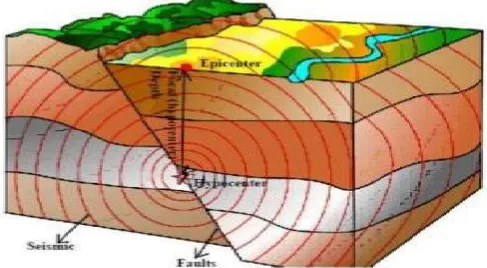
Epicentre:
The geographical point on the surface ofearth vertically above the focus of the earthquake.
Hypocentre or Focus:
The originating earthquake source of the elastic waves inside the earth which causes shaking of ground due to earthquake.Epicentral distance: Distance between epicentre and recording station in km.
Focal depth: The depth of focus from the epicentre is called focal depth. It is an important parameter in determining the damaging potential of an earthquake. Most of the damaging earthquakes have shallow focus with focal depths less than about 70km.
Fault: A fracture in the rocks along which strain is occasionally released as an earthquake. By definition, only active faults are associated with earthquakes.
Figure 1. Terminologies of earthquake
SEISMIC WAVES
During an earthquake there are different types of seismic waves generated, but in general there are two categories-
Body waves –
These waves travel through the earth’s inner layers.Surface waves –
These waves can only travel on the surface of the crust.V.
BODY WAVES
Figure 2. Primary - waves
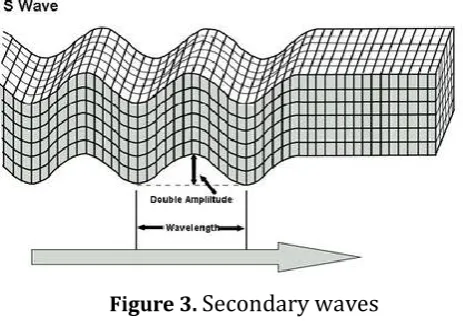
S-waves (Secondary waves) -
These waves are
felt after the P-waves. They move much slower and can only travel through solid rock. The particles in their path are moved side to side, up and down, perpendicular to the wave propagation.Figure 3.
Secondary waves
LOADS AND LOAD COMBINATIONS
The concepts presented in this section provide an overview of building loads and their effect on the structural response of typical R.C.C structures. As shown in Table, building loads can be divided into types based on the orientation of the structural action or forces that they induce: vertical and horizontal (i.e. lateral) loads.
Design loads for the residential building:
Loads are a primary consideration in any building design because they define the nature and magnitude of hazards are external forces that a building must resist to provide a reasonable performance(i.e., safety and serviceability) throughout the structure’s useful life. The anticipated loads are influenced by a building’s intended use (occupancy and function); configuration (size and shape) and location (climate and site conditions).Ultimately, the type and magnitude of design loads affect critical decisions such as material collection, construction details and architectural configuration.Dead Loads:
Dead loads consist of the permanent construction material loads compressing the roof, floor, wall, and foundation systems, including claddings, finishes and fixed equipment. Dead load is the total load of all of the components of the components of the building that generally do not change over time, such as the steel columns, concrete floors, bricks, roofing material etc. In Etabs assignment of dead load is automatically done by giving the property of the member. In load case we have option called self-weight which automatically calculates weights using the properties of material.
Example for calculation of dead load:
Dead load calculation Weight=Volume x Density Self-weight floor finish=0.15*25+1=4.8 kn/m^2
Imposed Loads
Live loads are produced by the use and occupancy of a building. Loads include those from human occupants, furnishings, no fixed equipment, storage, and construction and maintenance activities. As required to adequately define the loading condition, loads are presented in terms of uniform area loads, concentrated loads, and uniform line loads. The uniform and concentrated live loads should not be applied simultaneously a structural evaluation. Concentrated loads should be applied to a small area or surface consistent with the application and should be located or directed to give the maximum load effect possible in endues conditions. For example, the stair load should be applied to the centre of the stair tread between supports.
Floor load = 2.125KN/m2 (as per IS 875 Part 2)
(for residential building including floor finish)
Plate/Element Load = 2KN/m2 (Imposed/live load
on slab)
Wind loads:
is complex to the point that pressures may become too analytically intensive for precise consideration in design.
VI.
MODELLING AND ANALYSIS
DEFINE GEOMETRY:
The Building Plan Grid System and Storey Data form is used to specify horizontal and vertical grid line spacing, storey data, storey elevation and units. They automatically add the structural objects with appropriate properties to the model.
Figure 3.
Building Plan Grid System and Storey DataVII.
DEFINE MATERIAL PROPERTY
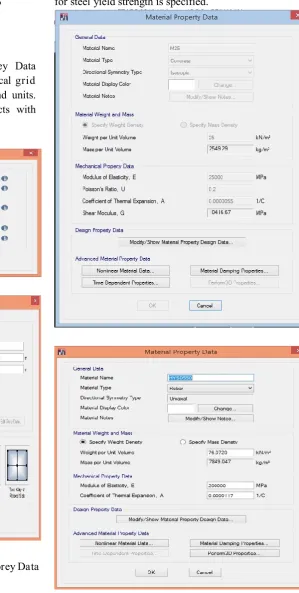
The material properties of each object in the model are
specified in the appropriate form. The material used is concrete, the grade of concrete, the properties of concrete such as Mass per unit volume, Modulus of Elasticity of concrete, Poisson ratio are specified and for steel yield strength is specified.
VIII.
DEFINE FRAME SECTION
Assign the frame section such as Column and Beam. Select the section property as Rectangle and define the depth, width and reinforcement details, cover provisions. Similarly for various sections like circular pipe, steel joist sections also assigned with suitable data.
Figure 5. Section properties and Reinforcement details
IX.
DEFINE WALL OR SLAB SECTION
Assign the slab or wall section then assign thesection name, thickness, material used, type and reinforcement details.
Figure 6. Define slab sections
X.
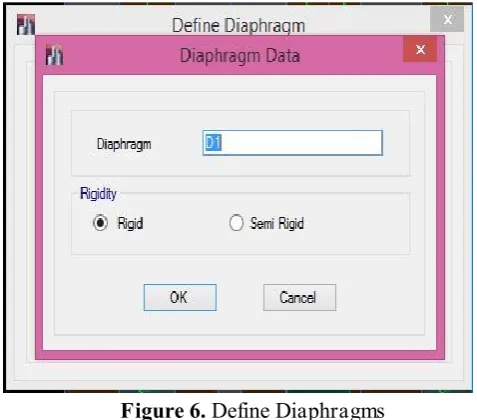
DEFINE DIAPHRAM
The lateral loads can be in the form of wind or seismic loads, the loads are automatically calculated from the dimensions and properties of the structure based on built-in options for a variety of building codes. For Rigid diaphragm systems, the wind loads applied at the geometric centres of each rigid floor diaphragm.
Figure 6. Define Diaphragms
XI.
DEFINE RESPONSE SPECTRUM FUNCTION
Figure 7. Define response spectrum function.
XII.
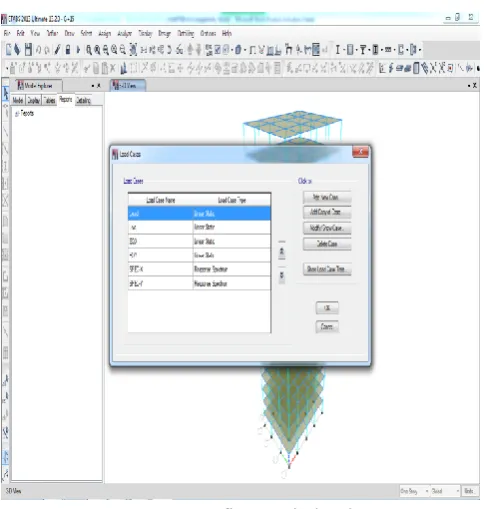
STATIC LOAD CASES
Loads represent the actions upon the structure, such as force, pressure, support displacement, thermal effects and others. A spatial distribution of loads upon the structure is called static load case. Define as many load cases as needed. Typically separate load case definitions would be used for dead load, live load, static earthquake load, wind load, snow load, and Thermal load.
Figure 7. Define static load case
XIII.
MODEL OUTPUT
A) OUTPUT: 3D-MODEL OF A RC FRAME
Figure 8.
3D model of RC frame
C) SHEAR FORCE FROM ANALYSIS
D) DISPLACEMENTS
XIV.
CONCLUSIONS
This paper presents a review of the comparison of static and dynamic analysis multi-storeyed building. Design parameters such as Displacement, Bending moment, Base shear, Storey drift, Torsion, Axial Force were the focus of the study. It was found that,
The difference of values of displacement between static and dynamic analysis is insignificant for lower stories but the difference is increased in higher stories and static analysis gives higher values than dynamic analysis.
Static analysis is not sufficient for high rise buildings and it’s necessary to provide dynamic analysis.
Building with re-entrant corners experienced more lateral drift and reduction in base shear capacity compared to regular building.
Base shear value is more in the zone 5 and that in the soft soil in irregular configuration.
The results of equivalent static analysis are approximately uneconomical because values of displacement are higher than dynamic analysis.
XV.
REFERENCES
[1]. Balaji.U and Selvarasan M.E "Design And Analysis of Multi Storied Building Under Static And DynamicLoading Condition Using ETABS." International Journal of Technical Research and Applications Volume 4,Issue 4. (July-Aug, 2016) [2]. Anirudh Gottala, Dr.shaik Yajdhani "Comparative
Study of Static and Dynamic seismic Analysis of Multistoried Building." IJSTE - International Journal of Science Technology & Engineering | Volume 2 | Issue01 | July 2015.
[3]. Mahesh N. Patil, Yogesh N. Sonawane "Seismic Analysis of Multistoried Building", International Journal of Engineering and Innovative Technology (IJEIT), Volume 4, Issue 9, March 2015.
[4]. Mohammed Rizwan Sultan, D. Gouse Peera "Dynamic Analysis Of Multi-storey building for different shapes", International Journal of Innovative Research in Advanced Engineering (IJIRAE), Issue 8, Volume 2 (August 2015). [5]. Mohit Sharma, Dr. Savita Maru "Dynamic
Analysis of Multistoried Regular Building." IOSR Journal of Mechanical and Civil Engineering (IOSR-JMCE) e-ISSN: 2278-1684,p-ISSN: 2320-334X, Volume 11, Issue 1 Ver. II (Jan. 2014). [6]. Mr. S.Mahesh, Mr. Dr.B.Panduranga Rao
"Comparison of analysis and design of regular and irregular configuration of multi Story building in various seismic zones and various types of soils using ETABS and STAAD",Journal of Mechanical and Civil Engineering (IOSR-JMCE), Volume 11, Issue 6 (Nov- Dec. 2014).