Improving Developmental Screening Documentation
and Referral Completion
abstract
BACKGROUND AND OBJECTIVES: Screening, early identification, and referral improves outcomes for young children at risk for developmen-tal delays. Effective developmendevelopmen-tal screening processes should include efforts to ensure referral completion and documentation of evaluation results and service eligibility in the child’s medical record. Our objec-tives were to improve provider documentation of actions taken after an abnormal developmental screening result and increase Early In-tervention (State Part C) referrals.
METHODS:Various strategies including an electronic medical record template, monthly clinical informatics reporting, and a phone follow-up after an abnormal screening result were implemented to enhance provider documentation of screening results and improve referral actions and outcomes.
RESULTS:Of the children eligible for screening (n= 3023), 2610 (86%) were screened, with 382 (15%) scoring in the abnormal range. With phone follow-up, 50% of the abnormal screenings were referred to community resources, including 43% to Early Intervention (EI), in contrast to 20% community referrals and 13% EI referrals with the screening template only (P , .0001). Provider documentation of EI outcomes increased when screening templates and follow-up calls were implemented together (31%) as compared with using the screening template alone (15%).
CONCLUSIONS:Enhanced documentation of developmental screening efforts using screening templates and clinical informatics reporting in combination with phone follow-up after an abnormal screening result improved developmental screening outcomes, including referral rates, completed evaluations, and provider documentation of EI services. Such strategies can be effectively used in pediatric primary care settings to improve screening processes and ensure that young children access appropriate services. Pediatrics 2014;134:e1181– e1188
AUTHORS:Ayelet Talmi, PhD,a,b,cMaya Bunik, MD, MSPH,b,c
Ryan Asherin, MA,aMichael Rannie, RN, MS,dTyler
Watlington, MD,bBrenda Beaty, MSPH,eand Stephen
Berman, MDb
aDepartments of Psychiatry, andbPediatrics, University of
Colorado, School of Medicine, Aurora, Colorado;cChildren’s
Outcomes Research, anddClinical Informatics, Children’s Hospital
Colorado, Aurora, Colorado; andePreventative Medicine and
Biometrics, Colorado Health Outcomes Program, University of Colorado Denver, Aurora, Colorado
KEY WORDS
developmental assessment, quality improvement, early intervention, pediatric, primary health care
ABBREVIATIONS
EI—early intervention EMR—electronic medical record RSU—referral status update
Dr Talmi conceptualized and designed the study, supervised intervention implementation, directed data collection, analysis, and preparation, drafted the initial manuscript, and reviewed and revised the manuscript; Dr Bunik helped conceptualize the study, oversaw developmental screening implementation, and drafted the results section of the initial manuscript; Mr Asherin developed the database management strategy used to integrate study data, managed data collection efforts, compiled and prepared data tables for the manuscript, and reviewed and revised the manuscript; Mr Rannie developed and implemented the clinical informatics reporting mechanisms used to gather data from electronic medical records, programmed informatics reports, and compiled data for analysis; Dr Watlington participated in study conceptualization and developed and implemented the provider templates (data collection tools) used to gather data; Ms Beaty prepared and analyzed the data and drafted sections of the manuscript; Dr Berman participated in study conceptualization, provided ongoing feedback during study implementation and data analysis, and critically reviewed the manuscript; and all authors approved thefinal manuscript as submitted.
www.pediatrics.org/cgi/doi/10.1542/peds.2012-1151
doi:10.1542/peds.2012-1151
Accepted for publication May 7, 2014
Address correspondence to Ayelet Talmi, PhD, Associate Professor, Departments of Psychiatry and Pediatrics, University of Colorado School of Medicine, Children’s Hospital Colorado, 13123 E 16th Ave, B130, Aurora, CO 80045. E-mail: [email protected]
(Continued on last page)
to improve long-term outcomes. In 2006, the American Academy of Pediatrics issued a policy statement recommending routine developmental screening using an empirically validated tool at 3 visits before age 3 years.5A variety of screening tools are used at well-child visits,6 al-though identification rates differ by tool.7 Standardized screening tools improve pediatric primary care providers’ability to identify children at risk for develop-mental delay and increase referrals to community services.8,9
Although rates of developmental screen-ing increased considerably between 2002 and 2009, more than half of pediatric primary care providers report not using standardized developmental screening instruments in their practice.10Between 28% and 61% of children who have ab-normal screens actually get referred for a more comprehensive evaluation.11,12 Thus, many children who have develop-mental delays do not receive services until their delays manifest more pro-foundly or when they experience
signi-ficant disruptions in functional abilities.13 In August of 2007, our clinic transitioned from using a developmental milestone checklist embedded in well-child visit templates to implementing universal developmental screening with a stan-dardized screening tool, the Ages & Stages Questionnaires®, Third Edition.14,15 We attributed implementation successes to a launch that included intensive provider and staff training, onsite sup-port from integrated developmental specialists, and an awareness building campaign incentivizing personnel for distributing, scoring, and documenting developmental screening efforts. Within 2 months of implementation, our ing rate surpassed 80%. These screen-ing practices had changed one year before initiating the quality improve-ment effort described below.
fi
referral completion were considerably lower, even with ongoing training efforts and availability of onsite developmental specialists. We uncovered numerous chal-lenges to our clinic’s screening processes. Screening processes include identifying children at risk for developmental delay, referring these children for evaluation, and documenting service eligibility. We designed and implemented the quality improvement efforts described below to improve screening processes, including systematic documentation by providers of screening results and actions taken after abnormal screening results.
The goals of our quality improvement efforts were to (1) improve provider documentation of screening and referral efforts; (2) identify actions taken after abnormal screening results; (3) design an intervention to improve referral out-comes, including referral to Early In-tervention (EI, the State Part C Program), referral completion, and documentation of referral outcomes; (4) evaluate the impact of the intervention by comparing referral outcomes throughout the in-tervention period; and (5) develop rec-ommendations for practice change based on ourfindings.
METHODS
Setting
The intervention was implemented in a large urban children’s hospital teach-ing clinic servteach-ing children at high risk and their families. The clinic is a primary training site for 42 general pediatric residents, 20 family medicine residents, 24 physician assistant students, and
∼60 medical students. The clinic pro-vides ∼22 000 primary care visits an-nually and uses an electronic medical record (EMR) to document care. More than 80% of children seen are publicly insured. This population has difficulty accessing community resources, and
The clinic houses an integrated mental health services program staffed by child psychologists, psychiatrists, mental health clinicians, and mental health trainees. The program provides direct clinical services and conducts training and education for pediatric health professionals.
Developmental screening is conducted at all well-child visits between age 6 months and 5 years using the Ages & Stages Questionnaires®, Third Edition. When a child scores in the abnormal range in 1 or more domains, the screen-ing results are considered abnormal. For this project, we examined screening pro-cesses during well-child visits between age 6 months and 3 years. We divided the intervention into 3 segments: (1) Screen-ing Template Baseline (baseline), (2) Phone Follow-up plus Screening Template (phone follow-up), and (3) Screening Template Post (post). Each segment in-cluded an independent group of children, with thefirst screening-eligible well-child visit occurring during different date ranges; baseline fell between October 1, 2008 and February 27, 2009, phone follow-up between March 1, 2009 and March 31, 2010, and post between April 1, 2010 and December 31, 2010.
Confidential patient information was used to provide services in the context of routine clinical care. Analyses were conducted on de-identified data. The project was approved by the Institu-tional Review Board at the University of Colorado.
Planning the Quality Improvement Intervention
and referral efforts including actions taken by providers for abnormal screen-ing results. Providers were trained to use the template and an electronic referral form for EI services. The template also allowed us to extract bimonthly reports on screening outcomes, including (1) results of the screen abnormal (yes/no), (2) referral made (yes/no), and (3) 2-month follow-up visit scheduled (yes/ no). Screening and referral outcomes and additional data obtained through chart reviews were tracked in a Micro-soft Access database. Research assis-tants reviewed charts and documented reasons for no referral or type of re-ferral made after an abnormal screen-ing result (Step 2).
Data tracking revealed that although the screening templates improved docu-mentation, information about referral outcomes was rarely documented in the medical record. In our clinic, pediatric providers were predominantly using passive monitoring, documenting eval-uation and eligibility for services if and when families returned to clinic and reported outcomes to providers. When they returned for a follow-up visit, fam-ilies frequently reported a breakdown between the referral from primary care and uptake of EI services, indicating no connection with the EI system, despite having been referred.
We revamped our provider education efforts to distinguish between“wait and see”and“watchful wait”approaches af-ter discovering that the most common reason for no referral was“follow-up at next visit.”With a“watchful wait”approach, providers were trained to schedule a follow-up visit before the next well-child visit to reassess developmental prog-ress and refer when indicated.
In reviewing the bimonthly data re-ports, we determined that educating providers would not adequately im-prove rates of referrals, particularly in cases in which families were seeing different providers at subsequent clinic
visits. As a result, our team developed the phone follow-up intervention to facil-itate appropriate referral after abnormal screening results and enhance provider documentation of referral outcomes.
Phone Follow-up
In March 2009, psychology fellows, who were providing integrated behavioral health services in our clinic and were trained in early childhood development, began reviewing charts and identifying children who had abnormal screening results and ambiguous documentation of referral outcomes (Step 3). Fellows initiated follow-up phone calls to families of children who had abnormal screening results and no referral or when the ac-tions taken after an abnormal screening result were ambiguous (eg, informatics report indicated an EI referral was made but no documentation existed or the action taken by the provider did not in-clude a referral). The purpose of the call was to discuss screening results, de-termine whether an EI referral had been made, and, if indicated, refer to early intervention services. Fellows conducted phone follow-ups between March 2009 and March 2010. The Supplemental Ap-pendix includes an EMR template that fellows used to document their follow-up calls. Fellows stopped making follow-up calls in April 2010 to allow us to study whether phone follow-up calls were im-proving referral outcomes enough to justify ongoing allocation of fellow time toward this effort.
Data Collection
Developmental screening template base-line data were collected between October 2008 and February 2009. Charts were abstracted in the manner described above. Data collection using the de-velopmental screening template con-tinued during and after the phone follow-up segment ended (April 2010 through December 2010). The Supple-mental Appendix depicts the workflow
and number of participants during each segment and details the phone follow-up procedures.
Planning the Study of the Intervention
We developed a tracking system in Microsoft Access to import bimonthly informatics reports with developmental screening template data and to conduct additional medical record abstractions. Research assistants reviewed charts to determine whether appropriate refer-rals had been made and recorded the actions taken by providers. Charts re-quiring additional referral actions were imported into a second Microsoft Access database used by the fellows to docu-ment whether an intervention phone follow-up was necessary.
Administrative database reviews moni-tored whether phone follow-up was be-ing conducted within one month after initial abnormal screening. Phone follow-up was completed for 74.67% of families eligible for calls (n = 45). The inter-vention was delivered during a single phone call. Multiple phone call attempts were made (median = 2) if families were not home or unavailable when the initial phone call was placed. Those families who were not reached by phone were mailed a letter with information about referral for EI.
practices in our clinic. We selected phone follow-up as a strategy to improve referral outcomes because it is routinely used in pediatric primary care as a mechanism for care coordination, communication, and resulting of referrals.
Methods of Evaluation
Research assistants reviewed charts for provider documentation of develop-mental screening processes, including actions taken on abnormal screening results, referrals, and eligibility for EI services (Step 4). Chart reviews for re-ferral results occurred between 2 and 8 months after the initial referral was made to allow adequate time for future clinic visits and documentation of re-ferral results.
Analysis
Comparisons between baseline, phone follow-up, and post segments were made by using Mantel-Haenszelx2tests and Fisher’s exact tests. Demographic variables included age, gender, ethnicity, language, andfinancial/insurance type. Outcome variables included screening rates, action taken by pediatric provider
referral.
RESULTS
Population Characteristics
The sample had slightly more males than females (Table 1). Approximately 53% of the sample identified as Hispanic/ Latino, and 26% of families reported Spanish as their primary language. The population was primarily publicly in-sured (79%). Older children were more likely to be screened (P,.0001). Chil-dren who were male, older, and
identi-fied as Hispanic or Latino were more likely to have an abnormal screening result (data not shown in Table 1). There were no demographic differences in children who were identified as having an abnormal screen across segments of the intervention.
Developmental Screening Rates
During the quality improvement inter-vention period, 2610 of the 3023 (86%) children eligible for screening had doc-umentation of screening in the EMR. Screening rates were lower during baseline (71%,n= 682/955) than during
, “ ”
thefirst well-child visit with a completed developmental screener. Overall, 15% (n= 100/682) of children scored in ab-normal range during baseline, whereas rates were 14% (n = 106/753) during phone follow-up and 15% (n= 176/1175) during post.
Action Taken on Abnormal Screens
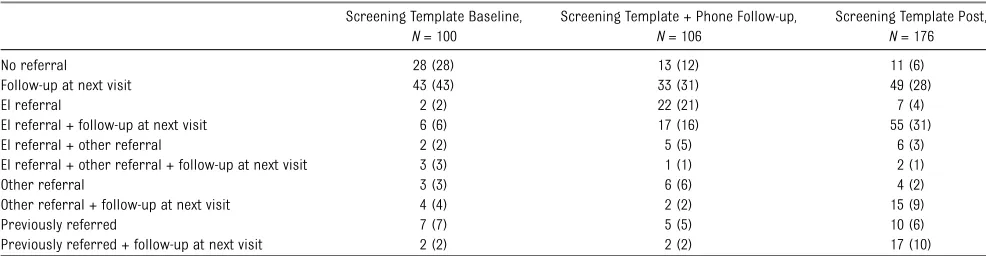
Before implementation of phone follow-ups (baseline), 20% (n = 20/100) of children who had abnormal screening results were referred to community resources. With phone follow-up, refer-rals increased to 50% (n= 53/106) and maintained at 51% (n= 89/176) during post (P , .0001). Table 2 shows the actions taken by primary care providers when screening results were abnormal. During baseline, 28% of providers did not make any referral and 43% recom-mended following up at the next visit. In contrast, far fewer providers made no referrals during phone follow-up (12%) and post (6%), and fewer, 31% and 28%, respectively, recommended following up at the next visit. Referrals to EI in-creased from 13% at baseline to 43% with phone follow-up and 39% post.
TABLE 1 Demographics for Total Clinic Population of Children Eligible for Screening at Well-Child Visits and Comparison of QII Population by Screening Period
Characteristic Total,N= 2610; 86% Screening Template Baseline,N= 100; 26%
Screening Template + Phone Follow-up,N= 106; 28%
Screening Template Post,N= 176; 46%
Pvalue
Gender
Male 51 (1314) 69 (69) 62 (66) 54 (92) .04
Female 49 (1256) 31 (31) 38 (40) 46 (79)
Ethnicity
Not Hispanic or Latino 47 (1191) 43 (42) 37 (38) 41 (70) .71
Hispanic or Latino 53 (1339) 57 (56) 63 (64) 59 (101)
Age group
,12 mo 42 (1109) 29 (29) 36 (38) 38 (66) .15
12 to,24 mo 33 (868) 45 (45) 31 (33) 40 (70)
24 to,36 mo 24 (633) 26 (26) 33 (35) 23 (40)
Language
English 70 (1807) 71 (71) 68 (72) 67 (114) .19 (Fisher’s exact)
Spanish 26 (657) 27 (27) 25 (26) 31 (53)
Other 4 (102) 2 (2) 8 (8) 2 (4)
Financial/insurance type
Medicaid 79 (2068) 74 (74) 84 (89) 82 (144) .16
Other 21 (542) 26 (26) 16 (17) 18 (32)
EI Referrals
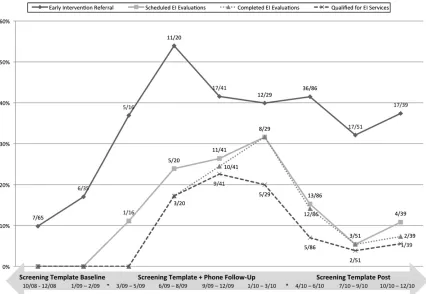
Figure 1 shows increased documenta-tion of EI referrals with phone follow-up (42%,n= 45/106) and post (40%,n= 70/176) when compared with baseline (13%, n= 13/100; P,.0001). During baseline, no EMRs had documentation (n= 0/13) of completed EI evaluations, whereas 38% (n= 17/45;P,.01) of the phone follow-up and 19% (n = 13/70;
P , .05) post had documentation of evaluation completion. With phone follow-up, 31% (n= 14/45) of primary care providers documented EI referral disposition, whereas only 15% (n= 2/13) did so at baseline. Rates of provider documentation of referral disposition were maintained after phone follow-up had stopped (31%,n = 22/70). Docu-mentation of children who qualified for EI services was higher during phone follow-up (31%,n= 14/45) than base-line (0%, n = 1/13; P , .05) or post (13%,n= 9/70;P,.05).
During the intervention period, we met regularly with representatives from the State Part C Program to improve com-munication of referral outcomes to primary care providers. Although the State Part C Program had been sending Referral Status Update (RSU) forms with information about referrals, the forms were not being returned to providers. Process changes included listing a single provider’s name and fax number as the point of contact for the
entire clinic and having our team pro-cess the RSUs for scanning into the EMR. As a result, documentation of RSU forms in the EMR increased from 23% (n= 3/13) during baseline to 60% (n= 27/45) with phone follow-up and 79% (n= 55/70) post (overallP,.0005; data not shown). However, as seen in Fig 1, providers rarely documented the status of EI referrals, suggesting that they likely did not know about referral out-comes even when the information was stored in the EMR.
DISCUSSION
This article describes a quality improve-ment intervention targeting provider documentation of screening processes and referral outcomes. Initiation of a de-velopmental screening template in the EMR in combination with a phone follow-up increased referrals to the State Part C Program and improved provider docu-mentation of completed EI referrals and evaluations. The intervention involved the development and implementation of a screening template, use of clinical in-formatics reports to collect and analyze EMR data, medical record abstraction, and telephone follow-up by postdoctoral psychology fellows. When providers were documenting using a developmental screening template, children who had abnormal screening results were less likely to be referred to EI services and had less documentation regarding referral
outcomes (eg, evaluation completion, el-igibility for services) in their EMRs than when providers used the screening tem-plate and families also received phone follow-up after an abnormal screening result.
Thefindings suggest that young children at risk for developmental delay may remain unidentified, or when identified, may not be referred for evaluation even with enhanced documentation strate-gies and extensive training and educa-tion efforts. Identifying developmental delays is necessary but not sufficient to ensure that appropriate referrals are made, services are obtained, and pri-mary care providers know the outcomes of referrals. During the screening tem-plate baseline, nearly a third of providers did not take any action based on ab-normal screening results and the most common action taken was to recom-mend a follow-up visit (43%). With phone follow-up and ongoing use of the de-velopmental screening template, pro-viders were less likely to use the“wait and see”approach and were more likely to make appropriate referrals. On the whole, providers were also more likely to document referral disposition during the phone follow-up segment than dur-ing baseline and post. Unfortunately, documentation of EI outcomes was missing from most charts during base-line and post, suggesting that screening templates embedded in the EMR did not
TABLE 2 Action Taken on Abnormal Screening Results (n= 382)
Screening Template Baseline,
N= 100
Screening Template + Phone Follow-up,
N= 106
Screening Template Post,
N= 176
No referral 28 (28) 13 (12) 11 (6)
Follow-up at next visit 43 (43) 33 (31) 49 (28)
EI referral 2 (2) 22 (21) 7 (4)
EI referral + follow-up at next visit 6 (6) 17 (16) 55 (31)
EI referral + other referral 2 (2) 5 (5) 6 (3)
EI referral + other referral + follow-up at next visit 3 (3) 1 (1) 2 (1)
Other referral 3 (3) 6 (6) 4 (2)
Other referral + follow-up at next visit 4 (4) 2 (2) 15 (9)
Previously referred 7 (7) 5 (5) 10 (6)
Previously referred + follow-up at next visit 2 (2) 2 (2) 17 (10)
All data are presented asN(%). Follow-up indicates that the provider recommended a follow-up review developmental status and, if relevant, referral outcomes. Other referral is a non-EI referral. Overall and between-group comparisons were all found to be significant: overall,P,.0001; baseline versus phone follow-up,P,.001; baseline versus post,P,.0001; phone follow-up versus post,P,.0001.
sufficiently alter provider practice around resulting referrals after abnormal de-velopment screening. Even with en-hanced EMR templates, providers were rarely following up with families and documenting the results of referrals for community-based EI services.
Without early identification and entry into a comprehensive and coordinated service system that includes a medical home, infants and young children who have special health care and develop-mental needs and their families are at significant risk for poor health and de-velopmental outcomes.16–18Importantly, in the context of a medical home, pedi-atric providers need to know about, discuss with families, and document the child’s involvement with community services. Ourfindings suggest that on-going efforts may be required to pro-mote pediatric providers’gathering and documenting developmental screening referral outcomes.
Lessons learned from this project in-cluded the utility of creating functional templates in the EMR that were provider-friendly for clinical documentation and enabled automated data collection and reporting. Even with such strategies, we had to manually review records to ex-tract information embedded within clin-ical documentation (eg, actions taken on abnormal screening results). Peri-odic chart reviews also yielded infor-mation about provider inconsistencies in using standardized EMR templates. Based on these reviews, we initiated quality improvement efforts to increase documentation compliance. The cur-rent project used postdoctoral fellows to conduct phone follow-up, which re-quired allocating fellow time toward this effort and away from direct clinical service. In reviewing our results, we determined that fellow time was better spent providing direct care, as phone calls could be more efficiently and
sus-tainably made by office staff who were responsible for care coordination and referrals. Strategies such as having all referral communication funneled through a single point of contact in the practice and using EMR features like best practice alerts would enhance tracking and im-prove documentation of referral out-comes in the medical record.
tracking systems in collaboration with Colorado’s Assuring Better Child Health and Development program.
Thefindings were limited by a few fac-tors. First, the intervention was con-ducted in a busy residency training clinic where provider experience with de-velopmental screening processes and local resources varied greatly. Although screening rates (86% screened) suggest excellent adherence to screening pro-tocols, trainee turnover and resident scheduling may have resulted in lack of continuity of care that impeded follow-up with families and, consequently, in-terfered with resulting of referrals and documenting referral outcomes. The Individuals with Disabilities Education Act19,20laws allow for a 45-day evalua-tion process during which service eligibility is determined. Even with a 2-month follow-up window, many families do not return to clinic with completed evaluations and eligibility determi-nations within the allotted time frame. Additionally, our data were limited to information documented or abstracted from our EMR. Finally, the intervention required resources including dedicated time for clinical informatics specialists, research assistants, and clinical per-sonnel to conduct the intervention and gather, track, and analyze data. Com-munity pediatric settings interested in replicating this approach would need to
dedicate staff and resources toward these efforts.
CONCLUSIONS
Even in a clinic with high rates of de-velopmental screening, we found that screening, identification, referral, and the use of a developmental screening template in the EMR did not adequately facilitate access to EI services for chil-dren at risk for developmental delays. Successful developmental screening processes require resulting referrals and documenting outcomes in medical records. Primary care providers’ know-ledge and documentation of referral outcomes enables providers to “close the loop,”thereby ensuring that young children receive necessary services and supports and that information about such services is provided to the child’s medical home.21Implementing a develop-mental screening template in combi-nation with phone follow-up yielded higher rates of referral and completed EI evaluations and greater documen-tation of referral outcomes in the patient’s medical record than use of the screening template alone.
Ideally, pediatric primary care providers who are screening and referring to EI services will also have procedures that allow them to monitor and document outcomes of developmental referrals.
Ongoing efforts to improve the develop-mental screening process include iden-tifying personnel to assist with gathering referral outcomes and re-referring as needed. Training and consultation around developmental screening has recently focused on helping providers systemati-cally document reasons for not referring and implement“watchful waits”instead of“wait and see”approaches. Lastly, we continue to work at the systems level to improve communication between pri-mary care providers and community referral sources. Developing processes that enhance information exchange, use technology and existing reporting mechanisms (eg, immunization regis-tries), and decrease the burden on fam-ilies and primary care providers will strengthen medical homes and facilitate comprehensive, coordinated services for young children.
ACKNOWLEDGMENTS
This project was completed with in-kind support from the following organiza-tions: The Irving Harris Program in Child Development and Infant Mental Health, Children’s Hospital Colorado, Children’s Outcomes Research Program, and Col-orado Health Outcomes Program.
We are grateful to the providers, staff, and families in the Child Health Clinic at Children’s Hospital Colorado for their contributions and ongoing support.
REFERENCES
1. Spittle AJ, Anderson PJ, Lee KJ, et al. Preventive care at home for very preterm infants impro-ves infant and caregiver outcomes at 2 years.
Pediatrics. 2010;126(1). Available at: www. pediatrics.org/cgi/content/full/126/1/e171 2. King TM, Glascoe FP. Developmental
sur-veillance of infants and young children in pediatric primary care.Curr Opin Pediatr. 2003;15(6):624–629
3. Reynolds AJ, Temple JA, Robertson DL, Mann EA. Long-term effects of an early childhood and juvenile arrest: A 15-year follow-up of low-income children in public schools.JAMA. 2001;285(18):2339–2346
4. Schor E. EPSDT, well-child care and child-ren’s development. Paper presented at the ABCD Screening Academy learning session; July, 2007; Houston, TX
5. Council on Children With Disabilities; Sec-tion on Developmental Behavioral Pediat-rics; Bright Futures Steering Committee; Medical Home Initiatives for Children With Special Needs Project Advisory Committee. Identifying infants and young children with developmental disorders in the medical home: an algorithm for developmental sur-veillance and screening. Pediatrics. 2006; 118(1):405–420
6. Drotar D, Stancin T, Dworkin PH, Sices L, Wood S. Selecting developmental surveil-lance and screening tools. Pediatr Rev. 2008;29(10):e52–e58
7. Sices L, Stancin T, Kirchner L, Bauchner H. PEDS and ASQ developmental screen-ing tests may not identify the same chil-dren.Pediatrics. 2009;124(4). Available at: www.pediatrics.org/cgi/content/full/124/ 4/e640
8. Guevara JP, Gerdes M, Localio R, et al. Ef-fectiveness of developmental screening in an urban setting. Pediatrics. 2013;131(1): 30–37
care settings: more evidence of feasibility and effectiveness. Pediatrics. 2009;123(2): 660–668
10. Radecki L, Sand-Loud N, O’Connor KG, Sharp S, Olson LM. Trends in the use of stan-dardized tools for developmental screening in early childhood: 2002-2009. Pediatrics. 2011;128(1):14–19
11. Halfon N, Stevens GD, Larson K, Olson LM. Duration of a well-child visit: association with content, family-centeredness, and sat-isfaction.Pediatrics. 2011;128(4):657–664 12. King TM, Tandon SD, Macias MM, et al.
Implementing developmental screening and referrals: lessons learned from a
na-Prevalence of developmental delays and participation in early intervention services for young children.Pediatrics. 2008;121(6). Available at: www.pediatrics.org/cgi/content/ full/121/6/e1503
14. Squires J. Ages & Stages Questionnaires: A Parent-Completed Child-Monitoring System. Baltimore: Brookes Publishing Co; 2009 15. Squires J, Twombly E, Bricker D, Potter L.
ASQ-3 User’s Guide, 3rd ed. Baltimore: Brookes Publishing Co; 2009
16. Peterson BS, Vohr B, Staib LH, et al. Re-gional brain volume abnormalities and long-term cognitive outcome in preterm infants.JAMA. 2000;284(15):1939–1947
mental retardation. Ment Retard Dev Dis-abil Res Rev. 1999;5(1):1–10
18. Wang ML, Dorer DJ, Fleming MP, Catlin EA. Clinical outcomes of near-term infants.
Pediatrics. 2004;114(2):372–376
19. Individuals with Disabilities Education Act of 1997, P.L. 105–117
20. Individuals with Disabilities Education Act of 2004, P.L. 108–446
21. Stille C, Turchi RM, Antonelli R, et al; Aca-demic Pediatric Association Task Force on Family-Centered Medical Home. The family-centered medical home: specific consid-erations for child health research and policy.Acad Pediatr. 2010;10(4):211–217
(Continued fromfirst page)
PEDIATRICS (ISSN Numbers: Print, 0031-4005; Online, 1098-4275).
Copyright © 2014 by the American Academy of Pediatrics
FINANCIAL DISCLOSURE:The authors have indicated they have nofinancial relationships relevant to this article to disclose.
FUNDING:All phases of this project were supported with foundation funding from Rose Community Foundation and The Colorado Health Foundation.
DOI: 10.1542/peds.2012-1151 originally published online September 1, 2014;
2014;134;e1181
Pediatrics
Beaty and Stephen Berman
Ayelet Talmi, Maya Bunik, Ryan Asherin, Michael Rannie, Tyler Watlington, Brenda
Improving Developmental Screening Documentation and Referral Completion
Services
Updated Information &
http://pediatrics.aappublications.org/content/134/4/e1181
including high resolution figures, can be found at:
References
http://pediatrics.aappublications.org/content/134/4/e1181#BIBL
This article cites 15 articles, 10 of which you can access for free at:
Subspecialty Collections
sub
http://www.aappublications.org/cgi/collection/quality_improvement_
Quality Improvement following collection(s):
This article, along with others on similar topics, appears in the
Permissions & Licensing
http://www.aappublications.org/site/misc/Permissions.xhtml
in its entirety can be found online at:
Information about reproducing this article in parts (figures, tables) or
Reprints
http://www.aappublications.org/site/misc/reprints.xhtml
DOI: 10.1542/peds.2012-1151 originally published online September 1, 2014;
2014;134;e1181
Pediatrics
http://pediatrics.aappublications.org/content/134/4/e1181
located on the World Wide Web at:
The online version of this article, along with updated information and services, is
http://pediatrics.aappublications.org/content/suppl/2014/08/26/peds.2012-1151.DCSupplemental
Data Supplement at:
by the American Academy of Pediatrics. All rights reserved. Print ISSN: 1073-0397.