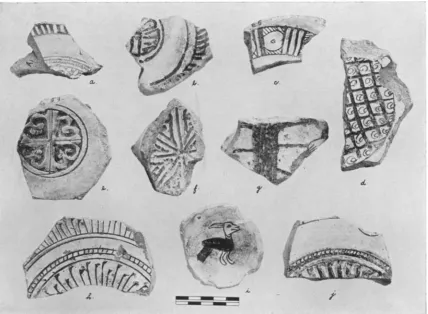
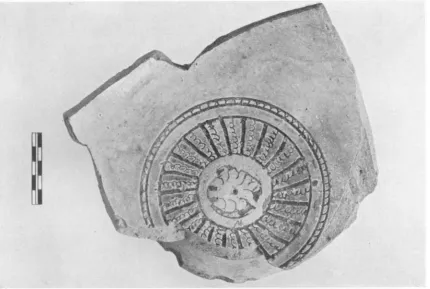
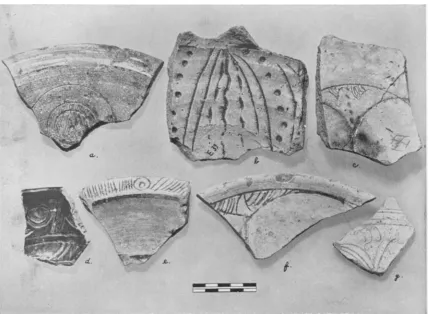
THE ROMAN AND BYZANTINE POTTERY
Plates VIII-X
The material discuissed here includes all the significant pieces of Roman and Byzantine pottery found during the first year of excavation in the Atlhenian Agora. It embraces, more specifically, those wares used in Athens from at least the first century B.C. to the eighteentlh A.D. so far as they are represented among the finds of the year's digging.
A brief introductory section on some iellenistic sherds does no more than emphasize the need of a study of the pottery of thiat period before the origins of the Roman fabrics can be determined. Since only in recent years have the ceramic products of the Christian centuries been given due notice in some reports of excavations in Greek and neighboring lands, little comparative matter is at hand, and as a consequlence of this anid due, also, to the nature of this report the treatment of the material is primarily descriptive.
HELLENISTIC PROGENITORS'
It is a truism to say that the Roman red-glazed pottery, the terra sigillata and the eastern provincial products, cannot be studied adequately and its problems resolved until a history of the Hellenistic wares has been written. So far the lack of closely dated material of that time and the refusal of most students to evince any interest except in the fancier vases lhave combined to prevent the appearance of such a work. The first season of the Agora gave no results of much value for the purpose but it
1 The numbers under which the shapes are disecussed refer to Pis. VIII-X wlhere almiost all the fragments to be described are drawn in profile half size. For the sake of brevity the following abbreviations will be uised in the discussion of the Roman Pottery. The iniitial letter, followed by a number alone refers to the numbered pot-forms of the particular work.
CH: refers to the pots found in Roman graves at the hill Cheliotomylos at Old Corinth. These will
appear shortly in a volume of the Corinth publications dealing with the North Cemetery.
D: Dragendorif, Bonner Jahrb. 96 and 97, 1895, pp. 18 ff. and Pls. 1-111.
E: Osterreich. Arch. Inst., Forschungen in Ephesos I, pp. 167 if.
K III: Mitteilutngen atus dem lKerarneikos 111, 0xe, Terra Sigiliata aus dern Kerameikos, Ath. Mitt. 52, 1927, pp.213if. K V: Karl Kilbler, titteitungen aus dent Kerarneikos V, Spiitantike Stempmelkeramik in Ath. Mitt. 56, 1931.,
pp. 75ff.
0: Kniipowitsch, Materialien ztr r6mnisch-germanischen KerZatik IV, I Die Kferaw7zik r6n ischer Zeit aus Olbia.
Pr: Zahn, Priene (Wiegand and Schrader), pp. 430 ff. Pg: Altertibuer von Pergamon I, 2, pp. 268 ff.
8: Technau, Griechisehe Ker-antik -imt Sanzischen Ileraion, Ath. Mitt. 54, 1929, pp. 48 ff.; Schneider, Sanios in fridchristlicher und byzantinischer Zeit, id., pp. 126 ff.
T: S. Loeselicke, Sigiltata-Thpfereie& in Tschandarli, Ath. Mitt. 37, 1912, pp. 344 ff. and Ph. XXVIII.
American School of Classical Studies at Athens is collaborating with JSTOR to digitize, preserve, and extend access to
Hesperia
2 80 FREDERICK 0. WAAGE
would be only a contilluance of past neglectful omission not to mention what little was brought to light.
Several fourth century and Hellenistic deposits were found but without stratigraphical evidence of successive deposition. A few fragments from these, together with others similar or patenltly Greek from disturbed deposits, illustrating the kind of pottery which was in use in the centuries preceding, the appearance of the Roman wares, will be mentioned briefly here to contrast and compare the shapes and glazes.
With all the digging which has been done in Athens the occasional occurrence of red glaze before Roman times could not have passed unobserved. Apart from mention of misfiring, however, small notice has been taken of thle phenomenon despite the fact that its frequency precludes the possibility of chance having been the cause in most cases. Even in the sixth century Athenian potters were producing red-glazed ware as is shown by several sherds, apparently from skyphoi of Corinthian shape, from a stratum of that date. As long, however, as black-glazed vases held sway the plain red ware would not greatly be sought after. Whether they continued to be produced throughout the fifth century in small quantity is unknown but at the end of the century and in the early fourth they occur rather frequently. As has been mentioned in describing some of the pottery from the Pnyx excavation, it is the lamps, more closely dated than the pots, which illustrate the fact best.1 As for the pottery, some of the profiles of P1. VIII are quite patently to be dated in the fifth or fourth centutry, the rest are later but none should come after the first century B.C. since they fall into none of the known classes
of Roman pottery and come, for the most part, from deposits predominately, if not exclusively, Hellenistic. All the pieces are assumed to be of Athenian manufacture since it is as yet impossible to distinguish the plain Hellenistic wares of different localities. In addition to this pottery, lamps of Types II, and V to V112 were found partially or wholly colored to the rich red-brown which Attic glaze shows when fired in an oxidizing atmosphere.
THE SHAPES. PLATE VIII, NUMBERS 1 TO 42
1 and 2. This shape seems to have had no Roman descendants. It is fairly common in fifth and fourth century times and is not infrequently red. No. 1, the earlier, has the bottom touched up with miltos and is unpainted except for a single ring; the bottom of No. 2 is completely covered with glaze.
3-9. Compare the stands of Samian vases, 0, 7 a and b. The high form of the fifth century, Nos. 3 and 4. is replaced by the lower in Hellenistic times. The brown color of 3 is not unique although, when red and black occur on the same vase, as
I Notes on Greek and Roman Pottery from the Pnyx; to be published in an early voluime of Hesperia,
Annlual of the American School of Classical Sttudies. Lamps of Broneer's types IV, Vl-VIII were fotund
with the glaze partly or wholly red.
THE ROMAN AND BYZANTlINE POTTER-Y 281 on 4, there is usually no transitional hue. Concerning the resemblance of 9 to our Roman Class I in clay and glaze more will be said presently.
10-18. No. 10 (Fig. 1) is a good fifth century sherd with impressed palmettes and is only partly glazed underneath, but the bottoms of the others in this group are covered with glaze. No. 11 (Fig. 1) has palmettes of later form, 12 concentric rows of fine slanting lines; 13 (Fig. 1), a circle of dots, roughly rouletted, with plain oval depressions supplanting palmettes. The others are plain or have a crude depressed circle (15) or spiral (13) formed on the wheel. The feet of plates suffered little change until Roman times.
19-24. These bear a striking, resemblance to our Roman Class III. The cone inside the bottom occurs on Samian pots but is not common.' Class III is boldly distinguished by the colie and heavy foot and one would like to regard these Hellenistic bases, showing a transition from black to red glaze, as marking the line of descent, but that can hardly be true if these are Attic.
25-27. Compare these heavy bases with those of Classes I alnd III. The glaze of these three fragments is of the splotchy, metallic lustre kind which is described below. 28-35. More Hellenistic feet. Compare 30 with 92. The profiles of 31-35 are rounded, the finish is smooth, the glaze is rich and thick and they are, therefore, of the same date as No. 2; hence the lack of similarity with Roman bases.
36-38. The rim form of 36 is a Hellenistic metallic form and often occurs in black glaze with metallic lustre. Neither it nor the earlier rounded rim lasts into Roman pottery which aped the more angular, metallic forms like 41. Nos. 37 and 38 show a lower foot. Compare Class I, 57--61.
39-41. The first (Fig. 1) has an excellent black glaze and must belong to the fifth century. Even its profile could be called metallic. The glaze of 40 is a thin wash which does not cover all the sherd evenly. No. 41 probably shows a development of this early form since the workmanship, the clay and the good glaze, which is non-porous and is mid-way in color between the early Attic red-brown and the Samian red, mark the sherd as Hellenistic, and it approximates none of the Roman classes. D 3 has a rim like this.
42. Little cups like this with in-curving sides were very popular in Roman pottery but Greek specimens are rare. The glaze is good and it is probably of the fourth century. In Roman times the rim changed its shape, the roll at the very edge indicating rather the copying of metal technique than a development of this simpler form.
43. A late fifth century shape (Fig. 1) which did not survive much later. It is noted here as an excellent example of the early Attic red-glazed pottery. Although the shape is usually found glazed in black, this fragment, of the best workmanship and of
1 If, indeed, the bases of this shape figured in Pr, Abb. 551, p. 433 are Samllian; the identity of profile
282 FREDERICK 0. WAAGE
extremely fine, thin fabric, is covered with a thick, shiny glaze (absorbent) of a uniform rich, red-brown. The shape and the thin fabric are in imitation of metal forms but the fine, even-colored glaze shows that the red color was intentional.
This brief survey of some Greek pottery shapes shows, then, that not all survived into Roman times and those that did underwent a change, usually in the direction of sharper profiles as a result of copying metal forms. But these few examples, which are limited to some of the discoveries in the Agora, are not significant for drawing conclusions. The few indications given by shape are useful but for the most part they are accidental and their chief value lies in proving the early manufacture of red-glazed ware in Athens. The fact that the natural (unfired) color of Attic glaze is red and that this color is retained by baking in an oxidizing atmosphere or is turned black in a reducing atmosphere, has been demonstrated by experiment and is illustrated by the pottery itself.' The quality and the color of the red glaze thus fired vary, naturally, with the composition and the temperature. It may have a glossy metallic sheen totally impervious, or a soft high gloss, very porous (as 43), or it may be intermediate betweell the two or it may be of inferior quality. None of the sherds here described shows the use of miltos as a coloring undercoat.2 In this connection, however, should be mentioned the metallic, varicolored lustre which seems to make its appearance about the same time as these Athenian red-glazed pots. It takes the form of a metallic sheen overlying the black glaze upon which light shines with an oil-on-water effect. On 10 it appears sparely, on the later 11, 19, 20, 25, 27, 29 and 30 more pronouncedly while on 26 it is so prominent as to resemble a glassy coat over the dull, black glaze. It occurs, too, on the foot and inside of 21 (black and dark red glaze) and on 24 (red) but its counterpart on red glaze seems to be a glassy sheen like the Arretine without the lustre. The method of producing, this effect is unknown but it is certain that an accident of firing first caused it. It should be noticed that the lustre is not uniform or unbroken on any of our sherds. On the early No. 10 it appears merely as thin lustre spots on the excellent glossy surface, on the others as a special surfacing which is always broken by matt patches over which it did not form. Later the trick was thoroughly mastered as some Campanian bowls with silver-lustred medallions show.3 Our sherds prove that the effect was often aimed at as do, also, some of the lamps of Type XVII on which it appears prominently. Almost all the plain black ware of Hellenistic times has this lustre to some degree and indeed the predilection for it may have delayed the arrival into favor of red glaze.
l The results of experiments conducted by Binns and Fraser are published by them in A.J. A. 33, 1929, pp. 1 ff. In examining the Greek pottery from the Pnyx it was fouind that the portions of the vase unexposed
to the atmosphere of the oven were the parts most freqtuently red. Similar observations had been made
previously by Zahn, Pr, p. 405, note to No. 32, and others.
2 An uniidercoat of miltos was found on several red-glazed fraginents from the Pnyx.
3 A. J. Butler in lslamic IPottery, although conceined chiefly with mediaeval wares, cites and illtustrates
more ancient examples of lustre in his chapters on Lustre TTTare and its Origin, pp. 37 if. The Campanian
~~~~9 0.
@M 1l.~~
~
13~
~~~~~~~~~~~~~~~~~~~~~~~~~~~~~~~~~~~~~~~~~~
3 __9s.*3. s
S t' y '
~~~~~~~~~~~~~~~~~~~~~~~~~~~~~~~~~~~~~~~~~~~~1-11-11L-1
t_S9~~~~~~~~~~~~~~~~L
--
i
'
284 FREDERICK 0. WAAGE
It has already been observed that the color of the Athenian red glaze approximates that of the Samian, or vice-versa. The hue is red-brown and prior to describing the Samian bases, Nos. 98 and 99, it can be noted that their glaze both in quality and in color is, if anything, more like that of the late fifth and early fourth century Nos. 2 and 43 than that of the Samian ware of the first and second centuries A.D. An interestingy
example of voluntary mottled effect in red and black is No. 44.1 A good metallic lustre covers most of the base, casting a violet hue over the red and a silvery tone over the black (Fig. 1). The coloring of this piece is unique.
Athenian clay as well as glaze undergoes changes beginning perhaps at the end of the fifth century. The finie buff to reddish clay varies in quality and not infrequently it is of a whitish to yellow-buff hue. This may be due to underbaking or to the admixture of another clay. No. 1 is made of the light clay which, in this case, is very soft; so too are other black-glazed pieces, 11, 19, 20, 27. The texture is grainy and on some better-baked sherds where the coloring is reddish, it resembles closely that of Class III. The presence of mica in some pots and lamps of the fourth and third centuries should be noted2 and it may well be that the great production of the fifth century exhausted the old clay beds and forced the use of others of inferior quality. No. 9 is a puzzlino piece; soft, light yellow-buff clay and dark red-brown glaze, non- porous and of poor gloss. In these respects it resembles Class I very closely yet the shape is unusual. The clay is somewhat nearer that of No. 1 than that of Class I and, although it is slightly more coarse-grained, the resemblance is striking. It was found in a Hellenistic deposit free from later intrusions which is to be dated roughly in the third and second centuries.
The series 19-24 is troublesome. Comparing the profiles with Class III one would presuppose a conniection immediately but while the glaze supports this view the clay for the most part does not. But Nos. 19-24 are Hellenistic and probably Athenian while Class III was in use certainly in the late first and in the second centuries A.D. and is
of Asia Minor origin. As noted above, 19 and 20 are black-glazed with a metallic lustre, but in the cases of 21, 22 and 27 the inside of the foot and the bottom are burned red,3
1 Base of a nearly flat dish; fine, red-buff clay, thin and hard-baked. Trhe outside is unglazed but very well smoothed; inside the glaze swirls around the centre in a mottling of black and of a light purple to reddish. The effect is striking if not beautiful but how this two-coloring was obtained is a problem. On some Early Helladic pots a streaked bi-chrome in black and red or orange seems to be brought about by the uneveil application of the glaze-paint (it looks actually as if two colors had been used); on those pots the thin and tlhick streaks are readily discernible but on this piece the black are not noticeably thicker than the reddish. I suspect, however, that that may be the cause, the thinner portions having re-oxidized after the reduction took place while the thicker did not.
2 It occurred nioticeably but in extremely fine particles ill lamps of Type VII (unglazed variety) and
soine contemporaneous pottery from the Pnyx.
THE ROMAN AND BYZANTINE POTTERY 285
and the lustre on the red brings a glassy finish to it as on Classes II (Italian) and III (Tschandarli). The clay, however, is unlike that of Class III. It has the light color of No. 1, burned occasionally to buff or reddish although that does not preclude the possibility of a high-temperature oxidizing oven, as a totally red glaze would necessitate, burning it to like color and hardness. No. 24 (all red) is most like Class III although clay and glaze are not quite so highly fired. Can these indeed be the ancestors of the Class III ware imported from Tschandarli.? At present one can merely point out the resemblances between these Hellenistic and some Roman pots, here so striking, and hope for an ex- planation in the future.
CLASS I. PERGAMENE
This distinctive and wide-spread ware needs no introduction beyond a brief reiteration of its characteristics, a thick, whitish-yellow clay and a dark red glaze, which has only fair lustre but is seldom porous. The occasional occurrence of pots of thin fabric, darker clay and lighter glaze detracts little from the compactness of the group. It has been discovered at Priene, Samos, Athens, Corinth and Olbia and in view of this distribution it must have been found at many other sites but has been neglected or overlooked by the publications.1
The identification of such pots as Pergamene was proposed by Zahn and has been followed by Knipowitsch.2 It is of course tentative alid must await confirmation by filids at Pergamon before final acceptance, but at present there are no reasons for rejecting the hypothesis and there are several for accepting it. In addition to those proposed by Zahn and Knipowitsch, another, perhiaps the most cogent so far, is suggested by the Agora pottery. There are certain pieces so like the pottery found by Loescheke at Tschandarli that one must suppose them to have been imported thence, for reasons presented in the discussion under Class III, and a comparison of these with the Pergamene betrays several points of similarity: a) whlile the clay and glaze of both these classes
1 Pottery belonging to this class whiclh has beeni recorded so far:
CH: 119, 239. E: p. 175, Nos. 65-67.
K: p. 216; No. 2 of Group IV should be incluided as a later specimien of the samne ware. 0: pp. 21 ff., Group C and some of D, pp. 29 ff.; see following inote.
1Pr: p. 437, Nos. 159-162 and pp. 447 ff.; judging from the profiles, it appears that some Pei-gamene pots of darker clay-color are incorrectly listed under Class A, pp. 430 ff., with the Samian.
Pg: So little pottery from Pergamon has been published, and that so suimmarily, that no conclusions
can be drawn from the few illtustrated on pp. 268-270; it shouLld be noted, however, that the most common
shapes of this class in Greece are not among them although that fact, because of the small number of
examples cited, cannot weigh too heavily against the proposed identification of the ware. S: pp. 48 ff.
2 Pr, pp. 447 ff. aiid 0, pp. 21 fi.; but the identity witli Knipowitscli's Pergainiene groulp rests on clay
and glaze rather than shape. The shapes from Olbia are different from those found elsewhere, except 0 12
and 14. Can it be that they represent Pergamene shapes of the second centaLry B.C. (before the ware seems
286 FREDERICK 0. WAAG1
are distinctive in their most characteristic phases there are some fragments which are almost transitional between the two in these respects; b) there is considerable similarity in the shapes of the two classes, particularly in the heavy fabric of the plates; c) in both classes the large plates when stacked in the oven for baking were separated from one another by small round disks of clay which occasionally 'in the Pergamene, always in the Tschandarli, left marks where they were in contact with the glaze on the inside and on the foot of the pot. Similar marking is not reported, nor to my knowledge found, on other Roman pottery. These points of resemblance greatly strengthen the cause for the identification of this ware as Pergamene when it is remembered how near to and in what intimate connection witlh the great city the port of Tschandarli muist have been. The date of the Pergamene pottery is not well fixed. The early fragments from the Kerameikos may belonig to the second century B.C. while the absence of late profiles, our
Nos. 107-109 for instance, suggests the end of the first century A.D. at the latest as a
terminus ante quen. Most of the Agora frag,ments should fall between 100 B.C. and 100 A.D.
45-53. Rims. The large diameters show them to be from plates or large bowls; 51 and 53 belong with the shape of 67. No. 52 is unusual in the softness of the clay but its color and texture and the glaze are very similar to 68 so it should be classed here provisionally if not definitely; the shape is uncommon but it appears in this class in E No. 66 and in the related piece from Tschandarli, T No. 25.
54-61. Bottoms of plates or shallow bowls. This is the most common as well as the most characteristic shape of the class, of which 54 is an excellent example (Fig. 1). The glaze is fairly light, the clay correspondingly buff and the inside is decorated with a double circle of rouletted lines. It is the only base, however, ornamented in any way except 58 which has two narrow grooves. More important in the case of 54 is the fact that there are plainly visible inside and on the foot the marks of the clay disks upon which a like pot was set, and on which this one rested, in the oven. Three otlher bases show similar marks and their occurrence is of great importance in proving a relation with Class III) the only other ware on which they occur. It should be noted that in the bases of heavy fabric, Nos. 54 and 55, the inside of the foot is deep while in those of thinner body, Nos. 57 to 60, it is on the same level as the outside. The chronological difference between these two cannot be determined. The Kerameikos plates are level' while our raised ones are far nearer them in similarity of glaze than the level bases, which show a more careless and thinner application of glaze. At Tschandarli bowls with level bases are dated in the reign of Tiberius2 but the raised Agora bases of thick fabric and of good glaze can be hardly later than the thinner specimens. There should, also, be compared the Arretine base, No. 88, which has a raised centre. The side of No. 61 bends up at a little distance from the foot and so resembles in this respect the shallow bowl bases of Nos. 92-94 (Class III) and the
K, p. 214, Abb. 1; but note that the only a little later No. 8 is slightly raised.
THE ROMAN AND BYZANTINE POTTERY 287 Tschandarli pots just mentioned. A sharp little ridge is left inside the foot of Nos. 59 and 60 (Fig. 1) and this peculiar way of finishing the bottom of a pot seems to be.a typical Pergamene device. It is found on some cups of this class from Corinth (unpublished), on our Nos. 62 (Fig. 1), 66 and 67 below and it is apparently copied in No. 91 of Class III. No. 56 is an uncommon form without an actual foot which seems to be unique.
62-68. Small bowls or cups. Nos. 62-64 are of the thick fabric, Nos. 65-68 of the thinner, althotugh the profiles show that there is no strict line to be drawn between the two, and since the workmanship on both is careful the termns " poor " and " fine " are not applicable. The more important difference is that of shapes which, in general, are but two. One is a small bowl-like cup with a round foot and with sides which rise uniformly to a plain rim. The straightness of the side of 62 is unusual and more often the side curves inward at the bottom as in 62 a. Cups of this shape are usually of a heavier, thicker fabric than those like 67 which illustrate the common early form, of Roman cup found in Samian and Arretine ware, the distinctive feature of which in this class is the high, straight foot. The side may, as in 67, or may not, as in 68, make an angle near the bottom. The fine quality as well as the sharper shape of 67 indicates it to be the earlier of the two. The high foot shows that, if anly influence is to be assumed here, it is Arretine and not Samian, for low feet were the rule even in the earliest Samian vases. Particularly characteristic of the thinner type of vase is the flatness of the base inside the foot, where the oft-occurring little ridge is found which has been mentioned above. One of the two similar pots from Corinth (CDH 119) can be dated in the first century A.D., and all others with similar high feet should not
be later.
The thin ware, particularly the cups, presents, thus, a superficial difference from the thick. They, also, seem to have been fired in a little clearer atmosphere so that the clay burned to a light buff and the glaze to a brighter red, changes which were facilitated by the lighter fabric and the usually thinner application of glaze. The glaze of 67 is glossy and of excellent quality, that of 68 and of the Corinth pots is poorer and more carelessly applied so that finger marks and light, porous patches appear where the clay is barely covered. The bases of plates do not show the color difference so distinctly since 59 has a glaze of a dark hue but the clay is a light salmon-buff, while the clay of 60 is the usual whitish-yellow but the glaze is light like that of the bowls. No. 63 is not glazed inside. It seems to be an exceptional case as it is the only pot or fragment of this class so far observed which is not completely covered by the glaze. Nos. 64-66 show exceptions to the common types. No. 64 appears to be the very high foot of a large cup of thick fabric which has a shape similar to that of 67 or 68. The flat bottom of 65 is unique and 66 combines a side like 67 with a foot like 62 and 63.
288 FREDERICK 0. WAAG1E
CLASS II. ITALIAN
As no great amount of Italian ware came to light this subject can be treated briefly. Except for two small fragments, all were of plain, wheel-made pottery, and several had small applied decorations. A few of the plain sherds showed an unusually light shade of clay-color similar to that of 59 and 64-69. The glaze, too, was a little darker than is customary, for the formation of which under-oxidation must have been responsible. On some pieces accidents of firing caused a slight bluish lustre with an oil-on-water color effect to form. Its feebleness shows that the occurrence was casual, and that it was not a relic of the Hellenistic lustre on black glaze which is mentioned above. It furnishes further evidence as to how readily and unavoidably this sheen was produced in small measure. 70 (755-P 88), 71 (1003-P 164) (Fig. 1). Fragments of moulded bowls showing a goat and the legs of a warrior holding a spear.
72-77. Straight, upright rims of plates (except 73 [1004-P 165], from a cup). The first three have the common applied decorations, a Medusa head, a double scroll (Fig. 1) and probably a wreath.
78-82. Curved rims of plates and bowls. The glaze was applied so thick on No. 78 that it is much crackled. No. 82 is part of the side of the shape of common cup with a rim like 73. It was copied in the Pergamene ware (our 67) but it is more likely that the similar Samian shape was copied by, rather than from, the Arretine.
83. A most interesting piece and a rare Arretine shape. It is a direct development of the shape found on the pre-Arretine pottery of the Pergamene group; compare K III, 5-7. This early form occurs also in the Samian (P 132) and in the Gallic (Oswald and Pryce, Terra Sigillata, P1. xli) where even in the first century A.D. it degenerates into
the later form, a straight sloping edge (Oswald and Pryce, ibid., 2) common in Greece in Samian ware of the second century (our 109 and references there).
84-88. Feet: 84 of a bowl, the others of plates or shallow dishes. The bottom of the plates inside the foot is raised as in the specimens of thick fabric of Class I, Pergamene, 54 and 55. No. 87 (Fig. 1) is one of the few Italian pieces which betray traces of stacking in the oven. On the bottom inside there is a circle marking the spot where the foot of a pot of the same size rested. Tiny bits of clay are imbedded in the glaze.
89 (476-SS 7) (Fig. 1). The stamp of Umbricius is a not uncommon one on Arretine vessels; C.I.L. XI, 6700, 819.
CLASS III. TSCHANDARLI
THE ROMAN AND BYZANTINE POTTERY 2'89 Corinth I saw reason to suggest ani Italian origin for them, but the new specimens from the Agora indicate Asia Minor as a certain provenience. Though the former attribution must be abandoned the considerations which prompted its adoption remain unchanged. The fragments include pieces Iof the bottoms of nine shallow bowls and the bases of six deep bowls. The lack of remains of the upper parts of the pots is strange for the fabric is not delicate. As the profiles show, it is thick, hard, and durable and so is not subject to slhattering. Most of the deep bowl-bases are whole. The workmanship is not very good for, though the inner surface is fairly well smoothed, the- outer is left in a rough state and is often scored by the tool. The clay is hard and rather granulated. It rang,es in color from a salmon-buff, which is a little more reddish and coarser in texture than that of the thin, Class I pots, to a dull, light red hue. A few particles of mica or quartz are occasionally noticeable. Inside, the glaze is of excellent quality and on most it can hardly be distingfuished from the Arretine, although it is just a little redder than Arretine usually is. The glaze outside is seldom as good as that inside, being less glossy and more carelessly applied; and sometimes, it is so poor as to be almost matt and porous. Variations in it and in the clay are best remarked by a description of some of the pieces.
90 (Fig. 1). This is one of the least characteristic of the group and is strongly reminiscent of Class I, Pergamene, in shape and fabric. Tlle clay is more finely grained than usual and has a light reddish-buff color. The glaze is that of this class but here it is a little lighter and is less glossy than most Arretine. On the outside it is even less glossy. A disk mark is visible on the inner surface.
91. This also has Class I resemblances such as the sharp little ridge left by the tool between the body and the foot, within the foot, which has been noted as occurring on Nos. 59, 60, 62, 66 and 67. The clay, too, is a rich, almost reddish salmon-buff, a hue met in lighter shades in Nos. 45, 59 and 64, but this may be due to underfiring, for the glaze is a little lighter than even on No. 90. Outside, as usual, it is thinner and is not so evenly applied. Above and below the foot there are the slightly impressed marks of clay disks used to separate the pots when stacked one upon the other in the oven.
92, 93 (Fig. 1). These two illustrate the characteristic shape of the Class. The clay is finely granulated, sometimes with tiny grains of yellow in it, and is hard-baked. Inside the glaze is thickly and evenly applied and varies a little in shade; outside it is always poorer, sometimes almost matt and with light, barely covered spots. Marks of the clay disks are always present.
290 FREDERICK 0. WAAGIE
95-97. Typical feet for the deep bowls of this class, with a cone of clay shaped inside. Similar examples have been found at Corinth. No. 95 has a perfect Arretine glaze inside and out. The interior is scratched by the tool in a line which makes a spiral from the centre. The glaze of Nos. 96 and 97 (Fig. 1) is almost as good but it is a trifle redde'r, and on the outside it is less carefully applied. The clay is similar to that of the shallow bowls, Nos. 91 and 92. Disks of clay were not used in stacking these pots for baking, for marks of them never appear on these bowl bases, while No. 96 does show that left by the foot of a superimposed pot.
A glance at the text and profiles of Loescheke's description of the pottery from Tschandarli will suffice to show the very great similarity of this group with it.' The shape of the bases of the shallow bowls is that of his 26 b, and like ours " ist die AuBen- seite gegeniiber der Innenseite oft vernachlassigt und nicht selten glanzlos " (p. 374). The shape of the smaller deep bowls is similar to his 19. Perhaps more striking is the presence of the disk marks. 'At Tschandarli not only were there found many sherds so marked, but the clay disks themselves were discovered in great numbers, proving thereby the presence of ovens. These marks do not occur in any other class of Roman pottery which I know except on some Pergamene fragments. Even the excellent glaze is matched, for in speaking, of the later pots Loescheke says (p. 351): " Ihr Ton ist meist dunkelrot und der Uberzug hat gleichfalls hochrote Farbe von lebhaftem Glanz. Hierdurch sehen sie den meisten gallischen und germanischen Sigillaten zum Verwechseln iihlllich." It has already been noted that more often the glaze of the pieces from the Agora is lighter' and redder than the Arretine usually is aind so is more like the Gallic. It is with these later pots from Tschandarli that ours must be correlated. The earlier ones are dated as Tiberian-Claudian on the basis of lamps found with them and the later are placed in the second century (T, p. 401 and 402). The deep' bowls were found in both early and- later strata, but the glaze of ours places them with the later, while amonlg the shallow bowls only No. 90 has a profile more like the earlier 26 a of Loescheke's series than the later 26 b. It is very probable,. however, that some of the Agora sherds belong to the first half of the first century A.D., and that none extends far into the second
century. None shows a glaze as poor as a late second century bowl from Corinth (CH 36). Two pieces from Olbia (22300, p. 47 and 22367, p. 48) indicate that the pots were exported northwards as well as to the west.
So here one has a ware which was made within the Pergamene sphere of influence but which exhibits Arretine characteristics. Certainly Loescheke is correct in emphasizing the strong Italian influence at Tschandarli in early Roman times (T, p. 402). The glaze shows a conscious effort at imitation, but the similarity of clay is a chance and a less frequent occurrence. Fortunately shape and fabric were not imitated closely, too, for then the two wares would be indistinguishable. As it is, some sherds are a problem., for instance CH 104 a from Corinth. In studying that material I classified it as an
THE ROMAN AND BYZANTINE POTTERY 291
example of late Italian manIlufacture and, though it now seems that the other pots of the group there described are not Italian, that sherd must still be regarded as such by reason of its thinness, and so it should be placed with the Arretine.'
But Tschandarli is not far from Pergamon and, if the Pergamene attribution of the ware so called is correct, there should be points of similarity between the two. Such indeed is the case. The shapes betray it well as illustrated in our Nos. 58 and 91, and the thickness of fabric is characteristic of most of the Pergamene and of all the Tschandarli pots. Nos. 90 and 91 are almost intermediary between the two classes, 90 recalling the thinner Pergamene bases and 91 possessing the little ridge inside the foot which is a particular Pergamene method of finishingf the base. Even the clay of 91 is like that of a few Per(gamene sherds, and the clay of all Class III is of the granulated, though usually coarser, consistency of the Pergamene. But the difficulty inherent in an identification based on similarity of clay is well evidenced by the identity in appearance of some of this class with some Arretine, as has already been remarked. The glaze is a more distinct feature but, of all other east-provincial fabrics, the Pergamene glaze most closely resembles Arretine, and therefore this class also, in color, and in hard, impervious quality. But the best evidence of a relation between these two classes is in the use, common to both, of clay disks for supports of vases in the oven. Their employment is limited to these two classes of pottery, the marks left by them on the glaze appearing occasionally on the large Pergamene bases and always on the Tschandarli.2 So this ware, iindubitably connected with the region niear Pergamon by identity with the Tschandarli pottery, gives powerful support to the correctness of the identification of the Pergamnene ware itself by the striking points of likeness between the two.
CLASS IV. SAMIAN
This ware, first identified correctly by Zahn, appears everywhere in Greek lands alnd is well on its way towards justifying its ancient fame in the eyes of scholars who
have hithierto been sceptical in their misunderstanding of the name.3 Unfortunately
Per lhaps the Italian pots with clay similar to tllat of this group weie made at some place otlher than
Aireti um. As inoted above, the clay in quLestion is a dark, brown-red, of graiiulated consistency with
maany yellow incltusions. It oCcurs in some of the later Ronman sberds and Kiibler calls "Egyptian" onle
such piece (K V, p. 84, n. 3). It seems barely possible that a fairly distinctive clay such as this coiild
have been used by potters working in Italy, Asia Minor anid Egypt; at present the problem 'can merely be stated, not resolved.
2 As noted under Class I, the disk marks occur on No. 54 and several other large bases of like shape.
Where tlley are clear enough to be measuLred they are fotund to be the same size on both the Tschanidarli
and Peigamene wares--0.015--17 m. in diameter.
3 T'he following material is known to me:
CHI: 2,12, 51., 207, 208, 216, 226, 227, 234, 235; as in the case of the Pergamene ware, Samian fragments are fairly common at Corinth and incluide some nearly whole pots and signatures, all as yet unptiblished
except a few stamps from the theatre, picttured inA.JA. 33, 1929, p.500, PLVIII, Nos.36-39: AlRPON and
292 FREDERICK 0. WAAGP
even since the identification was made students have not always troubled to appreciate
the fact, and this has delayed progress in the study of the ware. The date of the
earlier pieces is still unknown so its relation to the Arretine cannot be fixed, but two
of the pieces from the Agora are to be placed among the earliest typologically. The
characteristics of this class are a fine, brown (cinnamoni-hued) micaceous clay and a light red (" orange-red ") porous glaze.
98. Piece of the bottom of a plate like S II. The clay is less micaceous than
usual, very thin, very hard-baked and of a reddish rather than a cinnamon hue. The
glaze is darker and is more like the Arretine in its brownness. It seems to be wholly
impervious except inside the foot where water is slightly absorbed. The bottom was
decorated by a rouletted band of slanting lines.
99 (992-SS 111) (Fig. 1). Bottom of a small bowl somewhat like P. 147. Inside are three grooves and in the centre the stamp KAAA. The quality of the piece is hardly less excellent than that of No. 98. It is just a little thicker in fabric and is more characteristically Samian. The clay, although hard-baked, is decidedly micaceous, and the glaze, barely porous, is redder, although in color it is closer to the Athenian red glaze of the early fourth century .C. than it is to the Samian of the first and second A.D.
The stamp, carefully imprinted from a well-cut stone, gives us the name of a new Samian potter, or rather the part of the name, for there are a number of common ones with these initial letters.
On pots such as these the reputation of Samian ware was established. They must be dated in the first century B.c. although how early in it is uncertain. The lack of similarity in profile shows that in this respect at least there was no borrowing, in either direction between it and the Arretine.
The other sherds are later and resemble most closely Samian pots of the first and the second centuries A.D. Only No. 100 has the rich, thick, adherent glaze of earlier times.
KOIPANOY certainly, GEOAOPOY very probably, are the names of Sainian potters but no menitioln is made of the kind of ware or even of the kinid of clay atid glaze.
E: pp. 169 if., Nos. 15-64; almost all these are probably Sarniani.
K III: p. 221, No. 4 -Beil. XXVI, No. 9 (this is called Italian!) and p. 222, IV, No. 1 which is carelessly classed as "JiJungere hellenistisehe (kleinasiatische) Sigillata" along with a Pergamene fragment (No. 2).- Can one wonder at our lack of knowledge of the East Provincial wares when aii authority like Oxe cannot, or neglects to, distinguish Samian even from Italialn?
0: Group B, pp. 12ff. and some of D, pp. 29ff.
Pr: pp. 430 ff. and 440 ff.; the profiles indicate that somne Pergamene pots are incltuded with the Samian of Group A.
S: pp. 49 ff., II-IV. Strictly speaking, all pots of these groups are Samian since they ar-e local pr oducts but lnaturally it was the early ones of II which first made the ware famous; Technau is not correct, however, in intimating that one shape alone established the reputation (p. 50) for, as it is unnecessary to say, there must have been mxiore, our Nos. 98 and 99 for example. Shape is of primne importance only when
considered in relation to the ware in which it occurs.
THE ROMAN AND BYZANTINE POTTERY 293 100. Compare 0 5 of which this may be a later rather than a divergent form. The rim is narrower and curved, and the side is more bowed.
101, 102. The iubiquitous cup rims. No. 101, the earlier, is ornamented with the common applied double scroll. Compare our Hellenistic No. 42 and Arretine No. 82.
103. A simple form of bowl rim. 104. The side of a bowl like 0 9.
105, 10%. Rims of plates like 0 22. This shape wouild be expected rather in the second than in the first half of the first century A.D.
107-111. The first three show the rim form common in the second cent-ury, which occurs usually on flat-bottomed plates like 110 and 111. Compare CH 2 and 0 la; the latter is apparently dated too early. No. I11 has the bottom decorated inside with two sets of triple grooves and it doubtless carried a potter's stamp in the centre.
112-114. Bases of a small bowl or cup, 112, and of shallow open bowls, 113 and 114. After clay and glaze, the most distinctive feature of Samian ware is the very low foot or the complete absence of a foot. The inside of 113 (Fig. 1) is slightly sunk down in two steps, the ledge and disk thus formed being of large diameter in this instance. This is found commonly in later Samian pots, and several other fragYments show the same treatment.' No. 1 14 (Fig. 1) is the latest of this series. The glaze is thinner and is almost matt, and the clay is harder and less micaceous. The two grooves in the centre may be a reminiscence of the earlier method of interior decoration seen in No. 113. Similar grooves are found on the local bowls of later Roman times, as No. 277. This fragment may well belong to the late second century.
CLASS V. LATER ROMAN WARES
After the second century the wares of earlier times cease to appear and others, somewhat less characteristic, take their place. These form the great bulk of the Roman pottery from the Agora. They have here been grouped under the subdlivisions of a single class-heading, not by any means to belittle the real differences between them but rather to indicate that they do not form such closed groups as the preceding. Four different kinds of ware were distinguishable, the few variant pieces being placed with the group which they most resemble. The first three, A, B and C, represent importations, for the most part from Egypt; the last, D, embraces all the local products and so includes a few early pieces in addition to others which are contemporaneous with and are imitations of A, B and C. Stamped ware forms an important element in B, C and D. It has recently been made the subject of a thorough study by K. Kuibler (KV) who deals however, chiefly with the local products found in the Kerameikos. The stamped pottery
It occurs on the Corinth pot CH 234 and was copied on the local bowl CH 230.
294 FREDERICK 0. WAAGE
of the Agora is of particular importance since imported pieces were even more plentiful than the local ware and so add many more examples to the few found at the Kerameikos. Apart from the stamped ware there is little comparative data for the shapes of this later Roman pottery since it seems to have been neglected previously.'
A
The best sherds of the class are from pots made of extremely fine, pure red clay, which is thini and hard-baked. The clay has been made the factor of selectioln and serves to distinguish the fragments fairly well from all the others. The glaze varies from a good, impervious one of the hue of Arretine, which is rare, to one similar to the Samian but of thiinner texture. On most of the pots it is a thin, porous coating of poor gloss and of a hue which approximiates the Samianl but which is decidedly more pilnk, and is often almost matt. Inside it is usually thicker and more glossy than on the outside, although almost ilnvariably the exterior is completely glazed.
11a--116 (Profile of 115 is like that of 139). Of best workmanship are the flat, plain-rimmed plates like these. The fragmentary one, 115, was found in a bulrned stratum above coins of Gallienus and Salonina (253-268 A.D.). Apparently, then, the second half
of the third century saw a renascence of fine pottery in the east provincial district. The shape is an old Samian one2 and it is tempting to see in this ware a rebirth of the filne Samian pottery, but even though the difference in glaze might be spanned, the clay is quite different in color and is entirely free of mica. The rims and bases of over a dozen similar plates were found. No. 116 is thicker than usual and the tiny foot is placed at the angle of the side.
117. Doubtless the side of a similar plate but slightly curved.
118, 119. These two curved plate-rims are the only examples of this type in the group, all the others being like Nos. 115 and 116.
120. An excellent piece of the same quality as 115 and 116. The glaze, which is darker than usual, is a rich, glossy brown-red on both surfaces. It is slightly porous. Most probably this is the rim of a shallow bowl or plate.
121 (1000-P 161), 122 (1001-P 162) (Fig. 2). Rims of bowls with applied animals. The glaze is light and thin, and is considerably poorer than that of the fragments listed above. They show a fish and a dog, and are similar to fragmelnts which have been found at Corinth.
123 (Fig. 2), 124. Rims of bowls with glaze in color and quiality intermediate between the two preceding and No, 120.
The usual plight of undecorated ware. Kibler gives a list of the publications of stamnped ware, K V, pp. 79 and 80, notes. In the material available for consultation profiles are shown only in Fitzgerald, Beth-Shan Elxcavations, 1921-1923, Vol. 3, Pl. XXXIV and S, p. 127.
TrHE ROMAN AND BYZANTINE POrFlTERY 295 125. Perhaps this is a local imitation. The clay is coarser and is brown rather than red. The glaze is of fair quality.
126 (Fig. 2). The rim of a straight-sided platter, a shape uncommon in Greece.' The clay and the glaze. which is a little browner than usual and is impervious, are those of
113.~~~~~IO
133.
_~~~~~~~~~~~~1 'L _ _
4.~~~~~~Z
143.
_~~~~~~~I 1^s i-:
Fig. 2. Roman Pottery; Late A Ware
grood pots of this gro up but this fact does not connect the piece inextricably with them. It may be of earlier date.
127, 127a (Fig. 2). The rim and bottom (from different pots) of a small open bowl with applied animals. A similar fragment is shown on Fig. 2. The quality of the glaze is mediocre and is like that of Nos. 121 and 122.
128. A plate rim. The glaze is of Sainian color.
296 FREDERICK 0. WAAGE
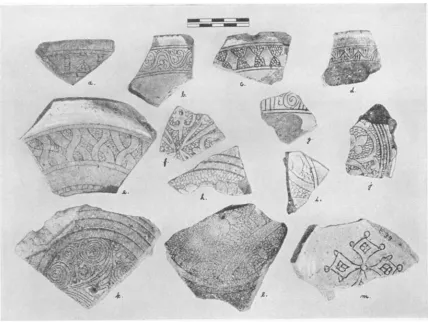
129-135 (Fig. 2). Rims of plates or of shallow bowls with roulette decoration. The feet of similar pieces are Nos. 142-145. No. 130 shows decoration on the inside, but this practice seems to have been reserved generally for smaller plates of much thinner fabric, some pieces of which are shown on Fig. 2 (not numbered). No. 146 gives the form of the base. No. 145 is small but has a foot like the larger ones and is decorated on the outside only. The clay of the larger bowls usually breaks with a shattered, laminated edge which' is quite different from the even smooth break of other pots of the group. This may be due to its somewhat greater thickness.
136-139. Bottoms of the fine plates like Nos. 115 and 116. The bottom is either flat and marked off from the side by a small set-out (136-138) or by a tiny flat ridge which forms a miniature foot (115, 116, 139). Several other' fragments of both types occur.
140-141. Feet of plates. Perhaps the form of the rim of this shape is No. 128. 142-145 (Fig. 2). Feet belonging witlh Nos. 129-133. Several grooves score the inside of all but No. 145. Two other fragments of large plates were found.
146 (Fig. 2). Bottom of the small plate mentioned above (129-135).
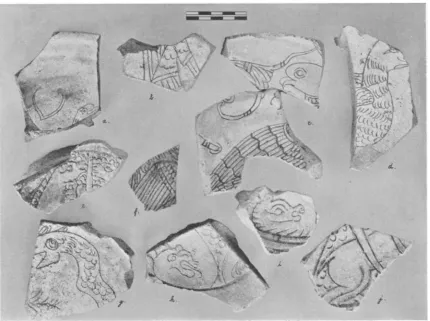
147-152 (Fig. 3). On none of the bases certainly to be placed in this group is there any stamped decoration, and either this ware went out of use before the custom of stamping the inside of pots became common or it was not affected by it. The plain curved rims, Nos. 118 and 119,- however, of fabric thicker than usual, seem to be later than the rest and they may have had stamped bases. At any rate, without definitely deciding that they belong here, one can assert that of all the stamped fragments only these numbers could be of this group by reason of clay and glaze. Nos. 147-149 are the better; the glaze of 147 is a thick, although not too glossy coat much browner than usual, that of the other two of a light red, Samian hue; the clay as usual is pure in quality, reddish in color. Nos. 150-152 are nearer Group B of which they might be unusually good specimens. On all these pieces the bottom is flat and is coverecl by the glaze in an application thinner than that oil the upper surface but not nearly so much more so as that on the outside of stamped sherds of Group B.
B
153-159. Thiese sherds are of a nature intermediate between A and B proper. Unlike B the clay is pure or nearly so but in color may resemble that of either group. The thiick fabric is foreign to A and on the whole they would belong, rather here with B. Shallow bowls and plates again seem to be the shapes although No. 153 (Fig. 2) may have been from a deep dish. Thle very edge of its rim is notched at intervals. Two other frag,ments of rims similar to No. 156 exist. No. 159 (Fig. 3) is the only base to be placed here unless it be some of the preceding stamped bases. As usual tlle inside is marked by several grooves. The outside is very thinly glazed.
THE ROMAN AND BYZANTINE POTTERY 297 At its best it is exactly like the red, porous Samian of good quality and, while on many pieces it appears thinner, lighter and almost matt, it never assumes the dark htues folund occasionally in A.
160, 161. The only two plain rims found. The excellent quality of the clay of No. 161 wouild justify its placement with the intermediate sherds above.
30]
F 8i. 3S2. R t t
162. Two keeled rims of almost straight-sided bowls occur.'
163-170. Rims of shallow bowls or plates with No. 170 showingf thle base form. No. 166 may be the piece of a spreading rim like Nos. 171-174. The series is arrang,ed
1 This seems to be a development of the keel of the slightly ridged rim of earlier pots like our Nos. 73, 101, 102; ill Atlheiis we find in the second and third centuries all overdevelopment of the straight rima (Nos. 280, 281) in both Eiurope and the Mediterranean area, of the keel; comnpare D138 with our No. 162;
also Fitzgerald, Beth-Shan Excarations, Vol. 3, P1. XXX IV, No. 48 and Dragenidorff, Bonner Jahrb. 101, p. 150,
298 FREDERICK 0. WAAGE
typologically but 163 is certainly the earliest. Compare our Samian Nos. 107, 109 and the notes there. Several other fragments mostly like 164 and 170 were found.
171-174. Rounded spreading rims of plates. Although they may not be parts of spreading rims Nos. 171 and 173 are included here because of similarity and perhaps No. 166 belongs to the same group.
175-179. Curved spreading rims of plates. With No. 175 should be compared Nos. 156-158 above. The clay of 178 is unutsually fine.
180-183. Straight spreadingf rims of bowls and plates. Unusually fine are No. 180 (1002-P 163) (Fig. 3) and No. 182 (Fig. 3). The gouges on the latter have left the inside gently fluted.
184-202, 221, 236. Bottoms of pots. Like No. 170, Nos. 189, 190, 184 to 187 and 202 show the foot forms. No. 188 is shaped like the bottom of 170; 191 and 192 have faint feet like 189 while on the others feet are not preserved. The majority of the better stamped bases belong here as Fig. 3 shows. Only 170, 184 and 185 seem not to have carried a stamped decoration, and 186 and 187 are too fragmentary to judge. On the outside most of the bottoms are glazed but the coat is always much poorer than that inside, and is often a mere wash.
202 (Fig. 3) is particularly important inasmuch as it is the only fragment of the group which is stamped with a Christian symbol. It is that of a cross (or the cross monogram, for it is uncertain whether the blur at one arm is the head of a rho or a mark of double stamping, being more likely the latter). Althoucgh the impression is fragmentary and not too clear it is evident from one arm that the cross is jewelled. This arm is divided into halves in the outer one of which there are three, in the inner, two pellets. The jewelled cross occurs in the earliest Christian centuries on Coptic grave-stones and on the so-called "African " lamps.'
C
Less distinctive in clay and glaze than the preceding but more so in shape is a third group of ware. A shallow bowl on a very low foot and with a keeled rim is almost the only form although the sizes differ considerably. It is a descendant of ail early Roman plate whose evolution Knipowitsch has shown in 0, p. 51, Abb. 12. The fabric is thin and hard-baked. The clay varies from brown to almost red, the latter hue being less common, and is finely granulated, and apart from tiny yellowish inclusions2 is otherwise pure. The glaze is usually a matt red paint although darker hues of fair gloss occur; rarely is the outside not wholly covered.
I Daltoni, Byzantine Art and Archaeology, p. 681; p. 611, Fig. 386,; Wulff, Altchristlichle und mittelalter- liche Bildverke I, Nos. 85 and 87 (cross) and Nos. 1238, 1239, 1241 (cross monogram); Dutliuit, La Sctulpture Copte, P1. LXIII a, c, and P1. LXVIII b.
THE ROMAN AND BYZANTINE POTTERY 299
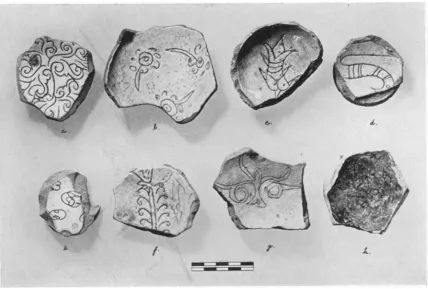
The rim forms are shown in 203-213.1 No. 203 is earlier than the others and belongs to a small bowl or cup. Bases to go withi this and with the half-dozen similar rims were not found but probably they were not stamped. No. 213 is smoked to black and purple and is probably an unsuccessful brother of 214-217 since the shape never occurs
_3 .
aol.~
~
~~~~~~~~~~3S
S | l, S~~~~~~
It 0 _
_ 1 1 236.~~~~~~~~~~~~~~~~~~~~06 @ _ v
Fig. 4. Roman Pottery; Late C Ware
burned whiolly red; it may, hiowever, be a local piece. The r'ims, except 213, occur bothi withi and without the roulette decoration illuistrated on Fig. 4.
I Pr', No. 164, Abb. 551, p. 433 belongs to this class and, similar to the following Nos. 214-217, the
300 FREDERICK 0. WAAG*:
214-217. These rims were fired so that the paint on the outside of the rim was black. Elsewlhere it is red. Four fragments with a profile similar to 208 are the same. The clay of 216 and 217 is less characteristic than usual but the peculiar firing recommends a place here rather than with the following group of local ware.
224, 225, 232, 234, 241, 218, 219. The first five show the common foot-form of stamped and unstamped bases. The last two occur, once each, unstamped.
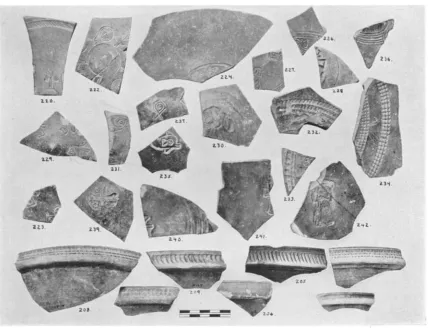
A majority of the bases are decorated with stamped designs (Fir,. 4) of which 220 (1017-P 178), 222 (1016-P 177), 223 stand apart from the others in excellency of workmanship and of glaze, which is a dark red of fair gloss. The clay is that of this group, however, so they are best included here. No feet are preserved.
Ten other sherds of ordinary quality show more simple designs. They are very fragmentary and only 224, 226-228, 237 are plain enough to be photographed. No. 225 has a palm, leaf and circle and forms a link with the fine sherds just mentioned. Its glaze is unusually dark but did not cover the outside near the foot. The clay and glaze of 226-228 are very light and are not characteristic of this group but they are more at home here than elsewhere (227 - 1015-P 176).
229-233, 235. These show little stamped animals. No. 230 (1009-P 170) seems to be a cock with a bunch of grapes? in his beak; 231 shows the heads of fish. Only with the animals were the roulettes, used to decorate some of the rims, also employed in. the bottoms of the pot as 232 (1007-P 168) and 233. No. 234 probably had animals in the centre. No. 235 (1008-P 169) is a dolphin.
236. This sherd has roughly incised lines between two sets of grooves and pendent from the outer ones. It resembles a sherd from the Kerameikos, KYV, Beil. XXXVI A, 6 and Abb. 3, 7.
239-242. Christian symbols (239 1018-P 179; 242 1005-P 166).
Parallels for the decorative stamps a-re found a) on the so-called African lamps, a type found throughout the Mediterranean area and manufactured locally in various places but upon the question of whose origin the authorities refuse to commit themselves, b) on products of the Coptic arts and crafts in all materials (in the light of which one would think the origin of the lamps to be clear).' The stamped pottery of the groups B and C is that which Kiibler has already indicated to be of Egyptian origin from the few samples of it found in the Kerameikos, and the greater richness of thiat from the Agora bears this out.2 Hardly less readily matched are the little animals wlhich appear occasionally. Again the two
For references to this type of lamp see the section on lamps. One lamp fragment of this type from the Agora (Inv. number 114-L 114) must, by reason of identity of clay and glaze, have been made at the same centre which prodc ced the pottery of Gronip B. rume, the lamps are more c'ommon in Africa than in Egypt and from there, too, come plates with stamped animals and Christian scenes and symbols (Leclercq, anutel d'Arehgologie ClG-e'tieXn3e II, pp. 530 f.) bat earlier than both are the decorative stamps which all
evidence on hand at the presenit connects with Egypt and to which, by identity of w'are, the later animal and Christiani symbols too are related.