SENSORY EVALUATION, ANTIOXIDANT, ANTIMICROBIAL ACTIVITIES AND COLOUR OF STRAWBERRY NECTAR ENRICHED WITH PRODIGIOSIN PIGMENT PRODUCED
FROM SERRATIA MARCESCENS
Ali S. Salama1, Abbas O. Toliba2, Behairy A. Akl1
1Microbiology Department, Faculty of Agriculture, Zagazig University, Egypt 2Food Science Department, Faculty of Agriculture, Zagazig University, Egypt
Article received 9.10.2019, Revised 30.11.2019, Accepted 6.12.2019
ABSTRACT
This study was performed to evaluate the impact of natural red pigment (prodigiosin) extracted from local microorganism of Serratia marcescens as a natural colouring, antioxidant and antimicrobial agents in strawberry nectar. The local S. marcescens was identified by morphological, biochemical tests as well as sequencing a fragment of the 16S rDNA gene as new Egyptian strain namely S. marcescens A1A. The antioxidant scavenging of prodigiosin was examined by 2,2-diphenyl-1-picrylhydrazyl (DPPH). The antibacterial activity of prodigiosin was assayed against three bacterial indicators (B. cereus, Staph. aureus and E. coli) by measuring the inhibition zones using disc-diffusion assay on Muller Hinton Agar. The results revealed that the free radical scavenging activity was increased in the prepared solutions with increasing the concentration of prodigiosin. The prodigiosin of S. marcescens A1A has prohibited the growth of tested bacteria effectively. On the other hand, the fortification of strawberry nectar with prodigiosin pigment improved the antimicrobial, antioxidant activities, colour, taste, clarity, thickness and overall acceptability of resulted products.
Keywords: Serratia marcescens; Prodigiosin; Strawberry nectar; Antioxidant; Antibacterial agent.
INTRODUCTION
Nowadays, food colouring with pigments obtainned from natural sources had a great interest and importance particularly that the using of synthetic pigments is unsafe. The microbial pigments are potentially good alternative ones to synthetic pigments which have toxicity problems for human and environmental systems (Venil and Lakshmanaperumalsamy, 2009). Colour of foods is very potent to clear its safety, freshness and which also show good sensorial values of food. Pigments have been reported to be as antioxidants, additives and different colourant agents when added to many food industries (Cserháti, 2006; Darshan and Manonmani, 2015).
The natural red pigment (Prodigiosin) is characterized by a common pyrrolylpyrromethene skeleton and is produced by various microbes (Khanafari et al., 2006). Prodigiosin is a red pigm-ent isolated from a few species such as Serratia,
Pseudomonas and Streptomyces produced as a secondary metabolite alkaloid with a unique tripyrrole chemical structure (Shaikh, 2016). The bright red pigment produced by Serratia spp. is among the more conspicuous pigments extant in the microbial world. These pigments have intrigued organic chemists and pharmacologists and could be played a vital role in the treatment of malaria diseases as immunosuppressant agents (Pandey et al., 2009). Prodigiosin is a promising drug owing due to their antibacterial activities (Darah et al., 2014; Khanam and Chandra, 2017), antifungal (Kalbe et al., 1996; Someya et al., 2001), immunosuppressive and anti-proliferative activity
(Chang et al., 2011), immunomodulators (Lee et al., 1995), and antimetastatic (Zhang et al., 2005). In 2018 Arivi-zhivendhan et al., revealed that addition of prodigiosin onto food material not only enhanced the antimicrobial and antioxidant pro-perties, food preservation but also gives food colo-uration for pleasant appearance. The individual chemical nature of prodigiosin made it a potent subject of many studies regarding its possible industrial applications, particularly as a food addi-tive (Diaz-Ruirz et al., 2001). To yogurt, milk and carbonated drinks lyophilized prodigiosin was successfully applied as colourant agent (Namaz-kar and Ahmad, 2013).
Strawberries (Frafaria x ananassa Duch.) are most commonly used fruits for processing of spreads, jellies, drinks and jam due to their aroma, attractive colour, flavour and nutritional value (Amaro et al., 2013; Curi et al., 2016 and Okut et al., 2018). As a source of magnesium, potassium, calcium, anthocyanins, vitamin C and flavonoids strawberry was considered a one of the potent source (Murtaza et al., 2004; Souza et al., 2014). Murtaza et al. (2004) processed strawberries into ready to serve drink is a perfect way to extend its shelf-life and get value added product.
As known a little research has so far been done to produce food products supplemented with prodigiosin pigment. Therefore, the aim of this study was to produce prodigiosin pigment from
propertiesofstrawberry nectars supplemented with different levels of prodigiosin pigment.
MATERIALS AND METHODS Materials
The indigenous Serratia marcescens bacteria used in the present study was isolated from soil in Sharkia Governorate, Egypt (Othman et al., 2019) and identified based on morphological, physiolo-gical and biochemical characteristics (Grimont and Grimont, 2005). This bacterium was genetically identified by sequencing fragments of 16S riboso-mal DNA gene and comparing sequences from the GenBank (Hegazy et al., 2019). The bacterium was maintained on nutrient agar slopes, subcultured monthly and kept at 4°C.
Ripe fresh strawberry fruits were purchased from local supermarket, Zagazig City, Sharkia Governorate, Egypt during winter 2019. The fruits were carefully washed using tap water at ambient temperature 18°C and directly subjected to the exp-eriment. Sugar (product of Nile Sugar Company) with ultimate purity 99.95% was used. All chemicals, reagents and bacterial media were of analytical grade and purchased from Al-Gomhoria Co., Zagazig Branch, Egypt.
Methods
Production and presumptive test for prodigiosin confirmation from Serratia strain: The tested
Serratia strain was transferred into 250 mL conical flasks with 100 mL of nutrient broth (NB), peptone glycerol broth (PGB) and trypticase soy broth (TSB) media (seed culture is 10% of the total volume of the fermentation media and the density of the used bacterium was 1x 10⁷cfu/mL and incubation at 30°C for 96 h. Prodigiosin extraction was carried out as described by Pradeep et al. (2013). The extracted pigment was dried using a rotary evaporator (R-124 BUCHI, Switzerland) and the concentrate obtained was dissolved in acidified methanol (96 mL methanol and 4 mL HCl) according to Garg et al. (2013). The produced prodigiosin was determined using the following equation (Mekhael and Yousif, 2009): Prodigiosin unit/cell = [OD499–(1.381 x OD620)] x 1000/ OD620, where: OD499 = pigment absorbance, OD620 = bacterial cell absorbance and 1.381 = constant equation.
Strawberry nectar processing: Strawberry nectar was produced from strawberry juice (7.8 °Brix) which was processed from strawberry fruits using kitchen fruit juice extractor (Mounilex, Frace) then filtered through cheese cloth. Strawberry nectar was prepared according to the General Standards for Fruit Juices and Nectars (Codex Alimentarius Commission 2005). The formula for one litter of
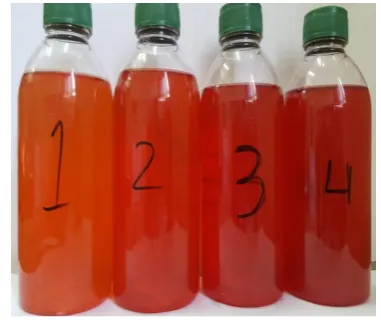
prepared nectar was 400 mL juice, 100 g sugar and the volume were filled up to one litter using bottled drinking water. The mixture was homogenized using food processor blender (Scarlett, China). Then the resulted nectar was divided into four portions. The first served as control of strawberry nectar and coded CSN. The second, third and fourth portions were supplemented with 0.25, 0.50 and 0.75% (v/v) of aqueous prodigiosin solution (100 mg/mL) and coded PSN0.25, PSN0.50 and PSN0.75, respectively. The nectars were filled in clean glass bottles (200 mL) and directly subjected to tests. For sensory evaluation, the nectar samples were cooled at 4°C for 2 h before conducting the test.
Antioxidant activity determination: The anti-oxidant activities of prodigiosin and four nectar treatments were determined using 2,2-diphenyl-1-pic-rylhydrazyl (DPPH) radicals scavenging assay according to Renukadevi and Vineeth (2017). The optical density was recorded and inhibition (%) was calculated by comparing the absorbance of the solution containing the test samples to that of blank control solution.
Antibacterial activity determination: The antibacterial activities of the prodigiosin and nectar treatments were determined against three bacteria, are Bacillus cereus, Staphylococcus aureus and
Escherichia coli obtained from the Agricultural Microbiology Department Faculty of Agriculture, Zagazig University, Egypt using disc-diffusion assay on Muller Hinton Agar as described by Ivanova et al.(2000).
Colour measurement: Colour attributes (Lightness, L; redness, a and yellowness, b) of CSN, PSN0.25, PSN0.50 and PSN0.75 were measured as described by (Rao et al., 2011) using calibrated Hunter Lab Colour Analyzer (Hunter Lab Colour Flex EZ, USA). The mean value of three readings of each colour value of nectar samples was reported. The overall colour changes in PSN0.25, PSN0.50 and PSN0.75 comparing with CSN were expressed by the delta-E relation according to the following equation:
ΔE= (L-L0)2 + (a-a0)2 + (b-b0)2 .
(for 2 h at 4°C) as coded samples using hedonic scale of 1 to 9 point.
Statistical analysis: Statistically, data collected on different parameters were analyzed by using MS-TAT-C programme (Anonymous, 1986) for analysis of variance and means were compared using Fisher's protected least significant differ-ences (LSD) test at 5% probability level (Steel et al., 1997). All data were expressed as the mean ±SD.
RESULTS AND DISCUSSION
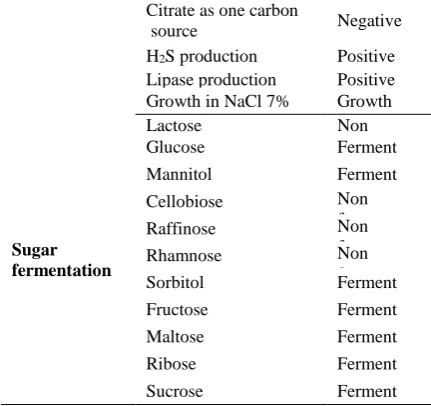
Identification of the Serratia isolate: Identifi- cation of the Serratia isolate was primarily invest-igated through morphological and biochemical features. Morphological and biochemical charac-teristics were used to identify the selected isolate as described by Grimont and Grimont (2005). Data in Table 1 showed that the isolate was short rod shape, gram negative, motile, non-spore forming, catalase positive, non-produced of indole, Vogesproskauer test positive, non-production H2S, grow in 3 % of NaCl and non-spore forming bacteria, cannot use the citrate as one source for carbon, grow in 7 % of NaCl. Identifying Serratia marcescens isolate was made mainly on the results of carbohydrate fermentation tests.
Table 1: Morphological and biochemical characteristics of Serratia marcescens A1A strain
Characteristic
Serratia
marcescens
A1A
Morphological
Cell Shape Short rod
Gram stain Negative
Motility Motile
Spore form Negative
Biochemical
Catalase production Negative Indole production Positive Voges – proskauer test Negative
Citrate as one carbon
source Negative
H2S production Positive Lipase production Positive Growth in NaCl 7% Growth
Sugar fermentation
Lactose Non
ferment
Glucose Ferment
Mannitol Ferment
Cellobiose Non
ferment
Raffinose Non
ferment
Rhamnose Non
ferment
Sorbitol Ferment
Fructose Ferment
Maltose Ferment
Ribose Ferment
Sucrose Ferment
The phylogenetic tree of the tested Serratia
strain was inferred by neighbour-joining distance method (Thompson et al., 1994). Based on the 16S ribosomal DNA sequence and the comparison with other relevant sequences available in the public databases (Figure 1), the BLAST search revealed maximum similarity scores with other bacteria. So, it is generally noticed that the tested isolate is quite different from the previously identified and registered Serratia species. The nearest relatedness is 98% with Serratia marcescens subsp.
marcescens strain NBRC 102204. The previously identified strains indicate that the studied isolate is a new identified Serratia marcescens Egyptian strain and given the code name S. marcescens A1A.
Serratia marcescens is a gram negative, non-motile, citrate positive bacterium. Colonies on nutrient agar are convex, circular with entire margin. Some strains produce characteristic red colour pigment called prodigiosin whereas rest does not (Kamble and Hiwarale, 2012).
Prodigiosin quantities produced by Serratia marcescens strain cultivated in NB, PGB and TSB media: Estimations of the prodigiosin pigment using colourimetric method in Serratia
culture cultivated in different media were shown in Table 2. Generally, the PGB medium gives the highest value of prodigiosin recorded in culture was obtained after 72 h of incubation (815.5 U/cell of prodigiosin) followed by NB medium (670.4 U/
cell prodigiosin) after 72 h of incubation. The lowest value of prodigiosin (140.2U/cell prodigi- osin) was recorded in TSB medium. Furthermore, highly amount of prodigiosin concentration was obtained after 72 h of incubation. The prodigiosin production is increasing gradually after 48 h and was reached the maximum towards 72h there after the production was decreasing towards 92 h in different media (Kamble and Hiwarale, 2012).
Table 2: Prodigiosin levels (unit/cell) in Serratia strain cultivated in NB, PGB and TSB media after 48, 72 and 96 hours of incubation
Cultivated media
Prodigiosin (unit/cell) during incubation time
48 h 72 h 96 h
NB medium 290.6±7.4a 670.4±11.5b 450.7±8.0b
PGB medium 310.9±10.3a 815.5±12.0a 632.0±8.7a
TS medium 140.2±6.0b 341.9±7.9c 340.2±6.0c
L.S.D. at 0.05 % 21.9 40.5 38.0
L.S.D. = Least Significant Difference. Values with different litters are significantly different in the same column.
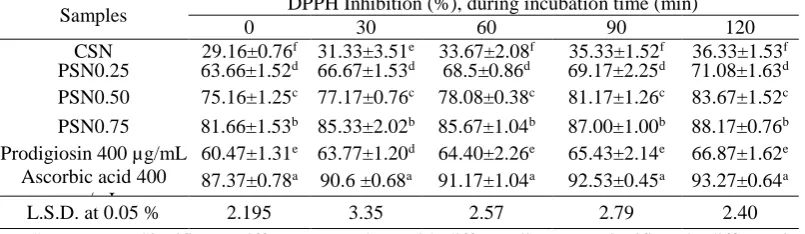
Antioxidant activity: Antioxidant activities of different strawberry nectars (CSN, PSN0.25, PSN 0.50 and PSN0.75) as well as prodigiosin were assessed by measuring the DPPH radical scaven-ging activity and the obtained results were illustra-ted in Table 3. The differences between all nectar samples, prodigiosin and ascorbic acid were significant (p≤0.05). These results showed that the DPPH scavenging values of all tested samples were increased during incubation time reaching the maximum at 120 min. On the other hand, the DPPH inhibition of strawberry nectars was increased by
increasing the prodigiosin level. PSN0.75 had the highest DPPH value comparing with other nectar samples recording 88.17% at 120 min of incubation time, while, prodigiosin recorded 66.87 % and ascorbicacid93.27%.Arivizhivendhanetal., (2018) reported that the bioactive prodigiosin extracted from Serratia effectively scavenged the free radical and inhibited the bacterial growth in food products. Some amino acids, such as histidine, tyrosine, methionine, and cysteine, have been reported to show antioxidant activity (Abdel-Hamid et al., 2017; Osman et al., 2019).
Table 3: Antioxidant activities of strawberry nectars, prodigiosin and ascorbic acid.
Samples DPPH Inhibition (%), during incubation time (min)
0 30 60 90 120
CSN 29.16±0.76f 31.33±3.51e 33.67±2.08f 35.33±1.52f 36.33±1.53f PSN0.25 63.66±1.52d 66.67±1.53d 68.5±0.86d 69.17±2.25d 71.08±1.63d PSN0.50 75.16±1.25c 77.17±0.76c 78.08±0.38c 81.17±1.26c 83.67±1.52c
PSN0.75 81.66±1.53b 85.33±2.02b 85.67±1.04b 87.00±1.00b 88.17±0.76b Prodigiosin 400 µg/mL 60.47±1.31e 63.77±1.20d 64.40±2.26e 65.43±2.14e 66.87±1.62e
Ascorbic acid 400 µg/mL
87.37±0.78a 90.6 ±0.68a 91.17±1.04a 92.53±0.45a 93.27±0.64a
L.S.D. at 0.05 % 2.195 3.35 2.57 2.79 2.40
L.S.D. = Least Significant Difference. Values with different litters are significantly different in the same column.
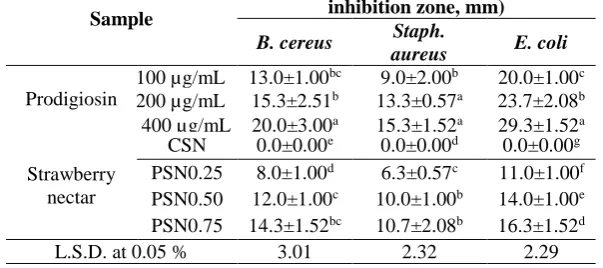
Antibacterial activity: Antibacterial activities of different strawberry nectars (CSN, PSN0.25, PSN 0.50 and PSN0.75) as well as prodigiosin solutions with different concentrations (100, 200 and 400µg/mL) were determined using disc-diffusion assay on Mueller Hinton Agar plates and presented in Table 4. The assessed antibacterial activities were performed against three pathogenic bacteria (B. cereus and Staph. aureusas G+ bacteria as well as E. coli as G-bacteria) by measuring the inhibition zones. The growth of all aforementioned
bacteria was inhibited by nectars and prodigiosin pigment. Generally, the diameter of the inhibition zones was significantly (p≤0.05) increased with the increase of prodigiosin concentration in all prodigiosin solutions and nectar samples. The 400 µg/mL prodigiosin solution had the highest diameter of inhibition zone being 20.0, 15.3 and 29.3 mm for B. cereus, Staph. aureus and E. coli, respectively. The prodigiosin having pyrrolyl pyrromethane skeleton was first charactarized from
including antibacterial activity (Gulani et al.,
2012), antifungal, antiproliferative agent and immunosuppressive (Khanafari et al., 2006). Prodigiosin has prohibited the growth of food borne pathogens effectively and the shelf life of the
food was also extended significantly (Arivizhivendhan et al., 2018). The prodigiosin of
Serratia marcescens IBRL USM 84 exhibited a broad inhibitory spectrum activity against more bacteria (Nwankwo et al., 2017).
Table 4: Antibacterial activities of strawberry nectars and prodigiosin solutions.
Sample
Antibacterial activity (Diameter of the inhibition zone, mm)
B. cereus Staph.
aureus E. coli
Prodigiosin
100 µg/mL 13.0±1.00bc 9.0±2.00b 20.0±1.00c 200 µg/mL 15.3±2.51b 13.3±0.57a 23.7±2.08b 400 µg/mL 20.0±3.00a 15.3±1.52a 29.3±1.52a
Strawberry nectar
CSN 0.0±0.00e 0.0±0.00d 0.0±0.00g
PSN0.25 8.0±1.00d 6.3±0.57c 11.0±1.00f PSN0.50 12.0±1.00c 10.0±1.00b 14.0±1.00e PSN0.75 14.3±1.52bc 10.7±2.08b 16.3±1.52d
L.S.D. at 0.05 % 3.01 2.32 2.29
L.S.D. = Least Significant Difference. Values with different litters are significantly different in the same column
Colour attributes of strawberry nectars and prodigiosin: Colour attributes (L, a, b and delta E) of strawberry nectar samples and prodigiosin solutions were measured using Hunter Lab colour analyzer and the recorded results were showed in Table 5. The L, a, b and delta E of all tested samples were significantly (p≤0.05) different. Additionally, the addition of prodigiosin to strawberry nectars increased its redness (a value) and decreesed its lightness (L value). Delta E for PSN0.25, PSN0.50 and PSN0.75 was calculated against CSN. The PSN0.75 had the highest delta E (36.62) followed
by PSN0.50 (22.36) and PSN 0.25 (12.10). Figure 2 shows the photos of CSN, PSN0.25, PSN0.50 and PSN0.75. The prodigiosin pigment has a flashy red colour and special chemical nature has made it the subject of many studies into its possible industrial applications, especially as a food additive (Song et al., 2006; Namazkar and Ahmad, 2013). Pigments (such as prodigiosin) from microorganisms can serve as a natural alternative source to replace synthetic pigments used in the food industry (Namazkar and Ahmad, 2013).
Table 5: Colour attributes of strawberry nectars and prodigiosin.
Nectar L, lightness a, redness b,
yellowness Delta E*
CSN 22.91±1.94a 4.06±0.52d 0.66±0.07a ND
PSN0.25 19.83±1.23b 5.65±0.23c 0.56±0.07ab 12.10±0.76c
PSN0.50 19.38±0.52b 7.20±0.46b 0.45±0.06bc 22.36±0.85b
PSN0.75 18.83±0.80b 8.52±0.55a 0.37±0.09c 36.62±1.04a
Prodigiosin 400 µg/mL 16.30±1.41c 4.43±1.00d 0.63±0.17ab ND L.S.D. at 0.05 % 2.33 1.10 0.18 2.07
*Delta E was calculated comparing with CSN sample. L.S.D. = Least Significant Difference.
Sensory properties: Results tabulated in Table 6 show the sensory properties of strawberry nectars enriched with different levels of prodigiosin. Generally, it was being recognized that all strawberry nectar samples were accepted by all judges. The colour, clarity, thickness and overall acceptability of all judged samples were significantly (p≤0.05) different, where the PSN0.25, PSN0.50 and PSN0.75 had higher colour, clarity, thickness and overall acceptability scores than those of CSN. On the other hand, taste and aroma of CSN, PSN0.25, PSN0.50 and PSN0.75 were similar. Prodigiosin improved the colour and appearance of some food products such as yogurt, milk and carbonated drinks (Namazkar and Ahmad, 2013).
Table 6: Sensory evaluation of different strawberry nectars.
Nectar Colour Taste Aroma Clarity Thickness Overall acceptability
CSN 6.33±0.63c 8.17±0.14a 8.21±8.21a 5.83±0.38c 6.75±0.66b 7.58±0.52c PSN0.25 7.08±0.38b 8.42±0.38a 8.37±8.36a 6.83±0.38b 7.16±0.76b 7.92±0.38bc PSN0.50 8.42±0.14a 8.66±0.29a 8.50±0.50a 7.75±0.25a 7.67±0.62ab 8.50±0.50ab PSN0.75 8.92±0.14a 8.67±0.38a 8.60±0.53a 8.41±0.62a 8.50±0.50a 8.75±0.25a L.S.D. at
0.05 % 0.72 N.S. N.S. 0.82 1.22 0.80
L.S.D. = Least Significant Difference. Values with different litters are significantly different in the same column.
Conclusions: Based on the study, the fortification of strawberry nectar with prodigiosin pigment produced from Serratia marcescens is a good way to enhance the colour, antioxidant, antibacterial activities and sensory properties of such products. Finally, more studies needed for determining the storability of foods containing prodigiosin pigment.
Acknowledgments
The authors extend their appreciation to the Faculty of Agriculture, Zagazig University, Zagazig, Egypt for their support.
REFERENCES
Abdel-Hamid. M., J. Otte, C. De Gobba, A. Osman, E. Hamad, Angiotensin I-converting enzyme inhibitory activity and antioxidant capacity of bioactive peptides derived from enzymatic hydrolysis of buffalo milk proteins. Inter. Dairy J. 66:91-98 (2017).
Alihosseini, F., K.S. Ju, J. Lango, B.D. Hammock, G. Sun, Antibacterial colourants: Characterization of prodiginines and their applications on textile materials. Biotechnol. Progr. 24(3): 742-747 (2008).
Amaro, L.F., M.T. Soares, C. Pinho, I.F. Almeida, O. Pinho, I. Ferreira, Processing and storage effects on anthocyanin composition and anti-oxidant activity of jams produced with Camarosa strawberry. Int. J. Food Sci. Technol. 48(10): 2071–2077 (2013).
Anonymous, MSTATC. Microcomputer Statistical Programme. Michigan State University, Michigan, Lansing, USA (1986).
Arivizhivendhan, K.V., M. Mahesh, R. Boopathy, S. Swarnalatha, R. Regina Mary, G. Sekaran, Antioxidant and antimicrobial activity of bioactive prodigiosin produced from Serratia marcescens using agricultural waste as a substrate. J. Food Sci. Technol. 55(7):2661-2670 (2018).
Chang, C.C.C., W.C.C. Chen, T.F.F. Ho, H.S.S. Wu, Y.H.H. Wei, Development of natural antitumor drugs by microorganisms. J. Bio. Sci. Bioeng. 111: 501–511(2011).
Chen, D., Y. Han, Z. Gu, Application of statistical methodology to the optimization of fermentative medium for carotenoids production by Rhodobacter sphaeroides. Process Biochem. 41:1773–1778 (2006). Figure 2: Photos of different strawberry nectar
Codex Alimentarius Commission, (2005) General standards for fruit juices and nectars. CODEX STAN 247-2005, http://www.fao.org/fao-who-codexalimentarius/sh-proxy/en, on 17 march 2019.
Cserháti, T., Liquid chromatography of natural pigments and synthetic dyes. 602. Vol. 7, eBook ISBN: 9780080465760,https://www.
lehmanns.de/shop/technik/21796477-9780080465760-liquid-chromat ography-of-natural-pigments-and-synthetic-dyes (2006). Curi, P.N., S.B. Tavares, B.A. Almeida, R. Pio,
M.P. Peche, R.V. Souza, Influence of subtropical region strawberry cultivars on jelly characteristics. J. Food Sci. 81(6):1515–1520 (2016).
Darah, I., T.F. Nazari, J. Kassim, S. Lim, Prodigiosin an antibacterial red pigment produced by Serratia marcescens IBRL USM 84 associated with a marine sponge
Xestospongia testudinaria. J. Appl. Pharm. Sci. 4: 1–6 (2014).
Darshan, N., H.K. Manonmani, Prodigiosin and its potential applications. J. Food Sci. Technol. 52(9): 5393–5407 (2015).
Diaz-Ruirz, C., B. Montaner, R. Pérez-Tomás, Prodigiosin induces cell death and morphological changes indicative of apoptosis in gastric cancer cell line HGT-1. Histol. Histopathol., 16(2): 415-421(2001).
Garg, R., S. Namazkar, W.Z. Ahmad, N. Nordin, Production and characterization of crude and encapsulated prodigiosin pigment. Int. J. Chem. Sci. Appl. 4:116–129 (2013).
Grimont, F., P.A.D. Grimont, Seen in Bergeyʼs Manual of Systematic Bacteriology, 2nd Ed., (The Proteobacteria) Part B, The Gamma Proteobacteria, Springer (2005)
Gulani, C., S. Bhattacharya, A. Das, Assessment of process parameters influencing the enhanced production of prodigiosin from Serratia marcescens and evaluation of its antimicro-bial, antioxidant and dyeing potentials. Malays J. Microbiol. 8(2): 116-22 (2012).
Hegazy, M.I., A.S. Salama, M.R. El-Ashry, A.I. Othman, Serratia marcescens and Pseudo-monas marcescens and Pseudomonas aerugi-nosa are promising candidates as biocontrol agents against root-knot nematodes (Meloidogyne spp.). Middle East J. Agri. Res. 8 (3): 828-838 (2019).
Ivanova, I., P. Kabadjova, A. Pantev, S. Danova, X. Dousset, Detection, purification and partial characterization of a novel bacteriocin substance produced by Lactoccous lactis
subsp. lactis b14 isolated from Boza-Bulgarian
traditional cereal beverage. Biocatalysis 41(6): 47-53 (2000).
Kalbe, C., P. Marten, G. Berg, Strains of the genus
Serratia as beneficial rhizobacteria of oil seed rape with antifungal properties. Microbiol. Res. 151:433–439 (1996).
Kamble, K.D., V.D. Hiwarale, Prodigiosin production from Serratia marcescens strains obtained from farm soil. Inter. J. Environ. Sci. 3: 631-638. (2012).
Khanafari, A., M.M. Assadi, F.A. Fakhr, Review of Prodigiosin, Pigmentation in Serratia marcescens. Online J. Biol. Sci. 6:1–13 (2006). Khanam, B., R. Chandra, Comparative analysis of
prodigiosin isolated from endophyte Serratia marcescens. Lett. Appl. Microbiol. 66: 194-201(2017).
LapendaLins, J.C., C.C.S. Maciel, H.S. Xavier, C.A. Alves da Silva, G.M. Campos-Takaki, Production and toxicological evaluation of prodigiosin from Serratia marcescens UCP/ WFCC1549 on mannitol solid medium. Inter. J. Appl. Res. Nat. Prod. 7 (2): 32-38 (2014). Lee, M.H., T. Kataoka, J. Magae, K. Nagai,
Immunomodulation of prodigiosin 25-C and con-canamycin B. In: Beuvery EC, Griffiths JB, Zeijlemaker WP (eds) Animal Cell Techno-logy: Developments Towards the 21st Century SE - 162. Springer Netherlands pp 1025–1029 (1995).
Matta, Z., E.I.V. Chambers, G. Naughton, Consumer and descriptive sensory analysis of black walnutsyrup.J.FoodSci.70(9):610-13 (2005).
Mekhael, R., S.Y. Yousif, The role of red pigment produced by Serratia marcescens as antibacterial and plasmid curing agent. J. Duhok. Univ. 12: 268-274 (2009).
Murtaza, M.A., N. Huma, J. Javaid, M.A. Shabbir, G. Mueen Ud Din, S. Mahmood, Studies on stability of strawberry drink stored at different temperatures. Int. J. Agri. Biol. 6(1): 58-60 (2004).
Namazkar, S., W.A. Ahmad, Spray-dried prodi-giosin from Serratia marcescens as a colou-rant. Bio. Sci. Biotechnol. Res. Asia 10(1): 69-76 (2013).
Nwankwo, I.U., V.O. Itaman, O.L. Chidiebere, M.P. Nwachukwu, Evaluation of antimicrobial activity of prodigiosin produced from Serratia marcescens against some pathogenic bacteria. Futo J. Series 3 (2): 93 – 102 (2017).
cooking conditions. J. Food Sci. Technol. 55(1): 90-100 (2018).
Osman, A., S. Abd-Elaziz, A. Salama, A. Abu Eita, M. Sitohy, Health protective actions of phycocyanin obtained from an Egyptian isolate of Spirulinaplatensison albino rats. Eurasia J. Biosci. 13: 105-112 (2019).
Othman, A.M., F.I. El-Zamik, M.I. Hegazy, A.S. Salama, Isolation and identification of Egyp-tian strains of Serratia marcescens produce antibacterial and antioxidant prodigiosin pigment. Zagazig J. Agric. Res. 46(5):1573-1582 (2019).
Pandey, R., R. Chander, K.B. Sainis, Prodigiosins as anticancer agents: Living up to their name, Curr. Pharm. Des. 15: 732-741(2009).
Pradeep, B.V., F.S. Pradeep, J. Angayarkanni, M. Palaniswamy, Optimization and production of prodigiosin from Serratia marcescens MBB-05 using various natural substrates. Asian J. Pharm. Clin. Res. 6:34–41(2013).
Rao, L., H. Khizar, L. Yi, E. Karangwa, S.Q. Xia, C.S. Jia, X.M. Zhang, Effect of ultrafiltration and fining adsorbents on the clarification of green tea. J. Food Engin. 102 (4): 321–326 (2011).
Renukadevi, K.P., M. Vineeth, Antimicrobial, antioxidant and cytotoxicity activity of pigm-ent produced from serratia marcescens. Euro-pean J. Biomed. Pharm. Sci. 4(2): 265-269 (2017).
Shaikh, Z. Biosynthesis of prodigiosin and its applications. IOSR J. Pharm. Biol. Sci. 11: 01-28 (2016).
Someya, N., M. Nakajima, K. Hirayae, T. Hibi, K. Akutsu, Synergistic antifungal activity of chitinolytic enzymes and prodigiosin produced by biocontrol bacterium, Serratia marcescens
strain B2 against gray mold pathogen,
Botrytiscinerea. J. Gen. Plant Pathol. 67: 312– 317 (2001).
Song, M.J., J. Bae, D.S. Lee, C.H. Kim, J.S. Kim, S.W. Kim, S.I. Hong, Purification and characterization of prodigiosin produced by integ-rated bioreactor from Serratia sp. KH-95. J. Bio. Sci. Bioeng. 101(2):157-161(2006). Souza, V.R., P.A.P. Pereira, T.L.T. Silva, L.C.O. Lima, R. Pio, F. Queiroz, Determination of the bioactive compounds, antioxidant activity and chemical composition of Brazilian blackberry, red raspberry, strawberry, blueberry and sweet cherry fruits. Food Chem. 156: 362–368 (2014).
Steel, R.G.D., J.H. Torrie, D.A. Dicky, Principles and procedures of statistics, a biological approach. 3rd ed. MacGraw Hill Book Co., New York, USA (1997).
Thompson, J.D., D.G. Higgins, T.J. Gibson, CLUSTAL W: Improving the sensitivity of progressive multiple sequence alignment through sequence weighting, position-specific gap penalties and weight matrix choice. Nucl. Acid Res. 22: 4673-4680 (1994).
Venil, C.K., P. Lakshmanaperumalsamy, An insightful overview on microbial pigment, prodigiosin. Electron J. Biol. 5(3): 49-61 (2009).