Spin-locking of half-integer quadrupolar nuclei in NMR
of solids: The far off-resonance case
Smita Odedraa, Stephen Wimperisb,∗
aSchool of Chemistry, University of Glasgow, Glasgow G12 8QQ, United Kingdom
bDepartment of Chemistry, Lancaster University, Lancaster LA1 4YB, United Kingdom
Abstract
Spin-locking of spinI= 3/2 andI= 5/2 nuclei in the presence of large
res-onance offsets has been studied using both approximate and exact theoretical
approaches and, in the case ofI= 3/2, experimentally. We show the variety of
coherences and population states produced in a far off-resonance spin-locking
NMR experiment (one consisting solely of a spin-locking pulse) and how these
vary with the radiofrequency field strength and offset frequency. Under magic
angle spinning (MAS) conditions and in the “adiabatic limit”, these spin-locked
states acquire a time dependence. We discuss the rotor-driven interconversion
of the spin-locked states, using an exact density matrix approach to confirm the
results of the approximate model. Using conventional and multiple-quantum
fil-tered spin-locking23Na (I= 3/2) NMR experiments under both static and MAS
conditions, we confirm the results of the theoretical calculations, demonstrating
the applicability of the approximate theoretical model to the far off-resonance
case. This simplified model includes only the effects of the initial rapid
dephas-ing of coherences that occurs at the start of the spin-lockdephas-ing period and its
success in reproducing both experimental and exact simulation data indicates
that it is this dephasing that is the dominant phenomenon in NMR spin-locking
of quadrupolar nuclei, as we have previously found for the on-resonance and
near-resonance cases. Potentially, far off-resonance spin-locking of quadrupolar
∗Corresponding author
nuclei could be of interest in experiments such as cross polarisation as a
conse-quence of the spin-locking pulse being applied to a better defined initial state
(the thermal equilibrium bulk magnetisation aligned along thez-axis) than can
be created in a powdered solid with a selective radiofrequency pulse, where the
effect of the pulse depends on the orientation of the individual crystallites.
Keywords: Quadrupolar nuclei, Spin-locking, Off-resonance
irradiation, Cross polarisation, 23Na
1. Introduction
The spin-locking experiment in NMR involves the application of a long
ra-diofrequency (rf) pulse in the direction of the bulk magnetisation vector in the
rotating frame, with the effect of locking the vector in place for up to several
seconds. No further evolution takes place under the influence of resonance
off-5
sets, J coupling or dipolar coupling while the magnetisation is spin-locked, as
the radiofrequency field strength (ω1 = |γB1|) is much stronger than any of
these interactions. This spin-locking is an essential part of many experiments
in NMR, most notably the cross-polarisation experiment where the spin-locking
pulse is used to transfer polarisation to less sensitive nuclei in the sample.
10
Although the simple vector model picture given above is valid for spin
I= 1/2 nuclei, the spin-locking behaviour of quadrupolar (spinI >1/2) nuclei
in solids is more challenging to understand. This is of particular significance
in cross-polarisation experiments involving quadrupolar nuclei, [1, 2, 3, 4]
in-cluding those where cross polarisation occurs from one quadrupolar nucleus to
15
another, [5, 6, 7, 8] or to a spinI= 1/2 nucleus. [9, 10, 11] The quadrupolar
split-ting parameter,ωQ, may be much larger than the radiofrequency field strength,
resulting in rapid evolution of the magnetisation on a time scale of 1/ωQbefore
the system settles into a spin-locked state of single- and multiple-quantum
co-herences as well as nonequilibrium population states. Experiments performed
20
under MAS will be more complex still, with a time-dependent quadrupolar
ωRt. [12, 13, 14, 15]
Previously, a simple theoretical model was presented by Ashbrook and
Wim-peris to describe the creation and evolution of coherences in a spin-locking
ex-25
periment involving half-integer quadrupolar nuclei.[16] This model assumes that
all components of the spin density operator that do not commute with the
spin-locking Hamiltonian will be rapidly dephased at the start of the experiment
and can be ignored. Subsequently, in a further study, the effects of
second-order quadrupolar interactions and small resonance offsets were considered.[17]
30
In the present work, a study of the far off-resonance case will be presented. The
magnetisation is left directed along thez-axis of the rotating frame before the
spin-locking pulse is applied.[12] Since this pulse is applied well away from the
Larmor frequency, there is a significantzcomponent to the effective field in the
rotating frame,B1,eff and hence the equilibrium magnetisation has a significant 35
component along the direction of the effective field; it is this component that is
spin-locked.
The first sections of this paper will briefly recap the simple theoretical model
of spin-locking based on the assumption of rapid initial dephasing. We will
make extensive use of this model as its success in reproducing experimental
40
and exact simulation data will indicate that, as with on- and near-resonance
spin-locking,[16, 17] the rapid initial dephasing that takes place at the start
of the locking period is the key to understanding the outcome of
spin-locking experiments on quadrupolar nuclei. Computer simulations employing
this model will then be presented, as well as exact density matrix calculations
45
for spin I = 3/2 andI = 5/2. These simulations, together with experimental
NMR results for the spin I = 3/2 nucleus 23Na, will provide insight into the
far off-resonance spin-locking phenomenon for half-integer quadrupolar nuclei
2. Pulse sequences for spin-locking
50
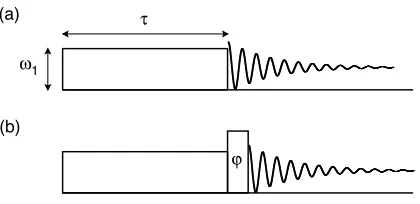
Figure 1 shows the pulse sequences for the far off-resonance experiments
described in this paper. Since the spin-locking pulse is applied far away from
the Larmor frequency, there is a significant z component to the effective field
B1,eff. The magnetisation is left directed along the z-axis of the rotating frame
before the spin-locking pulse is applied and so, unlike conventional on- (or near-)
55
resonance spin-locking, no initial pulse is required to create a particular state
first. Superficially, the pulse sequences resemble the well known two-dimensional
nutation experiment.[18, 19, 20] However, it is important to note that we are
not interested here in the nutation behaviour that occurs near the start of the
long pulse (indeed, we specifically ignore this) but only in the time-independent
60
states that eventually emerge. For observing the spin-locking of the central
transition, a single pulse of durationτ is used, as shown in Fig. 1a. This pulse
sequence is modified as shown in Fig. 1b to allow the observation of spin-locked
multiple-quantum coherences created by the rapid initial dephasing. In this case
the second pulse is phase cycled [21, 22] to convert the desired multiple-quantum
65
coherences into the observable single-quantum state.
3. Theoretical model of spin-locking
Previously, a simple theoretical model of spin locking has been introduced
[16] to describe (i) the creation of a variety of coherences by rapid initial
de-phasing and (ii), if the experiment is performed under MAS, the evolution of
70
these coherences on a timescale of 1/ωR where ωR is the MAS frequency. An
outline of the model is given here. The rotating-frame Hamiltonian during an
off-resonance spin-locking pulse is defined as
H =Hrf+HQ+HΩ, (1)
where the radiofrequency pulse Hamiltonian (Hrf) and the offset Hamiltonian
(HΩ) are given by, 75
HΩ= ΩIz. (3)
The first-order quadrupolar Hamiltonian is given by
HQ=ωQ
n Iz2−1
3I(I+ 1) o
, (4)
and, assuming the axial symmetry (η= 0), the first-order quadrupolar splitting
parameter is
ωQ=
ωPAS Q
2 (3 cos
2θ−1). (5)
where θ is the angle between the unique principal axis of the quadrupolar
in-80
teraction tensor and the applied static magnetic field and
ωQPAS= 3πCQ
2I(2I−1), (6)
with the quadrupolar coupling constant CQ in hertz. In this work, we can
ignore the second-order effects of the quadrupolar Hamiltonian as these are
“offset-like” and will be dwarfed by the magnitude of the resonance offsets we
will be considering.
85
When the spin-locking pulse is applied to the initial state σ(0), the system
begins to evolve under the influence of the Hamiltonian in Eq. 1, with the
time-dependence given by the Liouville−von Neumann equation,
d
dt σ(t) =−i[H, σ(t)]. (7)
Assuming that H is time-independent (and therefore ignoring any effects of
MAS at this stage), the solution is
90
σ(t) = exp{−iHt}σ(0) exp{+iHt}. (8)
A unitary transformationV can be used to diagonalise the Hamiltonian,
HD=V HV−1. (9)
Equation 8 can then be written as
or
σ0(t) = exp{−iHDt}σ0(0) exp{+iHDt} (11)
with
σ0(t) =V σ(t)V−1. (12)
The initial density operator σ(0) is thus transformed byV into the eigenbasis
95
of the spin-locking Hamiltonian, i.e., the frame in whichH is diagonal. The
off-diagonal elements ofσ0(0) evolve at rates determined byω1 andωQ and, when
considered across a powder sample whereωQ will vary according to crystallite
orientation, they will dephase rapidly at the start of the spin-locking pulse.
The diagonal elements, σ0D(0), are the states which commute with the
spin-100
locking Hamiltonian; these are the states which will be spin-locked. In a static
sample these states will remain unchanged for the durationτof the spin-locking
pulse. In the eigenbasis of the spin-locking Hamiltonian these are equivalent to
population states. When viewed back in the normal rotating frame using
σ(τ) =V−1σ0D(0)V (13)
the elements of the final density matrix correspond to a range of coherences and
105
population states.
Note that the removal of the off-diagonal density operator elements is a
non-unitary transformation that changes the norm, Tr{σ(t)2}, of the density operator. Therefore, the simple dephasing model of spin-locking strictly only
applies to experiments performed on powder samples in which nothing occurs
110
to refocus the coherences that dephase at the start of the spin-locking period.
During MAS, the quadrupolar splitting parameterωQ becomes time
depen-dent:
ωQ(t) =
ωPAS Q
2 {−
√
2 sin 2βcos(ωRt+ξ) + sin2βcos 2(ωRt+ξ)} (14)
where β is the angle between the unique principal axis of the quadrupolar
interaction tensor and the spinning axis andξis the initial phase about this axis.
115
per rotor period depending on the value ofβ. A measure of whether this
rotor-driven behaviour occurs adiabatically or suddenly in the weak-field (ω1ωPASQ )
limit is given by the adiabaticity parameter introduced by Vega,[12]
α= ω
2 1
2ωPAS Q ωR
(15)
In the “sudden limit” (α1), the zero-crossing of ωQ(t) occurs rapidly, and 120
the final stateσ(t) remains unchanged by MAS. In this case, the spin-locking
behaviour should be the same as in a static sample. Conversely, in the “adiabatic
limit” (α1), where the zero-crossing occurs slowly, the spin-locked states are time dependent. This can be incorporated into the model by using one unitary
transformation,V(0), to produce the initial state in the eigenbasis of the
spin-125
locking Hamiltonian but a different transformation,V(τ), to view the density
matrix in the rotating frame after a spin-locking pulse of durationτ,[16]
σ(τ) =V−1(τ)(V(0)σ(0)V−1(0))DV(τ). (16)
Although the final stateσ(τ) varies with the accumulated rotor phaseωRτ as a
result of this time dependence, the spins remain locked at all times. The third
case, whenα∼1, is called the intermediate regime; here, a zero-crossing will
130
partially convert population differences across spin-locking eigenstates into
off-diagonal coherences and the spin-locked magnetisation will decay on a timescale
of∼1/ωR.
4. Spin-locking calculations
4.1. Spin-locking model
135
This simple model of spin-locking can be utilised in numerical calculations,
which we have implemented using home-written Fortran codes. The tensor
operator T1,0, which is proportional to Iz and hence the thermal equilibrium
state, forms the initial density matrix. The spin-locking pulse Hamiltonian is
calculated using Equation 1. The Hamiltonian is diagonalised using the unitary
140
By setting the off-diagonal elements to equal zero, only the spin-locked, i.e.,
diagonal, elements of the density matrix are retained. The final density matrix
in the rotating frame is obtained using Eq. 12 or (for MAS) 16. The final states
are determined by calculating the expectation value of operatorQby taking the
145
trace of the final density matrix elements with the adjoint operatorQ†,
hQi= Tr{σ(τ)Q†}, (17)
where Q is typically a spherical tensor operator, Tl,p. We can also determine
the norm of the density operator,
Tr{σ(t)2}=X l
X
p
Tr{σ(t)Tl,−p}2. (18)
The norm of a density operator is conserved under a unitary transformation.[23]
However, as explained elsewhere,[16] the initial rapid dephasing that occurs
150
under a spin-locking field corresponds to a non-unitary transformation in our
simple model and so a change in the magnitude of the norm can be used as a
measure of the overall spin-locking efficiency.
4.2. Exact density matrix method
In order to explore the validity of the simple spin-locking model,
calcula-155
tions have also been carried out using an exact density matrix approach, again
implemented using home-written Fortran codes. The total experimental time
is broken down into 200 ns divisions (selected by empirical convergence during
trial calculations) and the Hamiltonian is assumed to be time-independent
dur-ing each step, thus allowdur-ing the time evolution of the density operator to be
160
calculated using the solution of the Liouville−von Neumann equation given in Eq. 8. An expectation value, powder averaged where required, was calculated
from the final density matrix as above.
5. Experimental details
Experiments were carried out on a Bruker Avance 400 spectrometer equipped
165
105.8 kHz for 23Na (I = 3/2). 23Na NMR studies were carried out using two
compounds, sodium nitrite (NaNO2) and sodium nitrate (NaNO3), which were
obtained commercially as powdered solids and packed in 4-mm rotors for both
static and MAS experiments. In order to limit the effects of rf inhomogeneity
170
on the experimental results, the samples were packed to a depth of around 1
cm only in the centre of the rotor, while the remaining volume of the rotor was
packed with powdered boron phosphate as a spacer material. Each compound
possesses a single crystallographically-distinct cation site, withωPAS
Q /2π = 84
kHz and η = 0 for NaNO3 [24] and ωPASQ /2π = 275 kHz and η = 0.109 for 175
NaNO2.[25] The central transition of sodium nitrite (NaNO2) has a
second-order broadened MAS lineshape at 9.4 T with a width of 660 Hz, but this is
still small compared with the resonance offsets (up to 200 kHz) we consider in
this work. The use of these two solid compounds, with their small and
medium-sized quadrupolar coupling constants, allows us to explore a wide range of ratios
180
of both the offset Ω and radiofrequency field strengthω1to the coupling constant
ωPAS
Q . Materials with much larger quadrupolar coupling constants would have
satellite transitions that lie outside of the usable bandwidths (1-2 MHz) of the
NMR probeheads available to us and the agreement between experiment and
theory, both exact and approximate, would be poor as a result of this purely
185
instrumental limitation.
6. Results and Discussion
6.1. SpinI= 3/2 in a static solid
Using the model of spin-locking described, the expectation values of the spin
I = 3/2 central transition single-element operator I−{1/2,−1/2} and the norm,
190
Tr{σ(t)2}, created by the rapid dephasing of the initial stateσ(0) =T
1,0 were
calculated as a function of radiofrequency field strength, ω1, and resonance
offset, Ω. Figure 2 shows the results as three-dimensional surface plots. The
quadrupolar splitting parameterωPAS
Q /2πwas 200 kHz and a single orientation
increases, Fig. 2a shows that the magnitude of the norm decreases, indicating
decreasing spin-locking efficiency. The extent of the falloff with ω1 decreases
as the resonance offset Ω increases. This is a simple consequence of the angle
between the effective spin-locking field in the rotating frame and the equilibrium
magnetisation increasing as ω1 increases but decreasing as Ω increases. At 200
offsets equal to around 0, ωPAS
Q and 2ωQPAS there are local dips in the surface
plot. In Fig. 2b the central transition (CT) intensity is equal to zero when either
ω1/2π= 0 (no spin-locking pulse) or Ω = 0 (the on-resonance pulse does not
lock the equilibrium z-magnetisation). The spin-locked CT intensity increases
as bothω1and Ω increase, with a dip in intensity at Ω/2π=ωQ= 200 kHz. 205
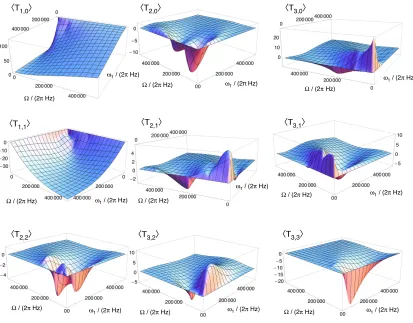
The three-dimensional surface plots in Fig. 3 show the expectation values of
the spinI= 3/2 spherical tensor operators for a powder sample. For simplicity,
only values for tensor operators with positive coherence orderpare shown
(al-though tensors with negativepwill also be present since the the density matrix
is Hermitian). In contrast to Fig. 2, the contribution of crystallites with
differ-210
ing values ofωQ according to orientation gives rise to modified behaviour; in
particular, distinctive features in the plots no longer arise only at offsets around
ωPAS
Q and 2ωPASQ .
TheT1,0plot is similar to the one seen in Fig. 2a for the norm; the magnitude
decreases asω1increases, with a more rapid falloff at lower offsets. A small dip 215
in intensity is seen at Ω/2π ≈120 kHz. T2,0 is created with most intensity at
Ω/2π = 90 kHz and ω1/2π = 50 kHz, while T3,0 has its greatest intensity at
lower resonance offsets and rf strengths, with a maximum at Ω/2π= 5 kHz and
ω1/2π= 10 kHz.
Next considering the single-quantum spin-locked states, T1,1 is zero when 220
eitherω1and Ω = 0, and as these are both increased, moreT1,1 is created. T2,1
is at a maximum when Ω/2π= 30 kHz and ω1/2π = 65 kHz. BothT2,1 and
T3,1 feature intensity dips at Ω/2π≈100 kHz at weak rf field strengths.
The magnitude and sign of theT2,2expectation value have a complex
depen-dence on the resonance offset and rf field strength, with a maximum magnitude
225
kHz andω1/2π= 97.5 kHz. The triple-quantum stateT3,3is created with
high-est intensity at low offsets, with a maximum at Ω/2π= 5 kHz andω1/2π= 65
kHz.
To confirm these model simulations, static 23Na NMR spin-locking exper-230
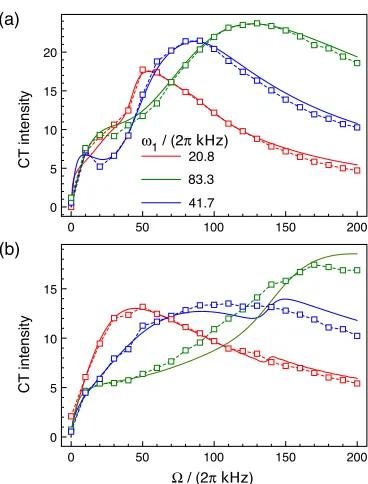
iments have been carried out. Figure 4 shows the 23Na central-transition
in-tensity for static sodium nitrate (Fig. 4a) and sodium nitrite (Fig. 4b) as a
function of increasing offset of the rf transmitter from the centre of the 23Na
lineshape at three different spin-locking field strengths. The experiments were
recorded using the pulse sequence shown in Fig. 1, with a spin-locking pulse
235
length equal to τ = 300 µs. A recycle interval of 10 s was employed in the
NaNO3 experiments, while a shorter interval of 1 s was used in the NaNO2
experiments. The experimentally-derived spin-locking intensities (datapoints
shown by squares joined by a dashed line) have been empirically scaled to allow
a comparison with the theoretical results for the expectation value ofI−{1/2,−1/2}
240
from the spin-locking model (shown by solid lines). The same scaling factor was
applied to all experimental data points shown in Figs. 4 and in 5.
In Fig. 4a, with the rf field strength equal to ω1/2π= 20.8 kHz, the
spin-locked CT intensity for NaNO3 increases to a maximum at Ω/2π = 50 kHz
before falling off again. With ω1/2π = 41.7 kHz, the CT intensity rises as 245
the offset increases, dipping at Ω/2π = 20 kHz before rising to a maximum
at Ω/2π = 90 kHz. At the strongest spin-locking field, the CT intensity rises
with increasing offset, dipping very slightly at Ω/2π= 30 kHz and reaching a
maximum at Ω/2π= 130 kHz, before falling off gradually. Asω1 increases, the
maximum amount of spin-locked CT obtained also increases. The experimental
250
results and the model show an excellent agreement at all three rf strengths for
NaNO3. While a simulation using exact density matrix theory would also reflect
the experimental results, we see here that calculations employing the simplified
rapid dephasing model of spin-locking are highly successful in predicting the
experimental outcome, indicating that it is the initial dephasing that dominates
255
the experimentally observed behaviour.
to Ω/2π= 50 kHz withω1/2π= 20.8 kHz before falling off again with a further
increase in the resonance offset. Atω1/2π= 41.7 kHz, the amount of CT
spin-locked builds up slowly to a maximum around Ω/2π = 100 kHz, and remains
260
fairly steady before decreasing at offsets greater than 140 kHz. At the strongest
rf field strength, the build up of the spin-locked CT intensity as the offset
increases is slower. A maximum is reached at Ω/2π= 170 kHz. A near-perfect
agreement between the experimental data and model is seen withω1/2π= 20.8
kHz, although a greater divergence is seen for the higher rf strengths.
265
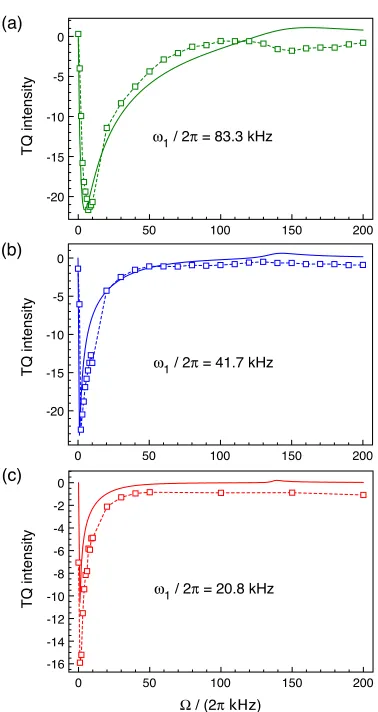
Figure 5 shows plots of the spin-locked 23Na triple-quantum intensity for
sodium nitrite as a function of resonance offset for three different rf field strengths.
The experimental points are compared to the expectation value of the
triple-quantum coherenceT3,3 calculated using the simple model of spin-locking. The
pulse sequence in Fig. 1b was used with a spin-locking pulse duration of 300µs.
270
The length of the conversion or mixing pulse was optimised for the conversion of
the triple-quantum coherences back into observable central-transition coherence
(1.6µs forω1/2π= 166.7 kHz).
With the spin-locking rf field strength set to 83.3 kHz, the amount of
triple-quantum coherence rises rapidly as the offset increases up to Ω/2π = 7 kHz.
275
The intensity then declines as the offset is raised further. Halving the rf strength
to 41.7 kHz, the maximum amount of triple-quantum coherence is created at
a lower offset of Ω/2π= 2 kHz. When the field strength is lowered further to
20.8 kHz, the occurrence of triple-quantum coherence is again shifted to a still
lower offset, with a maximum at Ω/2π= 1 kHz. It is clear that, except at high
280
rf field strengths, little TQ intensity arises in a static solid as a result of the far
off-resonance spin-locking experiment.
For the two strongest rf strengths, the calculations closely match the
ex-perimental results, although both slightly underestimate the amount of
spin-locked magnetisation present at higher offset. The calculation carried out with
285
ω1/2π= 20.8 kHz also significantly underestimates the amount of spin-locked
triple-quantum magnetisation created at low offsets. However, the general trend
6.2. SpinI= 3/2 under MAS
Sample rotation during MAS leads to more complex spin-locking behaviour
290
as the magnitude and sign of the quadrupolar splitting change, with the
spin-locking behaviour dependent on whether the zero-crossing occurs adiabatically
or suddenly. Figure 6 shows the expectation values of the I = 3/2 spherical
tensor operators formed by initial rapid dephasing as a function of time through
one complete rotor period in the adiabatic limit, at resonance offsets of Ω/2π=
295
50 kHz (Fig. 6a) and 100 kHz (Fig. 6b). The spin-locking field strength used in
these simulations wasω1/2π= 75 kHz and the quadrupolar splitting given by
ωPAS
Q /2π= 200 kHz. A single crystallite orientation was chosen withβ = 90◦
and an initial phase angle ofξ= 180◦, giving a value of ωQ/2π= 100 kHz at
the start of the rotor period.
300
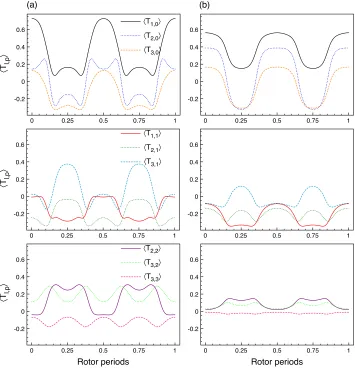
Looking first at Fig. 6a, T1,0 is most abundant at the start of the rotor
period, along with a significant amount of T2,1, T2,0 and T3,0. As the sample
rotates, the amount of T1,0 decreases then rises again slightly forming a local
maximum after a quarter turn of the rotor. This is mirrored by the next quarter
turn, returning T1,0 to its original amplitude. The same cycle is observed for 305
the second half of the rotor period. Similar behaviour is seen for T2,0. The
intensity of T1,1, T3,1 and T2,2 correspondingly rises as the population states
decline, giving maxima after a quarter turn and minima at a half turn. Both
T3,2 and T3,3 reach a maximum near an eighth of a rotor period before falling
to a minimum after another equal time period. Note that, as shown in Figure
310
5, there is littleT3,3 created by the initial dephasing at this magnitude of offset
but that more is created by adiabatic transfer during the rotation of the sample.
Next, considering the plots in Figure 6b where a larger offset of 100 kHz has
been used, we see that there is a smaller amplitude for the modulation of the
spin-locked states compared to the lower offset. At the start of the rotor period,
315
the population statesT1,0,T2,0andT3,0are present in greatest intensity in order
of decreasing rank. This is to be expected in view of the initial state being the
p= 0 population state T1,0 in this type of far off-resonance experiment. The
higher-order coherences, with the appearance of T1,1, T2,1 and T2,2 being the 320
most significant. A large decrease is observed in the intensities ofT3,1,T3,2and
T3,3 compared with the simulations for Ω/2π= 50 kHz in Fig. 6a.
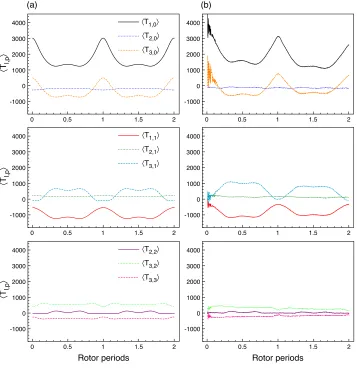
Density matrix calculations confirm the validity of the results found using
the spin-locking model. In Fig. 7, the spinI= 3/2 expectation values have been
calculated in a powder over two rotor periods using (a) the dephasing model
325
and (b) an exact density matrix approach. The oscillations seen before in Fig. 6
are strongly dependent on the crystallite orientation as defined in Eq. 3, while
here the summation of the orientations over the full range of β and ξ values
offers a more realistic representation of a typical experiment on a powder. After
a period of initial rapid dephasing (the noise-like oscillations on the left of
330
the plots), the states settle into a periodic interconversion of spin-locked states
in Fig. 7b, principally between populations and single-quantum coherences as
suggested by Fig. 6. The calculation using the simple model (Fig. 7a) shows
excellent agreement in predicting the evolution of the spin-locked states.
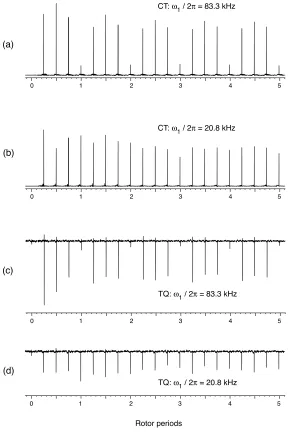
23Na MAS NMR spin-locking experiments have been performed on NaNO 2, 335
confirming the complex rotor-driven dynamics predicted by theory. Figure 8
shows experimental23Na spin-locked central-transition (Figs. 8a and 8b) and
triple-quantum (Figs. 8c and 8d) intensities as a function of the spin-locking
pulse length, where the maximum pulse length was equal to five full rotor periods
(500µs at a MAS frequency of ωR/2π = 10 kHz). In Fig. 8a the spin-locking 340
field strength used was 83.3 kHz, yielding an adiabaticity parameter ofα= 1.26.
In this adiabatic limit, the rotor-driven modulation is clearly apparent. As
the rotor turns, the CT intensity increases, reaching a maximum after a half
turn. This is followed by a decrease during the second half of the rotor period
as the various crystallites experience zero-crossings. At the end of each rotor
345
period, the crystallites have experienced either two or four zero-crossings, and
the original signal intensity is re-established. In Fig. 8b, the spin-locking field
strength was reduced to 20.8 kHz, yieldingα= 0.08. In these experiments, the
modulation of the eigenstates falls into the sudden limit and the effect of sample
rotation on the spin-locked states is much less pronounced. Similar effects are
seen in Figs. 8c and 8d, where the spin-locked triple-quantum coherence is
monitored as a function of spin-locking pulse duration in the adiabatic limit
(Fig. 8c) and the sudden limit (Fig. 8d). In the adiabatic limit, an obvious
modulation of the intensity is observed, with minima at integer rotor periods.
This corresponds to the simulations where population states are most abundant
355
at the start of each rotor period, and sample rotation induces coherence-transfer
to higher order states. When performed at a lower spin-locking field strength
(Fig. 8d), there is no obvious strong modulation of the amplitude with rotation.
6.3. SpinI= 5/2 under MAS
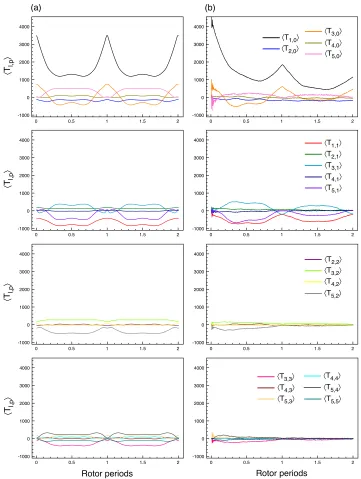
A comparison of the spinI= 5/2 results of the model with an exact density
360
matrix calculation is presented in Fig. 9. Here the evolution of the spin-locked
states has been calculated for the duration of two complete turns of the rotor.
The same simulation parameters are used as described for the corresponding
spinI = 3/2 simulation (Fig. 7), giving an adiabaticity parameter of α= 1.4
for the density matrix calculation. For the population states and single-quantum
365
coherences, a good qualitative agreement can be seen between the model and
the exact density matrix simulations. However, for the higher order coherences,
the magnitude of the spin-locked states decays on the timescale of around 1/ωR
in the density matrix simulations, such that there is little magnetisation
spin-locked in these states during the second rotor period. This behaviour is also
370
observed in conventional or near-resonance spin-locking[17] for spin I = 5/2
and appears to be a consequence of the greater number of spin transitions
blur-ring the distinction between the ”adiabatic” and ”sudden” spin-locking regimes
originally defined by Vega[12] for spinI = 3/2. Purely adiabatic behaviour is
known[17] to be difficult to observe for spinI= 5/2, whatever the value of the
375
adiabaticity parameter, and there always appears to be some degree of
dephas-ing on a timescale of 1/ωR. Our simplified model of spin-locking, which assumes
that a rapid initial dephasing takes place and that spin-locking under MAS is
then entirely in either the sudden or adiabatic regimes, is not able to reproduce
this level of detail.
7. Conclusions
Using the model of quadrupolar spin-locking introduced by Ashbrook and
Wimperis [16] which predicts the spin-locked state after an initial period of
rapid dephasing, we have investigated the far off-resonance case of spin locking
for spin I = 3/2 and I = 5/2 nuclei. Since the offset is large, there is a
385
significantz-component to the effective fieldB1,eff and so the magnetisation is
left directed along the rotating-frame z-axis before the pulse is applied. We
have made extensive use of this simplified model as its success in reproducing
experimental and exact simulation data indicates that, as with on- and
near-resonance spin-locking,[16, 17] the rapid initial dephasing that takes place at
390
the start of the off-resonance spin-locking period is the key phenomenon in such
experiments performed on quadrupolar nuclei.
Three-dimensional surface plots showing the creation of a range of
differ-ent coherences as a function of offset and spin-locking field strength have been
presented. In the plots for single-orientation nuclear spin, features occur in the
395
plots at integer multiples ofωQPAS(see Fig. 2), while more complicated behaviour
is observed in the powder simulations (Fig. 3). Spin I = 3/2 calculations
us-ing the dephasus-ing model were found to be successful in predictus-ing the results
of single-quantum and triple-quantum experiments carried out on NaNO2 and
NaNO3 (Figs. 4 and 5). 400
Under MAS, a time dependence is introduced to the quadrupolar splitting
parameter, and the spin-locking behaviour in the weak-field limit (ω1 ωQ)
falls into different regimes according to the value of the adiabaticity parameter
α, as defined by Vega. [12] In the adiabatic limit, α1, the spin-locked states also acquire a time dependence. The rotor-driven interconversion of eigenstates
405
predicted by the rapid dephasing model calculations are reflected by the
brute-force density matrix simulations in Figs. 7 and 9.
In the sudden limit,α1, the spin-locked states under MAS are expected to be similar to those found in static solids. This was found in Figs. 8b and 8d,
triple-quantum central transition amplitudes with MAS.
As in our previous investigations of the spin-locking of quadrupolar nuclei,
the rapid dephasing model has been shown to explain virtually all of the key
features in far-off resonance spin-locking experiments found both
experimen-tally and in exact density matrix calculations. Relaxation effects are clearly not
415
included in either the exact or approximate theoretical models used here but
are unlikely to be important on experimentally accessible timescales unless
sig-nificant dynamics are present in the solid. The close agreement between theory
and experiments in this work is noteworthy. Far off-resonance spin-locking of
quadrupolar nuclei requires an initial state (the thermal equilibrium bulk
mag-420
netisation) that is created solely by spin-lattice and spin-spin relaxation during
the long relaxation interval. In contrast, if a central-transition selective pulse
is applied to create the initial state, as in conventional spin-locking, that initial
state will be much less well defined in a powder as a consequence of the
impossi-bility of the conditionω1ωQholding for all crystallites. Therefore, although 425
possibly only of esoteric interest, we believe that far off-resonance spin-locking
could be relevant to experiments such as cross polarisation from one quadrupolar
nucleus to another,[5, 6, 7, 8] or to a spinI= 1/2 nucleus,[9, 10, 11] as we would
expect better agreement with any prior theoretical investigation. Off-resonance
cross polarisation has been investigated before for spinI= 1/2 nuclei[26] and is
430
not generally considered to be a useful technique in that application but the
par-ticular features of cross polarisation involving quadrupolar nuclei[3] may make
it worthwhile re-examining.
8. Acknowledgements
We are grateful to EPSRC for a studentship (SO) and to Professor Sharon
435
Ashbrook (St Andrews, UK) for useful discussions about spin-locking of
9. Funding
This research did not receive any specific grant from funding agencies in the
public, commercial, or not-for-profit sectors.
440
10. References
[1] R. K. Harris, G. J. Nesbitt, Cross polarization for quadrupolar nuclei:
pro-ton to sodium-23, Journal of Magnetic Resonance 78 (1988) 245–256.
[2] S. Ding, C. A. McDowell, Theoretical calculations of the CPMAS spectral
lineshapes of half-integer quadrupole systems, Journal of Magnetic
Reso-445
nance A 114 (1995) 80–87.
[3] S. Ashbrook, S. Wimperis, Single- and multiple-quantum cross-polarization
in NMR of quadrupolar nuclei in static samples, Molecular Physics 98
(2000) 1–26.
[4] M. Ed´en, Quadrupolar coupling selective cross-polarization in solid state
450
NMR, Physical Chemistry Chemical Physics 8 (2006) 1994–1999.
[5] L. van W¨ullen, L. Z¨uchner, W. M¨uller-Warmuth, H. Eckert,11B-27Al and
27Al-11B double-resonance experiments on a glassy sodium alumino-borate,
Solid State Nuclear Magnetic Resonance 6 (1996) 203–212.
[6] J. C. C. Chan, M. Bertmer, H. Eckert, Double-quantum cross-polarization
455
between half-integer quadrupolar spin systems: 11B-23Na and 11B-27Al,
Chemical Physics Letters 292 (1998) 154–160.
[7] J. C. C. Chan, M. Bertmer, H. Eckert, Site connectivities in amorphous
materials studied by double-resonance nmr of quadrupolar nuclei:
High-resolution11B-27Al spectroscopy of alumino-borate glasses, Journal of the 460
American Chemical Society 121 (1999) 5238–5248.
[8] J. C. C. Chan, High-resolution heteronuclear correlation between
[9] C. A. Fyfe, H. Grondey, K. T. Mueller, K. C. Wong-Moon, T. Markus,
Coherence transfer involving quadrupolar nuclei in solids: 27Al-31P
cross-465
polarization NMR in the molecular sieve VPI-5, Journal of the American
Chemical Society 114 (1992) 5876–5878.
[10] S. M. De Paul, M. Ernst, J. S. Shore, J. F. Stebbins, A. Pines,
Cross-polarization from quadrupolar nuclei to silicon using low radio-frequency
amplitudes during magic-angle spinning, Journal of Physical Chemistry B
470
101 (1997) 3240–3249.
[11] R. Siegel, J. Rocha, L. Mafra, Combining STMAS and CRAMPS NMR
spectroscopy: High-resolution HETCOR NMR spectra of quadrupolar and
1H nuclei in solids, Chemical Physics Letters 470 (2009) 337–341.
[12] A. J. Vega, MAS NMR spin locking of half-integer quadrupolar nuclei,
475
Journal of Magnetic Resonance 96 (1992) 50–68.
[13] W. Sun, J. T. Stephen, L. D. Potter, Y. Wu, Rotation-induced
reso-nance and second-order quadrupolar effects on spin locking of half-integer
quadrupolar nuclei, Journal of Magnetic Resonance 116 (1995) 181–188.
[14] G. Jeschke, Spin locking ofI= 3/2 nuclei in static and spinning samples: A
480
description by abstract spins and Floquet formalism, Journal of Chemical
Physics 108 (1998) 907–917.
[15] Y. Zhang, F. Deng, J. Qui, C. Ye, Spin-locking mechanism of spin I =
3/2 quadrupolar nuclei undergo magic angle spinning, Solid State Nuclear
Magnetic Resonance 15 (2000) 209–216.
485
[16] S. Ashbrook, S. Wimperis, Spin-locking of half-integer quadrupolar nuclei
in nuclear magnetic resonance of solids: Creation and evolution of
coher-ences, Journal of Chemical Physics 120 (2004) 2719–2731.
[17] S. Ashbrook, S. Wimperis, Spin-locking of half-integer quadrupolar nuclei
in nuclear magnetic resonance of solids: Second-order quadrupolar and
490
[18] A. P. M. Kentgens, J. J. M. Lemmens, F. M. M. Geurts, W. S. Veeman,
Two-dimensional solid-state nutation nmr of half-integer quadrupolar
nu-clei, Journal of Magnetic Resonance 71 (1987) 62–74.
[19] A. Samoson, E. Lippmaa, 2d nmr nutation spectroscopy in solids, Journal
495
of Magnetic Resonance 79 (1988) 255–268.
[20] A. P. M. Kentgens, Off-resonance nutation nuclear magnetic resonance
spectroscopy of half-integer quadrupolar nuclei, Progress in Nuclear
Mag-netic Resonance Spectroscopy 32 (1998) 141–164.
[21] G. Bodenhausen, H. Kogler, R. R. Ernst, Selection of coherence transfer
500
pathways in NMR pulse experiments, Journal of Magnetic Resonance 58
(1984) 370–388.
[22] P. J. Hore, J. A. Jones, S. Wimperis, NMR: The Toolkit (2nd edition),
Oxford University Press, 2015.
[23] O. W. Sørensen, Polarization transfer experiments in high-resolution NMR
505
spectroscopy, Progress in Nuclear Magnetic Resonance Spectroscopy 21
(1989) 503–569.
[24] A. P. M. Kentgens, A practical guide to solid-state NMR of half-integer
quadrupolar nuclei with some applications to disordered systems,
Geo-derma 80 (1997) 271–306.
510
[25] E. Kundla, A. Samoson, E. Lippmaa, High-resolution NMR of quadrupolar
nuclei in rotating solids, Chemical Physics Letters 83 (1981) 229–232.
[26] A. Bax, B. L. Hawkins, G. E. Maciel, Off-resonance cross-polarization:
A technique to reduce rf power requirements for magnetization transfer
experiments in solids, Journal of Magnetic Resonance 59 (1984) 530–535.
τ
ω1
ϕ
(a)
[image:21.612.202.412.148.250.2](b)
Figure 1: Pulse sequences for observing spin-locked (a) single-quantum and (b)
multiple-quantum coherences under far off-resonance conditions.
(a)
(b)
ω1 / (2π Hz) Ω / (2π Hz)
ω1 / (2π Hz)
Ω / (2π Hz)
CT Norm
Figure 2: Three-dimensional surface plots of the spinI= 3/2 expectation values for (a) the
density operator norm and (b) the central transition (CT) created by rapid dephasing of the
initial stateT1,0under spin-locking, as a function ofω1and Ω. Results are plotted for a single
orientation (θ= 0) withωPAS
[image:21.612.221.374.353.568.2]ω1 / (2π Hz)
Ω / (2π Hz)
ω1 / (2π Hz)
Ω / (2π Hz) 〈T2,0〉
ω1 / (2π Hz) Ω / (2π Hz)
〈T3,0〉
〈T1,1〉
ω1 / (2π Hz)
Ω / (2π Hz) 〈T2,1〉
ω1 / (2π Hz)
Ω / (2π Hz) 〈T3,1〉
ω1 / (2π Hz)
Ω / (2π Hz) 〈T2,2〉
ω1 / (2π Hz)
Ω / (2π Hz) 〈T3,2〉
ω1 / (2π Hz)
Ω / (2π Hz) 〈T3,3〉 ω1 / (2π Hz)
〈T1,0〉
[image:22.612.136.549.197.520.2]Ω / (2π Hz)
Figure 3: Three-dimensional surface plots of the spinI= 3/2 expectation values of spherical
tensor operators,Tl,p created by rapid dephasing of initial stateT1,0 under a spin-locking
Hamiltonian, as a function of ω1 and Ω. Results are plotted for a powder sample with
ωPAS
(a)
(b)
0 50 100 150 200
0 5 10 15
0 50 100 150 200
0 5 10 15 20
CT
in
te
n
si
ty
Ω / (2π kHz) ω1 / (2π kHz)
CT
i
n
te
n
si
ty
[image:23.612.215.399.221.463.2]83.3 41.7 20.8
Figure 4: Spin-locked23Na NMR central-transition intensity in (a) NaNO3and (b) NaNO2as
a function of resonance offset, recorded using the pulse sequence in Fig. 1a. The spin-locking
pulse duration was 300µs in each case. Experimental points are shown by squares joined by
a dashed line, while the spin-locking intensities calculated using the spin-locking model are
shown by a solid line. The intensities of all experimental points were multiplied by the same
(a)
(b)
T
Q
i
n
te
n
si
ty
Ω / (2πkHz)
ω1 / 2π = 83.3 kHz
T
Q
i
n
te
n
si
ty
0 50 100 150 200
-16 -14 -12 -10 -8 -6 -4 -2 0
0 50 100 150 200
-20 -15 -10 -5 0
0 50 100 150 200
-20 -15 -10 -5 0
T
Q
i
n
te
n
si
ty
(c)
ω1 / 2π = 41.7 kHz
[image:24.612.213.402.170.526.2]ω1 / 2π = 20.8 kHz
Figure 5: Spin-locked23Na NMR triple-quantum intensity in NaNO2 as a function of
reso-nance offset, recorded using the pulse sequence in Fig. 1b for spin-locking rf field strengths
of (a) 83.3 kHz, (b) 41.7 kHz and (c) 20.8 kHz. The spin-locking pulse duration was 300µs
in each case. Experimental points are shown by squares joined by a dashed line, while the
(a) (b)
Rotor periods
〈
Tl,p
〉
0 0.25 0.5 0.75 1
-0.2 0 0.2 0.4 0.6
0 0.25 0.5 0.75 1
-0.2 0 0.2 0.4 0.6
0 0.25 0.5 0.75 1
-0.2 0 0.2 0.4 0.6 Rotor periods
0 0.25 0.5 0.75 1
-0.2 0 0.2 0.4 0.6
0 0.25 0.5 0.75 1
-0.2 0 0.2 0.4 0.6
0 0.25 0.5 0.75 1
-0.2 0 0.2 0.4 0.6 〈 Tl,p 〉 〈 Tl,p 〉
〈T1,0〉 〈T2,0〉 〈T3,0〉
〈T1,1〉 〈T2,1〉 〈T3,1〉
[image:25.612.137.492.167.539.2]〈T2,2〉 〈T3,2〉 〈T3,3〉
Figure 6: Expectation values ofI = 3/2 spherical tensor operators,Tl,p, created by rapid
dephasing of an initial stateT1,0 under spin-locking and MAS. The resonance offset was
(a) Ω/2π = 50 kHz and (b) Ω/2π = 100 kHz. Results are plotted as a function of rotor
period for a single crystallite orientation (β= 90◦andξ= 180◦) withω
1/2π= 75 kHz and
ωPAS
(a) (b) Rotor periods 〈 Tl,p 〉 Rotor periods 〈 Tl,p 〉 〈 Tl,p 〉
〈T1,0〉
〈T2,0〉 〈T3,0〉
〈T1,1〉
〈T2,1〉
〈T3,1〉
〈T2,2〉
〈T3,2〉
〈T3,3〉
0 0.5 1 1.5 2
-1000 0 1000 2000 3000 4000
0 0.5 1 1.5 2
-1000 0 1000 2000 3000 4000
0 0.5 1 1.5 2
-1000 0 1000 2000 3000 4000
0 0.5 1 1.5 2
-1000 0 1000 2000 3000 4000
0 0.5 1 1.5 2
-1000 0 1000 2000 3000 4000
0 0.5 1 1.5 2
[image:26.612.137.494.170.539.2]-1000 0 1000 2000 3000 4000
Figure 7: Evolution of expectation values ofI= 3/2 spherical tensor operators,Tl,p, under
MAS. Results are plotted for a powder withωPAS
Q /2π = 200 kHz, ω1/2π = 75 kHz and
Ω/2π= 50 kHz. Results are shown for (a) the spin-locking model and (b) an exact density
matrix calculation. The MAS rate in (b) wasωR/2π = 10 kHz, yielding an adiabaticity
(a)
(b)
Rotor periods
!!"# !!"$ !%"# !%"$ !&"# !&"$ !'"# !'"$ !$"#
$"$0 1 2 3 4 5(()
!!"# !!"$ !%"# !%"$ !&"# !&"$ !'"# !'"$ !$"#
$"$ (()
Rotor periods
0 1 2 3 4 5
!!"# !!"$ !%"# !%"$ !&"# !&"$ !'"# !'"$ !$"#
$"$ (()
Rotor periods
0 1 2 3 4 5
!!"# !!"$ !%"# !%"$ !&"# !&"$ !'"# !'"$ !$"#
$"$ (()
Rotor periods
0 1 2 3 4 5
(c)
(d)
CT: ω1 / 2π = 83.3 kHz
CT: ω1 / 2π = 20.8 kHz
TQ: ω1 / 2π = 83.3 kHz
TQ: ω1 / 2π = 20.8 kHz
[image:27.612.150.438.150.582.2]Rotor periods
Figure 8: 23Na MAS NMR experiments, showing the signal intensity of the (a, b) central
transition and (c, d) triple-quantum coherence during the spin-locking of NaNO2 at a
reso-nance offset of 50 kHz with varying spin-locking durations. The MAS rate wasωR/2π= 10
0 0.5 1 1.5 2 -1000 0 1000 2000 3000 4000
0 0.5 1 1.5 2
-1000 0 1000 2000 3000 4000
0 0.5 1 1.5 2
-1000 0 1000 2000 3000 4000
0 0.5 1 1.5 2
-1000 0 1000 2000 3000 4000
0 0.5 1 1.5 2
-1000 0 1000 2000 3000 4000
0 0.5 1 1.5 2
-1000 0 1000 2000 3000 4000 (a) (b) Rotor periods 〈 Tl,p 〉 Rotor periods 〈 Tl,p 〉 〈 Tl,p 〉
〈T1,0〉 〈T2,0〉
〈T3,0〉
〈T1,1〉 〈T2,1〉 〈T3,1〉
〈T2,2〉
〈T3,3〉
0 0.5 1 1.5 2
-1000 0 1000 2000 3000 4000 〈 Tl,p 〉
0 0.5 1 1.5 2
-1000 0 1000 2000 3000 4000
〈T4,0〉 〈T5,0〉
〈T4,1〉 〈T5,1〉
〈T3,2〉 〈T4,2〉 〈T5,2〉
〈T4,3〉 〈T5,3〉
[image:28.612.133.494.124.603.2]〈T4,4〉 〈T5,4〉 〈T5,5〉
Figure 9: Evolution of expectation values ofI= 5/2 spherical tensor operators,Tl,p, under
MAS. Results are plotted for a powder withωPAS
Q /2π = 200 kHz, ω1/2π = 75 kHz and
Ω/2π= 50 kHz. Results are shown for (a) the spin-locking model and (b) an exact density