R
A
Muhammad Zubair Khan (Corresponding Author) Research Assistant Cardiology –Internal Medicine De-partment, Virginia Commonwealth University
Cell: +92-333-9135965
Email: [email protected]
Date Received: July 14, 2017
Date Revised: December 27, 2017
Date Accepted: January 20, 2018
INTRODUCTION
In recent decades, the interventional cardiology procedure has advanced substantially, resulting in a greater degree of patient safety. PCI and diagnostic catheterization are among the most common cedures interventional cardiology. During these pro-cedures the CM are frequently used for imaging the coronary and other peripheral vasculature, which can cause the CI-AKI. CI-AKI is a significant challenge for cardiologists because PCI or diagnostic catheterization patients most likely have diabetes and CKD, which is a significant risk factor for CI-AKI.
This paper presents an update on the current definitions, pathogenesis, risk factors and impact of heart failures on the CIN and preventive measures of CI-AKI as applied specifically to cardiac intervention. Few consensus statements were developed, after reviewing the literature.
MATERIAL & METHODS
Literature about the epidemiology, current defi-nitions, pathophysiology, risk factors, contrast media,
CONTRAST-INDUCED NEPHROPATHY
Muhammad Zubair Khan, Rayaan Faruqi
Department of Cardiology –Internal Medicine Department, Virginia Commonwealth University, USA
ABSTRACT
Objectives: To know the epidemiology, current definitions, pathophysiology, risk factors, contrast media, and preven-tative strategies of CI-AKI.
Material & Methods: Various studies have been reviewed and their conclusion have been discussed in this paper.
Results: CIN (Contrast-induced Nephropathy) is one of the complications after PCI that accounts for hospital-acquired renal failure, with adverse effects on prognosis, prolonging hospital stays and health care costs. CIN is most widely defined as an increase in serum creatinine of 0.5 mg/dl (44.2umole/L) or a 25% increase from the baseline value of 48 hours after the procedure. Multiple risk factors are involved in the development of CIN; these factors are divided into the patient- and procedure-related factors.
Conclusion: It is recommended that CIN can be prevented by adequate hydration through the IV normal saline.
Key Words: Pathophysiology, contrast media, Nephropathy.
This article may be cited as: Khan MZ, Faruqi R. Contrast-Induced Nephropathy. J Med Sci 2018; 26: (1) 79-84.
and preventative strategies of CI-AKI was compiled and categorized accordingly.
RESULT/DISCUSSION
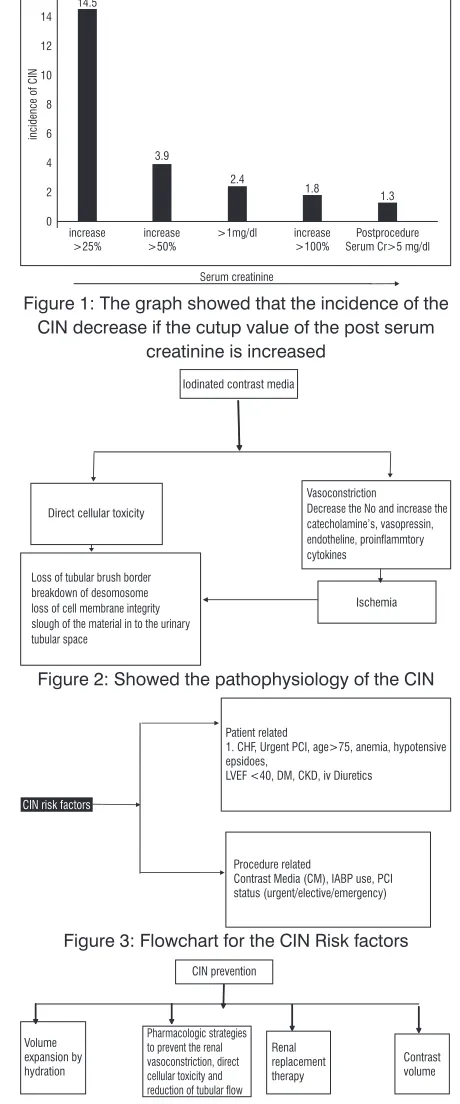
Epidemiology:The incidence of the CIN depends on the studies inclusion criteria such as patient populations, risk fac-tors and it also varies on the criteria which it is defined [Figure 1]. The average incidence of the CIN in general population is reported to 1.2 to 1.6% but in some studies it shows up to 50% or more depend on the risk factors and criteria for definition1,2. Mayo clinic registry data
reported that in 1826 patients, the incidence of CI-AKI was 14.55% who underwent PCI3 and McCullough et al reported that the incidence of CIN was 14.5% in 1826 patients4 who underwent percutaneous coronary
interventions (PCI). Nash and Colleagues found that the incidence of CIN was 7.2% of 4622 general hospital patients5.
Definitions:
Various kinds of definitions have been used for CIN. CIN is most widely defined as an increase in serum creatinine level of ≥ 0.5mg/dl (26.4 μmol/l) or a percentage increase in serum creatinine level of ≥ 25% from the baseline within 48 hours6. The ESUR modified
basis of AKIN criteria8, which is an increase in serum
creatinine by 50% or 0.3 mg/dl after PCI compared with the baseline. However, in AKIN the time frame for the post creatinine changes is within 48 hours. According to NCDR, the highest creatinine value, within 30 days after the indexed procedure, should be used for the definition of CIN9. The ERBP (European Renal Best
Practice) recommends the same definition and grading of AKIN criteria for CIN10.
Pathophysiology:
Etiology of CIN is multifactorial. CIN is mostly due to the vasoconstriction and direct cellular toxicity (Figure 2). When the CM is injected to the intra-arterial system, there is trainset vasodilation of arterial circuit in the kidney via the release of nitroxide, followed by sustained arteriolar vasoconstriction by the release of angiotensin, aldosterone, the vasopressin, cate-cholamine’s, endothelin, pro-inflammatory cytokines and decreased nitric oxide (NO) and an increase in sympathetic tone11,12. When there is reduced number
nephrons in the setting of diabetes and CKD patients, the sustained vasocontraction can cause ischemia, offering a reason the incidence of CIN is might be higher in CKD and Diabetes patients. The region of the medulla is mostly affected because of the 10% of total renal blood flow that goes to the medulla13. High
concentration of contrast within the tubules cause direct cellular toxicity due to which the integrity of cell mem-brane loss, desmosome breakdown, and shedding of these dead cells in to tubular space. This phenomenon promotes the stasis of the CM in the urine, which enable the movement of the contrast media in to the interstitial
Table 1: Pharmacologic strategies to prevent the CI-AKI
Potentially Beneficial
Methods Mechanism of thePrevention
Hydration Increase GFR
Theophylline and
aminophylline Vasodilatory effect
N-acetylcysteine Antioxidant and
Anti-inflammatory
Ascorbic acid Antioxidant
Statin Antioxidant
Prostaglandin E1 Vasodilatory effect
Trimetazidine Antioxidant
No consistent effect
Calcium channel blocker Renal Vasodilatory effect
Fenoldopam Renal Vasodilatory effect
Dopamine Renal Vasodilatory effect
Potentially detrimental Mannitol
furosemide
Endothelin receptor antagonists
Figure 1: The graph showed that the incidence of the CIN decrease if the cutup value of the post serum
creatinine is increased
Figure 2: Showed the pathophysiology of the CIN
Figure 3: Flowchart for the CIN Risk factors
the cardiac procedures. Some studies mentioned the dose of contrast should be equal to the GFR in high risk patients25 but as a general rule the volume of the
amount of contrast media during the PCI and cardiac catheterization should not more than twice of the GFR of the patient26.
Consensuses statement:
1. CIN is a serious complication, the third leading cause of hospital-acquired renal failure, following the cardiac catheterization using the contrast media in high-risk patients.
2. The most common definition used for the CI-AKI is an increase in serum creatinine level of ≥ 0.5mg/ dl (26.4 μmol/l) or a percentage increase in serum creatinine level of ≥ 25% from the baseline within 48 hrs, but the most recent NCDR definition for the CI-AKI is an increase in serum creatinine by 50% or 0.3 mg/dl after PCI compared with the baseline.
3. The rate of CIN is lower in the intravenous ad-ministration of the contrast as compared to the intra-arterial.
4. The pathophysiology of the CIN is mostly due
to the direct cellular toxicity of the CM and vaso-constriction from hormones and cytokines, which release due to CM.
5. Higher contrast volume shows the association of higher incidence of CI-AKI in patients at high risk. However, small volumes up to 30 ml can cause the CIN incidence in high risk patients.
6. Adequate hydration with normal saline or isotonic crystalloid can lower the incidence of CI-AKI, if the hydration is properly done for 4hrs before the procedure and continued for 8-24 hrs after the procedure.
7. No pharmacologic treatment is better than the
normal saline or isotonic crystalloid.
Preventive measures: A. Hydration:
CIN is prevented by the following four-way (Figure 4), but volume expansion is the most critical measure for reducing CIN and should be used in all high-risk patients undergoing contrast media procedures.
The most recent guidelines for the prevention of CI-AKI in patients with chronic kidney disease are increasing volume expansion by adequate hydration 12 hours before and 24 hours after diagnostic cardiac catheterization and PCI, at speed of 1 ml/kg per hour27,28.
However, there is very limited data which shows that space. The contrast causes further direct cellular toxicity
there14. The histopathologic changes in the tubules due
to the contrast is called “osmotic nephrosis15. It has
been hypothesized that hydration by normal saline may attenuate the risk of CI-AKI by expanding intravascular volume, reducing the production of reactive oxygen species, reducing the renin-angiotensin activation and increasing the nitric oxide production and dilution of the contrast medium within the tubular lumen16,17. In
addition, the hydration attenuates the urine viscosity, which speeds up the excretion of the contrast medium within the tubules18.
Risk factors:
There are two kinds of risk factors, patient related and procedure related (Figure 3)14.
Contrast media:
Three kinds of contrasts are used during angiog-raphy on the basis of the osmolality: Isosmolal [IOCM] 290mosm/kg, low osmolal [LOCM] 600 to 800mosm/ kg and high osmolol [HOCM] 2000mosm/kg19. Studies
have proven that the incidence of CIN is lower with IOCM than with LOCM in high-risk patients who underwent cardiac catheterization. However, the incidence of CIN is equal among IOCM and LOCM in low-risk patients undergoing CT19,20. The incidence of CIN after PCI is
related to the dose of CM. Therefore, CM should be used in low dosages in all patients, especially in at high-risk patients. These recommendations cannot be applied to directly intravenous such as an intravenous urography or enhanced CT. A safe route does not exist for the IV use of CM.
The incidence of the CI-AKI after the PCI and di-agnostic Ca this related to the amount of CM used. CM should be used in low dosages in all the patients. A safe route and recommendation does not exist for the IV use of CM23. The incidence of CIN was reported as low in
the IV used CM patients who underwent enhanced CT as compared to the patients who had the 1 intra-arterial administration of CM forPCI or angiography21,22.The
Contrast Media Safety Committee (CMSC) concluded that the risk of CI-AKI is significantly lower because risk factors for CIN is higher in intra-arterial procedure than the intravenous procedures. Studies mentioned that the rate of CIN was high if the GFR was decreased21
in the patients who underwent IV procedures such as enhanced CT. Contrast Media even up to 30 ml can cause CIN in high risk patients like those with diabetes and CKD. Multivariate analyses have shown that those patients who have CIN, usually high contrast were used in these patients23,24.
these guidelines are used in clinical practice. The most frequently used protocol for adequate hydration with normal saline in clinical practice is fluid supplementation for 12 hours before and after the procedure at speed of 1 ml/kg per hour.
Recently, faster and shorter procedural hydration with normal saline (≥3 mL/h) has demonstrated remark-able benefits in reducing the risk of CI-AKI. Moreover, the REMEDIAL II study and Mythous study investigated the effects of fast hydration with the Renal Guard and found that the incidence of the CI-AKI was lower in Renal Guard group as compared to the control group27-29.
The POSEIDON study conducted by Brar et al assessed the efficacy of a new fluid protocol based on the left ventricular end-diastolic pressure (LVEDP)30.
LVEDP is a good predictor for the pre-load and shows a good clinical correlation of volume status. The POSE-IDON study found that low intravascular volume status patients got a high volume of normal saline infusion based on the hemodynamically guided strategy. The POSEIDON study showed the lower rate of CIN in the intervention group as compare to the control group.
B. Contrast Media:
Using a low volume of contrast to prevent CI-AKI is also an interesting principal of prevention. IOCM is safe in all high-risk patients even in CKD and diabe-tes23-26. IOCM should be used in all high risk patients
to decrease the rate of CI-AKI.
C. Pharmacologic strategies:
There are standard drugs for the prevention of CI-AKI. The pharmacologicagents and strategies which were used in the small clinical trials are listed in the Table 1.
Sodium Bicarbonate:
Sodium bicarbonate may decrease the incidence of CIN by alkalinizing the urine, which decreases the formation of free radicals and increases the neutraliza-tion of the oxygen radicals. Efficacy of bicarbonates in the prevention of CIN is controversial. Studies have mentioned that the IV sodium bicarbonate can decrease the rate of CIN more as compared to the intravenous isotonic saline with or without NAC31. Meanwhile, other
studies did not show any significant risk reduction32.
One retrospective study at mayo clinic found that the rate of CIN increase with IV sodium bicarbonate33. N-acetyl cysteine (NAC)
N-acetyl cysteine (NAC) N-acetylcysteine (NAC) has been used in different studies during the last few decades. NAC is a cheap and safe drug which has vasodilatory and antioxidant properties. There were different protocols used in the selection of an ideal re-gime of NAC, but the most widely used protocol was 600
mg oral regimen twice daily. More than 30 randomized trials were conducted to determine the role of NAC in preventing CI-AKI. The result of these studies conflict with some studies reporting a decrease in the incidence of CIN, while some studies show no significant benefits.
It has been noticed in some studies that higher doses of NAC give better protection34,35. A meta-analysis
has been performed and their results are also conflict-ing. The current guidelines mentioned that NAC is not used in the prevention of CIN. In conclusion, the current opinion for the use of the NAC is that it should not be used for the prevention of CI-AKI.
Ascorbic acid:
Spargies et al conducted study in which the effect of ascorbic acid was investigated. The study showed that the incidence of CI-AKI was 20% in the placebo group and 9% in the ascorbic group, p-0.02. This de-crease incidence in the ascorbic group was due to the antioxidant activity35.
Trimezatidine:
Studies demonstrated that trimezatidine has anti-oxidant activity especially in renal and other vital organs. A clinical trial was conducted in which trimezatidine was compared to the IV saline hydration group in patients with chronic renal failure undergoing elective procedure. The incidence of the CI-AKI was significantly higher in the patients receiving only intravenous normal saline group35.
D. Hemodialysis:
Hemodialysis before the procedures are not effective in preventing the incidence of CIN35.
E. Others: Statins:
Statins are effective in decreasing the prevention of the CI-AKI. Statin may decrease the rate of CIN in sev-eral ways, including decrease the uptake of the contrast media in to the tubular cells, endothelial dysfunction, attenuation of free radical, protection of podocyte, and decreasing inflammation. Studies have reported that patients who were on statins during the PCI or other cardiovascular procedures have low rates of CI-AKI36.
All randomized trials have confirmed that this concept is right. Thus, statins should be used at the baseline of any cardiac catheterization procedure and continue for the long-term course of the care, provided that the patient tolerated the statin very well.
Renin-angiotensin system inhibitors
because it vasodilates the renal efferent arteriole, which decreases the pressure in the glomerulus and decreases GFR. Due to decreased flushing of the contrast in the tubules of the nephron, the most recent study of the CAPTAIN trial demonstrated that patients with CKD, continuing ACEI/ARBs compared with hold-ing ACI/ARBs prior to the cardiac catheterization, the group withholding ACEI/ARBs experienced a significant reduction in post-procedural rise of creatinine and a nonsignificant reduction in CIN37. These ACEI/ARBs
should be stopped or discuss the cardiac Cath physi-cian before catheterization.
Nephrotoxic drugs:
The use of the diuretics especially loop diuretics, NSAID, Coxibs, amphotericin or antibiotics like amino-glycosides showed a higher incidence of the CI-AKI35.
The contrast media safety committee, suggested that the nephrotoxic drugs should be discussed with re-ferring physicians and withdrawal of these drugs before catheterization should be on the basis of their benefits and harms. The incidence of the CI-AKI is largely due to the frequent use of the CM for intervention procedures in high risk patients.
The use of loop diuretics, non-steroidal anti-in-flammatory drugs, coxibs, aminoglycosides, or am-photericin showed a higher incidence of CIN35. In the
previous guidelines, nephrotoxic drugs withdrawal was recommended for at least 24 hrs before the procedure. In clinical practice, this guideline is poorly followed.
The contrast media safety committee, therefore, suggested that the possible withdrawal of nephrotoxic drugs before contrast medium in a high-risk patient should be discussed with their referring physicians, and their removal should balance the relative benefits and harms.
CONCLUSION
The Incidence of the CI-AKI is largely due to the frequent use of the CM for intervention procedures like PCI and diagnostic catheterization in high risk patients. These CIN patients may also have other risk factors, which may be attributed to CIN.
RECOMMENDATIONS
The incidence of CIN can be decreased by ad-equate hydration, pharmacologic methods, use of a low dose of CM and renal replacement therapy, but the most adequate and efficient way for prevention of CIN is adequate hydration by intravenous normal saline.
REFERENCES
1. Parfrey PS, Griffiths SM, Barrett BJ, et al. Contrast materialinduced renal failure in patients with diabetes
mellitus, renal insufficiency, or both. A prospective controlled study. N Engl J Med 1989;320:143-49. 2. Rich MW, Crecelius CA. Incidence, risk factors,
and clinical course of acute renal insufficiency after cardiac catheterization in patients 70 years of age or older. A prospective study. Arch Intern Med 1990;150:1237-42.
3. Rihal CS, Textor SC, Grill DE, et al. Incidence and prognostic importance of acute renal failure after percutaneous coronary intervention. Circulation 2002;105:2259-64.
4. McCullough PA, Wolyn R, Rocher LL, et al. Acute renal failure after coronary intervention: Incidence, risk factors, and relationship to mortality. Am J Med 1997;103:368-75.
5. Nash k, hafeez A, Hou S. Hospital acquired renal insufficinecy Am J kidney Dis 2002:39:930-36. 6. Harjai KJ, Raizada A, Shenoy C, et al. A comparison
of contemporary definitions of contrast nephropathy in patients undergoing percutaneous coronary in-tervention and a proposal for a novel nephropathy grading system. Am J Cardiol 2008; 101: 812-19. 7. Stacul F, van der Molen AJ, Reimer P, Webb JA,
Thomsen HS, Morcos SK, Almén T,Aspelin P, Bel-lin MF, Clement O, Heinz-Peer G; Contrast Media Safety Committee of European Society of Urogenital Radiology (ESUR). Contrast induced nephropathy: updated ESUR Contrast Media Safety Committee guidelines. EurRadiol. 2011 Dec;21(12):2527-41. 8. Mehta RL, Kellum JA, Shah SV, Molitoris BA,
Ron-co C, Warnock DG, Levin A; Acute Kidney Injury Network. Acute Kidney Injury Network: report of an initiative to improve outcomes in acute kidney injury. Crit Care. 2007;11(2):81-86.
9. Inohara T, Kohsaka S, Abe T, Miyata H, Numasawa Y, Ueda I, Nishi Y, Naito K, Shibata M, Hayashida K, et al. Development and validation of a pre-percutane-ous coronary intervention risk model of contrast-in-duced acute kidney injury with an integer scoring system. Am J Cardiol. 2015;115:1636-42.
11. Goldenberg I, Matetzky S. Nephropathy induced by contrast media: pathogenesis,risk factors and pre-ventive strategies. CMAJ. 2005. 24;172(11):1461-71. 12. Dangas G, Iakovou I, Nikolsky E, Aymong ED, Mintz
GS, Kipshidze NN, Lansky AJ, Moussa I, Stone GW, Moses JW, et al: Contrast-induced nephropathy after percutaneous coronary interventions in relation to chronic kidney disease and hemodynamic variables. Am J Cardiol. 2005, 95: 13-19.
13. Brezis M, Rosen S. Hypoxia of the renal medulla — its implications for disease. N Engl J Med 1995; 332:647-55.
14. McCullough PA, Choi JP, Feghali GA, Schussler JM, Stoler RM, Vallabahn RC, Mehta A, et al. Contrast-In-duced Acute Kidney Injury. J Am CollCardiol. 2016. 27;68(13):1465-73.
15. Seeliger E, Wronski T, Ladwig M, Dobrowolski L, Vo-gel T, Godes M, Persson PB, Flemming B, et al. The renin-angiotensin system and the third mechanism of renal blood flow autoregulation. Am J Physiol Renal Physiol. 2009;296:1334-45.
16. Heyman SN, Rosen S, Khamaisi M, Idee JM, Rosenberger C. Reactive oxygen species and the pathogenesis of radiocontrast-induced nephropathy. Invest Radiol. 2010;45:188-95.
viscosity with iso-osmolar contrast media in the rat. Radiology. 2010;256:406-14.
18. Aspelin P, Aubry P, Fransson SG. Nephrotoxic effects in high-risk patients undergoing angiography. N Engl J Med 2003;348:491-99.
19. Chalmers N, Jackson RW. Comparison of iodixa-nol and iohexol in Renal impairment. Br J Radiol 1999;72:701-03.
20. Davidson C, Stacul F, McCullough PA. Contrast medium use. Am J Cardiol 2006;98:42K-58K. 21. Lindsay J, Canos DA, Apple S. Causes of acute
renal dysfunction after percutaneous coronary inter-vention and comparison of late mortality rates with postprocedure rise of creatine kinase-MB versus rise of serum creatinine. Am J Cardiol 2004;94:786-89. 22. Birck R, Krzossok S, Markowetz F. Acetylcysteine for
prevention of contrast nephropathy: meta-analysis. Lancet 2003;362:598-603.
23. Laskey WK, Jenkins C, Selzer F. Volume-tocreatinine clearance ratio: a pharmacokinetically based risk factor for prediction of early creatinine increase after percutaneous coronary intervention. J Am CollCar-diol2007:50:584-90.
24. Khwaja A. KDIGO clinical practice guidelines for acute kidney injury. Nephron Clinical Practice. 2012;120(4):c179-84.
25. Marenzi G, Ferrari C, Marana I, Assanelli E, De Metrio M, Teruzzi G. Prevention of contrast nephropathy by furosemide with matched hydration: the MYTHOS (Induced Diuresis With Matched Hydration Com-pared to Standard Hydration for Contrast Induced Nephropathy Prevention) trial. JACC CardiovascIn-terv. 2012;5:90-97.
26. Windecker S, Kolh P, Alfonso F, Collet JP, Cremer J, Falk V A. 2014 ESC/EACTS guidelines on myocar-dial revascularization: the Task Force on Myocarmyocar-dial Revascularization of the European Society of Cardi-ology (ESC) and the European Association for Car-dio-Thoracic Surgery (EACTS). Developed with the special contribution of the European Association of Percutaneous Cardiovascular Interventions (EAPCI). Eur Heart J. 2014;35:2541-2619.
27. Brar SS, Aharonian V, Mansukhani P, Moore N, Shen AY, Jorgensen M. Short L, Kane K. Haemodynam-ic-guided fluid administration for the prevention of contrast-induced acute kidney injury: the POSEIDON randomised controlled trial. Lancet. 2014;383:1814-23.
28. Navaneethan SD, Singh S, Appasamy S, Wing RE, Sehgal AR. Sodium bicarbonate therapy for prevention of contrast-induced nephropathy: A systematic review and meta-analysis. Am J Kidney Dis 2009;53:617-27.
29. Saidin R, Zainudin S, Kong N, Maskon O, Saaidin N, Shah S. Intravenous sodium bicarbonate versus nor-mal saline infusion as prophylaxis against contrast nephropathy in patients with chronic kidney disease undergoing coronary angiography or angioplasty. J Am SocNephrol 2006;17:766-69.
30. From AM, Bartholmai BJ, Williams AW, Cha SS, Pflueger A, McDonald FS. Sodium bicarbonate is associated with an increased incidence of contrast nephropathy: A retrospective cohort study of 7977 patients at mayo clinic. Clin J Am SocNephrol 2008;3:10-18.
31. Gonzales DA, Norsworthy KJ, Kern SJ. A meta-analysis of N-acetylcysteine in contrast-induced nephrotoxicity: unsupervised clustering to resolve heterogeneity. BMC Med 2007;5:32.
32. Bartorelli AL, Marenzi G. Contrast-induced nephrop-athy J IntervCardiol, 2008;21:74-85.
33. Khanal S, Attallah N, Smith DE. Statin therapy re-duces contrast-induced nephropathy: an analysis of contemporary percutaneous interventions. Am J Med 2005; 18:843-49.
34. Bainey KR, Rahim S, Etherington K, Rokoss ML, Natarajan MK, Velianou JL, et al. Effects of with-drawing vs continuing renin-angiotensin blockers on incidence of acute kidney injury in patients with renal insufficiency undergoing cardiac catheterization: Results from the Angiotensin Converting Enzyme Inhibitor/Angiotensin Receptor Blocker and Contrast Induced Nephropathy in Patients Receiving Cardiac Catheterization (CAPTAIN) trial. Am Heart J. 2015 Jul 1;170(1):110-16.
AUTHOR’S CONTRIBUTION
Following authors have made substantial contributions to the manuscript as under:
Khan MZ: Main idea, manuscript writing.
Faruqi R: Editing.
Authors agree to be accountable for all aspects of the work in ensuring that questions related to the accuracy or integrity of any part of the work are appropriately investigated and resolved.
CONFLICT OF INTEREST: Authors declare no conflict of interest